
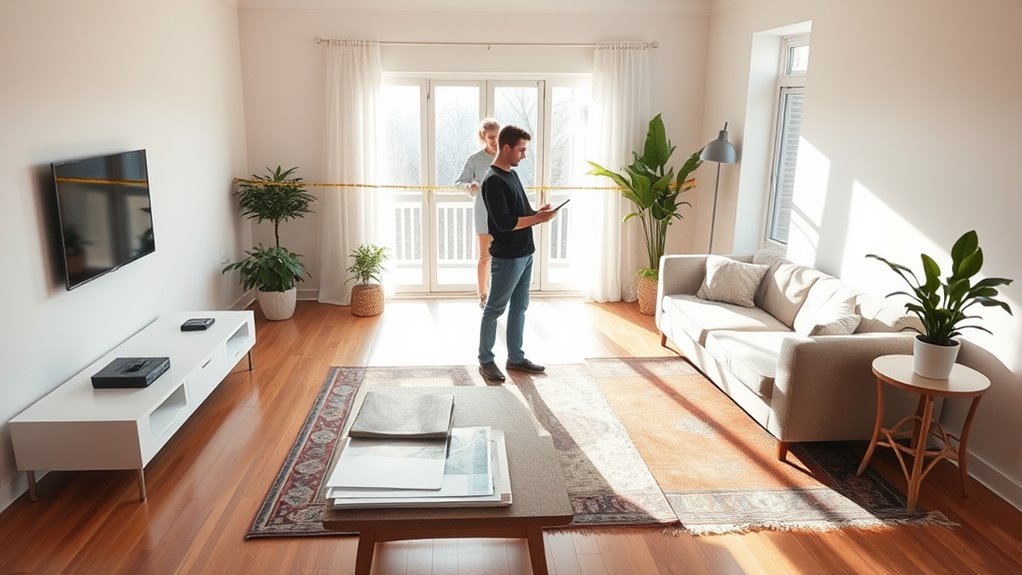
Learning how to measure your living room for furniture and rugs before you shop prevents pieces that crowd the floor, block walkways, or get stuck in a narrow hallway on delivery day. When you work in a fixed order—room shell, architectural features, delivery route, furniture dimensions, and floor-tape layout—you replace guesswork with exact numbers. A simple sketch and 45 minutes with a tape measure will give you every measurement you need to buy with confidence.
Quick Answer
Measure your living room’s length, width, and ceiling height at three levels, then map doors, windows, vents, outlets, and the full delivery path. Leave 30 to 36 inches for main walkways, 14 to 18 inches between a sofa and coffee table, and 12 to 24 inches of bare floor around a rug that holds at least the front legs of seating.
At a Glance
| Time Required | 30 to 60 minutes for one room; allow an extra 15 minutes if measuring stairways, elevators, and hallway turns |
| Difficulty | Easy, provided you measure from trim and record the smallest usable numbers |
| Tools Needed | 25-foot locking tape measure, pencil, notepad or graph paper, 1-inch painter’s tape, smartphone camera, and optional laser measure |
| Cost | $0 if you own a tape measure; $5 to $40 if buying a locking tape measure, graph paper, and painter’s tape |
How to Measure Your Living Room for Furniture and Rugs
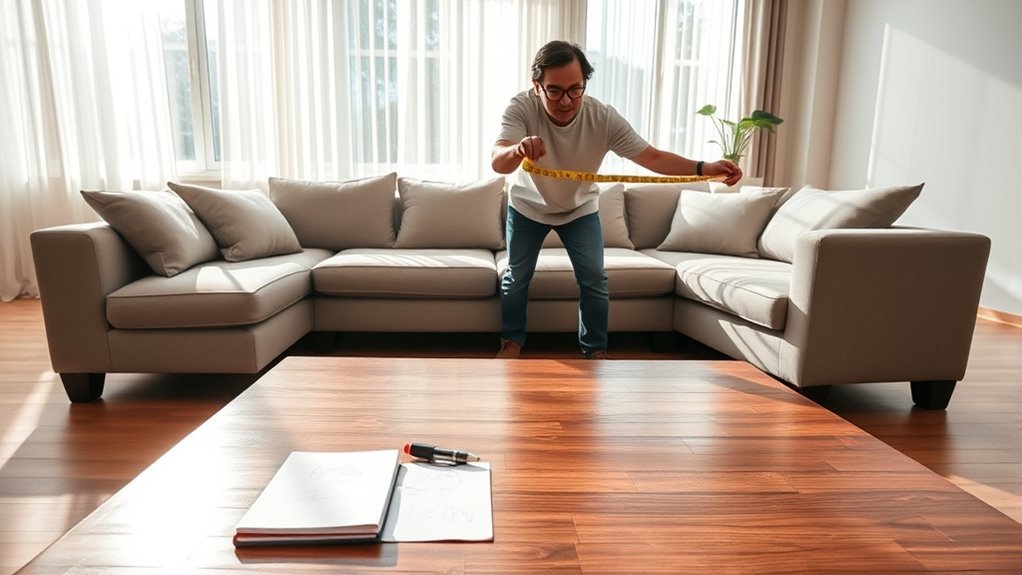
To measure your living room accurately, start with the bare room shell at three heights, sketch a floor plan with every permanent obstacle, measure your delivery path from the street to the room, and tape out your planned furniture and rug footprints on the floor. Always rely on the smallest measurement between any two points so bowed drywall or thick baseboards never catch you off guard.
Begin by measuring the room from wall to wall near the floor (just above the baseboard), at waist height (about 36 inches up), and near the ceiling. Plaster, drywall corners, and older framing frequently shift by 0.5 to 1.5 inches across a span. Recording the narrowest figure prevents a console, bookcase, or sectional from fitting on paper but binding against the wall in real life.
Next, draw a rough bird’s-eye floor plan on plain paper or 1/4-inch graph paper, where one grid square equals 6 inches or 1 foot. Write down each wall length and mark every fixed element that affects placement: windows, doors, door swing arcs, fireplace hearths, radiators, floor vents, electrical outlets, coaxial or fiber ports, light switches, built-ins, and sloped ceilings.
Finally, use low-tack painter’s tape to mark the exact length and depth of sofas, accent chairs, coffee tables, media consoles, and area rugs directly on the floor. Walk through the taped layout at your normal pace. If you have to turn sideways, step over a taped corner, or squeeze behind a chair, adjust the dimensions before you spend a dollar.
Pro Tip: Stick a piece of painter’s tape with the wall’s width and outlet heights written on it directly onto each wall before taking a straight-on photo with your phone. When you browse a showroom or compare product specs online, those labeled photos show window heights, vents, and tight corners at a glance.
Essential Tools for Measuring Your Space
A sturdy 25-foot metal locking tape measure and a roll of 1-inch blue painter’s tape are the two essential tools for measuring a living room. Adding graph paper, a smartphone camera, and an optional laser distance meter speeds up long wall spans and keeps your numbers organized in one place.
| Tool | Purpose | Best Use |
|---|---|---|
| 25-Foot Locking Tape Measure | Measures room dimensions, trim, furniture, doorways, and rugs | Most accurate everyday tool; rigid metal blade stays straight across long spans |
| Notepad or 1/4-Inch Graph Paper & Pencil | Records measurements in inches and sketches a scaled floor plan | Keeps all dimensions, outlet locations, and clearance math in one place |
| Smartphone Camera | Captures windows, outlets, vents, trim profiles, and tight hallway turns | Quick visual reference while shopping online or consulting a designer |
| 1-Inch Painter’s Tape | Marks the exact footprint of sofas, tables, chairs, and rugs on the floor | Lets you test furniture scale, leg placement, and walkway width before buying |
| Laser Distance Measure | Measures long walls, open-concept rooms, and high ceilings in seconds | Helpful for rooms longer than 20 feet, vaulted ceilings, or solo measuring |
Step-by-Step Guide to Measuring Room Dimensions
Follow the same four-step sequence every time: measure the room shell, measure trim and usable wall segments, measure the delivery path, and measure existing furniture. Recording every figure in both feet-and-inches and total inches (for example, 7 feet 4 inches / 88 inches) prevents math errors when comparing product spec sheets.
1. Measure the Room Shell
- Measure the full length of each wall from corner to corner, recording both total inches and feet-and-inches.
- Measure the width of the room in at least three places—near one end, in the center, and near the opposite end—to catch out-of-square walls.
- Measure the diagonal distance between opposite corners (north-east to south-west, then north-west to south-east); if the two diagonals differ by more than 1 inch, note that the room is not square so you leave extra border space around large rugs.
- Measure ceiling height from the finished floor to the ceiling in several spots, especially if your room has soffits, beams, or sloped ceilings, or if you are shopping for tall bookcases (often 72 to 84 inches high) and drapery.
- Circle the smallest measurement whenever two points differ, and use that number as your maximum limit.
2. Measure Trim, Baseboards, and Usable Wall Space
Furniture with straight legs or solid backs sits against the baseboard, not flush against the drywall. Standard baseboards add 0.5 to 0.75 inches on each wall, and quarter-round shoe molding adds another 0.5 to 0.75 inches. Measure from the face of the baseboard or radiator cover to find your true usable floor width, and measure each unbroken wall segment between door casings and window trim.
3. Measure Entry and Delivery Paths
Before ordering a sofa, sectional, armoire, or rolled 9-by-12-foot rug, walk the entire route from the delivery truck or curb to the living room. Following the measurement method in The Spruce’s sofa measuring guide, compare the piece’s width, depth, height, and diagonal depth against every pinch point along the route:
- Exterior and interior doorways: Measure the clear opening width between the door stop and the face of the open door (standard front doors are typically 36 inches wide by 80 inches tall, while older interior doors may be 28 to 32 inches wide). Note that removing a door from its hinges gains about 1.5 to 2 inches of width.
- Hallways and 90-degree turns: Measure hallway width, ceiling height, and the horizontal clearance from the inside corner of a turn to the opposite wall.
- Staircases and landings: Measure the clear width between the wall and the handrail or banister spindles, the landing depth, and the vertical head clearance from both the bottom step and top step to the overhead ceiling.
- Elevators: Measure the elevator door opening width and height, plus the interior cab width, depth, ceiling height, and corner-to-corner diagonal.
- Protruding obstacles: Subtract the projection of wall sconces, pendant lights, fire sprinklers, radiators, mail slots, and handrail brackets along the path.
To bring a sofa through a doorway horizontally, the doorway’s clear width must be greater than either the sofa’s depth or its diagonal depth (plus 1 to 2 inches of breathing room for the movers’ hands). To stand a sofa on end vertically to pivot around a tight hallway corner or fit inside an elevator, both the doorway height and the hallway or elevator ceiling height must exceed the sofa’s overall width (length).
If a retailer’s spec sheet does not list diagonal depth, you can measure an existing piece by laying a straightedge from the top of the back frame (with loose cushions removed) to the front edge of the arm, then measuring perpendicular from the bottom-back corner up to that straightedge. When shopping online, you can also estimate the maximum corner-to-corner diagonal by squaring the sofa’s height, squaring its depth, adding those two numbers together, and taking the square root.
Warning: Never rely on sofa width alone when checking delivery access. Compare the sofa’s depth, height, and diagonal depth against every doorway, stair landing, and hallway turn; a sofa that clears a 34-inch front door can still get wedged at a 36-inch hallway corner if its 88-inch length cannot pivot or stand upright under a low ceiling.
4. Measure Existing Furniture
If you plan to keep any current pieces, measure five dimensions for each item: overall width (arm to arm), overall depth (front to back), overall height, seat height from the floor (usually 17 to 20 inches), and usable seat depth. For motion or storage furniture, measure both the closed footprint and the fully extended footprint: recliners typically require 60 to 68 inches of total depth when open (including 3 to 12 inches behind the backrest), and queen sleeper sofas extend to about 85 to 90 inches deep when unfolded.
Documenting Architectural Features and Fixtures
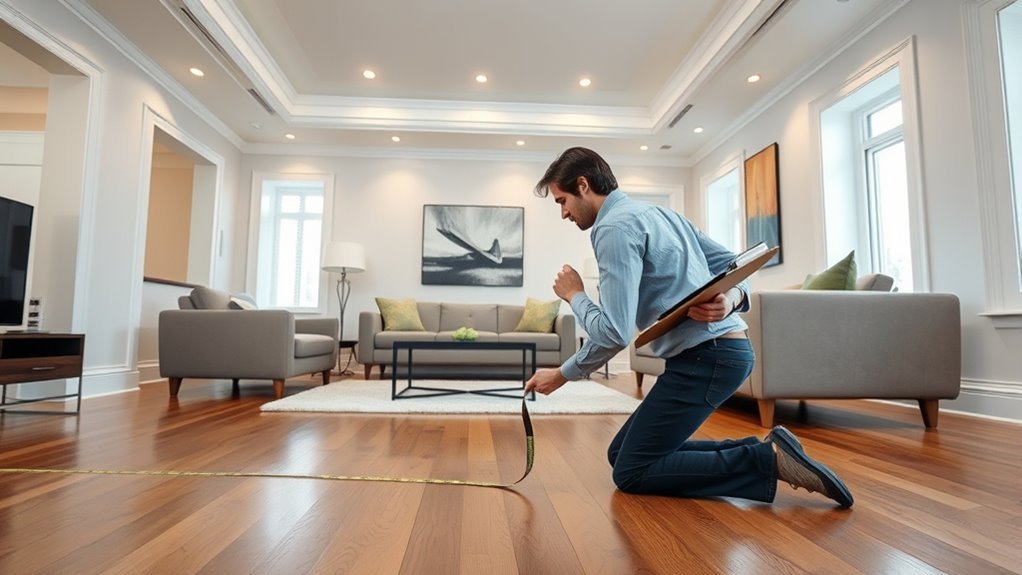
Permanent architectural features dictate where large furniture can safely and comfortably sit. Mapping door swings, window sill heights, fireplaces, heaters, vents, and outlets on your floor plan ensures your new sofa or media console never blocks airflow, covers a power source, or collides with an opening door.
Measure Doors And Entryways
Measure every doorway, archway, and French or sliding door connected to the living room, even if you do not plan to place furniture nearby. Record four details on your sketch:
- Clear opening width and height: Measure inside the jamb from the door stop to the face of the open door, and from the threshold or saddle to the top stop.
- Door swing direction and arc: Draw the quarter-circle path the door sweeps into the room (a 32-inch door needs at least 32 inches of clear floor arc, plus room for a person standing beside it).
- Threshold gap beneath the door: Measure the vertical gap between the bottom of the door slab and the floor if an area rug will reach the doorway; most interior doors clear only 0.375 to 0.75 inches, which can catch on thick high-pile rugs.
- Trim and casing width: Measure from the outer edge of the door casing to the nearest corner so you know how deep a bookcase or console can sit behind or beside the door.
Document Permanent Fixtures
Record the width, height, depth, and distance from the nearest corner for every permanent fixture on your walls and floor:
- Windows and drapery space: Measure window width (outside of trim to outside of trim), height from the floor to the bottom of the sill, and height from the floor to the top of the casing. If hanging curtains, plan to mount the rod 4 to 6 inches above the window frame (or 2 to 4 inches below the ceiling) and extend the rod 6 to 12 inches past each side of the frame so open panels stack clear of the glass.
- HVAC supply and return vents: Mark every floor register, wall grille, and cold-air return. The U.S. Department of Energy’s Energy Saver Guide advises keeping air vents completely unblocked by furniture, rugs, or drapes so your heating and cooling system operates safely and efficiently. Leave 6 to 12 inches of open space around floor vents, or choose raised-leg furniture (at least 4 inches of under-clearance) paired with a magnetic air deflector.
- Fireplaces, wood stoves, and radiators: Measure the width and depth of the fireplace surround and floor hearth. Keep upholstered furniture, curtains, and area rugs at least 36 inches away from wood-burning stoves, open fireplaces, and portable space heaters, and leave 6 to 12 inches of airflow space in front of hot-water or steam radiators.
- Outlets, switches, and media ports: Measure the distance from the corner and height from the floor for electrical outlets, coaxial/Ethernet jacks, thermostats, and wall sconces so a tall bookcase or high-backed sectional does not bury everyday controls.
Note: The U.S. Access Board’s ADA Standards require a 36-inch minimum clear width for accessible walking surfaces in covered spaces. While private homes are not bound by commercial ADA rules, 36 inches remains the gold-standard benchmark for comfortable, barrier-free main living room walkways.
Planning Walkways and Clearances
Clearance is the breathing room around furniture that lets people walk through the space, sit down, reach a drink, and open drawers without bumping their knees. As highlighted in Good Housekeeping’s designer guide on common living room mistakes, ignoring how people move through and live in the room is one of the fastest ways to make a well-furnished space feel cramped.
| Living Room Zone or Feature | Target Clearance | Why This Distance Works |
|---|---|---|
| Main traffic walkways (doorway to doorway) | 30 to 36 inches | Allows adults, strollers, and mobility aids to pass comfortably without turning sideways |
| Secondary or low-traffic paths (between chairs or around a side table) | 24 to 30 inches | Works for single-person access in compact rooms without feeling blocked |
| Sofa or chair front edge to coffee table | 14 to 18 inches (18 inches ideal) | Close enough to set down a glass from a seated position while leaving comfortable knee room |
| Seating to side table or end table | 0 to 6 inches | Keeps lamps and drinks within easy reach; aim for a table height within 1 to 2 inches of the arm height |
| Conversation distance between facing seats | 6 to 8 feet (10 feet maximum) | Keeps people close enough to talk at a normal volume without shouting across the room |
| Sofa back to wall (non-walkway) | 3 to 4 inches | Prevents upholstery from rubbing drywall, clears baseboards, and leaves room for curtains to hang straight |
| TV screen to primary seating | About 1.5× the diagonal screen size (e.g., 7 to 8 feet for a 65-inch TV) | Reduces eye and neck strain; center the screen near seated eye level (typically 42 inches from the floor) |
For households where a resident or guest uses a wheelchair, walker, or stroller indoors, allow extra maneuvering room at doorways and inside the seating zone. In addition to the ADA clear floor space benchmark of 30 by 48 inches for stationary access to switches, windows, and tables, ADA Section 304.3 turning space standards specify a 60-inch-diameter circular area (or a 60-by-60-inch T-shaped zone with 36-inch-wide arms) so a wheelchair can complete a full 360-degree turn.
Choosing the Right Rug Size
A living room rug should visually anchor the entire seating group rather than float like a postage stamp in the middle of the floor. In most rooms, choose a rug that leaves 12 to 24 inches of bare floor visible along the walls (or 8 to 12 inches in small rooms) and extends at least 6 to 8 inches past both ends of your sofa.
| Standard Rug Size | Typical Room Dimensions | Best Furniture & Leg Placement |
|---|---|---|
| 5′ × 8′ (60″ × 96″) | Compact rooms under 10′ × 12′ or studio zones | Apartment sofa or loveseat (under 76 inches wide) with front legs on the rug, or coffee table centered with an even gap to seating |
| 6′ × 9′ (72″ × 108″) | Small living rooms around 10′ × 13′ to 11′ × 14′ | 78-to-84-inch sofa plus one accent chair with front legs resting 6 to 10 inches onto the rug |
| 8′ × 10′ (96″ × 120″) | Medium living rooms around 12′ × 14′ to 14′ × 17′ | Standard 84-inch sofa and two chairs with front legs on the rug and coffee table fully on the rug |
| 9′ × 12′ (108″ × 144″) | Large living rooms around 14′ × 17′ to 16′ × 20′ | L-shaped sectional, two facing sofas, or full seating group with all four legs of every piece on the rug |
| 10′ × 14′ (120″ × 168″) | Oversized rooms 16′ × 20′ and larger or open floor plans | Large U-shaped sectionals or floating seating arrangements with all furniture legs plus side tables on the rug |
Recommended Products

PET FRIENDLY & NON-SLIP BACKING: 8x10 area rugs featuring simple of colors while promising a luxurious feel underfoot. The blend of a hexagon pattern and a stylish design. Non-slip TPR backing makes the covering for bringing your space together. Make the most of your time at home with our pet-friendly and easy-to-clean area rugs. Elevate the floors of your home with this show-stopping and detailed rug

Ultra-Soft Low Pile Rug: Gent drizz living room rugs 8x10 made of Upgraded durable low pile faux wool fibers, 0.25'' thick, featuring a soft fuzzy density surface, soft and pliable to the touch, providing great comfort for your bare feet. The low pile makes it easy for your Large area rug to clean and is perfect for homes with kids and pets

Trendy Modern Rug: Our area rug is designed in today's popular minimalist style, featuring adaptable printed patterns that seamlessly blend into a wide range of interior aesthetics. This neutral rug adds understated elegance with a strong feeling of individuality to your living room, bedroom, dining room, nursery or playroom.
All Legs on the Rug
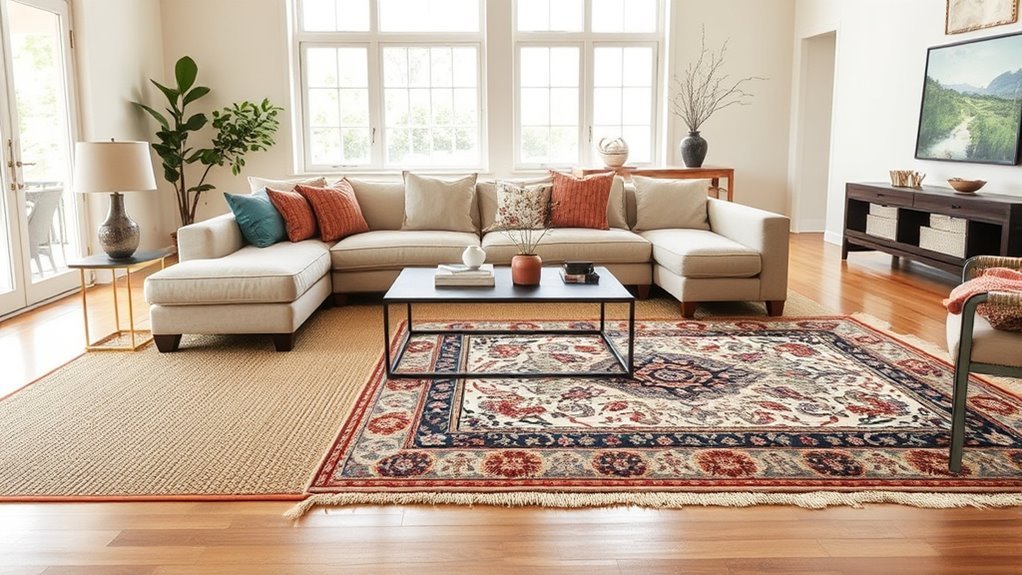
Placing all four legs of the sofa, armchairs, and coffee table on the rug creates the most unified, high-end look, especially in rooms measuring 15 by 18 feet or larger and in open-concept spaces where the rug defines the living zone. Typically requiring a 9-by-12-foot or 10-by-14-foot rug, this layout works best when the rug extends 6 to 12 inches behind the backs of floating chairs so back legs never slip off the edge.
Front Legs on the Rug
Placing the front legs of the sofa and chairs 6 to 12 inches onto the rug while leaving the back legs on the bare floor is the most versatile option for small-to-medium living rooms, especially when a sofa sits near a wall. Current interior design guidance from Architectural Digest and Ideal Home recommends this front-legs-on rule because an 8-by-10-foot rug can tie the whole conversation group together without paying for hidden rug square footage against the baseboard.
Small-Room Floating Rug
If your room is very compact, placing a 5-by-8-foot or 6-by-9-foot rug under only the coffee table with all seating legs on the bare floor can work when proportioned carefully. Leave a uniform 4-to-8-inch strip of bare floor between the front edge of the sofa and the edge of the rug, and make sure the rug length roughly matches the inner width between your sofa arms so the center does not look cramped.
How to Test Rug Size Before Buying
- Pick the two closest standard rug sizes for your room (for example, 8 by 10 feet vs. 9 by 12 feet).
- Outline both rug perimeters on the floor with painter’s tape, orienting the long side of the rug parallel to your longest sofa wall.
- Mark the footprints of your sofa, chairs, and coffee table inside the taped border.
- Verify that the rug extends at least 6 to 8 inches past each arm of the sofa and that furniture legs land cleanly on or off the rug rather than straddling the binding edge.
- Check door swings, floor vents, and rug pad sizing—remember to order a rug pad 2 inches smaller than the rug’s length and width (1 inch shorter per side) so the rug edges taper smoothly to the floor.
What Common Measuring Mistakes Should You Avoid?
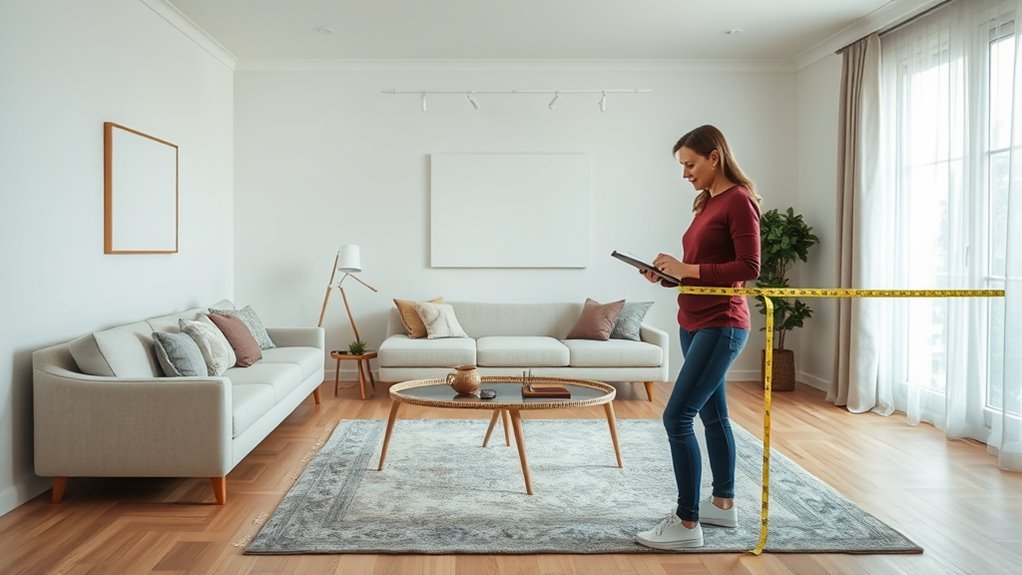
Even a 2-inch measuring mistake can trigger restocking fees of 10% to 25%, return freight charges, or a layout that blocks daily movement. Watch out for these seven frequent errors before placing an order:
- Measuring drywall instead of baseboards and trim: Thick baseboards, window sills, and radiator covers steal 1 to 3 inches of usable width and keep cabinets from sitting flush against the wall.
- Measuring only the living room and skipping the delivery route: A 92-inch sofa that fits your living room wall is useless if it cannot pivot through a 34-inch hallway turn or fit inside your building’s elevator.
- Forgetting diagonal depth and removable legs: Always check diagonal depth for angled doorway entry, and note whether the sofa’s feet unscrew (which often reduces depth and height by 2 to 4 inches during delivery).
- Skipping ceiling height and vertical scale: An 84-inch bookcase or high-backed sofa looks balanced under a 9- or 10-foot ceiling but can overwhelm a room with a low 7.5- or 8-foot ceiling.
- Buying a rug that is one size too small: Choosing a 5-by-8-foot rug for a standard seating group where an 8-by-10-foot rug belongs makes the room feel smaller and visually fragmented.
- Covering HVAC vents, outlets, and light switches: Placing a solid-base sectional directly over a floor register traps heat or cooled air and strains your HVAC blower.
- Skipping the painter’s tape floor test: Showroom floors have high ceilings and wide aisles that make bulky furniture look smaller than it will feel inside your home.
Planning Your Furniture Layout for Comfort
An effective living room layout balances clear traffic paths with comfortable reach and sightlines for how your household actually uses the space. Before locking in dimensions, decide whether the room’s primary job is face-to-face conversation, watching television, reading, kids’ play, or a combination of zones.
Recommended Products
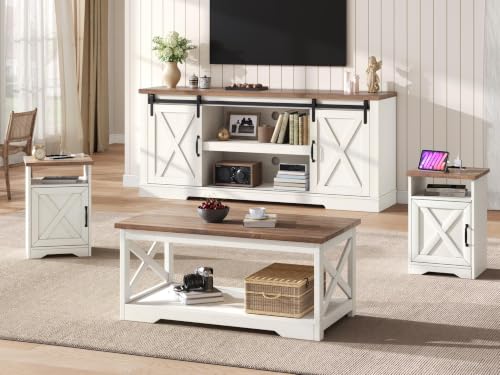
Farmhouse Style Construction: Features a sliding barn door TV stand, coffee table, and 2 end tables all made from MDF and particle board, finished in a stylish distressed white

【Farmhouse Living Room Set】4-piece farmhouse table set includes large entertainment center with power outlets & barn door fits 78" TVs, coffee table & 2 end tables, unified farmhouse barn door-inspired design save your choice time.

【Perfect Contemporary Sofa - 4 Piece Living Room Sets】TYBOATLE black faux leather sectional couches has a quality aesthetic design. This comfortable sofa is ideal for any space, with a wide sofa arm shape, convenient arm side pockets, and a highly technological USB charging feature, a sofa that is a perfect blend of modern and mid-century style that can be placed in living rooms, offices, RVs, apartments, and more.
Traffic Flow Considerations
Route primary walkways around the perimeter of the seating group whenever possible so family members can cross the room without walking between seated guests and the television or fireplace. Keep Sharp 90-degree coffee table corners out of narrow pass-throughs; in tight rooms with heavy foot traffic, a round or oval coffee table adds 4 to 6 inches of diagonal hip clearance around the corners.
- Primary routes: Reserve your widest 30-to-36-inch paths for the main path between doorways.
- Conversation radius: Group sofas and accent chairs within a 6-to-8-foot circle so nobody has to lean forward or raise their voice.
- Focal point alignment: Center your main sofa on the fireplace, primary window, or media console rather than pushing every piece flat against the perimeter walls.
Furniture Proportions and Scale
Scale measures how furniture pieces relate both to the room shell and to one another. Use the two-thirds rule to size your coffee table: multiply your sofa’s width by 0.67 to find the ideal table length (for example, an 84-inch sofa pairs naturally with a 54-to-56-inch coffee table), and pick a coffee table height equal to your sofa seat cushion height or 1 to 2 inches lower.
When mixing a sofa with accent chairs and an ottoman, check seat heights before buying. Following Ideal Home’s 4-inch seating height rule, keep the seat heights of all sofas, armchairs, and ottomans in the same conversation group within 4 inches of one another (for example, pairing an 18-inch-high sofa seat with 16-to-20-inch-high accent chairs). This keeps everyone near the same eye level and makes the seating arrangement look cohesive.
The best layout is not the one that fills the room. It is the one that leaves enough space to walk, sit, reach, open, and relax without thinking about it.
How to Prepare Your Measurements for Expert Consultation
Bringing a complete measurement packet to an interior designer, showroom consultant, or delivery coordinator lets them verify fit and scale in minutes. Organize your notes into six items before your appointment:
- Scaled room sketch: Include wall lengths, room width at three points, ceiling height, and compass orientation (which way windows face for natural light).
- Labeled wall and doorway photos: Include straight-on shots of every wall, doorway, stairwell, and tight hallway corner.
- Fixed feature log: List the exact locations and heights of outlets, switches, HVAC vents, radiators, fireplaces, and cable ports.
- Existing furniture specs: Record width, depth, height, and seat height for every piece staying in the room.
- Clearance requirements: Note your target walkway widths (such as 36-inch accessible paths) and any recliner or sleeper extension zones.
- Candidate product dimensions: Bring the width, depth, height, seat height, and diagonal depth for every sofa, chair, table, and rug on your shortlist.
Living Room Measurement Checklist
Run through this final verification checklist with your tape measure before placing a furniture or rug order:
- Room length, width (measured at floor, waist, and ceiling), and ceiling height
- Usable wall segments measured between baseboards, door casings, and window trim
- Door clear opening width, height, swing direction, and under-door floor gap
- Window width, height, sill height from floor, and curtain rod mounting clearance
- Fireplace hearth, radiator, built-in cabinet, and floor/wall HVAC vent dimensions
- Electrical outlet, light switch, thermostat, and cable/fiber jack coordinates
- Main walkways (30 to 36 inches), secondary paths (24 to 30 inches), and sofa-to-table gap (14 to 18 inches)
- Sofa, chair, table, console, and rug footprints (plus open depth for recliners or sleepers)
- Full delivery path clearances: exterior doors, hallways, 90-degree turns, stairs, and elevators
- Sofa diagonal depth and overall length compared against doorway widths and ceiling heights
- Painter’s tape floor test completed for both furniture and rug boundaries
Key Takeaways
- Measure every wall at floor, waist, and ceiling height, and always plan around the smallest usable measurement between baseboards.
- Verify that your doorway width exceeds a sofa’s depth or diagonal depth for horizontal entry, or that ceiling height exceeds sofa length for vertical pivoting.
- Keep seats within a 6-to-8-foot conversation circle, with seat heights within 4 inches of each other and a coffee table about two-thirds the sofa’s width.
- Size your living room rug so it extends at least 6 to 8 inches past each end of the sofa while leaving 12 to 24 inches of bare floor along the walls.
- Outline both your furniture and rug dimensions with 1-inch painter’s tape on the floor to test walkways, door swings, and vent clearance before ordering.
Frequently Asked Questions
What is the 2/3 rule for living rooms?
The 2/3 rule is a proportion guideline used to scale furniture pieces to one another, such as choosing a coffee table that is about two-thirds (67%) the width of your sofa. For example, an 84-inch sofa pairs well with a 56-inch coffee table. Designers also use it to size artwork or sofas relative to a wall, rather than filling two-thirds of the entire floor with furniture.
How do you measure your living room for a couch?
Measure the usable wall length (between baseboards and trim) or open floor zone where the couch will sit, then subtract space for side tables and 30-to-36-inch walkways. Next, measure the clear width and height of every doorway, hallway, staircase, and elevator along the delivery route, and compare those numbers with the couch’s width, depth, height, and diagonal depth.
What is the 4-inch rule for seating in a living room?
The 4-inch rule states that the seat heights of all sofas, armchairs, and ottomans grouped in the same conversation zone should be within 4 inches of one another. Keeping seat heights close—such as pairing an 18-inch sofa seat with 16-to-20-inch accent chairs—ensures everyone sits at a natural eye level for conversation.
What is the biggest mistake in furniture placement?
The biggest mistake in furniture placement is buying pieces before checking scale and traffic flow in the room. A sofa or cabinet may physically fit against a wall while still blocking a 30-to-36-inch walkway, crowding a doorway swing, covering an HVAC vent, or overpowering the rug. Taping out footprints on the floor first prevents this mistake.
How much space should be between a sofa and coffee table?
Leave 14 to 18 inches between the front edge of your sofa and the edge of the coffee table, with 18 inches being the ideal target for most living rooms. That distance is close enough to set down a drink or grab a remote without leaning awkwardly, while leaving comfortable legroom to sit down and stand up.
Should all furniture legs be on the living room rug?
Placing all furniture legs on the rug is ideal for larger rooms and open floor plans, but placing just the front legs of your sofa and chairs 6 to 12 inches onto the rug works equally well in small and medium rooms. Both approaches visually anchor the seating group, whereas a tiny rug that touches no seating often makes the room feel disconnected.
What size rug do I need for my living room?
Most medium living rooms (around 12 by 14 feet to 14 by 17 feet) need an 8-by-10-foot rug, while larger rooms (14 by 17 feet and up) or sectional layouts usually need a 9-by-12-foot or 10-by-14-foot rug. Subtract 2 to 4 feet from your room’s length and width to leave a 12-to-24-inch bare-floor border, and ensure the rug is at least 12 to 16 inches wider than your sofa.
How do I know if a sofa will fit through my door?
A sofa will fit through a doorway horizontally if the doorway’s clear width is wider than either the sofa’s depth or its diagonal depth, ideally with 1 to 2 inches to spare. If the hallway requires standing the sofa upright on its end to turn a corner, both the doorway height and hallway ceiling height must be taller than the sofa’s overall width.
Conclusion
Measuring your living room is the simplest way to prevent layout headaches and delivery-day surprises before they happen. Grab a 25-foot locking tape measure and a roll of painter’s tape today, record your room shell and delivery path dimensions on a quick sketch, and test your favorite sofa and rug footprints right on the floor before you place your order.
Sources
- The Spruce: How to Properly Measure a Sofa: Supports measuring sofa width, depth, height, diagonal depth, and delivery path clearances.
- U.S. Department of Energy: Energy Saver Guide: Supports keeping air vents and registers unobstructed by furniture, rugs, and drapes.
- U.S. Access Board ADA Standards, Section 403.5.1 Clear Width: Supports the 36-inch minimum clear width benchmark for accessible walking paths.
- Good Housekeeping: Designers Say Most People Make This Living Room Mistake: Supports planning traffic flow, walkway clearances, and coffee-table spacing before buying furniture.
- U.S. Access Board ADA Standards, Section 305.3 Clear Floor or Ground Space: Supports the 30-by-48-inch clear floor space benchmark for stationary access.
- U.S. Access Board ADA Standards, Chapter 3: Building Blocks (Section 304.3 Turning Space): Supports the 60-inch circular and T-shaped wheelchair turning space benchmarks.
- Architectural Digest: How to Figure Out the Best Area Rug Size for Your Space: Supports sizing living room rugs to the seating group and placing at least the front legs on the rug.
- Ideal Home: How the Sofa’s Front Legs on a Rug Rule Works: Supports anchoring small and medium living rooms by placing the front legs of seating on the rug.
- Ideal Home: The 4-Inch Rule for Living Room Seating: Supports keeping seat heights of sofas, chairs, and ottomans within 4 inches of one another.


[…] you move a sofa or buy anything new, measure the room. A long narrow living room needs a simple plan because a few inches can decide whether the room […]