Chemical desiccant moisture absorbers provide passive humidity control in enclosed or semi-enclosed spaces such as an RV, car, closet, safe, storage bin, or filament dry box. For 2026, the Camco Moisture Absorber Bucket is the most convenient disposable option for stationary RV storage, while the Wisedry Rechargeable Silica Gel Pack is a strong reusable choice for vehicle condensation. The 100g rechargeable packs suit drawers and small containers, the large 600g silica gel packs provide more material for bigger enclosed storage zones, and activated alumina is a specialized option for sealed 3D-printer filament systems.
Quick Comparison
| Product | Best For | Format | Reusable? | Main Limitation | Amazon |
|---|---|---|---|---|---|
| Camco Moisture Absorber Bucket | RV, camper, boat, or closet storage | 5 lb bucket | No | Must remain upright and be replaced when spent | Check Details |
| Wisedry Silica Gel Car Dehumidifier | Car condensation and reusable storage control | Two 500g bags | Yes | Must be weighed and heated as directed | Check Details |
| 100g Rechargeable Desiccant Pack | Safes, drawers, luggage, and storage bins | Five 100g packs | Yes | Best only in compact enclosed spaces | Check Details |
| Large Silica Gel Desiccant Packs | Garage cabinets, cars, and large sealed containers | Five 600g bags | Yes | Bulky and ineffective for open-room humidity control | Check Details |
| Activated Alumina Desiccant | 3D-printer filament dry boxes | Loose desiccant beads | Yes, if the product permits regeneration | Needs secure containment and product-specific high-heat regeneration | Check Details |
Camco Moisture Absorber Bucket for RV Storage
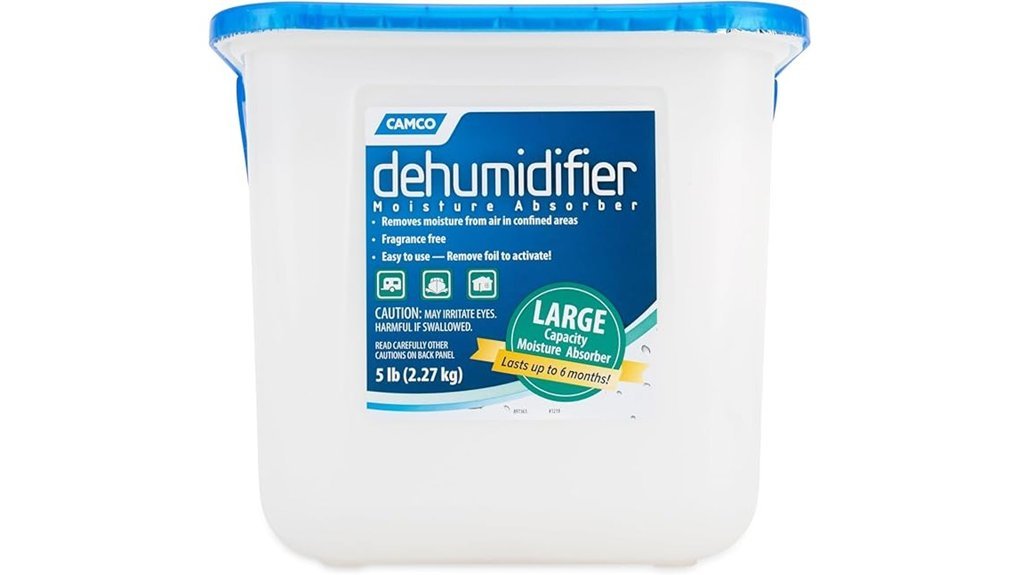
The Camco Moisture Absorber Bucket is a practical choice when you want passive moisture control without electricity. Camco identifies it as a 5-pound bucket with fragrance-free moisture-absorbing material. Its large format is better suited to stationary RVs, campers, boats, closets, and seasonal storage areas than small packet-style desiccants.
Why you’ll like it: It is simple to place, requires no charging, and works until the moisture-absorbing material becomes spent. The bucket format collects the resulting moisture solution, provided the container remains upright on a stable, protected surface.
Who should buy this: RV or boat owners preparing an enclosed space for storage, especially when power is unavailable.
Who should avoid this: Anyone who needs a reusable product, whole-room humidity control, or a spill-resistant option for a vehicle while it is moving.
Best For: RV owners, campers, boat owners, and anyone needing passive moisture control in an enclosed storage area.
Pros:
- Large bucket format is convenient for seasonal storage.
- Fragrance-free design avoids strong added scents.
- Runs without electricity or routine recharging.
Cons:
- Single-use design creates ongoing replacement cost.
- Must stay upright to reduce the risk of spills.
- Not a substitute for a powered dehumidifier in a wet room.
Wisedry Rechargeable Silica Gel Car Dehumidifier Pack
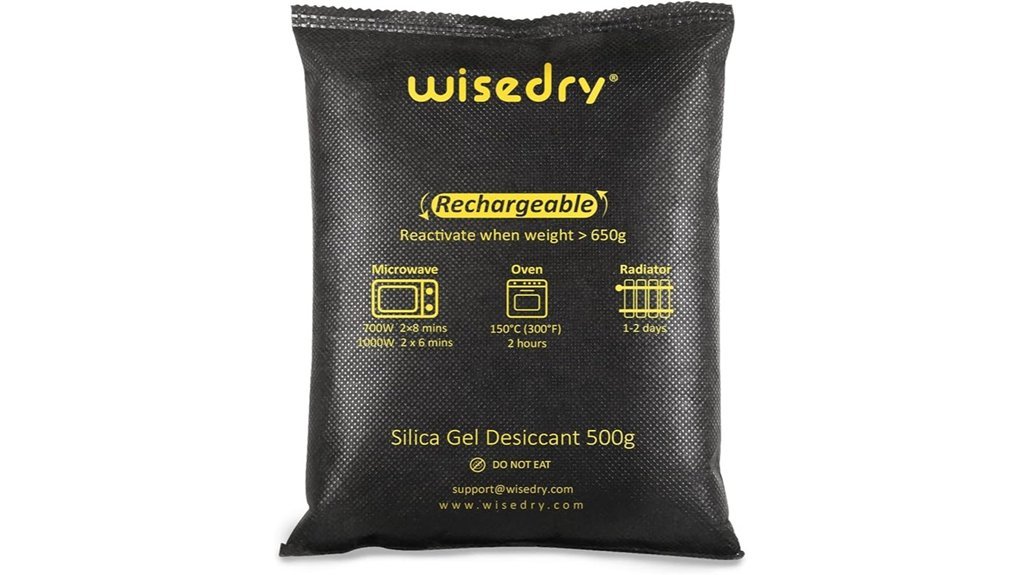
Wisedry’s Rechargeable Silica Gel Car Dehumidifier Pack includes two 500-gram bags designed to adsorb moisture in cars, closets, garages, RVs, boats, and storage rooms. It is especially useful for reducing the damp conditions that contribute to window condensation during cold weather.
Wisedry states that each 500-gram bag adsorbs about 150 grams of moisture, with a stated maximum of 180 grams under suitable conditions. The manufacturer also advises weighing the bag before reactivation and not heating an unsaturated bag. Use only the supplied microwave or oven directions, avoid overheating, and let the bag cool fully before returning it to the vehicle.
Why you’ll like it: The two-bag setup lets you alternate bags or place one at each end of a vehicle. Individual packaging also helps keep an unused bag dry before deployment.
Who should buy this: Drivers who regularly deal with interior condensation and want a reusable alternative to disposable tubs.
Who should avoid this: Buyers who do not want to monitor bag weight, follow timed heating steps, or wait for the bag to cool before reuse.
Best For: Cars, RVs, boats, closets, garages, and reusable moisture control in enclosed spaces.
Pros:
- Two large 500-gram silica gel bags.
- Reusable after proper heat reactivation.
- Useful for vehicle condensation and storage humidity.
Cons:
- Reactivation requires careful timing and cooling.
- Capacity depends on temperature, humidity, and enclosure size.
- Heavier than compact packet-style desiccants.
100g Rechargeable Desiccant Pack (5 Count)
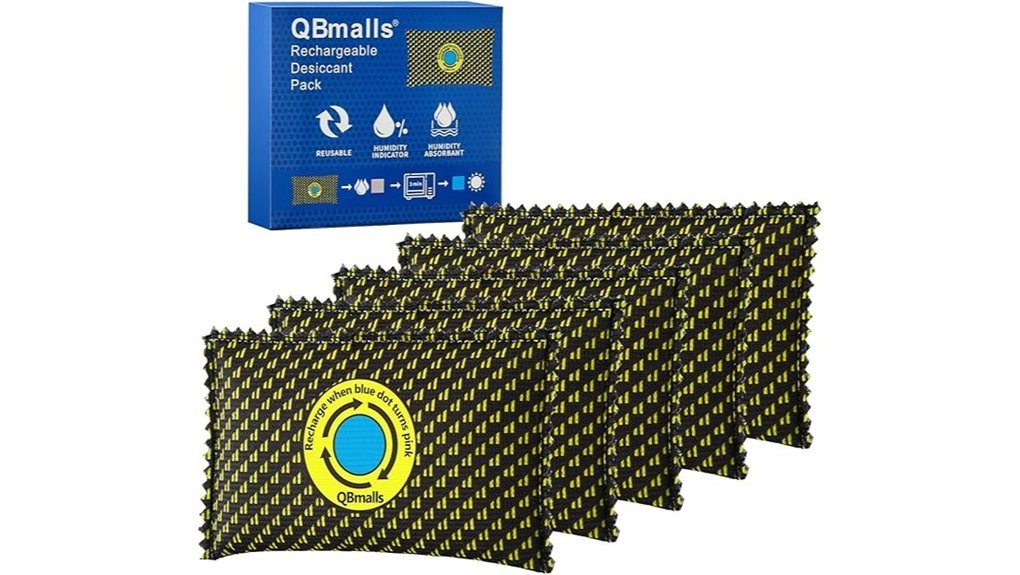
The 100g Rechargeable Desiccant Pack set includes five compact moisture absorbers for safes, drawers, luggage, camera cases, closets, storage bins, campers, and cars. Dividing the material among five packs makes it easier to protect several small enclosures instead of concentrating all the desiccant in one location.
Why you’ll like it: The listing describes reusable packs with a color-changing moisture indicator. That makes routine checks easier, but the listing also contains inconsistent automated specifications unrelated to passive desiccant performance. Ignore room-coverage and extraction-rate fields, and follow only the printed reactivation directions supplied with the product.
Who should buy this: Buyers who need flexible, reusable moisture control for several compact enclosed spaces.
Who should avoid this: Anyone trying to lower humidity throughout a basement, bedroom, or other open room.
Best For: Documents, electronics, safes, drawers, luggage, and other small storage spaces.
Pros:
- Five-pack format covers several small containers.
- Rechargeable design can reduce disposable waste.
- Moisture-status indicator makes maintenance easier.
Cons:
- Seller metadata includes unreliable room-coverage and extraction fields.
- May need frequent reactivation in humid conditions.
- Performance drops quickly in open or frequently accessed spaces.
Large Silica Gel Desiccant Packs (5 Pack)
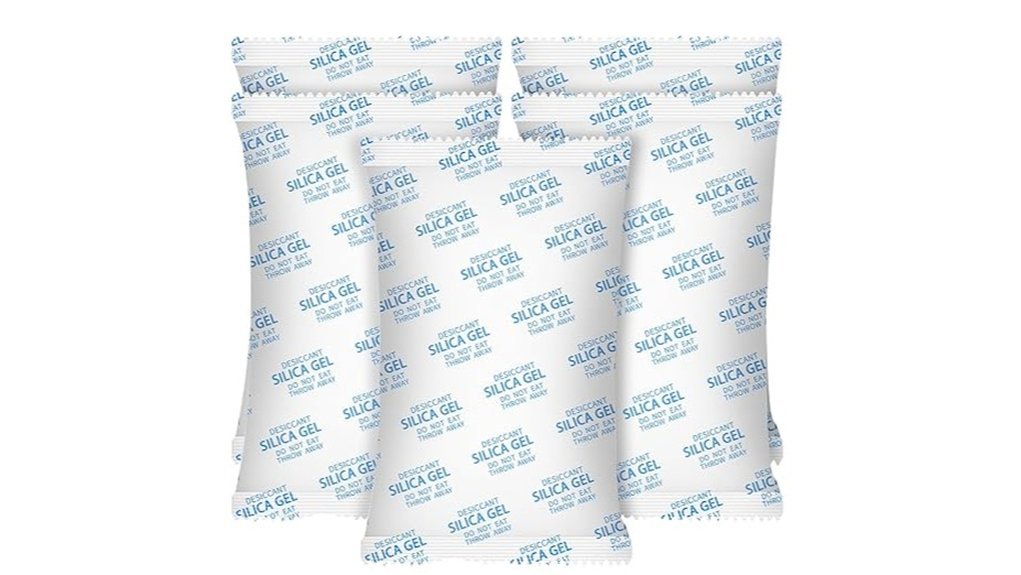
These Large Silica Gel Desiccant Packs are designed for buyers who need more material than a standard sachet can provide. The set contains five 600-gram bags, and the listing states that each bag can adsorb up to 240 grams of moisture under suitable conditions. Their larger format makes them useful in cars, garage cabinets, sealed basement-storage bins, safes, and 3D-filament containers.
The listing also describes transparent, cobalt-chloride-free silica gel and provides oven and microwave reactivation methods. Always use the temperature, power setting, and timing printed on the product instructions because overheating can damage the outer bag. Do not treat a “food safe” marketing claim as permission for direct contact with food unless the packaging specifically authorizes that use.
Why you’ll like it: The five-bag set lets you distribute substantial desiccant capacity across several storage zones or combine bags in one larger sealed area.
Who should buy this: Buyers with large sealed containers, multiple vehicles, garage cabinets, or several filament dry boxes.
Who should avoid this: Anyone who only needs a tiny packet for a drawer or who cannot safely reactivate large bags.
Best For: Larger sealed storage areas, cars, garage cabinets, safes, and filament storage systems.
Pros:
- Five large 600-gram bags provide flexible placement.
- Reusable when reactivated according to the instructions.
- Cobalt-chloride-free formulation avoids blue indicator beads.
Cons:
- Large bags take more storage space.
- Open rooms may require more capacity than passive bags can provide.
- Improper heating can damage the packet material.
Activated Alumina Desiccant for Filament Drying
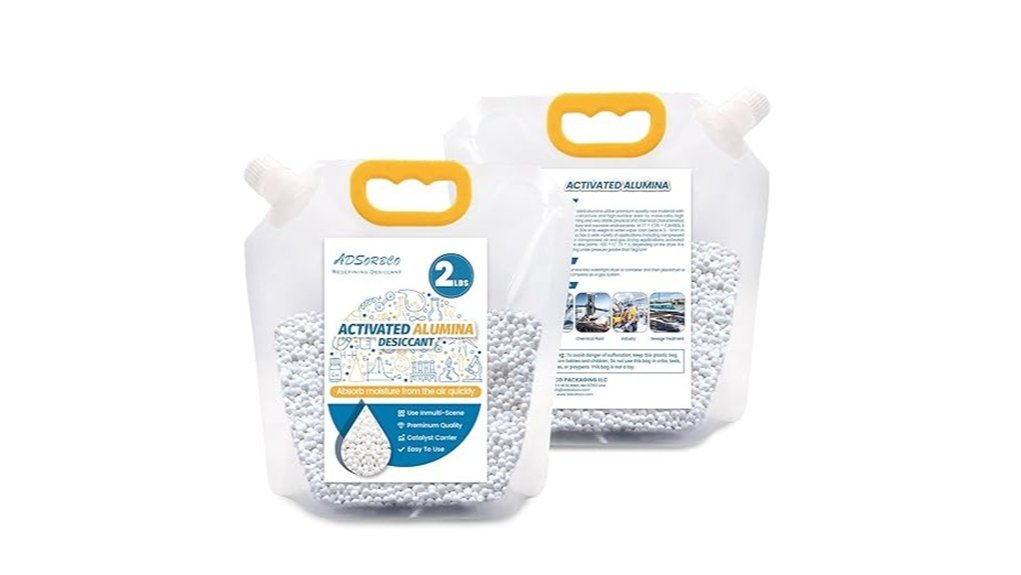
This loose Activated Alumina Desiccant is a specialized option for 3D-printing enthusiasts who use sealed dry boxes, spool containers, or filament-management systems. Activated alumina is a porous adsorbent that can help maintain low humidity when the beads are held in a secure, breathable container.
Do not rely on broad claims that activated alumina is always “10 times stronger” than silica gel. Actual water uptake and drying performance depend on relative humidity, temperature, airflow, bead condition, and regeneration method. Activated alumina usually needs substantially higher regeneration temperatures than many silica gel bags, so use only the product’s stated instructions and a heat-safe container.
Why you’ll like it: Loose beads can be divided among suitable refillable canisters, making the material adaptable to different filament-storage systems. It is most useful for maintaining a dry enclosure, not for quickly restoring filament that has already absorbed substantial moisture.
Who should buy this: 3D-printing users who already have a sealed container, a hygrometer, and a safe way to contain and regenerate loose desiccant.
Who should avoid this: Households with children or pets who may access loose beads, or anyone who wants a ready-to-use sealed bag.
Best For: Filament dry boxes, refillable desiccant holders, and specialized sealed storage systems.
Pros:
- Adaptable to refillable holders and custom dry-box setups.
- Can be regenerated when the manufacturer’s instructions permit.
- Works well as part of a monitored, sealed dry-box setup.
Cons:
- Loose beads require secure containment.
- Dust can irritate eyes, skin, or the respiratory system.
- Regeneration may require higher heat than ordinary silica gel packets.
- It does not replace a heated filament dryer for already-wet material.
Factors to Consider When Choosing a Chemical Desiccant Moisture Absorber
The best desiccant depends less on marketing language and more on the space you need to protect, how often that space is opened, the desiccant material, the amount included, and how willing you are to replace or regenerate it. Use the following checks before buying.
1. Moisture Capacity and Space Type
Match the product to the enclosure. Small 100-gram packs are suitable for drawers, safes, luggage, and sealed bins. Larger 500- or 600-gram bags are more appropriate for cars, garage cabinets, and large containers. A bucket-style absorber is convenient for stationary RV or boat storage but must remain upright. Passive desiccants work best in enclosed or semi-enclosed spaces; they are usually not powerful enough to manage an open wet basement or an occupied room with ongoing moisture entry.
2. Moisture Maintenance Versus Active Drying
A passive desiccant is best at maintaining drier air around stored items. It does not remove water as quickly as a powered dehumidifier, and it may not restore materials that are already wet. For damp rooms, fix the moisture source and use an appropriately sized powered dehumidifier. For wet 3D-printer filament, use a dedicated heated filament dryer at a temperature suitable for that material, then transfer the spool to a sealed dry box with desiccant.
3. Desiccant Material
Silica gel and activated alumina remove water vapor mainly by adsorption onto their porous surfaces. Deliquescent bucket products capture moisture and eventually form a liquid solution. Silica gel bags are convenient and widely reusable, activated alumina suits refillable systems, and bucket absorbers are simple but disposable. Choose the material that matches your maintenance preference and spill tolerance.
4. Rechargeability Options
Reusable desiccants can reduce replacement costs, but only when regenerated safely. Microwave, oven, radiator, sunlight, and high-temperature regeneration methods are not interchangeable across products. Follow the exact instructions supplied with the desiccant, use the recommended temperature or power level, avoid overheating, and let the material cool before returning it to a sealed container.
5. Size and Portability
Compact packs are easy to distribute among several small spaces. Large bags provide more capacity but occupy more room and may be awkward in glove boxes or small drawers. Loose activated alumina is flexible, although it needs a breathable holder that prevents beads and dust from escaping.
6. Indicator and Maintenance Method
Some desiccants use color-changing indicator beads, while others must be weighed or checked according to the manufacturer’s schedule. An indicator can make maintenance easier, but it does not replace the product instructions. Replace damaged bags immediately, especially if beads can escape.
7. Safety and Placement
Keep desiccant products away from children and pets. Do not eat the packets or beads. Avoid breathing dust from loose activated alumina, and prevent contact with eyes. Place liquid-forming bucket absorbers on a stable, protected surface where a spill will not damage fabrics, electronics, wood, or metal.
8. Cost-Effectiveness
Disposable buckets cost less upfront but require replacement. Rechargeable silica gel and activated alumina may offer better long-term value if you can regenerate them safely and repeatedly. Compare the amount of desiccant, expected maintenance frequency, heat energy required for reactivation, and the cost of replacing damaged bags.
Before You Buy Checklist
- Measure the container or storage area you want to protect.
- Choose a bucket only where it can remain upright.
- Choose packets or bags for cars, safes, drawers, and bins.
- Confirm whether the product is disposable or rechargeable.
- Check the exact oven, microwave, or high-heat regeneration instructions before purchase.
- Use loose beads only inside a secure breathable holder.
- Add a hygrometer when protecting filament, electronics, documents, or other humidity-sensitive items.
- Use a heated dryer for already-wet filament or other materials that require active drying.
- Choose a powered dehumidifier when moisture enters continuously or the whole room feels damp.
Frequently Asked Questions
How Do Chemical Desiccants Work?
Silica gel and activated alumina mainly adsorb water molecules onto their porous internal surfaces. Deliquescent salts used in bucket absorbers take up moisture and gradually form a liquid solution. Both approaches reduce moisture around stored items, but their capacity depends on temperature, relative humidity, airflow, and enclosure size.
Can Desiccant Packs Be Reused After Saturation?
Many silica gel and activated alumina products can be regenerated with heat, but not every packet is microwave-safe or oven-safe. Follow the exact manufacturer instructions. Disposable bucket absorbers are normally replaced rather than regenerated.
How Long Do Desiccants Last?
There is no universal lifespan. A pack may last much longer in a sealed dry box than in a frequently opened car or humid garage. Check the indicator, weight, or maintenance guidance supplied with the product and regenerate or replace it when saturated.
Can Passive Desiccants Dehumidify a Whole Room?
Usually not effectively. Passive desiccants are best for enclosed storage, vehicles, safes, cabinets, and small containers. A powered dehumidifier is generally the better choice for an occupied room, open basement, laundry area, or any space with continuous moisture intrusion.
Can Desiccant Dry Wet 3D-Printer Filament?
Desiccant is better for maintaining low humidity around dry filament than for quickly removing moisture already absorbed by a spool. Dry wet filament in a dedicated heated filament dryer using the material maker’s temperature guidance, then store it in a sealed box with desiccant and a hygrometer.
Are There Safety Concerns With Desiccant Products?
Silica gel is generally considered low toxicity, but packets and beads can be choking hazards and may irritate the eyes, skin, or respiratory system. Indicator chemicals, loose activated alumina, and liquid-forming salts can have different safety and handling requirements. Keep all desiccants away from children and pets, avoid inhaling dust, and follow the product label.
How Do I Dispose of Used Desiccants?
Follow the product label and local waste rules. Many intact household silica gel packs can go in regular trash, while liquid-filled bucket absorbers should be sealed to prevent leaks. Do not pour collected liquid onto plants, metal surfaces, or household materials unless the manufacturer specifically permits it.
Final Recommendation
Best simple choice for RV storage: Camco Moisture Absorber Bucket.
Best reusable choice for car condensation: Wisedry Rechargeable Silica Gel Pack.
Best for compact storage: 100g Rechargeable Desiccant Pack set.
Best for larger sealed storage zones: Large 600g Silica Gel Desiccant Packs.
Best specialized option for filament: Activated Alumina Desiccant used in a secure dry-box holder.
Conclusion
The best chemical desiccant moisture absorber is the one that fits your enclosure, spill tolerance, and maintenance routine. A disposable bucket is convenient for stationary RV or boat storage, while rechargeable silica gel bags are easier to reuse in cars, closets, safes, and storage bins. Large bags offer more material for sealed storage zones, compact packs provide flexible placement, and activated alumina works best in monitored refillable filament systems. Keep expectations realistic, follow the exact regeneration instructions, use a heated dryer for already-wet filament, and choose a powered dehumidifier when moisture affects an entire room.