The best reusable moisture absorbers for conservatory storage are designed for small enclosed spaces, not for drying the entire room. Reusable silica gel can help protect cameras, documents, books, tools, electronics, jewellery, and collectibles kept inside sealed or low-leak cupboards, cases, drawers, and storage boxes.
For this job, the Sukh Orange beads provide the most flexible supply, Wisesorb offers a larger bulk quantity, and the Patelai canisters provide the neatest ready-to-place format. If condensation is forming across conservatory windows or walls, use a correctly rated room dehumidifier and investigate ventilation, heating, insulation, or water-entry problems instead.
Quick Verdict
- Best Overall for Flexible Storage: Sukh Orange Silica Desiccant Beads, because the 430g supply can be divided among several secure breathable bags.
- Best Bulk Option: Wisesorb Color-Changing Silica Gel Beads, for users protecting several sealed containers or a larger collection of stored equipment.
- Best for Small Enclosures: Patelai Reusable Silica Gel Canisters, because the three compact tins are already contained and easy to inspect.
How We Compared These Products
These recommendations are based on product format, desiccant quantity, indicator visibility, permitted reactivation method, containment requirements, and suitability for sealed or low-leak storage. We also considered the most important limitation: passive silica gel saturates much faster when exposed to an open room or a frequently opened enclosure.
Manufacturer coverage figures are treated only as starting estimates. Actual maintenance intervals depend on the enclosure seal, ambient humidity, stored materials, and how often the space is opened.
Quick Comparison
| Product | Format | Best Use | Indicator | Reactivation | Main Limitation | Details |
|---|---|---|---|---|---|---|
| Sukh Orange 430g | Loose 3–5mm beads | Multiple storage boxes, camera cases, books, documents, and collectibles | Orange to dark green | Microwave or oven, following the current product directions | Needs secure breathable containment and regular checking | Check Details on Amazon |
| Wisesorb 2 lb | Loose blue indicating beads | Several sealed boxes, safes, tool storage areas, and equipment cases | Blue to pink | Oven, following the current product directions | Loose beads require careful handling and containment | Check Details on Amazon |
| Patelai 3-Piece Canisters | Three separate vented 40g tins | Small cupboards, bags, drawers, cases, and storage boxes | Orange to dark green | Oven only; never microwave metal tins | Limited capacity for large, leaky, or frequently opened spaces | Check Details on Amazon |
Sukh Orange Silica Desiccant Beads 430g
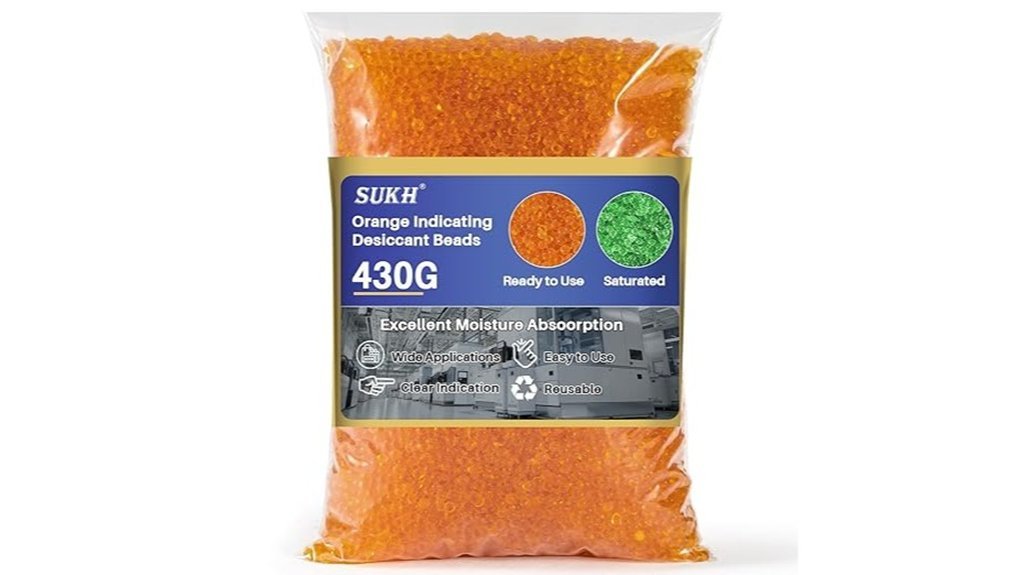
Best Overall for Flexible Storage: The Sukh pack contains 430g of reusable orange indicating silica gel beads measuring approximately 3–5mm. The loose format solves a common storage problem: one supply can be divided among several secure breathable bags instead of being limited to a single fixed canister.
This makes the product useful for cameras, jewellery, documents, books, electronics, tools, and collectibles kept inside sealed or low-leak containers in a conservatory. It is especially practical when the boxes or cases vary in size.
The beads change from orange to dark green as they take on moisture. The product directions state that they can be reactivated in a microwave for about 9–12 minutes or in an oven at 93–121°C (200–250°F) for roughly 30 minutes to two hours. Follow the current label directions, use a suitable microwave-safe or oven-safe container, check the beads during heating, and let them cool fully before returning them to storage.
Why You’ll Like It
You can divide one larger supply among several enclosures and adjust the amount used in each breathable bag to suit different container sizes.
Who Should Buy This: People who want reusable moisture control for several enclosed storage areas and do not mind preparing their own secure breathable bags.
Who Should Avoid This: Anyone seeking hands-off whole-room humidity control or anyone who would prefer not to measure and handle loose beads.
Pros:
- Large enough to divide among multiple storage containers.
- Colour-changing beads provide a visible maintenance cue.
- Can suit differently sized cases, boxes, and cupboards.
- Offers microwave and oven reactivation methods when the current product instructions are followed.
Cons:
- Loose beads need breathable, secure containment.
- Performance drops quickly in open or frequently accessed spaces.
- Requires regular inspection and reactivation.
- Uneven heating or excessive temperature could damage the beads, so the instructions must be followed carefully.
Wisesorb Color-Changing Silica Gel Desiccant Beads
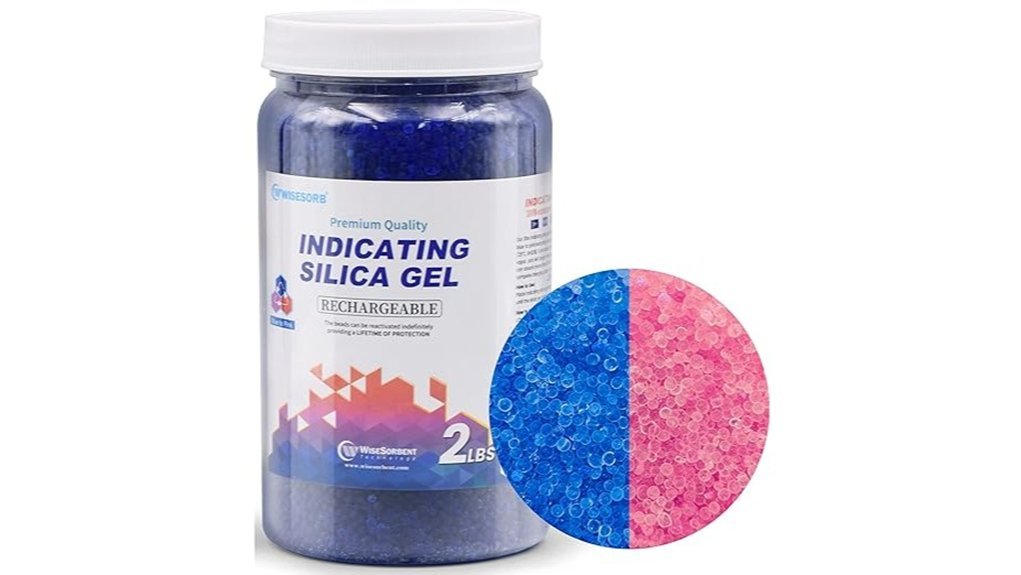
Best Bulk Option: Wisesorb supplies 2 lb of blue-to-pink indicating silica gel beads in a storage jar. The larger quantity is intended for buyers who need to distribute reusable desiccant among several enclosed storage areas rather than protect one small drawer or case.
It can be divided among secure breathable bags for sealed boxes, safes, tool storage, document containers, camera cases, and equipment cases. The main advantage is quantity and flexibility, but the beads still require suitable containment and regular maintenance.
The product information states that the indicator begins changing colour as humidity rises and progresses towards pink as the beads approach their stated saturation range. An initial colour shift should not automatically be treated as full saturation.
The listing estimates that 40g of active gel can protect up to approximately 30 cubic feet in an airtight enclosed space. Treat this only as a starting manufacturer estimate. A cupboard with gaps, a container opened every day, damp stored materials, or very humid room air can shorten the useful interval substantially.
The product directions specify oven reactivation at approximately 93–121°C (200–250°F). Reactivation time depends on saturation and the current instructions supplied with the product. Spread the beads in a suitable heat-safe container, do not exceed the stated temperature, monitor the colour, and let the material cool before reuse.
Safety and Indicator Note
Do not assume the indicator chemistry from the bead colour alone. Check the current product label or safety data before use. Keep loose beads securely contained, away from children and pets, and avoid direct contact with food or medicine unless the packaging expressly approves that use.
Who Should Buy This: People who need a larger reusable supply for several enclosed storage areas and are comfortable measuring and containing loose beads.
Who Should Avoid This: Anyone who wants a ready-to-place canister or a product for whole-room conservatory condensation control.
Pros:
- Large 2 lb quantity suits several storage containers.
- Blue-to-pink indicator provides a visible maintenance cue.
- Loose format can be divided for different enclosure sizes.
- Reusable after correct oven reactivation.
Cons:
- Requires secure breathable bags or vented containers.
- The quoted coverage assumes an enclosed space and must not be treated as room coverage.
- Indicator chemistry should be confirmed from the current label or safety information.
- The large supply may be unnecessary for someone protecting only one small drawer or case.
Patelai Reusable Silica Gel Canisters (3 Pieces)
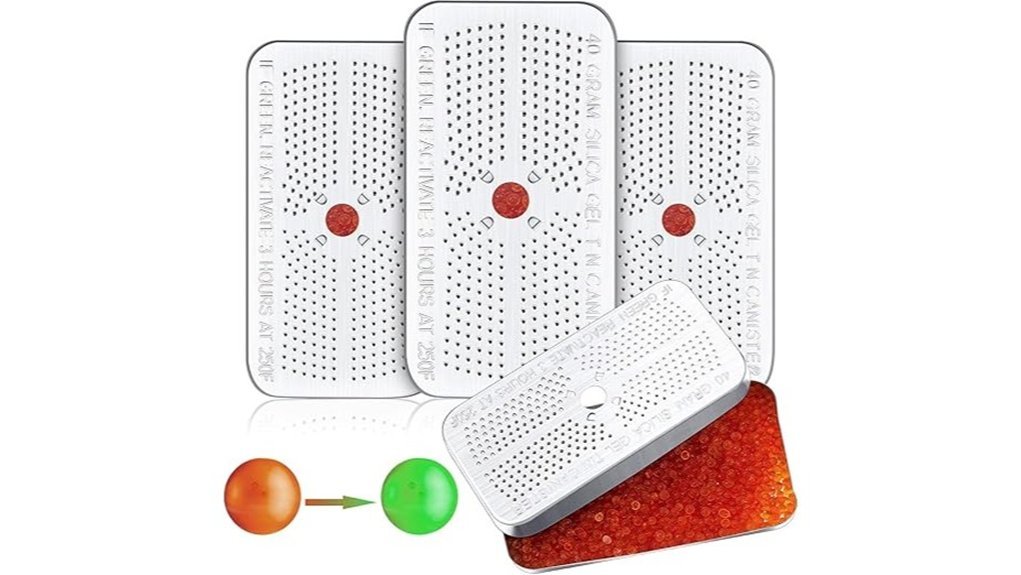
Best for Small Enclosures: Patelai’s set includes three separate vented aluminium canisters, each containing 40g of indicating silica gel. The three-piece format lets you place one contained unit in each of three small storage areas without filling bags or measuring loose beads.
At about 4.13 × 2.17 × 0.59 inches per canister, the slim tins are easier to place in drawers, cabinets, storage boxes, equipment bags, camera cases, and other tight spaces. Their contained design also reduces the chance of loose beads spilling among stored belongings.
The beads change from orange to dark green as they absorb moisture. The product directions call for oven reactivation at 138–149°C (280–300°F) for approximately two to three hours or longer when heavily saturated. Because the canisters are metal, never put them in a microwave. Preheat and use the oven only as directed, handle the hot tins carefully, and let them cool completely before returning them to storage.
The listing describes each canister as suitable for an enclosed space of up to about 30 cubic feet. This is a best-case product estimate rather than a guaranteed result. A poorly sealed cabinet, damp contents, or a box opened frequently may require much more frequent reactivation.
Why You’ll Like It
The ready-contained design is neat, easy to move, and simple to inspect without filling bags or handling loose beads during normal use.
Who Should Buy This: People who want straightforward reusable moisture absorbers for up to three small enclosed storage areas.
Who Should Avoid This: Anyone protecting a large cabinet, an entire conservatory, or an area that is opened frequently and receives a constant supply of humid air.
Pros:
- Three compact, ready-to-place canisters.
- Vented metal bodies keep the beads contained while permitting airflow.
- Orange-to-dark-green indicator makes maintenance easier to judge.
- Useful for distributing moisture control among three separate small spaces.
Cons:
- Small individual capacity is unsuitable for room-scale damp.
- Oven reactivation takes approximately two to three hours or longer when heavily saturated.
- Hot metal canisters require careful handling and full cooling.
- Fixed canister capacity is less adaptable than loose beads.
How to Choose a Reusable Desiccant for Conservatory Storage

The right product depends less on the total size of the conservatory and more on the volume, seal quality, and opening frequency of the enclosure you want to protect. Silica gel can be useful inside a sealed storage box but may saturate quickly when left exposed to an open room.
Whole Room or Enclosed Storage?
Start by identifying the actual moisture problem. Reusable beads and canisters are designed for relatively small enclosed spaces. They are not substitutes for powered room dehumidification, suitable ventilation, heating, leak repairs, drainage work, or insulation when condensation is forming across conservatory windows and walls.
When Silica Gel Is Not Enough
Choose a room-scale solution or investigate the building when you have widespread window condensation, damp walls, water entry, a persistent musty odour, or humidity that returns quickly throughout the conservatory. Passive desiccant is most useful for protecting specific stored items inside an enclosure.
Enclosure Volume and Air Leakage
Use any product coverage figure only as a starting estimate. A well-sealed box retains dry conditions longer than a cupboard with large gaps. Frequently opening the enclosure also replaces drier internal air with humid room air, so the desiccant will require reactivation sooner.
Loose Beads or Canisters
Loose beads offer greater flexibility because you can divide them among several secure breathable bags and adjust the quantity for differently sized containers. Canisters are neater and easier to move, but each tin has a fixed capacity. Choose loose beads for varied container sizes and canisters for simple, contained placement.
Colour Indicator
An indicating desiccant helps you judge when maintenance is due, but the first colour shift does not always mean the beads are fully saturated. Follow the product-specific colour guide rather than assuming every orange, green, blue, or pink indicator behaves in the same way.
Reactivation Method
Check the permitted heating method before buying. The Sukh listing allows microwave or oven reactivation when its directions are followed. The Wisesorb beads are presented as oven-reactivated in this comparison, while the Patelai metal canisters must be reactivated in an oven. Never microwave a metal canister, and never exceed the temperature stated by the product manufacturer.
Safe Containment
Keep loose beads in a secure breathable bag or vented container that will not open among stored belongings. Prevent access by children and pets, avoid direct contact with food or medicine unless the packaging expressly approves it, and wash your hands after handling loose material. Let all heated material cool completely before returning it to storage.
Monitoring Humidity
A small digital hygrometer can show whether the enclosure is actually staying dry. Place it near the stored items rather than outside the box. If humidity rises soon after correct reactivation, improve the seal, reduce how often the enclosure is opened, or adjust the amount of desiccant within the product instructions.
Maintenance and Replacement
Reusable silica gel still requires ongoing inspection. Replace the material if it no longer returns to the stated dry colour after correct reactivation, if the container becomes damaged, or if humidity begins rising unusually quickly despite a good enclosure seal and proper use.
Before You Buy
- Confirm that you are treating a small enclosed space rather than the entire conservatory.
- Measure the approximate internal volume of the box, cabinet, drawer, or case.
- Check how well the enclosure seals and how often it will be opened.
- Choose secure containment if you are buying loose beads.
- Check the exact indicator colour guide and reactivation directions.
- Make sure you have a safe heating method approved for that specific product.
- Plan to monitor humidity and reactivate the desiccant when needed.
- Confirm that children and pets cannot reach the beads or hot canisters.
Frequently Asked Questions
Can Silica Gel Dehumidify a Whole Conservatory?
No. Small reusable beads and canisters do not have enough practical capacity for continuous room-level moisture loads. Use them inside sealed or low-leak storage containers. For widespread window condensation or damp walls, address ventilation, leaks, heating, insulation, or use a correctly rated room dehumidifier.
How Often Should I Reactivate Silica Gel?
There is no dependable fixed schedule. Reactivate it when the product’s indicator reaches the stated colour or when a hygrometer shows that enclosure humidity is rising. Damp conditions, air leakage, enclosure size, wet stored materials, and frequent opening can shorten the interval considerably.
Are Reusable Desiccants Safe Around Children and Pets?
They should be kept securely out of reach. Loose beads and small bags can be swallowed or create a choking risk, while freshly heated beads and metal canisters can cause burns. Use secure containment and follow the current product label and safety information.
Can They Stop Condensation on Conservatory Windows?
Not across an open conservatory. These products are intended for small enclosed storage spaces. Window condensation usually requires room-scale humidity control, suitable ventilation, warmer internal glass surfaces, reduced moisture generation, or repairs to water-entry and insulation problems.
Can I Microwave Reusable Silica Gel?
Only when the instructions for that specific product allow it and only in a suitable microwave-safe container. The Sukh listing permits microwave reactivation. Do not microwave Patelai metal canisters, and use oven directions for products that specify oven-only reactivation.
Which Format Is Easiest to Use?
Patelai canisters are the simplest to place and inspect because the beads are already contained. Sukh and Wisesorb loose beads are more flexible for unusual container sizes, but they require secure breathable bags and more careful handling.
Should I Still Use a Hygrometer?
Yes. A colour indicator shows the condition of the desiccant, while a hygrometer shows the actual humidity around the stored items. Using both makes it easier to identify an inadequate quantity, a poor enclosure seal, or a need for more frequent reactivation.
Do Reusable Silica Gel Beads Last Forever?
No fixed service life applies to every product. Correct reactivation allows repeated use, but performance may eventually decline. Replace the beads or canister if the indicator no longer returns to its stated dry colour or the enclosure stops remaining dry for a reasonable interval.
Final Recommendation
Choose Sukh Orange beads when you want one adaptable supply for several sealed storage boxes, cases, or cupboards. Choose Wisesorb when you need a larger bulk quantity and are comfortable measuring and containing loose beads. Choose Patelai canisters when neat, ready-to-place moisture control matters more than maximum flexibility.
None of these products should be selected as a substitute for a powered whole-room dehumidifier. Their strongest use is protecting specific belongings inside small enclosed spaces.
Whichever format you choose, follow the exact reactivation instructions, keep the product securely contained, and monitor the enclosure with a hygrometer. For room-wide conservatory condensation, use a properly rated room solution and address the underlying source of moisture.