Affiliate disclosure: This article contains Amazon affiliate links. We may earn a commission from qualifying purchases at no extra cost to you.
Updated August 2026
Musty smells often point to excess moisture, limited ventilation, a leak, or damp materials. This guide compares dehumidifiers and moisture absorbers for musty smells, but the products do not all work the same way. Four are passive calcium-chloride absorbers for small or enclosed spaces, while the Onsekin CS08 is a compact powered dehumidifier for ongoing light moisture collection.
For a closet, cabinet, laundry area, or storage zone, a passive absorber may be the simplest choice. For a room where humidity returns every day, choose a powered unit with a meaningful moisture-removal rating. No product here can repair a leak, dry saturated building materials quickly, or remove established mold.
Quick Verdict
- Best overall for odor-focused small spaces: ZARPAX Activated Charcoal Moisture Absorber
- Best refillable option: Arm & Hammer Fragrance Free Moisture Absorber
- Best compact powered option: Onsekin CS08 Dehumidifier with Aromatherapy Diffuser
- Best for larger stationary storage areas: DampRid Hi-Capacity Bucket
- Best multi-pack value: Vacplus Moisture Absorbers
How these picks were evaluated
The comparison focuses on product type, intended space, odor-control features, maintenance, spill risk, powered versus passive operation, and the clarity of each product’s limitations. These recommendations are based on product information and use-case fit, not claimed hands-on testing.
| Product | Type | Best For | Main Limitation | Check Details |
|---|---|---|---|---|
| ZARPAX Activated Charcoal Set | Disposable calcium-chloride absorber with activated charcoal | Closets, cabinets, bathrooms, and small storage areas | Not designed for severe or whole-room humidity | Check on Amazon |
| Arm & Hammer Fragrance Free 14 oz | Refillable passive moisture-absorber tub | Closets, laundry rooms, mudrooms, and other enclosed areas | Needs monitoring, careful draining, and refilling | Check on Amazon |
| Onsekin CS08 Dehumidifier | Powered semiconductor dehumidifier | Small rooms or localized areas with light, recurring humidity | Advertised floor-area coverage is not a standardized daily removal rating | Check on Amazon |
| DampRid Hi-Capacity Bucket | Large passive moisture-absorber bucket | Garages, stored boats or campers, storage rooms, and stationary spaces | Passive absorption may be too slow for persistently wet areas | Check on Amazon |
| Vacplus Moisture Absorbers 6 Pack | Disposable calcium-chloride boxes | Treating several closets, cabinets, bathrooms, or storage zones | Each box has limited capacity and must remain upright | Check on Amazon |
Before you buy: Find the moisture source first. A product may reduce humidity or odor, but it will not repair plumbing, stop rainwater intrusion, dry soaked drywall, or remediate mold. A musty smell that returns after cleaning deserves further investigation.
ZARPAX Activated Charcoal Moisture Absorber Set of 4: Best Overall for Small Spaces
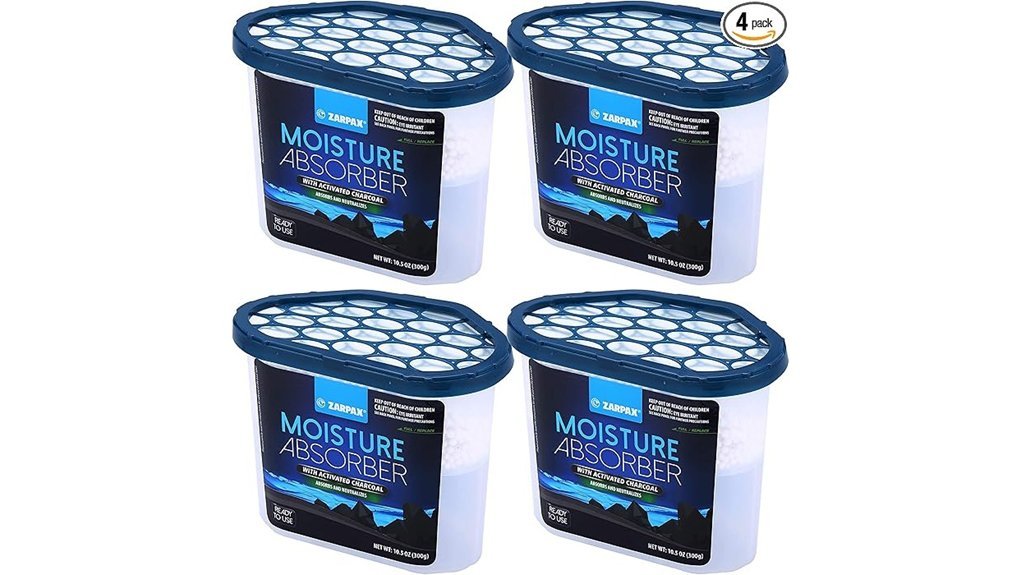
The ZARPAX Activated Charcoal Moisture Absorber combines calcium chloride for passive moisture collection with activated charcoal for odor control. Its compact, self-standing format is suitable for closets, cabinets, bathrooms, kitchens, and other small areas where an electric unit would be inconvenient.
To use it, remove the outer seal as directed, keep the inner membrane in place, replace the top cover, and set the container upright on a flat surface. The crystals dissolve as moisture collects below. Temperature, airflow, and humidity affect service life, so check the container rather than relying on a fixed replacement date.
Why You’ll Like It: It addresses mild dampness and stale odor without electricity, and the four-pack lets you treat several enclosed zones at once.
Best For: Closets, cabinets, bathrooms away from splash zones, kitchens, and small storage areas with mild moisture or musty odor.
Who Should Avoid It: Anyone trying to control high humidity across a large room, basement, or whole home.
Pros:
- Uses calcium chloride for moisture collection and activated charcoal for odor control.
- Compact, lightweight, and easy to distribute across several small spaces.
- Requires no outlet, batteries, fan, or drain hose.
Cons:
- Single-use containers must be replaced after the crystals dissolve.
- Capacity is limited compared with powered dehumidifiers.
- The container must remain upright and away from items that could be damaged by a spill.
Arm & Hammer Fragrance Free Moisture Absorber 14 oz: Best Refillable Tub

The Arm & Hammer Fragrance Free Moisture Absorber is a practical choice for shoppers who want a reusable tub rather than replacing the entire container each time. It is intended for closets, laundry rooms, mudrooms, and other enclosed areas where mild excess moisture and stagnant air contribute to odor.
Remove the lid, peel away the foil seal, and replace the lid before use. As the crystals dissolve, liquid collects in the lower part of the tub. Duration varies with temperature and humidity. Monitor the level, handle the collected liquid carefully, and refill the tub only according to the product label.
Why You’ll Like It: The refillable design can reduce container waste, while the fragrance-free formula avoids masking a musty smell with perfume.
Best For: Small enclosed spaces where you want silent passive moisture control and a refillable container.
Who Should Avoid It: Homes with active leaks, severe dampness, or large open rooms that need continuous powered moisture removal.
Pros:
- Fragrance-free formula suits households that do not want added scent.
- Refillable tub can be reused with compatible refill crystals.
- No electricity, batteries, drain hose, or operating noise.
Cons:
- Collected liquid must be monitored, drained, and disposed of as directed.
- Performance and service life vary with room conditions.
- It is not intended to manage heavy whole-room humidity.
Onsekin CS08 Dehumidifier with Aromatherapy Diffuser: Best Compact Powered Option
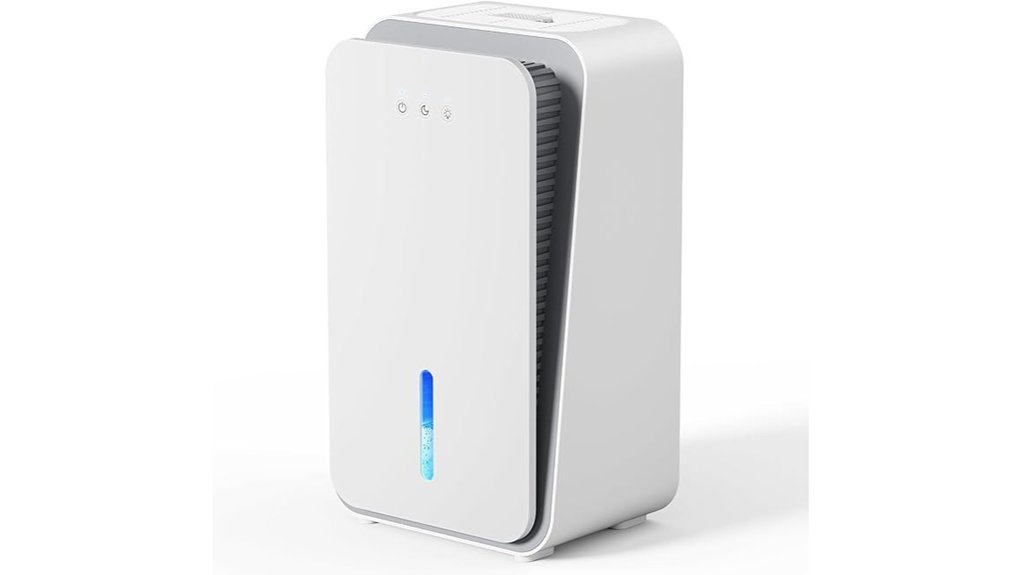
The Onsekin CS08 is the only powered dehumidifier in this group. The listing describes semiconductor condensation technology, an aromatherapy pad, seven-color LED lighting, sleep mode, auto shut-off, and a continuous-drain option.
The listing also markets the unit for spaces up to 1,000 sq. ft., but that floor-area figure is not the same as a standardized pint-per-day moisture-removal rating. Compact semiconductor models are generally better suited to localized, light, or moderate moisture than to a persistently wet basement. Judge suitability by the actual water collected, room temperature, starting humidity, and whether the relative humidity is falling.
Why You’ll Like It: It offers ongoing moisture collection, automatic shut-off, and quiet-mode features in a compact format that can move between suitable rooms.
Best For: Small bedrooms, offices, bathrooms away from splash zones, and other localized areas where mild humidity returns regularly.
Who Should Avoid It: Buyers who need a clearly rated high-capacity unit for flooding, major leaks, wet building materials, or persistent basement humidity.
Pros:
- Powered operation supports ongoing moisture collection.
- Sleep mode is intended to reduce fan noise and lighting at night.
- Auto shut-off helps reduce overflow risk when the tank is full or incorrectly installed.
- The drain option may reduce manual tank emptying when installed exactly as directed.
Cons:
- The advertised coverage figure does not show how many pints or ounces the unit removes per day under standardized conditions.
- The tank, filter, air inlets, and drain path require routine cleaning.
- Aromatherapy adds scent but does not remove the source of a musty odor.
- It is not a substitute for a compressor dehumidifier when the moisture load is high.
Placement caution: Keep the unit on a stable surface with clear airflow. Do not place it where it can be splashed, submerged, or reached from a tub or shower. Follow the manual for drainage and aromatherapy use.
DampRid Hi-Capacity Moisture Absorber Bucket (2 Pack): Best for Larger Stationary Areas
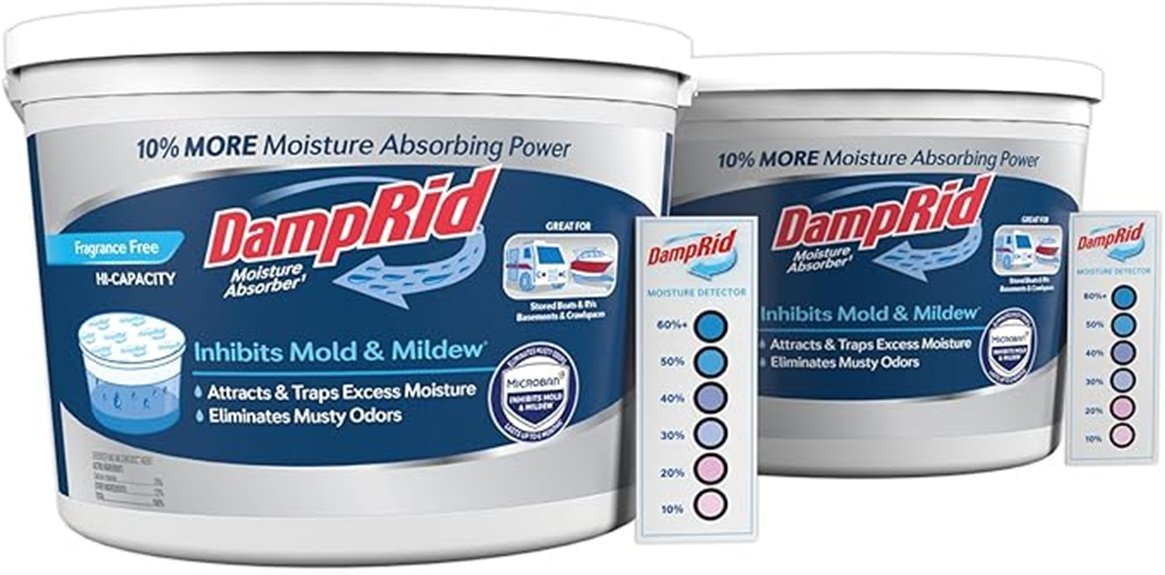
The DampRid Hi-Capacity Moisture Absorber Bucket is designed for stationary use in larger enclosed areas such as garages, storage rooms, stored boats, stored campers, and seasonal properties. Its bucket format holds more moisture-absorbing material than the small tubs and boxes in this guide.
Place the bucket on a flat, stable surface and follow the package directions without removing any protected membrane that is meant to remain in place. Replace the product when its crystals have dissolved and the package indicator shows it has reached the replacement point. Actual service life depends on temperature, ventilation, humidity, and the amount of moisture entering the area.
Why You’ll Like It: The larger passive format is easier to manage than scattering several small boxes around one stationary storage area.
Best For: Garages, storage rooms, stored boats or campers, and other larger enclosed areas with mild to moderate dampness.
Who Should Avoid It: Moving vehicles, unstable surfaces, occupied spaces where it could be tipped, or very wet areas that require powered dehumidification and drainage.
Pros:
- Higher passive capacity than compact moisture-absorber tubs and boxes.
- Works without electricity and produces no fan noise.
- Well suited to stationary spaces that are checked periodically.
Cons:
- A liquid-filled bucket can spill if tipped or damaged.
- The entire unit must be replaced when it reaches its limit.
- Passive absorption may be too slow for severe or continuously renewed humidity.
Vacplus Moisture Absorbers 6 Pack for Humidity Control: Best Multi-Pack Value
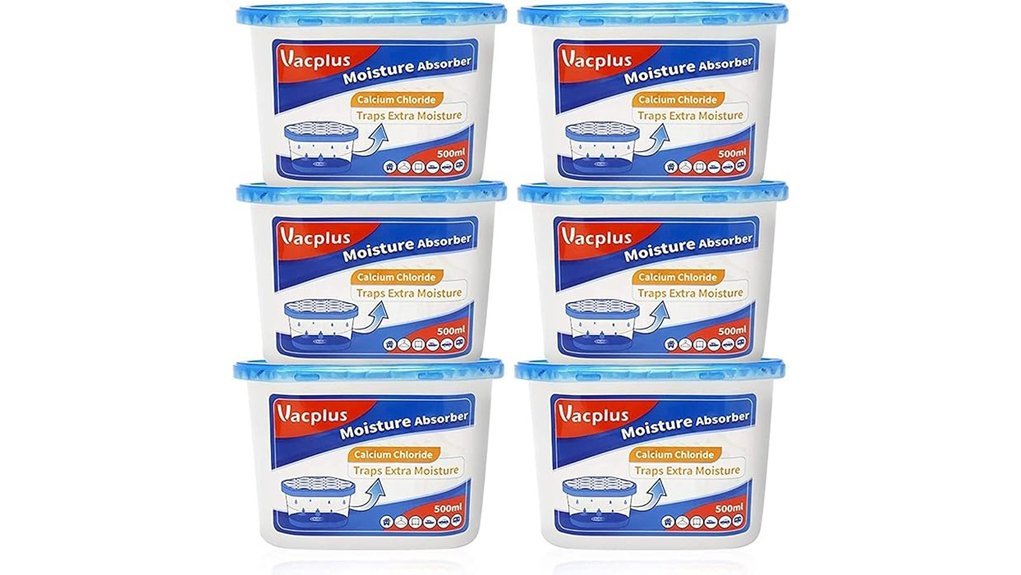
Vacplus Moisture Absorbers are a convenient six-pack for placing passive moisture control in several small areas at once. Each 10.5-ounce box uses spherical calcium chloride, while a separate water-collecting layer lets you see liquid accumulating below the crystals.
The fragrance-free design is useful in bathrooms, closets, kitchens, laundry areas, and storage spaces where added scent is unwanted. The lock-wet paper layer is intended to reduce leakage, but it does not remove the need for careful placement. Keep every box upright on a level surface and away from children, pets, metal, leather, electronics, and absorbent materials.
Why You’ll Like It: Six individual boxes make it easy to target several damp spots without moving one container from room to room.
Best For: Households that need small passive absorbers for multiple closets, cabinets, bathrooms, or storage zones.
Who Should Avoid It: Buyers who want a refillable or rechargeable product, or anyone who needs rapid whole-room dehumidification.
Pros:
- Spherical calcium chloride increases exposed surface area for passive moisture collection.
- Fragrance-free formula does not add perfume to the room.
- Transparent collecting layer makes progress easy to monitor.
- Six-pack format supports several small placement zones.
Cons:
- Each box has limited capacity in high-humidity conditions.
- Units are disposable rather than refillable or rechargeable.
- Collected liquid requires careful handling and disposal.
How to Choose Moisture Control for Musty Smells
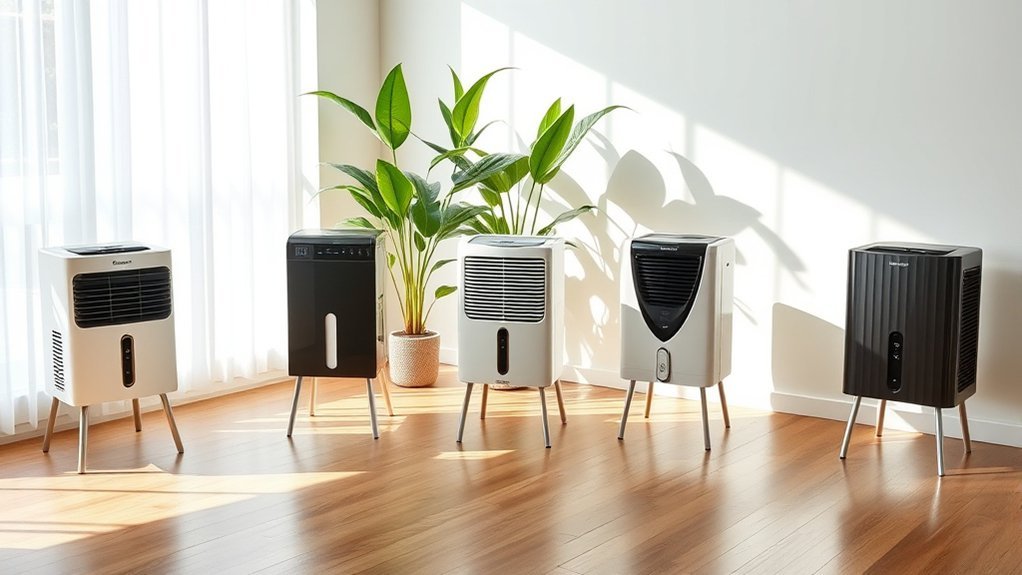
The right choice depends on whether you have a small enclosed area with mild dampness or a room that needs active, continuous moisture removal. Compare product type, measurable capacity, placement, maintenance, safety, and the moisture source before buying.
Passive Absorber or Powered Dehumidifier
Passive calcium-chloride absorbers are silent, outlet-free, and easy to place. They work best in closets, cabinets, storage bins, laundry areas, and other enclosed spaces with a limited moisture load. A powered dehumidifier moves air through the unit and is usually the better choice when humidity returns continuously across a room. For a damp basement or large living area, look for a compressor dehumidifier with a clearly stated daily pint rating rather than relying only on an advertised square-foot figure.
Space Size and Moisture Severity
Room size alone does not tell the whole story. A small room with a plumbing leak, wet drywall, poor exhaust ventilation, or incoming ground moisture may need more removal capacity than a larger but mostly dry storage room. Use passive tubs and boxes for targeted zones. Choose active equipment when you need air circulation and ongoing collection, and move to a higher-capacity unit when humidity remains elevated despite normal ventilation.
Compare Capacity the Right Way
Powered dehumidifiers are commonly compared by how much moisture they remove per day under stated test conditions. Passive absorbers are sold by the amount of desiccant in the container. These measurements are not interchangeable. A large-looking bucket can still collect moisture much more slowly than a powered compressor unit.
Use a Hygrometer and Track Results
A separate hygrometer helps confirm whether relative humidity is actually falling. The U.S. Environmental Protection Agency recommends keeping indoor humidity below 60%, ideally around 30% to 50% relative humidity. If readings remain high, condensation continues, or the odor returns quickly, inspect for leaks, wet materials, poor ventilation, drainage problems, or hidden mold.
Noise, Lighting, and Bedroom Use
Passive absorbers are silent. Powered models use fans and cooling components, so noise tone, vibration, indicator lights, and control layout matter in bedrooms and offices. Look for a sleep mode and the ability to switch off decorative lighting. Place the unit where airflow is not blocked and where vibration will not be amplified by furniture.
Safety and Placement
Place every absorber or dehumidifier on a stable, level surface. Calcium-chloride products create a salty liquid that may damage surfaces if spilled, so follow the label and keep them away from children, pets, leather, metal, electronics, documents, and fabrics unless the manufacturer says otherwise. Powered units should have automatic shut-off and must be kept away from splash, standing water, and blocked air inlets.
Maintenance and Ongoing Cost
Disposable absorbers require complete replacement. Refillable tubs need compatible crystals plus careful draining. Powered units need tank, filter, inlet, and drain-path cleaning. Before buying, consider how often you can check the product and whether replacement packs, refills, or drain access are practical for the intended location.
Find the Source of the Musty Smell
Moisture control works best after the cause is corrected. Check plumbing, roof and window leaks, bathroom and dryer ventilation, HVAC drain pans, condensation on cold surfaces, damp carpet, stored fabrics, and water entering through foundations. The EPA advises drying wet materials promptly and fixing leaks because lowering humidity alone does not remove existing mold or repair water damage.
Safety Note: Do not rely on fragrance or charcoal to hide a persistent odor. Investigate visible staining, soft drywall, peeling finishes, water damage, or recurring condensation. Significant leaks, widespread mold, sewage contamination, or soaked building materials may require qualified professional help.
Frequently Asked Questions
Do Moisture Absorbers Remove Musty Odors?
They may reduce the excess moisture that contributes to musty conditions, and activated-charcoal products may help reduce odor. However, they cannot repair leaks, dry saturated materials quickly, or remove established mold. Lasting odor control requires correcting the moisture source and cleaning affected materials appropriately.
Is a Passive Moisture Absorber the Same as a Powered Dehumidifier?
No. A passive absorber uses a desiccant such as calcium chloride and works slowly without electricity or forced airflow. A powered dehumidifier moves air through a moisture-removal system and collects water while operating. Passive products are best for small enclosed zones; powered units are generally better for full rooms and recurring humidity.
How Often Should I Empty or Replace It?
Check the level regularly and follow the product instructions. A powered tank may need frequent emptying in humid conditions unless a drain is connected. Passive absorbers should be replaced or refilled when their crystals have dissolved and the collection chamber reaches the marked limit. Temperature and humidity can change service life substantially.
Can These Products Prevent Mold?
Lower humidity can make conditions less favorable for mold, but no absorber or dehumidifier removes existing growth or solves water intrusion. Clean or remediate existing mold appropriately, repair leaks, and dry wet materials promptly. Keep monitoring humidity after the visible problem is addressed.
What Indoor Humidity Level Should I Aim For?
A practical target is about 30% to 50% relative humidity, while keeping it below 60%. Climate and season matter, so use a hygrometer and watch for condensation, damp surfaces, or overly dry air. Persistent high readings may require better ventilation, source repair, or a higher-capacity powered dehumidifier.
Can I Use a Moisture Absorber in a Car or RV?
Only use a container in a parked vehicle when it can remain upright and secure. Remove or firmly secure any liquid-collecting absorber before driving, and follow the product label. For stored campers, boats, and RVs, a larger passive bucket may be practical if it is placed on a stable surface and checked regularly.
Can I Use a Powered Dehumidifier in a Bathroom?
Only when the manufacturer permits the location and the unit can remain safely away from the tub, shower, sink, splash, and standing water. Never operate electrical equipment where it could be reached from water. Passive absorbers avoid electrical risk but still need stable placement away from children, pets, and surfaces vulnerable to spills.
Can Aromatherapy Fix a Musty Room?
No. Aromatherapy can add a preferred scent, but it does not remove moisture, mold, or contaminated materials. Use fragrance only as an optional comfort feature after addressing leaks, damp materials, ventilation, cleaning, and humidity.
Final Recommendation
For closets, cabinets, and other small enclosed spaces, passive moisture absorbers offer quiet, simple control. The ZARPAX set is the strongest odor-focused all-around option, Arm & Hammer is the better refillable choice, and the Vacplus six-pack makes it easy to treat several small zones. The DampRid Hi-Capacity Bucket suits larger stationary storage areas, while the Onsekin CS08 is the only powered option in this comparison for ongoing light moisture collection.
Match the product to the actual moisture load, use a hygrometer to confirm results, and investigate any musty smell that returns. For persistent room humidity, prioritize a powered dehumidifier with a clear daily removal rating. The most effective long-term solution combines moisture control with leak repair, ventilation, prompt drying, and proper cleaning.