Disclosure: As an Amazon Associate I earn from qualifying purchases. Product details and availability can change, so always check the latest listing, specs, compatibility, and seller information before buying.
If your bearded dragon’s enclosure keeps climbing above the safe daytime 30–40% humidity range, the right humidity-control setup can vent trapped moisture, exchange stagnant air, and protect your reptile from damp husbandry conditions. For most keepers searching for a dehumidifier for a bearded dragon, the safest tank-level fix is not placing a bulky appliance inside the habitat. Instead, a quiet reptile ventilation fan, an automatic thermo-hygrometer fan controller, or an external room dehumidifier gives you precise moisture control without sacrificing floor space.
This guide compares six reptile-focused airflow and humidity tools built for bearded dragon tanks, glass terrariums, and PVC vivariums. We evaluate dual-fan humidistat systems, magnetic mesh-top fans, USB monitor-and-fan combos, variable-speed circulation fans, and a 4-stage terrarium air purifier—alongside practical rules on probe placement, airflow direction, and daytime versus nighttime humidity targets.
Quick Answer
To lower humidity in a bearded dragon tank, start with an accurate digital hygrometer and a cool-side exhaust ventilation fan that exchanges damp tank air with drier room air. Target 30–40% relative humidity during the day (up to 50% is generally safe, and natural nighttime rises to 50–60% are normal when lights are off). If the surrounding room itself stays above 55–60% humidity, pair your tank fan with a standalone room dehumidifier outside the enclosure.
Quick Picks
- Best automatic humidity-control setup: 2 Pack Reptile Fan with Thermo-Hygrometer (DAOTAILI).
- Best simple mesh-top fan: REPTI ZOO Reptile Terrarium Ventilation Fan (PFS01).
- Best USB-powered monitor and fan: Reptile Terrarium Thermometer Hygrometer with Ventilation Fan (GeeKoit).
- Best adjustable airflow: Reptile Humidity Fan for Terrarium Air Circulation (RUNWUSHENG).
- Best dual-LED display controller: Reptile Tank Ventilation Fan with Thermometer and Humidity Gauge.
- Best quiet air-cleaning support: REPTI ZOO Reptile Glass Terrarium Air Purifier.
Quick Verdict
Before buying, match the device to where the moisture originates: terrarium ventilation fans do not condense water out of the air—they swap enclosure air with room air. If your tank is more humid than your room (due to water bowls, fresh greens, or restricted screen airflow), an automatic humidity-sensor fan like the DAOTAILI 2-Pack or RUNWUSHENG Variable-Speed Fan will quickly drop tank humidity. If your entire home or reptile room is humid, run a compressor dehumidifier in the room and use a gentle mesh-top fan to circulate that dry air through the vivarium.
Before You Buy
Equipment works best when paired with sound arid husbandry. Before installing a fan, rule out common setup mistakes that artificially inflate humidity readings or trap moisture inside the tank:
- Check water bowl placement: Never place a water dish directly under or next to the basking lamp; radiant heat evaporates water rapidly and spikes relative humidity.
- Stop misting the enclosure: Bearded dragons come from semi-arid Australian woodlands and scrublands. Misting the tank walls creates damp, stagnant air. Hydrate your dragon via gut-loaded insects, fresh greens, and a shallow water dish on the cool side.
- Mount fans on the cool side as exhaust: Position your primary ventilation fan on the cool end of the tank pulling air out. This draws warm, dry air from the basking zone across the habitat without blowing cold room air directly onto your dragon’s basking spot.
- Don’t panic over nighttime humidity rises: Cooler air holds less moisture, so relative humidity naturally climbs when basking lights turn off at night. Nighttime readings of 50–60% are completely normal in nature as long as surfaces stay dry and air continues to move gently.
How These Options Were Selected
We evaluated reptile airflow and humidity-management tools across six practical criteria for arid vivariums: automatic humidistat triggers, airflow adjustability, acoustic noise levels, mounting versatility (metal screen mesh vs. PVC/glass routing), sensor probe design, and low-voltage cable safety. Because small chemical desiccant packs or residential dehumidifiers should never be placed inside a reptile enclosure where a dragon could ingest or climb on them, our selections focus on external-mount ventilation fans, sensor controllers, and enclosed filtration units.
Quick Comparison of Bearded Dragon Humidity-Control Options
| Product | Best For | Key Feature | Buyer Note | CTA |
|---|---|---|---|---|
| 2 Pack Reptile Fan with Thermo-Hygrometer | Automatic humidity response (40–120 gal tanks) | Dual-fan setup with LCD humidistat controller | Ideal when you want cross-tank airflow that triggers automatically when moisture rises. | Check Price on Amazon |
| REPTI ZOO Reptile Terrarium Ventilation Fan | Fast mesh-top airflow | Tool-free magnetic mount and low-noise motor | Best for keepers who want simple, manual mesh-top exhaust without programming. | Check Price on Amazon |
| Reptile Terrarium Thermometer Hygrometer with Ventilation Fan | Compact USB-powered monitoring | Integrated thermo-hygrometer, fan, and bracket | Great for smaller indoor enclosures where USB power is readily accessible. | Check Price on Amazon |
| Reptile Humidity Fan for Terrarium Air Circulation | Adjustable airflow speed | External sensor probe with variable speed dial | Lets you dial back fan speed so you don’t cool down the basking gradient. | Check Price on Amazon |
| Reptile Tank Ventilation Fan with Thermometer and Humidity Gauge | At-a-glance LED monitoring | High-contrast dual LED display with auto fan trigger | Easy to read across a dark room while automating basic moisture exhaust. | Check Price on Amazon |
| REPTI ZOO Reptile Glass Terrarium Air Purifier | Odor & dust filtration in glass tanks | 4-layer filter media with timer and low-dB operation | Built for stale air, dust, and odor control—not active moisture removal. | Check Product Details on Amazon |
2 Pack Reptile Fan with Thermo-Hygrometer
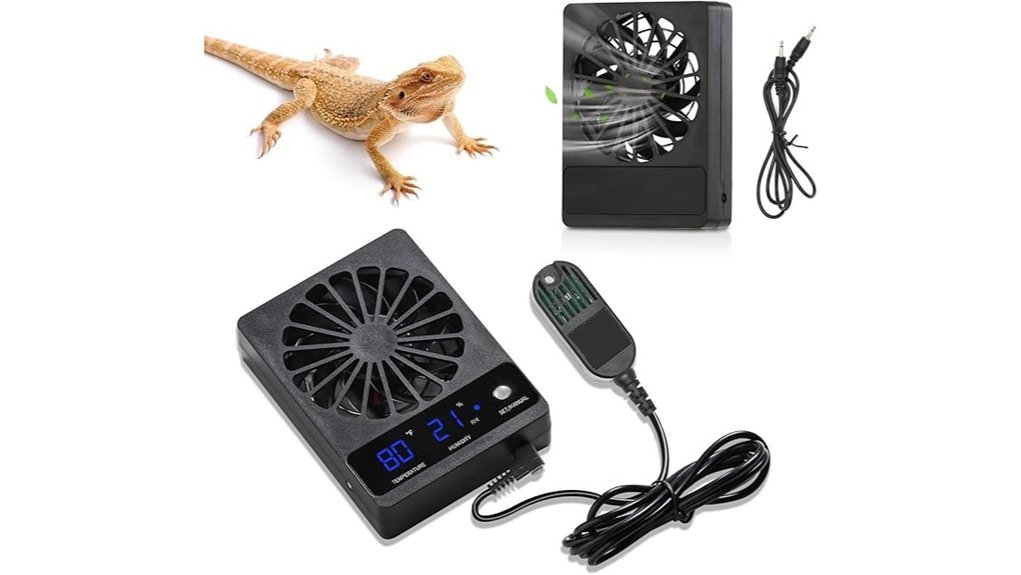
Best automatic humidity-control setup. The DAOTAILI 2 Pack Reptile Fan with Thermo-Hygrometer is the most versatile choice for adult bearded dragon enclosures (such as standard 4x2x2-foot or 40-to-120-gallon tanks) that need automated cross-ventilation. You get a dual-fan system paired with an external LCD controller that monitors both temperature and relative humidity in real time. Rather than leaving a fan running all day, you can program a humidity threshold so the fans activate only when moisture climbs above your target range.
Having two fans in the box unlocks a huge husbandry advantage: you can mount one fan on the cool side as an exhaust to pull damp air out, or use both fans on larger screen tops to clear stagnant pockets after feeding fresh greens or refilling water dishes.
Key Specifications:
- Configuration: Dual ventilation fans + wired LCD thermo-hygrometer controller
- Operation Modes: Automatic threshold trigger and manual override
- Power Source: Wired DC/USB low-voltage power
- Ideal Enclosure Fit: Medium to large mesh-top or vented terrariums (40–120 gallons)
Why You’ll Like It: The dual-fan layout moves air evenly across longer enclosures, and the automatic shutoff prevents the fans from running unnecessarily once humidity drops back into the 30–40% target zone.
Best For: Bearded dragon keepers who want automated, hands-off humidity management and real-time monitoring across glass terrariums, PVC cages, or multi-vent reptile enclosures.
Pros:
- Dual-fan configuration allows simultaneous cool-side exhaust and gentle cross-tank circulation.
- Wired LCD controller displays live temperature and humidity readings outside the cage.
- Automatic threshold mode prevents over-drying or cooling the enclosure when humidity is already normal.
Cons:
- Extra wiring between the two fans, sensor probe, and controller requires tidy cable management.
- Needs nearby wall outlet access rather than battery power.
- Built-in sensor should be calibrated against an independent digital hygrometer during initial setup.
Who Should Buy This: Buy this if you have a 40-gallon or larger bearded dragon tank that experiences regular humidity spikes on rainy days or after lights-out.
Who Should Skip It: Skip it if you have a small tank with a single screen vent and want a minimalist, single-fan unit with minimal cabling.
REPTI ZOO Reptile Terrarium Ventilation Fan
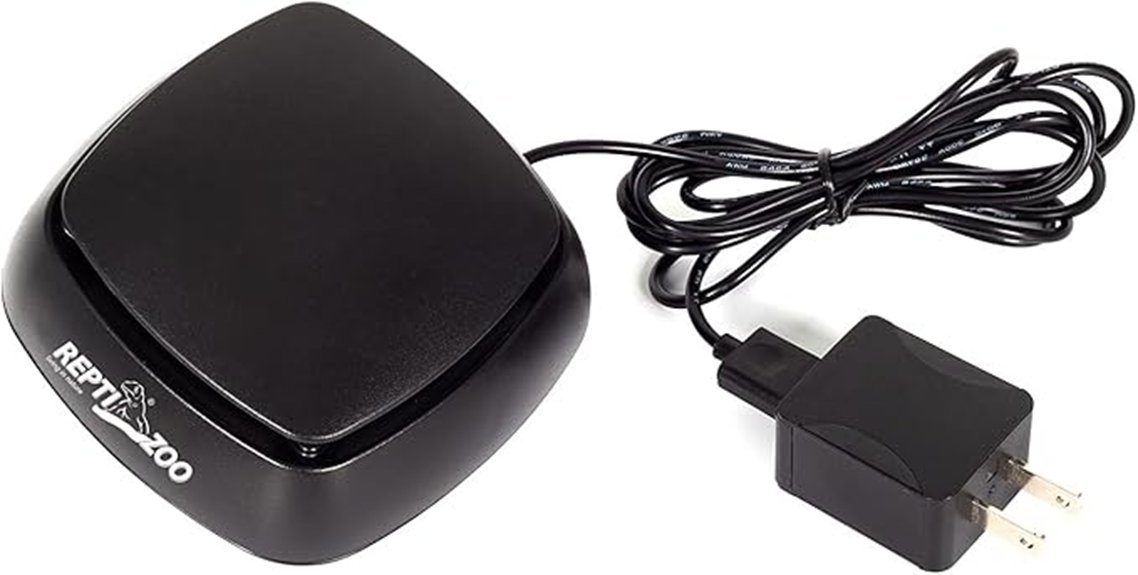
Best simple mesh-top airflow pick. REPTI ZOO’s PFS01 ventilation fan is built for keepers who already own a trusted digital hygrometer and simply need a quiet, reliable exhaust fan for a screen-top terrarium. It installs quickly onto metal mesh lids without drilling or adhesives, using a magnetic/bracket mounting design to stay flat and unobtrusive on top of the cage.
Because this unit focuses purely on mechanical air exchange rather than onboard digital sensors, there are fewer electronic components to fail. You can run it manually during humid afternoon hours or plug it into a standard mechanical outlet timer or external reptile humidistat (such as an Inkbird controller) for automated cycles.
Key Specifications:
- Model: REPTI ZOO PFS01
- Mounting Style: Tool-free magnetic/mesh-top attachment
- Control Type: Simple on/off operation (compatible with external timers)
- Ideal Enclosure Fit: Standard metal screen-top glass terrariums
Why You’ll Like It: It keeps your setup clean and simple—no probe wires hanging inside the vivarium and no complicated button sequences to program.
Best For: Reptile keepers who want a quiet, low-profile exhaust fan for a mesh-top tank and prefer using their own standalone hygrometer or external timer.
Pros:
- Tool-free magnetic mounting secures quickly to compatible screen lids.
- Low-vibration, quiet motor avoids startling skittish or resting dragons.
- Works well with external smart plugs or outlet timers for scheduled air exchange.
Cons:
- No built-in hygrometer display or automatic humidity shutoff.
- Fixed single-speed airflow cannot be dialed up or down manually.
- Designed specifically for mesh tops; cannot attach directly to solid glass or solid-top PVC roofs without a screen cutout.
Who Should Buy This: Buy it if you have a mesh-top enclosure, already monitor humidity with separate gauges, and want a straightforward exhaust fan.
Who Should Skip It: Skip it if you want an all-in-one unit that reads tank humidity and turns itself on and off automatically.
Reptile Terrarium Thermometer Hygrometer with Ventilation Fan
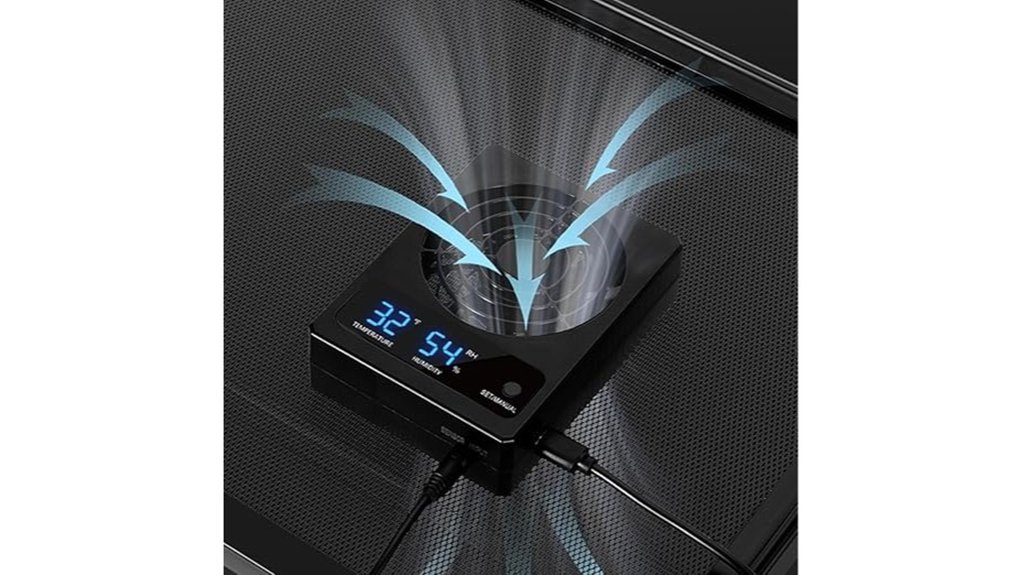
Best USB-powered monitor and fan combo. If you want to consolidate your cool-side gauge and exhaust fan into a single footprint, GeeKoit’s USB thermo-hygrometer fan combines a digital display, ventilation fan, and mounting bracket in one compact housing. Because it draws continuous 5V power over USB, you never have to worry about button-cell batteries dying mid-week and leaving you blind to a humidity spike.
When installing an all-in-one monitor and fan, placement is crucial: mount the unit on the cool side away from the radiant heat of your basking bulb so the temperature readout reflects true cool-end ambient air while the fan vents rising moisture.
Key Specifications:
- Configuration: Integrated single fan + digital thermometer/hygrometer + mounting bracket
- Power Source: 5V USB cable (USB wall brick may need to be supplied separately)
- Display Type: Integrated LED temperature and humidity readout
- Ideal Enclosure Fit: Small to medium indoor glass or screen-top terrariums
Why You’ll Like It: It eliminates battery replacements for your hygrometer while keeping both your readout and ventilation fan in one tidy, easy-to-check spot.
Best For: Keepers with indoor enclosures near a USB power strip who want an all-in-one cool-side monitor and gentle ventilation fan.
Pros:
- Combines a thermo-hygrometer, ventilation fan, and mounting bracket in a single compact body.
- Continuous USB power means the digital display never dims or dies from flat batteries.
- Bright LED numbers make daily temperature and humidity checks effortless.
Cons:
- USB wall adapter is typically not included in the box.
- Single-fan output is better suited for 20-to-50-gallon tanks than oversized 120-gallon habitats.
- Because the sensor is close to the fan housing, readings reflect air right at the vent rather than deep on the tank floor.
Who Should Buy This: Buy it if you want a space-saving, USB-powered unit that displays tank conditions and vents air from one spot.
Who Should Skip It: Skip it if you want a long wired probe that you can position down near the substrate while keeping the fan mounted high on the screen.
Reptile Humidity Fan for Terrarium Air Circulation
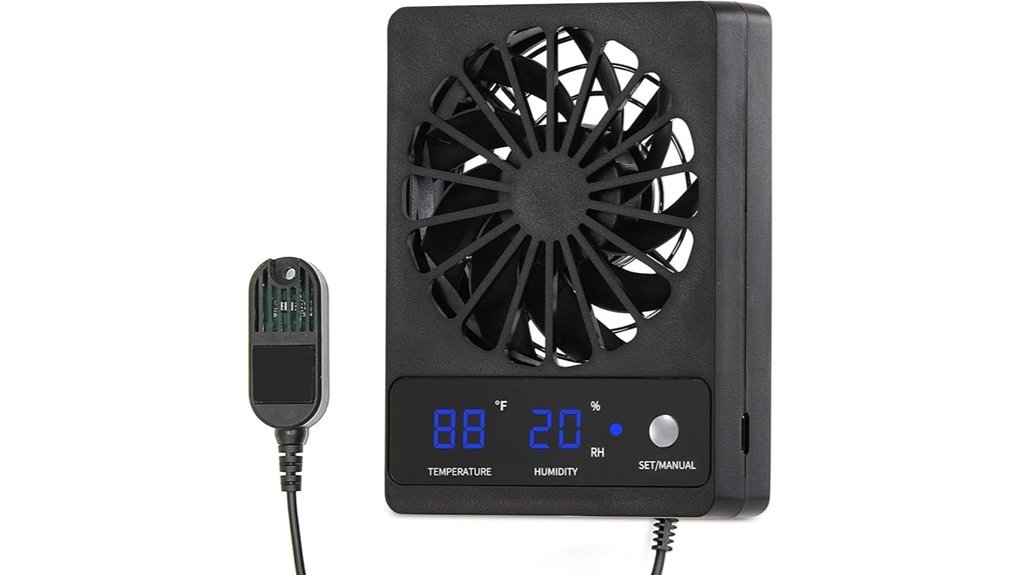
Best adjustable airflow option. One common problem with single-speed reptile fans is that they can move air too aggressively in cooler rooms, stripping away ambient heat and dropping your bearded dragon’s thermal gradient. RUNWUSHENG’s reptile humidity fan solves this by pairing an automatic humidity threshold controller with a physical rotary speed dial and an external sensor probe.
You can place the wired probe mid-height inside the enclosure for an accurate reading, set your maximum humidity limit on the bright display, and turn the speed dial down to a gentle whisper so damp air vents gradually without creating a cold draft inside the tank.
Key Specifications:
- Airflow Control: Variable speed dial + automatic humidity threshold activation
- Sensor Design: Wired external temperature and humidity probe
- Display: High-visibility digital readout for day and night checks
- Ideal Enclosure Fit: Glass, wood, or PVC terrariums needing customizable airflow speed
Why You’ll Like It: The variable speed dial lets you balance moisture removal against heat retention—crucial during winter when room air is chilly or during summer monsoons when you need maximum exhaust.
Best For: Keepers who want both automatic threshold activation and manual fan-speed tuning to protect their bearded dragon’s temperature gradient.
Pros:
- Rotary speed dial lets you fine-tune both airflow strength and fan noise.
- External wired probe measures humidity where your dragon actually lives, not just at the top screen.
- Automatic threshold trigger kicks in only when tank humidity exceeds your preset limit.
Cons:
- Lightweight plastic casing feels less rugged than heavy-duty industrial fans.
- Finding the ideal balance between the speed dial and humidity threshold takes a day or two of initial tweaking.
- Probe suction cup may need occasional re-wetting or a clip to stay firmly attached to textured backgrounds.
Who Should Buy This: Buy it if fixed-speed fans cool your tank down too much or sound too loud in your room.
Who Should Skip It: Skip it if you prefer a zero-configuration fan with no dials, probes, or thresholds to set up.
Reptile Tank Ventilation Fan with Thermometer and Humidity Gauge
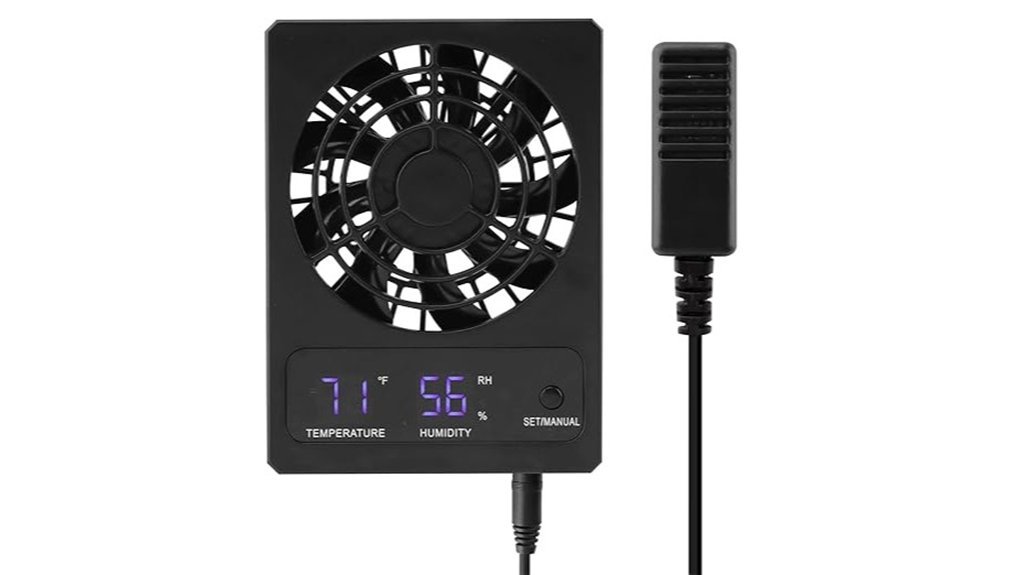
Best dual-LED display controller. If you struggle to read dim, unlit LCD screens across a reptile room, this Reptile Tank Ventilation Fan with Thermometer and Humidity Gauge stands out for its crisp dual LED readout. It displays live temperature and relative humidity simultaneously in bright numerals while automating a single low-noise exhaust fan whenever enclosure moisture rises past your set point.
You can run it in automatic humidity-trigger mode to catch post-feeding or overnight moisture spikes, or switch it to continuous circulation during muggy weather. Because the LED display is self-illuminated, consider positioning the readout outside the tank so the light does not disturb your bearded dragon’s pitch-black sleep cycle at night.
Key Specifications:
- Configuration: Single ventilation fan + dual-line LED digital controller
- Operation Modes: Automatic humidity threshold trigger and continuous airflow
- Power Source: Wired DC/USB low-voltage adapter
- Ideal Enclosure Fit: Single-tank bearded dragon setups (20–75 gallons)
Why You’ll Like It: The high-contrast dual LED display makes it easy to verify both temperature and humidity from across the room without squinting at a tiny LCD screen.
Best For: Reptile owners who want an easy-to-read illuminated display and straightforward automatic moisture exhaust for a single enclosure.
Pros:
- Bright dual LED screen clearly separates temperature and humidity readings at a glance.
- Automatic trigger vents damp, stagnant air before condensation or odors build up.
- Low-wattage, quiet fan operation suits daily indoor terrarium use.
Cons:
- Bright LED numerals should be mounted outside the vivarium so they do not disrupt nighttime darkness.
- Requires safe DC/USB cord routing away from heat lamps and climbing branches.
- Does not support Wi-Fi smartphone alerts or smart-home app integration.
Who Should Buy This: Buy it if readability and simple, single-tank automatic humidity control are your top priorities.
Who Should Skip It: Skip it if you need dual fans for an extra-long vivarium or want smartphone app logging.
REPTI ZOO Reptile Glass Terrarium Air Purifier
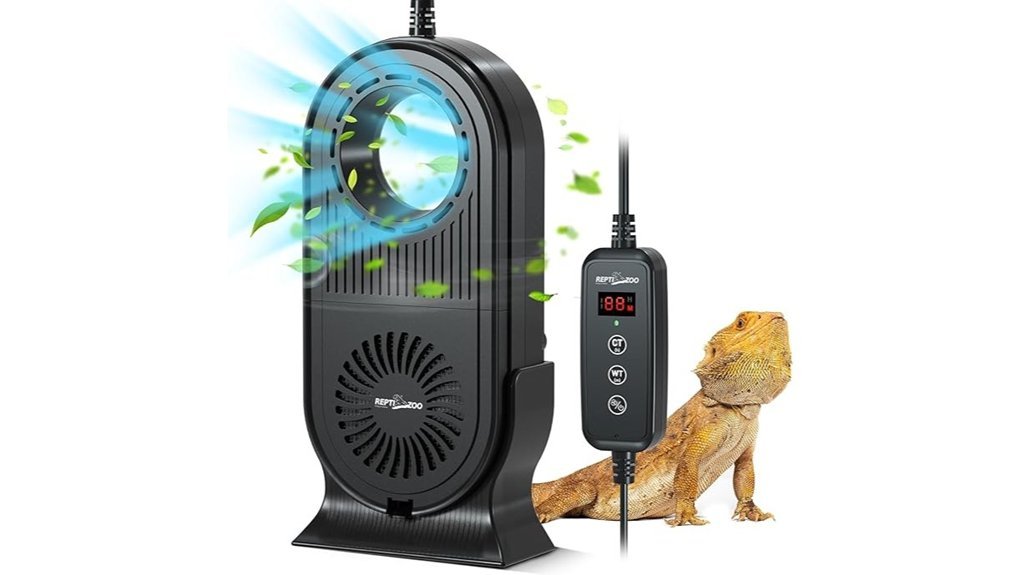
Best quiet air-cleaning support. While standard ventilation fans simply push air in or out, the REPTI ZOO Reptile Glass Terrarium Air Purifier passes enclosure air through a 4-layer filtration cartridge to trap fine substrate dust, dander, and organic odors while gently circulating air. You can mount it on glass, stand it upright, or route its nozzle through a side cable port on compatible terrariums.
Be clear on what this unit does and does not do: it is an air purifier and gentle air mover, not a moisture-condensing dehumidifier. However, if your bearded dragon’s enclosure sits in a bedroom or home office, uses loose arid substrate that kicks up fine dust, or develops lingering odors between spot-cleanings, this unit keeps the habitat air noticeably fresher and moving gently without the hum of a room-sized appliance.
Key Specifications:
- Filtration System: Replaceable 4-layer filter media (particulate and odor filtration)
- Controls: Inline controller with built-in timer settings
- Mounting Options: Standalone, glass mount, or side-pass routing
- Primary Role: Air purification, dust reduction, odor control, and light air circulation
Why You’ll Like It: It tackles enclosure odors and airborne substrate dust quietly, and the built-in timer lets you schedule filtration runs without manual switching.
Best For: Reptile keepers who want quiet odor and dust filtration alongside mild air movement in glass terrariums located in bedrooms or living spaces.
Pros:
- 4-layer filtration captures airborne dust and reduces reptile waste and greens odors.
- Whisper-quiet operation won’t disturb sleep in bedrooms or quiet offices.
- Built-in timer and flexible mounting options make integration into glass tanks clean and easy.
Cons:
- Does not actively dehumidify damp air—must be paired with proper screen ventilation if humidity is high.
- Requires periodic filter cartridge replacements every 3 to 6 months.
- No onboard hygrometer display or humidity sensor.
Who Should Buy This: Buy it if your primary headache is stale air, fine substrate dust, or enclosure odor rather than severe moisture buildup.
Who Should Skip It: Skip it if your tank is reading 60%+ daytime humidity and you need an active exhaust fan or room dehumidifier to pull moisture down fast.
Factors to Consider When Choosing a Humidity-Control Tool for a Bearded Dragon
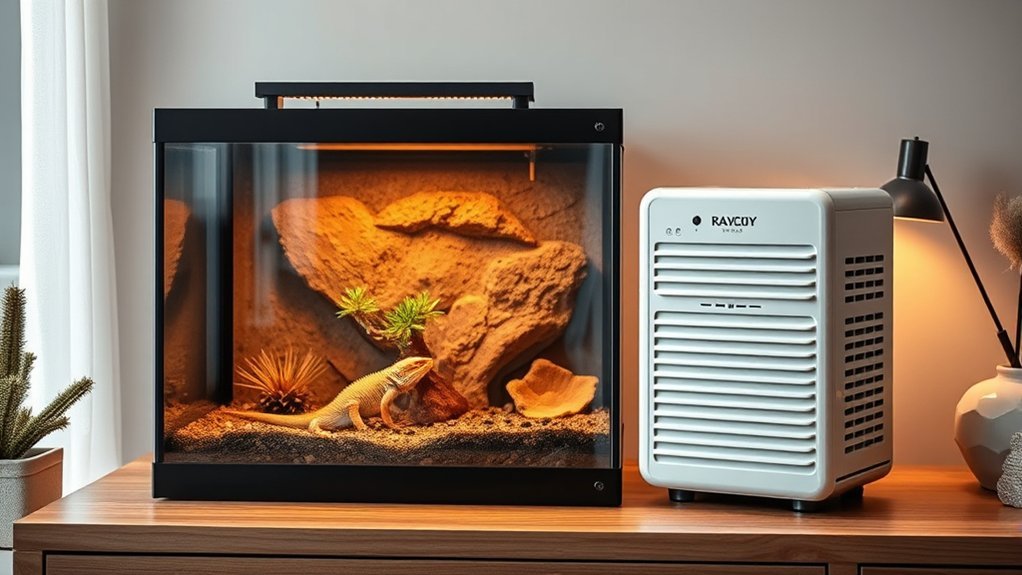
Selecting the right dehumidifier or ventilation setup for a bearded dragon comes down to understanding how heat, air exchange, and ambient room moisture interact. A poorly placed fan can ruin your basking temperatures, while an inaccurate sensor can cause a fan to run nonstop. Use the eight factors below to dial in a safe, effective setup.
Humidity Control Range (Day vs. Night Targets)
Bearded dragons (Pogona vitticeps) thrive when daytime relative humidity sits around 30–40% in the general enclosure (often 20–30% directly under the hot basking lamp and 35–45% on the cool side). However, many keepers panic when humidity climbs to 50–60% at night after the heat lamps turn off. Because cooler air holds less water vapor, a nighttime rise in relative humidity is completely natural and occurs in the Australian outback as well. Program your automatic fan threshold around 40–45% during the day, and allow a slightly higher threshold at night (or run brief, low-speed ventilation cycles) so you prevent stagnant condensation without chilling your sleeping dragon.
Airflow Strength & Direction (Exhaust vs. Intake)
Strong circulation pulls evaporated moisture out of your bearded dragon’s habitat, but airflow direction matters just as much as CFM rating. Always mount a single ventilation fan on the cool end of the enclosure facing outward (exhaust mode). Pulling air out of the cool side draws warm, dry air from the basking zone across the vivarium and expels damp air into the room. Avoid pointing an intake fan downward onto the basking platform, which cools the surface temperature and forces your basking thermostat or halogen bulb to work harder.
Noise Levels
Bearded dragons rely on calm, predictable environments, and high-pitched fan whine or deck vibration on a metal screen lid can cause chronic stress and hiding behavior. Look for low-decibel brush-free DC fans (typically rated under 30–35 dB) or variable-speed models like the RUNWUSHENG fan that let you dial down RPMs. Adding a thin rubber washer or silicone pad between a hard plastic fan frame and a metal mesh lid also dampens vibration noise significantly.
Sensor Accuracy & Probe Placement
A humidistat fan is only as smart as its sensor. If the sensor is built directly into the fan casing on top of the screen lid, it may read room air rather than tank air. Models with a wired external probe let you measure conditions mid-height inside the enclosure where your dragon spends its time. During initial setup, place an independent, calibrated digital hygrometer next to the fan’s probe for 24 hours to verify that the readings match within 3–5%.
Auto Activation (Humidistat Control)
Manual fans require you to check the tank constantly and flip a switch whenever humidity climbs. A fan with automatic humidistat activation turns on automatically the moment moisture crosses your preset percentage (for example, 42% RH) and shuts off once the enclosure drops back into range. This prevents both prolonged dampness on rainy days and excessive over-drying when the house air is already crisp.
Tank Size Fit
Enclosure volume dictates how much airflow you need. A juvenile bearded dragon in a 40-gallon breeder tank can easily be managed with a single compact USB fan. An adult bearded dragon housed in the recommended 4x2x2-foot (120-gallon) PVC or glass enclosure has triple the air volume—making a dual-fan setup (one assisting intake on the warm side and one exhausting from the cool side) far more effective at preventing dead air pockets in the corners.
Power Efficiency
Terrarium ventilation fans run on low-voltage 5V or 12V DC power and typically consume only 1 to 5 watts—a tiny fraction of the electricity used by basking bulbs or room-sized compressor dehumidifiers. Pairing a low-wattage DC fan with automatic threshold shutoff keeps energy consumption negligible while extending the lifespan of the fan bearings.
Easy Installation & Enclosure Compatibility
Check your enclosure’s roof and wall material before ordering. Metal screen tops work seamlessly with magnetic or clip-on fans like the REPTI ZOO PFS01. Solid-top PVC or wooden enclosures require fans that can mount over pre-cut circular or slotted side vents using screws, brackets, or suction mounts, along with cable pass-throughs that keep low-voltage wires out of your dragon’s reach.
Which One Should You Choose?
- For 4x2x2-foot (120-gallon) or larger tanks with frequent humidity swings: Choose the DAOTAILI 2 Pack Reptile Fan with Thermo-Hygrometer for automated dual-fan cross-ventilation.
- For keepers worried about cooling down the tank or fan noise: Choose the RUNWUSHENG Reptile Humidity Fan so you can dial down the fan speed manually while keeping auto-trigger protection.
- For a simple metal screen top when you already own a hygrometer: Choose the REPTI ZOO Reptile Terrarium Ventilation Fan (PFS01) for tool-free magnetic exhaust.
- For a compact all-in-one USB display and fan on a smaller tank: Choose the GeeKoit Thermometer Hygrometer Fan or the Dual LED Reptile Tank Ventilation Fan.
- For dusty arid substrates or enclosure odors in a bedroom: Choose the REPTI ZOO Glass Terrarium Air Purifier alongside normal screen ventilation.
Pro Tips for Better Humidity Control
- Use basking heat to your advantage: Relative humidity drops as air temperature rises. Ensuring your basking surface reaches the proper 95–105°F (35–40.5°C) with a halogen flood bulb naturally lowers daytime relative humidity inside the enclosure.
- Switch to non-moisture-retaining substrates: Damp coconut fiber or wet bioactive soil mixes constantly release moisture into the air. If you struggle with high humidity, use slate tile, non-adhesive shelf liner, or a properly dried arid topsoil/play-sand substrate.
- Remove uneaten wet greens by evening: Fresh salads and misted vegetables evaporate water all day under tank lights; clearing leftover greens before lights-out reduces overnight humidity spikes.
- Wipe fan blades monthly: Arid enclosures and calcium powders create fine dust that coats fan blades and humidity probes, reducing airflow and slowing down sensor response times.
Safety Note
Never mount an unguarded fan inside an enclosure where a bearded dragon can climb onto the housing, catch a toe or tail in the blades, or chew on low-voltage cords. Mount fans on the exterior of the screen lid or outside vent grilles whenever possible, secure probe wires flat against the tank wall with reptile-safe clips, and never place chemical moisture absorbers (such as calcium chloride tubs or silica packets) inside the habitat.
Frequently Asked Questions
What Humidity Range Is Best for a Bearded Dragon?
Aim for 30–40% relative humidity during the day (with readings between 20% and 50% generally considered safe during active heating hours). At night, when basking lamps turn off and temperatures drop, humidity naturally rises to 50–60%—which mirrors conditions in their native Australian habitat and is safe as long as the enclosure has good ventilation and surfaces remain dry.
How Often Should I Replace a Bearded Dragon Dehumidifier or Purifier Filter?
Standard reptile ventilation fans do not use replaceable filters—simply unplug the fan and wipe dust off the blades and mesh grille every 2 to 4 weeks. If you use an enclosed filtration unit like the REPTI ZOO Terrarium Air Purifier, replace the 4-layer filter cartridge every 3 to 6 months (or sooner if you use dusty loose substrate).
Can a Dehumidifier or Fan Dry Out My Bearded Dragon’s Enclosure Too Much?
Yes. Consistently dropping daytime humidity below 20% can contribute to dysecdysis (stuck shed) and dehydration. Use a fan with an automatic humidistat shutoff set around 35–40% rather than running high-speed fans continuously in an already dry room, and provide a humid hide during shedding cycles if needed.
Are Dehumidifiers Safe to Run Overnight in a Reptile Room?
Yes, running a room dehumidifier outside the tank overnight is completely safe and prevents damp, musty room air. If you run a tank-mounted ventilation fan overnight, set its threshold higher (around 55–60%) or use a low speed so it does not pull cold drafts into the enclosure while your dragon sleeps.
Do Dehumidifiers Reduce Respiratory Problems in Bearded Dragons?
Maintaining proper 30–40% daytime humidity and strong air exchange helps prevent the damp, stagnant, cool conditions that predispose bearded dragons to upper respiratory infections (URIs). However, a fan or dehumidifier is a preventative husbandry tool, not a medical cure—if your dragon shows open-mouth breathing, clicking sounds, nasal discharge, or lethargy, consult an exotic reptile veterinarian immediately.
Where Should I Place the Humidity Probe?
Mount the humidity probe inside the enclosure at mid-height on the cool or middle zone, at least 6 to 8 inches away from the water dish, basking bulb, and direct fan exhaust stream. Checking both the warm side and cool side with a separate digital hygrometer during setup ensures your readings reflect true habitat conditions.
Do I Need a Room Dehumidifier or a Tank Fan?
Compare your tank hygrometer against your room’s ambient humidity. If your room sits at 40% humidity but the tank reads 55%, a tank ventilation fan will easily vent the trapped moisture and fix the problem. If the room itself sits at 65% humidity, a tank fan alone can only bring in 65% humid room air—so you will need a room dehumidifier outside the cage alongside gentle tank airflow.
Final Recommendation
For the most reliable all-around setup, go with the DAOTAILI 2 Pack Reptile Fan with Thermo-Hygrometer (for 40-to-120-gallon tanks needing automated dual-fan airflow) or the RUNWUSHENG Reptile Humidity Fan (if you want a manual speed dial to prevent cooling the basking gradient). Mount your exhaust fan on the cool side, set your daytime trigger around 40–45%, and pair it with a room dehumidifier if your home stays humid year-round.
Conclusion
Keeping humidity in check for a bearded dragon does not require guesswork once you separate tank-level air stagnation from room-level moisture. By combining proper basking temperatures and dry substrate with a quiet, sensor-controlled reptile ventilation fan mounted on the cool side, you can vent excess moisture automatically before it stresses your pet. Verify your readings with an independent digital hygrometer, route all cables safely outside the habitat, and your bearded dragon will enjoy a crisp, well-ventilated home day after day.