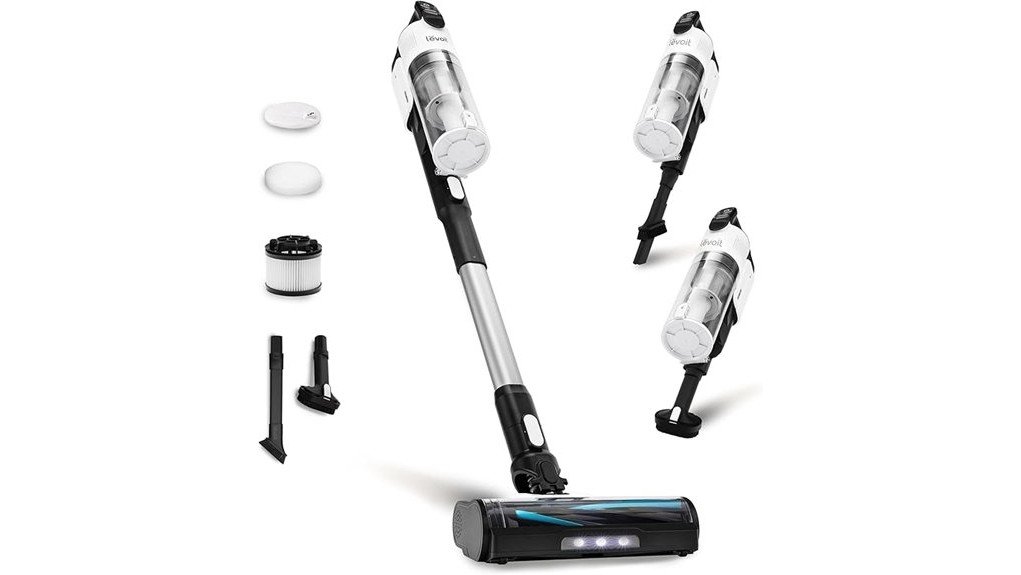
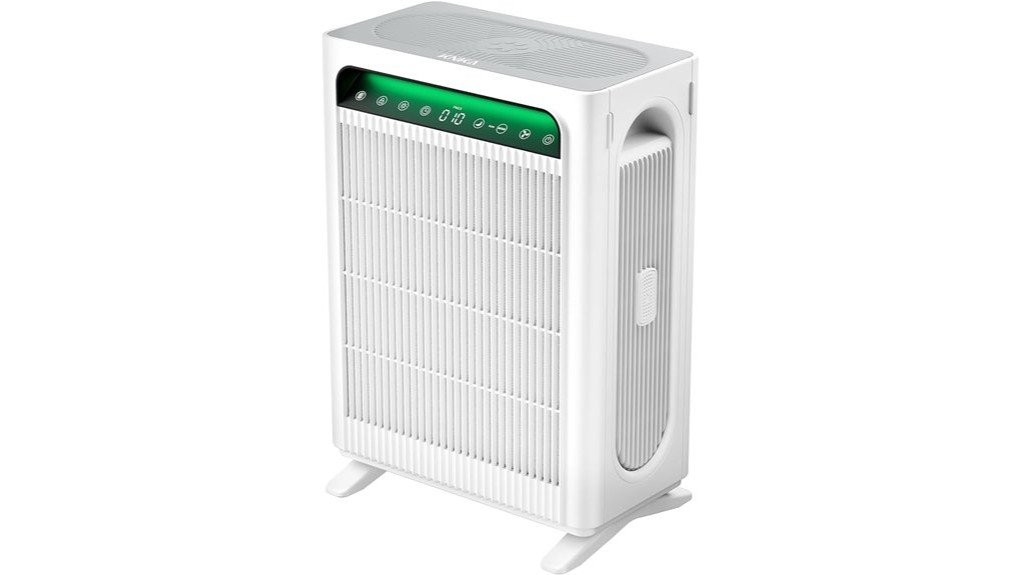
The best home air purifier for you depends on your room size, the pollutants you want to reduce, and how quickly you need the air cleaned. For 2026, the LEVOIT Vital 200S-P is the strongest all-around option in this guide, while the MOOKA PR1 offers useful pet-focused controls. The compact AROEVE MK01 works best in bedrooms and small offices, and the AEOCKY Cybertron combines a compact design with strong Turbo-mode airflow and ENERGY STAR certification. Compare CADR, filtration stages, noise, sensors, replacement-filter costs, and realistic room coverage before choosing.
Affiliate disclosure: As an Amazon Associate, we may earn from qualifying purchases made through links on this page, at no additional cost to you.
Quick Verdict
- Best Overall: LEVOIT Vital 200S-P for verified performance, app controls, and larger living spaces.
- Best for Pet-Focused Features: MOOKA PR1 for Pet Mode, a washable pre-filter, and real-time PM2.5 monitoring.
- Best for Small Bedrooms: AROEVE MK01 for compact placement and quiet sleep operation.
- Best Energy-Efficient Pick: AEOCKY Cybertron for ENERGY STAR certification, a compact body, and high-output Turbo Mode.
Quick Comparison of the Best Home Air Purifiers
Maximum coverage numbers are manufacturer-advertised figures and may be based on different air-change rates. For a fair comparison, also check the purifier’s CADR, your ceiling height, and how many air changes per hour you want.
| Air Purifier | Best For | Advertised Coverage | Standout Features | Main Limitation | Check Details |
|---|---|---|---|---|---|
| LEVOIT Vital 200S-P | Smart large-room use | Up to 1,875 sq. ft. | AHAM VERIFIDE, air-quality sensor, VeSync app, washable pre-filter | Larger and heavier than compact bedroom units | Check on Amazon |
| MOOKA PR1 | Pet hair, dander, and changing air quality | Up to 2,200 sq. ft. | Pet Mode, PM2.5 display, Auto Mode, washable pre-filter, 26 dB sleep setting | Maximum coverage does not indicate equally fast cleaning throughout the full area | Check on Amazon |
| AROEVE MK01 | Bedrooms and small offices | Up to 287 sq. ft. | Compact design, 360-degree intake, 22 dB sleep setting, aroma pad | Not intended for large living rooms or open floor plans | Check on Amazon |
| AEOCKY Cybertron | Efficient operation and compact large-room performance | Up to 2,300 sq. ft. at 1 ACH; about 480 sq. ft. at 4.8 ACH | 240 CADR Turbo Mode, Auto Mode, air-quality monitor, washable pre-filter, ENERGY STAR | Long filter-life claims depend on use conditions and compatible replacement filters | Check on Amazon |
How These Air Purifiers Were Compared
These recommendations are based on the products’ listed specifications and the practical details that matter most to home buyers. The main comparison points were:
- Room suitability: Whether the purifier fits a small bedroom, larger living room, or open space.
- Air-cleaning performance: Available CADR information, filtration stages, intake design, and air-change context.
- Pet and odor features: Washable pre-filters, carbon filtration, Pet Mode, and hair-friendly intake designs.
- Comfort: Sleep settings, noise claims, light controls, and size.
- Convenience: Air-quality sensors, automatic fan adjustment, app control, timers, and filter reminders.
- Ongoing ownership: Replacement-filter frequency, compatible-filter availability, and energy efficiency.
Important: An air purifier can help reduce airborne particles, but it cannot remove every pollutant source. Continue to vacuum, control smoke and moisture, clean pet areas, ventilate when appropriate, and maintain your HVAC filters.
LEVOIT Air Purifier for Large Rooms (Vital 200S-P)
Best Overall
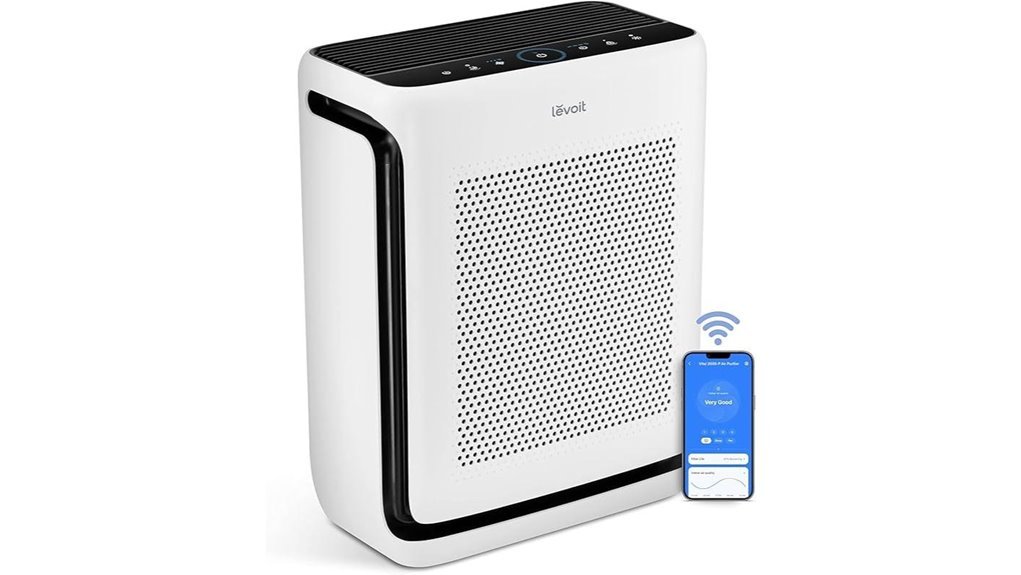
The LEVOIT Vital 200S-P is the best all-around choice here for buyers who want dependable large-room performance with useful smart controls. It has manufacturer-advertised coverage up to 1,875 square feet, but it will clean the air more frequently when used in a smaller room.
Its three-stage system combines a washable pre-filter with particle and odor filtration. The wide intake is useful in homes with pets because it can collect larger debris before it reaches the main filter. An onboard air-quality sensor supports automatic adjustment, while the VeSync app lets you review conditions, change settings, create schedules, and control the unit remotely.
AHAM VERIFIDE status gives buyers a stronger performance reference than an unsupported square-foot claim alone. The purifier also includes a sleep setting for nighttime use.
Why You’ll Like It:
- Balances large-room capability, verified performance information, and smart controls.
- Washable pre-filter can help protect the main filter from visible dust and pet hair.
- Air-quality monitoring and automatic adjustment reduce the need for constant manual changes.
- App scheduling is useful when you want the purifier to run around sleep, work, or allergy-season routines.
Who Should Buy This: Buyers who want a feature-rich purifier for a living room, primary bedroom, or pet-friendly home.
Who Should Avoid This: Buyers who only need a basic purifier for a very small room or who do not plan to use app features.
Pros:
- Advertised coverage up to 1,875 square feet.
- AHAM VERIFIDE performance information provides a useful comparison point.
- Three-stage filtration with a washable pre-filter.
- Real-time air-quality monitoring, Auto Mode, scheduling, and VeSync app control.
Cons:
- At 13.2 pounds, it is less portable than the compact models in this guide.
- Its larger body requires more floor space.
- The maximum coverage figure should not be confused with rapid, multiple-times-per-hour cleaning across the entire area.
MOOKA Air Purifier for Large Rooms (PR1)
Best for Pet-Focused Features
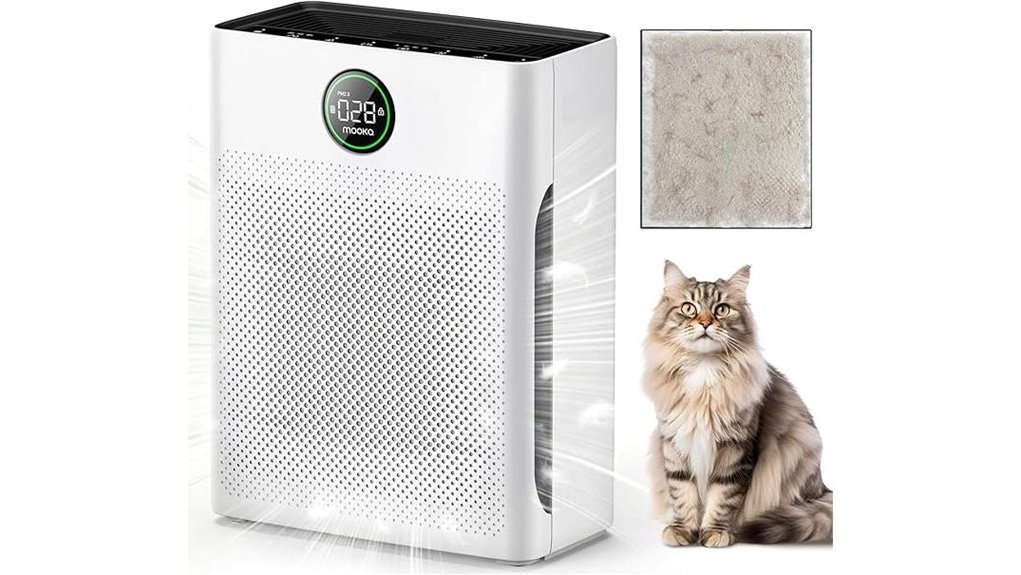
The MOOKA PR1 is a practical option for pet owners who want automatic air-quality adjustment without paying mainly for app connectivity. Its listed features include a washable pre-filter, four-stage filtration, a PM2.5 sensor, Auto Mode, and a dedicated Pet Mode.
The manufacturer advertises coverage up to 2,200 square feet. Treat that as a maximum-use claim rather than a promise of fast cleaning throughout a full 2,200-square-foot floor plan. It will provide more air changes per hour in a smaller room.
Pet Mode increases airflow to help collect airborne hair, dander, and odor-carrying particles more quickly. The real-time display lets you see changing PM2.5 conditions, while Auto Mode adjusts the fan without repeated input. Six operating options include Sleep, three manual speeds, Auto, and Pet Mode.
Why You’ll Like It:
- Pet Mode gives households a simple way to increase airflow during shedding, cleaning, or odor events.
- The washable pre-filter can collect larger hair and dust before they reach the replaceable filter.
- The PM2.5 display provides more information than a purifier with only basic fan buttons.
- A 26 dB listed sleep setting, timer, and child lock make it easier to use in bedrooms and family spaces.
Who Should Buy This: Pet owners who want a sensor, automatic adjustment, and dedicated pet controls in a reasonably compact purifier.
Who Should Avoid This: Buyers who specifically want Wi-Fi app control or independently published CADR comparisons.
Pros:
- Four-stage filtration with a washable pre-filter.
- Pet Mode, PM2.5 display, and automatic fan adjustment.
- Six operating settings, timer, child lock, and filter reminder.
- Sleep operation is listed as low as 26 dB.
Cons:
- Replacement filters are generally recommended every three to six months, depending on use and air conditions.
- The 2,200-square-foot headline does not show how many air changes the unit provides in that full space.
- The aroma feature may not suit fragrance-sensitive users or every pet household.
AROEVE Air Purifier for Bedroom and Home
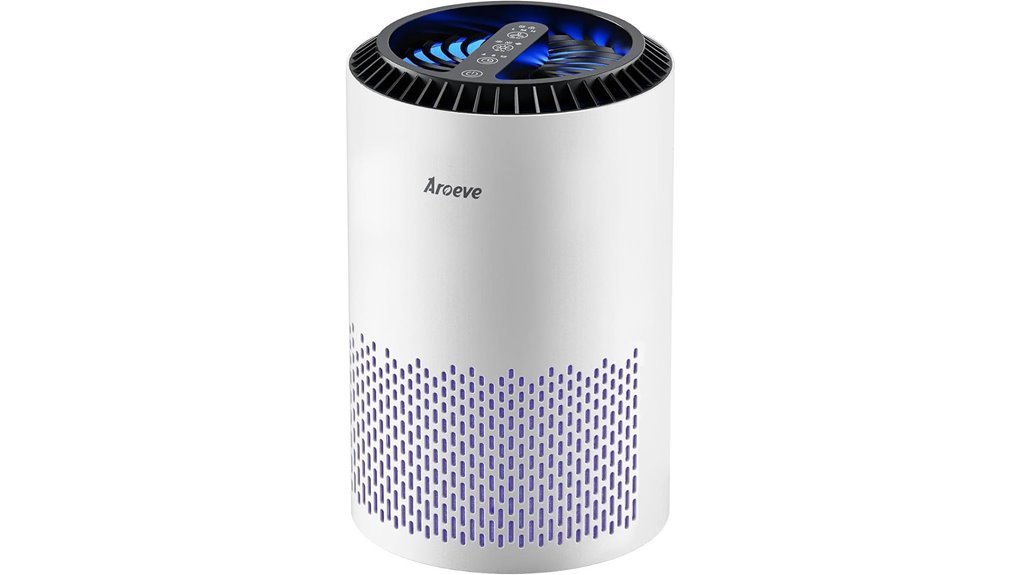
Best for Small Bedrooms
The AROEVE MK01 is the clearest choice in this guide for a bedroom, dorm room, home office, or other small enclosed space. Its manufacturer-advertised coverage is up to 287 square feet, making its intended use more modest and easier to understand than the large maximum figures used by some competitors.
The dual-channel design and 360-degree air inlets pull air from around the purifier instead of relying on a narrow intake. It is designed to filter airborne smoke particles, pollen, dander, hair, and odors. Sleep Mode reduces the fan to its lowest setting, with listed noise as low as 22 dB.
An aroma pad lets you add a small amount of essential oil if desired. This is optional, and users with fragrance sensitivities, respiratory concerns, or sensitive pets may prefer to leave the pad unused.
Why You’ll Like It:
- Small footprint fits more easily on a nightstand, desk, or limited floor area.
- Quiet sleep operation is suitable for light sleepers.
- Simple controls work well for users who do not want an app or complicated menu.
- A filter indicator helps prevent missed replacement intervals.
Who Should Buy This: Someone who needs straightforward air cleaning in a small bedroom, office, or dorm room.
Who Should Avoid This: Anyone shopping for a purifier for a large living room, basement, or open floor plan.
Pros:
- Advertised coverage up to 287 square feet.
- Dual-channel design with 360-degree air intake.
- Sleep Mode is listed as low as 22 dB.
- Compact, simple, and easier to place than large-room units.
Cons:
- Small-room performance is not suitable for large spaces.
- The main filter is replaceable rather than washable and may need changing every three to six months.
- No real-time PM2.5 display, automatic sensor adjustment, or app control is listed.
AEOCKY Air Purifier for Large Rooms and Pets
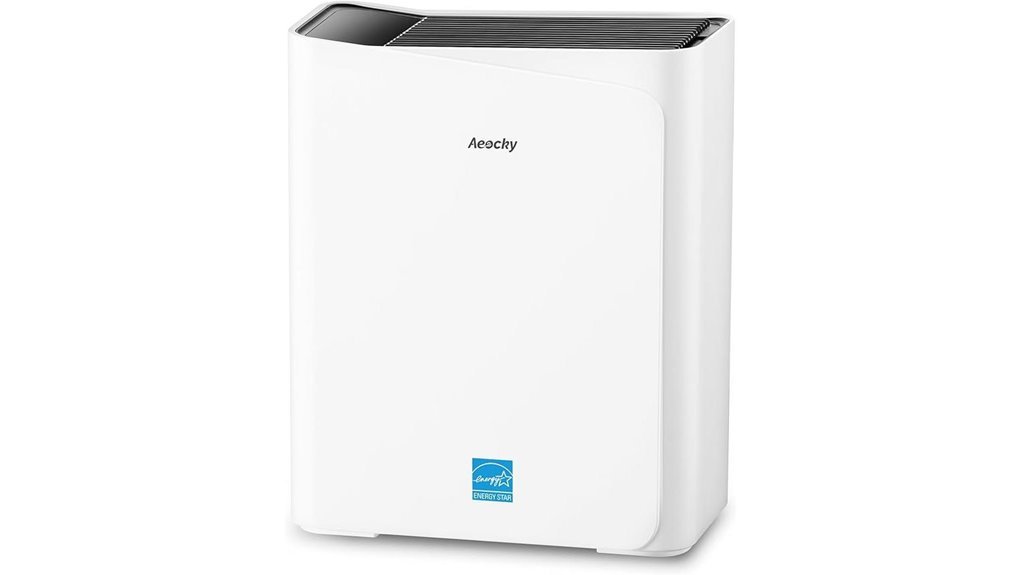
Best Energy-Efficient Pick
The AEOCKY Cybertron stands out for combining a compact body with a listed 240 CADR in Turbo Mode, an air-quality monitor, automatic fan adjustment, and ENERGY STAR certification.
The manufacturer advertises one air change per hour in a room up to 2,300 square feet and approximately 4.8 air changes per hour in a room around 480 square feet. This added context makes it easier to decide whether the purifier fits your expectations. Buyers dealing with smoke, heavy pollen, or pet dander will usually benefit from sizing for several air changes per hour rather than relying on the largest headline area.
Its filtration system includes a washable pre-filter and a multi-effect replaceable filter designed for particles and odors. The proprietary YearChange filter is marketed for longer service life, but real replacement timing will depend on fan speed, pollutant levels, operating hours, cleaning, and use of compatible filters.
Why You’ll Like It:
- The published 240 CADR gives buyers a clearer performance reference.
- Turbo Mode provides higher airflow when pollution levels rise.
- Auto Mode uses the onboard sensor to change speed as conditions change.
- ENERGY STAR certification helps buyers compare energy efficiency.
- The compact dimensions and 5.9-pound listed weight make it easier to move than many large-room purifiers.
Who Should Buy This: Buyers who want a compact, sensor-equipped purifier with strong Turbo output and an energy-efficiency certification.
Who Should Avoid This: Buyers who require smartphone app control or who do not want to rely on a brand-specific replacement-filter system.
Pros:
- Listed 240 CADR in Turbo Mode.
- Coverage claim includes useful air-changes-per-hour context.
- Washable pre-filter, Auto Mode, Sleep Mode, timer, and air-quality display.
- ENERGY STAR, CARB, ETL, and FCC certifications are listed.
Cons:
- Long filter-life and savings claims will vary by home and operating conditions.
- Best replacement performance may depend on using compatible AEOCKY filters.
- No Wi-Fi app control is listed.
- The full 2,300-square-foot claim represents only about one air change per hour.
Factors to Consider When Choosing a Home Air Purifier
A purifier should be selected according to the room where it will actually operate, not simply the largest coverage number printed in a product title. Compare CADR, air changes per hour, filtration stages, noise, controls, filter expenses, and placement requirements.
Room Size, CADR, and Air Changes
Start by measuring the room’s length and width. Multiply those numbers to find the square footage. Rooms with ceilings higher than eight feet contain more air, so they generally require a purifier with more airflow than the same floor area with a standard ceiling.
CADR, or Clean Air Delivery Rate, shows how quickly a purifier supplies filtered air. A higher smoke CADR generally supports a larger room or more frequent air cleaning. As a practical starting point for an eight-foot ceiling, look for a smoke CADR equal to roughly two-thirds of the room’s square footage. Choose more capacity when dealing with wildfire smoke, heavy pet dander, open doorways, or higher ceilings.
Also check air changes per hour. One air change per hour means the purifier processes a volume of air equal to the room volume once each hour. Several air changes per hour provide more frequent filtration and are usually preferable when air quality is a major concern.
Filtration Stages
A useful home purifier normally combines more than one filtration stage:
- Pre-filter: Collects larger dust, lint, hair, and pet fur. Washable versions can reduce buildup on the main filter.
- Particle filter: Targets smaller airborne particles such as pollen, dust, smoke particles, and dander.
- Activated-carbon layer: Helps reduce some odors and gases, although a thin carbon sheet will not perform like a purifier containing a large amount of carbon.
Do not wash a main filter unless the manufacturer specifically labels it washable. Water can damage filter media and reduce performance.
Noise Levels
Noise matters most in bedrooms, nurseries, offices, and study areas. The lowest advertised decibel figure usually applies only to the slowest sleep setting. Higher fan speeds will be louder but will also clean the air faster.
Choose a model with a dedicated Sleep Mode if you are sensitive to noise or light. Check whether Sleep Mode only dims the display or also reduces airflow, because very low airflow may not provide enough overnight cleaning in a large room.
Air-Quality Sensors and Auto Mode
A PM2.5 sensor can show changes in fine-particle levels caused by cooking, smoke, outdoor pollution, cleaning, or pet activity. Auto Mode uses that information to change fan speed without constant manual adjustment.
Sensors add convenience, but they are not laboratory instruments. Place the purifier away from walls, curtains, humidifiers, cooking steam, and direct airflow that could distort readings.
Smart Controls
App control is useful when you want remote adjustment, schedules, filter alerts, or historical air-quality information. It is not essential for filtration performance. A purifier with good CADR and simple physical buttons may be a better value if you will not use Wi-Fi features.
Before buying a smart purifier, check whether all important controls remain available on the unit itself. This allows normal operation if the internet connection or app service is unavailable.
Pet Hair, Dander, and Odors
A purifier can capture airborne dander and some loose hair, but most pet hair settles quickly on floors and furniture. Continue to vacuum, brush pets, wash bedding, and clean litter or accident areas.
For pet odors, look for an activated-carbon stage and enough airflow for the room. A fragrance pad may cover an odor temporarily, but it does not remove the odor source. Fragrance may also be unsuitable for sensitive people or animals.
Filter Replacement and Maintenance Costs
Check the replacement-filter model and expected interval before purchasing the purifier. A lower-priced unit can become expensive if filters are costly, difficult to find, or require frequent replacement.
Three to six months is a common recommendation for some compact purifiers, but the actual interval varies. Heavy smoke, pets, construction dust, high fan speeds, and continuous operation can shorten filter life. A lightly used purifier in cleaner conditions may last longer.
Clean a washable pre-filter according to the manual and let it dry completely before reinstalling it. Also wipe dust from air inlets and sensor openings so airflow and automatic controls continue to work correctly.
Energy Efficiency and Safety
Air purifiers may operate for many hours each day, so power consumption matters. ENERGY STAR-certified models meet current efficiency requirements and make it easier to compare clean-air delivery with electricity use.
For normal home use, a fan-and-filter purifier that does not intentionally generate ozone is generally the simpler choice. Review the product manual, keep intake and outlet vents clear, use the correct replacement filter, and connect the unit directly as instructed by the manufacturer.
Air Purifier Placement
Place the purifier where air can move freely around its intake and outlet. Avoid pushing it tightly into a corner, behind furniture, under a desk, or against curtains. Follow the clearance instructions in the manual.
A single portable purifier will not clean several closed rooms equally. Place it in the room where you spend the most time, or use separate correctly sized units in bedrooms and living areas.
Before You Buy: Quick Checklist
- Measure the room and note the ceiling height.
- Compare CADR rather than relying only on maximum square footage.
- Decide whether you need several air changes per hour.
- Check whether the pre-filter is washable.
- Confirm the replacement-filter model, cost, and availability.
- Look for carbon filtration if odors are a priority.
- Choose Sleep Mode for bedroom use.
- Decide whether sensors, Auto Mode, or app control are worth paying for.
- Confirm that the purifier does not intentionally emit ozone.
- Check the unit’s dimensions and required wall clearance.
Frequently Asked Questions
How Often Should I Replace an Air Purifier Filter?
Follow the manufacturer’s instructions and filter indicator. Some filters are recommended for replacement every three to six months, while others may last longer. Replace the filter sooner if airflow drops, odors remain, the filter appears heavily loaded, or the home has smoke, pets, or ongoing construction dust. Wash only the pre-filter unless the main filter is specifically labeled washable.
What CADR Do I Need for My Room?
For an eight-foot ceiling, a useful starting point is a smoke CADR around two-thirds of the room’s square footage. A 300-square-foot room would therefore call for roughly 195 CFM or more. Choose a higher CADR for tall ceilings, smoke events, heavy pet dander, or faster air cleaning.
Do Air Purifiers Remove Pet Odors?
An air purifier with activated carbon can reduce some airborne pet odors, but it cannot remove the original source. Clean litter boxes, bedding, carpets, upholstery, and accident areas regularly. A washable pre-filter is also useful for collecting larger pet hair before it reaches the main filter.
Can I Run an Air Purifier Overnight?
Most household air purifiers are designed for extended operation when used according to their manuals. Keep the vents clear, use the correct filter, and select Sleep Mode if fan noise or display lights disturb you. Avoid using an extension cord unless the manufacturer permits it.
Should I Avoid Air Purifiers That Produce Ozone?
For ordinary occupied rooms, choose a purifier that does not intentionally produce ozone. Fan-and-filter models can remove particles without relying on ozone generation. Check the product’s certifications and operating technology rather than assuming every “ionizer” or “air sanitizing” feature works the same way.
Is a Large Coverage Number Always Better?
No. A large maximum coverage number may represent only one air change per hour. A purifier used in a smaller room can process the room’s air several times per hour and may provide more useful performance. Compare CADR and ACH whenever that information is available.
Conclusion
The LEVOIT Vital 200S-P is the strongest overall recommendation for buyers who want verified performance information, app control, automatic adjustment, and a washable pre-filter. Choose the MOOKA PR1 when Pet Mode and a PM2.5 display are higher priorities.
For a small bedroom or office, the AROEVE MK01 is easier to place and offers quieter sleep operation without unnecessary smart features. The AEOCKY Cybertron is the better fit for buyers who value a compact body, published Turbo-mode CADR, air-change context, and ENERGY STAR certification.
Final Recommendation
Match the purifier to the room where it will operate most often. Use CADR and desired air changes per hour as your main sizing tools, then compare noise, sensors, controls, and replacement-filter costs. The best purifier is not necessarily the one with the largest advertised area—it is the one that can clean your actual room frequently enough while remaining affordable and convenient to run.