Disclosure: As an Amazon Associate, we earn from qualifying purchases. If you click a link on this page and make a purchase, we may receive a small commission at no extra cost to you.
An HVAC UV light can help control biological buildup around coils, but choosing the wrong model or installing it incorrectly can create electrical, UV-exposure, and compatibility problems. The BioShieldUV® 18W 24V HVAC UV Light, model BioSL18-HVAC-1, combines a magnetic lamp holder, 253.7nm UV-C output, an external HVAC ballast, and an 8,000-hour rated lamp life. Its compact design is appealing if you want a dedicated coil-focused UV-C system, but the 24V HVAC version requires proper wiring and professional installation. This review explains its verified specifications, installation limits, maintenance needs, safety points, and who should consider it.
Quick Verdict
Rating: Recommended with caveats
Best For: Homeowners with compatible HVAC equipment who want continuous UV-C exposure around an evaporator coil and can use a licensed HVAC or electrical professional for installation.
Bottom Line: The 18W SL18-HVAC gives you a compact magnetic mounting system, 253.7nm UV-C output, a monitoring viewport, and replaceable lamps. Its main tradeoff is that this is not a simple plug-in room purifier, and the HVAC-powered version requires correct 24V wiring and careful placement inside the air handler.
| Specification | Detail |
|---|---|
| Product | BioShieldUV® 18W 24V HVAC UV Light |
| Model | BioSL18-HVAC-1 / SL18-HVAC |
| Product Type | HVAC-mounted UV-C lamp system |
| Power | 18W |
| Voltage | 24V HVAC configuration |
| Power Connection | External ballast connected to a dedicated HVAC transformer |
| UV-C Wavelength | 253.7nm manufacturer specification |
| Rated Lamp Life | Approximately 8,000 hours |
| Replacement Schedule | Manufacturer recommends replacement about every 10 months during continuous operation |
| Bulbs | Two UV bulbs listed with the product |
| Mounting | Magnetic steel bracket, with screw-mount option for non-magnetic surfaces |
| Dimensions | 0.79 x 0.79 x 13.9 inches |
| Weight | 1.85 pounds |
| Monitoring | External sight-glass viewport for visual lamp-status checks |
| Installation Location | Supply or return ductwork in a dry location, positioned toward the HVAC coil |
| Installation Requirement | Current manufacturer instructions require a licensed HVAC technician or electrical contractor for HVAC-powered models |
What Is the BioShieldUV 18W HVAC UV Light?
The BioShieldUV SL18-HVAC is a fixed HVAC UV-C system rather than a portable room air purifier. Its lamp sits inside compatible HVAC ductwork or an air-handler cabinet, where UV-C light can be aimed toward the evaporator coil and drain-pan area.
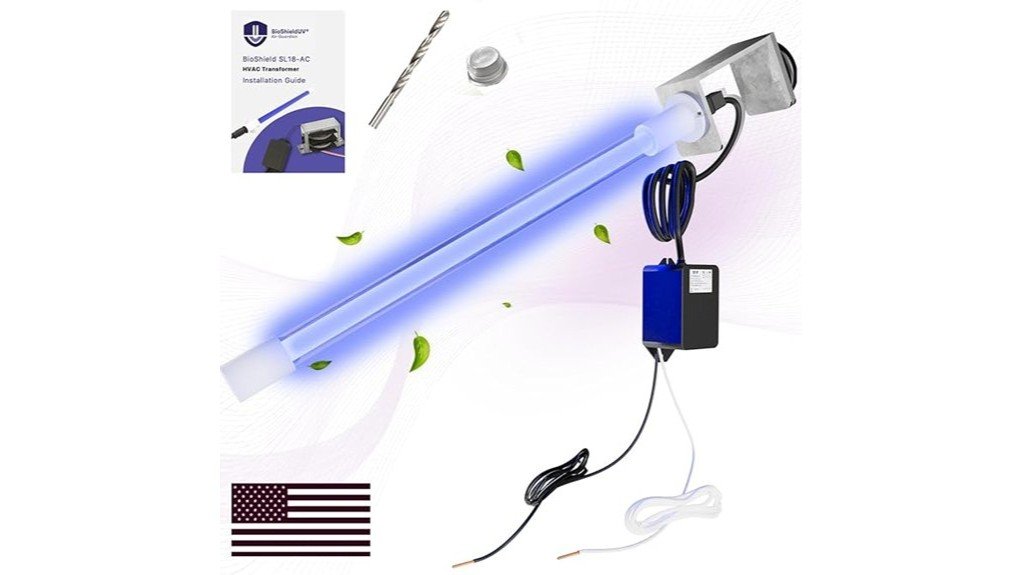
The 18W model uses an external ballast and a 24V HVAC power connection. A magnetic steel holder makes positioning easier on compatible metal surfaces, while included self-tapping screws provide another mounting option when the surface is not magnetic enough for the bracket.
The system also includes a viewport that lets you confirm that the lamp is powered without opening the air handler. That is useful for routine checks, although visible light does not tell you how much useful UV-C output remains as the lamp ages.
Key Takeaways
- The verified SL18-HVAC model uses 18W power and 253.7nm UV-C for HVAC applications.
- Its rated lamp life is approximately 8,000 hours, with BioShieldUV recommending replacement about every 10 months during continuous use.
- The HVAC version uses an external ballast and 24V HVAC power connection, so it should not be confused with the wall-plug version.
- The magnetic bracket simplifies lamp positioning on steel surfaces, but sufficient internal clearance and correct UV-C exposure direction still matter.
- Current manufacturer guidance requires the HVAC version to be installed by a licensed HVAC technician or electrical contractor.
- UV-C should complement proper filtration, ventilation, cleaning, and HVAC maintenance rather than replace them.
Who Should Buy It?
Best For
- You have a compatible central HVAC system with enough room to position the lamp near the evaporator coil.
- You want continuous UV-C exposure around coil and drain-pan surfaces as part of a broader HVAC maintenance strategy.
- You are comfortable having the 24V HVAC model installed and wired by a qualified professional.
Skip If
- You want a portable purifier that you can move between rooms.
- Your air handler lacks suitable clearance or a safe location for UV-C exposure.
- You want a simple wall-outlet installation rather than an HVAC-powered 24V model.
Before You Buy: The SL18-HVAC is not the plug-in version. BioShieldUV’s current instructions require its HVAC-powered models to be installed by a licensed HVAC technician or electrical contractor. Check the model, available cabinet space, mounting surface, and power arrangement before ordering.
How UV-C Technology Compares to Other Air Purification Methods
UV-C, particle filtration, and activated carbon solve different problems. A HEPA or high-efficiency HVAC filter physically captures particles passing through it. Activated carbon is mainly used for gases and odors. An HVAC UV-C lamp exposes surfaces and nearby air to ultraviolet energy, with effectiveness depending on wavelength, exposure time, intensity, airflow, and installation position.
That means you should not treat the BioShieldUV as a replacement for your HVAC filter. The manufacturer itself advises that UV-C does not replace filtration, ventilation, or other indoor-air-quality measures.
The strongest use case for a system like this is continuous UV-C exposure around HVAC components where moisture can encourage biological buildup, especially the evaporator coil and drain-pan area. Correct positioning is therefore more important than simply having a UV lamp somewhere inside the duct.
Design, Mounting, and Compatibility
The SL18-HVAC uses a steel magnetic holder, which lets an installer adjust the lamp position before finalizing the setup. On a suitable steel surface, this can be simpler than permanently drilling a large mounting opening for the lamp itself.
The magnetic mount is not universal. BioShieldUV specifies that the bracket sticks to steel, so aluminum, composite, insulated, or other non-ferrous surfaces may require the included screw-mount method. The lamp assembly also has to fit fully inside the cabinet without contacting the coil, wiring, insulation, filter media, or other components.
Manufacturer placement guidance calls for a clear line of sight toward the evaporator coil. Direct UV-C exposure should be kept away from vulnerable materials such as exposed wiring, plastic drain pans, foam insulation, flex-duct liner, and filter media unless those materials are properly protected.
Pro Tip: Ask your installer to confirm the exact lamp position before drilling the cable and sight-glass holes. UV-C works by line-of-sight exposure, so a well-positioned 18W lamp can make more sense than a poorly positioned higher-output system.
UV-C Output and Ozone Considerations
The verified product information lists a UV-C wavelength near 253nm, while BioShieldUV’s current installation materials specify 253.7nm. This wavelength is used in germicidal UV-C equipment, but real performance depends on delivered dose and exposure conditions rather than wavelength alone.
The ASIN-specific product information reports an ozone test result of 0.013 ppm. BioShieldUV’s newer general materials report approximately 0.014 ppm for its devices. Because those published numbers differ slightly, it is more accurate to describe the product as having a low manufacturer-reported ozone output rather than claiming one universal measurement for every unit and test condition.
You should also avoid treating any HVAC UV-C product as a medical device or as proof that your indoor air is free from viruses, bacteria, allergens, or mold. BioShieldUV’s current guidance says its UV-C products do not replace filtration, ventilation, or normal HVAC maintenance.
Installing the SL18-HVAC System
Installation is one of the most important differences between this model and BioShieldUV’s wall-plug versions. The SL18-HVAC uses an external ballast connected to a dedicated HVAC power source, so the manufacturer currently requires installation by a licensed HVAC technician or electrical contractor.
The kit design includes the magnetic holder, lamp cable, cable gland, step drill bit, viewport, warning sticker, and self-tapping screws. The installer places the lamp inside the cabinet, routes its cable through the duct wall, mounts the external ballast, makes the required power connection, and installs the exterior sight glass.
BioShieldUV’s current instructions recommend positioning the lamp so it has a clear line of sight toward the evaporator coil. They also warn that UV-C can degrade plastics, foam, filter material, and exposed wiring that remain directly illuminated for long periods.
Setup Checks Before Installation
- Confirm that you are buying the SL18-HVAC / BioSL18-HVAC-1 rather than a wall-plug variant.
- Have a qualified installer confirm that the HVAC system has a suitable electrical connection.
- Check that the lamp can fit fully inside the cabinet without striking internal components.
- Confirm that the mounting point is steel if you want to use the magnetic holder.
- Keep UV-C exposure away from vulnerable plastics, filter media, insulation, and wiring unless appropriately shielded.
- Follow the current BioShieldUV installation manual and applicable electrical and mechanical codes.
How It Performs in Real Use
For a Typical Central HVAC System
In a compatible air handler, the magnetic bracket gives the installer useful flexibility when aiming the lamp toward the evaporator coil. Once connected to constant power, the system is designed for continuous operation rather than turning on only when the blower runs.
For Humid Coil Areas
The product makes the most sense where the evaporator coil and nearby drain area stay damp during cooling cycles. Those are the surfaces the lamp can continuously illuminate when positioned correctly. It should still be paired with normal coil cleaning, drainage checks, filter replacement, and moisture control.
For Tight or Non-Magnetic Cabinets
This is where fit becomes more important. A magnetic mount will not attach to every HVAC cabinet surface, and the lamp needs enough internal room to avoid contact with other components. The included screw-mount option helps with non-magnetic surfaces, but it does not solve a cabinet that is simply too cramped.
For Long-Term Operation
The 8,000-hour lamp rating means maintenance is infrequent, but not optional. BioShieldUV currently recommends replacing the TruBlu lamp about every 10 months during continuous operation. The viewport makes it easy to see whether the lamp is glowing, but an old lamp can still produce visible light after useful UV-C output has declined.
Maintenance and Lamp Replacement
Routine maintenance is simpler than installation. You can use the exterior viewport to confirm that the lamp is powered without opening the air handler. A missing glow can indicate a power, transformer, ballast, connector, or lamp problem that needs troubleshooting.
Do not use visible brightness as the only replacement indicator. The manufacturer rates the lamp for about 8,000 hours and currently recommends a roughly 10-month replacement schedule for continuous use.
Power must be disconnected before the cabinet is opened or the lamp is serviced. The manufacturer also advises handling UV lamps with gloves because oils from your skin can affect lamp output.
Installation and UV-C Safety
Direct UV-C exposure can injure eyes and skin, so the lamp belongs inside the closed HVAC system and should be installed according to the manufacturer’s instructions. Never look directly at an operating UV-C lamp inside an open cabinet.
The manufacturer’s manual also warns that UV-C can degrade some materials with prolonged direct exposure. Plastic components, foam insulation, flex-duct liner, filter media, and exposed wiring may need shielding or a different lamp position.
The lamp contains a small amount of mercury. A broken lamp should not be handled with bare hands, and disposal should follow applicable local requirements for mercury-containing lamps.
This system is designed for dry HVAC locations. Installation, wiring, positioning, shielding, and maintenance should follow the current manual and local electrical and mechanical codes.
Pros and Cons
Pros
- Verified 18W, 253.7nm UV-C design for HVAC installation.
- Magnetic holder allows flexible positioning on compatible steel surfaces.
- External viewport lets you check lamp operation without opening the cabinet.
- Approximately 8,000-hour rated lamp life reduces frequent maintenance.
- Installation kit includes mounting and cable-routing hardware for the SL series.
Cons
- The 24V HVAC model requires professional installation under current manufacturer guidance.
- Magnetic mounting only works directly on suitable steel surfaces.
- Correct positioning and adequate cabinet clearance are essential, so it will not suit every HVAC layout.
Is It Worth the Price?
The BioShieldUV 18W model sits toward the more accessible end of dedicated HVAC UV-C equipment compared with many contractor-focused systems. Its value comes from the replaceable lamp, magnetic mounting system, external monitoring viewport, included installation hardware, and continuous HVAC integration.
You will get the most value if your goal is focused UV-C exposure around a compatible evaporator coil and you already plan to have the unit professionally installed. It is less compelling if you mainly want room-level particle filtration, odor removal, or a purifier you can move around the house.
Remember to include future replacement lamps and professional installation in your total ownership cost. The product is not a one-time maintenance solution.
How It Compares to Alternatives
Other HVAC UV-C options include systems from Fresh-Aire UV, RGF, and Honeywell. The main comparison points are not simply lamp wattage. You should also compare mounting method, electrical requirements, required installer involvement, lamp replacement cost, cabinet clearance, certification documentation, and access to replacement parts.
The BioShieldUV SL18-HVAC makes the most sense if you specifically want its compact magnetic mounting approach and 24V HVAC integration. If you prefer a wall-powered design or a different treatment technology, compare those alternatives before deciding.
Frequently Asked Questions
Does the BioShieldUV SL18-HVAC require professional installation?
Yes. BioShieldUV’s current SL-series instructions state that HVAC-powered models must be installed by a licensed HVAC technician or electrical contractor. The SL18-HVAC uses an external ballast and a dedicated HVAC power connection.
How often should you replace the BioShieldUV lamp?
The lamp is rated for approximately 8,000 hours. BioShieldUV currently recommends replacement about every 10 months during continuous operation because useful UV-C output can decline even while the lamp still produces visible blue light.
Is the SL18-HVAC the same as the wall-plug BioShieldUV model?
No. This reviewed model is the HVAC-powered SL18-HVAC configuration. BioShieldUV also sells wall-plug versions, so check the model and power method carefully before buying.
Will the magnetic holder work in every HVAC system?
No. The magnetic holder needs a suitable steel mounting surface. BioShieldUV provides a screw-mount method for non-magnetic surfaces, but your system still needs enough internal clearance and a safe lamp position.
Does BioShieldUV replace an HVAC filter?
No. UV-C and filtration have different jobs. Continue using the correct HVAC filter, ventilation practices, moisture control, cleaning, and normal system maintenance.
Can UV-C damage parts inside an HVAC system?
Long-term direct UV-C exposure can degrade some plastics, foam insulation, flex-duct liner, filter media, and exposed wiring. Proper lamp placement and shielding of vulnerable materials are therefore important parts of installation.
How do you know whether the UV-C lamp is working?
The HVAC version uses an exterior sight-glass viewport so you can check for the lamp’s blue glow without opening the cabinet. A visible glow confirms power, but it does not mean an old lamp still has full UV-C output.
The Bottom Line
The BioShieldUV 18W 24V SL18-HVAC is worth considering if you want a compact UV-C system aimed at a compatible HVAC coil and value its magnetic mounting, viewport, 253.7nm output, and 8,000-hour lamp rating. Skip it if you need a portable purifier, cannot accommodate the required placement, or want a simple plug-in installation because this HVAC-powered model requires professional installation.
Ready to Buy?
Check the latest product details and confirm that the 24V HVAC version matches your system before you decide.