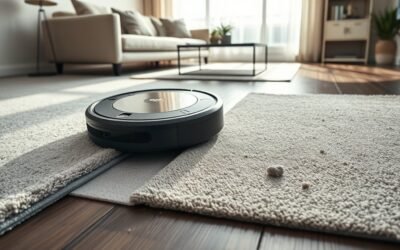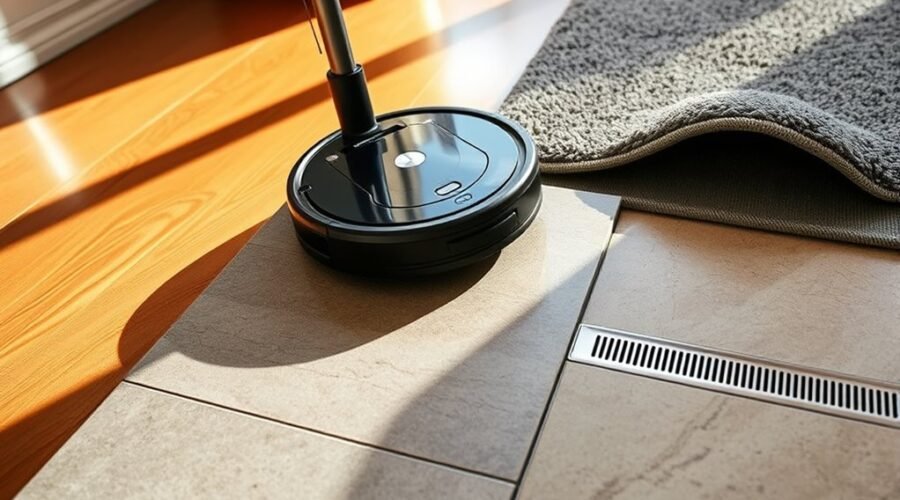
Robot vacuums on uneven floors can handle daily cleaning, but rough patches and height changes can interrupt their work. A machine may clean textured tile without trouble yet stop at one raised doorway. The key is matching the robot’s wheels, ground clearance, and navigation system to your home’s flooring.
Quick Answer
Yes. Robot vacuums can clean mildly uneven floors, including textured tile, shallow grout, and small floor transitions. Many conventional models handle thresholds around 15–20 mm, while specialized models can climb higher. However, steep edges, warped boards, and deep gaps may cause stalls. Measure your floor transitions and compare the exact model’s climbing specifications.
Key Takeaways
- A robot’s threshold-climbing ability is different from its ability to clean dirt from uneven surfaces.
- Deep grout lines can trap debris even when the robot moves across the tiles without getting stuck.
- Larger drive wheels, floating brushes, and adjustable chassis systems help on irregular flooring.
- Manufacturer ratings depend on threshold shape and testing conditions, so real-world climbing can vary.
- A secured threshold ramp or no-go zone can prevent repeated stalls at difficult transitions.
Can Robot Vacuums Clean Uneven Floors?
)
Yes, robot vacuums can clean uneven floors when the surface changes are within their movement and cleaning limits. They work best on firm flooring with minor bumps, shallow joints, and gentle transitions between rooms.
However, crossing an obstacle and cleaning an uneven surface are different tasks. A robot might climb a doorway strip successfully but leave dust inside deep tile joints.
Most models rely on spring-loaded drive wheels, a front caster, and sensors to move across the floor. More advanced machines may use active chassis lifting or specialized climbing mechanisms.
Here is what you can expect from different surfaces:
| Floor condition | Expected performance | Main concern |
|---|---|---|
| Lightly textured tile | Usually good | Dirt inside surface texture |
| Shallow grout lines | Generally manageable | Fine dust left in joints |
| Small door thresholds | Depends on climbing rating | Wheels slipping or chassis catching |
| Warped wooden boards | Variable | Raised edges and loose boards |
| Deep gaps or rough concrete | Often difficult | Wheel trapping, scraping, and missed debris |
Wood floors can also shift with moisture and temperature changes. If boards become raised or separated, the robot may struggle even when the floor previously cleaned well.
The most suitable robot depends on the height, shape, and frequency of these irregularities.
Why Do Robot Vacuums Get Stuck on Bumps?
Robot vacuums get stuck when a bump lifts the chassis, blocks a wheel, or prevents the robot from maintaining traction. Sensors may also interpret certain floor changes as obstacles or possible drops.
A robot’s drive wheels must push the body over a raised edge. If the wheels lose grip or the front bumper catches, the machine may reverse, turn away, or report that it is stuck.
Common causes include:
- Limited ground clearance: The underside catches on a raised plank or threshold.
- Small or dirty wheels: Hair, grit, and dust reduce the wheels’ ability to grip.
- Sharp transitions: A vertical edge is harder to climb than a sloped edge of the same height.
- Sensor errors: Dark strips, unusual reflections, or dirty sensors can cause unnecessary avoidance.
- Deep gaps: A caster wheel may drop into a groove and interrupt movement.
Floor shape matters as much as obstacle height. A robot may cross a smooth, sloped strip but fail at a lower threshold with a sharp vertical edge.
Warning: Do not run a robot vacuum over exposed nails, sharp splinters, loose metal strips, or unstable floorboards. These hazards can damage the wheels, brushes, and underside of the machine. Repair the affected area before cleaning.
If your robot repeatedly stops at the same bump, try these fixes in order:
- Clean the wheels and sensors. Remove trapped hair and debris, then wipe the sensors according to the manufacturer’s instructions.
- Inspect the floor. Remove loose objects and check whether a board or transition strip has lifted.
- Measure the obstacle. Compare its height and shape with the robot’s rated climbing ability.
- Improve the transition. Use a compatible, securely fitted threshold ramp where practical.
- Exclude the area if necessary. Set a no-go zone so the robot stops attempting an obstacle it cannot cross safely.
When a robot cleans normally elsewhere but always fails at one location, the floor geometry is a more likely cause than a general suction problem.
How Do Robot Vacuums Handle Thresholds and Grout?
Robot vacuums handle thresholds by lifting their wheels and body over raised edges. They clean grout using brushes and airflow to remove debris from recessed joints.
These tasks demand different features. Thresholds depend mainly on traction and clearance, while grout cleaning depends on brush contact, airflow, and the depth of the joints.
Threshold Climbing Limits
Many conventional robot vacuums can cross thresholds around 15–20 mm, or approximately 0.6–0.8 inches. Some newer designs climb substantially higher using active lifting systems.
However, a manufacturer’s maximum climbing figure does not guarantee that the robot will cross every obstacle of that height.
The Ecovacs threshold guide explains how obstacle height, edge shape, crossing angle, and navigation behavior affect success.
Three details deserve particular attention:
- Height: Measure vertically from the lower floor to the top of the obstacle.
- Shape: A beveled or sloped edge is usually easier to cross than a square vertical lip.
- Configuration: A single raised threshold differs from a two-stage transition, such as a stepped door track.
Wider, well-supported wheels and adaptive suspension can help the robot maintain traction while climbing.
Some premium models can lift their chassis or deploy additional climbing mechanisms. These features extend their usable range but do not make them suitable for ordinary staircases.
Grout Line Challenges
Robot vacuums can clean shallow grout lines, but deeply recessed joints often retain dirt. The main problem is usually limited brush contact or airflow inside the groove, rather than the robot being unable to detect the grout.
Wide or uneven joints may also produce vibrations as the wheels cross them. In severe cases, small wheels can catch on damaged tile edges.
For better grout cleaning, look for:
- Floating main brushes that follow small changes in floor height.
- Good airflow and debris pickup on hard surfaces.
- Controlled mopping pressure for textured tile.
- Navigation that covers the floor without repeatedly skipping difficult areas.
Machines with spinning or vibrating mops may help loosen dirt on textured tiles. However, mop pads do not always reach the bottom of deep grout lines.
Stained or deeply embedded grout may still need a suitable grout brush and manual cleaning.
What Features Help Robot Vacuums Work on Rough Floors?
The best robot vacuums for rough floors combine stable drive wheels, suitable ground clearance, effective brushes, and reliable obstacle detection. Strong suction helps with debris pickup, but it cannot compensate for a chassis that repeatedly gets stuck.
Focus on these features when comparing machines:
- Large drive wheels: Help the robot roll over small bumps and floor transitions.
- Adaptive suspension: Allows wheel movement to accommodate changes in floor height.
- Floating main brush: Helps maintain cleaning contact as the surface changes.
- Automatic height adjustment: Allows compatible brushes, mops, or chassis systems to adapt to different surfaces.
- Obstacle detection: Helps the robot identify objects and avoid unsuitable routes.
- Adjustable suction: Lets you adapt the cleaning mode to different floor conditions.
- No-go zones: Prevent repeated attempts to cross dangerous or impassable areas.
Suction power needs careful interpretation. Manufacturers commonly advertise suction in pascals (Pa), a measure of pressure. However, a high Pa figure does not automatically mean better cleaning on rough floors.
Brush design, airflow, sealing, and cleaning patterns also influence how much dirt a robot removes.
The original 5,000Pa guideline can serve as a rough shopping reference, but it is not a verified universal minimum for uneven flooring. Similarly, a 12,000Pa rating should not be treated as proof that a robot cleans every grout line better than a lower-rated model.
When comparing options, prioritize demonstrated cleaning performance and obstacle-crossing ability over suction specifications alone.
Which Robot Vacuums Work Best on Uneven Floors?
The best robot vacuum for uneven floors depends on whether your main challenge is dirt trapped in textured surfaces or height differences between rooms. Several models offer useful features, but their climbing limits differ significantly.
The Narwal Freo Z Ultra, Ecovacs Deebot X2 Omni, Roborock S8 Pro Ultra, and MOVA Z60 Ultra Roller Complete are relevant options to compare.
Here are their published threshold specifications:
| Robot vacuum | Stated climbing limit | Important detail |
|---|---|---|
| Narwal Freo Z Ultra | 20 mm (0.79 in) | Narwal specifies up to 20 mm on clean, dry surfaces and 18 mm under some mopping conditions. |
| Ecovacs Deebot X2 Omni | 22 mm (0.87 in) | Uses a floating main brush and automatic mop lifting. |
| Roborock S8 Pro Ultra | 20 mm (0.79 in) | Includes an auto-lifting brush and LiDAR navigation. |
| MOVA Z60 Ultra Roller Complete | 48 mm single threshold; 80 mm two-stage threshold | Uses StepMaster 2.0 and chassis-lifting technology for higher obstacles. |
These figures are manufacturer ratings, not guarantees for every flooring arrangement. A robot may perform differently when crossing a narrow track, a slippery edge, or a transition at an angle.
Independent testing adds useful context. In a Vacuum Wars threshold test, the MOVA Z60 Ultra cleared a 51 mm single barrier, exceeding its published 48 mm single-threshold rating.
That result demonstrates strong climbing ability under the test conditions. It does not mean the robot can climb regular stairs or every obstacle of the same height.
For general cleaning, suction and brush design still matter. Narwal’s official model comparison lists the Freo Z Ultra at 12,000Pa and includes a floating brush system.
The Ecovacs X2 Omni has an advertised 8,000Pa suction rating, while Roborock lists 6,000Pa for the S8 Pro Ultra. MOVA advertises 28,000Pa for the Z60 Ultra Roller Complete.
These specifications describe different machines, but the numbers alone do not establish a reliable ranking for cleaning textured tile or deep grout.
For ordinary room transitions, the Narwal, Ecovacs, and Roborock models may be suitable. For particularly tall thresholds, the MOVA offers a much higher published climbing limit.
How to Choose the Right Robot Vacuum for Your Home?
Choose a robot vacuum by measuring your floor irregularities before comparing models. The tallest obstacle, roughest surface, and narrowest transition usually reveal which features matter most.
Use this checklist to narrow your options:
- Identify your flooring types. Note whether you have hardwood, laminate, textured tile, carpet, concrete, or a mixture of surfaces.
- Measure every important threshold. Record the vertical height from the lower floor to the highest edge. Measure stepped thresholds separately.
- Check ground clearance and climbing ability. Compare your measurements with the manufacturer’s exact model specifications.
- Examine the wheel and brush design. Look for stable drive wheels, floating brushes, and adaptive suspension where available.
- Compare cleaning performance. Consider suction, airflow, mopping features, and tested debris pickup rather than relying only on advertised Pa ratings.
- Review navigation features. Look for reliable obstacle avoidance, room mapping, and no-go zones.
- Consider daily ownership. Check battery capacity, noise, maintenance needs, replacement parts, and the type of cleaning dock.
- Review performance on similar floors. Give extra weight to demonstrations or independent tests involving thresholds and surfaces like yours.
For homes with multiple stories, multi-floor mapping is especially useful. Roborock’s multi-floor mapping instructions confirm support for saved maps on compatible models, including the S8 Pro Ultra.
However, multi-floor mapping does not mean the robot can travel up or down a staircase. You must move it between separate levels yourself.
Pro Tip: Before scheduling unattended cleaning, supervise a full run through your most difficult floor transitions. Test the robot in the cleaning modes you plan to use. A model that crosses a threshold while vacuuming may behave differently when its mop system is active.
If your floor has major height changes, loose boards, or deep damaged joints, correcting those problems may be more useful than buying a robot with a higher suction rating.
Frequently Asked Questions
Which Robot Vacuum Cleaner Is Best for Uneven Floors?
The best model depends on your floor conditions. The Narwal Freo Z Ultra is a reasonable option for smaller thresholds, with a rated 20 mm climb on dry surfaces. For taller single thresholds, the MOVA Z60 Ultra Roller Complete offers a higher published 48 mm rating. Cleaning performance, price, and maintenance also matter.
What Are the Downsides of Using a Robotic Vacuum Cleaner?
Robot vacuums can get stuck on thresholds, miss dirt in deep grout, and struggle with damaged flooring. They also need regular brush, wheel, and sensor cleaning. Battery life, noise, replacement parts, and varying carpet performance are other limitations. A manual vacuum may still be necessary for deep cleaning.
Which Robot Vacuum Is Best for Multi-Level Floors?
For homes with separate stories, choose a robot with multi-floor mapping, such as the Roborock S8 Pro Ultra, and carry it between floors. For high transitions within one level, the MOVA Z60 Ultra Roller Complete is worth comparing because of its climbing system. Neither option automatically travels up an ordinary staircase.
Can a Robot Vacuum Clean Different Floors?
Yes. A suitable robot vacuum can clean compatible hardwood, laminate, tile, and carpet surfaces. Floating brushes, carpet detection, and adjustable mop systems help when moving between flooring types. However, deep grout, thick carpet, and sharp height changes may still reduce cleaning performance or require manual attention.
Can Robot Vacuums Climb Stairs?
No. Ordinary robot vacuums are not designed to climb a full staircase. Their obstacle-climbing systems are intended for smaller floor transitions and thresholds. Most use cliff sensors to detect drops and avoid falling. You must carry the robot between stories unless you use separate machines on each level.
Can Robot Vacuums Clean Deep Grout Lines?
Robot vacuums can remove loose dust and debris from some recessed grout lines. However, deeply embedded dirt may remain because the brush and mop cannot fully reach the groove. Regular vacuuming helps prevent buildup, but stained or heavily soiled grout may still need manual scrubbing.
Conclusion
Robot vacuums can clean uneven floors effectively when bumps, grooves, and thresholds stay within the machine’s capabilities. For most homes, suitable wheels, reliable navigation, and brush design matter more than an impressive suction rating alone.
Measure your highest thresholds, identify damaged or deeply textured areas, and compare verified model specifications before choosing. The right combination of cleaning features and floor preparation can reduce stalls and make everyday cleaning more dependable.
Sources
- Narwal Robotics: Freo Z Ultra Product Help: Confirms the model’s obstacle-climbing specifications and operating conditions.
- Ecovacs: Deebot X2 Omni Specifications: Supports the 22 mm barrier-crossing figure and cleaning features.
- Roborock: S8 Pro Ultra Basic Information: Confirms the 20 mm climbing specification and product features.
- MOVA: Z60 Ultra Roller Complete: Documents single-threshold and two-stage climbing limits, chassis lifting, and suction specifications.
- Vacuum Wars: Robot Vacuum Threshold Climbing Test: Provides independent obstacle-crossing test results for the MOVA Z60 Ultra.
- Narwal Robotics: Robot Vacuum Comparison: Supports the Freo Z Ultra suction and brush specifications.
- Ecovacs: Robot Vacuums and Thresholds: Explains how threshold dimensions, shapes, and navigation affect crossing performance.
- Roborock Support: Multiple Floor Maps: Documents multi-floor mapping support and operation on separate home levels.