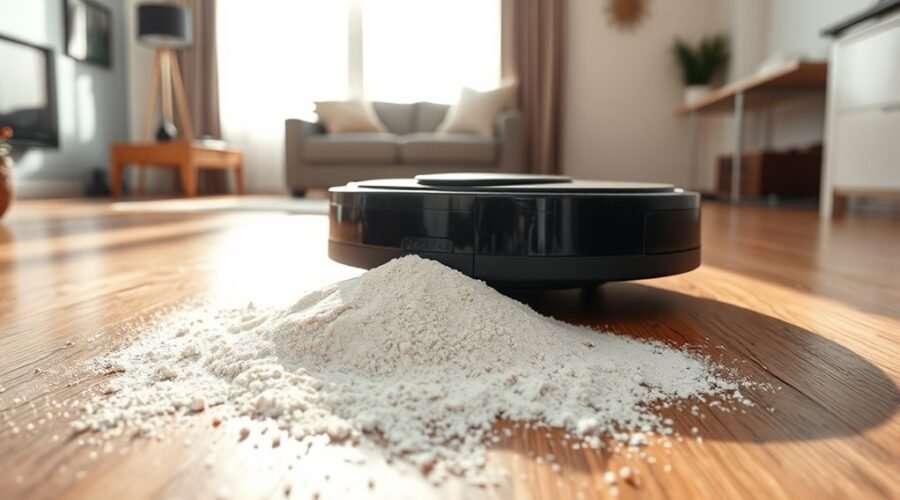
Can a robot vacuum clean fine powder without leaving dust behind? For a light layer of household dust, it often can, especially on smooth floors. However, thick powder spills, fine dust trapped in carpets, and hazardous renovation debris need a different approach. Knowing these limits helps you clean effectively without damaging your vacuum.
Quick Answer
Yes, a robot vacuum can pick up a light layer of dry, ordinary household powder, especially from smooth floors. It is not a good choice for large amounts of flour, baking soda, or renovation dust. Airflow, brush contact, sealed filtration, and regular filter care matter more than suction ratings alone.
Key Takeaways
- Smooth tile, hardwood, and vinyl are generally easier to clean than carpet fibers, rough tile, or deep grout.
- A high suction rating in pascals does not guarantee better fine-powder pickup.
- True HEPA filtration and a properly sealed vacuum are different from an E11-rated filter alone.
- A second cleaning pass may help remove powder left in floor textures and along edges.
- Heavy powder spills and construction dust can overwhelm household robot vacuums.
Can a Robot Vacuum Clean Fine Powder?
)
Yes. A robot vacuum can remove small amounts of loose, dry powder from hard floors and some low-pile carpets. The best results depend on the machine’s airflow, main brush, filtration system, and ability to cover the affected area.
Everyday household dust is usually easier to manage than a concentrated spill of flour, baking soda, or other fine material. A thin dust film may disappear during a normal cleaning cycle. A visible pile can clog the filter or overwhelm the dustbin.
Models with strong suction and floating main brushes can collect loose particles efficiently. A floating brush adjusts its contact with the floor, helping it reach dust in shallow gaps and uneven surfaces.
A robot vacuum can manage light household powder, but it should not replace a suitable vacuum designed for heavy fine-dust cleanup.
Smart navigation can also improve coverage. LiDAR, which uses laser measurements to map a room, helps the robot follow organized cleaning paths rather than moving randomly.
However, navigation cannot make an unsuitable vacuum safe for hazardous dust. You should consider both the material being cleaned and the machine’s limitations.
Why Fine Powder Is Hard for Robot Vacuums
Fine powder creates problems because its small particles can enter narrow spaces, settle into surface textures, and load filters quickly. Lightweight particles may also become airborne when brushes spin or exhaust air disturbs the floor.
Unlike larger crumbs, fine powder can form a thin, persistent layer. Even when the floor looks clean, some residue may remain in carpet fibers, tile texture, or grout lines.
Three common problems affect performance:
- Restricted airflow: Fine particles accumulate on filters and can reduce the volume of air moving through the vacuum.
- Dust scattering: Fast-spinning brushes may push lightweight powder away from the suction inlet.
- Incomplete coverage: Corners, furniture legs, and uneven flooring can prevent the intake from reaching every particle.
Robot vacuums also have compact dustbins and narrow internal passages. These designs work well for routine cleaning but can struggle with concentrated powder.
Warning: Do not use an ordinary household robot vacuum to clean drywall sanding dust, concrete dust, suspected lead-contaminated dust, or other hazardous renovation debris. These materials may require specialized containment and suitable HEPA-filtered equipment. OSHA’s silica dust housekeeping guidance explains why dust-generating cleanup methods can create exposure risks.
For ordinary household cleaning, the amount of powder matters as much as its texture. A light film is a routine maintenance task. A large spill is better handled separately before running the robot.
What Features Help a Robot Vacuum Pick Up Fine Powder?
The most useful features are effective airflow, efficient filtration, good brush contact, and reliable floor coverage. These systems work together to lift fine powder, move it into the dustbin, and reduce the amount released into the room.
No single feature guarantees complete cleaning. A powerful motor cannot compensate for a clogged filter or a brush that scatters debris.
Strong Suction Power
Strong suction helps lift fine powder from hard floors and shallow carpet fibers. However, the advertised suction number does not show how much powder the vacuum actually collects.
Suction is often listed in pascals (Pa), a unit of pressure. For example, the DEEBOT X2 OMNI has an advertised maximum suction rating of 8,000 Pa.
That figure describes the manufacturer’s rated suction performance. It is not a measurement of fine-powder removal from a floor.
Real cleaning depends on several additional factors:
- The amount of airflow reaching the floor.
- The distance between the suction inlet and the surface.
- Brush contact and how particles move toward the intake.
- Filter condition and dustbin airflow resistance.
- The cleaning path and number of passes.
For this reason, a robot with a lower advertised suction rating can sometimes achieve better pickup than a more powerful model with a weaker brush or airflow design.
Fine-Pore Filtration
Fine-pore filtration helps keep collected particles inside the vacuum instead of allowing them to escape through the exhaust. It is especially useful when cleaning fine household dust.
However, filtration efficiency varies by model. A filter described as high-efficiency, antibacterial, or washable is not automatically a true HEPA filter.
The seal around the dustbin and filter also matters. Air that escapes through gaps may carry fine particles back into the room.
A properly designed filtration system should provide:
- A filter suited to capturing fine particles.
- A secure fit between the filter and its housing.
- Dustbin seals that limit air leakage.
- An accessible filter that can be maintained according to the manufacturer’s instructions.
Fine-powder cleaning places extra demand on these components. Even an efficient filter can restrict airflow when excessive dust accumulates on its surface.
Edge-Cleaning Brushes
Edge-cleaning brushes help move powder away from baseboards and toward the main suction inlet. They are useful because most robot vacuums cannot position their central brush directly against every wall.
Longer or flexible side brushes may reach narrow gaps that a fixed central brush misses. Some machines use dual side brushes to cover a wider area.
However, additional brushes do not automatically improve fine-powder pickup. Brush speed, rotation direction, and suction placement determine whether the particles are collected or scattered.
Robots with dedicated edge-cleaning modes may slow down or make additional passes near walls. This can improve coverage, especially where dust repeatedly accumulates.
Best Surfaces for Fine Powder Cleanup
Smooth, sealed hard floors are generally the easiest surfaces for a robot vacuum to clean. Powder stays near the surface, allowing the vacuum to collect it without pulling particles from deep fibers.
Low-pile rugs can also be cleaned, although fine material may remain trapped between fibers. The floor’s texture, finish, and condition influence how much residue remains.
Hard Floors and Tile
Tile, sealed hardwood, laminate, and vinyl usually provide favorable conditions for fine-powder pickup. Their relatively flat surfaces allow brushes and suction inlets to reach loose dust directly.
However, textured tile and deep grout lines can hold powder below the path of the brush. Even strong suction may leave residue in these areas.
| Surface | Fine-Powder Cleaning Result |
|---|---|
| Smooth tile | Usually effective for light, loose powder |
| Sealed hardwood floors | Good pickup, with possible residue near floorboard joints |
| Grout lines | Deeper grooves may retain powder after cleaning |
| Thin dust film | Often manageable with routine cleaning |
| Laminate or vinyl | Generally good pickup on smooth, dry surfaces |
Floor condition matters too. A dry, loose dust layer is easier to remove than powder mixed with moisture, grease, or sticky residue.
After vacuuming, you may still notice a faint film on some hard floors. If the surface manufacturer allows it, a suitable damp-cleaning method can remove the remaining residue once loose powder has been collected.
Low-Pile Rugs and Mats
Low-pile rugs and mats are easier for robot vacuums to clean than thick, high-pile carpets. Their shorter fibers expose more loose dust to the brush and suction inlet.
However, fine powder can still settle between the fibers. A robot may remove the visible surface layer while leaving embedded material behind.
Machines with floating brushes and adjustable suction can improve contact as they move from hard flooring to rugs. Carpet detection can also help compatible models adjust their cleaning behavior.
For better coverage, use a compatible carpet-cleaning mode and allow an additional pass when needed.
Thick rugs, delicate textiles, and loose fringes require more care. Follow the rug manufacturer’s cleaning guidance, particularly when the material is sensitive to mechanical brushing.
Where Robot Vacuums Struggle With Fine Powder
Robot vacuums struggle most with heavy powder spills, thick carpets, deep floor gaps, and narrow corners. These conditions make it harder for the machine to reach particles and maintain consistent airflow.
Lower-powered models may have difficulty lifting embedded dust. However, there is no reliable universal suction threshold that guarantees fine-powder cleaning.
Fine-powder pickup depends on the complete cleaning system, not simply whether a vacuum exceeds a particular suction rating.
Common problem areas include:
- Deep carpet fibers: Fine material can settle beneath the surface and resist extraction.
- Room corners: Round robot bodies may leave small areas beyond the main brush’s reach.
- Furniture edges: Narrow clearance can prevent the robot from positioning itself correctly.
- Heavy powder deposits: Concentrated debris can load filters quickly and reduce airflow.
- Uneven flooring: Gaps, grooves, and rough textures can hold powder below the brush.
A standard roller brush may also scatter fine material on smooth flooring. Rubber and floating designs can help, but actual performance still depends on the complete brush system.
Another limitation is automatic dustbin emptying. Very fine powder can collect inside the bin, around seals, or along the dust-transfer passage instead of moving cleanly into the dock’s collection bag.
Repeated runs may improve light-dust pickup, but they are not a solution for an unsuitable machine or excessive powder buildup.
How HEPA Filters Control Fine Dust
A true HEPA filter is designed to capture at least 99.97% of airborne particles measuring 0.3 microns under the relevant US definition. This makes HEPA filtration useful for limiting the release of fine particles collected by a vacuum.
However, that efficiency figure describes filtration, not the amount of powder removed from the floor.
The filter must receive the air carrying the dust. If the vacuum has poorly sealed pathways, some particles may escape before reaching the filter.
The US Environmental Protection Agency explains this distinction in its HEPA vacuum requirements for renovation dust. A suitable HEPA vacuum must be designed so that the collected airflow passes through the final HEPA filter without bypass leakage.
This is why a machine containing a fine-particle filter is not automatically equivalent to a sealed HEPA vacuum.
HEPA and E11 filters are not the same classification. The E11-rated filters listed for several DEEBOT models provide high-efficiency particle filtration, but that rating should not be presented as a verified 99.97% HEPA claim.
An antibacterial filter is different again. Antibacterial treatment does not, by itself, establish how efficiently the filter captures airborne particles.
For routine dust control, check the manufacturer’s stated filter class and the vacuum’s sealing design. Replace damaged or overloaded filters rather than assuming that cleaning will always restore their performance.
How Brush Design and Suction Affect Pickup
Brush design determines how fine powder moves across the floor, while suction carries loosened particles into the dustbin. Both must work together for effective cleaning.
Rubber main brushes can maintain consistent contact with hard floors and help guide loose dust toward the intake. Floating brushes adjust to small changes in floor height, which can improve pickup across mixed surfaces.
The DEEBOT T20 OMNI uses an all-rubber floating main brush. The DEEBOT X2 OMNI also uses a floating rubber main brush, paired with a higher advertised suction rating.
Side brushes support edge cleaning, but their movement can occasionally spread lightweight debris. If you notice powder being pushed outward, a slower cleaning cycle or a different supported cleaning mode may improve the result.
Carpet pickup presents a different challenge. The brush must disturb particles caught between fibers before the airflow can carry them away.
On hard floors, excessive agitation may be less useful. Good intake placement and controlled brush movement can matter more than aggressive brushing.
Dirty brush rollers and blocked suction openings reduce performance on both surfaces. Keeping these components clear helps the machine maintain consistent pickup.
How to Improve Robot Vacuum Performance on Fine Powder
To improve fine-powder cleaning, start by checking that the material is suitable for your robot vacuum. Then prepare the floor, choose an appropriate cleaning mode, and inspect the result.
These steps work best for small amounts of ordinary, dry household dust.
- Identify the powder. Confirm that the material is ordinary household debris and that your vacuum’s instructions permit its collection. Do not use the robot for unknown or hazardous dust.
- Remove concentrated deposits. If there is a visible pile of flour, baking soda, or similar material, use a suitable cleanup method rather than sending the robot directly through it.
- Clear the cleaning area. Move loose cables and small objects that could interfere with the robot’s path or cause it to miss patches of dust.
- Select a suitable cleaning mode. Use the standard or higher-suction setting for light powder where the manufacturer permits it. Choose vacuum-only mode when you need to collect dry material without wetting it.
- Run a focused cleaning cycle. If your robot supports room or zone cleaning, direct it to the affected area. This reduces unnecessary travel and helps cover the powder consistently.
- Repeat only when needed. A second pass can remove loose residue missed during the first cycle. Stop if the machine begins scattering dust or shows signs of restricted airflow.
- Inspect the dustbin and filter. After collecting fine material, look for packed dust, blocked openings, or a filter covered with powder. Maintain these parts according to the model’s instructions.
Pro Tip: Shine a light across a smooth floor from a low angle after cleaning. This can reveal a remaining dust film that is difficult to see from above. Use the result to decide whether a spot-cleaning pass or a suitable manual cleaning method is needed.
If suction weakens after cleaning, turn off the robot and check its accessible components. Never continue running a vacuum that overheats, makes an unusual sound, or shows signs of a blockage.
Filter maintenance deserves particular attention. For example, the DEEBOT N10 PLUS instruction manual specifies weekly maintenance for the main brush and antibacterial filter, with filter replacement every three to six months.
Those intervals apply to that model’s manual, not every robot vacuum. More frequent inspection may be needed after unusually dusty cleaning sessions. Wash a filter only if its instructions permit washing, and reinstall it only after it is completely dry.
Best Robot Vacuums for Fine Powder
The best robot vacuum for fine powder is one that combines effective pickup, suitable filtration, and consistent navigation. Advertised suction alone is not enough to establish which model cleans fine debris most effectively.
The following DEEBOT models from the original comparison offer different combinations of suction, brush design, and filtration. These are specification-based options, not a verified ranking from controlled fine-powder tests.
| Robot Vacuum | Advertised Maximum Suction | Relevant Features |
|---|---|---|
| DEEBOT X2 OMNI | 8,000 Pa | Floating rubber brush, E11 filter, LiDAR navigation, square design |
| DEEBOT T20 OMNI | 6,000 Pa | Floating all-rubber brush, E11 filter, automatic emptying |
| DEEBOT N10 PLUS | 3,800 Pa (US listing) | Floating main brush, E11 antibacterial filter, LiDAR mapping |
DEEBOT X2 OMNI
The DEEBOT X2 OMNI combines an advertised 8,000 Pa suction rating with a floating rubber main brush.
Its square-shaped design aims to improve coverage near room edges. LiDAR mapping and obstacle avoidance support organized cleaning across mixed floor layouts.
The manufacturer specifies an E11 high-efficiency filter, not a verified true HEPA filtration system. Its specifications make it worth evaluating for routine fine-dust cleaning, but they do not establish a measured powder pickup rate.
DEEBOT T20 OMNI
The DEEBOT T20 OMNI has an advertised maximum suction rating of 6,000 Pa and a floating all-rubber main brush.
It also provides carpet detection, automatic dust collection, and an E11-rated high-efficiency filter.
These features support everyday dust management across hard floors and carpets. However, its filtration specification should not be confused with a fully sealed HEPA vacuum suitable for hazardous powder.
DEEBOT N10 PLUS
The DEEBOT N10 PLUS offers a floating main brush, LiDAR navigation, and an antibacterial E11-rated filter.
Its US product listing specifies 3,800 Pa maximum suction. Specifications can differ by regional version, so the exact model matters when comparing suction figures.
The floating brush is designed to maintain contact across mixed flooring. Automatic dust collection adds convenience during routine cleaning, although fine powder can still collect inside the dustbin and transfer passages.
For all three machines, compare real fine-debris pickup results, filter specifications, maintenance requirements, and your floor types before making a decision.
Frequently Asked Questions
Can Vacuums Pick Up Powder?
Yes, vacuums can collect many kinds of dry powder when their filtration and airflow systems are suitable. Small amounts of household dust are generally easier to handle than concentrated flour or baking soda spills. Heavy fine-dust cleanup requires equipment designed for that material.
What Are the Downsides of Using a Robotic Vacuum Cleaner?
Robot vacuums may miss corners, struggle with embedded carpet dust, and require frequent maintenance. Their compact dustbins and narrow airflow paths can also become overloaded by fine powder. They are useful for regular floor care but cannot fully replace manual cleaning for every type of mess.
Which Pool Robot Is Best for Cleaning Fine Particles?
There is no single verified best model for every pool. The Maytronics Dolphin S200 supports an ultra-fine filter kit, while the Zodiac DuoX DX4050 iQ uses dual-stage 150/60-micron filtration. These are pool-cleaning specifications, not ratings for household robot vacuums.
What Liquid Can I Put in a Robot Vacuum?
Do not put liquid into a robot vacuum’s dry suction system. A vacuum-mop combination may accept water or manufacturer-approved cleaning solution in its designated tank. Follow the exact model instructions, and never assume that a mopping function makes the vacuum safe for picking up puddles or wet powder.
Can a Robot Vacuum Clean Flour or Baking Soda?
A robot vacuum may collect a small amount of dry flour or baking soda, but it should not be used for a large powder spill unless the manufacturer permits it. Both materials can load fine filters and restrict airflow. Use a suitable alternative for concentrated spills and inspect the vacuum after accidental pickup.
Should You Mop After Vacuuming Fine Powder?
You can mop after removing loose powder if the flooring and material are suitable for damp cleaning. Use a floor-approved method for any remaining dust film. Avoid wetting unknown powders, construction debris, or moisture-sensitive surfaces. A dry-only robot vacuum must never be used to collect the resulting moisture.
Conclusion
A robot vacuum can clean light amounts of fine powder, particularly on smooth, dry floors. Its success depends on airflow, brush design, filtration, and how thoroughly it covers the area.
For routine household dust, use suitable cleaning settings and inspect the filter after heavier-than-normal pickup. For concentrated powder spills or hazardous renovation debris, choose a cleaning method designed for the material instead of relying on a robot vacuum.
Sources
- US Environmental Protection Agency, HEPA Vacuum Guidance: HEPA filtration efficiency, vacuum sealing, and renovation dust containment.
- Occupational Safety and Health Administration, Crystalline Silica Guidance: Dust exposure risks and appropriate housekeeping methods.
- ECOVACS, DEEBOT X2 OMNI Specifications: Suction rating, brush design, filtration, and navigation.
- ECOVACS, DEEBOT T20 OMNI Specifications: Suction rating, floating rubber brush, and E11 filtration.
- ECOVACS, DEEBOT N10 PLUS Specifications: US suction rating, floating brush, and antibacterial filter.
- ECOVACS, DEEBOT N10 PLUS Instruction Manual: Recommended maintenance and filter replacement intervals.
- Maytronics, Dolphin S200: Pool-cleaning coverage and ultra-fine filtration compatibility.
- Zodiac, DuoX DX4050 iQ: Dual-stage pool filtration specifications.