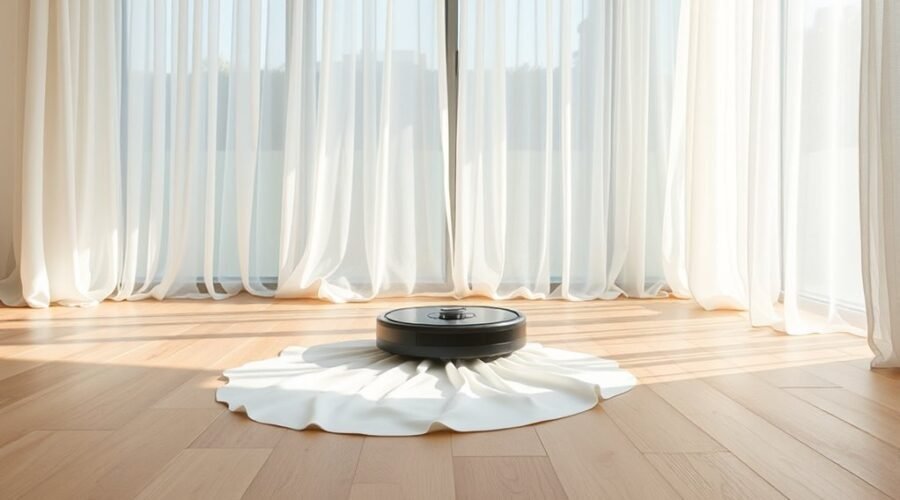
Can robot vacuums handle floor-length curtains without getting stuck? It depends on how the fabric hangs and how the vacuum detects obstacles. Long hems, loose tassels, and curtains that pool on the floor can interrupt cleaning. However, a few simple changes can help your robot clean near windows without damaging the fabric.
Quick Answer
Yes, many robot vacuums can clean near floor-length curtains, but fabric that drags or pools on the floor may wrap around a brush or wheel. Lift or tie back the hems, remove cords and tassels, and use a mapped no-go zone if needed. Watch one test run before scheduling unattended cleaning.
At a Glance
| Time Required | A quick pre-clean check and one test run |
| Difficulty | Easy |
| Tools Needed | Curtain tiebacks or clips; optional robot vacuum app with no-go zones |
How Floor-Length Curtains Confuse Robot Vacuums
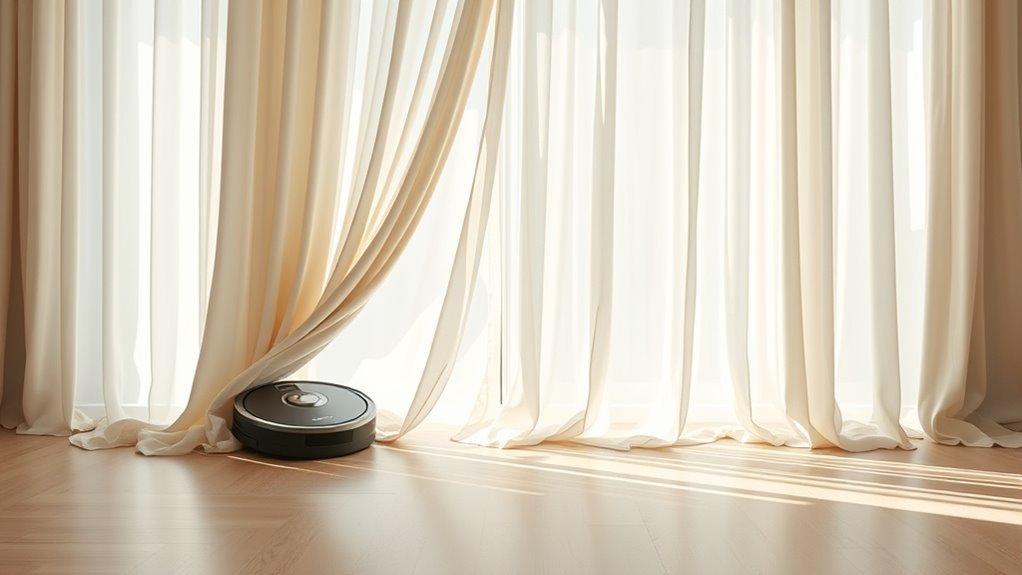
Floor-length curtains can interfere with robot vacuums in two main ways. The fabric may become tangled in moving parts, or the navigation system may treat the curtain as an obstacle. Either problem can leave the floor near your windows uncleaned.
The exact behavior depends on the vacuum’s sensors, the curtain material, and how much fabric touches the floor.
How Curtains Affect Navigation Sensors
Many robot vacuums use LiDAR, cameras, or other sensors to detect obstacles and plan cleaning routes. LiDAR uses laser light to measure distances around the robot.
Hanging fabric can appear to be a solid barrier. In fact, one manufacturer’s curtain detection guidance explains that its laser-based robot may mark curtains as inaccessible and avoid passing through them.
This can create a problem when curtains cover an otherwise open area near a wall or window. The robot may turn away without cleaning the floor behind them.
Cliff sensors work differently. They face downward to detect drops beneath the machine, as explained in this manufacturer’s sensor documentation. Hanging dark curtains do not normally trigger cliff detection simply because they are dark.
However, dark fabric lying beneath the robot can create a different surface-detection problem on some models.
How Curtain Fabric Causes Snags
The second problem is physical contact. A robot vacuum may push into a hanging curtain, pull the hem underneath its body, or catch loose threads in its brushes.
Common trouble spots include:
- Pooled curtains: Extra fabric rests on the floor where brushes or wheels may catch it.
- Loose tassels: Decorative strings can wrap around rotating brushes.
- Lightweight fabric: The robot may drag loose material instead of moving around it.
- Heavy drapes: Thick folds may block the robot’s path or prevent it from reaching wall edges.
Advanced obstacle detection can reduce contact, but it does not guarantee that every curtain will be recognized correctly.
That is why preparing the curtains is often more reliable than depending on the vacuum to avoid them automatically.
Keep Curtains Off the Floor Before Cleaning
The easiest way to prevent curtain-related problems is to keep the fabric above the robot’s cleaning path. You do not need to shorten your curtains permanently. You can secure them temporarily before each cleaning session.
This approach helps prevent brush tangles while allowing the vacuum to reach areas that hanging fabric might otherwise block.
Manufacturer robot vacuum preparation guidance also recommends tying up curtains so the machine can pass through the area more easily.
How to Secure Curtains Before Vacuuming
- Inspect the curtain length. Look for hems, folds, and decorative ends resting on the floor.
- Lift the loose fabric. Gather the curtain away from the robot’s wheels and brushes.
- Secure it gently. Use curtain tiebacks, soft fabric ties, chip clips, or clothespins where suitable.
- Tuck away dangling tassels. Keep decorative strings from hanging into the robot’s path.
- Check the floor clearance. Confirm that the fabric will remain above the moving robot during cleaning.
- Test the arrangement. Observe the vacuum as it approaches the window and follows the wall.
Warning: Avoid fastening clips directly onto delicate curtain fabric if they may leave marks or cause damage. Keep clips, curtain cords, and loose ties out of the robot’s reach. A caught cord can pull on the curtain or nearby objects.
For heavier curtains, existing wall-mounted tiebacks may hold the fabric more securely than small clips. For lightweight curtains, a loose fabric tie is often enough.
There is no single clearance height that works for every robot vacuum. The curtain must remain clear of the machine’s body and moving parts.
Once the fabric is secured, the robot should have a better chance of cleaning close to the baseboards and window edges.
Prep Nearby Floors for a Smooth Run
Even when curtains are lifted, nearby objects can interfere with the cleaning route. Clear the floor around windows, furniture, and curtain edges before starting the robot vacuum.
A clean path gives the machine fewer obstacles to detect and reduces the chance of repeated stops.
What to Remove From the Cleaning Area
Pay special attention to items hidden by curtains or placed near window walls.
- Electrical cords: Lift charging cables and extension cords off the floor.
- Shoes and clothing: Remove items that could become trapped beneath the robot.
- Small toys: Pick up objects that may block wheels or brushes.
- Loose rug edges: Flatten curled corners and keep decorative fringe away from moving parts.
- Lightweight objects: Move anything that could be pulled or knocked over if the robot catches a nearby cord.
You usually do not need to move every piece of furniture. Instead, make sure the vacuum has enough room to pass between furniture legs and the curtain area.
Test the Robot’s Cleaning Route
Before relying on scheduled cleaning, run the vacuum through the prepared area while you watch.
Look for these signs of successful navigation:
- The robot approaches the window without repeatedly turning away.
- Its wheels and brushes do not touch loose curtain fabric.
- It follows the wall without becoming trapped.
- It reaches accessible floor areas without leaving obvious gaps.
- It completes the section without a brush or navigation error.
If the robot repeatedly avoids the same location, check whether a curtain fold blocks its sensors or a piece of furniture narrows the route.
Correct the obstruction and run another test before using an unattended schedule.
Set Virtual Walls for Curtain Zones
Virtual walls and no-go zones can keep compatible robot vacuums away from floor-length curtains. These features let you define parts of a room that the robot should avoid.
They are especially useful when you cannot lift heavy curtains or when delicate drapes regularly cause the machine to get stuck.
However, not every robot vacuum supports app-based no-go zones. The feature depends on the model and its mapping capabilities.
How to Create a Curtain No-Go Zone
- Open the robot vacuum app. Select the saved map of the room containing the curtains.
- Find the zone controls. Look for options such as No-Go Zone, Keep-Out Zone, or Virtual Wall.
- Mark the curtain area. Place the restricted boundary around the fabric that could touch the machine.
- Adjust the boundary. Leave a little extra space around the problem area.
- Save the zone. Confirm that the restriction appears on the map.
- Run a test. Watch the robot approach the boundary to confirm it stays outside the marked area.
According to official Smart Map guidance, keep-out zones should cover the full area you want the robot to avoid. A small buffer helps account for navigation differences.
Remember that a no-go zone also prevents cleaning inside the marked area. Avoid blocking a large section of the room when only a small curtain edge causes trouble.
Can Robot Vacuums Clean Behind Curtains Automatically?
Some newer robot vacuums offer more advanced curtain handling. Certain models allow you to identify curtain locations on a map so the robot can clean behind fabric barriers.
For example, a manufacturer’s curtain-aware cleaning feature uses manually marked curtain positions to help the robot reach areas behind curtains and soft partitions.
This is different from an ordinary no-go zone, which tells the vacuum to stay away.
These advanced features are model-specific. Do not assume your vacuum can safely pass through hanging fabric unless its documentation supports that behavior.
Also, some apps save restricted areas for all cleaning sessions rather than allowing different boundaries at different times. You may need to edit the map when changing your curtain arrangement.
If your vacuum lacks virtual boundaries, securing the curtains or using a compatible physical barrier is a practical alternative.
Fix Curtain Snags and Stalls Fast
If your robot vacuum gets caught in a curtain, stop the cleaning cycle before pulling the fabric free. Moving the machine while its brushes are still turning may tighten the tangle.
Most minor snags can be resolved by releasing the fabric, inspecting the moving parts, and correcting the curtain position.
If curtain fabric can reach the robot’s brushes or wheels, secure it before restarting the cleaning cycle.
What to Do When the Robot Gets Stuck
- Pause and switch off the vacuum. Follow the stopping instructions for your model.
- Release the curtain gently. Avoid pulling hard on fabric caught around the wheels or brushes.
- Inspect the main brush. Check for wrapped threads, loose tassels, and fabric fibers.
- Check the side brush and wheels. Remove any material restricting their movement.
- Examine the curtain. Look for loose stitching, pulled threads, or other damage.
- Raise the fabric. Secure the hem so the same section cannot become trapped again.
- Restart cleaning. Test the area while watching for another snag.
Always follow your vacuum’s maintenance instructions before removing brushes or other components.
What If the Robot Still Avoids the Curtains?
If the machine moves freely but keeps avoiding the window area, the issue may be navigation rather than a physical tangle.
Try these checks in order:
- Make sure hanging fabric is not blocking the robot’s forward-facing sensors.
- Gently clean accessible sensor surfaces using the method recommended for your model.
- Check the app for a saved no-go zone covering the area.
- Confirm that the room layout has not changed enough to confuse the saved map.
- Restart the vacuum and test the route again.
If the robot continues to report sensor or brush errors after you remove the obstruction, check its manual or contact the manufacturer’s support team.
A persistent error may indicate a mechanical or sensor problem rather than an issue with the curtains.
For curtains that repeatedly cause trouble, keeping the area restricted is better than forcing the robot through the fabric.
Frequently Asked Questions
What Are the Downsides of Using a Robotic Vacuum Cleaner?
Robot vacuums may miss corners or deep dirt, need brush and filter care, and can get tangled in cords, tassels, or curtain hems. They also make noise and may stop to recharge. Navigation, suction, floor compatibility, app features, and maintenance costs vary by model.
What Vacuum Attachment for Curtains?
Use a soft dusting brush or upholstery attachment on a regular vacuum to remove dust from curtains. Choose gentle suction for delicate fabric and follow the care label. A robot vacuum cleans floors, not hanging curtains, so it cannot replace this task.
How Many Sq Ft Can a Robot Vacuum Handle?
There is no guaranteed floor area per charge for every robot vacuum. One manufacturer’s guide puts typical coverage at about 1,500 to 2,000 square feet on a full charge. Actual coverage depends on floor type, suction setting, furniture, and whether the robot can recharge and resume.
Can Robot Vacuums Go Over Thick Rugs?
Some robot vacuums can cross and clean medium-pile rugs, but very thick or plush rugs may trap the wheels or brush. Fringe makes tangling more likely. Check the carpet limits for your model and fold loose rug tassels out of the cleaning path.
Can a Robot Vacuum Clean Behind Floor-Length Curtains?
Sometimes, but hanging fabric can look like a wall to the navigation system, so the robot may skip the floor behind it. Lift or tie back the curtain for reliable access. Some newer models can recognize manually marked curtain areas, but this feature is not universal.
Do No-Go Zones Work If the Robot Has No Smart Map?
Usually not. App-based no-go zones require a compatible mapping feature. If your vacuum lacks it, lift the curtains or use a physical boundary approved for that model. Test the first run to ensure the robot avoids the fabric without missing too much floor.
Conclusion
Robot vacuums can handle floor-length curtains when you prepare the room properly. The biggest risks are loose fabric catching the brushes and sensors treating curtains as obstacles. Raising the hems, securing tassels, clearing nearby floors, and using no-go zones can make cleaning more reliable.
For the best results, secure your curtains and watch one cleaning cycle. If the robot still struggles, restrict the problem area and clean the missed floor manually rather than risking damage to the curtains or vacuum.
Sources
- Xiaomi Support: Why Robot Vacuums Cannot Pass Through Curtains: Explains how laser navigation may mark curtains as inaccessible.
- Xiaomi Robot Vacuum 6 Pro FAQ: Explains cliff sensor placement and obstacle detection behavior.
- eufy Support: Tips on Using the Omni C20: Supports tying up curtains, clearing loose objects, and using no-go zones.
- iRobot Support: Guide to Smart Maps: Explains mapping features, keep-out zones, model compatibility, and boundary placement.
- Roborock: Qrevo Edge 3 Pro: Documents manually marked curtain areas and cleaning behind soft partitions.
- Dyson: Deep Cleaning Guidance: Recommends using a soft brush tool to clean curtains and blinds.
- eufy: Robot Vacuums for Large Houses: Provides approximate cleaning coverage and factors affecting runtime.
- eufy Support: Carpet Compatibility: Explains how thick rugs, dark surfaces, and fringe affect robot vacuum operation.