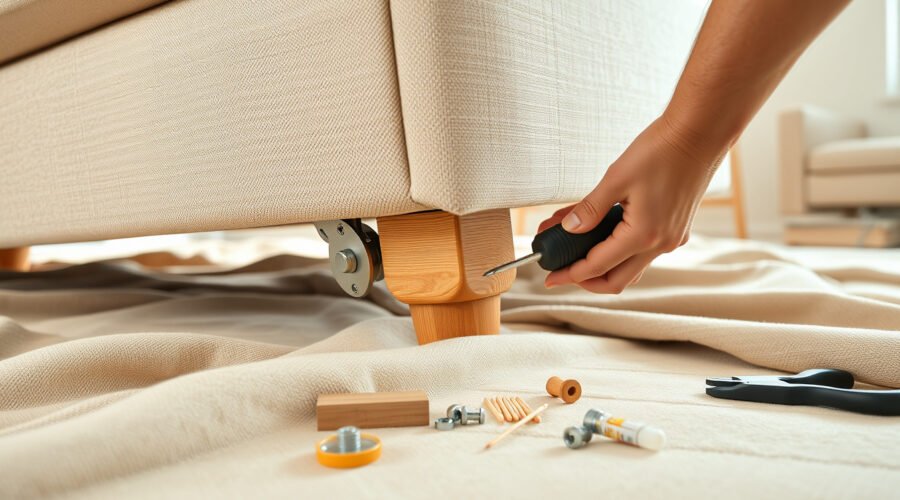
A wobbly couch usually points to a failing mechanical connection beneath the upholstery rather than a broken leg. Knowing how to tighten loose sofa legs before a loose boltChews through the hardwood corner block can save you from a costly frame rebuild. Whether your couch uses Twist-On hanger bolts, pronged T-nuts, or screw-on mounting plates, matching the right fix to the exact hardware failure keeps the repair solid for years.
Quick Answer
To tighten loose sofa legs, flip the sofa onto a soft blanket, confirm whether the leg unscrews or uses bolts, and inspect the corner block. Hand-tighten loose screws, lock and drive loose hanger bolts using two nuts, plug stripped screw holes with glued hardwood dowels, or install a matching 5/16-inch or M8 mounting plate into solid frame wood.
Key Takeaways
- Never force a leg to twist until you confirm it uses a center hanger bolt rather than fixed dowels or hidden lag bolts.
- Match US imperial (5/16″-18) and metric (M8 x 1.25) threads carefully—they look nearly identical but cross-thread if mixed.
- Use the double-nut method instead of pliers to tighten a loose hanger bolt into a wooden leg without crushing the threads.
- Plug stripped wood screw holes with PVA wood glue and hardwood dowels or toothpicks, then let the repair cure for 24 hours.
- Replace pulled-out pronged T-nuts with screw-on mounting plates or hex-drive threaded inserts anchored into solid hardwood.
Quick Repair Decision Guide
Match your repair method directly to the part that moves when you test the leg. Tightening a screw into torn wood fibers only offers a temporary hold, while stripped threads or cracked corner blocks require new hardware before the sofa carries weight again.
| What You Find | Best Fix | Do Not Do This |
|---|---|---|
| Loose plate screw with firm wood grip | Tighten by hand with a #2 Phillips or Pozidriv screwdriver | Drive with high drill torque until the wood strips |
| Hanger bolt backing out of the wooden leg | Lock two matching nuts on the exposed stud and wrench the bolt clockwise into the leg | Grip the exposed machine threads directly with metal pliers |
| Stripped wood screw hole in the frame | Glue in a 1/4-inch hardwood dowel or toothpicks, cure for 24 hours, and drill a new pilot hole | Pack the hole with crumbly wood putty or drive the same screw back in |
| Spinning or stripped T-nut / insert nut | Pull down while unscrewing to remove the leg, then install a screw-on T-plate or threaded insert | Force a 5/16-inch bolt into an M8 metric nut or vice versa |
| Cracked or chewed-up corner hole | Bridge the damaged center hole with a 4-screw steel mounting plate anchored into solid perimeter wood | Use a longer center bolt without reinforcing the mount |
| Leg does not twist off | Pop off the bottom plastic glide cap to check for a recessed hex bolt, or peel back the dust cover | Pry or twist a glued mortise-and-tenon leg until the frame splits |
| Sofa rocks but all hardware is tight | Check the floor with a spirit level and add an adjustable threaded glide or rigid furniture shim | Sand or saw a leg shorter before verifying the floor is level |
Identify Common Causes of Loose Sofa Legs
Sofa legs loosen primarily when sideways shear forces—such as sliding the couch across a rug or dropping onto a corner cushion—work against the metal fasteners. Over time, that leverage compresses the wood fibers around the corner block or backs the threaded stud out of its socket.
Most removable sofa legs rely on a dual-threaded stud called a hanger bolt. The pointed lag-screw end threads into the wooden leg, while the blunt machine-screw end threads into a receiving fastener inside the sofa frame: either a 3-prong T-nut, a screw-in threaded insert, or a flat metal mounting plate. When a leg wobbles, either the machine thread has backed out, the wood thread has loosened inside the leg, or the receiving nut has torn free from the frame.
Choosing the right replacement part depends on how the nut grips the wood. For a clear breakdown of pullout strength across barrel inserts, flanged hex inserts, and pronged T-nuts, see Rockler’s guide to T-nuts and threaded inserts.
Find Exactly What Is Loose
Before buying replacement hardware, hold the loose leg firmly and wiggle it gently while watching the joint where the leg meets the sofa base. The specific part that shifts tells you which component failed.
| What Moves | Likely Problem Area | What to Inspect |
|---|---|---|
| Leg turns and tightens normally | Hanger bolt simply backed out of the nut | Check whether the bolt stays seated inside the leg or unscrews from the leg instead |
| Leg spins endlessly in both directions | Internal 3-prong T-nut broke free inside the frame | Pull down firmly on the leg while turning counterclockwise so the T-nut prongs catch enough to unthread |
| Mounting plate rocks against the wood | Loose or stripped perimeter wood screws | Remove plate screws and test whether the screw holes in the corner block are stripped |
| Entire corner of the wood frame flexes | Cracked corner block or loose frame joinery | Unstaple a small section of the black cambric dust cover to inspect the internal corner block |
| Joint is rock-solid, but the sofa wobbles | Uneven floor or missing bottom glide pad | Compare floor level across all four corners and inspect the bottom plastic or felt glides |
Get Your Tools and Supplies Ready
Gather your tools and hardware before flipping the sofa so you can complete the inspection and repair in one session. Having a small bowl or magnetic tray nearby prevents removed screws and washers from disappearing into carpet pile.
| Tool or Supply | Purpose | Key Specification or Note |
|---|---|---|
| #2 Phillips or Pozidriv screwdriver | Removes and tightens mounting plate screws by hand | Hand tools prevent over-torquing and stripping wood fibers |
| Cordless drill and fractional bits | Drills pilot holes and bores holes for dowels or inserts | Common sizes: 1/8″ (pilot holes), 1/4″ or 3/8″ (dowels/T-nuts), 7/16″ (softwood inserts) |
| Two wrenches or locking pliers | Tightens hanger bolts via the double-nut method | Use two matching machine nuts (5/16″-18 or M8) locked together on the stud |
| Hex keys (Allen wrenches) | Drives hex-socket threaded inserts and recessed leg bolts | Needed for E-Z Hex style inserts and legs with hidden through-bolts |
| Steel mounting plates or T-plates | Bridges a torn center hole and anchors into fresh wood | Match internal threads to your leg bolt (5/16″-18 UNC or M8 x 1.25) |
| Hardwood dowels or wooden toothpicks | Rebuilds stripped screw holes with solid wood fibers | Fluted birch or oak dowels (1/4″ or 3/8″) hold stronger than toothpicks for heavy loads |
| PVA wood glue | Bonds wood plugs and dowels permanently into the frame | Allow 24 hours of cure time before putting weight back on the leg |
| Two-part cold-weld epoxy | Secures loose metal inserts or hanger bolts in oversized holes | Cures fully in 15 to 24 hours; wipe excess off exposed threads immediately |
| Flat pry bar or stiff putty knife | Applies downward tension on spinning legs and pops off glide caps | Also useful for lifting stuck mounting plates without splintering the wood |
Recommended Products

Cam locks for furniture are crafted from durable alloy steel with nickel plating, ensuring rust and corrosion resistance for long-term use in humid or high-temperature environments. Before purchasing, measure your pre-drilled hole’s diameter, depth, and connecting hole length to ensure compatibility

Gorilla All Purpose Wood Filler is the go-to product for strong, durable repairs on cracks, gouges and holes.

Package: You will receive 680pcs bolts and nuts Assortment kit,including 13 sizes screws,4 sizes nuts,4 sizes flat washers and 4 sizes lock washers,meet your needs in daily life
Prepare Your Sofa for Repair
Clear a workspace large enough to lay the sofa onto its back or upside down on a clean moving blanket or area rug. Remove all seat cushions, back pillows, and throw blankets first to reduce the frame’s weight and keep loose fabric out of your way.
Before twisting a loose leg, verify how it attaches to the frame. Most modern upholstered sofas use twist-off legs with a center hanger bolt, but some mid-century, IKEA, and hardwood-frame sofas use two vertical hex bolts hidden beneath a snap-on plastic foot cap, angled corner brackets, or glued dowel joinery. If a leg refuses to turn counterclockwise by hand, do not force it—pop off the bottom plastic glide cap with a flathead screwdriver or pull back a corner of the underside dust cover to see the fasteners.
Warning: Always lift and flip a full-size sofa with a second person. Rolling a heavy couch over onto one corner alone places extreme leverage on the remaining legs and can snap the wooden corner blocks.
Remove Old Legs and Inspect Hardware
Unscrew the loose leg counterclockwise by hand and set its washers and screws in a container. If the leg spins endlessly without backing out, the internal 3-prong T-nut has pulled loose from the wood inside the frame and is rotating with the bolt.
To free a spinning leg, wedge a flat pry bar or wide putty knife between the top of the leg and the sofa frame (or pull straight outward firmly) while turning the leg counterclockwise. The outward pressure forces the T-nut’s metal prongs against the wood inside the frame just enough for the hanger bolt to unthread. If a mounting plate’s wood screws spin in place without backing out, slide a flathead screwdriver blade under the screw head to pry upward gently as you turn.
Once the leg is off, inspect both sides of the connection: check whether the hanger bolt is bent or loose inside the leg, check whether the frame’s T-nut or insert is stripped or missing, and poke the surrounding wood with a screwdriver tip to make sure the corner block is solid hardwood or plywood rather than crushed particleboard.
Select an Effective Repair Method for Loose Legs
Choose your repair based on which part failed during your inspection. Tightening sound fasteners takes minutes, whereas stripped wood or pulled-out T-nuts require rebuilding the mounting point so the repair handles sideways movement without loosening again.
Recommended Products

Durable Heavy-Duty Construction: Crafted from premium-grade steel for unmatched strength, ensuring long-lasting support to reinforce wobbly legs, cracked joints, or weakened furniture frames

Strengthen/ Repair Furniture- No more wobbly legs ! This furniture leg attachment plates are designed for attaching legs to new or damaged sofas, couches, seats, ottomans and more.

COMPLETE 4-PIECE REPAIR KIT – Includes 4 heavy-duty metal T-plates (49mm x 49mm / 2"x2"), 4 M8 hanger bolts, 4 M8 female converters, and 16 screw adapters for 5mm unthreaded holes. Perfect for reinforcing wobbly legs on sofas, couches, chairs, tables, ottomans, and more.
Effective Repair Techniques
Use the method below that matches the exact damage on your sofa leg or corner block:
- Tighten a loose hanger bolt inside the leg (Double-Nut Method): If the hanger bolt unscrews from the wooden leg instead of the sofa frame, do not grab the machine threads with pliers. Thread two matching machine nuts onto the exposed machine-thread end and tighten them together using two wrenches until they lock. Use a wrench on the outer nut to drive the pointed lag screw clockwise deep into the leg, then unlock and remove both nuts.
- Rebuild stripped wood screw holes with dowels or toothpicks: When mounting plate screws spin freely, coat wooden toothpicks or a fluted 1/4-inch hardwood dowel in PVA wood glue and tap them snugly into the stripped hole. Family Handyman’s stripped screw-hole guide walks through packing and trimming the wood flush once dry.
- Replace a pulled-out T-nut with a screw-on mounting plate or threaded insert: Standard 3-prong T-nuts are hammered into the top face of a wood rail before upholstery is attached; hammering a new one into the bottom of the sofa fails because tightening the leg or moving the couch pulls the T-nut straight out of the hole. Instead, cover the damaged center hole with a 4-screw steel mounting plate (T-plate) anchored into fresh wood around the perimeter, or drive in a hex-socket threaded insert.
- Epoxy a loose stud or oversized insert hole: If a hanger bolt’s wood hole is slightly wallowed or a replacement insert needs extra grip in worn wood, coat the outer threads with two-part cold-weld epoxy. According to J-B Weld’s Original Cold-Weld epoxy specifications, two-part steel-reinforced epoxy sets in 4 to 6 hours and reaches a full structural cure in 15 to 24 hours.
Match Standard Sofa Leg Thread Sizes (5/16″-18 vs. M8)
Before buying a new mounting plate, T-nut, or threaded insert, verify the thread size of your sofa leg’s hanger bolt. Using mismatched threads is the single most common DIY furniture repair mistake because the two most popular sizes look nearly identical to the naked eye.
- 5/16″-18 UNC (US Standard): Used on the vast majority of American-made sofas and replacement legs. The bolt has an outside diameter of 5/16 inch (7.94 mm) and a coarse pitch of 18 threads per inch.
- M8 x 1.25 (Metric Standard): Common on IKEA sofas and imported European or Asian furniture. The bolt has an outside diameter of 8.0 mm (0.315 inch) and a thread pitch of 1.25 mm per turn.
- 3/8″-16 UNC or M10 x 1.5 (Heavy-Duty): Found on oversized sectionals and heavy hardwood frames, measuring 3/8 inch (9.53 mm) or 10.0 mm in diameter.
Because 5/16″-18 (7.94 mm) and M8 (8.0 mm) differ in diameter by less than a tenth of a millimeter, an M8 bolt will start threading into a 5/16″-18 plate or insert for one or two turns before binding tightly as the thread pitches clash. Never force a bolt that binds after two turns—take the detached leg to a hardware store’s thread-checker board to confirm whether it is 5/16″-18 or M8 x 1.25.
Safety Considerations During Repair
Wear safety glasses whenever you drill overhead or into dense hardwood corner blocks, and put on work gloves when pulling back upholstery staples or handling stamped steel mounting plates. Keep your drill clutch set to a low torque setting when driving mounting screws so the bit does not slip and gouge the fabric or crack the frame.
How to Properly Install New Hardware or Brackets
Installing a new threaded insert or mounting plate requires clean, solid wood and exact hole sizing. Rushing the drill step or skipping glue cure times will cause the replacement hardware to pull loose the first time the sofa is slid across the floor.
Recommended Products

Package Contents: You will receive 4 pieces of sturdy T-nut fasteners, 12 pieces of M4x25mm fixing screws and 4 pieces of mesh rubber pads.The perfect fastening kit can help you strengthen and repair furniture.

【Set of 4 Leg Mounting Plate】: This package includes a set of four leg mounting plates, 4 pcs M8 hanger bolts, 4 pcs M8 female converters and 16 pcs 16 pcs of screw adapters for 5mm unthreaded holes, providing you with all the necessary components to securely attach legs to your furniture. Each plate is designed for stability and durability, ensuring long-lasting support.

【Universal Compatibility】 Fit most table legs, furniture legs, and sofa brackets, making them ideal for repairing wobbly legs or attaching new legs to damaged couches, ottomans, and chairs. The square mounting plate design ensures a secure fit for removable furniture legs and provides long-lasting stability.
Check the Mounting Point Before Installation
Inspect the corner block beneath the dust cover before drilling any new holes. Fasteners must bite into solid kiln-dried hardwood or multi-ply structural plywood—never solely into thin upholstery tack strips, cardboard, or crumbling particleboard.
| Hardware Type | Target Thread Size | Required Drill Bit Size | Best Frame Application |
|---|---|---|---|
| 3-prong T-nut (installed from inside rail) | 5/16″-18 UNC | 3/8 inch | Accessible top/inside face of solid wood rail |
| Hex-drive flanged insert (E-Z Hex style) | 5/16″-18 or M8 | 7/16 inch (softwood) / 1/2 inch (hardwood) | Bottom-access repair in pine, plywood, or poplar blocks |
| Brass knife-thread insert (E-Z Knife style) | 5/16″-18 UNC | 33/64 inch (or 1/2 inch in softer maple/oak) | Dense hardwood corner blocks (oak, maple, beech) |
| 4-screw flat steel mounting plate (T-plate) | 5/16″-18 or M8 | 1/8 inch pilot holes for #8 or #10 wood screws | Stripped or blown-out center hole with sound perimeter wood |
Always verify the exact outer diameter of your insert before boring into the frame; E-Z LOK’s threaded insert drill chart lists exact bit specifications by wood density and thread series.
Step-By-Step Installation Process
Follow these steps in sequence to rebuild a damaged mount and install replacement hardware squarely:
- Clear and flip the sofa: Remove all cushions and work with a helper to turn the sofa upside down onto a protective blanket.
- Remove the loose leg and old hardware: Unscrew the leg, back out loose mounting plate screws, and extract any damaged insert nut or loose T-nut.
- Plug stripped wood holes: For stripped screw holes, coat toothpicks or a 1/4-inch fluted hardwood dowel with PVA wood glue and tap them into the hole. For a torn center T-nut hole that will receive a new threaded insert, drill the hole clean to 1/2 inch and glue in a matching 1/2-inch hardwood dowel.
- Wait for the adhesive to cure: According to Titebond’s wood glue curing guidelines, stressed structural joints must cure for a full 24 hours before you drill into them or apply load.
- Cut the repair flush and mark the center: Saw or chisel the cured dowel or toothpicks flush with the wood surface, then mark the exact original leg position so the leg alignment does not shift.
- Drill pilot or insert holes: Drill 1/8-inch pilot holes for mounting plate screws, or bore the specified hole size (such as 7/16 inch for a 5/16″-18 hex insert) straight into the wood at a 90-degree angle.
- Install the new plate or insert: Drive hex inserts flush using an Allen wrench, or secure the new steel mounting plate using #8 or #10 pan-head wood screws tightened evenly in stages.
- Thread the sofa leg in by hand: Turn the leg clockwise into the new plate or insert until the top shoulder of the leg seats snugly against the frame without crushing the upholstery fabric.
Ensuring Secure Attachment
Pre-drilling pilot holes prevents thick #8, #10, or #12 mounting plate screws from splitting dry hardwood corner blocks. Select a drill bit matching the inner root diameter of the screw (excluding the outer threads); Lowe’s pilot-hole guide demonstrates how to match bit sizes to wood screws for maximum holding power.
When adding a surface-mounted steel T-plate to one corner of a sofa, check the plate’s thickness (typically 1/16 to 1/8 inch). If the plate has a raised central barrel, install it with the barrel projecting upward into the center clearance hole in the frame so the plate does not push that corner higher than the other three legs.
Reattach Legs Securely for Stability
Once all wood repairs have cured and your replacement hardware is anchored, reattach each leg and test the joint before turning the sofa upright. A properly seated leg should pull flat against the frame rail with zero side-to-side play when you push against the bottom of the foot.
- Clean the mating surface: Trim away any bunched black dust-cover fabric or stray staples trapped between the top of the leg and the mounting plate so the wood seats flush.
- Hand-tighten until snug: Spin the leg clockwise until it contacts the frame firmly, then give it a final quarter-turn by hand. Square or angled tapered legs should stop in their proper visual orientation without being backed out a full turn.
- Add a thin washer for clockable angled legs: If a square or splayed mid-century leg tightens fully while facing the wrong angle, place a thin 5/16-inch flat steel or nylon washer over the hanger bolt to change the stopping point so it locks tight in the right direction.
- Test upright on the floor: With a helper, flip the sofa back onto its feet and press downward on each corner armrest to confirm no joint clicks or shifts.
Ensure Proper Alignment of Sofa Legs
Proper leg alignment ensures weight transfers straight down into the floor rather than bending the hanger bolt at an awkward angle. Before drilling pilot holes for a new mounting plate, measure the inset distance from both the front edge and side edge of the sofa frame on an undamaged corner and replicate those exact measurements.
Pay close attention to splayed (angled) legs common on mid-century modern couches. These sofas use either angled mounting plates (typically tilted at 8 to 12 degrees) or legs cut with an angled top shoulder—make sure the replacement plate or leg angle points outward toward the corner rather than tilting inward under the frame.
Pro Tip: When fastening a 4-screw mounting plate, drive all four screws three-quarters of the way in before tightening any single screw down fully. Tightening in a crisscross pattern keeps the plate centered and prevents it from shifting off your layout marks.
Common Mistakes to Avoid
Avoiding a few common shortcuts prevents you from stripping fresh hardware or cracking the sofa’s structural rail during your repair:
- Using wood filler or spackle instead of real wood plugs: Standard wood putty and spackle lack wood fibers and crumble under shear load. Always rebuild stripped screw holes with glued hardwood dowels or toothpicks.
- Hammering a 3-prong T-nut into the underside of the frame: Pronged T-nuts only resist pullout when installed from the opposite side of the wood rail. On the underside of a sofa, use a screw-on T-nut, a 4-screw mounting plate, or a threaded insert.
- Gripping hanger bolt threads with bare pliers: Pliers flatten the sharp crests of 5/16″-18 or M8 machine threads, causing the bolt to strip out the new nut inside the sofa. Always use the double-nut method.
- Loading a glued repair before 24 hours: Flipping the sofa upright and sitting on it after an hour of drying breaks the curing PVA glue bond before it reaches full strength.
- Sawing a leg shorter to fix a wobble: Floors are frequently uneven, especially near walls or over area rug edges. Confirm the floor is level before permanently altering a leg.
Final Touches for a Professional Finish
After the hardware is tight and any glue or epoxy has cured for a full 24 hours, re-staple the black cambric dust cover neatly to the underside of the frame using a heavy-duty stapler with 1/4-inch or 3/8-inch staples. Keeping the dust cover taut hides the repair plates and keeps dust and pets out of the sofa springs.
Check floor contact on all four legs (plus any center support leg on long 3-seat sofas or sectionals). Stick heavy-duty felt pads onto the bottom of each leg for hardwood or tile floors, and adjust any threaded center support foot so it just touches the floor when the sofa is unweighted—if a center leg is set too tall, the sofa will teeter like a seesaw.
When to Call a Furniture Repair Professional
Contact an upholstery or furniture repair specialist if peeling back the dust cover reveals a split main frame rail, a shattered corner block detached from the side apron, or broken sinuous springs. A simple mounting plate cannot hold if the surrounding wooden frame rail itself has fractured.
Professional restoration is also the safest route for antique sofas, heirloom hardwood frames with traditional mortise-and-tenon legs, or high-value designer pieces where surface-mounted hardware would reduce the piece’s value. Support any broken corner with solid wood blocking and keep the sofa unloaded until the frame is repaired.
Frequently Asked Questions
How do you tighten loose sofa legs?
Flip the sofa onto a soft blanket, remove the cushions, and check how the leg attaches. Turn screw-in legs clockwise by hand until snug, tighten loose mounting plate screws with a #2 Phillips screwdriver, or use the double-nut method to drive a loose hanger bolt back into the leg. If the wood holes are stripped, plug them with glued hardwood dowels and let them cure for 24 hours before reinstalling.
What do I do if my sofa leg keeps spinning and won’t tighten or come off?
A leg that spins endlessly in both directions usually means the internal 3-prong T-nut has pulled free from the wood inside the frame and is turning with the bolt. Pull straight down firmly on the leg (or wedge a flat pry bar between the leg and frame) while turning counterclockwise so the T-nut prongs bite into the wood long enough to unthread the bolt, then install a screw-on mounting plate or threaded insert.
How do you tighten a sagging sofa?
First check whether the sofa frame is tilting from a loose corner or center support leg, or whether the seat cushions are sinking into the base. Tightening loose leg hardware and adjusting the center support foot stops frame rocking, whereas a sagging seat deck requires re-clipping loose sinuous springs, tightening stretched webbing, or adding high-density foam cushion supports.
Can you fix a sofa leg with stripped screw holes?
Yes, you can rebuild stripped wood screw holes by coating wooden toothpicks or a 1/4-inch fluted hardwood dowel in PVA wood glue and tapping them tightly into the hole. Let the glue cure for 24 hours, trim the wood flush, and drill a 1/8-inch pilot hole before driving the screw back in. If the center hanger-bolt hole is torn out, bridge it with a 4-screw steel mounting plate anchored into fresh wood.
Should you use metal brackets on all sofa legs?
No, you only need to install a metal mounting plate on the damaged corner unless the new plate adds noticeable thickness (1/8 inch or more) that makes the sofa sit unevenly. Always verify that the bracket’s thread matches your leg’s hanger bolt—typically 5/16″-18 UNC on US furniture or M8 x 1.25 on imported and IKEA sofas.
When should you replace a sofa leg instead of tightening it?
Replace the sofa leg when the wood or plastic body is split through the center, the hanger bolt is bent, or the internal wood around the bolt is too splintered to hold a glued dowel repair. Tightening a cracked leg or bent bolt will fail under weight and can tear out the sofa’s corner block.
Can an uneven floor make sofa legs feel loose?
Yes, an uneven floor or a sofa sitting half-on and half-off an area rug will cause the frame to rock diagonally even when every leg is tight. Watch the leg-to-frame joints while gently rocking the couch; if the hardware stays completely still, level the short corner with a felt pad for tiny gaps or a threaded furniture leveler for larger gaps.
Conclusion
A lasting sofa leg repair comes down to fixing why the fastener loosened rather than forcing a stripped screw or bolt tighter. Match your replacement T-nuts, inserts, or mounting plates to the exact hanger-bolt thread (5/16″-18 or M8), rebuild stripped wood holes with glued hardwood dowels, and give wood glue or epoxy a full 24 hours to cure before flipping the couch upright.
Start by wiggling the loose corner while watching the joint to see whether the bolt, mounting plate, or internal T-nut is moving—then take the loose leg to the hardware store’s thread checker so you bring home the exact matching part on the first trip.
Sources
- Rockler Woodworking and Hardware: Comparison of pullout strength and installation methods for pronged T-nuts, screw-on T-nuts, and threaded inserts
- Family Handyman: Rebuilding stripped wood screw holes with wood glue, toothpicks, and hardwood dowels
- J-B Weld: Setting and 15-to-24-hour full cure specifications for Original Cold-Weld two-part epoxy
- E-Z LOK: Official drill bit size chart for softwood hex-drive and hardwood knife-thread wood inserts
- Titebond (Franklin International): Clamping times and 24-hour cure guidelines for stressed structural wood glue joints
- Lowe’s Home Improvement: Sizing and drilling pilot holes for wood screws to prevent splitting