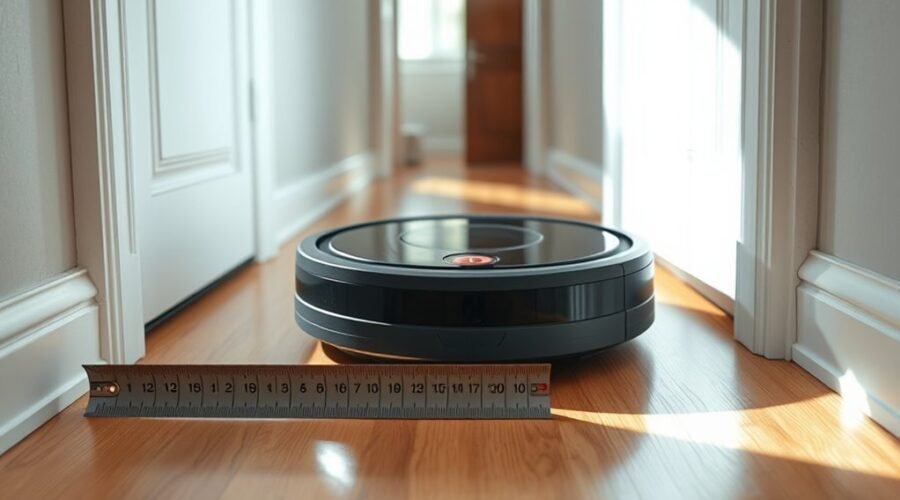
Before buying a robot vacuum, check whether it can move freely between your rooms. Robot vacuum doorway width matters because a narrow gap, thick door trim, or raised threshold can stop automatic cleaning. This guide explains the clearance different robots need, how to measure your openings, and what to do when your vacuum gets stuck.
Quick Answer
A robot vacuum generally needs an opening wider than its body, plus room for its sensors to navigate. Many full-size models work best with approximately 40 cm (15.7 inches) of clear passage, although some specify 36–37 cm. Compact robots may fit narrower gaps. Always check your model’s dimensions, recommended passage width, and threshold-climbing limit.
At a Glance
| Difficulty | Easy |
| Tools Needed | Tape measure and robot vacuum specifications |
What Doorway Width Do Robot Vacuums Need?
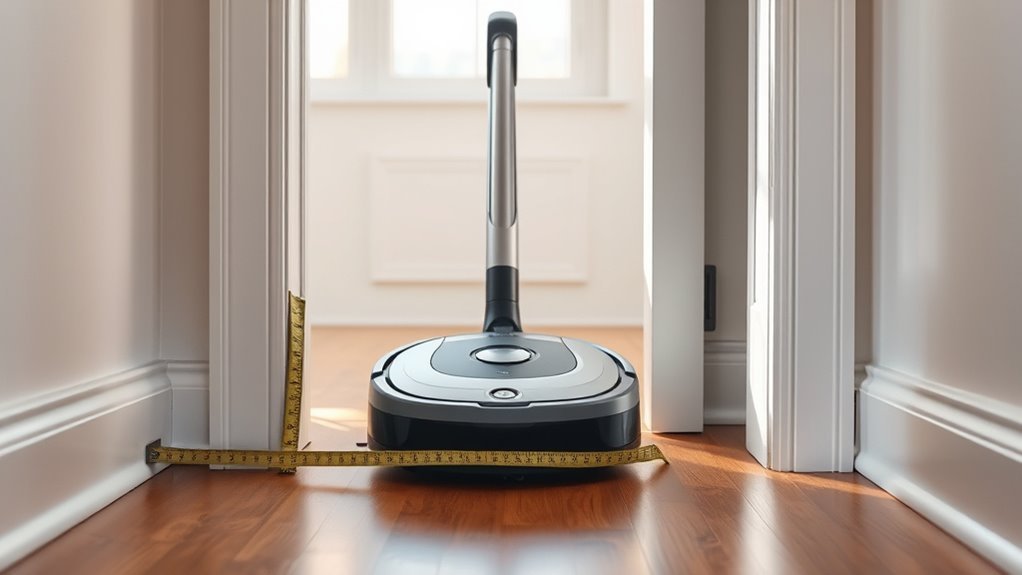
The minimum doorway width depends on your robot’s actual dimensions and navigation system. A robot measuring 35 cm across may require a wider opening to enter without repeated collisions or turning problems.
For example, official narrow-passage guidance for a 35 cm robot specifies a minimum width of 40 cm. It also explains that passage through openings around this limit may be inconsistent.
Other models have different requirements. Some can enter openings measuring 36 cm, while compact designs may fit considerably narrower spaces.
The following measurements show why there is no single minimum for every robot vacuum.
| Clear Opening | What It Means |
|---|---|
| 28 cm (11 inches) | Too narrow for most full-size robots. Certain compact designs may physically fit, but passage is not guaranteed. |
| 36–39 cm (14.2–15.4 inches) | Suitable for some models, but others need more space for reliable navigation. |
| 40 cm (15.7 inches) or wider | A practical target for many full-size robots, provided the manufacturer allows it. |
| 80–90 cm (31.5–35.4 inches) | Provides generous clearance for most household robot vacuums when the door is fully open. |
Manufacturer guidance supports these differences. One robot vacuum support guide specifies a 36 cm minimum passage, while published dimensions and clearance recommendations suggest at least 40 cm for flexible movement through narrow hallways.
Many ordinary residential doorways are 80–90 cm wide, so doorway width is rarely the problem when a door opens completely. A partially open door, however, can reduce the usable space considerably.
Robot shape also matters. Round bodies generally turn easily in open spaces, while D-shaped designs can clean closer to some edges. Neither design guarantees passage through a gap barely wider than the machine.
A robot’s physical width tells you whether it might fit. Its recommended passage width tells you whether it can navigate the opening reliably.
How Do You Measure Door Frames for Clearance?
Measure the narrowest clear opening with the door in its normal cleaning position. Then compare that measurement with the robot’s published width and minimum passage requirement.
You should also measure thresholds and check for low obstacles near the entrance. These can block a vacuum even when the doorway itself is wide enough.
- Open the door completely. Position it as it will remain during automatic cleaning. Check whether the door leaf or hardware blocks part of the opening.
- Measure the usable width. Place a tape measure between the nearest fixed obstacles on opposite sides. Measure near the floor, where the robot travels.
- Check the narrowest point. Look for projecting trim, doorstops, furniture legs, and other objects that reduce the passage.
- Measure any overhead restriction. If the opening passes beneath furniture or a low barrier, measure from the floor to the lowest solid point.
- Measure the threshold. Record the vertical rise from the lower floor surface to the top of the raised strip. Check both sides if the floor levels differ.
- Compare the measurements. Use the manufacturer’s dimensions, minimum passage width, height clearance, and obstacle-crossing specifications.
- Test the route. With the area clear, allow the robot to approach and cross the doorway during a normal cleaning run. Confirm it can also return.
Use this checklist when deciding whether an opening is suitable.
| Measurement | Target | Result |
|---|---|---|
| Width at narrowest point | Meets the model’s minimum passage width | Pass or fail |
| Height beneath low obstacles | Robot height plus manufacturer-recommended clearance | Pass or fail |
| Nearby obstacles | None blocking the robot’s travel path | Clear or restricted |
| Threshold height | Within the robot’s rated climbing capability | Pass or fail |
A common mistake is measuring the door frame without accounting for the open door. The width that matters is the space the robot can actually use.
Also, don’t assume that a few millimeters of overhead clearance will always be enough. Navigation sensors may detect a low surface and prevent entry, even when the robot’s body could physically fit.
Which Doorway Obstructions Cause the Most Trouble?
The most common doorway problems come from obstacles that reduce usable floor space or interfere with the robot’s sensors. A wide doorway may still become impassable when household items crowd its entrance.
Check these trouble spots first:
- Furniture legs: Chairs, cabinets, and tables positioned beside an entrance can narrow the robot’s turning space.
- Shoes, bags, and toys: Loose objects can force the robot to change direction or abandon the route.
- Raised thresholds: A high strip can cause wheel slipping or leave the chassis resting on the obstacle.
- Thick rugs: Folded edges and loose corners may catch wheels or brushes.
- Door trim and moldings: Protruding pieces can make an otherwise wide opening too narrow.
- Partially closed doors: A door can reduce the available width or swing into the robot’s path.
- Low furniture: Nearby furniture can leave enough space for the robot’s body but not its sensor tower.
Door thresholds deserve extra attention because crossing ability varies greatly between models.
Many conventional robot vacuums can manage thresholds around 1.5–2 cm (0.6–0.8 inches). More advanced lifting designs can handle taller obstacles.
For example, published advanced threshold specifications describe a robot capable of crossing single thresholds up to 4.5 cm. Its higher combined rating applies to a specific two-layer obstacle, not one continuous vertical step.
Actual performance can also depend on the threshold’s shape, floor grip, and the angle of approach. A sloped transition may be easier to cross than a sharp vertical edge of the same height.
Pro Tip: If your robot crosses a threshold but cannot return, test both directions separately. Differences in floor height, wheel grip, and approach angle can make the return trip harder.
For reliable automatic cleaning, remove temporary clutter before each run and keep the robot’s route consistent. This helps prevent repeated stops and missed rooms.
How Do Robot Vacuum Size and Shape Affect Passage?
A robot vacuum’s width, height, shape, and ground clearance determine where it can travel. Smaller robots can enter tighter gaps, while larger models need more room to turn and avoid obstacles.
Many full-size robots measure around 33–35 cm (13–13.8 inches) across. However, compact designs and larger machines fall outside that range.
Some compact robots measure just 24.8 cm across, according to published mini robot dimensions. That makes them physically capable of entering narrower openings than a standard 35 cm machine, provided their navigation system allows it.
Round vs. D-Shaped Robot Vacuums
Round robot vacuums can rotate within a relatively small area, which helps them change direction around obstacles. However, their circular shape can leave some corners harder to reach.
D-shaped robots have a straighter front or side edge that may improve cleaning along walls and corners. Their larger footprint in certain directions can make tight turns more difficult.
Round bodies generally turn easily, while D-shaped designs can follow edges and corners more closely.
Neither shape should be judged by appearance alone. Compare the complete body dimensions, including protruding parts, before deciding whether a particular doorway is suitable.
Robot Height and Vertical Clearance
Height matters most beneath furniture, low shelves, and other overhead restrictions near a doorway. Some low-profile robot vacuums stand under 3.94 inches (10 cm), while models with raised navigation towers may be taller.
Allow more space than the robot’s listed height so that it can detect and move beneath an obstacle without becoming trapped.
Low height does not automatically mean better access. The vacuum still needs enough ground clearance to handle rugs and floor transitions.
Why Ground Clearance Matters
Ground clearance is the distance between the floor and the robot’s underside. It affects how easily the vacuum passes over uneven flooring.
Wheels, suspension, and a lifting chassis also affect climbing performance. Suction power and battery life influence cleaning performance, but they do not determine whether a robot can physically cross a doorway.
For homes with several raised thresholds, compare obstacle-climbing specifications before choosing a vacuum. For narrow rooms, prioritize overall body dimensions and reliable navigation.
How Can You Fix Tight Doorways Robot Vacuums Can’t Cross?
If your robot vacuum cannot cross a doorway, start by removing obstacles and checking the measurements. Most access problems should be investigated before considering permanent changes to a door frame.
Use the following fixes, starting with the simplest.
- Open the door fully. Make sure it stays open throughout the cleaning cycle. A partially open door can leave too little usable width.
- Remove movable obstacles. Clear shoes, rugs, toys, bags, and nearby furniture that obstruct the path.
- Check the doorway dimensions. Confirm that the opening meets your vacuum’s minimum passage requirement, not just its physical body width.
- Inspect the threshold. Compare its measured height with your robot’s obstacle-crossing limit.
- Consider a threshold ramp. If the manufacturer supports the approach, a stable ramp may help the robot cross a raised floor transition.
- Check the cleaning map. On models with mapping, make sure the doorway is recognized as an opening rather than a wall or blocked area.
- Try a fresh cleaning run. Start from the charging dock and allow the robot to approach the doorway normally.
- Consider physical changes only if needed. Where a fixed frame is genuinely too narrow, professional widening or a suitable door-frame modification may provide a permanent solution.
Using a small ramp is a recognized solution for some robots that cannot climb a high threshold. See the manufacturer’s threshold troubleshooting advice, which recommends a ramp for a model limited to 20 mm obstacles.
Warning: Never force a robot vacuum over a threshold or use an unstable ramp. Avoid placing ramps where they create a tripping hazard or interfere with doors. Structural changes to a frame should be assessed by a qualified professional.
If the robot repeatedly becomes trapped in a doorway that cannot be changed, use a no-go zone or physical barrier where supported. You can then clean the inaccessible room separately.
A slim robot may be a better long-term option when several openings are genuinely too narrow. However, replacing the vacuum will not fix a closed door, blocked route, or mapping problem.
After changing furniture or renovating a room, repeat the doorway measurements and run a test cleaning cycle. This confirms that the vacuum can reach every intended room and return to its dock.
Frequently Asked Questions
How Much Clearance Does a Robot Vacuum Need?
A robot vacuum needs an opening wider than its body, with extra room for reliable navigation. Many full-size models require approximately 36–40 cm of passage width, although requirements vary. Vertical clearance depends on robot height and sensors. The charging dock also needs open space around it.
Can You Tell Robot Vacuum Areas Not to Go To?
Yes. Many mapping robot vacuums let you create no-go zones or virtual walls to block selected areas. Supported models may also use physical boundary accessories or magnetic strips. These features can keep the vacuum away from difficult thresholds, pet areas, and spaces where it frequently gets stuck.
Can Robot Hoovers Go Over Door Thresholds?
Yes. Many robot hoovers can cross thresholds around 1.5–2 cm high, while some advanced models can handle taller obstacles. Success depends on wheel design, ground clearance, threshold shape, and floor conditions. Always compare the threshold height with your specific model’s climbing specification.
How to Set Boundaries for a Robot Vacuum?
Open your robot’s mapping controls, select a supported boundary feature, mark the restricted area, and save the changes. Available options may include no-go zones, virtual walls, or physical magnetic strips. Confirm the robot respects the boundary during a cleaning run. Feature availability depends on the model.
For practical setup guidance, the official smart mapping guide explains how compatible robots use room maps and keep-out zones.
Charging clearance is separate from doorway clearance. One official docking guide recommends at least 0.5 m (1.5 feet) on each side and 1.2 m (4 feet) in front of its dock. Other manufacturers may specify different distances.
Conclusion
The right robot vacuum doorway width depends on your machine’s size and navigation requirements. For many full-size models, approximately 40 cm of clear passage is a useful target, but manufacturer specifications should guide your decision.
Measure the narrowest opening, inspect raised thresholds, and remove obstacles before testing your vacuum. A clear route and suitable floor transitions help the robot move between rooms without repeated manual assistance.
Sources
- Narwal Robotics: Robot Vacuum Dimensions: Robot measurements, recommended passage width, and under-furniture clearance.
- Xiaomi: Robot Vacuum 6 FAQ: Minimum passage width and navigation limitations for a 35 cm robot.
- eufy Support: Missed Cleaning Areas: Model-specific doorway clearance and obstacles preventing access.
- SwitchBot Support: Mini Robot Dimensions: Compact robot body measurements.
- Roborock Support: Saros 20 FAQ: Single-layer and double-layer threshold-crossing specifications.
- Xiaomi: H50 Pro FAQ: Threshold limits and ramp guidance.
- iRobot Support: Where to Place the Dock: Recommended charging dock clearance.
- iRobot Support: Guide to Smart Maps: Mapping features and restricted cleaning zones.