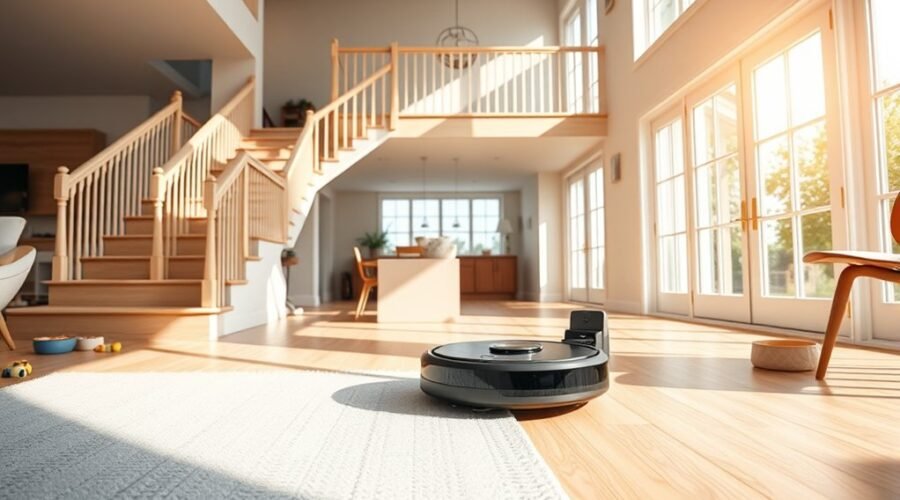
A robot vacuum for multiple floors can clean upstairs, downstairs, and basement rooms without needing a separate machine for every level. The key is to save a map for each floor and understand what happens when the robot works away from its charging dock. With the right setup, you can manage cleaning zones, schedules, carpets, and navigation more easily.
Quick Answer
Yes, a robot vacuum can clean multiple floors if it supports multi-floor mapping. Create and save a separate map for each level, then carry the robot between floors. Set no-go zones and cleaning preferences for each map. Whether you must move the dock depends on the model and its cleaning mode.
At a Glance
| Difficulty | Easy to moderate, depending on the robot and app |
| Tools Needed | Robot vacuum with multi-floor mapping, companion app, charging dock, and Wi-Fi connection |
Can a Robot Vacuum Clean Multiple Floors?
)
Yes. Many modern robot vacuums can clean multiple stories by storing a separate digital floor plan for each level. This feature is called multi-floor mapping.
Once you save the maps, the robot can recognize or load the correct layout after you move it. It can then follow room boundaries, avoid restricted areas, and clean in an organized pattern.
However, robot vacuums cannot climb ordinary household staircases. You must carry the machine between floors, even if it has advanced navigation or obstacle-climbing technology.
The number of supported maps varies by model. Some machines store two or three permanent maps, while others support four or five floor plans. Certain models also keep a temporary map for an unfamiliar area.
Before relying on one robot for your entire home, consider these features:
- Multi-map storage: The robot should save enough floor plans for every level you want to clean.
- Automatic floor recognition: Some robots identify the correct floor without requiring manual map selection.
- Cliff sensors: Downward-facing sensors help detect drops near stairs and raised landings.
- Floor-specific cleaning: Separate maps allow different room settings, restricted areas, and cleaning modes.
- Battery capacity: The robot needs enough charge to finish a level when its dock is elsewhere.
- Practical portability: Robot weight and a secure carrying position matter if you move it frequently.
Strong suction also helps when one floor has carpets and another has tile or hardwood. However, a higher suction rating alone does not guarantee better multi-floor navigation.
A robot without saved multi-floor maps may still vacuum another story manually. It simply may not remember room divisions, cleaning zones, or previous routes when you move it.
Map Each Floor in the App
To set up multi-floor cleaning, create and save a separate map for every story. Start with your main floor, then repeat the process upstairs, downstairs, or in the basement.
Most mapping robots offer a dedicated mapping function in their companion app. Some can quickly scan a level without running a complete vacuuming cycle.
- Charge the robot: Start with enough battery power to complete the mapping session. Connect the vacuum to its companion app and Wi-Fi network.
- Prepare the floor: Remove loose cords, toys, and other objects that could trap the robot. Open doors to rooms you want included in the map.
- Enable multi-floor mapping: Find the app’s map-management feature and allow multiple maps to be saved.
- Create a new map: Place the vacuum on the target floor and start the app’s mapping function. Do not pick up or reposition it during the scan.
- Save and name the map: Use clear labels such as Main Floor, Upstairs, or Basement. Confirm that the rooms and boundaries appear correctly.
- Repeat for other floors: Create another map for each remaining level. Check that the earlier maps remain available.
For supported DEEBOT models, the ECOVACS multi-floor mapping instructions use the Map menu, followed by the plus button, Add New, and Quick Mapping.
Other brands may use different menu names. Some models automatically save the new map, while others ask you to confirm it after the mapping run.
Do not delete or overwrite your existing map when adding a new floor. If the app warns that map storage is full, review which saved layouts you actually need before replacing one.
You can tell the setup worked when the app displays separate floor plans and lets you return to each one without scanning the entire level again.
Move the Robot and Dock to the Right Floor
You do not always need to move the charging dock when cleaning another floor. Some robots map and vacuum a different level using only the machine, while others work better when their dock is nearby.
For initial setup, placing the robot and dock together can help models that need the station as a mapping reference. It also provides a charging point if the first mapping run takes longer than expected.
However, this is not a universal requirement. The Roborock multi-level mapping guide explains that supported models can create additional floor maps without relocating the dock.
After the floor maps are saved, use this routine for normal cleaning:
- Charge the vacuum at its usual docking station.
- Carry the robot to the floor you want to clean.
- Place it on an open, level area away from stairs.
- Select the saved floor map if the robot does not recognize the level automatically.
- Choose the cleaning mode and start the session.
- When cleaning finishes, carry the robot back to its station for charging and maintenance.
Without a dock on the active floor, many robots return to their original starting point rather than their charging station. They cannot travel downstairs to reach a dock on another level.
Mopping requires extra planning. Automatic mop washing, dust emptying, water refilling, and battery top-ups may depend on the dock being nearby.
For example, the ECOVACS X11 PRO OMNI floor-switching instructions describe separate vacuum-only and vacuum-and-mop procedures.
In vacuum-only mode, you move the robot, select the floor map, and start cleaning. For vacuuming and mopping, ECOVACS recommends washing the mopping pads before moving the robot and setting the pad-washing interval to Time Priority at 25 minutes.
If the station is unavailable when pad washing is due, the robot may continue cleaning without completing that wash. You must return it to the station afterward for dust collection, mop cleaning, and drying.
Pro Tip: Keep the docking station on the floor you clean most often. For a large upstairs mopping session, consider relocating the station if your model supports it and needs frequent pad washing or battery charging.
If you move the dock, follow the manufacturer’s placement instructions. Models that use its saved position as a reference may need the station returned to that same location for reliable navigation.
Set Per-Floor No-Go Zones and Schedules
Separate floor maps let you give each story its own cleaning rules. This is useful when the main floor has busy living spaces, while upper floors contain bedrooms, rugs, or sensitive furniture.
Focus on three settings: no-go zones, cleaning schedules, and map customization. Each makes the robot’s routine better suited to the layout of that floor.
Floor-Specific No-Go Zones
No-go zones are virtual boundaries that tell a robot vacuum where it must not travel. Create them individually on every saved floor map.
Start by marking stair openings, fragile furniture, loose cables, and cluttered spaces. You can also exclude pet bowls or areas where the robot regularly becomes trapped.
Useful restricted areas include:
- Stair landings: Keep the robot away from exposed edges and unusual drops.
- Pet feeding areas: Prevent collisions with food and water bowls.
- Low-clearance furniture: Block areas where the robot gets wedged underneath.
- Delicate rugs: Use no-mop zones where available to prevent unwanted moisture.
- Cluttered corners: Exclude areas with cords, small objects, or unstable furniture.
Cliff sensors normally detect drops, but they can become less reliable when dirty or when they encounter certain dark, reflective, or carpeted surfaces.
Warning: Never rely only on a virtual no-go zone or cliff sensor to prevent a fall. Use a physical barrier near exposed stair edges if detection is uncertain. Do not cover or disable cliff sensors. Stop using the robot near stairs if it repeatedly fails to detect a drop.
According to eufy’s stair-safety guidance, dirty sensors and certain floor surfaces can interfere with drop detection. The manufacturer recommends sensor cleaning and physical barriers when needed.
Review no-go zones after moving furniture or changing the room layout. A boundary that worked with an older arrangement may leave an important area unprotected.
Separate Cleaning Schedules
Different floors often need different cleaning frequencies. A living room or entryway may collect dirt daily, while a quiet bedroom may need less frequent attention.
With supported apps, you can create floor-specific routines that control cleaning frequency, room selection, suction strength, and cleaning mode.
For example:
- Main floor: Schedule frequent cleaning for entryways, kitchens, and living areas.
- Upper floor: Use quieter vacuuming sessions for bedrooms and hallways.
- Basement: Set occasional cleaning for storage or recreation areas.
- Pet zones: Increase cleaning frequency where fur and tracked litter collect.
Check how your model handles schedules before relying on automatic operation across different floors. Some apps support separate saved routines but still require you to select the floor manually.
A schedule cannot physically move a robot upstairs. If the vacuum remains on the main level, an upstairs routine may not run as intended.
The practical solution is to schedule cleaning when you can place the robot on the correct floor. If your app supports notifications, reminders can help you keep that routine consistent.
Daily cleaning is generally suitable for robot vacuums, although the right frequency depends on flooring, pets, noise preferences, and how quickly dust collects.
App-Based Map Customization
Map customization lets you control how the robot cleans each level after the initial mapping run. Most advanced mapping apps allow you to adjust room boundaries and cleaning areas.
Depending on the model, you may be able to:
- Rename rooms and floor maps for easier identification.
- Divide large rooms or merge spaces that the robot mapped incorrectly.
- Set room-specific suction levels for carpets and hard floors.
- Adjust water flow or select vacuum-only cleaning for sensitive surfaces.
- Build cleaning sequences for busy rooms, entryways, and pet areas.
- Save edited maps or restore a previous layout if the app supports backups.
For example, a main-floor map might include a kitchen, dining area, and hardwood living room. You could select stronger suction for a carpeted section while excluding a delicate rug from mopping.
The upstairs map could use a different room order and cleaning mode without changing the settings downstairs.
After major furniture changes, check the saved map. Small changes may only require editing a zone, while significant layout changes can justify remapping.
Some apps automatically recognize which floor the robot is on. Others require manual selection. Keeping maps clearly labeled helps prevent mistakes when switching levels.
Best DEEBOT Robot Vacuums for Multi-Floor Homes
Several premium DEEBOT models are suitable for multi-floor cleaning because they combine smart navigation, strong suction, and customizable cleaning routines.
The DEEBOT X12 OmniCyclone, X11 PRO OMNI, and T80 OMNI offer different advantages. Their best features depend on whether you prioritize deep cleaning, obstacle avoidance, or carrying the robot between levels.
| Model | Maximum Suction | Robot Weight | Standout Feature |
|---|---|---|---|
| DEEBOT X12 OmniCyclone | 22,000 Pa | 5.5 kg | FocusJet stain treatment |
| DEEBOT X11 PRO OMNI | 19,500 Pa | About 5.3 kg | PowerBoost charging and AIVI 3D |
| DEEBOT T80 OMNI | 18,000 Pa | 4.95 kg | Slim design and Carpet First |
Suction figures are manufacturer-stated maximums. Robot weights exclude the docking stations. Actual cleaning results depend on the surface and selected mode.
DEEBOT X12 OmniCyclone
The DEEBOT X12 OmniCyclone offers up to 22,000 Pa suction and 22 L/s airflow through its BLAST cleaning system.
Its FocusJet Technology sprays water onto stubborn dried-on stains before the roller mop cleans them. This is useful for kitchen and dining areas with hard floors.
The X12 also uses AIVI 3D 4.0 for obstacle awareness and TruEdge technology for closer cleaning along walls and furniture.
PowerBoost Charging Plus can replenish up to 13% battery power in three minutes during dock-based cleaning intervals, according to ECOVACS.
For multi-floor use, the main limitation is its dependence on the station for automated mop maintenance. At 5.5 kg, it is also worth considering how often you will carry it upstairs.
DEEBOT X11 PRO OMNI
The DEEBOT X11 PRO OMNI combines up to 19,500 Pa suction with AIVI 3D 3.0 obstacle recognition and PowerBoost Technology.
Its fast-charging system can restore approximately 6% battery power in three minutes during routine mop-washing breaks at the station.
It also uses OZMO ROLLER 2.0 for wet cleaning and TruEdge 3.0 for better coverage near walls.
This model is a practical option when your floors contain a mix of furniture, carpets, and hard surfaces. Its documented floor-switching procedure also makes vacuum-only cleaning away from the station straightforward.
However, its fast-charging benefits are only available when the robot can access its dock.
DEEBOT T80 OMNI
The DEEBOT T80 OMNI has a slim 3.86-inch body, up to 18,000 Pa suction, and Carpet First cleaning.
Carpet First tells the robot to vacuum carpets before wet mopping, helping reduce the chance of transferring moisture onto rugs.
The T80 also uses AIVI 3D navigation to react to obstacles and adjust its cleaning route.
At approximately 4.95 kg, it is lighter than the X12 and X11 PRO OMNI. That may make it more convenient for homes where you carry the robot between floors frequently.
Its slim design also helps it reach beneath some low furniture, although you should still measure the available clearance before relying on that feature.
Which DEEBOT should you choose? Consider the X12 for stronger suction and advanced stain treatment, the X11 PRO OMNI for obstacle-aware cleaning and quick dock-based charging, or the T80 for lower robot weight and mixed-floor cleaning.
All three still require manual transport between separate stories. Also confirm the exact map-storage limit and available cleaning modes for your model before buying.
Fix Common Multi-Floor Navigation Problems
Most multi-floor navigation problems come from incorrect map selection, incomplete mapping, weak connectivity, or confusion about where the charging station is located.
Start with the simplest checks before deleting a map or resetting the robot. A complete remapping run should usually be a later step.
| Problem | Likely Cause | What to Do |
|---|---|---|
| Robot uses the wrong floor map | Floor recognition or map selection failed | Select the correct saved map and allow the robot to locate itself |
| Map disappears after switching floors | Multi-map saving is off or storage is full | Enable multi-map saving and review existing maps before adding another |
| Robot searches for its dock upstairs | Charging or mop maintenance requires the station | Use a supported dock-free mode or move the station when necessary |
| Robot misses rooms or becomes lost | Map is incomplete, outdated, or incorrectly positioned | Try relocation, correct room boundaries, or remap if needed |
| Robot avoids dark flooring or struggles near stairs | Cliff sensor interference or contamination | Clean the sensors, use a physical barrier near drops, and contact support if the issue continues |
If the robot starts cleaning on the wrong floor, stop the cycle and select the appropriate map. Position it in an open area so it has enough visual or sensor references to locate itself.
For a missing room, check whether the door was open during the original mapping run. Also review any no-go zone that might accidentally block access.
Weak Wi-Fi can interfere with app communication, map synchronization, or remote commands. Improve coverage on each level if you notice repeated connection failures.
Regular maintenance also matters. Clean the navigation sensors, cliff sensors, brushes, and wheels according to the manufacturer’s instructions.
Before switching stories, make sure the dustbin is not full and the battery has enough charge for the next session.
When mopping several floors, empty collected debris, wash dirty pads, and refill water as needed between levels. This helps prevent carrying dirt from one part of the house to another.
If navigation remains unreliable, install available app and firmware updates, then try rebuilding only the affected floor map. Avoid a factory reset unless the manufacturer’s troubleshooting instructions specifically require one, because it may erase saved settings and maps.
Key Takeaways
- Multi-floor map capacity varies by model. Confirm how many permanent maps your robot can save before setting up every level.
- Some robots can map and vacuum another floor without moving the dock, but automatic mop washing and recharging may be unavailable.
- Scheduled upstairs cleaning still requires the robot to be on the correct level when the routine starts.
- Cliff sensors, virtual no-go zones, and physical barriers work together to reduce risks around stairways.
- When floor recognition fails, select the right map and try relocation before deleting maps or resetting the machine.
Frequently Asked Questions
Can I Use a Robot Vacuum on Multiple Floors, and if So, How?
Yes. Choose a model with multi-floor mapping, create and save one map per level, and carry the robot to the floor you want cleaned. Select that map before starting. A robot cannot climb a staircase, and you may need to bring it back to the dock for charging, emptying, or mop care.
Is It Okay to Use a Robot Vacuum Every Day?
Yes. Daily use is usually fine when the flooring suits the vacuum and you keep the brush, filter, wheels, and sensors clean. Use a shorter or quieter cycle in bedrooms and low-traffic areas. For carpets and pet hair, set suction and cleaning frequency to match the mess.
What Is the Best Robot Vacuum for Cleaning Multiple Floors?
The Dreame L40 Ultra is a strong choice because its manufacturer says it supports maps for up to four floors, room cleaning, and no-go zones. The best option for your home still depends on stair safety, how heavy the robot is to carry, and whether you need automatic mopping away from its dock.
What Robot Vacuum and Mop Can I Use for Multiple Floors?
The DEEBOT X12 OmniCyclone supports multi-floor cleaning and is described as storing four maps. It has up to 22,000 Pa suction, and published reviews list up to 200 minutes of battery life, depending on mode. Carry it between stories, then return it to the OMNI station for mop washing and charging.
Conclusion
A robot vacuum can manage a multi-story home when you create separate floor maps, choose the correct cleaning settings, and move the machine between levels safely.
Start by mapping one floor at a time. Then add no-go zones, set practical cleaning schedules, and decide where the dock should stay.
If you use a premium DEEBOT or another vacuum-and-mop model, pay particular attention to cleaning away from the station. Strong suction and smart navigation help, but reliable multi-floor cleaning still depends on accurate maps, safe stair boundaries, and regular maintenance.
Sources
- ECOVACS Support: How to Create Multi-Floor Maps: Official multi-floor mapping steps and app instructions.
- Roborock Support Center: Multiple Maps for Multi-Level Houses: Mapping without moving the charging dock and recognizing saved floors.
- ECOVACS Support: Switching Floor Maps and Starting Cleaning: Vacuum-only and mopping procedures when cleaning another floor.
- eufy Support: Robot Vacuum Stair Safety: Cliff sensor limitations, maintenance, and precautions around stairways.
- ECOVACS: DEEBOT X12 OmniCyclone Specifications: Suction, airflow, FocusJet, navigation, charging, and robot weight.
- ECOVACS: DEEBOT X11 PRO OMNI Specifications: PowerBoost charging, suction, obstacle avoidance, and robot weight.
- ECOVACS: DEEBOT T80 OMNI Specifications: Suction, slim dimensions, robot weight, and Carpet First functionality.
- Dreame: L40 Robot Vacuum Comparison: Multi-floor mapping capacity and navigation features of the L40 Ultra.