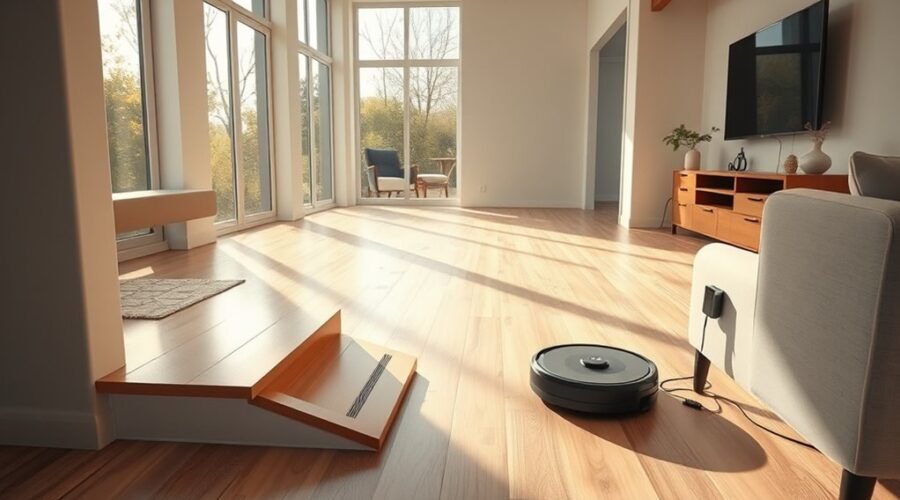
Robot vacuums can work well in split-level homes, but only if the setup is done correctly. LiDAR mapping, saved floor plans, and manual dock placement are central to the process. The user must switch maps before each run and protect stairs with no-go zones. Small errors in alignment or floor selection can disrupt coverage, which is why the daily routine matters more than it first appears.
How Multi-Floor Robot Vacuums Work
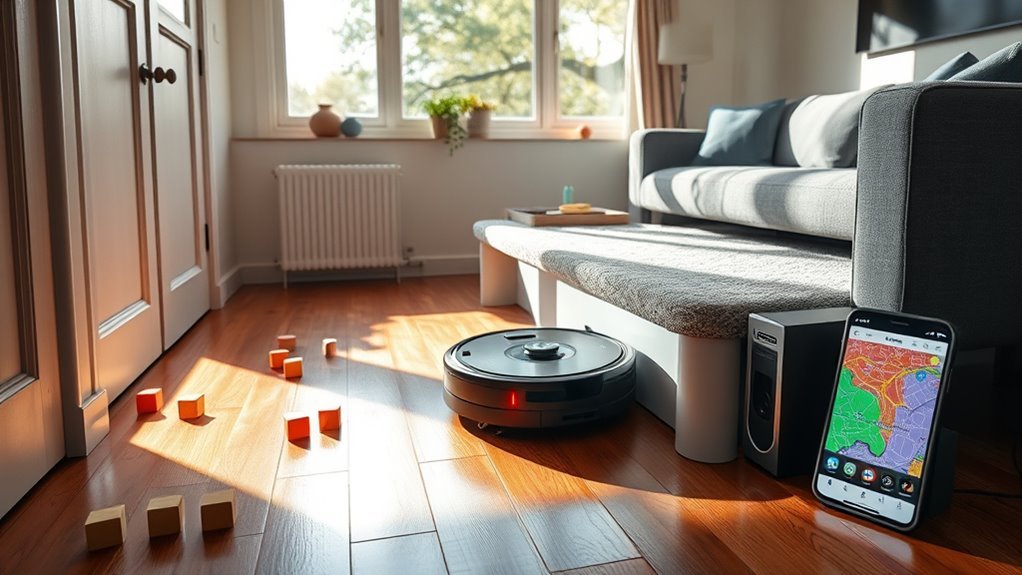
Multi-floor robot vacuums use LiDAR navigation to map each level accurately, allowing them to clean distinct areas without duplicating routes. This multi-floor robot capability depends on multi-floor mapping, where stored floor plans guide coverage and reduce wasted motion.
Obstacle detection lets the unit identify furniture, cords, and other hazards, while cliff sensors prevent falls near stairs and open landings. Because stairs cannot be climbed, manual transportation between levels remains necessary, yet operation stays autonomous once placed.
Obstacle detection and cliff sensors help the vacuum avoid hazards, while manual transport between floors keeps it running autonomously.
Users can customize cleaning schedules for each floor and set no-go zones to preserve delicate areas or block high-traffic spaces. Premium models may support recharge and resume, extending coverage after battery recovery.
The result is a practical system that lowers oversight, preserves time, and supports cleaner living across split-level homes.
Map Each Floor in the App
With mapping and obstacle avoidance handled by the robot itself, the next step is to register each level in the app. The Robot Vacuum should be carried to the target floor, placed with its dock, and started in setup mode to create a fresh map. A full cleaning pass improves mapping accuracy and lets the system read the room geometry without manual correction.
- Enable multi-map saving in the app so each floor plan is stored separately.
- Label every map clearly, such as “main level” or “upper level,” for fast selection.
- Before each cleaning run, choose the correct saved map to keep navigation aligned with the active floor.
A well-maintained multi-floor app record reduces confusion and preserves control over cleaning.
After layout changes, furniture moves, or room reconfiguration, the map should be checked and updated to keep the Vacuum’s navigation precise and the user’s routine independent.
Move the Dock and Save a Second Map
To create a usable second-floor map, the robot and docking station should be moved upstairs together.
The app should then be set to save a second map under a distinct label with multi-map support enabled.
A full cleaning cycle on the upper level allows the robot to build an accurate map for that floor.
Move Dock Upstairs
When a split-level home requires coverage on a different floor, the dock should be moved upstairs before the robot starts mapping. This move dock upstairs step enables multi-floor mapping without confusion and lets the app setup create a new map for that level. The cleaning plan should be distinct, so saved maps remain organized and efficient navigation is preserved.
- Place the dock on the upper floor and power it.
- Launch the app setup and start a new map.
- Run a full cleaning cycle so the robot learns the layout accurately.
After completion, label the map clearly and verify that saved maps are enabled.
Regular review of the app keeps the system aligned with daily use and supports practical freedom from manual vacuuming.
Save Second Floor Map
Saving a second floor map requires moving both the robot vacuum and its dock to the upper level before starting a new mapping session in the app.
This save second floor map process lets a vacuum for large homes support multi-floor mapping without manual reconfiguration each day. A full mapping run should be completed so the layout is recorded accurately, then the map should be labeled clearly in the app.
Afterward, second-floor cleaning settings and no-go zones can be adjusted to match the rooms and stair boundaries. For multi-floor cleaning, the system should keep each plan separate to prevent routing errors.
As furniture changes, the saved map should be reviewed and updated. This routine preserves reliable performance and reduces dependence on repeated setup.
Select the Right Floor Before Cleaning
Before each cleaning cycle, the correct floor map must be selected in the app so the robot vacuum cleans the intended level rather than the wrong one. In reliable multi-floor homes, app Map Management should be used to select the corresponding, saved map for the current environment.
After initial mapping, each level should be labeled clearly, allowing fast switching without confusion and preserving autonomous freedom from repeated manual corrections.
After initial mapping, label each floor clearly for quick switching and fewer manual corrections.
- Open the app and confirm the active floor map matches the level being cleaned.
- Verify that the saved map reflects recent furniture or room changes.
- Start the cycle only after the correct map is loaded and ready.
When the robot is moved to another floor, the dock should also be relocated for setup if a fresh map is needed.
Floor-specific no-go zones may then be applied, but create no-go zones only after the map selection is confirmed. Regular updates keep navigation accurate and cleaning efficient.
Set No-Go Zones for Stairs and Thresholds
No-go zones act as a critical safety boundary in the app, keeping the robot vacuum away from stairs, ledges, and other drop-offs that cliff sensors may not always interpret early enough.
To set no-go zones, the user should draw precise virtual barriers around stair edges, raised landings, and problematic thresholds. This threshold management reduces the chance of jams, scuffs, or falls on split levels.
The mapping feature on premium models can store multiple floor plans, allowing each level to carry its own exclusions without manual rebuilding. After furniture moves or layout changes, the app should be updated so boundaries remain accurate.
During daily use, the first cleaning runs should be monitored closely to confirm the vacuum respects each boundary. Minor corrections can then be made for ideal performance.
This setup preserves autonomy while keeping the machine moving safely, efficiently, and without unnecessary intervention across every level.
Choose the Right Floor Settings
Selecting the correct floor settings in the app helps a robot vacuum operate accurately across a split-level home. Each floor should be mapped separately so the system stores distinct floor maps for multiple levels and applies the right app settings during each run.
- Create accurate floor maps for every level, then label them clearly.
- Assign cleaning schedules to match traffic patterns and different floor types.
- Define no-go zones around stair landings, tight passages, and busy areas.
Strong Wi-Fi coverage on every floor is essential for real-time updates, stable control, and reliable switching between maps. Without it, navigation capabilities can degrade and cleaning routes may become incomplete.
Strong Wi-Fi coverage on every floor ensures stable control, real-time updates, and reliable map switching for uninterrupted cleaning.
Software updates should also be installed regularly, since they improve movement logic and support better handling of multiple levels.
With precise floor settings, the device works with less supervision, giving the user more freedom while maintaining disciplined, repeatable cleaning across the home.
Best DEEBOT Models for Split-Level Homes
For split-level homes, the DEEBOT X12 OmniCyclone offers the strongest performance profile, combining 22,000 Pa suction with multi-floor mapping to handle varied debris and surface demands across multiple levels.
As a best Robot Vacuum candidate, it pairs strong suction with separate floor plans, letting users assign customized cleaning schedules and no-go zones by level.
The DEEBOT X11 PRO OMNI adds obstacle avoidance and PowerBoost Technology, supporting steadier battery life during extended cleaning runs.
The DEEBOT T80 OMNI suits tighter spaces; its 3.86-inch body slips under low furniture and maintains coverage across floors without excess drag.
These DEEBOT models work best when sensors stay clean and filters are replaced on schedule, preserving mapping accuracy and airflow.
For households seeking practical autonomy, the lineup reduces manual intervention and supports cleaner transitions between levels, making routine maintenance more manageable and freeing time for other work.
Fix Multi-Floor Mapping Problems
Multi-floor mapping issues are typically corrected by carrying the robot vacuum and its dock to the target level and running a full cleaning cycle to rebuild the floor map.
The dock should remain matched to the same floor during setup, since many systems use its position as part of the navigation reference.
Once the map is saved, each floor plan should be labeled clearly in the app to prevent selection errors during future cleaning runs.
Rebuild Floor Maps
When floor plans become inaccurate or the robot vacuum confuses one level for another, rebuilding the maps is often the most effective fix. To rebuild floor maps, move the unit and charging dock, or self-cleaning dock, to each level and run the app’s mapping process anew.
- Fully charge the robot before starting.
- Clear obstacles so sensors read the room cleanly.
- Save and label multiple maps in the app for fast recall.
A fresh map gives the machine precise boundaries, reducing errors across split level homes. Regular software updates should also be checked in the app, since they can improve multi-floor handling and navigation logic.
If the robot still misidentifies floors, reset it and repeat the mapping process until each level is stored accurately. This restores dependable autonomy and easier daily use.
Match Dock To Floor
Proper docking alignment is essential for split level homes, since the robot vacuum should always start from a dock placed on the same floor to produce accurate maps and reliable navigation.
During setup, the dock should remain on that level until initial mapping is complete. The app can then create separate maps for each floor and label them clearly.
When the robot is moved upstairs or downstairs, the dock should be transported with it to preserve floor-specific positioning. Multi-floor mapping in the app should be enabled so cleaning schedules, no-go zones, and saved maps stay distinct.
Each map should be reviewed regularly and updated after furniture changes or layout shifts. This disciplined process reduces navigation errors and lets the system operate with practical independence across floors.
Frequently Asked Questions
What Is the Best Robot Vacuum for a Split-Level House?
The Roborock Qrevo CurvX is often best: strong robot vacuum features, reliable navigation technology, excellent cleaning efficiency, and good battery life. He should compare noise levels, maintenance tips, floor types, and price comparison before choosing.
Is It Okay to Use a Robot Vacuum Every Day?
Like a steady current, daily use is usually fine. It supports daily cleaning, controls pet hair, and fits most floor types. Attention to battery life, noise level, smart features, scheduling options, and maintenance tips matters.
Can I Use a Robot Vacuum on Multiple Floors, and if So, How?
Yes; many robot vacuum features support multiple floors through multi floor mapping. He should move dock, map each floor, save plans, then choose the correct map. Obstacle detection, battery life, app connectivity, maintenance tips, floor types improve cleaning efficiency.
Which Robot Vacuum Is Best for Multi-Level Floors?
The Roborock Qrevo CurvX suits multi-level floors best, balancing robot vacuum features, multi level compatibility, navigation technology, cleaning efficiency, battery life, smart home integration, floor type adaptability, and low noise levels.
Conclusion
Robot vacuums can work well in split-level homes, but only when each floor is mapped separately and the correct map is selected before every run. Some users worry that moving the dock is inconvenient, yet multi-map support and saved cleaning zones make the process routine. With proper stair exclusions, aligned docking, and regular sensor maintenance, a LiDAR-based DEEBOT can navigate multiple levels reliably and keep daily cleaning consistent.