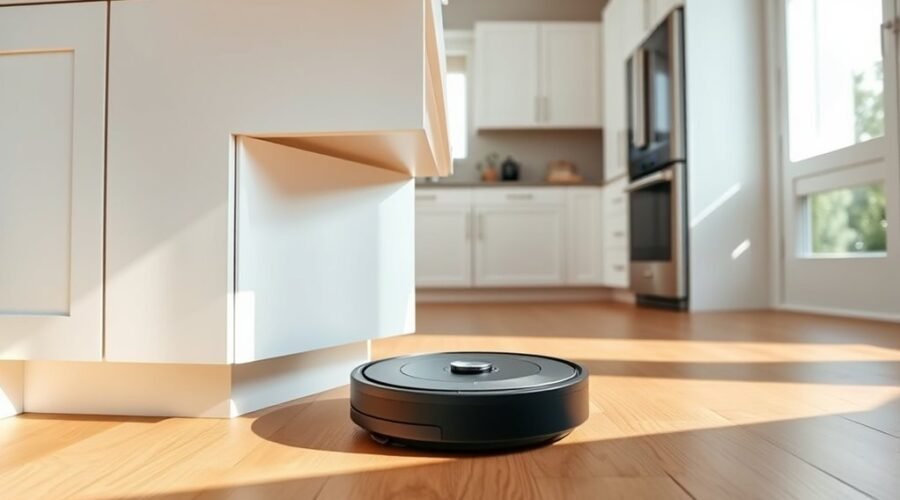
Robot vacuum toe kick clearance can decide whether your cleaner reaches the dusty edges beneath kitchen cabinets or gets stuck trying. The right fit depends on more than the gap you can see. You also need to consider the vacuum’s full height, cabinet recess depth, floor surface, and nearby obstacles. This guide explains how to measure those spaces, compare robot sizes, and prevent clearance problems.
Quick Answer
Most kitchen toe kicks are about 4 inches high, which can accommodate many robot vacuums measuring 3 to 3.5 inches tall. However, 4 inches is not a universal requirement. A shorter robot may fit a lower opening, while taller models need more space. Measure the full robot height and leave extra clearance to prevent snagging.
Key Takeaways
- A standard kitchen toe kick is commonly 4 inches high and 3 inches deep, but actual dimensions vary.
- The toe-kick recess usually has a back panel, so a robot cannot travel beneath the entire cabinet.
- Measure the vacuum’s highest point, including any raised laser sensor or navigation tower.
- Allow extra clearance for uneven floors, carpet pile, trim, and furniture that may sag.
- Docking space is separate from furniture clearance and varies by manufacturer.
How Much Toe Kick Clearance Do Robot Vacuums Need?
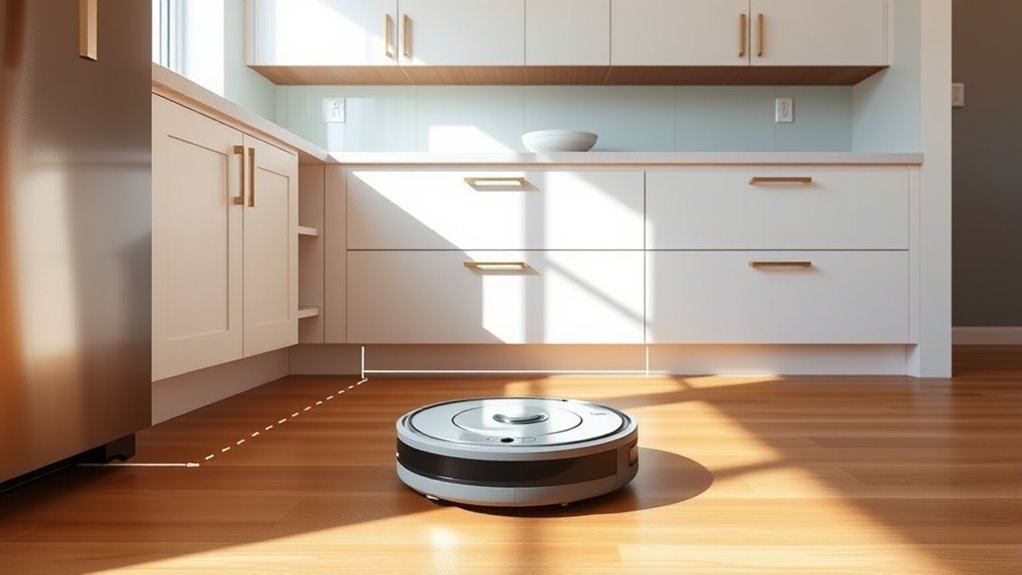
A 4-inch-high toe kick provides useful clearance for many slim robot vacuums. However, the exact requirement depends on the model’s height and the shape of the opening. Some robots measure less than 3 inches tall, while others exceed 4 inches.
A 4-inch toe kick is a common cabinet dimension, not a guarantee that every robot vacuum will fit or clean the entire recessed area.
For example, a robot that stands 3 inches tall has approximately 1 inch of vertical space beneath a 4-inch cabinet opening. A 3.6-inch-tall robot has only 0.4 inches remaining.
That difference matters when the floor is uneven or the cabinet has a downward-facing lip.
As a practical target, aim for around 0.5 inches of extra vertical clearance when your layout allows it. Treat this as a planning margin rather than a universal manufacturer requirement.
You should also understand the cabinet’s construction. Most traditional toe kicks have a recessed vertical panel behind the opening. That panel limits how far the vacuum can reach.
In many kitchens, the robot can approach the recess and sweep part of its floor edge with a side brush. It cannot travel beneath the full cabinet unless the space is actually open.
Why Toe Kick Clearance Matters
Toe kick clearance matters because insufficient space can prevent a robot vacuum from reaching cabinet edges and nearby floor areas. A tight opening can also trap the robot or cause repeated contact with cabinet trim.
When clearance is suitable, the cleaner can approach recessed edges more consistently. Its side brush may collect crumbs, dust, and hair that gather along the cabinet base.
However, height and cleaning reach are different measurements. A robot might fit beneath the cabinet overhang but still fail to clean the deepest part of the recess.
Its round body, brush position, bumper, and navigation sensors all affect how close it travels to the recessed panel.
A robot that repeatedly wedges beneath cabinetry may also interrupt cleaning cycles. In some cases, you must manually remove it before it can return to its charging station.
Checking the available space before buying or installing a robot helps reduce these problems.
How to Measure Toe Kick Space
Measure toe kick space at the narrowest usable point, not just the most visible opening. You need a tape measure, a straightedge, and the manufacturer’s dimensions for your robot vacuum.
Record the vertical height, horizontal setback, and clear width. Then check for trim, flooring changes, and anything that may interfere with the robot.
Measure Cabinet Depth
First, distinguish cabinet depth from toe-kick depth. Standard kitchen base cabinets are commonly about 24 inches deep, but that measurement does not tell you how far a robot can enter the toe-kick area.
The toe-kick setback is typically around 3 inches. Measure it horizontally from the cabinet’s front face to the recessed panel behind it.
For reference, the cabinet manufacturer’s toe-kick dimension guide describes a common planning example of 4 inches high and 3 inches deep.
These dimensions are not universal. Custom cabinets, islands, bathroom vanities, and furniture-style bases may have different profiles.
| Measurement | Typical Value | What It Means |
|---|---|---|
| Toe kick height | 4 inches | Vertical opening beneath the cabinet face |
| Toe kick depth | 3 inches | Horizontal distance to the recessed panel |
| Base cabinet depth | 24 inches | Overall cabinet depth, not robot access depth |
| Robot vacuum height | Model-dependent | Measure or confirm the highest point |
| Obstructions | Check individually | Trim, fasteners, cords, and floor transitions |
| Flooring variation | Account for changes | Can reduce effective clearance |
For a traditional enclosed cabinet base, the robot’s body generally cannot move beyond the recessed panel. Its side brush may reach partway into that shallow space, depending on the design.
Check Clearance Height
Measure the vertical clearance from the finished floor to the lowest part of the cabinet overhang. Repeat the measurement at several points because floors and cabinet edges are not always perfectly level.
- Measure from the finished floor. Place your tape measure directly beneath the cabinet’s front edge.
- Find the lowest obstruction. Check for lips, trim, and downward-facing cabinet parts.
- Measure the vacuum’s full height. Include the top sensor housing or laser navigation tower.
- Compare the two measurements. Subtract the robot’s height from the smallest opening height.
- Check the approach path. Make sure the robot can reach the cabinet without crossing a thick rug or raised threshold.
For example, if your opening measures 4 inches and the robot stands 3.4 inches tall, the remaining vertical clearance is 0.6 inches.
This gives the robot more room than an opening measuring exactly 3.4 inches.
Pro Tip: Use a straightedge across the cabinet opening to find hidden low points. Measure near corners, support legs, and flooring transitions, where the usable gap may be smaller than it appears.
Once you have the lowest height, compare it with the manufacturer’s stated clearance requirement. Some manufacturers recommend more space than the robot’s physical height alone.
Account for Obstacles
Even when the opening is tall enough, obstacles can prevent a robot vacuum from moving freely. Check the full approach route before assuming the area is accessible.
Common problems include:
- Baseboards and trim: Protruding edges can catch the bumper or top cover.
- Uneven flooring: Raised spots can reduce the usable opening.
- Rug edges: Thick carpet or mats can lift the robot closer to the cabinet.
- Loose cables: Wires can become tangled in brushes or wheels.
- Cabinet supports: Legs, brackets, and fasteners may narrow the approach.
- Debris buildup: Larger crumbs, objects, and accumulated dirt can interfere with movement.
Also measure the clear width when a robot must pass between cabinet legs or through a narrow opening. The gap must accommodate the robot’s body and allow it to maneuver without binding.
After clearing obstacles, run a supervised cleaning cycle to confirm that the robot can approach, turn, and leave the area without assistance.
Which Robot Vacuums Fit Low Clearances?
Low-profile robot vacuums are better suited to tight spaces because their bodies sit closer to the floor. However, compatibility depends on the exact model rather than the brand alone.
Models with raised navigation sensors may require considerably more vertical space. Some newer designs use retractable sensors to reduce their height beneath furniture.
Low-Profile Vacuum Models
Several robot vacuum models illustrate why you should compare actual dimensions before buying. A difference of less than an inch can determine whether a machine fits beneath a cabinet or sofa.
According to eufy’s official furniture-clearance guidance, the RoboVac 11S is about 2.85 inches tall, while several laser-navigation models are substantially taller.
The iRobot Roomba j7 specifications list a height of 3.4 inches. The j7+ uses the same robot body with a self-emptying dock.
The Roborock Saros 10 specifications show two robot heights because its laser navigation system can retract.
| Robot Vacuum | Published Height | 4-Inch Opening |
|---|---|---|
| eufy RoboVac 11S | 2.85 inches | Ample nominal height clearance |
| iRobot Roomba j7 / j7+ | 3.4 inches | 0.6 inches of nominal margin |
| Roborock Saros 10 | 3.14 inches retracted; 3.68 inches raised | Fit depends on sensor position and navigation behavior |
| eufy L50 / L60 series | 4.09 inches | Too tall for a true 4-inch opening |
These measurements describe the robot bodies, not guaranteed minimum passing heights. Always consider the manufacturer’s navigation requirements and the available margin.
Clearance and Dock Space
A robot that fits beneath furniture may still need much more room around its charging dock. These are separate requirements and should not be confused.
The robot’s body height controls access beneath furniture. Its dock needs enough surrounding floor space for approach, alignment, and departure.
For example, a slim robot may fit beneath a 3.5-inch opening but require several feet of open floor space in front of its charging base.
If the docking station has a tall self-emptying or mop-washing unit, you must also account for its overhead clearance.
Keep the docking station outside narrow toe-kick recesses unless the manufacturer explicitly supports that installation.
Best Fit Features
The best robot vacuum for low-clearance spaces combines a short body with reliable navigation and effective edge cleaning. Height remains the first measurement to consider.
Useful features include:
- Low-profile construction: Allows access beneath lower furniture and cabinet edges.
- Retractable navigation sensors: Can reduce the robot’s height in supported cleaning modes.
- Effective side brushes: Help sweep debris from recessed edges toward the main cleaning path.
- Obstacle detection: Helps the robot recognize furniture, trim, and other restrictions.
- No-go zones: Let compatible models avoid spaces where they repeatedly become stuck.
- Suitable body geometry: Helps the robot move around furniture legs and approach corners.
A tapered or rounded body may help around certain obstacles, but it cannot overcome an opening shorter than the robot’s full operating height.
For narrow cabinet spaces, prioritize a verified height specification and practical edge-cleaning performance over appearance alone.
Recommended Clearances for Beds and Sofas
Beds and sofas do not have a universal robot vacuum clearance requirement. The correct gap depends on the specific machine, its navigation sensors, and the furniture’s lowest point.
A low-profile robot around 3 inches tall may fit beneath furniture with 3.5 to 4 inches of space. Taller machines may require significantly more.
For example, Narwal’s official furniture-clearance guidance recommends 5.1 to 5.5 inches for the listed Freo models to support effective navigation beneath beds and sofas.
This shows why a general recommendation of 3.6 inches cannot apply to every vacuum.
For beds, check the frame rails, center supports, and any low crossbars. The visible space beneath the outer frame may be higher than the opening farther inside.
For sofas, measure the lowest solid component rather than just the leg height. Fabric skirts, sagging cushions, and support structures may interfere with movement.
Thick carpet also changes the effective clearance because the robot rides above the hard floor beneath the pile.
Choose furniture clearance based on the actual machine you own or plan to buy, with enough extra room to avoid contact.
Why Robot Vacuums Get Stuck Under Cabinets
Robot vacuums usually get stuck beneath cabinets because the opening is too close to the machine’s height or contains an obstruction that prevents movement. A gap may appear accessible from one angle but become narrower as the robot moves forward.
The most common causes are:
- Cabinet lips: The front edge catches the robot’s top cover or sensor housing.
- Insufficient vertical margin: The robot fits tightly and cannot move freely.
- Uneven floors: A raised section reduces clearance beneath the cabinet.
- Thick rugs: Carpet pile lifts the robot into the overhang.
- Restricted turning space: The robot enters an area where it cannot turn or reverse easily.
- Navigation limitations: Sensors may fail to recognize an overhang or incorrectly judge the available opening.
When this happens, the robot may repeatedly move forward and backward, rotate in place, or stop with a stuck warning.
If the problem occurs at the same cabinet every time, the location likely needs a physical adjustment or a restricted cleaning boundary.
Warning: Do not force a robot vacuum beneath a cabinet or pull it out roughly when stuck. Power it off if appropriate, remove it carefully, and inspect the sensor housing, bumper, and brushes for damage before restarting.
Even after solving the clearance problem, the deepest part of a conventional toe-kick recess may still require occasional manual cleaning.
How to Fix Docking Problems in Tight Spaces
Docking problems often result from blocked approach paths, poor station placement, or dirty navigation components. The first step is to measure the space around the dock using the requirements for your specific model.
Do not assume every robot needs the same amount of clearance. Manufacturer recommendations differ, and newer dock designs may have different space requirements.
Measure Dock Clearance
Start by checking how much clear floor space surrounds the charging station. Measure the left, right, and front approach areas, then confirm that the dock sits on a hard, level surface.
For many Roborock models, the manufacturer’s dock placement guidance recommends:
- At least 0.5 meters (1.6 feet) on each side.
- At least 1.5 meters (4.9 feet) in front.
- At least 1 meter (3.3 feet) above the dock.
- A hard, flat floor with the station against a wall.
For Roomba models, iRobot’s docking guidance generally recommends about 0.5 meters on either side and 1.2 meters in front. It also provides guidance for stairs, nearby docks, and overhead access.
These are manufacturer-specific examples, not interchangeable rules for every machine.
A robot may physically reach its dock in a smaller space, but that does not mean the placement meets its recommended operating conditions.
Reposition for Better Alignment
If your measurements meet the manufacturer’s requirements but the robot still misses its dock, adjust the station’s position and remove nearby obstacles.
- Move the dock against a straight wall. Make sure it sits flat rather than at an angle.
- Clear the approach path. Remove cords, rugs, baskets, and furniture that interrupt movement.
- Check the floor. Place the station on a stable, level surface rather than thick carpet.
- Inspect the sensors. Gently clean accessible docking sensors and signal areas according to the manual.
- Check the charging contacts. Remove visible dust or debris using the manufacturer’s recommended method.
- Test the return route. Start a cleaning cycle and confirm that the robot can find and enter the dock.
If the robot still fails, review its saved map and docking settings where supported. A recently moved dock may require the robot to recognize the new location.
Repeated failure after repositioning may indicate dirty sensors, damaged contacts, or another model-specific problem that requires manufacturer support.
Toe Kick Clearance Tips for Beds and Sofas
Unlike cabinets, beds and sofas usually have open space beneath them rather than a shallow enclosed toe kick. This gives robot vacuums more potential cleaning coverage, but the furniture must provide a clear route.
To improve access beneath low furniture:
- Measure the lowest point: Check frame rails, braces, and sagging fabric rather than relying only on leg height.
- Remove floor clutter: Keep shoes, storage boxes, cables, and loose items away from the robot’s path.
- Consider suitable furniture risers: Raising compatible furniture may provide the extra clearance needed.
- Check stability: Make sure furniture remains secure and properly supported after any height adjustment.
- Keep the exit path open: The robot must be able to leave the space as easily as it enters.
A slightly taller furniture opening can make a meaningful difference when the original gap is close to the robot’s height.
However, raising furniture is not always appropriate. Consider the frame design, load, stability, and manufacturer instructions before making changes.
For low beds or sofas that cannot be raised safely, use a suitable slim robot or clean the inaccessible space manually.
Common Toe Kick Clearance Mistakes
The biggest toe kick clearance mistake is assuming a standard 4-inch cabinet opening guarantees robot vacuum access. Actual fit depends on the robot’s height, the recess structure, and the surrounding floor.
Other common mistakes include:
- Confusing cabinet depth with toe-kick depth: A 24-inch-deep cabinet does not provide 24 inches of open floor space beneath it.
- Ignoring the kickboard: Most traditional recessed bases have a back panel that prevents deeper access.
- Measuring only the robot’s main body: The raised sensor housing may be its highest point.
- Using one measurement for the whole kitchen: Flooring and trim can change between cabinet sections.
- Assuming a robot can clean every corner: Round bodies and fixed brushes may leave debris along deep edges.
- Ignoring rugs and mats: These can reduce the effective opening by raising the robot.
- Confusing docking requirements with furniture clearance: The station needs its own placement measurements.
Correcting these mistakes before buying a robot vacuum can save repeated cleaning interruptions and unsuitable equipment choices.
Remember that a manufacturer’s published robot height is only one part of compatibility. The full movement path must also work.
When a Robot Vacuum Won’t Fit Under Furniture
If a robot vacuum is taller than the available opening, it cannot safely pass beneath the furniture. When the gap is only slightly higher than the robot, it may still become stuck because of floor changes or obstacles.
Your options depend on whether you can change the furniture, use a different robot, or restrict access.
The manufacturer’s eufy Omni E35 troubleshooting guidance explains that tight gaps can cause the robot to misjudge available space. It recommends checking measurements and using supported no-go zones or suitable furniture risers.
Try the following solutions in order:
- Remove temporary obstacles. Clear rugs, objects, or loose materials that reduce access.
- Check the lowest clearance. Measure the actual gap and compare it with the robot’s required height.
- Adjust removable trim if appropriate. Only make changes that are safe and do not affect cabinet support or other installations.
- Raise compatible furniture. Use appropriate supports only when the furniture can be lifted safely.
- Set a no-go zone. Prevent compatible robots from entering openings where they repeatedly become trapped.
- Use another cleaning method. A crevice attachment or slim manual vacuum may reach areas the robot cannot.
For an enclosed kitchen toe kick, changing the robot’s height will not necessarily increase its reach beyond the recessed panel.
If cabinet modifications would affect structural supports, plumbing, electrical wiring, or built-in appliances, consult a qualified professional before proceeding.
Pro Tip: Before purchasing a replacement vacuum, make a simple cardboard height template matching the proposed robot’s tallest point. Use it to check whether your narrowest furniture openings offer enough room, then confirm the manufacturer’s actual passing-clearance requirement.
Frequently Asked Questions
How Much Clearance Does a Robot Vacuum Need?
A robot vacuum needs an opening taller than its full operating height. Many slim models measure around 3 to 3.5 inches, so a 4-inch gap often provides useful room. However, taller machines may require more clearance. Measure the narrowest point and compare it with the manufacturer’s published requirements.
What Is the Recommended Clearance Height for a Robot Vacuum?
Four inches is a useful planning target for many low-profile robot vacuums, but it is not a universal recommendation. The ideal height depends on the model. Leaving about half an inch beyond the robot’s full height provides a practical margin when space allows, while manufacturer-specific requirements take priority.
Which Robot Vacuum Has the Lowest Clearance?
The eufy RoboVac 11S is one low-profile option, with a published body height of about 2.85 inches. However, it is not possible to call it the lowest-clearance robot across all available models without a complete comparison. Check each manufacturer’s minimum passing height rather than relying on body height alone.
How Much Clearance Does Roborock Need to Vacuum Under Furniture?
Roborock clearance depends on the model. For example, the Saros 10 measures approximately 3.14 inches with its navigation sensor retracted and 3.68 inches with the sensor raised. A suitable opening must account for its operating configuration, available movement space, and the manufacturer’s specific low-clearance instructions.
Can a Robot Vacuum Clean Under Kitchen Cabinets?
A robot vacuum can clean exposed floor edges beneath a cabinet overhang when clearance allows. However, most traditional kitchen toe kicks are shallow recesses with a vertical panel behind them. The robot cannot travel through that panel, although its side brush may reach part of the recessed floor.
Will a Robot Vacuum Get Stuck in a 4-Inch Gap?
Yes, a robot vacuum can get stuck in a 4-inch gap if its body is nearly that tall or the space contains obstructions. Raised navigation sensors, uneven flooring, and carpet pile can reduce usable clearance. Compare the actual opening with the manufacturer’s requirements and avoid tight spaces that repeatedly trap the robot.
Conclusion
Robot vacuum toe kick clearance depends on the actual opening, cabinet construction, and vacuum height. A 4-inch gap works for many slim models, but it cannot guarantee access for every machine.
Measure the lowest usable height, check the toe-kick setback, and follow your robot’s clearance specifications. If the opening is too tight, adjust the space safely or restrict access to prevent repeated jams.
Sources
- JWQ Cabinetry, Cabinet Toe Kick Guide: Typical cabinet recess height and depth.
- eufy Support, Can the RoboVac Go Under My Furniture?: Model-specific robot heights and clearance limitations.
- iRobot, Roomba j7 Product Specifications: Published robot dimensions.
- Roborock, Saros 10 Product Specifications: Robot height with the laser navigation sensor raised and retracted.
- Narwal Support, Furniture Clearance Requirements: Recommended space beneath beds and sofas.
- Roborock Support, Where Should I Position My Device?: Charging dock placement and clearance.
- iRobot Support, Where to Place the Dock: Charging station positioning requirements.
- eufy Support, Omni E35 Stuck-Vacuum Troubleshooting: Tight-clearance problems, no-go zones, and furniture adjustments.