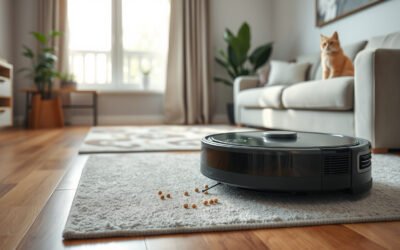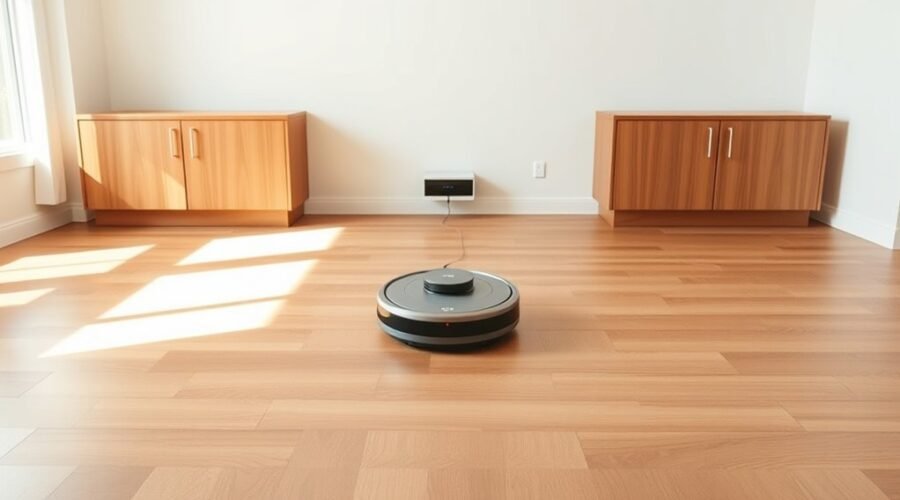
A robot vacuum dock does not need a large area, but it does need enough open space to work reliably. Most setups perform best with about 0.5 meters on each side and roughly 1.2 meters in front, with a wider lane helping even more. Placement also matters. A flat, hard surface near power and a clear route can prevent docking issues, but the exact limits depend on the home and the model.
How Much Space Does a Robot Vacuum Dock Need?
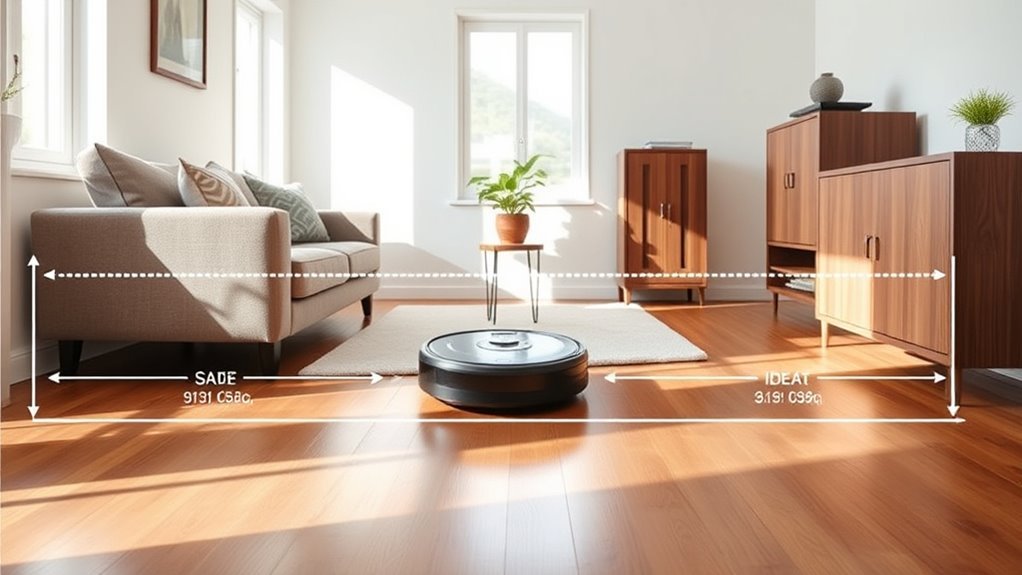
A robot vacuum dock typically needs about 0.5 meters, or 1.5 feet, of clear space on each side and roughly 1.2 meters, or 4 feet, in front to allow reliable approach, alignment, and departure.
This space around the robot vacuum dock helps the machine find its way home without confusion or repeated misses. A flat, hard surface near a power outlet supports steady charging and consistent contact.
Obstacles, cords, and furniture legs can interrupt navigation and reduce docking reliability. A wider clear lane, ideally about 5 feet in front, gives the unit room to correct its path and complete the return cycle.
In multi-floor homes, placement should remain on the same level the robot serves, since stairs are not traversed independently.
Proper dock placement reduces wasted effort, protects autonomy, and keeps cleaning routines efficient.
How Much Side Clearance Does a Robot Vacuum Dock Need?
Side clearance is one of the main factors that affects how reliably a robot vacuum returns to its dock. For strong docking performance, a robot vacuum dock should ideally have at least 0.5 meters of open space on each side. This spacing gives the machine room to align itself without clipping walls, furniture, or other obstacles. Limited side clearance can confuse navigation, slow the return process, or cause repeated failed attempts. Clear pathways around the dock help preserve clean movement and reduce avoidable interference.
| Side clearance | Typical result | Practical note |
|---|---|---|
| 0.5 m each side | Best reliability | Recommended baseline |
| 20 cm each side | Often workable | User reports vary |
| Less than 20 cm | Higher risk | Model dependent |
Some users report acceptable results with tighter placement, but that should not be treated as universal. The manual for the specific model remains the final reference for safe spacing and proper function.
How Much Front Clearance Does a Robot Vacuum Dock Need?
Front clearance is another key requirement for reliable docking, and a robot vacuum dock typically needs about 1.5 feet (0.5 meters) of open space in front to let the machine approach and align without obstruction.
This front clearance gives the robot vacuum room to detect the dock, adjust its path, and complete the return cycle with less friction or hesitation. Many manufacturers recommend even more—around 5 feet (152 cm)—to support smoother navigation and reduce the chance of missed connections.
If the space ahead is cramped, the robot may slow, turn away, or fail to dock altogether. A flat, level surface also helps the dock remain stable and makes alignment more consistent.
Keeping the area free of furniture, cords, and other obstacles preserves the robot’s autonomy and reduces manual intervention. Clear access in front of the dock is thus essential for dependable, low-effort operation.
Where Should You Place a Robot Vacuum Dock in a Small Home?
In a small home, the best place for a robot vacuum dock is usually near a power outlet on a hard, flat surface with enough open space around it for reliable docking and charging.
The dock dimensions should fit the room without narrowing walkways or creating clutter. Aim for at least 0.5 meters on each side and 1.5 meters in front, so the robot can approach freely and return without strain.
Aim for at least 0.5 meters on each side and 1.5 meters in front for easy docking.
A practical placement also keeps the dock visible, stable, and easy to service.
- Use a wall edge that stays open.
- Keep cords secured and out of traffic paths.
- Favor recessed niches or slim consoles when floor space is limited.
- Avoid hidden spots behind large appliances.
This approach supports cleaner movement, fewer obstacles, and a more liberated living space.
It also helps the dock remain integrated into the home while preserving access, order, and daily convenience.
What Causes Robot Vacuum Docking Problems?
Robot vacuum docking problems often begin with wrong dock placement, especially when the station lacks the recommended clearance or sits on an uneven surface that prevents proper alignment.
An obstructed return path, such as furniture or other items placed too close, can block the robot before it reaches the charging contacts.
Weak signal or power can also disrupt docking by preventing the dock from communicating or supplying charge reliably.
Wrong Dock Placement
Poor dock placement is a common reason a robot vacuum fails to return home reliably. The dock should have enough open space for clear navigation and ideal performance, with dock placement keeping at least 0.5m on each side and 1.2m in front. Walls, furniture, and other obstacles can prevent accurate alignment.
- Place the dock on a flat, stable surface.
- Avoid dark corners that weaken sensor guidance.
- Keep it away from large metal appliances that may interfere with signals.
- In multi-floor homes, assign each level a practical docking setup.
When the station is positioned correctly, the robot can map space more effectively and return with less effort.
Routine maintenance supports dependable charging and reduces avoidable downtime.
Obstructed Return Path
An obstructed return path is a frequent cause of docking failure, especially when furniture, cables, or decorative items block the vacuum’s approach to the home base. When the robot cannot travel directly to the dock, it may circle, hesitate, or miss alignment, which wastes time and can drain the battery.
A clear docking area should include at least 1.5 feet, or 0.5 m, of open space in front of the dock so the unit can line up correctly. Regularly check the docking area for cords, low objects, and clutter that interrupt the path.
Maintaining an organized, clear docking area gives the robot the freedom to return efficiently, charge reliably, and complete cleaning tasks with less intervention.
Weak Signal Or Power
Weak signal or inconsistent power can also interfere with docking performance, especially in smart robot vacuums that rely on a stable connection to the dock for mapping, navigation, and charging functions.
Weak Wi-Fi signals may limit communication in larger homes, while a dock inside a room with thick walls or metal appliances can reduce reliability. Power outlet issues, such as loose plugs or tripped breakers, may stop charging altogether.
- Check signal strength near the dock.
- Test the outlet and cord.
- Keep the dock on a level surface.
- Clear dust from sensors and contacts.
A free, efficient routine depends on steady power, clear communication, and regular maintenance.
Real Robot Vacuum Dock Setup Examples
Real-world examples show that a dock can work with less space than the usual recommendation of about 0.5 meters on each side and 1.2 meters in front.
Some users report reliable docking with only 15 to 20 cm of side clearance, especially in small-space setups where placement is carefully arranged.
Hidden dock placement can also succeed when the robot has a clear approach path, even if the surrounding room is tight.
Real-World Dock Clearances
Although manufacturer guidance often calls for about 0.5 meters of clearance on each side and roughly 1.2 meters in front, real robot vacuum dock setups can work with less space in practice.
In a practical robot vacuum setup, clearance needs vary by model, room layout, and floor type, so users often test what still supports ideal docking.
- Justin De Mers reported success with only 20 cm on one side.
- Chris Harding found 15 cm adequate in his setup.
- Community forums show many similar deviations from stated guidelines.
- A level surface, hard flooring, and no obstacles improve results.
These examples suggest that docking freedom is not fixed by rules alone. Instead, careful placement and testing can reveal workable clearances without sacrificing performance.
Small-Space Dock Setups
A handful of real robot vacuum dock setups show that tight clearances can still work reliably. Community reports suggest that small-space dock setups often succeed with 15-20cm on each side, giving users more freedom than strict manuals imply. For robot vacuum storage, the key is easy access for the unit, not excess floor area.
| Setup example | Reported clearance |
|---|---|
| Justin De Mers | Wall, end table, air purifier |
| Chris Harding | 20cm |
| Jamie Littlewood | 15cm |
| Community users | 15-20cm |
These cases indicate that practical testing matters more than rigid assumptions. Docks placed in compact spots have continued to charge and launch normally. For many households, the useful standard is simple: enough room for consistent docking, easy access, and a layout that supports reliable daily use without surrendering precious space.
Hidden Dock Placement Ideas
Practical dock placement does not have to mean leaving the unit exposed in open floor space. Many homes hide the dock behind end tables, entertainment units, or slim console tables, using 15 to 20 cm on each side and preserving movement.
- Recessed wall niches can free floor space while keeping access simple.
- Under-bed zones suit smaller apartments, where the dock stays hidden yet usable.
- Decorative mats or temporary screens can define the dock area without disrupting decor.
- Hallway shelves can conceal charging stations and blend them into daily circulation.
These setups support autonomy by reducing visual clutter and making the dock feel integrated rather than intrusive.
When Can You Use Less Dock Clearance?
Less dock clearance can sometimes work when the robot vacuum has strong navigation and a straightforward approach path, even if the space falls short of the manufacturer’s ideal recommendation.
Less dock clearance can still work when navigation is strong and the approach path is straightforward.
In practice, some robot vacuums dock reliably with only 15 cm on each side, and community reports show that a wall on one side, end tables, or nearby appliances do not always prevent success.
This flexibility matters for tighter rooms where standard dock clearance is hard to provide. Advanced-navigation models are often more forgiving, especially when the dock faces an open, direct route.
Even so, obstacles should still be checked carefully, because performance can change with floor plan, furniture placement, and the robot’s own sensing system.
Recommended spacing remains the safer choice for maximum consistency, but many users find reduced space sufficient.
The result is more freedom in placement without automatically sacrificing daily operation.
Frequently Asked Questions
Where to Put a Robot Vacuum Dock?
A robot vacuum dock should go on a hard, flat floor near an outlet, in ideal locations with open clearance, away from furniture placement obstacles, walls, and stairs, to maximize charging efficiency and navigation reliability.
What Are the Recommended Dimensions for a Roborock Docking Station?
Roborock docking stations generally need about 0.5 meters on each side and 1.2 meters in front. These dock placement tips support robot vacuum compatibility, simplify docking station maintenance, and keep operation efficient, unobstructed, and autonomous.
How Much Clearance Does a Robot Vacuum Need?
A robot vacuum typically needs about 0.5 meters on each side and 1.2 meters in front. Clearance requirements depend on robot vacuum height, docking station placement, and a level, obstacle-free path for reliable docking.
What Is the Best Docking Station for a Robot Vacuum?
Like a quiet harbor for a machine, the best docking station matches the vacuum’s model, offers reliable charging efficiency, and supports practical robot vacuum features. Strong docking station compatibility, easy access, and tidy cable management matter most.
Conclusion
In practical terms, a robot vacuum dock performs best when given a modest but respectful amount of breathing room: roughly 1.5 feet on each side and about 4 feet in front, with an even wider lane preferred when possible. A flat, hard surface near power remains the most reliable setting. With clear pathways and minimal clutter, docking tends to proceed more gracefully, reducing the chance of awkward pauses, missed approaches, or other small navigational misunderstandings.