Choosing between a traditional vs transitional living room comes down to how formal, detailed, and modern you want your space to feel. Traditional rooms lean into classic 18th- and 19th-century silhouettes, symmetrical layouts, dark woods, and rich textiles. Transitional rooms keep that classic comfort but simplify the furniture profiles, lighten the color palette, and mix in modern materials so the space feels relaxed and current.
Quick Answer
A traditional living room is formal, symmetrical, and richly detailed, featuring carved dark woods, rolled-arm upholstery, layered patterns, and jewel or warm neutral tones. A transitional living room blends traditional warmth with modern simplicity, using clean-lined seating, warm neutral palettes, mixed materials, and fewer accessories for a lighter, more flexible space.
Key Takeaways
- Choose traditional design if you love formal symmetry, architectural millwork, antique casework, patterned rugs, and saturated hues like navy, burgundy, or forest green.
- Choose transitional design if you want an airy, family-friendly room built on warm neutrals, organic textures, and streamlined upholstery that is easy to refresh.
- Tell them apart by silhouette and surface detail: traditional furniture uses turned or cabriole legs and tufted backs, while transitional furniture favors tapered legs, track arms, and smooth surfaces.
- Use the 60-30-10 color formula: dedicate 60% of the room to a dominant base shade, 30% to a secondary tone on upholstery or drapery, and 10% to accents.
- Blend both styles with a 70/30 split: let one style lead at 70% of the room and use the other for 30% as a deliberate contrast, anchored by consistent scale and repeated finishes.
What Defines Traditional Living Room Style?
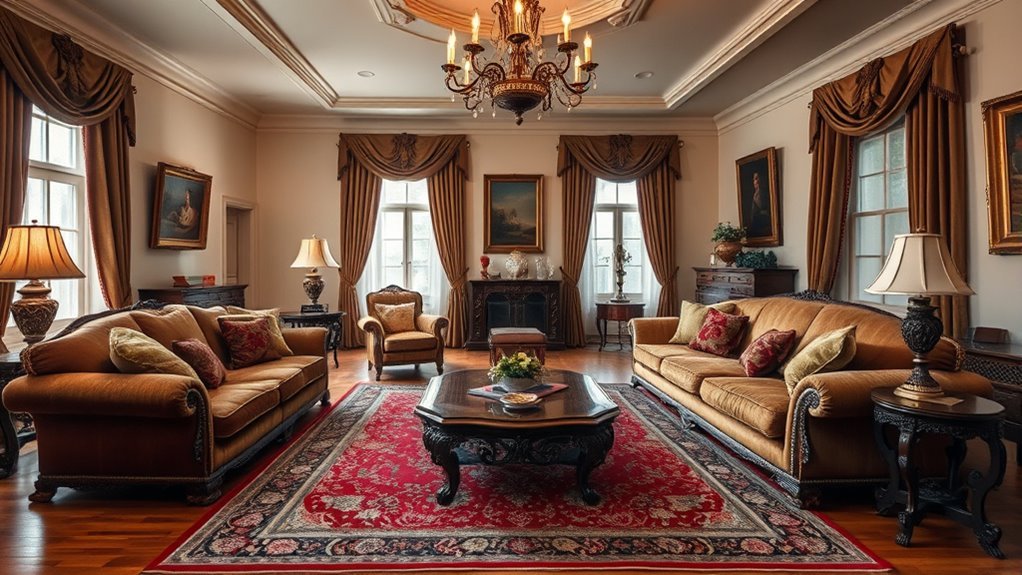
A traditional living room is rooted in classic European and American decorative arts from the 18th and 19th centuries. It combines formal furniture silhouettes, carved wood, symmetrical arrangements, and layered textiles to create a space that feels established, graceful, and intentionally ordered rather than stiff or museum-like.
Historical Roots and Classic Silhouettes
Common traditional living room features include rolled-arm sofas, wingback chairs, carved coffee tables, matching end tables, framed oil paintings or botanical prints, Oriental or Persian-style rugs, and pleated drapery. Many of these pieces trace directly to historic periods documented in Queen Anne and Chippendale furniture styles from 1730 to 1790. Queen Anne design popularized S-curved cabriole legs, pad or slipper feet, and cushioned comfort, while Thomas Chippendale’s 1754 pattern book, The Gentleman and Cabinet-Maker’s Director, codified ball-and-claw feet, pierced chair splats, and carved mahogany casework.
Mid-18th-century Rococo artisans also shaped traditional interiors through ornamental carving. As explained in the Victoria and Albert Museum’s introduction to the Rococo style, the movement took its name from the French word rocaille (rock or broken shell) and favored asymmetrical S- and C-scrolls alongside stylized acanthus leaves between 1740 and 1770. You can see how American cabinetmakers adapted these carved motifs in The Metropolitan Museum of Art’s American Rococo essay.
Rich Color Palettes and Layered Fabrics
Color and textile weight are major clues in a traditional room. Walls and upholstery often feature deeper, richer shades such as burgundy, navy, forest green, chocolate brown, warm cream, antique gold, and muted jewel tones. Fabrics include velvet, damask, silk, brocade, wool, leather, and heavy linen, often finished with piping, bullion fringe, or nailhead trim to make the seating feel substantial.
Note: Traditional does not have to mean formal to the point of discomfort. A traditional living room still works for everyday family life when you choose deep, supportive seat cushions, durable performance velvet or leather, and warm lighting.
Key Characteristics of Transitional Living Room Design
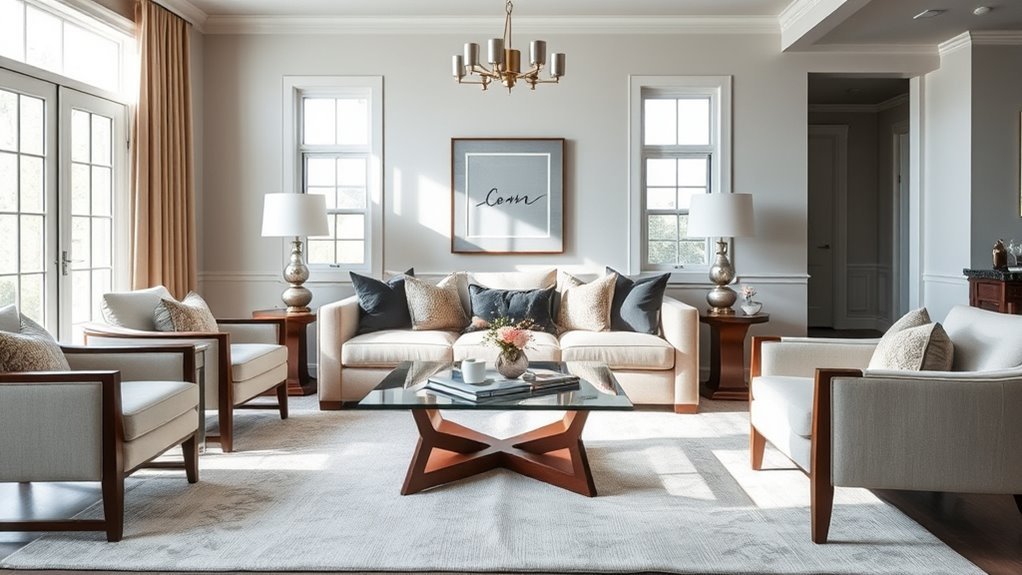
A transitional living room bridges traditional warmth and modern restraint. It keeps the inviting proportions and classic architectural bones of a traditional space while stripping away heavy ornament, dark visual weight, and fussy accessories in favor of clean lines and tactile materials.
Design publications widely define the look as a middle ground between eras. Architectural Digest describes transitional design as a blend that feels classic and current at once, while The Spruce highlights neutral palettes, mixed materials, layered textures, and restrained decor as its core traits.
Streamlined Profiles and Mixed Materials
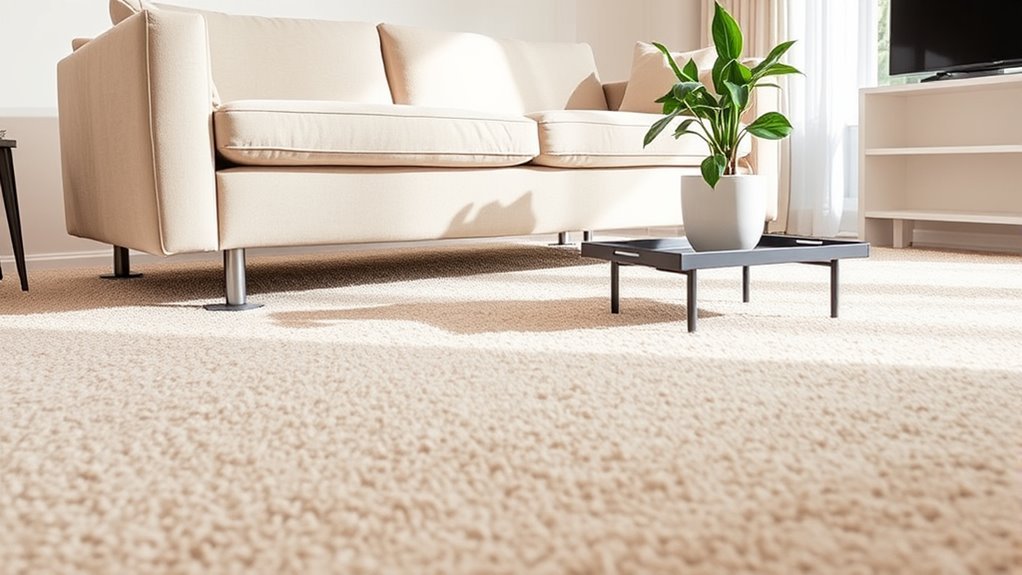
In a transitional living room, you might pair a straight-lined track-arm sofa with a vintage walnut side table, lay a muted antique rug beneath a simple travertine or marble coffee table, or update a classic wingback chair in crisp, unpatterned linen. The room retains warmth and character, but the overall impression is calmer and less formal than a strictly traditional space.
Typical transitional living room features include:
- Warm neutral foundations: Ivory, alabaster, beige, greige (gray-beige), taupe, soft pewter, and medium oak or walnut tones.
- Balanced silhouettes: Straight sofa frames softened by gently sloped arms, barrel-back swivel chairs, or round metal accent tables.
- Contrast in materials: Natural wood paired with blackened steel, brushed brass, glass, honed stone, nubby bouclé, linen, wool, and smooth saddle leather.
- Tailored window treatments: Simple linen or cotton pinch-pleat panels hung on clean metal rods rather than heavy swags, valances, or tassels.
- Edited surfaces: Fewer, larger-scale accessories—such as a single ceramic vessel, a stack of art books, and a sculptural table lamp—instead of crowded curio displays.
Traditional vs. Transitional Living Room Styles: Key Differences
The fastest way to tell a traditional vs transitional living room apart is to look at ornament, contrast, and symmetry. Traditional design celebrates decorative craftsmanship, matching furniture pairs, and layered pattern. Transitional design edits those details down so silhouette, texture, and open space carry the room.
| Feature | Traditional Living Room | Transitional Living Room |
| Overall feel | Formal, classic, polished, and richly layered. | Balanced, relaxed, tailored, and airy. |
| Furniture shapes | Rolled arms, carved wood frames, skirted upholstery, button tufting, cabriole or turned legs, wingback chairs. | Track or sloped arms, tapered legs or plinth bases, unskirted sofas, barrel chairs, mixed vintage and modern tables. |
| Color palette | Saturated jewel tones (navy, burgundy, emerald), warm cream, antique gold, and dark mahogany or cherry stains. | Warm white, ivory, greige, taupe, and soft gray, accented with muted blue, olive, charcoal, and medium oak or walnut. |
| Fabrics and patterns | Velvet, silk, damask, brocade, chinoiserie, florals, stripes, and intricate Oriental rugs. | Linen, bouclé, wool, leather, and chenille in solid weaves, subtle geometrics, or tone-on-tone textures. |
| Architectural trim | Multi-piece crown molding, dentil trim, chair rails, raised-panel wainscoting, and carved fireplace mantels. | Simple single-profile crown molding, Shaker or flat-panel millwork, and clean stone or plaster fireplace surrounds. |
| Layout and lighting | Strict mirror-image symmetry around a fireplace, paired ginger-jar lamps, crystal chandeliers, and shaded sconces. | Asymmetrical visual balance, modular or L-shaped seating, sculptural metal pendants, and minimalist floor lamps. |
| Best for | Historic homes, closed floor plans, formal entertaining spaces, and collectors of antiques and fine art. | Busy households, open-concept layouts, mixed furniture collections, and rooms needing low-maintenance warmth. |
Furniture and Layout Choices
Furniture silhouette and room arrangement establish the mood before you add a single pillow. Traditional rooms rely on carved detail and mirror-image pairs to create order, while transitional rooms simplify the furniture profiles and use flexible, asymmetrical balance that still respects comfortable human scale.
Recommended Products

5-in-1 Convertible Boneless Sofa & Sleeper Bed : Tired of bulky, space-hogging furniture? Our versatile boneless floor sofa breaks the limits of traditional couches. It effortlessly transforms from a comfortable 3-seat sofa into an oversized sleeper bed, lounge recliner or casual game seat with a simple flip. Whether you are hosting overnight guests, enjoying family movie nights, relaxing during daily lounging or setting up a casual gaming corner, this multi-functional piece works perfectly for living rooms, bedrooms, apartments, dorms and game rooms.

Machine Washable & Easy to Clean: The surface features water-repellent performance for simple cleanup when drinks spill accidentally, reducing the chance of liquid soaking deep into fibers. You can wipe spills quickly with a towel, remove local stains via spot cleaning with a damp cloth, or regularly vacuum for daily upkeep. The whole rug supports machine washing for deeper cleaning
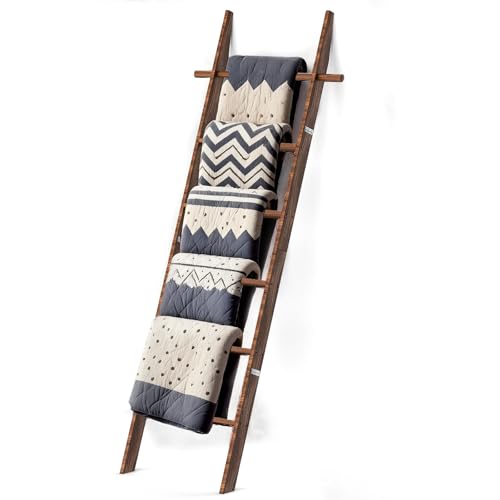
Premium Handcrafted Quality: Made from high-quality wood by skilled craftsmen, this quilt rack ladder ensures sturdiness and durability. Its smooth surface prevents snagging on blankets and clothing, while non-slip pads protect your walls and floors.
Comparing Sofa, Chair, and Table Profiles
In a traditional living room, furniture celebrates visible joinery and ornament: rolled English or Lawson arms, turned or cabriole legs, diamond-tufted backs, nailhead trim, and tailored box-pleat skirts. Matching pairs anchor the room, such as twin table lamps on matching mahogany end tables or two wingback chairs facing a sofa.
In a transitional living room, furniture retains generous seat depth (typically 21 to 24 inches) but drops the ornate trim. A sofa may feature a gentle curve or slim track arm with exposed tapered wood legs. Coffee tables, consoles, and bookcases use clean rectangular, oval, or drum shapes crafted from white oak, walnut, honed limestone, or blackened iron.
Spacing and Layout Proportions
Whether you arrange pieces symmetrically or asymmetrically, both styles depend on clear layout measurements so the room functions comfortably:
- Coffee table distance: Leave 14 to 18 inches between the front edge of the sofa and the coffee table—close enough to set down a drink without leaning far forward, yet wide enough for knee clearance.
- Coffee table dimensions: Choose a table roughly two-thirds the length of your sofa and within 1 to 2 inches of the sofa’s seat height (usually 16 to 18 inches tall).
- Walkway clearance: Maintain 30 to 36 inches of open floor on main traffic paths around the seating group, and at least 24 inches in secondary pass-throughs.
- Conversation radius: Keep seats within 8 to 9 feet of one another so guests can talk comfortably without raising their voices.
Colors, Materials, and Textures
Traditional living rooms build depth through color contrast and multi-pattern layering, whereas transitional living rooms build depth through tactile contrast within a quiet neutral palette. Applying the classic 60-30-10 color rule makes either palette look intentional rather than accidental.
Applying the 60-30-10 Color Rule
In both styles, assign 60% of the room to your dominant color (walls, large area rug, and main sofa), 30% to a secondary color (accent chairs, drapery, and wood casework), and 10% to accents (pillows, artwork, and lighting):
- Traditional 60-30-10 example: 60% warm cream walls and a beige-ground Persian rug; 30% deep navy velvet upholstery and dark mahogany tables; 10% burgundy and antique brass accents in pillows, picture frames, and table lamps.
- Transitional 60-30-10 example: 60% warm white walls, an ivory wool rug, and a greige linen sofa; 30% warm walnut tables and taupe leather accent chairs; 10% matte black iron lighting and muted olive or slate-blue textiles.
Lighting Temperature and Material Contrast
Because transitional rooms use fewer patterns, texture carries the visual interest: slubby linen beside smooth saddle leather, wire-brushed oak beside glass, or honed marble beside woven seagrass baskets. Lighting temperature also affects how these materials read. According to the U.S. Department of Energy’s guide to energy-efficient light bulbs, warm light around 2,700 K flatters wood finishes, furniture, and fabrics in residential living spaces, whereas cooler bulbs above 4,000 K can make warm neutrals and rich woods look gray and clinical.
Pro Tip: If a neutral transitional room feels flat, repeat each key material at least three times at different heights—such as aged brass on a ceiling pendant, a floor lamp base, and frames on a console—and layer three light sources (overhead ambient, reading task lamps, and picture or sconce accent lighting) on separate dimmers.
How to Choose the Perfect Living Room Style for Your Needs
Choose between a traditional and transitional living room by evaluating three practical factors: your home’s architecture, the furniture you already own, and how your household uses the room every day. The right choice works with your floor plan rather than fighting it.
Recommended Products

[Included Piece] Includes one (1) square coffee table for drinks, books and decorative displays in front of your sofa. Other furniture and styling accessories shown with the table are not included.

✔MATERIAL: 92% polyester and 8% spandex. Soft material, comfortable and wrinkle resistant, no ironing required. Stretchable Material, stretch that recovers quickly, secure fit with sewn-in elastic hem.Armless accent chair slipcover stretchable fabric turns your accent wing chair into a fire-new look without any trouble.

Sold Individually for Free Choice: Seven sizes are available: 28" x 28" couch cover for armrests, chairs and single sofa, 36" x 36" couch covers for recliners and backrests, 36" x 47" couch covers for sofa for loveseats, 36" x 63" sectional couch covers for 2 seater sofas, 36" x 71"/36" x 83" sofa covers for 2-3 seater sofas, and 36" x 94" pet couch covers for sofa for extra-large sofas seating 3-4. Our sofa cushions are sold individually. Please measure your sofa first to select the appropriate size and number of sofa covers.
Match Your Architecture and Existing Furniture
Start with the permanent bones of your home. If your living room has multi-piece crown molding, a carved fireplace mantel, arched doorways, built-in bookcases, and dark hardwood floors, traditional design will look right at home. If your house has an open-concept floor plan, simple baseboard trim, large contemporary windows, or sightlines directly into a modern kitchen, transitional design transitions much more smoothly from zone to zone.
Next, audit what you already own. If your favorite pieces are heirlooms, dark cherry or mahogany tables, Oriental rugs, and brass lamps, leaning traditional lets you use them naturally. If your collection mixes an inherited wood chest with a clean-lined sectional and abstract art, transitional design gives you a framework that unifies both.
Prioritize Daily Function and Usability
Interior design is about far more than surface appearance; it requires planning environments that support daily function, traffic flow, durability, and comfort. The Council for Interior Design Qualification defines interior design as a profession that applies specialized knowledge to interior spaces to promote health, safety, welfare, and usability, while the American Society of Interior Designers emphasizes that well-designed interiors directly support human well-being and daily behavior. If your household includes children, pets, or frequent casual gatherings, transitional design’s washable performance fabrics, rounded table corners, and uncluttered surfaces are often easier to maintain than delicate silk drapery or heavily carved antiques.
Blending Traditional and Transitional Elements
You do not have to commit 100% to one label. Designers frequently use the 70/30 style rule to blend both looks: dedicate 70% of the room to one dominant style for cohesion, and use the remaining 30% for the secondary style to add contrast and personality.
Avoid a 50/50 split, which can make the room feel undecided, and avoid pairing extreme opposites without a bridge—such as placing a heavily gilded Rococo settee next to an ultra-minimal chrome-and-glass table. Instead, follow these five steps:
- Set a quiet 60% base color. Paint walls in warm white, ivory, beige, greige, or soft taupe so traditional dark woods and modern upholstery share a calm backdrop.
- Select one or two traditional anchors (your 30%). Choose a vintage Oriental rug, a carved Chippendale coffee table, a pair of wingback chairs, or an ornate gold-framed mirror above the mantel.
- Surround anchors with streamlined pieces (your 70%). Pair that carved table or vintage rug with a track-arm linen sofa, plain pinch-pleat curtains, and a simple oak media console.
- Bridge the eras by repeating finishes. If you bring in a dark walnut antique chest, echo that dark tone in two picture frames or a tray on the coffee table. If you use matte black metal on a modern chandelier, repeat it on the curtain rod.
- Leave 30% to 40% of tabletop surfaces clear. Traditional pieces carry high visual detail, so giving them open breathing space keeps the room feeling fresh and intentional.
Recommended Products

COLLECTION PIECE: Introducing the American Heritage Collection - Elevate your home décor with stylish and functional furniture pieces that are perfect for any home decor.

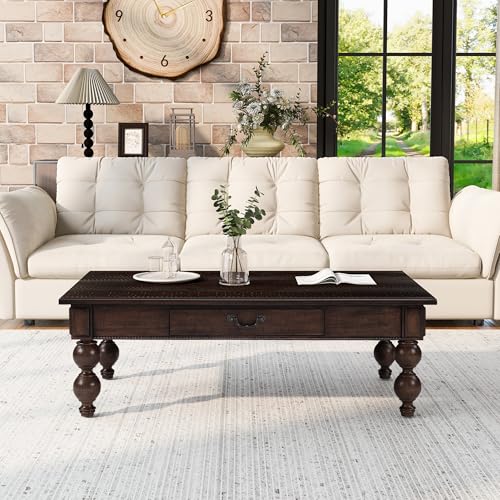
Timeless Vintage Aesthetic - Featuring a distressed wood finish, classic turned legs and an elegant traditional handle, this retro rectangular coffee table adds warm, old-world charm and becomes an eye-catching centerpiece for cozy, traditional living spaces.
Common Mistakes to Avoid
Even well-chosen furniture can look awkward if scale, texture, and lighting are out of balance. Watch out for these four common decorating mistakes when designing a traditional or transitional living room:
- Buying a matching showroom set: Purchasing a matching sofa, loveseat, coffee table, and two end tables from the same collection makes a traditional room feel dated and a transitional room feel like a catalog. Mix wood tones and upholstery textures instead.
- Making a neutral transitional room sterile: All-beige walls, a flat beige sofa, and a plain beige rug look washed out without contrast. Add nubby bouclé, woven wool, natural wood grain, greenery, and 10% dark accents (like bronze, charcoal, or black) to ground the eye.
- Ignoring seat height and visual weight: Placing a heavy, 38-inch-tall rolled-arm traditional sofa next to a low-profile modern chair with a 15-inch seat height looks lopsided. Keep adjacent seat heights within 1 to 2 inches of each other.
- Relying on a single overhead fixture: Overhead recessed cans alone flatten rich traditional fabrics and wash out warm transitional neutrals. Combine overhead fixtures with table and floor lamps at eye level when seated.
Frequently Asked Questions
What does transitional living room style mean?
Transitional living room style is a balanced blend of traditional and modern interior design. It combines classic comfort and warm proportions with clean furniture lines, neutral color palettes, mixed materials, and restrained accessories so the room feels timeless without looking formal or heavy.
What is a traditional style living room?
A traditional style living room is a formal, classic space inspired by 18th- and 19th-century European and American decor. It features symmetrical seating layouts, rolled-arm sofas, wingback chairs, carved dark wood tables, patterned Oriental rugs, tailored drapery, and rich colors like navy, burgundy, forest green, and cream.
What does a transitional living room look like?
A transitional living room looks calm, tailored, and lightly layered, built on a warm neutral base of ivory, greige, or taupe. It typically pairs a clean-lined track-arm or softly curved sofa with a muted vintage rug, a natural wood or stone coffee table, simple metal lighting, and minimal tabletop clutter.
Is transitional design outdated?
No, transitional design is not outdated because it avoids extreme, short-lived micro-trends. Because the foundational pieces use classic proportions and neutral upholstery, you can easily refresh the space over time by swapping throw pillows, artwork, lighting, or accent tables.
Can you mix traditional and transitional furniture?
Yes, you can mix traditional and transitional furniture easily because both styles share classic human-scale proportions. Keep adjacent seat heights within 1 to 2 inches, surround an ornate traditional piece with simpler upholstery, and repeat wood tones or metal finishes at least three times across the room.
Which style is better for a small living room?
Transitional style is usually better for a small living room because its warm neutral palette, exposed-leg seating, and uncluttered surfaces make compact spaces feel larger. Traditional style can still work in a small room if you choose apartment-scale seating, skip heavy valances, and keep 30 to 36 inches clear for walkways.
What is the 70/30 rule in a transitional living room?
The 70/30 rule means dedicating 70% of your living room to one dominant design style and 30% to a contrasting style. For example, you can build 70% of the room with clean-lined transitional seating and neutral walls, then layer in 30% traditional character through an antique chest, a Persian rug, and brass sconces.
How is transitional style different from modern or contemporary style?
Transitional style is warmer and softer than strict modern or contemporary design. While modern design favors low-profile geometric forms, stark contrast, and minimal ornament, transitional design keeps plush, deep-seated classic upholstery and pairs it with warm woods, soft neutrals, and subtle architectural trim.
Conclusion
Traditional and transitional living room styles both create welcoming, enduring spaces, but they differ in formality and detail. Choose traditional design if you love carved woodwork, symmetrical pairs, patterned textiles, and saturated colors. Choose transitional design if you prefer a warm neutral backdrop, streamlined upholstery, mixed textures, and a layout that adapts easily to everyday family life.
To get started, measure your main seating area to ensure 14 to 18 inches around the coffee table and 30 to 36 inches for walkways, pick one anchor piece you already love, and apply the 70/30 rule to build a cohesive room around it.
Sources
- Council for Interior Design Qualification — What Is Interior Design?: supports the article’s guidance on space planning, function, safety, materials, lighting, and usability.
- The Metropolitan Museum of Art — American Rococo: supports historical context for ornamental furniture, carving, scrollwork, and 18th-century decorative influence.
- The Metropolitan Museum of Art — American Furniture, 1730–1790: Queen Anne and Chippendale Styles: supports details on cabriole legs, pad feet, pierced chair splats, ball-and-claw feet, and Thomas Chippendale’s 1754 furniture designs.
- Victoria and Albert Museum — The Rococo Style: An Introduction: supports the 1740–1770 period dates, French rocaille shell origins, S- and C-curves, and acanthus-leaf motifs.
- Architectural Digest — Transitional Design 101: supports the definition of transitional design as a blend of traditional and modern influences.
- The Spruce — What Is Transitional Design Style?: supports details on neutral palettes, mixed materials, texture, and restrained decor.
- U.S. Department of Energy — Purchasing Energy-Efficient Light Bulbs: supports the 2,700 K warm light recommendation for residential wood finishes, furniture, and fabrics.
- American Society of Interior Designers — About Interior Design: supports how functional interior design aligns spatial planning and material selection with human well-being and daily living.
- Schema.org — Article: supports the Article structured data used for this informational article.
- Schema.org — FAQPage: supports the FAQPage structured data used for the FAQ section.