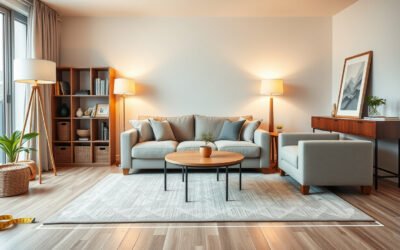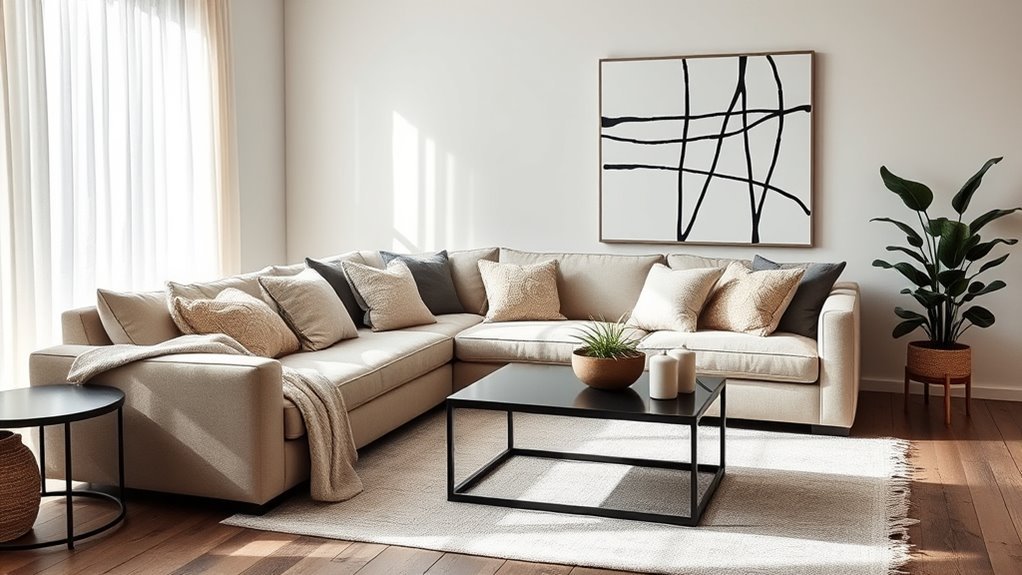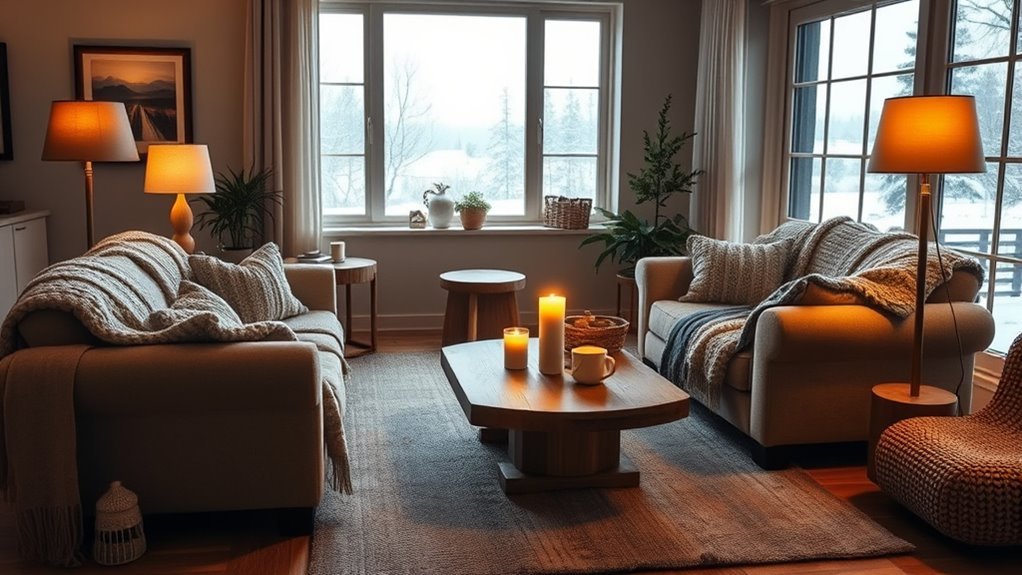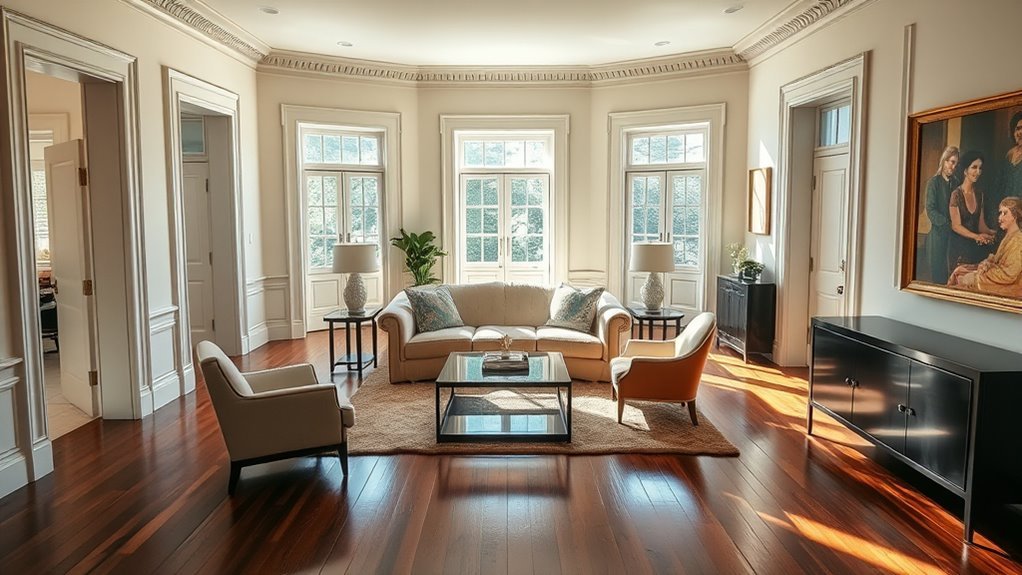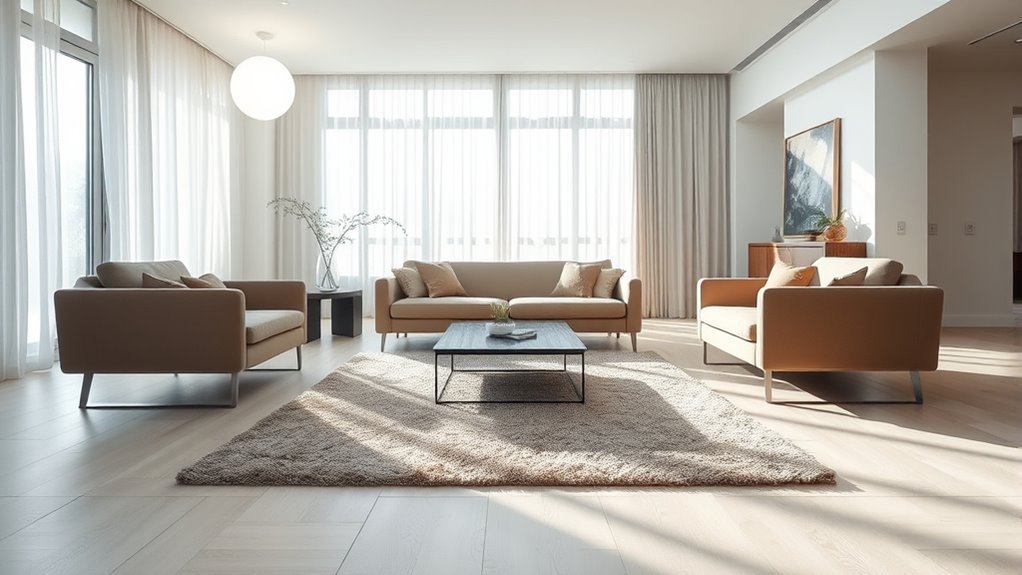
An awkward living room with multiple doors can make every furniture choice feel wrong. Swinging doors, cross-room walkways, and short wall segments often leave your sofa floating in the middle of traffic or your chairs blocking an entry. By mapping your pathways first and anchoring seating around one clear focal point, you can turn a chopped-up floor plan into a comfortable, balanced living space.
Quick Answer
To arrange an awkward living room with multiple doors, map a 36-inch clear walkway between entries first, then anchor your main seating around one focal point. Float the sofa away from door swings, keep 14 to 18 inches around the coffee table, and use a low-pile area rug to connect the seating zone.
Key Takeaways
- Route main traffic paths behind or around your seating group so people never walk between the sofa and the TV.
- Maintain 36 inches of width for primary walkways and at least 24 to 30 inches for secondary paths between furniture pieces.
- Keep a 30-to-36-inch radius completely clear around every swinging door and leave 18 to 24 inches by the door latch.
- Anchor your main seating group on an 8-by-10-foot or 9-by-12-foot rug with at least the front legs of every seat on the rug.
- Choose apartment-scale sofas (72 to 80 inches wide), swivel chairs, and movable ottomans instead of bulky matching sets.
Identify Your Awkward Living Room’s Focal Point
Every successful layout in an awkward living room with multiple doors starts with a single visual anchor. Choosing one dominant feature tells the eye where to rest so the eye focuses on your seating area rather than the surrounding doorways. Your primary focal point can be an architectural feature like a fireplace or picture window, or an added feature like a media console or large-scale artwork.
Scan the room for the longest uninterrupted wall segment or the strongest natural feature. Orient your largest seating piece so it faces that anchor directly without backing into a door swing. If your focal point is a television, position the primary sofa at a comfortable viewing distance of 1.0 to 1.6 times the screen’s diagonal measurement for a 4K display—about 5.5 to 8.8 feet away for a 65-inch screen.
If your room has two competing focal points, such as a corner fireplace and a wall-mounted TV on an adjacent wall, avoid splitting your furniture into two disconnected groups. Instead, place the sofa facing the primary feature and add a pair of swivel chairs that can turn toward either wall, or angle the main seating group at 45 degrees toward the midpoint between both features.
Create Functional Zones With Furniture Arrangement
Dividing the floor plan into purposeful zones prevents a multi-door room from feeling like a hallway. Start by placing your primary conversation or TV zone in the most protected pocket of the room, then use remaining corners between doorways for smaller tasks like reading or storage. Grouping pieces tightly within each zone makes the layout look deliberate rather than scattered.
When doors break up your perimeter walls, resist the urge to line furniture along every short wall segment. Instead, float your sofa several feet into the room and let foot traffic pass behind the sofa back. According to the University of Nebraska–Lincoln Extension furniture arrangement guide, routing traffic lanes around conversation groupings rather than through the middle of them preserves both social comfort and easy room circulation.
Keep seating within a conversation zone between 4 and 8 feet apart so guests can talk comfortably without raising their voices. Place your coffee table 14 to 18 inches from the edge of the sofa seat—close enough to set down a cup without leaning far forward, yet wide enough for comfortable legroom. In tight secondary corners between two doors, tuck in a single armchair paired with a 12-to-16-inch drink table.
| Zone | Furniture Example | Target Spacing | Purpose |
|---|---|---|---|
| Lounging | Sofa, coffee table, and ottoman | 14–18 in. sofa-to-table gap; 4–8 ft. between facing seats | Relaxing, TV viewing, and daily conversation |
| Reading | Armchair, floor lamp, and drink table | 6–12 in. from chair arm to side table; 30 in. clear access | Quiet solo seating in corners between doors |
| Entertaining | Modular sectional and nesting tables | 36 in. perimeter walkway; 24–30 in. between chairs | Flexible gatherings, board games, and hosting |
Recommended Products

Stylish Hidden Litter Box Design Mid-century modern cabinet hides the litter box inside a recessed compartment, functioning as a chic side table. It masks litter mess and odors while matching bedroom and living room decor perfectly


【UNIQUE DESIGN】: 1/6 Scale dolls furniture toy, fine workmanship and texture, comfortable to touch. great accessories for your action figure dolls
Make Sure People Can Move Around Easily
Clear circulation paths are the foundation of any room with multiple entry points. Aim for 36 inches of clear width on primary paths connecting active doorways, and never drop below 24 to 30 inches on minor paths between furniture pieces. The U.S. Access Board accessible route guidelines specify a 36-inch continuous clear walking width—narrowing to no less than 32 inches at doorways for up to 24 inches of depth—as the benchmark for comfortable, barrier-free passage.
Check the swing direction of every hinged door before placing a single piece of furniture. Standard interior and exterior doors measure 30 to 36 inches wide and require a full 90-degree arc to open cleanly, plus 18 to 24 inches of standing clearance beside the latch handle. For doors that lead outdoors or serve as emergency exits, the National Fire Protection Association residential escape guidelines emphasize keeping exit routes and doorways free of obstructions with at least 24 to 32 inches of clear width at all times.
To visually separate a walkway from a floated seating area without blocking sightlines, place a narrow console table (10 to 14 inches deep and no taller than the sofa back) directly behind the sofa. Open-frame armchairs, low benches, and leggy mid-century silhouettes also create subtle boundaries while letting light pass underneath.
Pro tip: Outline your sofa, chairs, and full 90-degree door swing arcs on the floor with painter’s tape first, then walk through every doorway carrying a laundry basket to catch tight pinch points before lifting heavy furniture.
Define Spaces With Rugs and Decor
Area rugs and vertical decor act as invisible walls that hold a seating zone together when doorways break up the perimeter. A properly sized rug creates a visual island on the floor, signaling exactly where the conversation area begins and where the surrounding walkways pass by. Complement the rug with targeted lighting and wall art so each zone feels complete on its own.
Choose a rug large enough that at least the front legs of your sofa and chairs sit 6 to 12 inches onto the rug surface; for most living rooms, an 8-by-10-foot or 9-by-12-foot rug works best. Leave 6 to 18 inches of bare floor between the rug edge and the walls. If a rug edge must extend near an active doorway, pick a flatweave or low-pile rug under 1/4 to 3/8 inch thick so the bottom sweep of the door glides over it without catching.
Because multiple doors leave you with narrow wall piers instead of wide walls, build upward with tall, shallow bookcases (12 inches deep), wall-mounted sconces, and vertical gallery arrangements. Whenever you place tall shelving or media units near busy walkways where children or guests brush past, secure the furniture directly to wall studs using anti-tip brackets as recommended by the U.S. Consumer Product Safety Commission Anchor It! campaign.
| Element | Sizing & Placement Rule | Purpose |
|---|---|---|
| Area rugs | 8×10 ft. or 9×12 ft.; front furniture legs 6–12 in. on rug | Define functional zones and anchor floating seating |
| Textures | Flatweave or low pile (under 3/8 in.) near door swings | Add warmth without blocking hinged doors |
| Color schemes | 60-30-10 ratio across upholstery, rugs, and accents | Create visual cohesion across interrupted walls |
| Plants | Upright varieties in 10–14 in. planters tucked in dead corners | Soften sharp door frames without narrowing paths |
| Art & lighting | Hang art centers at 57–60 in.; use wall sconces near entries | Draw the eye upward and save floor space |
Recommended Products

Machine Washable Area Rugs: Our living room rug, one of the 8x10 area rugs, surfaces is resistant to stains and dirt, and can be easily cleaned with a rag or vacuum cleaner; for deep cleaning, use a washing machine

Ultra-Soft Low Pile Rug: Gent drizz living room rugs 8x10 made of Upgraded durable low pile faux wool fibers, 0.25'' thick, featuring a soft fuzzy density surface, soft and pliable to the touch, providing great comfort for your bare feet. The low pile makes it easy for your Large area rug to clean and is perfect for homes with kids and pets

Soft & Durable: This 8x10 area rug low-pile combines soft faux wool fibers with a 0.25-inch height for comfort. Tight weaving reduces shedding and edge fraying, making it perfect for high-traffic areas like living rooms, bedrooms, and entryways
Choose Flexible Seating Options
Adaptable, trim-profile furniture gives you far more layout freedom when doors limit your wall space. Instead of forcing a deep, oversized sofa and matching loveseat into a chopped-up room, mix a compact main sofa with lighter pieces that pivot, tuck away, or serve two functions. Keeping individual footprints smaller preserves your 36-inch walkways without sacrificing guest capacity.
- Use modular seating: Reversible chaises and armless modular units (around 32 to 36 inches deep) let you switch an L-shaped configuration from left to right if you rearrange the room.
- Add 360-degree swivel chairs: Compact swivel barrel chairs (28 to 32 inches wide) can face the sofa for conversation, pivot toward the TV for movie night, or turn toward an adjacent room without scraping the floor.
- Try lightweight or armless chairs: Chairs without bulky rolled arms save 6 to 10 inches of width per seat and keep sightlines open across doorways.
- Choose dual-purpose storage pieces: Upholstered cube ottomans (18 by 18 inches) and narrow storage benches store throws and board games, slide neatly under a console table, and pull out as extra seating when guests arrive.
When shopping for a tight multi-door layout, look for apartment-scale sofas measuring 72 to 80 inches long and 34 to 36 inches deep, rather than deep-seated lounge sofas that exceed 40 inches in depth. Choosing sofas and chairs with exposed legs (4 to 6 inches off the floor) also lets more floor show through, making a smaller room look noticeably wider.
Recommended Products

MODERN SWIVEL ACCENT CHAIR DESIGN - This petite accent chair features a rounded barrel silhouette with an open back for a clean, modern look. Designed to offer stylish, comfortable seating, it works well as a statement chair or complementary piece in living rooms, bedrooms, offices, or reading areas.

ADJUSTABLE TRAY TABLE & CUP HOLDER: Multi-angle tray table support up to 18 lbs and equipped with a cup holder— keep drinks, snacks, or a tablet within easy reach, no side table needed. It can meet your various needs and add a touch of minimalism to your living room

Modern Barrel Design: Featuring a curved barrel-style backrest, soft chenille upholstery, and a solid wood base, this swivel accent chair brings modern elegance and cozy texture to living rooms, bedrooms, or reading corners.
Common Layout Mistakes to Avoid
Most frustrating multi-door layouts fail because the furniture fights the room’s natural circulation paths. When seating forces people to zig-zag around table corners or walk repeatedly in front of the television screen, the room feels chaotic even with expensive decor. Fixing these four common layout errors immediately restores balance and comfort.
First, never route a primary walkway straight through the middle of your conversation zone or between the sofa and the TV. If two opposing doors create a diagonal path across the room, float the seating group to one side of that path so foot traffic flows behind the sofa.
Second, avoid pushing every seat flush against the perimeter walls. In a room broken up by doors, lining the walls often leaves a 10-to-12-foot gap across the center that feels like a waiting room and makes quiet conversation difficult. Pulling your chairs and sofa inward onto a central area rug creates an intimate 4-to-8-foot conversation circle while freeing up the perimeter for walking paths.
Third, avoid undersized “postage stamp” rugs (such as 4-by-6-foot or 5-by-7-foot rugs) that float entirely under the coffee table without touching any seating; small rugs visually chop the floor into even more pieces. Finally, keep tiny plant stands, floor baskets, and coat racks out of entry pinch points where they narrow walkways below 32 inches.
Frequently Asked Questions
How do you style a room with lots of doors?
Style a room with lots of doors by keeping all active doorways clear and anchoring your furniture around one focal point. Float your seating group on an area rug, leave 36-inch pathways around the perimeter, and use slim vertical decor like wall sconces and tall shelving on narrow wall sections.
Where should a sofa go in a living room with multiple doors?
Place the sofa against the longest uninterrupted wall if it can face your focal point without blocking a doorway. When doors break up every wall, float the sofa in the center of the room facing the focal point and leave a 36-inch walkway behind the sofa back.
Can you put furniture in front of a doorway?
Never place furniture in front of exterior exit doors or active interior doorways. If a secondary closet or redundant interior door is never used, you can place a lightweight bench or accent chair near it, provided the piece is easy to move and does not block an emergency exit route.
How do rugs help an awkward living room layout?
Rugs visually group floating furniture into a single cohesive zone so seats do not look scattered across the floor. They also establish clear boundaries between the stationary conversation area and the surrounding 36-inch walkways connecting your doors.
How much space do you need behind a floating sofa?
Leave at least 36 inches behind a floating sofa if that space serves as a main walkway between doorways. For a minor path used by one person at a time, 24 to 30 inches is enough, and if there is no walkway behind the sofa, leave 3 to 5 inches from the wall for visual breathing room.
What size rug works best in a living room with multiple walkways?
An 8-by-10-foot or 9-by-12-foot area rug fits most multi-door living rooms by anchoring the front legs of the sofa and chairs 6 to 12 inches onto the rug. Choose a low-pile or flatweave rug under 3/8 inch thick if the edge sits near a swinging door.
Conclusion
An awkward living room with multiple doors works best when you protect the pathways first and build your seating zone inside the remaining footprint. By keeping 36-inch main walkways open, floating your sofa around a single focal point, and anchoring the group on a properly sized rug, you stop the room from feeling like a hallway.
Start today by measuring your wall segments, door swing arcs, and sofa dimensions, then mark your new layout on the floor with painter’s tape. Walk through every doorway and test each seat to confirm the flow feels effortless before moving your furniture into place.
Sources
- University of Nebraska–Lincoln Extension (EC56-1116 Furniture Arrangement): Routing traffic lanes around conversation groupings and keeping tables within comfortable reach of seating.
- U.S. Access Board (ADA Standards Chapter 4: Accessible Routes): Minimum 36-inch continuous clear walkway width and 32-inch clear doorway passage standards.
- National Fire Protection Association (Means of Escape in Residential Fires): Keeping residential doorways and escape paths clear with at least 24 to 32 inches of unobstructed width.
- U.S. Consumer Product Safety Commission (Anchor It! Campaign): Securing tall shelving, bookcases, and media furniture to wall studs to prevent tip-over hazards along walkways.