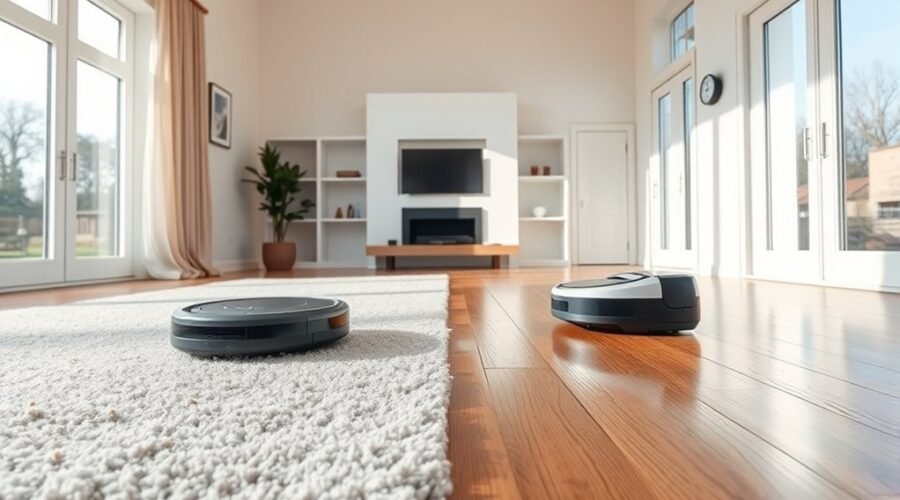
Choosing between a vacuum-only robot and a vacuum mop robot depends on your floors, cleaning habits, and budget. Both can collect dust, crumbs, and pet hair, but only a vacuum-and-mop model adds wet cleaning for suitable hard floors. This vacuum only vs vacuum mop comparison explains how they differ in cleaning performance, carpet protection, maintenance, battery use, and long-term costs.
Quick Answer
Choose a vacuum-only robot if your home has mostly carpets or rugs and you want simpler maintenance. Choose a vacuum mop robot if you have mostly sealed hard floors and want regular damp cleaning. For mixed flooring, a hybrid with reliable carpet detection, mop lifting, or automatic mop removal offers greater flexibility.
Last checked: October 28, 2026. Product specifications and listed prices were checked against manufacturer sources. Cleaning test figures were checked against the original independent test.
Key Takeaways
- A mopping function does not automatically reduce vacuuming performance. Brush design, airflow, navigation, and cleaning settings matter more.
- Basic mop pads handle light floor marks. Rotating pads and self-cleaning rollers may improve scrubbing, depending on the model.
- Automatic mop lifting does not guarantee that thick carpets will stay dry. Mop clearance and rug height must be considered together.
- A self-washing dock reduces daily handling but adds water tanks, cleaning parts, and possible replacement costs.
- Buying price alone cannot determine value. A basic combo can cost less than a premium vacuum-only robot.
What Is a Vacuum Only Robot?
)
A vacuum-only robot is an automatic floor cleaner that collects dry dirt without using water or a mop. It uses suction, rotating brushes, and an onboard dustbin to collect dust, crumbs, pet hair, and other loose debris.
Most models can clean hard floors, low-pile carpets, and suitable rugs. Their carpet performance depends on brush contact, airflow, navigation, and the ability to pull dirt from between carpet fibres.
Vacuum-only robots generally have simpler cleaning systems because they do not need water tanks, mop pads, or wet-cleaning equipment.
Their main advantages include:
- Simple maintenance: Empty the dustbin, clean the filter, and remove hair from the brushes.
- Dry-floor cleaning: No risk of damp mop pads dragging across carpets.
- Automated schedules: Many models support app controls, room mapping, and regular cleaning routines.
- Fewer wet-cleaning parts: No water lines, mop rollers, or dirty-water reservoirs to service.
Some vacuum-only models include self-emptying docks that transfer collected debris into a larger container. This reduces how often you need to empty the robot itself.
However, suction cannot remove dried food marks, sticky residue, or stains that need water and gentle scrubbing. You must clean those areas with a separate mop or suitable floor cleaner.
Robots also work best when cords, small toys, and loose objects do not block their paths. High-pile rugs and thick carpet edges can remain difficult for some models.
What Is a Vacuum Mop Robot?
A vacuum mop robot combines dry vacuuming with damp floor cleaning. It collects loose debris while using a mop pad or roller to remove fine dirt and light marks from suitable hard floors.
These hybrid robots usually have a dustbin, a mopping system, and a water supply. Some clean with both functions during the same run, while others use separate vacuuming and mopping modes.
There are three common mopping designs:
- Flat mop pads: A damp cloth wipes the floor as the robot moves. Some versions vibrate to loosen dirt.
- Rotating mop pads: Spinning pads apply repeated contact to help remove marks and residue.
- Roller mops: A moving roller washes the surface, with some systems supplying fresh water and collecting dirty water during cleaning.
For example, the ECOVACS DEEBOT X8 PRO OMNI uses a self-washing roller mop, carpet-care features, and an automated cleaning station.
Advanced vacuum mop robots may also offer automatic water refilling, heated mop washing, drying, and dustbin emptying.
These features make regular cleaning more convenient, particularly in kitchens, dining rooms, and homes with children or pets.
However, a robot mop is mainly intended for routine maintenance. Dried stains may require repeated passes, and large liquid spills can still need manual cleanup.
You must also manage the water system. Even a self-cleaning model needs periodic attention to its reservoirs, filters, and mopping parts.
Vacuum Only vs Vacuum Mop: Key Differences
The main difference between vacuum-only and vacuum mop robots is dry cleaning versus combined dry and wet cleaning. Both can vacuum carpets and hard floors, but a hybrid adds equipment for removing light surface marks with water.
The comparison below shows how that extra function affects everyday ownership.
| Aspect | Difference |
|---|---|
| Cleaning mode | Vacuum-only robots collect dry debris. Hybrid models can also damp-mop suitable hard floors. |
| Maintenance | Vacuum-only models need dustbin, filter, and brush care. Hybrids add mop and water-system maintenance. |
| Floor compatibility | Both can vacuum suitable carpets and hard floors. Mopping is intended for compatible hard surfaces. |
| Cost considerations | Basic vacuum-only models are often simpler, while advanced hybrids may cost more because of their mopping systems and docks. |
| Advanced features | Both may offer smart mapping and self-emptying. Hybrids can also provide mop lifting, pad washing, drying, and water refilling. |
Neither type is automatically better at vacuuming. A well-designed hybrid may collect more carpet debris than a poorly performing vacuum-only robot.
Battery life also varies by model. Running a mop system can affect energy use and cleaning time, but battery size, suction level, floor area, and dock visits all matter.
A hybrid may pause to wash its mop or refill water, while a vacuum-only robot may continue cleaning until it needs charging or bin emptying.
If you want the simplest routine, vacuum-only models have fewer components to manage. If you regularly mop hard floors, a hybrid can reduce the need for separate cleaning sessions.
Which Robot Works Best on Your Floors?
The best robot depends on the flooring throughout your home. Carpet-heavy homes benefit most from strong dry-debris pickup, while hard-floor homes can make greater use of automated mopping.
For mixed flooring, look closely at how a hybrid handles rugs, carpets, and changes between rooms.
Floor Type Match
Match the robot to the surfaces you clean most often. A mopping feature adds little value if most of your home is carpeted, but it can save regular work when sealed hard floors cover several rooms.
Use these guidelines:
- Mostly carpets: Choose a robot with strong carpet pickup, a suitable brush roll, and dependable navigation. A mop is optional.
- Mostly tile: A vacuum mop combo can remove loose debris and help clean everyday marks between manual deep-cleaning sessions.
- Sealed vinyl or laminate: Consider a hybrid with adjustable water delivery and a cleaning mode approved for your floor.
- Sealed hardwood: Use only a compatible damp-cleaning setting. Avoid excessive moisture and standing water.
- Mixed carpets and hard floors: Look for carpet detection, mop lifting or removal, and room-specific cleaning controls.
Do not assume every vacuum mop robot can safely clean every hard surface. Unsealed wood, moisture-sensitive flooring, and some specialty finishes may require dry cleaning only.
If you have high-pile carpets, check whether the robot can travel over them without getting stuck. You should also consider the height of the mop mechanism when raised.
A robot with a lifting mop may still touch thick carpet fibres or long rug fringes.
The Roborock Saros 10R illustrates a different approach. Its dock can automatically remove mop mounts before certain vacuum-only or carpet-cleaning tasks when that feature is enabled.
That means a hybrid does not always have to carry wet mop pads across the carpet.
Pro Tip: If your home has several area rugs, compare the robot’s actual mop clearance with the height of your rug fibres. A model that works well on low-pile carpet may still drag a damp pad across thicker rugs.
Carpet Vs Hard Floors
Carpet and hard floors need different cleaning methods. Carpets require effective agitation and suction to remove embedded debris, while hard floors benefit from both dry pickup and damp wiping.
Importantly, you cannot judge the difference by assuming that every vacuum-only robot outperforms every hybrid.
An independent robot vacuum comparison published by The Hook Up in February 2025 reported strong vacuuming results from several hybrid robots.
The reviewer tested a mixture of flour, rice, salt, and flax seed husks. The following results came from that specific test setup.
| Test Surface | Robot Model | Debris Pickup Result |
|---|---|---|
| High-pile carpet | ECOVACS X8 Pro OMNI | 75.5% (30.2 g of 40 g) |
| Luxury vinyl plank hard floor | 3i S10 Ultra | 99.75% (39.9 g of 40 g) |
| High-pile carpet and hard floor | Roborock Saros 10R | 72% on carpet; 98.25% on hard floor |
These figures measure debris collected during controlled vacuuming tests. They do not measure mopping performance or represent a guaranteed cleaning percentage in every home.
All three robots are vacuum-and-mop hybrids, and the hard-floor tests used vacuum-only operation.
This matters because the ECOVACS X8 Pro OMNI performed strongly on carpet despite having a mopping system. The 3i S10 Ultra performed particularly well on hard-floor debris pickup.
The test also shows why you should compare actual cleaning results rather than relying only on advertised suction power.
For carpeted homes, prioritise brush design, hair handling, carpet pickup, and navigation. For hard floors, compare mopping performance, water management, and the ability to remove fine dust without leaving residue.
Mopping Needs And Tradeoffs
A vacuum mop robot makes the most sense when you regularly clean hard floors with water. It can reduce repeated manual mopping after meals, muddy footprints, and everyday household traffic.
However, mopping ability varies significantly between models.
Basic systems often use a damp pad that wipes the floor. More advanced systems use spinning pads or rollers, sometimes with automatic rinsing and dirty-water collection.
The tradeoffs include:
- Cleaning depth: Basic pads may struggle with dried stains, even when they remove fine dust effectively.
- Carpet protection: Mop lifting, automatic removal, or separate no-mop zones may be needed.
- Water management: Tanks and pads need regular cleaning to prevent dirty residue from spreading.
- Cleaning duration: Mop washing, water refilling, and repeated passes can extend a cleaning session.
- Dock space: Full-service mopping stations may require more room than compact charging docks.
Not every hybrid can lift its mop. For example, iRobot’s instructions for its Roomba 100/1000 Combo models explain that these robots can detect and avoid rugs but cannot lift their mopping pads to cross them.
That is why carpet detection and mop lifting should be treated as separate features.
Warning: Do not use a vacuum-only robot to collect liquids. Also, do not assume a standard robot mop can absorb large spills. Remove standing liquid manually unless the manufacturer specifically approves the robot for wet pickup. Never add household cleaners, disinfectants, or hot water to a robot’s tank unless its instructions allow them.
If you have frequent light marks on tile or other sealed flooring, a capable vacuum mop combo can make daily cleaning easier.
If your main problem is embedded carpet dirt, choosing strong vacuuming performance is more important than paying for an advanced mop.
Vacuum Only vs Vacuum Mop Costs
Vacuum-only robots often have lower equipment and maintenance costs when you compare similarly equipped models. However, a premium vacuum-only robot can cost more than a basic vacuum mop robot.
The total cost depends on the cleaner, its dock, replacement parts, and how often you use the wet-cleaning function.
Upfront Purchase Price
The purchase price depends on navigation, suction performance, dock automation, and mopping features. A robot with basic damp wiping may cost less than a vacuum-only model with advanced mapping and a self-emptying station.
At the premium end, automatic mop washing, heated drying, and water management can push the cost much higher.
The table below uses manufacturer-listed UK examples checked on October 28, 2026. These are individual product prices, not market averages.
| Type | Listed Price or Cost | Example |
|---|---|---|
| Vacuum-only robot with self-emptying | £399 listed | eufy C10 White |
| Robot vacuum-and-mop combo | £169.99 sale price; £269.99 regular listed price | Hoover HG2 Hydro TurboSlim |
| Premium robot vacuum-and-mop combo | £1,299 listed | eufy Omni S1 Pro |
| Manual vacuum mop | Separate product category; not directly comparable | BISSELL CrossWave or Shark VACMOP |
| Replacement mopping component | £29.99 listed | ECOVACS X8 Pro OMNI mopping roller |
These prices show why the purchase decision should focus on features rather than category alone. The Hoover combo example was listed at a lower promotional price than the eufy vacuum-only example.
At the same time, the premium eufy S1 Pro illustrates how automated washing, drying, and water handling can increase the price of a hybrid.
BISSELL CrossWave and Shark VACMOP products belong to the manually operated vacuum-mop category. They should not be compared directly with autonomous cleaning robots because you must guide them across the floor.
Before buying, check whether the listed package includes a basic charging dock, a self-emptying station, or a full-service mop-cleaning station.
Maintenance And Supplies
Vacuum-only robots usually require fewer types of replacement parts than vacuum mop robots. Both need filters, brushes, and dustbin care, but hybrids also need attention to their mopping equipment.
Common vacuum-only maintenance includes:
- Emptying the onboard dustbin or dock container.
- Cleaning or replacing filters.
- Removing hair and fibres from the brush roll.
- Cleaning sensors, wheels, and charging contacts.
Vacuum mop robots require these tasks too. They also need regular cleaning of mop pads, rollers, water tanks, and the station’s washing area.
Some models use special cleaning solutions or replacement mop components.
For a real cost example, the official ECOVACS UK store lists a replacement X8 Pro OMNI mopping roller at £29.99.
Replacement frequency depends on usage, floor conditions, and the manufacturer’s maintenance guidance.
Self-cleaning docks reduce daily effort, but they do not eliminate maintenance. You may still need to empty dirty-water tanks, refill fresh water, replace dust bags, and clean the dock’s washing tray.
Some advanced models use recycled-water systems or automated water handling. These can reduce certain routine tasks, although they introduce additional components that may need service.
Long-Term Value
Long-term value depends on how much useful cleaning you get for the total cost of ownership. A cheaper purchase is not always the better deal if it leaves you with frequent manual cleaning.
Consider the following over a five-year ownership period:
- Purchase cost: The robot, dock, and included accessories.
- Consumables: Dust bags, filters, brushes, mop pads, rollers, and approved cleaning solutions.
- Maintenance time: How often you empty, wash, refill, or inspect the machine.
- Repair and replacement: Availability and cost of batteries, wheels, sensors, and other parts.
- Cleaning value: How much regular vacuuming and mopping the robot handles without help.
Vacuum-only robots can offer good value in carpet-heavy homes because a mopping system would receive little use.
However, extra parts do not automatically mean a hybrid will fail sooner. Battery quality, product design, repairability, and maintenance habits also affect lifespan.
A reliable hybrid may save more work over time if you would otherwise mop large hard-floor areas by hand.
Do not choose a robot based solely on a claimed lifespan. Compare the warranty, spare-parts availability, replacement costs, and cleaning performance before deciding.
Which Robot Is Easier to Maintain?
Vacuum-only robots are generally easier to maintain because they have no wet-cleaning system. They mainly require dustbin care, filter maintenance, brush cleaning, and occasional sensor checks.
Vacuum-only robots usually need fewer maintenance tasks, while vacuum mop robots add pad washing, water handling, and dock cleaning.
For example, a vacuum-only robot with a self-emptying dock may need only occasional dust-bag replacement and routine brush and filter checks.
By contrast, a hybrid such as the Roborock Saros 10R or ECOVACS X8 Pro OMNI can automate several mopping tasks but still has additional equipment to maintain.
The eufy S1 Pro also uses a self-cleaning roller system. Its roller, dirty-water collection components, and filters require proper care to maintain cleaning performance.
Dirty mop pads and clogged water pathways can reduce effectiveness. A poorly maintained system may leave streaks, spread residue, or develop unpleasant odours.
Maintenance also depends on your household:
- Pets: Hair can wrap around brushes or collect in the robot’s intake, even with anti-tangle features.
- Large homes: More floor area increases debris pickup and may require additional water refills or mop washing.
- Frequent spills: Mopping equipment needs more attention when it regularly handles sticky dirt.
- Dusty environments: Filters, brushes, and collection bins may need more frequent cleaning.
If you want the least complicated maintenance routine, a vacuum-only robot is usually the simpler option.
If you want to reduce manual mopping, a hybrid with automated washing and drying may be worth the extra water-system maintenance.
Before purchasing either type, check how easily you can remove the brush roll, clean the filter, access the dustbin, and replace worn parts.
Frequently Asked Questions
Which Is Better for My Home, a Robot Vacuum or a Vacuum and Mop?
If most of your rooms are carpeted, start with a vacuum-only robot. If you have mostly sealed hard floors, a vacuum-and-mop robot adds useful damp cleaning. For mixed floors, compare carpet pickup, mop lifting, navigation, noise, battery performance, and how much maintenance you are willing to do.
Is It Better to Get a Robot Vacuum With or Without a Mop?
Get a robot vacuum without a mop if you mainly need dry debris removal and simpler maintenance. Choose one with a mop if you regularly clean suitable hard floors. Neither design automatically offers better suction or battery life, so compare actual performance, floor compatibility, and maintenance requirements.
Is It Better to Get Separate Robot Vacuum and Mop?
Separate robots can make sense when you want specialised vacuuming and mopping or need independent cleaning schedules. However, two machines require more storage, charging space, and maintenance. A capable hybrid is usually more convenient if you want one robot to handle both jobs across mixed floors.
What Are the Drawbacks of Vacuum Mops?
The main drawbacks are extra maintenance, water management, replacement parts, and limits on which floors can be mopped. Some models also need more dock space or longer cleaning cycles. However, vacuuming performance, noise, scheduling options, and battery life vary by model rather than being consistently worse than vacuum-only robots.
Conclusion
The choice between a vacuum-only robot and a vacuum mop robot comes down to what you need to clean. Vacuum-only models are a practical choice for dry debris, carpeted rooms, and simpler maintenance. Vacuum mop robots offer extra convenience on suitable hard floors by combining vacuuming with damp cleaning.
Neither type guarantees better suction, longer battery life, or greater durability. Those results depend on the individual robot and its design.
Start by identifying your main floor types, then compare tested cleaning performance, carpet protection, dock features, and replacement costs. Choose the machine that solves your most frequent cleaning problem without adding features you rarely need.
Sources
- Roborock Global: Saros 10R: Official specifications covering automatic mop removal, carpet handling, and dock maintenance.
- ECOVACS: DEEBOT X8 PRO OMNI: Manufacturer information on roller mopping, suction, carpet care, and self-cleaning functions.
- iRobot Support: Roomba Combo Mopping Instructions: Carpet avoidance, mop limitations, water-tank maintenance, and approved cleaning liquids.
- The Hook Up: Ultimate Robot Vacuum and Mop Comparison 2025: Original independent testing methodology and measured carpet and hard-floor debris pickup results.
- eufy UK: Robot Vacuum C10 White: Vacuum-only model features and manufacturer-listed UK pricing.
- Hoover UK: HG2 Hydro TurboSlim: Robot vacuum-and-mop functionality and listed UK promotional pricing.
- eufy UK: Omni S1 Pro: Premium hybrid specifications, automated mopping features, and listed UK pricing.
- ECOVACS UK: X8 PRO OMNI Mopping Roller: Official replacement roller compatibility and listed accessory price.