
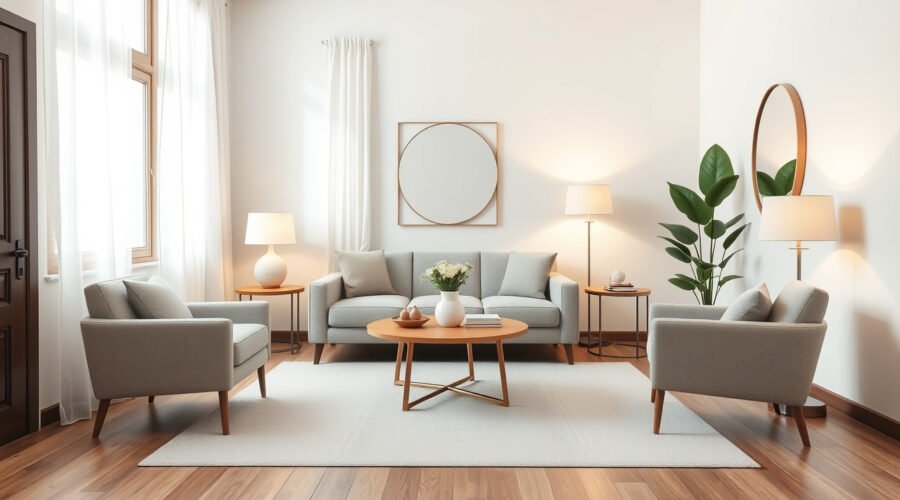
If you’re wondering why your living room feels small, square footage is rarely the only culprit. Even a generously sized room can feel boxed in when a deep sofa pinches the main walkway, a tiny rug splits the seating group into floating islands, or a single overhead light leaves the corners in shadow. Before you spend money on new decor or storage bins, walk through a quick layout, scale, and lighting audit to open up the floor space you already have.
Quick Answer
A living room usually feels cramped because blocked walkways, deep upholstery, dim corners, and disconnected rugs interrupt movement and sightlines—not just because of low square footage. Fix the room in five steps: clear a 30-to-36-inch main path, swap or reposition bulky furniture, layer 2700K–3000K lighting, anchor seating on one proportional rug, and clear surface clutter.
At a Glance
| First Thing to Check | The walkway from the doorway to the main sofa. If you must turn sideways or weave around tables, fix the layout first. |
| Target Clearances | 30–36 inches for main walkways (18–24 inches in tight rooms) and 14–18 inches between the sofa and coffee table. |
| Best Free Fixes | Clear the primary path, remove one unused accent piece, pull curtains completely off the glass, move a lamp into a dark corner, and hide loose cords. |
| Buy Only If Needed | Upgrade to a larger rug, a shallower sofa (32–34 inches deep), an extra floor or table lamp, or closed media storage only after resetting your layout. |
Why Does Your Living Room Feel Small? Use This 5-Pass Audit
Your living room feels small when physical obstacles or visual breaks stop your eye and feet from moving freely across the space. Diagnose the room in the exact order people experience it: traffic flow first, then furniture scale, lighting, seating cohesion, and surface clutter. Auditing in this order stops you from buying a new rug or lamp when the real problem is a sofa blocking the entry.
- Flow: Can you enter, cross, and exit the room along a clear 30-to-36-inch path without weaving around furniture edges?
- Scale: Does an extra-deep sectional, recliner, coffee table, or media console swallow too much floor depth?
- Light: Do the four corners vanish into shadow after sunset because you rely on a single ceiling fixture?
- Anchor: Do the sofa, chairs, coffee table, and area rug connect as one unified zone or float like separate islands?
- Edit: Can your eyes rest on clear sections of wall, shelf, tabletop, and exposed flooring?
Most cramped living rooms display at least two of these seven warning signs:
- A sofa back or accent chair blocks the direct sightline and path from the main doorway.
- Seating or media cabinets exceed standard depths, narrowing the center of the room.
- An undersized rug floats under the coffee table without touching any seating pieces.
- One overhead fixture creates glare in the center of the room while leaving perimeter walls dim.
- Low curtain rods or narrow panels cover the outer edges of the window glass.
- Every horizontal surface holds remotes, candles, books, mail, or small decorative objects.
- All major furniture pieces stop at the same 30-to-36-inch height, creating a flat, boxy horizon line.
Stand in the doorway and snap one photo at eye level, then take one photo from each corner. Looking at a flat two-dimensional image makes pinched walkways, cord clutter, and top-heavy furniture stand out immediately.
Note: Design measurements are practical benchmarks, not rigid laws. In a compact studio or narrow apartment, prioritize a clear main walkway, comfortable seating reach, and an open doorway sightline over textbook symmetry.
Can Furniture Layout Make a Living Room Feel Bigger?
Yes, rearranging your layout is the fastest free way to make a living room feel larger because it restores natural circulation and opens sightlines. A room feels cramped both when furniture blocks the natural walking path and when every seat is shoved flat against the perimeter walls, leaving an awkward dead zone in the center.
No federal law dictates furniture spacing inside a private residence, but accessibility standards offer a helpful physical benchmark. The 2010 ADA Standards for Accessible Design specify a 36-inch minimum clear width for accessible walking routes (narrowing to 32 inches at doorways for a distance up to 24 inches) and a 60-inch diameter circle for wheelchair turning space. Treat 36 inches as an ideal comfort benchmark for major walkways, and see our wheelchair-accessible living room layout guide for dedicated mobility planning.
In a standard living room, protect your primary route from the entry to the seating area first. If floor depth allows, pull the sofa 3 to 6 inches off the wall and angle accent chairs inward toward the coffee table. That small air gap behind upholstery creates subtle shadow and depth, tricking the eye into reading the room walls as farther back.
| Layout Problem | Why It Shrinks the Room | Better Fix |
|---|---|---|
| Every piece is pushed flat against the walls | Creates a wide, empty gap in the middle and forces people to walk through the conversation zone. | Pull seating 3–6 inches off the wall if space allows, or bring chairs inward to touch the front edge of the area rug. |
| Oversized rectangular coffee table blocks flow | Sharp corners pinch the gap between the sofa and media unit, forcing sideways steps. | Switch to a round or oval table, nesting tables, or a C-table that slides under the sofa frame. |
| Too many single-purpose accent pieces | Extra side tables, magazine racks, and footstools cover visible floor area. | Remove the least-used piece immediately and replace bulky items with a storage ottoman when needed. |
How Much Space Should You Leave Between Living Room Furniture?
Leave 30 to 36 inches for primary walkways around large furniture, 18 to 24 inches for secondary pass-throughs in tight rooms, and 14 to 18 inches between the front edge of your sofa cushions and the coffee table. Mapping these exact clearances with painter’s tape before lifting heavy furniture prevents bruised shins and cramped seating.
Use these standard interior design clearance measurements to test your floor plan:
- Main traffic pathways: Aim for 30 to 36 inches of unobstructed width from the doorway through the room so two people can pass or one person can walk briskly without turning sideways.
- Secondary gaps Between furniture: Leave at least 18 to 24 inches between an accent chair and a side wall or bookcase when space is tight.
- Sofa to coffee table: Set the coffee table 14 to 18 inches from the front edge of the sofa seat cushions (12 to 14 inches in a compact apartment; 18 to 20 inches for reclining sofas). That distance lets you set down a mug without leaning forward while leaving comfortable legroom.
- Coffee table proportions: Choose a table that measures one-half to two-thirds the length of your sofa, with a tabletop height level with the sofa seat cushion or 1 to 2 inches lower.
- Door swings and vents: Keep at least 36 inches clear in front of hinged entry or closet doors, and leave 6 to 12 inches in front of radiators, baseboard heaters, and air return vents.
Pro Tip: If your living room is narrower than 10 feet and you cannot float the sofa, keep the sofa against the longest wall and swap a standard coffee table for two 16-inch round drink tables that move out of the walkway when not in use.
Recommended Products

👍𝗦𝗧𝗬𝗟𝗜𝗦𝗛 & 𝗦𝗔𝗙𝗘 𝗥𝗢𝗨𝗡𝗗𝗘𝗗 𝗗𝗘𝗦𝗜𝗚𝗡 — Prioritizing safety and style, this small round end table features smooth, rounded edges to prevent injuries, particularly in homes with children or elderly family members. Its contemporary aesthetic complements any living space while offering peace of mind.

【LED Light Strip】: This corner shelf has been specially equipped with LED light strips, with multiple colors available for adjustment. It can create a cozy atmosphere at night, enhance the gaming experience when placed in the game room, or add the atmosphere when watching movies at night when placed in the living room.

Small Bookshelf for Small Spaces: Featuring a compact design, the floor standing tree bookshelf optimizes floor space, making it an excellent choice for bedrooms, home offices, corners, hallways, or smaller living rooms. This narrow small bookcase organizer provides ample storage for books, CDs, game cassettes, decorations, and more. Keep your belongings stylishly organized, ensuring a neat and clutter-free space. ( Book shelf dimensions: 47.4"H*14.6"L*"7.9"W )
Does Better Lighting Make a Living Room Look Bigger?
Yes, layered lighting makes a living room look noticeably larger by illuminating recessed corners and vertical walls so your brain perceives the full perimeter of the room. Relying on a single overhead ceiling fixture casts downward shadows and leaves the outer edges dark, which visually shrinks the walls inward after sunset.
Lighting designers typically target 10 to 20 lumens per square foot (10 to 20 foot-candles) for a residential living room. For a 150-square-foot living room (such as a 10-by-15-foot space), aim for roughly 1,500 to 3,000 total lumens divided across three distinct layers rather than one blinding central fixture.
Layered Lighting Solutions
Splitting your total lumens across three heights removes harsh shadows and pushes light into the corners of the room. Position your light sources so the bottom of table or floor lamp shades sits near seated eye level (about 40 to 42 inches off the floor) to prevent bulb glare.
- Ambient light: A diffused ceiling flush mount, chandelier, or torchiere floor lamp that bounces soft general illumination off the ceiling.
- Task light: A directed table lamp, swing-arm wall sconce, or floor reading lamp placed right beside a sofa arm or reading chair where you read, work, or play board games.
- Accent light: A picture light, LED shelf strip, or small uplight aimed at artwork, indoor plants, or textured drapery to pull the eye toward the room’s boundaries.
To balance warm evening lamps with overhead fixtures without clashing, see our guide to mixed lighting color temperatures in a living room.
Color Temperature Considerations
Correlated color temperature (CCT), measured in kelvins (K), controls how warm (yellow-gold) or cool (blue-white) a white bulb looks. The U.S. Department of Energy’s current light-bulb guidance classifies 2700K as friendly and personal, 3000K as warm and pleasing for homes, 3500K as neutral, and 4100K as neat, clean, and efficient. The DOE also cautions that jumping abruptly from 2700K to 4100K in the same space is jarring and causes occupant dissatisfaction.
Keep your living room bulbs within a tight 2700K-to-3000K range for ambient and accent lamps so walls feel warm and cohesive. If you have a dedicated reading nook or desk corner, you can step up to a 3000K-to-3500K task bulb with a Color Rendering Index (CRI) of 80 or higher (90+ is ideal for keeping paint and fabric colors true).
| Temperature Range (Kelvin) | Visual Appearance (DOE) | Practical Living Room Use |
|---|---|---|
| 2700K–3000K | Warm, friendly, and pleasing | Best for main ambient fixtures, corner floor lamps, and relaxed evening seating areas. |
| 3000K–3500K | Warm to neutral white | Ideal for reading lamps, puzzle or game tables, and daytime work corners. |
| 4000K–4100K+ | Cool, neat, and crisp | Use sparingly for focused hobby tasks; can make cool gray living room walls look sterile at night. |
When buying bulbs, check lumens for brightness rather than watts. ENERGY STAR notes that wattage measures only energy draw, and the FTC’s Shopping for Light Bulbs guide points out that an 800-lumen LED bulb (the brightness of a traditional 60-watt incandescent) uses only about 9 watts, while a 450-lumen LED replaces a 40-watt bulb. Using three or four 450-to-800-lumen lamps around the perimeter spreads light far more evenly than a single 1,600-lumen ceiling bulb.
What Colors Make a Living Room Feel Bigger?
Light neutrals and soft cool or warm tones with a Light Reflectance Value (LRV) of 60 to 70 or higher make a dim living room feel bigger by bouncing more natural and artificial light back into the space. However, low-contrast transitions between walls, trim, and drapery matter just as much as the paint shade itself.
In building lighting assessments, the DOE’s Indoor Environmental Quality resources and 2024 assessment guide note that standard interior reflectance baselines average roughly 80% for ceilings, 50% for walls, and 20% for floors, while cautioning that overly glossy surfaces cause uncomfortable glare. On paint fan decks, LRV runs from 0 (absolute black) to 100 (pure reflective white):
- High-LRV light neutrals (LRV 65–85): Soft warm whites, creamy off-whites, and pale greiges reflect maximum daylight in north-facing or small-window rooms.
- Mid-tone calming hues (LRV 50–65): Muted sage green, misty blue, and warm sand keep sunny rooms airy without washing out in afternoon glare.
- Deep enveloping shades (LRV 15–45): Navy, charcoal, or forest green can blur corner shadows when paired with multiple lamps and matching painted trim.
If you are deciding between a bright airy palette and a moody color-drenched look, read our light vs. dark paint guide for small living rooms.
Accent Color Variations
Repeating one accent color family across three separated spots guides the eye smoothly around the room instead of stopping on isolated bursts of color. Rather than buying matching emerald pillows, curtains, and vases, vary the tone across sage, olive, and moss so the palette feels layered and intentional.
Light and Dark Shades
Large surfaces—walls, curtains, area rugs, and sofas—control visual weight far more than small throw pillows. When a sofa or storage wall is dark, balance it by painting the walls and trim in the same undertone or hanging curtains that match the wall shade so the eye does not hit high-contrast vertical stripes every few feet.
Texture and Pattern Choices
Finish sheen and pattern scale keep a tight color palette from looking sterile or busy. Use matte or eggshell paint on walls to hide drywall flaws and prevent harsh lamp glare, and save satin or semi-gloss for baseboards and interior doors. Limit bold patterns to one primary anchor—such as the area rug or two accent pillows—while keeping the sofa upholstery and curtains solid or subtly woven.
Can Too Much Decor Make a Living Room Feel Smaller?
Yes, crowding tabletops, shelves, and walls with dozens of small objects creates visual noise that makes a room feel smaller and more chaotic. When every surface is covered edge to edge, your eyes have no negative space to rest, causing the brain to read the room as full.
Edit your living room accessories in three quick passes: remove items that belong in other rooms, group remaining pieces onto trays, and leave at least 30% to 40% of every shelf and tabletop completely bare.
- Corral tabletop items: Place one low tray on the coffee table to hold a candle and coaster set rather than scattering five separate objects across the surface.
- Scale up wall art: Hang one large framed print or canvas (roughly two-thirds the width of the sofa) instead of a busy grid of tiny frames that chops up the wall.
- Hide daily electronics: Tuck TV remotes, charging cables, and gaming controllers inside a lidded box or console drawer.
- Edit floor baskets: Keep one woven basket for extra throws, and clear out secondary bins or magazine racks that eat up corner floor space.
- Leave shelf breathing room: Alternate vertical book stacks with open gaps on bookcases so the shelving unit does not read as a solid wall of clutter.
Warning: Never buy extra freestanding cube shelves or storage carts before decluttering, and never stack storage bins in front of heating vents, radiators, or main walkways—doing so wastes money, restricts airflow, and creates a tripping hazard in tight quarters.
How Do You Make a Low Living Room Feel Taller?
To make a low living room feel taller, combine low-profile seating (30 to 34 inches high) with vertical elements that draw the eye toward the ceiling. When your sofa, armchairs, media console, and bookcases all stop at the exact same waist-high line, the top half of the room feels unused and heavy.
Create an upward sightline using two or three of these vertical adjustments:
- High-mounted floor-length curtains: Hang curtain rods 6 to 12 inches above the window casing (or 1 to 2 inches below the ceiling or crown molding) so fabric falls in a long vertical line to the floor.
- Low-back upholstery: Choose a sofa with a 30-to-33-inch back height to leave more open wall visible between the cushions and the ceiling.
- One tall corner element: Place a slim 60-to-70-inch arc lamp or an upright indoor tree (like a parlor palm or ficus) in a dim corner to pull sightlines upward.
- Vertical mirrors or art: Hang a portrait-oriented mirror or vertical diptych above a narrow console table.
- Lighter ceiling paint: Paint the ceiling a crisp flat white (LRV 80+) or match it to light walls to soften the upper corner line.
Can Functional Zones Make a Living Room Feel More Organized?
Yes, dividing a multipurpose living room into clear functional zones stops work gear, toys, and TV equipment from spilling across the entire floor. Instead of adding bulky room dividers or folding screens that block daylight, define each activity zone using rug edges, lamp placement, and chair orientation.
| Zone | Key Elements | Space-Saving Boundary Trick |
|---|---|---|
| Conversation Area | Sofa, accent chair, coffee table, and 2700K lamp. | Anchor the front legs of every seat on one large area rug. |
| Reading Nook | Armchair, 3000K–3500K task lamp, and narrow drink table. | Angle the chair 15–30 degrees into a quiet corner with a wall-mounted sconce. |
| Entertainment Zone | Wall-mounted TV, shallow media console (12–16 inches deep), and concealed cords. | Keep the wall around the screen free of small gallery frames. |
Can a Too-Small Rug Make a Living Room Feel Smaller?
Yes, a “postage-stamp” rug that sits only under the coffee table visually shrinks a living room because it draws a tight rectangle in the center of the floor and pushes the surrounding furniture outward. A properly scaled rug unites the sofa, chairs, and table into a single, expansive footprint.
Use these three sizing rules when choosing or repositioning a living room rug:
- The front-legs rule: Size the rug so at least the front two legs of the sofa and main accent chairs sit 6 to 8 inches onto the rug surface.
- Sofa overhang: Pick a rug that extends at least 6 to 12 inches past both outer arms of your sofa (for example, an 8-by-10-foot rug for a standard 78-to-84-inch sofa, or a 6-by-9-foot rug in a compact 10-by-12-foot apartment room).
- Wall border clearance: Leave 12 to 18 inches of exposed flooring between the rug edge and the room walls (or 10 to 12 inches in very small rooms) so the floor acts as a clean frame without looking wall-to-wall.
Can Curtains Make a Living Room Look Smaller?
Heavy curtains hung on a short, narrow rod right on top of the window trim make a living room look both shorter and darker. When open curtain panels rest over the outer panes of glass, they block up to a third of your incoming daylight and make the window look narrow.
Mount your curtain rod 4 to 8 inches above the window frame (or up to 6 to 12 inches higher where ceiling height allows) and extend the rod 6 to 12 inches past each side of the window casing. That extra width lets the open fabric stack completely against the wall beside the glass, exposing 100% of the window opening and making the entire wall look wider.
Choose floor-length panels that kiss the floor or float 0.5 inches above it; short apron-length curtains cut the wall in half horizontally. In dim rooms, hang sheer or light-filtering linen panels in a shade close to your wall color so daylight diffuses softly without heavy visual contrast.
Where Should You Put a Mirror to Make a Living Room Feel Bigger?
Hang a mirror perpendicular to or directly across from a window, or behind a table lamp, so it reflects natural daylight, greenery, or warm light deeper into the room. A mirror only expands a room when it reflects an open, bright view; placing one across from a cluttered bookcase or TV screen simply doubles the visual noise.
Above a sofa or console table, choose one large mirror with a slim metal or wood frame rather than a cluster of small decorative mirrors. Hanging a vertical mirror in a narrow walkway or beside a window creates the illusion of an extra architectural opening without adding visual weight.
How Does Texture Add Depth Without Adding Clutter?
Tactile texture adds visual interest through surface contrast rather than extra decorative knickknacks, allowing you to keep a calm, spacious color palette without the room feeling flat. When you pair rough, smooth, matte, and woven materials in similar tones, light catches each surface differently and creates natural depth.
Try pairing three to four distinct material textures across your core furniture pieces:
- Window and floor: Pair breezy linen curtains with a flatweave wool or braided jute rug.
- Seating contrast: Place a Nubby bouclé or chunky knit throw over a smooth leather or tightly woven performance-fabric chair.
- Hard surfaces: Balance a matte oak or walnut coffee table with a glazed ceramic lamp base and a slim blackened-steel side table.
What Furniture Makes a Living Room Feel Bigger?
Furniture with a shallow depth (32 to 34 inches for sofas), exposed legs (4 to 6 inches off the floor), slim track arms, and open or glass bases makes a living room feel bigger by preserving floor area and unobstructed sightlines. Deep, skirted, overstuffed furniture blocks your view of the baseboards and floor, making walls feel closer together.
When shopping for or editing furniture, match the dimensions to your room’s exact bottleneck:
- Check sofa depth first: Standard sofas measure about 36 inches deep overall (with a 21-to-24-inch inside seat depth), while lounge sectionals often exceed 40 inches. Switching to an apartment-depth or shallow sofa (32 to 34 inches overall, with an 18-to-20-inch seat depth) reclaims 4 to 8 inches of walkway width across the entire room.
- Show more floor under pieces: Sofas and chairs raised on 4-to-6-inch tapered legs let light and sightlines travel underneath the frame, tricking the brain into reading the floor as wider.
- Use open or transparent bases: A glass-top coffee table or open-metal-frame side table occupies zero visual mass compared with a solid blocky trunk.
- Avoid tiny “dollhouse” furniture: One well-scaled 72-to-80-inch sofa with slim arms looks calmer and more spacious than cramming four undersized chairs and three tiny tables into the same footprint.
| Furniture Choice | Target Measurement / Feature | Spatial Benefit |
|---|---|---|
| Shallow-depth sofa | 32–34 in. overall depth (18–20 in. seat depth) | Frees up 4–8 inches of central walkway width in narrow rooms. |
| Raised-leg seating | 4–6 in. exposed legs, no floor-length skirt | Allows floor and rug to remain visible underneath the frame. |
| Low-profile backrest | 30–34 in. total height | Preserves open sightlines across the room and leaves more wall exposed above. |
Recommended Products

Magnetic Remote & Foot Control: GOEBLESON floor lamps for living room comes with a remote and a foot switch. The magnetic remote sticks onto the pole or any metal surface for easy access. The foot switch provides a convenient backup option to turn on/off quickly without reaching for the remote. The remote control standing lamp is such convenient for setting the smart lighting from the comfort of your couch or bed
Can TV and Storage Furniture Make the Room Feel Cramped?
Yes, a deep media console (18 to 24 inches deep), an oversized TV screen mounted too high, or tangled cables and open shelves packed with electronics quickly crowd a small living room. Streamlining the media wall reclaims valuable walkway clearance and eliminates a major source of visual clutter.
Choose a slim media console (12 to 16 inches deep) or a wall-mounted floating cabinet that leaves the floor visible underneath. Match your 4K TV size to your actual seating distance—roughly 1.5 times the screen diagonal, meaning a 55-to-60-inch TV works comfortably at a 7.5-to-8-foot viewing distance without dominating the wall—and mount the center of the screen about 42 to 44 inches off the floor. Hide routers, game consoles, and power strips behind solid cabinet doors; for help choosing the right storage setup, see our comparison of open shelving vs. closed storage in the living room.
How Do You Make All the Fixes Look Cohesive?
To make all your layout, lighting, and scale fixes look cohesive, follow a 60-30-10 color balance and repeat two or three core finishes across the room. When every piece of furniture introduces a brand-new wood tone, metal finish, or accent color, the eye bounces around the room and reads the space as smaller.
Use one dominant neutral for 60% of the room (walls, large rug, or drapery), a secondary tone for 30% (sofa or armchairs), and a focused accent family for the final 10% (pillows, art, or ceramics). Repeat your hardware and wood finishes intentionally—such as pairing a warm oak coffee table with matching oak picture frames, or echoing a matte black floor lamp in a black curtain rod—while balancing three types of contrast:
- Height contrast: Combine a low 32-inch sofa, a 42-inch seated-eye-level table lamp, and a 65-inch corner plant or high curtain rod.
- Texture contrast: Mix smooth painted walls, a woven wool or jute rug, and soft linen or velvet textiles.
- Light contrast: Layer 2700K–3000K ambient and accent lamps with focused 3000K–3500K task lighting so no corner goes dark.
Key Takeaways
- Audit in five steps (flow → scale → light → anchor → edit): Fix blocked 30-to-36-inch walkways and 14-to-18-inch coffee table clearances before buying new decor.
- Cut furniture depth, not comfort: Swap 40-inch-deep lounge sofas and 20-inch media units for 32-to-34-inch apartment-depth sofas with exposed legs and 12-to-16-inch consoles.
- Layer 1,500–3,000 lumens across the room: Replace a single harsh overhead bulb with three or four 2700K–3000K lamps (10–20 lumens per square foot) to erase dark corners.
- Anchor the seating zone: Place at least the front legs of the sofa and chairs on one proportional rug while leaving 12–18 inches of bare floor around the room edges.
- Pull the eye upward: Mount curtain rods 4–8 inches above the window casing and 6–12 inches wider on each side so open panels stack completely off the glass.
- Leave 30%–40% negative space: Group tabletop items onto a single tray and hide cords and remotes inside closed storage so your eyes have calm places to rest.
Frequently Asked Questions
How do I make a smaller living room look bigger?
To make a small living room look bigger, clear a 30-to-36-inch main walkway, use a shallow sofa (32 to 34 inches deep) with exposed legs, and anchor all seating on one large rug. Add three layers of 2700K–3000K lighting to brighten dark corners, hang curtain rods 4 to 8 inches higher and 6 to 12 inches wider than the window frame, and leave 30% to 40% of surfaces bare.
Why does my living room feel small even though it is not tiny?
A spacious living room feels small when movement and sightlines are broken up by deep upholstery, blocked doorway paths, a floating postage-stamp rug, or a single overhead light that leaves the walls in shadow. Heavy curtains covering the window glass and small clutter scattered across every tabletop also compress the room visually.
What should I not do when decorating a small living room?
Do not buy furniture before taping out measurements on the floor, rely on a single ceiling fixture, or place a tiny rug under only the coffee table. Avoid blocking windows with heavy curtains, filling every corner with open storage baskets, or hanging grids of tiny picture frames that fragment your walls.
Should all living room furniture be against the wall?
No, pushing every piece flat against the walls often creates an awkward dead zone in the center of the room. If your layout allows a clear 30-to-36-inch walkway, pull the sofa or chairs 3 to 6 inches away from the wall and rest their front legs on the area rug to create depth and a connected conversation area.
What color makes a living room feel bigger?
Light neutrals, soft warm whites, pale greiges, and muted blues or greens with a Light Reflectance Value (LRV) of 60 to 70 or higher reflect the most light and make dim rooms feel larger. Deeper colors (LRV 25 to 45) can also work when you paint the walls and trim the same shade to blur corner lines and use layered lamps.
What is the fastest free fix for a cramped living room?
Clear the primary walkway from the doorway to the sofa, remove one rarely used small table or footstool, and open your curtains completely off the window glass. Next, group loose tabletop items onto one tray, tuck visible cords out of sight, and move an existing lamp into the darkest corner of the room.
Conclusion
Understanding why your living room feels small comes down to five connected priorities: unobstructed traffic flow, right-sized furniture depth, layered perimeter lighting, a unifying area rug, and edited surfaces. Tackling them in that exact order prevents wasted spending, because a new lamp or mirror cannot fix a sofa that blocks the doorway.
Start with a 15-minute zero-cost reset today: take a photo from your doorway, clear a 30-inch path to the main seat, remove one unnecessary small piece of furniture, and move a lamp into the darkest corner. Take a second doorway photo to compare the sightlines before deciding what, if anything, you still need to buy.
Sources
- U.S. Department of Energy – Purchasing Energy-Efficient Light Bulbs: Supports correlated color temperature (Kelvin) appearance ratings, Color Rendering Index (CRI) minimums, and bulb efficiency guidance.
- U.S. Department of Energy – Energy Efficiency and Indoor Environmental Quality Assessment Guide: Supports standard interior surface reflectance baselines (80% ceilings, 50% walls, 20% floors) and glare precautions.
- U.S. Department of Energy – Energy Efficiency and Indoor Environmental Quality Resources: Supports indoor lighting and environmental quality assessment practices.
- ENERGY STAR – Learn About Brightness: Supports comparing light bulb brightness in lumens rather than watts.
- Federal Trade Commission – Shopping for Light Bulbs: Supports FTC Lighting Facts label metrics and incandescent-to-LED lumen and wattage equivalencies (800 lumens for 60W; 450 lumens for 40W).
- ADA.gov – 2010 ADA Standards for Accessible Design: Supports the 36-inch minimum clear width benchmark for accessible routes and 32-inch doorway pass-through exceptions.



[…] Why Does My Living Room Look Smaller Than It Is? Causes & Fixes […]