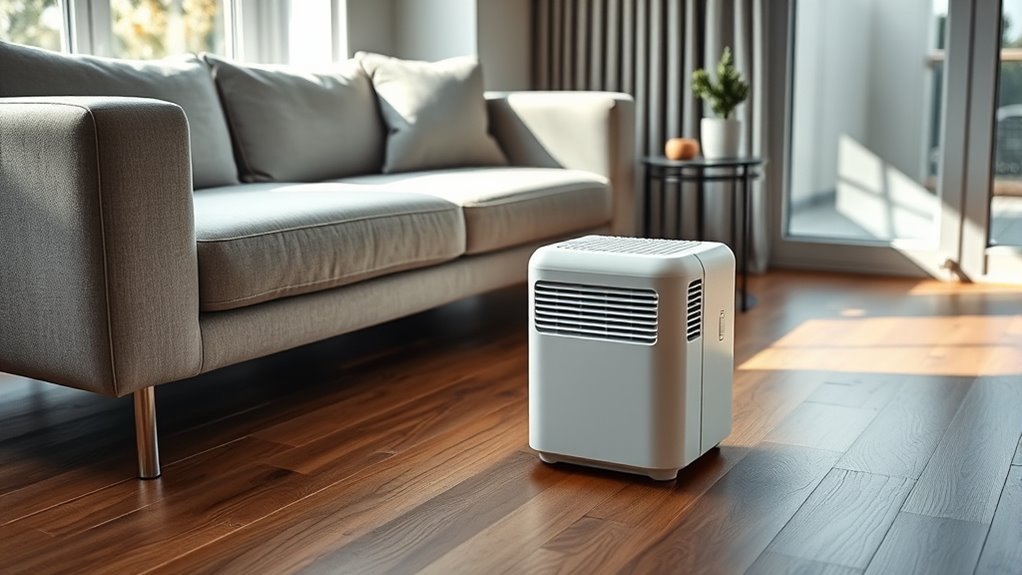
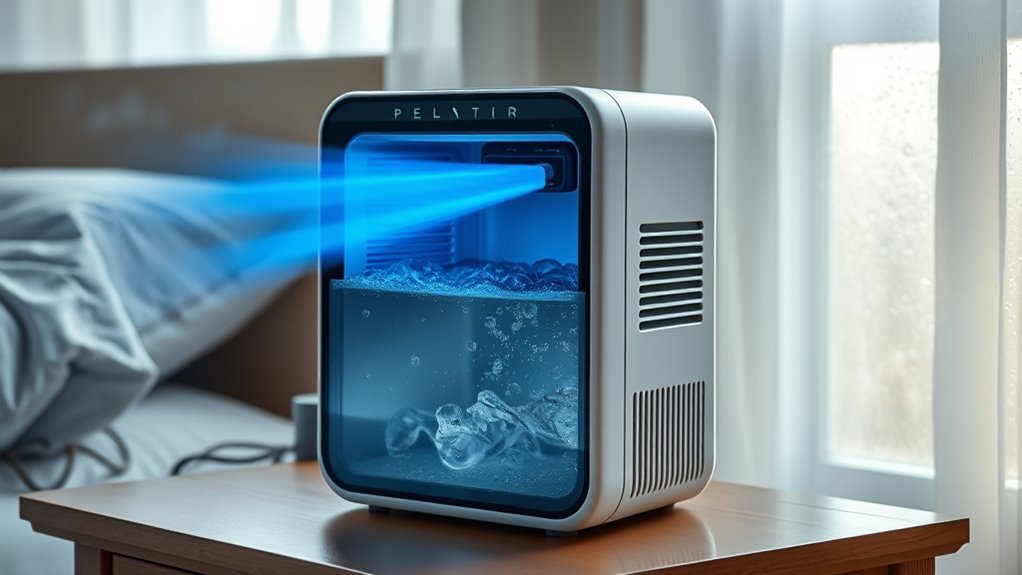
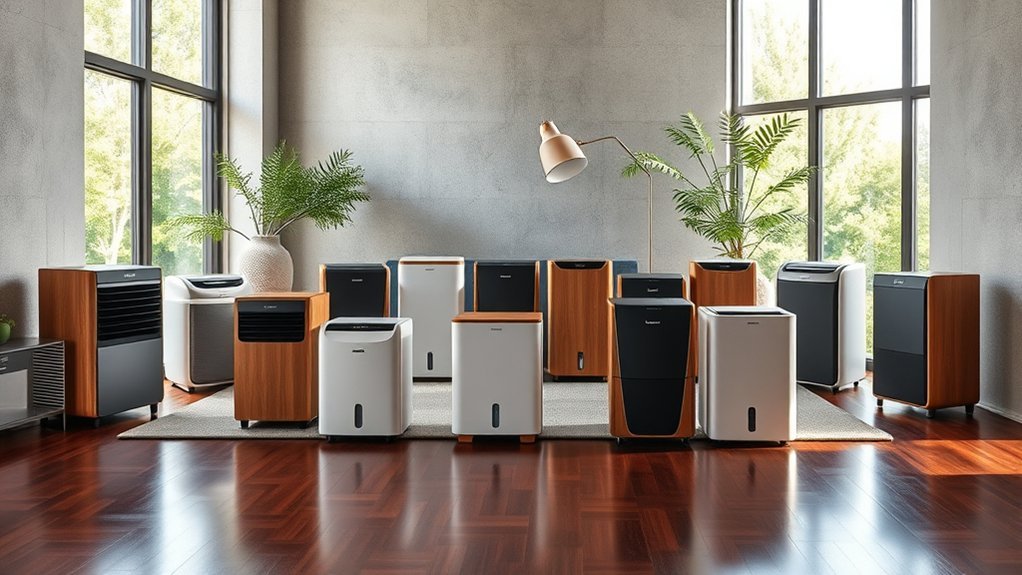
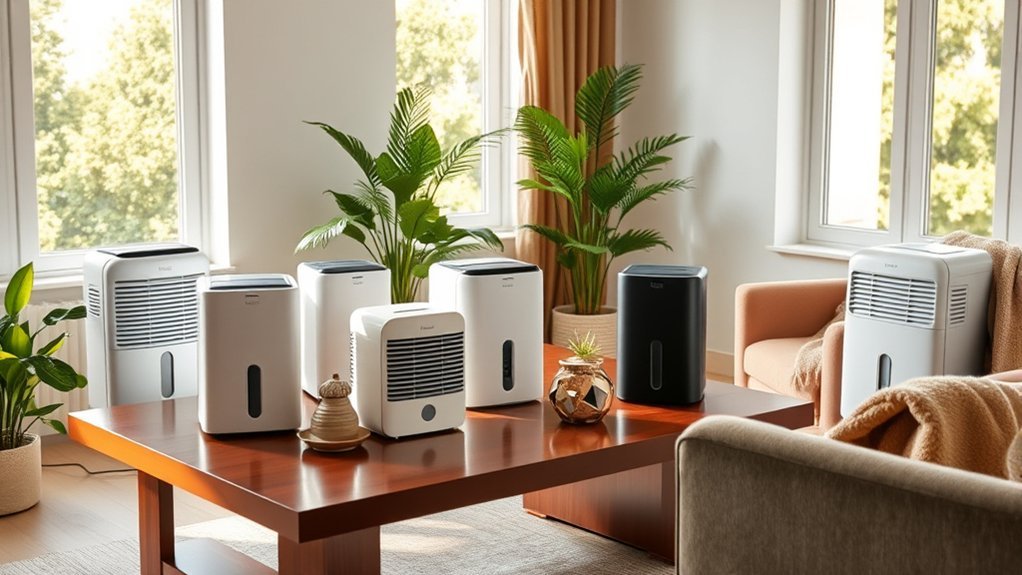
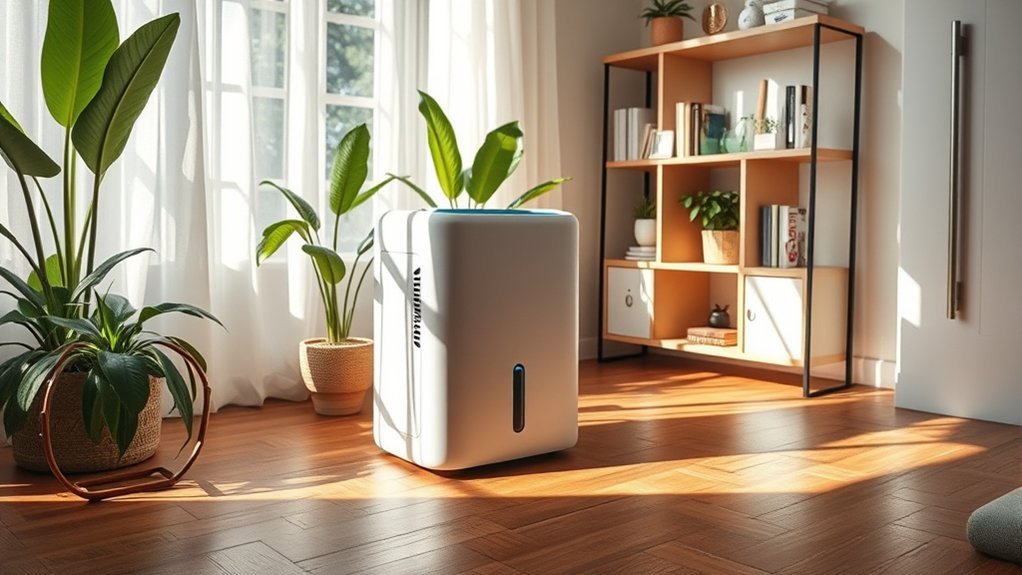
Choosing the best dehumidifier is less about buying the machine with the largest advertised number and more about matching moisture-removal capacity, drainage, noise, controls, and operating conditions to your space. This updated 2026 guide compares 12 linked dehumidifiers, from compact semiconductor units for light moisture to compressor models for basements, living areas, laundry rooms, garages, and RVs.
Important capacity note: Not every pint figure in this category uses the same test method. Frigidaire and Midea publish standardized daily capacities, while several other brands advertise a higher “maximum” output measured in unusually hot and humid conditions. Where a standardized EPA or ENERGY STAR capacity could be identified, it is shown separately from the seller-listed maximum.
Room-size reminder: Manufacturer square-foot ratings are useful for basic comparison, but actual results depend on temperature, starting humidity, ceiling height, airflow, open doors, laundry, and water intrusion. A dehumidifier can manage airborne moisture, but it cannot repair a plumbing leak, foundation seepage, or poor exterior drainage.
Quick verdict
Choose the Frigidaire 50 Pint for the strongest combination of standardized capacity and Wi-Fi control. The Midea Cube 20 Pint is the best space-saving smart option, while the Avylo ADC018 is the most useful choice when a built-in pump is more important than maximum standardized output. The Yaufey JD025Q-80 offers ENERGY STAR-certified gravity drainage, and the TENKER belongs only in small enclosed spaces with light moisture.
Key takeaways
- Compare standardized pint ratings before comparing seller maximums.
- Choose gravity drainage only when the hose can run continuously downhill.
- Choose a pump when water must travel upward to a sink, window, or elevated drain.
- Treat advertised square-foot coverage as an estimate rather than a guarantee.
- Use a semiconductor unit only for light moisture in a small enclosed space.
Quick Comparison of the Best Dehumidifiers
| Model | Best For | Capacity Context | Listed Coverage | Drainage | Amazon |
|---|---|---|---|---|---|
| Frigidaire 50 Pint Dehumidifier with Wi-Fi | Best Overall for Large Smart Spaces | 50 pints/day under a standardized rating | Up to 4,500 sq. ft. | Removable bucket or gravity drain | Check Current Details |
| Midea Cube 20 Pint Dehumidifier | Best Space-Saving Smart Pick | 20 pints/day under a standardized rating | Up to 1,500 sq. ft. | Bucket or included gravity-drain hose | Check Current Details |
| Yaufey JD025Q-80 ENERGY STAR Dehumidifier | Best ENERGY STAR Gravity-Drain Alternative | 24.93 pints/day standardized; seller markets up to 80 pints/day at high heat and humidity | Seller lists up to 5,000 sq. ft. | 1.06-gallon tank or gravity drain | Check Current Details |
| Avylo ADC018 Dehumidifier with Built-In Pump | Best Built-In Pump Pick | 24.5 pints/day standardized; seller markets up to 90 pints/day at 95°F and 95% RH | Seller lists up to 5,000 sq. ft. | Bucket, gravity drain, or pump drain | Check Current Details |
| AEOCKY Boreas Max 50-Pint Dehumidifier | Best Mid-to-Large Room Balance | Seller-listed maximum of 50 pints/day; confirm test conditions | Up to 3,500 sq. ft. | 0.8-gallon tank or drain hose | Check Current Details |
| VEAGASO VG380 Dehumidifier | Best Value for Medium Rooms | Seller-listed maximum of 34 pints/day under hot, humid conditions | Up to 2,500 sq. ft. | 0.53-gallon tank or included hose | Check Current Details |
| PLUSCENT PD10 Dehumidifier | Best Flexible Medium-Room Pick | Seller-listed maximum of 32 pints/day | Up to 2,500 sq. ft. | 2-liter tank or included hose | Check Current Details |
| SEMKAP PD8R-03ME Dehumidifier | Best Alternative for Medium Rooms | Seller-listed maximum of 32 pints/day at 95°F and 90% RH | Up to 2,500 sq. ft. | 2.5-liter tank or included hose | Check Current Details |
| GoGuess YC3D6-PRO Dehumidifier | Best Medium-Room and RV Pick | Seller-listed maximum of 21 pints/day at 95°F and 90% RH | Up to 1,600 sq. ft. | 2.3-liter tank or gravity drain | Check Current Details |
| Glowells PD20A26 Dehumidifier | Best for Laundry-Drying Support | Seller-listed maximum of 21 pints/day | Up to 1,500 sq. ft. | Bucket or gravity-drain hose | Check Current Details |
| Midea EasyDry 22 Pint Dehumidifier | Best Simple Standard-Profile Pick | 22 pints/day under a standardized rating | Up to 1,500 sq. ft. | 0.8-gallon tank or gravity drain | Check Current Details |
| TENKER QIG-D05 Dehumidifier | Best Compact Semiconductor Pick | Up to 35 oz/day at 86°F and 80% RH | Best treated as a small enclosed-space unit | 77-ounce removable tank | Check Current Details |
Frigidaire 50 Pint Dehumidifier with Wi-Fi
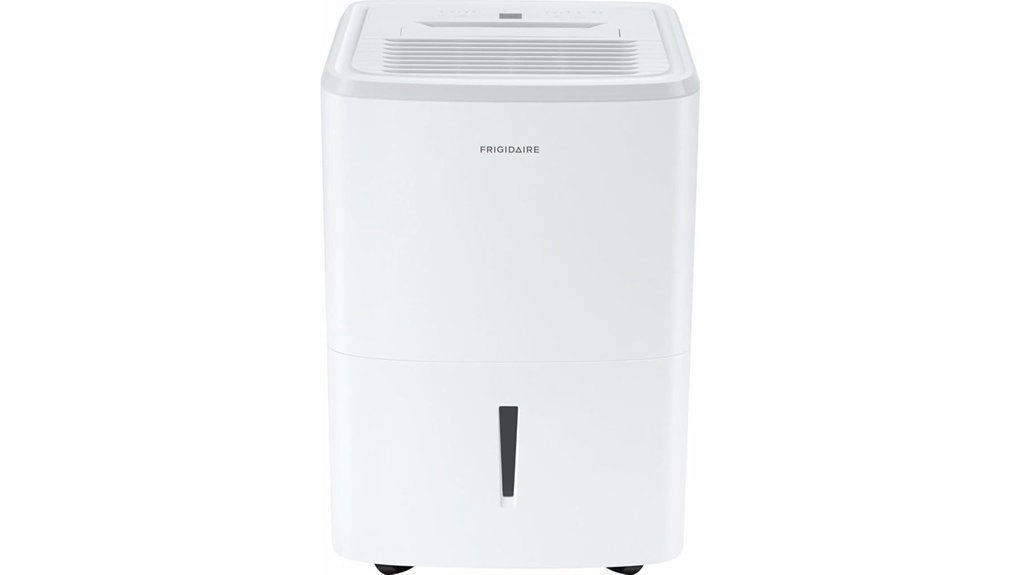
Best Overall for Large Smart Spaces
The linked Frigidaire FHDD5034Y1 combines a standardized 50-pint daily capacity with Wi-Fi control. It is listed for spaces up to 4,500 square feet and includes three fan speeds, adjustable humidity control, a washable filter, automatic shutoff, and continuous-drain capability. Remote control is useful when the machine runs in a basement, garage, or another area that is inconvenient to check frequently.
Capacity Context: Its 50-pint rating is a more useful apples-to-apples benchmark than seller maximums measured only under extreme heat and humidity.
Best For: Large basements, garages, and homeowners who want strong standardized capacity with app-based control.
Why You’ll Like It: It combines a recognizable appliance brand, substantial moisture-removal capacity, physical controls, and remote monitoring in one unit.
Who Should Avoid It: It weighs roughly 44.5 pounds and is less convenient for frequent movement between floors or small rooms.
Pros:
- Standardized 50-pint daily capacity.
- Wi-Fi control through Frigidaire’s connected-appliance system.
- Three fan speeds and adjustable humidity control.
- Bucket and continuous gravity-drain operation.
Cons:
- Large and relatively heavy.
- Wi-Fi setup may be unnecessary for buyers who prefer simple manual controls.
- Advertised coverage still depends on temperature, airflow, and moisture load.
Midea Cube 20 Pint Dehumidifier with Smart Control
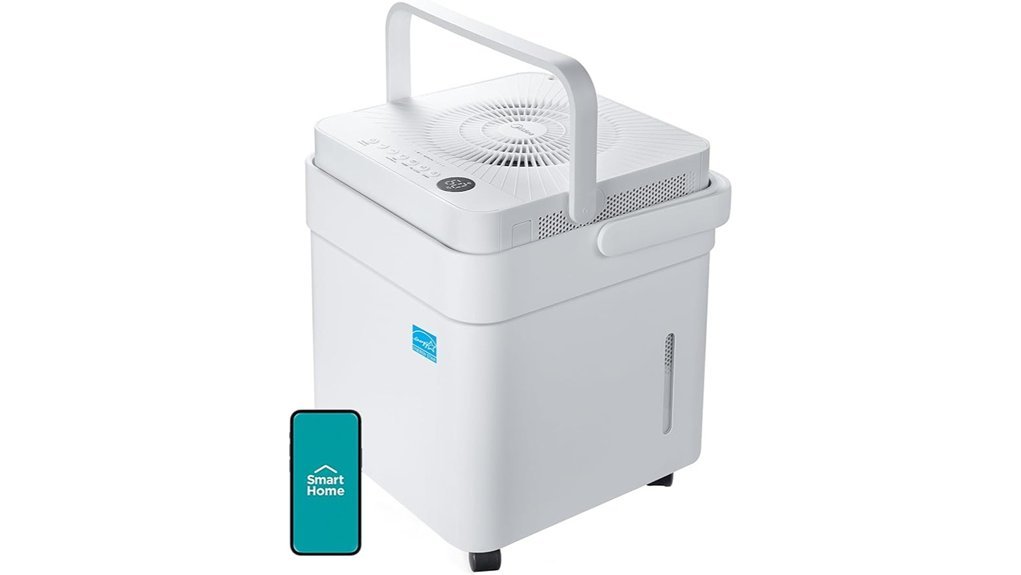
Best Space-Saving Smart Pick
The Midea Cube MAD20S1QWT is a 20-pint ENERGY STAR dehumidifier rated for spaces up to 1,500 square feet. Its lift-and-twist body operates in an extended configuration and nests down for more compact storage. SmartHome app control and voice-assistant compatibility make it practical for buyers who want remote access without choosing a large 50-pint cabinet.
Capacity Context: The 20-pint figure is a standardized rating and can be compared more directly with other DOE- or ENERGY STAR-rated models.
Best For: Medium rooms where compact storage, app control, and flexible drainage matter.
Why You’ll Like It: The nesting design helps reduce storage bulk, while the included drain hose can reduce trips to empty the bucket.
Who Should Avoid It: Choose a larger standardized-capacity model for a persistently wet basement or a large open floor plan.
Pros:
- Standardized 20-pint performance.
- SmartHome app and voice-assistant compatibility.
- Nestable lift-and-twist design.
- Included continuous-drain hose.
Cons:
- Lower capacity than a standardized 35- or 50-pint unit.
- App pairing adds an extra setup step.
- The unit weighs about 33 pounds and is not a mini portable appliance.
Yaufey JD025Q-80 ENERGY STAR Dehumidifier
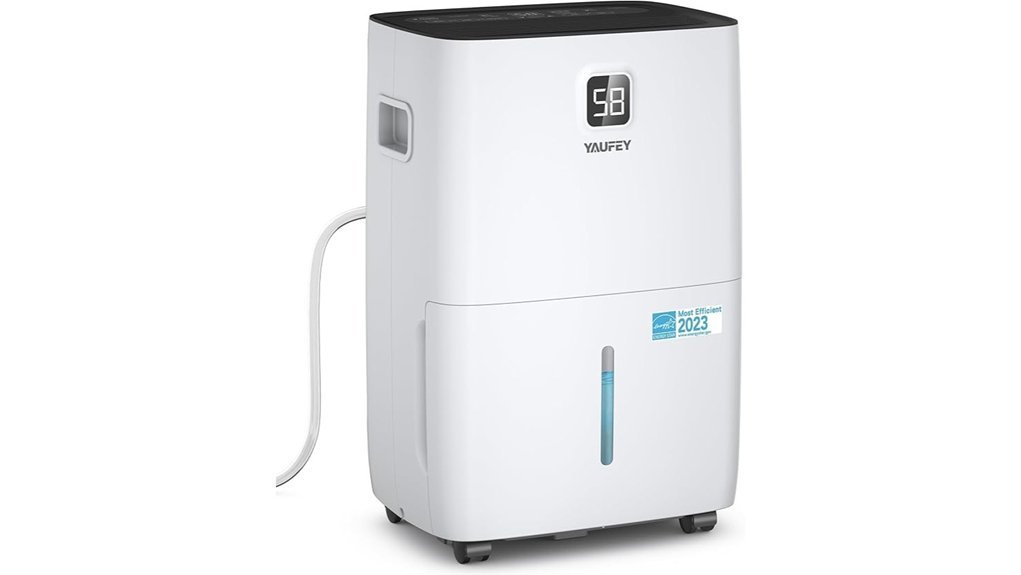
Best ENERGY STAR Gravity-Drain Alternative
The Yaufey JD025Q-80 includes a 1.06-gallon tank, drain hose, adjustable humidity control, automatic shutoff, automatic defrost, timer, reusable filter, and caster wheels. Its seller listing advertises up to 80 pints per day at approximately 95°F and 90% relative humidity, but ENERGY STAR certification data lists a standardized water-removal capacity of 24.93 pints per day.
Capacity Context: Use the 24.93-pint standardized figure when comparing this model with the Frigidaire or Midea units. The larger 80-pint maximum is not an equivalent test rating.
Best For: Medium-to-large areas with access to a low floor drain and buyers who value ENERGY STAR certification.
Why You’ll Like It: It combines certified efficiency, a reasonably large bucket, and included gravity-drain equipment.
Who Should Avoid It: Do not buy it expecting the same standardized output as a true 80-pint commercial or whole-home dehumidifier.
Pros:
- ENERGY STAR-certified 24.93-pint standardized capacity.
- 1.06-gallon tank and included drain hose.
- Automatic defrost, timer, and adjustable humidistat.
- Reusable filter and caster wheels.
Cons:
- The 80-pint marketing figure can be confusing.
- Continuous drainage requires a downhill hose route.
- The 5,000-square-foot claim should be treated as a seller estimate.
Avylo ADC018 Dehumidifier with Built-In Pump
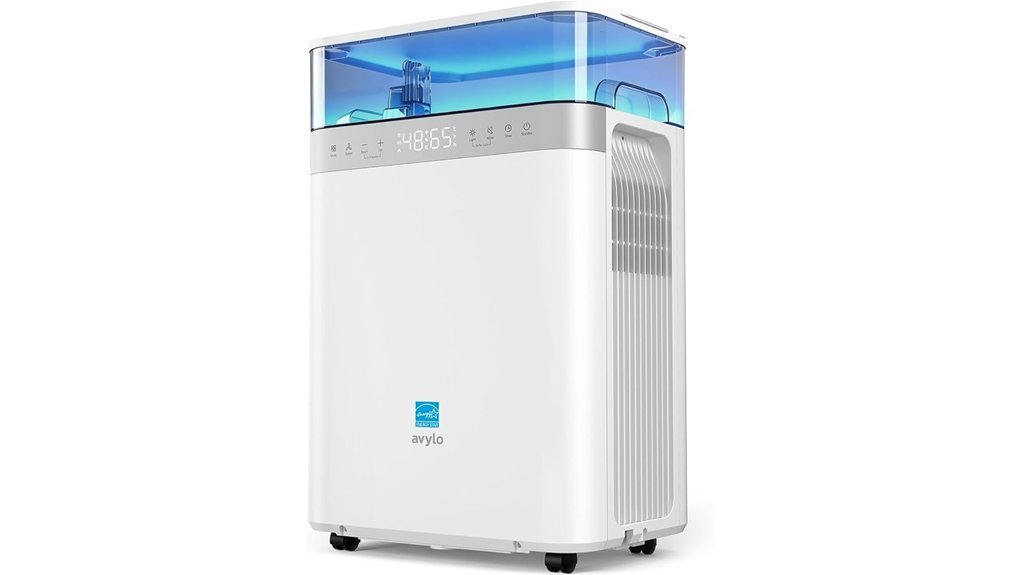
Best Built-In Pump Pick
The Avylo ADC018 stands out because its listing combines bucket drainage, gravity drainage, and a built-in pump. The seller advertises a top-mounted 2.11-gallon tank, automatic defrost, and up to 90 pints of moisture removal at 95°F and 95% relative humidity. ENERGY STAR data lists a standardized capacity of 24.5 pints per day and identifies the model as meeting ENERGY STAR Most Efficient 2025 criteria.
Capacity Context: The standardized 24.5-pint figure is the fair comparison point. The advertised 90-pint figure reflects much more demanding temperature and humidity conditions.
Best For: Basements where water must be lifted to a sink, window, laundry drain, or another elevated outlet.
Why You’ll Like It: The pump gives you more placement flexibility than a gravity-only dehumidifier and reduces dependence on manual bucket emptying.
Who Should Avoid It: Skip the extra pump complexity when a nearby floor drain already provides a reliable downhill route.
Pros:
- Built-in pump supports elevated drainage.
- Large seller-listed 2.11-gallon top-mounted tank.
- ENERGY STAR-certified 24.5-pint standardized capacity.
- Automatic defrost and humidity control.
Cons:
- The 90-pint seller maximum is not equivalent to a standardized 90-pint rating.
- Pump hoses must be routed and secured carefully.
- The pump adds more parts and complexity than a gravity-drain system.
AEOCKY Boreas Max 50-Pint Dehumidifier
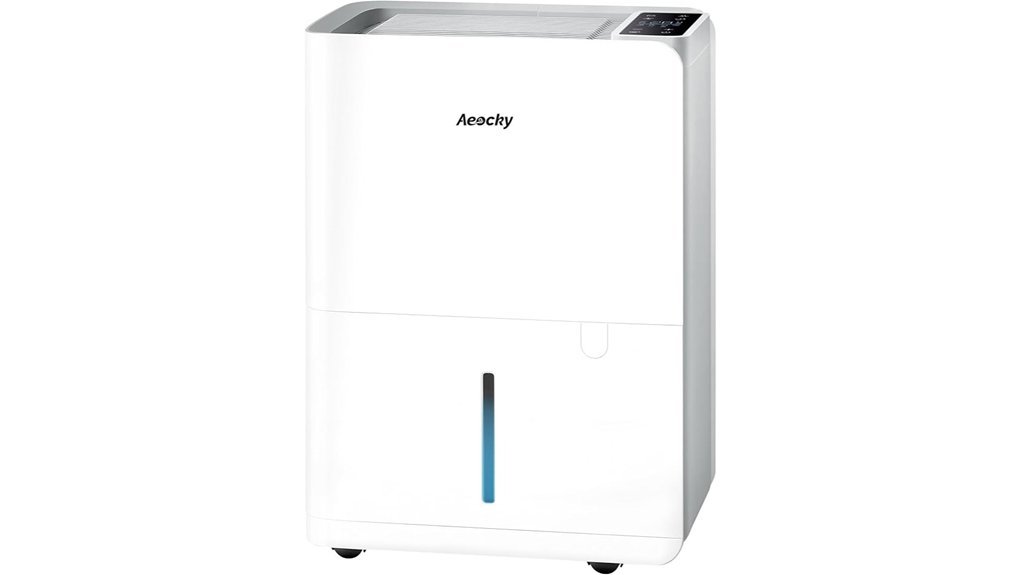
Best Mid-to-Large Room Balance
The AEOCKY Boreas is advertised with a maximum output of 50 pints per day and coverage up to 3,500 square feet. It includes a drain hose, a 0.8-gallon tank, an adjustable humidistat, and a seller-listed sound level around 40 dB. Its capacity and cabinet size place it between compact room models and the largest basement appliances.
Capacity Context: The brand describes this as a maximum 50-pint model. Confirm the test conditions before comparing that number directly with a standardized 50-pint rating.
Best For: Basements, garages, and larger rooms needing more capability than a mini or low-output semiconductor unit.
Why You’ll Like It: The design offers a useful combination of drainage, humidity control, portability, and moderate cabinet size.
Who Should Avoid It: Buyers who require a clearly published standardized capacity may prefer a model with an easily identifiable ENERGY STAR record.
Pros:
- Seller-listed maximum output of 50 pints per day.
- Drain hose and adjustable humidistat.
- Listed 40 dB sound positioning.
- More manageable than some oversized basement cabinets.
Cons:
- The maximum rating may use different test conditions from standardized capacities.
- The 0.8-gallon bucket can fill quickly in damp conditions.
- Coverage and sound claims depend on room conditions and operating mode.
VEAGASO VG380 Dehumidifier with Drain Hose
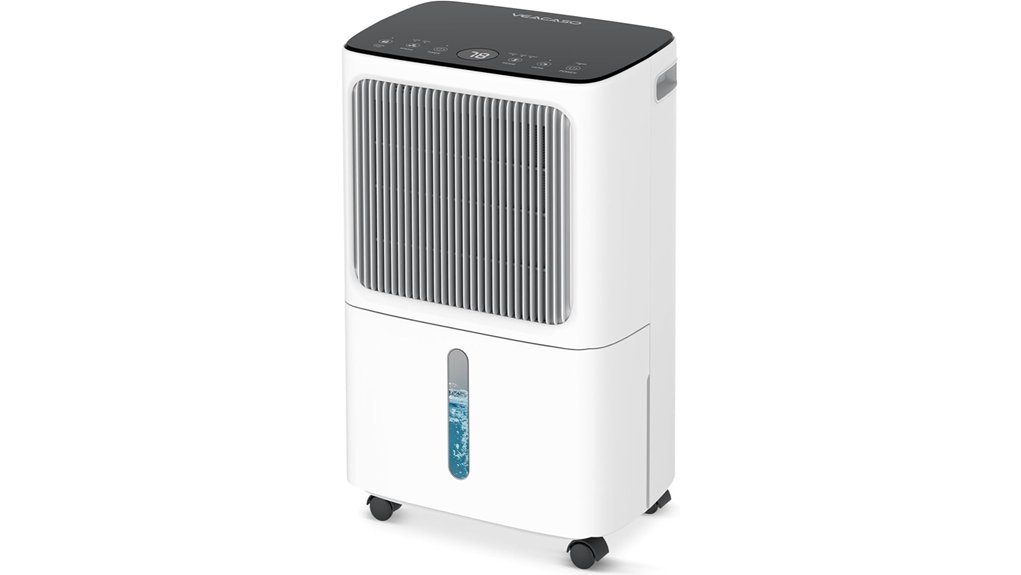
Best Value for Medium Rooms
The VEAGASO VG380 is advertised to remove a maximum of 34 pints per day in hot, humid conditions and to serve spaces up to 2,500 square feet. It offers dehumidify, dry-clothes, and continuous modes, plus a 24-hour timer, adjustable humidity control, a 2-liter tank, washable filter, caster wheels, and an included drain hose.
Capacity Context: Treat 34 pints as a seller maximum rather than assuming it equals a standardized 34-pint rating.
Best For: Bedrooms, living areas, laundry rooms, and moderately damp basements with a suitable drain.
Why You’ll Like It: It combines useful controls and continuous drainage without moving into an extra-large cabinet.
Who Should Avoid It: The 0.53-gallon tank is small for high-humidity use unless the hose is connected.
Pros:
- Three operating modes.
- Adjustable humidistat and 24-hour timer.
- Included drain hose and washable filter.
- Seller-listed sound level of 40 dB or less.
Cons:
- The 34-pint maximum is measured under hot, humid conditions.
- The small tank may require frequent emptying.
- Real-world noise can exceed the lowest advertised figure at higher fan speeds.
PLUSCENT PD10 Dehumidifier for Medium and Large Rooms
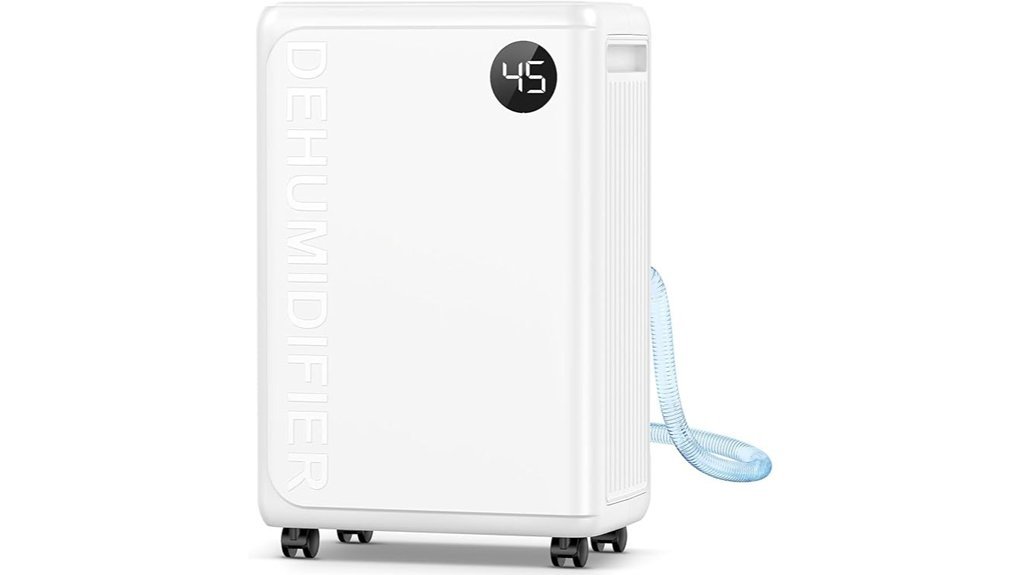
Best Flexible Medium-Room Pick
The PLUSCENT PD10 is advertised with a maximum output of 32 pints per day and coverage up to 2,500 square feet. Its feature set includes multiple operating modes, a 24-hour timer, automatic defrost, automatic restart, adjustable humidity control, a 2-liter tank, washable filter, child lock, and an included drain hose.
Capacity Context: The 32-pint number is a seller-listed maximum. Confirm the stated test conditions before comparing it with standardized ratings.
Best For: Homes, laundry areas, and RVs needing a movable compressor model with several operating modes.
Why You’ll Like It: Automatic defrost, restart, timer, and child-lock functions provide more control than a basic mini dehumidifier.
Who Should Avoid It: For severe water intrusion or a very wet open basement, a larger standardized-capacity model may be easier to live with.
Pros:
- Multiple operating modes and adjustable humidity control.
- Automatic defrost and restart.
- Included drain hose.
- Washable filter and child lock.
Cons:
- The seller maximum is not directly comparable with a standardized 32-pint rating.
- Hose drainage still depends on gravity.
- The 2-liter tank may fill quickly in damp weather.
SEMKAP PD8R-03ME Dehumidifier
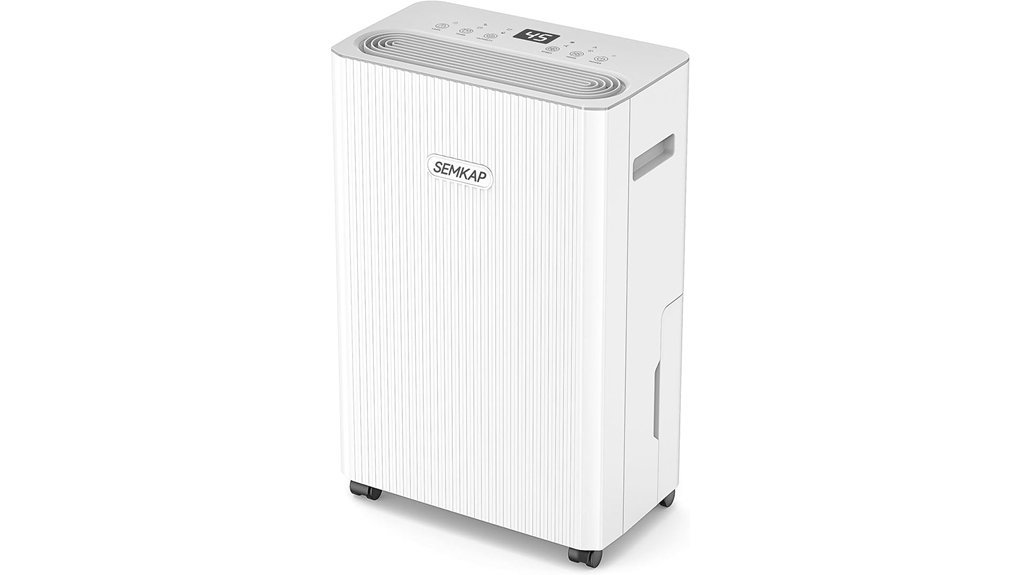
Best Alternative for Medium Rooms
The SEMKAP PD8R-03ME is advertised to remove up to 32 pints per day at 95°F and 90% relative humidity. Its listing includes a 2.5-liter tank, drain hose, adjustable humidity control, automatic defrost, automatic restart, automatic shutoff, washable filter, caster wheels, and a 24-hour timer.
Capacity Context: The 32-pint figure is a high-temperature, high-humidity maximum rather than a standardized room-condition rating.
Best For: Bedrooms, bathrooms, laundry rooms, and moderately damp basements where a 2.5-liter tank or gravity drain is practical.
Why You’ll Like It: It includes the core controls and drainage accessories many buyers need without requiring an app.
Who Should Avoid It: Choose a pump model when there is no suitable low drain and you do not want to empty the tank.
Pros:
- 2.5-liter tank is larger than several competing private-label models.
- Drain hose, washable filter, and caster wheels.
- Automatic defrost and restart.
- Timer and adjustable humidity control.
Cons:
- The maximum output uses hot, humid test conditions.
- No built-in pump is advertised.
- Low-noise positioning is not a substitute for an independently measured sound test.
GoGuess YC3D6-PRO Dehumidifier for Home and RV
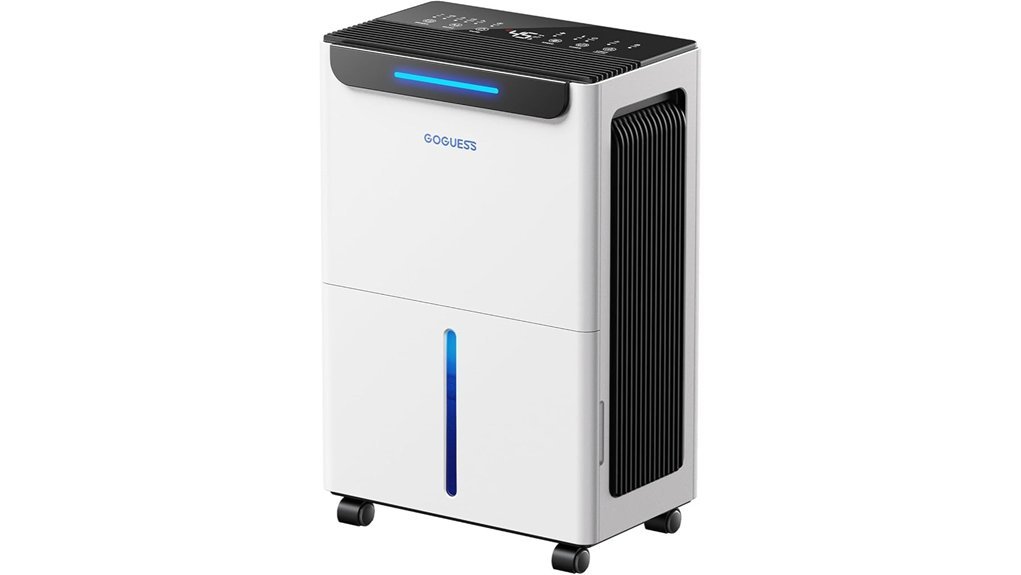
Best Medium-Room and RV Pick
The GoGuess YC3D6-PRO is advertised to remove up to 21 pints per day at 95°F and 90% relative humidity. It includes three operating modes, a 24-hour timer, adjustable humidity control, a drain-hose connection, caster wheels, and a 2.3-liter tank with automatic shutoff.
Capacity Context: Its 21-pint figure is a seller maximum under hot, humid conditions rather than a standardized 21-pint rating.
Best For: Bedrooms, bathrooms, medium rooms, and RVs with an appropriate 120V shore-power or electrical setup.
Why You’ll Like It: It provides compressor-based moisture removal in a relatively moderate-size package.
Who Should Avoid It: Choose a larger standardized-capacity unit for a wet basement, open floor plan, or heavy laundry-drying load.
Pros:
- Three modes, timer, and adjustable humidistat.
- Manual and continuous drainage options.
- More effective for persistent humidity than a small semiconductor unit.
Cons:
- The 2.3-liter tank can fill quickly.
- The seller maximum depends on very warm, humid test conditions.
- RV users must confirm voltage, wattage, outlet, and circuit compatibility.
Glowells PD20A26 Dehumidifier for Large Rooms
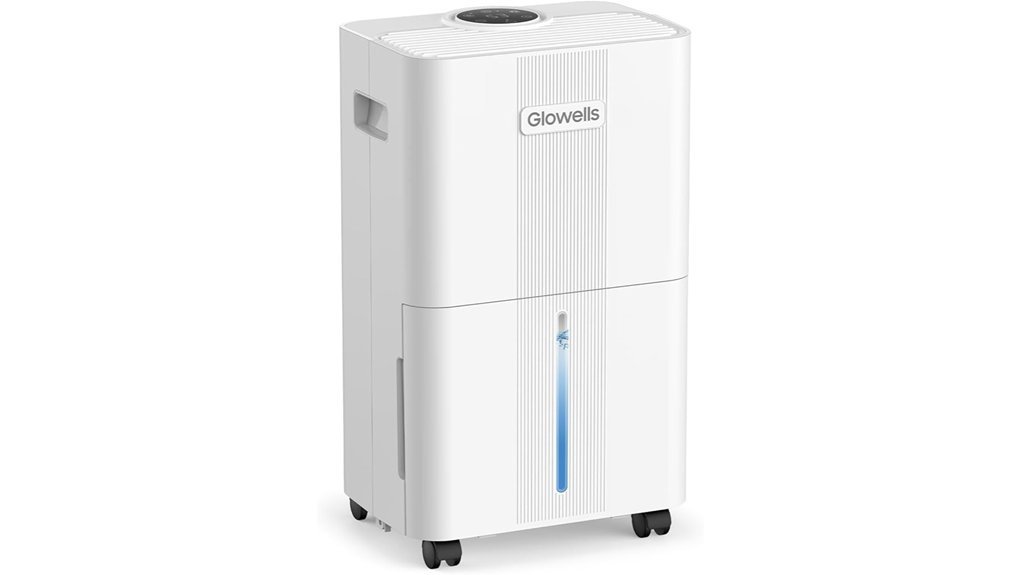
Best for Laundry-Drying Support
The Glowells PD20A26 is advertised with a maximum output of 21 pints per day and coverage up to 1,500 square feet. It includes three modes, a 24-hour timer, humidity control, a drain-hose option, and a dedicated dry-clothes setting.
Capacity Context: The 21-pint figure is seller-provided. Check the exact listing for its test conditions before comparing it with standardized capacities.
Best For: Bedrooms, laundry areas, RVs, and medium rooms that can benefit from a dedicated clothes-drying mode.
Why You’ll Like It: The laundry-focused mode gives it a clearer use case than many other private-label models with similar maximum output.
Who Should Avoid It: Do not expect it to handle the same moisture load as a standardized 35- or 50-pint basement model.
Pros:
- Three operating modes and a 24-hour timer.
- Dedicated dry-clothes setting.
- Bucket and gravity-drain options.
Cons:
- Limited independently published performance information.
- Continuous drainage requires proper downhill hose placement.
- Seller sound and coverage claims should be treated as estimates.
Midea EasyDry 22 Pint ENERGY STAR Dehumidifier
Best Simple Standard-Profile Pick
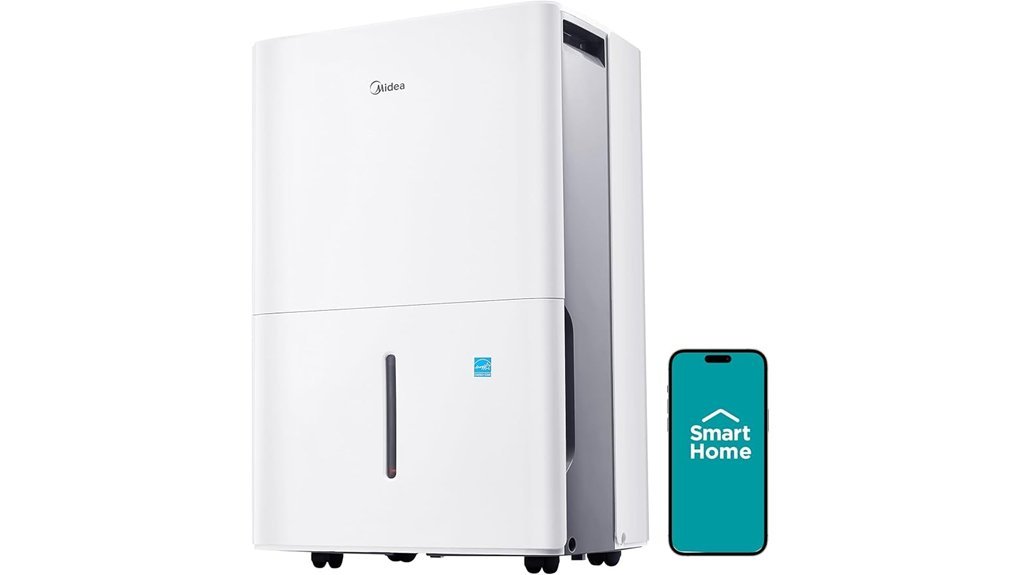
The linked Midea MAD22C1AWS EasyDry model removes up to 22 pints per day under its standardized rating and is listed for spaces up to 1,500 square feet. It has a conventional upright cabinet, four caster wheels, a built-in timer, automatic shutoff, a reusable filter, and continuous-drain capability.
Important Feature Check: This linked EasyDry model is not a Wi-Fi or SmartHome model. Buyers who want app control should choose the Midea Cube or verify a different Smart Access model and ASIN.
Best For: Medium rooms where buyers want a straightforward Midea dehumidifier without app setup.
Why You’ll Like It: It offers a standardized capacity, conventional controls, caster wheels, and a familiar upright design.
Who Should Avoid It: Choose another model if remote control, voice-assistant support, or a built-in pump is required.
Pros:
- Standardized 22-pint daily capacity.
- ENERGY STAR-certified efficiency.
- Reusable filter and caster wheels.
- Simple timer and humidity controls.
Cons:
- No Wi-Fi or SmartHome control on the linked model.
- The 0.8-gallon tank may need frequent emptying.
- Confirm whether a drain hose is included with the current variation.
TENKER QIG-D05 Dehumidifier with 77 oz Water Tank
Best Compact Semiconductor Pick
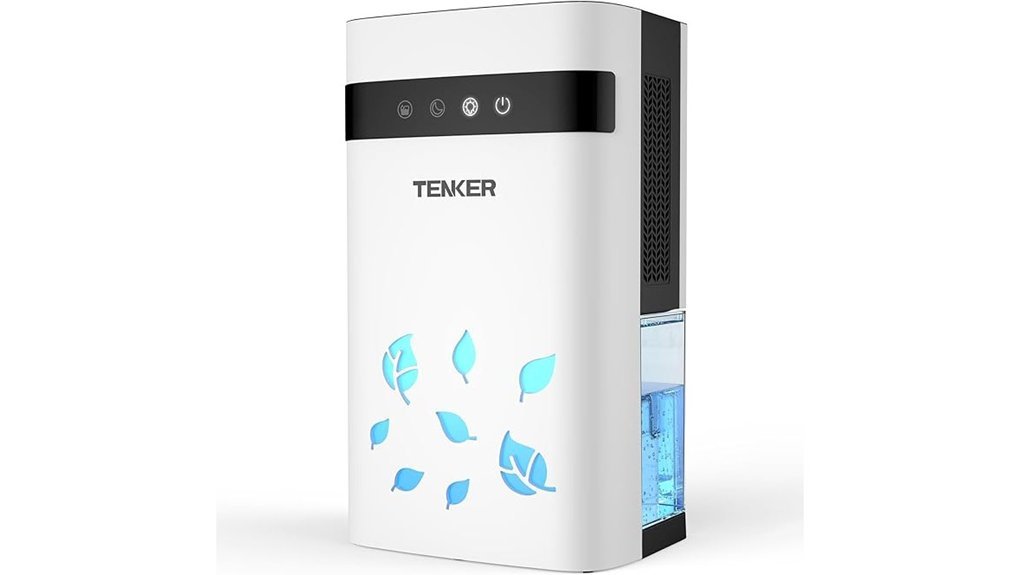
The TENKER QIG-D05 is different from the compressor models above. It uses semiconductor condensation technology, has a 77-ounce tank, and is advertised to collect up to 35 ounces per day at 86°F and 80% relative humidity in a closed room. Its sleep mode is listed below 30 dB, and the unit includes automatic shutoff, two operating speeds, and seven-color lighting.
Capacity Context: Thirty-five ounces is about 1.8 pints. That is far below the daily output of even a standardized 20-pint compressor model.
Best For: Closets, small bathrooms, RV sleeping areas, and compact bedrooms with light moisture.
Why You’ll Like It: It is compact, quiet, easy to move, and simple to operate when the goal is mild moisture control.
Who Should Avoid It: Do not choose it as the primary solution for a wet basement, large room, active leak, or persistent condensation problem.
Pros:
- Compact and lightweight.
- 77-ounce removable tank.
- Sleep mode is listed below 30 dB.
- Automatic shutoff helps prevent overflow.
Cons:
- Moisture-removal output is far below compressor models.
- Performance drops as temperature and humidity decrease.
- The advertised 1,000-square-foot coverage should not be compared with compressor coverage.
Factors to Consider When Choosing a Dehumidifier
The right dehumidifier should control humidity without forcing you to overpay for unused capacity, repeatedly empty an undersized tank, or install a drainage system that does not suit the room. Use the points below to narrow the list.
Compare Standardized and Maximum Capacities
A standardized pint rating and a seller maximum measured at 95°F and 90% or 95% relative humidity are not equivalent. When available, use the EPA, DOE, or ENERGY STAR capacity for direct comparison. Treat a seller maximum as additional context rather than the primary ranking number.
Start With Moisture Load, Not Only Square Footage
A mildly damp bedroom needs less capacity than a cool basement with visible condensation, indoor laundry, seepage, or frequent door openings. Treat manufacturer square-foot ratings as estimates and use a separate hygrometer to track the room’s actual relative humidity.
Choose Compressor or Semiconductor Technology
Compressor dehumidifiers are the better match for persistent humidity and larger spaces. Small semiconductor models such as the TENKER are quieter and lighter, but their daily water-removal output is much lower. They are best for closets, small bathrooms, RV sleeping areas, and light moisture rather than wet basements.
Match Drainage to the Room
A removable bucket works without plumbing but requires regular emptying. Gravity drainage is convenient when the hose can run continuously downhill to a floor drain. A built-in pump, such as the one advertised for the Avylo, is useful when water must move upward to an elevated drain. Always secure the hose and follow the manufacturer’s routing and height limits.
Compare Tank Size With Daily Capacity
A machine with a small tank may shut off several times a day in humid weather. Buyers who cannot use continuous drainage should prioritize a larger bucket, easy access, a comfortable handle, a clear full-tank indicator, and an automatic shutoff function.
Look for a Humidistat, Auto Defrost, and Restart
An adjustable humidistat lets the unit cycle around your selected target instead of running continuously. Automatic defrost is valuable in cooler basements, while auto restart can help the unit resume operation after a power interruption. Confirm these features on the exact model variation.
Consider Noise and Placement
Noise matters in bedrooms, offices, and living areas. Published decibel figures can help, but fan speed, compressor cycling, floor vibration, and room acoustics affect what you hear. Leave the required clearance around the air intake and exhaust, keep the filter accessible, and place the machine on a level surface.
Use Energy Claims Carefully
ENERGY STAR certification is more useful than broad marketing promises about annual dollar savings. Actual operating cost depends on wattage, runtime, humidity setting, climate, and local electricity rates. Do not treat a seller’s maximum savings estimate as a guaranteed result.
Before You Buy Checklist
- Measure the room and classify it as mildly damp, very damp, or wet.
- Compare standardized capacity before seller maximums.
- Decide whether you can use a bucket, gravity hose, or built-in pump.
- Check the lowest operating temperature for a cool basement.
- Confirm tank size, hose inclusion, warranty, filter type, and support.
- Check the electrical requirements before using a model in an RV.
- Plan a grounded outlet location without relying on an extension cord unless the manual permits it.
- Repair active leaks and remove standing water before relying on dehumidification.
Frequently Asked Questions
What humidity level should I set?
A target around 40% to 50% relative humidity is a practical starting point for many homes. Adjust the setting for your climate and watch for condensation, musty odors, or excessive dryness. A separate hygrometer can help you verify the dehumidifier’s display.
Why do different brands use different pint ratings?
Some brands publish standardized output measured under regulated test conditions. Others promote a maximum measured at temperatures around 95°F and relative humidity around 90% or higher. The second number will usually look much larger, so check the test conditions before comparing models.
How many pints do I need for a basement?
A mildly damp basement may be manageable with a standardized 20- to 35-pint unit. A very damp, large, or frequently used basement may benefit from a standardized 40- to 50-pint model. Temperature, drainage, ceiling height, and moisture severity matter as much as floor area.
Does a higher square-foot rating always mean better performance?
No. Brands may calculate coverage using different assumptions. Compare standardized pints per day, test conditions, drainage, operating temperature, and measured humidity rather than relying on floor area alone.
Should I buy a dehumidifier with a pump?
A pump is worthwhile when the only suitable drain is higher than the machine. If you have a nearby floor drain and can maintain a steady downhill hose slope, a gravity-drain model is simpler and often sufficient.
Can a dehumidifier stop mold?
Lower humidity can make conditions less favorable for mold growth, but a dehumidifier does not remove existing mold or repair the moisture source. Fix leaks, dry wet materials promptly, and use appropriate cleanup or professional remediation when needed.
How often should I clean the filter and tank?
Follow the manual, inspect the filter regularly, and clean it when dust builds up. Rinse and dry the tank periodically to limit residue and odors. Check continuous-drain and pump hoses for kinks, clogs, loose connections, or unwanted upward sections.
Why does my dehumidifier collect less water in a cool room?
Cooler air contains less water vapor, and frost can form on compressor coils. A model with automatic defrost may temporarily stop dehumidifying while it clears frost, reducing water collection during colder periods.
How long do dehumidifiers usually last?
Service life varies with construction, runtime, room conditions, cleaning, drainage, and electrical stress. Regular filter care, unobstructed airflow, proper hose routing, and correct sizing can help the unit operate reliably for longer.
Final Recommendation
Compare standardized capacity first, then choose the drainage system.
For the strongest all-around combination of standardized output and connected control, choose the Frigidaire 50 Pint. The Midea Cube 20 Pint is the better smart option for a medium room and compact storage. Choose the Avylo ADC018 when its built-in pump solves an elevated-drain problem, but compare it using its 24.5-pint standardized rating rather than its 90-pint seller maximum.
The Yaufey JD025Q-80 is a practical ENERGY STAR gravity-drain alternative with a standardized capacity of 24.93 pints per day. The Midea EasyDry 22 Pint is the simpler non-smart option, while the TENKER should be limited to small enclosed spaces with mild moisture.
Before ordering, confirm the current Amazon variation, capacity test conditions, included drainage accessories, electrical requirements, warranty terms, and return policy.