How a Peltier Dehumidifier Works: Quick Answer
How does a Peltier dehumidifier work? It chills a metal surface below the air’s dew point, so water vapor condenses on it and drips into a tank while drier air returns to the space. Use one for light dampness in closets, cabinets, RV storage areas, wardrobes, and other small enclosed spaces. Do not use one as a basement dryer, flood cleanup tool, or replacement for a full-size compressor or desiccant dehumidifier.
Quick Answer
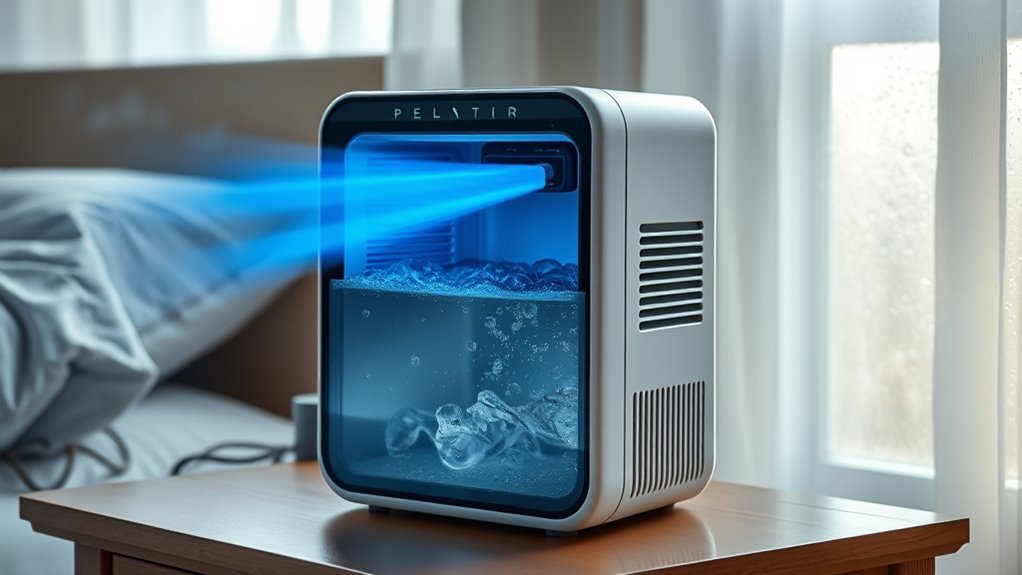
A Peltier dehumidifier uses a thermoelectric module to make one side cold and the other side warm. A fan moves humid air over the cold side. When that surface is below the air’s dew point, moisture condenses into droplets, runs into a tank, and drier air returns to the space.
Key Takeaways
- Peltier dehumidifiers work by cooling a plate below the air’s dew point so water vapor turns into liquid water.
- They are best for small, enclosed spaces with mild dampness, not whole rooms with heavy moisture problems.
- Warm, humid air gives the best results. Cold rooms, low humidity, poor airflow, and frost reduce water collection.
- Use a hygrometer instead of guessing. For many homes, the practical indoor target is about 30% to 50% relative humidity.
- If you need to remove pints of water per day, choose a compressor or desiccant dehumidifier instead.
Should You Use a Peltier Dehumidifier?
Use a Peltier dehumidifier only when the moisture problem is small, local, and easy to measure. The best test is simple: place a hygrometer in the space, run the unit with doors closed, and check whether relative humidity drops over the next day or two. If the reading barely changes, the space is too large, too cold, too damp, or poorly sealed for this type of unit.
| Choose Peltier If… | Skip Peltier If… |
|---|---|
| You need quiet, light-duty moisture control in a closet, cabinet, RV, wardrobe, or small bathroom corner. | You need to dry a basement, wet wall, flooded floor, laundry room, or large bedroom. |
| The room is warm enough for condensation to form and humidity is above your target range. | The space is cold, leaky, moldy, water-damaged, or still gaining moisture from a leak. |
| You mainly want to reduce musty air around stored items and can empty a small tank often. | You expect several pints of daily water removal or fast humidity control across a full room. |
What Is a Peltier Dehumidifier?
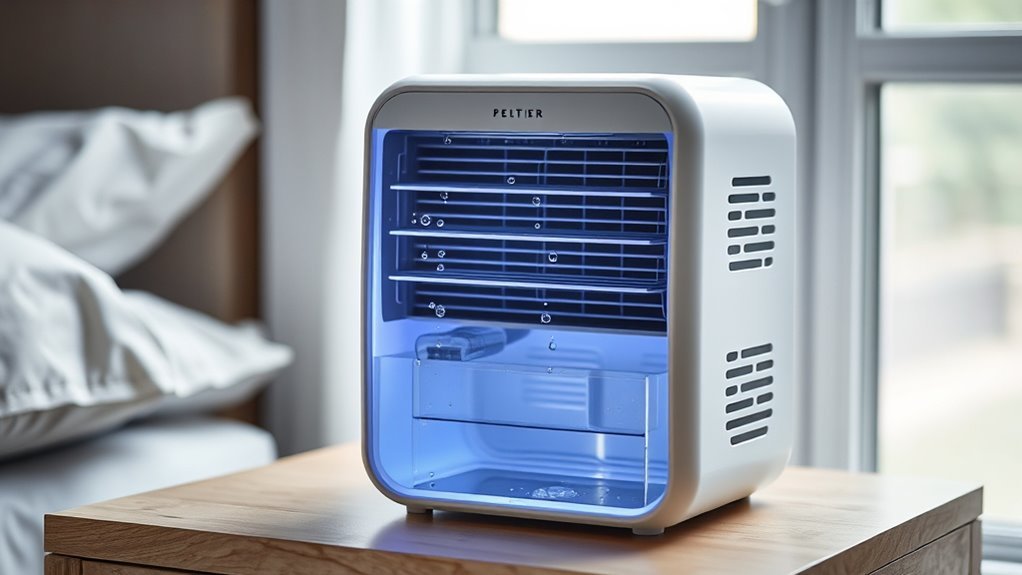
A Peltier dehumidifier is a compact moisture-removal device that uses a thermoelectric module, also called a Peltier module, instead of a compressor. When DC power passes through the module, heat moves from one face to the other. One face becomes cold, and the opposite face becomes warm.
That cold face is the working surface. The dehumidifier pulls humid air across it, water condenses, and the droplets collect in a tank or tray. Because there is no compressor, these units are usually lightweight and quieter than full-size refrigerant dehumidifiers. They also do not use a refrigerant circuit.
The tradeoff is capacity. A Peltier dehumidifier removes moisture slowly (see what a Peltier dehumidifier is and where it fits). It is a targeted tool for mild dampness, not a high-capacity drying machine.
Note: Do not judge a mini dehumidifier by tank size alone. A 500 ml or 1,000 ml tank tells you how much water it can hold, not how much water it will remove in a day.
How Does a Peltier Dehumidifier Work?
A Peltier dehumidifier works in four simple stages: thermoelectric cooling, condensation, heat rejection, and water collection.
1. The Peltier Module Creates a Cold Side
The Peltier module acts like a small solid-state heat pump. When current flows through the module, heat moves from one side to the other. The cold side absorbs heat, while the warm side releases it through a heat sink and fan.
This is why a Peltier dehumidifier can cool a plate without a compressor. The module itself has no moving parts, although the dehumidifier still uses a fan to move air.
2. Humid Air Passes Over the Cold Surface
Moist air contains water vapor. When that air touches a surface that is cold enough, the air next to the surface can reach saturation. Once it reaches that point, some of the water vapor changes into liquid droplets.
The key term is dew point. The National Weather Service explains dew point as the temperature at which water vapor turns into liquid water droplets. In a Peltier dehumidifier, condensation happens when the cold plate is at or below the dew point of the nearby air.
3. The Warm Side Dumps Heat Back Into the Room
The warm side does not remove moisture directly. Its job is to get rid of the heat pulled from the cold side, plus heat created by the electrical input. A heat sink spreads that heat, and a fan moves it into the surrounding air.
| Part | What It Does |
|---|---|
| Cold plate or fins | Chills incoming humid air so moisture can condense. |
| Peltier module | Moves heat from the cold side to the warm side. |
| Heat sink | Spreads heat so the warm side can release it. |
| Fan | Moves room air across the cold side and warm-side heat sink. |
| Tank or tray | Collects condensed water droplets. |
4. Condensed Water Runs Into the Tank
As droplets form on the cold fins or plate, gravity pulls them into a small collection tray or reservoir. Many compact units shut off automatically when the tank is full, but you should still check the tank often. A full tank stops moisture removal.
Why Does Moisture Condense on the Cold Side?
Moisture condenses on the cold side because the amount of water vapor air can contain before reaching saturation depends strongly on temperature. As humid air next to the cold surface cools, it can reach its dew point. Once that happens, water vapor begins condensing into liquid droplets.
A Peltier dehumidifier only collects water when its cold surface is cold enough for the room’s actual dew point.
This is why a Peltier dehumidifier can collect water quickly on a warm, muggy day but collect very little in a cool room with the same relative humidity reading. Temperature, relative humidity, dew point, and airflow all matter.
Why Do Peltier Dehumidifiers Work Best in Small Spaces?
Peltier dehumidifiers work best in small spaces because they process air slowly and remove a small amount of moisture at a time. In a closet, bathroom cabinet, RV storage area, boat cabin, wardrobe, gun-safe room, or small office nook, the air volume is limited. That gives the device a fair chance to lower local humidity.
In a large bedroom, basement, laundry room, or open-plan area, new humid air constantly mixes into the space. A small thermoelectric unit cannot keep up with that moisture load.
| Good Uses | Poor Uses |
|---|---|
| Closets and wardrobes | Wet basements |
| Small bathrooms with mild condensation | Flood cleanup |
| RV cabinets and boat cabins | Whole-home humidity control |
| Storage shelves and small enclosed rooms | Laundry drying or seepage problems |
What Performance Should You Expect?
Expect modest water collection. A Peltier dehumidifier may collect visible water in warm, humid conditions, but it may collect very little in cooler or drier air. Manufacturer ratings are based on stated operating or test conditions, so your real tank output may be lower.
For full-size dehumidifiers, ENERGY STAR explains that capacity is the amount of water removed per 24 hours at test conditions, while energy efficiency is measured by how many liters of water are removed per kilowatt-hour. That matters because two dehumidifiers can have similar tank sizes but very different daily removal rates.
Measurement tip: Compare the unit’s stated 24-hour removal rate, tank size, room-volume claim, and test conditions. Tank capacity only tells you when you may need to empty the unit. It does not prove the unit can lower humidity in your space.
How to Read Peltier Capacity Claims
Current manufacturer specifications show why extraction rate and tank size should be treated as separate numbers. The examples below are published maximum ratings for specific products, not promises of what every Peltier dehumidifier will collect in your room.
| Manufacturer Example | Stated Maximum Removal | Tank Capacity |
|---|---|---|
| Pro Breeze 500ml Mini Dehumidifier | Up to 250 ml per day | 500 ml |
| Pro Breeze 1500ml Mini Dehumidifier | Up to 500 ml per day | 1,500 ml |
| Trotec TTP 2 E | Maximum 0.22 L per 24 hours | 0.5 L |
These examples also show why tank capacity is not an extraction rating. A tank may hold two or three days of the unit’s stated maximum daily output. Real collection can be lower when the room is cooler, drier, larger, or less sealed than the conditions assumed by the manufacturer.
What Affects Water Collection?
- Room temperature: Warmer, humid conditions generally provide more moisture for the cold surface to condense.
- Relative humidity: Higher humidity gives the cold plate more moisture to collect.
- Dew point: If the plate is not below dew point, little or no condensation forms.
- Airflow: Blocked vents reduce how much humid air reaches the cold surface.
- Space size: Large rooms overwhelm small thermoelectric units.
- Dust and dirt: Dirty vents and fins reduce heat transfer and moisture removal.
What Are the Limits of Peltier Dehumidifiers in Cold Rooms?
Peltier dehumidifiers often struggle in cool rooms for two reasons. First, as temperature falls, saturation vapor pressure falls, and cool indoor air often contains less water per cubic meter than warm, humid air. That can reduce the amount of condensate available to collect. Second, the cold side can become cold enough for frost or ice to form, especially if airflow is poor.
Warning: If the cold side frosts over or the fan sounds strained, turn the unit off, unplug it, let it defrost, and check the manual before restarting. Do not scrape ice from the unit while it is plugged in.
If the space is regularly cool, check the dehumidifier’s stated minimum operating temperature instead of assuming every Peltier model will work there. A desiccant dehumidifier or a low-temperature-rated compressor model may be a better choice when persistent cold is part of the problem. ENERGY STAR also notes that cooler test conditions can reduce dehumidifier capacity because there is less water available to remove from cooler air.
How Do Peltier, Compressor, and Desiccant Dehumidifiers Compare?
Peltier, compressor, and desiccant dehumidifiers all remove moisture, but they do it in different ways. The right choice depends on room size, temperature, noise tolerance, and how much water you need removed each day.
| Type | Best For | Main Limits |
|---|---|---|
| Peltier | Closets, cabinets, RVs, wardrobes, small bathrooms, quiet light-duty moisture control | Low capacity, reduced output in many cool conditions, poor fit for large moisture loads |
| Compressor | Bedrooms, basements, laundry rooms, larger damp spaces, high daily water removal | Larger, louder, may frost or cycle poorly in cool spaces unless rated for them |
| Desiccant | Cool spaces, garages, boats, storage rooms, steady low-temperature drying | Can use more heat/electricity and may not be necessary for mild warm-room dampness |
Recommended Products

2X SEMICONDUCTOR CONDENSERS: In order to improve the efficiency, our dehumidifiers equipped with DUAL semiconductor condensers which almost double the effect of other small dehumidifiers. It effectively absorb up to 700ml excess moisture per day (Tested in 86°F, 80% RH which can achieve optimal performance). Our dehumidifier can cover various small spaces such as bathrooms, kitchens, cloakrooms, RV, etc.

HIGH EFFICIENT DEHUMIDIFIERS FOR HOME:Say goodbye to excess moisture with our powerful home dehumidifiers. Utilizing cutting-edge dual semiconductor technology, they remove up to 40 oz of water daily (tested at 86°F, 80% RH) to protect your space from dampness and odors. With a large 95 oz reservoir, this unit requires less maintenance and continuous operation. Whether it’s a humid basement, a stuffy bathroom, a bedroom, closet, or your RV, this compact powerhouse keeps every corner dry and fresh

Upgrade High Efficient Dehumidification: Dehumidifier utilize semi conductor condensation technology, ensuring quiet operation while effectively extracting moisture from the air. This advanced feature helps keep humidity levels below 45%
How Can You Get Better Results From a Peltier Dehumidifier?
To get better results from a Peltier dehumidifier, use it in the smallest practical space, keep air moving through the unit, and measure humidity with a separate hygrometer.
- Close the space. Shut closet doors, cabinet doors, or room doors so the unit is not trying to dry unlimited incoming air.
- Leave clearance around vents. Keep the intake and exhaust away from walls, towels, clothes, boxes, and furniture.
- Place it near the damp source. In a bathroom, place it where steam or condensation lingers, but never where it can be splashed.
- Use a hygrometer. Aim for a practical indoor range around 30% to 50% relative humidity. The EPA recommends keeping indoor humidity below 60%, ideally 30% to 50%.
- Empty the tank early. Do not wait for overflow or automatic shutoff. A full tank stops drying.
- Clean vents and filters, if fitted. Dust reduces airflow and heat transfer.
- Fix the moisture source. A dehumidifier cannot solve a leak, missing exhaust fan, wet insulation, or foundation seepage.
Pro Tip: If the unit runs all day but the humidity reading barely changes, the space is too large, too cold, too wet, or poorly sealed for a Peltier dehumidifier.
Recommended Products

Thermo-electric Peltier module Technology: Tiny in Size, Big on Power with No Moving Parts. Reduces humidity in Closet, Basement, Crawl Space, RV, Boat, Car, Home, Bathroom, Bedroom , Small Areas and Tiny Spaces

1600 Sq.Ft High Capacity Dehumidifier- The GoGuess basement dehumidifier is equipped with a quiet yet powerful compressor that efficiently extracts up to 21 pints of moisture per day (tested at 95°F and 90% RH). Perfect for use in basements, offices, bathrooms, bedrooms, kitchens, storage areas, living rooms, laundry spaces, garages, crawl spaces, and RVs. It helps maintain a healthy humidity level between 30% and 70%, promoting a more comfortable and healthier indoor environment

【𝐄𝐍𝐄𝐑𝐆𝐘 𝐒𝐓𝐀𝐑 𝐂𝐞𝐫𝐭𝐢𝐟𝐢𝐞𝐝 𝐟𝐨𝐫 𝐄𝐟𝐟𝐢𝐜𝐢𝐞𝐧𝐭 𝐏𝐞𝐫𝐟𝐨𝐫𝐦𝐚𝐧𝐜𝐞】Delivers consistent dehumidification across a variety of real-life conditions. Designed for energy-efficient operation, helping reduce excess power consumption and lower long-term energy costs without sacrificing performance
Maintenance and Safety Checklist
A Peltier dehumidifier is simple, but it still combines electricity, water, heat, and a fan. Treat it like a small appliance, not a passive moisture absorber.
- Plug it into a safe outlet and follow the manufacturer’s electrical instructions.
- Keep cords, adapters, and extension leads away from collected water.
- Do not place the unit where it can fall into a sink, tub, shower, or bucket.
- Do not block the warm-side exhaust; trapped heat reduces performance and can shorten unit life.
- Empty, rinse, and dry the tank regularly to prevent slime and odors.
- Wipe dust from the intake and exhaust grilles.
- Stop using the unit if you smell burning, see melted plastic, hear grinding, or notice repeated shutoffs.
Recommended Products

🍃Advanced Small Dehumidifier for Home: Designed for lasting home use, our bathroom dehumidifier works gently and steadily to maintain a balanced humidity level. The large 44 OZ (1.3L) water tank minimizes emptying frequency. Suitable for dorm room, camper, apartment, room, office and living room. No more dampness-just fresh, comfortable air everywhere

✔ EASY TO USE: This mini dehumidifier is spill and mess free. Just hang and go! Non-toxic, child and pet safe! Your small rooms will be dry and odor free. Works for areas up to 333 cubic feet.
Frequently Asked Questions
How does a thermoelectric Peltier module work?
A thermoelectric Peltier module moves heat when DC current passes through semiconductor junctions. One side becomes cold because heat is pulled away from it, while the other side becomes warm because that heat is released there. In a dehumidifier, the cold side condenses moisture and the warm side rejects heat.
How much water can a Peltier dehumidifier remove?
A Peltier dehumidifier usually removes a small amount of water compared with a compressor model. The exact amount depends on the unit, room temperature, relative humidity, dew point, airflow, and how sealed the space is. Check the daily removal rate and test conditions, not just the tank size.
Can a Peltier dehumidifier dry a basement?
Usually not for a typical basement. A small Peltier dehumidifier is too slow for most basement moisture loads. Use a properly sized compressor dehumidifier for a warm basement or consider a desiccant or low-temperature-rated model for a persistently cool space. Fix leaks, seepage, and drainage problems before relying on any dehumidifier.
Can you use a Peltier dehumidifier in a bathroom?
You can use one in a small bathroom with mild lingering humidity, but it should not replace an exhaust fan. Keep the unit away from splash zones, tubs, sinks, and showers. If the bathroom stays wet after showers, improve ventilation first.
Why is my Peltier dehumidifier not collecting much water?
The most common reasons are low room temperature, low humidity, weak airflow, blocked vents, dirty fins, a full tank, or a space that is too large. Check the room with a hygrometer. If the humidity is already near your target range, the unit may not collect much water because there is not much moisture left to remove.
Are Peltier dehumidifiers energy efficient?
Peltier dehumidifiers can have low power draw because they are small, but low wattage does not by itself prove high dehumidification efficiency. Compare how much water the unit removes for the electricity it uses, along with the conditions used for the rating. A low-power unit that removes very little water may still be the wrong choice for a large moisture load.
Conclusion
A Peltier dehumidifier is a quiet, compact way to control light moisture in a small enclosed space. It works by using a thermoelectric module to chill a surface below the air’s dew point, turning water vapor into droplets that collect in a tank. Its strengths are simplicity, low noise, and portability. Its limits are low capacity, reduced output in many cool conditions, and slow drying.
Use one for closets, cabinets, RVs, small bathrooms, and mild condensation. Compare the daily water-removal rating rather than tank size alone. Read our verdict on whether Peltier dehumidifiers are any good before you buy. Choose a compressor or desiccant dehumidifier when you need real room drying, basement moisture control, laundry drying, or several pints of water removal per day.
Sources
- Ferrotec — Thermoelectric Modules — backs up how thermoelectric modules move heat from one side to the other.
- Ferrotec — Peltier Cooling vs Traditional Refrigeration — backs up solid-state, no-compressor, no-hazardous-gas advantages and dehumidification use.
- Ferrotec — Heat Sink Considerations — backs up hot-side heat rejection and the heat load handled by the heat sink.
- National Weather Service — Dew Point — backs up dew point and condensation explanation.
- ENERGY STAR — Dehumidifier Testing and Capacity — backs up capacity and efficiency rating language.
- U.S. EPA — Mold, Moisture, and Your Home — backs up indoor humidity guidance and moisture-control recommendations.
- Pro Breeze — 500ml Mini Dehumidifier — backs up the example 250 ml/day extraction claim and 500 ml tank capacity.
- Pro Breeze — 1500ml Mini Dehumidifier — backs up the example 500 ml/day extraction claim and 1,500 ml tank capacity.
- Trotec — Peltier Air Dehumidifier TTP 2 E — backs up the example 0.22 L/24h maximum dehumidification capacity and 0.5 L tank.