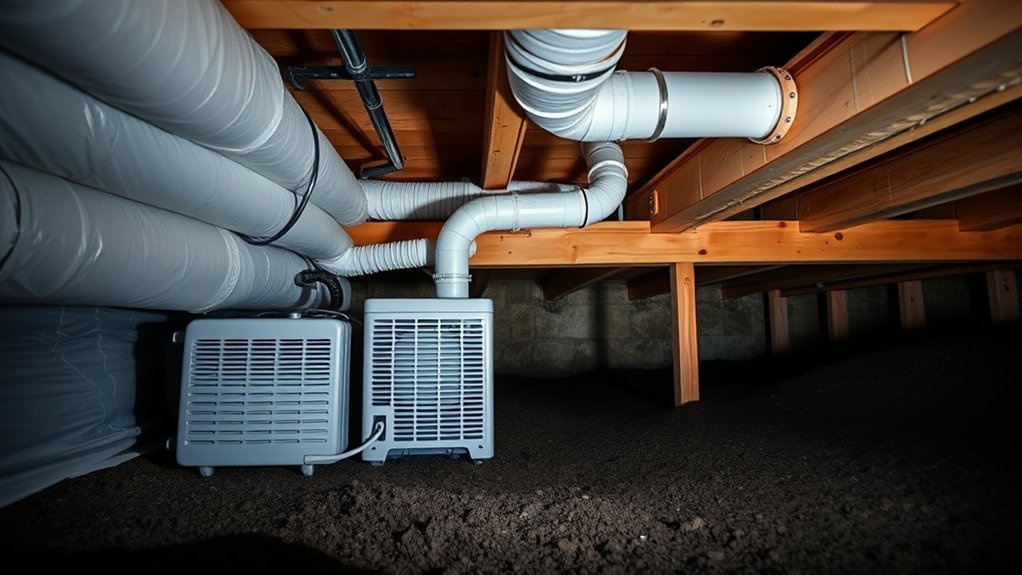
Are crawl space dehumidifiers worth it? Because air naturally rises through subfloor gaps and duct penetrations via the stack effect, up to half of the air on your first floor can originate in the crawl space. Controlling excess dampness below your home protects floor joists from rot, stops musty indoor odors, and prevents mold growth before it starts.
Quick Answer
Yes, a crawl space dehumidifier is worth the $1,000 to $3,000 installed cost when a digital hygrometer repeatedly reads above 60% relative humidity after plumbing leaks, standing water, and bare soil are addressed. It is not a substitute for exterior drainage, leak repair, or a sealed ground vapor barrier.
Last checked: October 15, 2026. Dates and figures were verified against official sources.
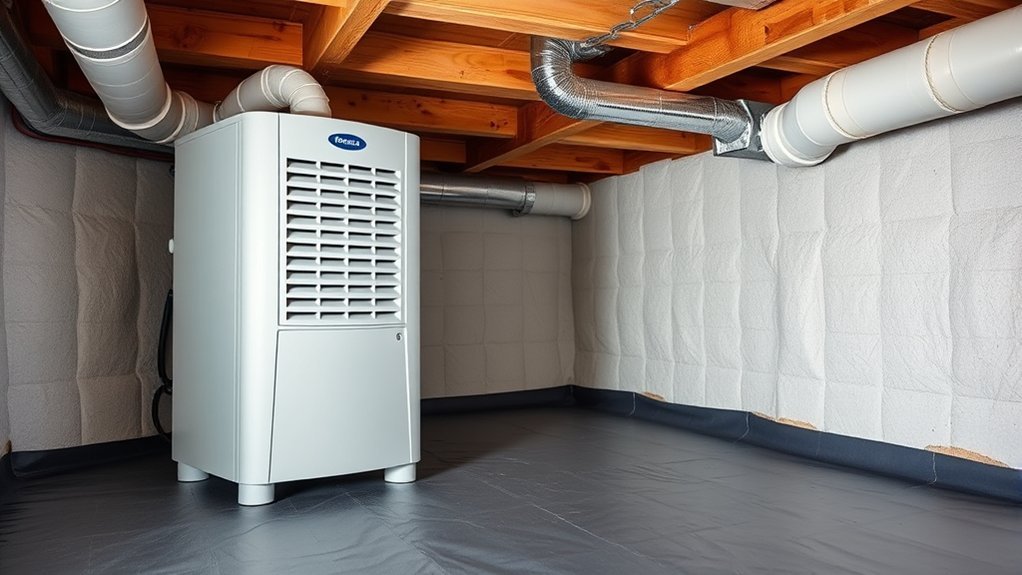
Are Crawl Space Dehumidifiers Worth It? Quick Decision Check
Whether a unit pays off depends on what is driving your moisture level right now. A dehumidifier removes water vapor from the air, so it succeeds only when liquid water entry and open soil evaporation are already under control.
| What you find | Worth it? | Best next step |
|---|---|---|
| Humidity repeatedly above 60%, no standing water, main moisture sources controlled | Usually yes | Size and install a crawl space-rated unit with continuous drainage and auto-restart. |
| Standing water, plumbing leak, or water entering after rain | Not as the first fix | Correct exterior grading, downspouts, plumbing leaks, or sump drainage first. |
| Bare soil, open vents, or major air leaks in a humid climate | Usually not the first step | Install a sealed Class I vapor retarder (minimum 6-mil, 10–20 mil preferred) and seal air leaks per local code, then retest humidity. |
| Humidity stays below 60% year-round, with no odor, condensation, or damp wood | Usually unnecessary | Keep monitoring with a remote hygrometer through humid summer weather and heavy rain. |
According to the U.S. EPA guide to mold and moisture, homeowners should keep indoor relative humidity below 60 percent, and ideally between 30 and 50 percent. The EPA also notes that wet surfaces should be dried within 24 to 48 hours to prevent mold germination, giving you a clear benchmark for taking action.
What a Crawl Space Dehumidifier Does
A crawl space dehumidifier pulls damp air across cold evaporator coils to condense water vapor into liquid, then discharges the water through a gravity hose or condensate pump. By holding relative humidity around 45% to 55%, it stops condensation on cool metal ducts, water pipes, and sill plates.
Mold spores require moisture to germinate, while structural wood-decay fungi require elevated wood moisture to break down framing. According to USDA Forest Products Laboratory wood decay research, fungal decay does not progress when wood moisture content stays below 20%. At typical crawl space temperatures, keeping relative humidity below 60% holds wood equilibrium moisture content safely between 9% and 12%.
A dehumidifier does not kill existing mold colonies. If mold is already growing on joists or subflooring, fix the water source and clean or remediate the affected surfaces first, then run the dehumidifier to prevent regrowth. Because building science studies show that 40% to 50% of first-floor air rises from the crawl space through floor penetrations and duct leaks, drying the air underneath also reduces musty odors and allergen levels upstairs.
Fix Moisture Sources Before Buying One
Running a dehumidifier over bare dirt or puddles forces the compressor to run nonstop without solving the root problem. Bare soil alone can release 10 to 15 gallons of water vapor per day per 1,000 square feet. ENERGY STAR’s closed crawl space design guidance treats moisture control as a complete system combining exterior drainage, a continuous ground vapor retarder, air sealing, and mechanical drying.
Follow this order of work before plugging in a unit:
- Stop bulk water entry. Repair leaking supply or drain pipes, clean gutters, extend downspouts at least 5 feet away from the foundation, and grade soil to slope away at a minimum 5% grade (3 inches of fall over 5 feet).
- Install an interior drain or sump pump if groundwater intrudes. If water seeps through foundation walls or rises from a high water table after storms, add a perimeter drain tile and sump basin before sealing the floor.
- Cover bare earth with a sealed vapor retarder. Under the DOE Building America Solution Center unvented crawl space guide and International Residential Code (IRC) Section R408.3, exposed soil requires a continuous minimum 6-mil Class I polyethylene liner (10- to 20-mil reinforced liners resist tearing under foot traffic), overlapped 6 to 12 inches at seams, taped shut, and extended at least 6 inches up foundation walls.
- Seal outdoor air leaks. When converting to an unvented crawl space in a humid climate, seal foundation vents, rim joists, and the access door as local building and termite-inspection codes allow.
- Add mechanical drying to hold target humidity. Once liquid water and ground vapor are blocked, install a properly sized crawl space dehumidifier to maintain relative humidity between 45% and 55%.
Warning: Never seal crawl space vents or alter airflow if a gas furnace, water heater, or other fuel-burning appliance sits in the crawl space until a qualified HVAC professional verifies combustion air supply and venting. Sealing vents around atmospheric-draft appliances can cause dangerous carbon monoxide backdrafting. Also check local radon levels and flood-vent requirements before closing a foundation.
When a Crawl Space Dehumidifier Pays Off
A dedicated dehumidifier is an insurance policy against structural wood rot, sagging subfloors, ruined fiberglass insulation, and indoor mold. It is worth the investment when passive steps alone cannot keep relative humidity below 60%.
- Sustained high humidity: An independent hygrometer consistently reads above 60% RH across several days.
- Damp framing: A pin-type wood moisture meter shows floor joists or sill plates creeping above 16% to 18% moisture content.
- Surface sweating: Condensation forms on cold water pipes, metal HVAC ducts, masonry walls, or the top of the vapor barrier during summer.
- Persistent musty smells: Earthy or mildew odors rise into living spaces after rain or during muggy months.
- Sealed space with trapped humidity: You already encapsulated the crawl space, but seasonal moisture or indoor air exchange keeps humidity above 60%.
Wait on buying a unit if relative humidity naturally stays between 30% and 55% year-round, if standing water still pools after storms, or if a one-time plumbing leak has been repaired and the framing has already dried below 15% moisture content.
Pro Tip: Place a wireless digital hygrometer with min/max memory near the center of the crawl space—suspended a few inches below a floor joist and away from vents or exterior doors—and log readings for 7 to 14 days across both dry and rainy weather before sizing equipment.
Crawl Space Dehumidifier Cost
Installing a crawl space dehumidifier costs between $1,000 and $3,000 on average, according to HomeGuide’s crawl space dehumidifier cost data. The unit itself typically runs $300 to $2,000 depending on pint capacity and build quality, while professional installation labor adds $700 to $1,000.
| Cost item | Typical range (2026) | What drives the price |
|---|---|---|
| 50-pint crawl space dehumidifier | $300–$1,500 (unit) / $1,000–$2,500 (installed) | Suits tighter spaces under 1,500 sq ft with moderate dampness. |
| 60-pint crawl space dehumidifier | $500–$1,700 (unit) / $1,200–$2,700 (installed) | Mid-size crawl spaces or higher seasonal humidity loads. |
| 70-pint+ commercial/whole-house unit | $800–$2,000 (unit) / $1,500–$3,500 (installed) | Large footprints (2,000+ sq ft), very damp conditions, or ducted setups. |
| Dedicated GFCI outlet or condensate pump | $150–$400 (if not present) | Required when no grounded receptacle or gravity drain path exists. |
| Full crawl space encapsulation | $3,000–$15,000 (separate project) | Heavy-duty 12–20 mil liner, wall insulation, vent sealing, and drainage. |
| Monthly electricity | About $15–$45/month | Depends on wattage (typically 400W–700W), daily run hours, and local kWh rate. |
How to Estimate Running Cost
You can calculate monthly electricity use from the unit’s nameplate wattage and average daily runtime. Use this formula: Monthly kWh = (Rated Watts ÷ 1,000) × Daily Run Hours × 30, then multiply by your utility rate.
Based on the U.S. Energy Information Administration residential electricity rate average of 18.31 cents per kWh (July 2026), a 500-watt dehumidifier running 6 hours a day in a sealed crawl space uses 90 kWh per month, costing about $16.48 per month. In an unsealed, leaky crawl space where that same 500-watt unit runs 16 hours a day, power consumption jumps to 240 kWh, or $43.94 per month.
According to ENERGY STAR’s dehumidifier criteria (current specification effective October 1, 2025), certified dehumidifiers are 20% more efficient than non-certified models, measured by their Integrated Energy Factor in liters of water removed per kilowatt-hour (L/kWh). Choosing a certified unit and sealing air leaks are the two fastest ways to keep monthly bills low.
Downsides to Weigh
- Upfront expense: Commercial-grade crawl space units, condensate pumps, and electrical circuits cost significantly more than bedroom portables.
- Ongoing electricity bills: Unsealed vents or bare soil can force the compressor to run almost continuously during summer.
- Routine maintenance: Air filters (typically MERV-8 to MERV-11), drain lines, and condensate pumps require periodic cleaning in a tight space.
- Drainage failure risk: A kinked vinyl hose, algae-clogged drain line, or failed pump float switch can spill water back onto the liner.
- Equipment lifespan limits: Dedicated crawl space dehumidifiers generally last 7 to 10 years, whereas consumer room units placed under a house often fail in 3 to 5 years.
Sizing and Installing One
Proper sizing depends on square footage, tightness of the building envelope, and starting humidity. Since the U.S. Department of Energy updated its test standard, portable capacities are measured at 65°F and 60% relative humidity rather than the older 80°F benchmark—meaning a unit labeled 50 pints today removes roughly the same moisture as a pre-2019 70-pint model.
For spaces under 2,000 square feet, ENERGY STAR recommends 20 to 30 pints per day for moderately damp spaces (50%–75% RH), 25 to 40 pints for very damp spaces (75%–90% RH), and 30 to 50+ pints when walls sweat or seepage occurs (90%–100% RH). Spaces over 2,000 square feet require 30 to 50+ pints on the 65°F scale, and IRC Section R408.3 specifies a capacity of 70 pints (33 liters) per day per 1,000 square feet when using dehumidification as the code-required conditioning method for an unvented crawl space.
- Low-temperature operation: Crawl spaces frequently drop below 60°F in spring, fall, and winter. Standard room units often ice up below 65°F, whereas dedicated crawl space models include hot-gas or auto-defrost controls to operate down to 33°F–40°F.
- Auto-restart after power outages: Choose a unit that automatically resumes operation at your saved setpoint after a storm outage, so the crawl space does not sit damp for weeks unnoticed.
- Level placement and clearance: Set the unit level on concrete blocks or a rigid pad 4 to 6 inches above the floor, or suspend it from floor joists with vibration-isolating straps, leaving at least 12 to 24 inches of clearance at the intake and exhaust.
- Dedicated drainage and power: Route a gravity drain line or condensate pump discharge to an approved exterior drain, sump basin, or plumbing trap, and plug the unit into a dedicated, code-compliant GFCI-protected receptacle—never an extension cord.
Signs You Need More Than a Dehumidifier
A dehumidifier cannot fix liquid water intrusion or structural damage. Address these underlying issues before relying on mechanical drying:
- Standing puddles, wet mud, or water trickling through block walls after rain.
- White powdery efflorescence or high-water staining along foundation masonry.
- Crushed, disconnected, or overflowing gutters and downspouts dumping water next to footings.
- Leaking plumbing traps, water supply lines, or HVAC condensate pans.
- Spongy subfloors, rotted sill plates, or notched and sagging floor joists.
- Visible mold covering a wide area or rodent infestations in fiberglass batt insulation.
Maintenance After Installation
A 15-minute seasonal check keeps your dehumidifier running efficiently and prevents water backups:
- Monitor an independent hygrometer: Keep a remote sensor in the living space so you can verify crawl space relative humidity stays between 45% and 55% without crawling under the house every week.
- Clean or replace the air filter every 3 to 6 months: Wash reusable mesh filters or swap pleated MERV filters per the manufacturer’s manual so dust does not choke airflow across the coils.
- Flush the drain line and test the condensate pump twice a year: Pour a small amount of water or manufacturer-approved cleaning solution into the pump reservoir before summer to confirm the float switch triggers and the discharge tube is clear of slime or kinks.
- Inspect the evaporator coils annually: Wipe or vacuum dust buildup off the fins before peak summer humidity arrives.
If your dehumidifier runs 24/7 after the first two weeks of drying out the structure, check for a setpoint below 45%, a dirty air filter, iced coils, a torn vapor barrier, a popped foundation vent block, or a hidden plumbing leak.
When to Call a Professional
Bring in a licensed waterproofing contractor, structural specialist, or NATE-certified HVAC technician if you find recurring groundwater seepage, sewage leaks, sagging floors, rotted beams, combustion appliances in a crawl space you want to seal, or no existing GFCI electrical outlet.
Note: The U.S. EPA advises that if visible mold covers more than about 10 square feet (roughly a 3-foot by 3-foot patch) or involves sewage or contaminated floodwater, you should hire a qualified mold remediation professional rather than attempting DIY cleanup.
Frequently Asked Questions
Do I really need a dehumidifier in my crawl space?
Yes, you likely need active dehumidification if crawl space relative humidity repeatedly rises above 60% after plumbing leaks, exterior drainage, and bare soil are addressed. If a digital hygrometer shows humidity staying below 60% through rainy and muggy weather without mechanical drying, continued monitoring is usually enough.
Does a sealed crawl space need a dehumidifier?
Yes, building codes such as IRC Section R408.3 require an unvented, sealed crawl space to have an approved drying or conditioning method, which is typically a dedicated dehumidifier or a regulated supply of conditioned HVAC air. Even with a taped vapor barrier and sealed vents, moisture from the home above and construction materials can push humidity past 60% without mechanical drying.
Can I use a crawl space dehumidifier without encapsulation?
You can run a dehumidifier without full wall-to-wall encapsulation, but you should at least cover bare soil with a sealed 6-mil or thicker polyethylene ground vapor barrier and close open vents where code permits. Without a ground liner and basic air sealing, moisture evaporates from the dirt and enters from outdoors faster than the machine can remove it, driving up electric bills.
How much does a crawl space dehumidifier cost?
A crawl space dehumidifier costs $1,000 to $3,000 with professional installation, or $300 to $2,000 for the unit alone, according to HomeGuide. Larger 70-pint commercial units, new GFCI outlets, condensate pumps, and tight access increase the price, while full crawl space encapsulation is a separate $3,000 to $15,000 project.
What humidity should a crawl space be?
Keep crawl space relative humidity below 60%, with most building science pros targeting a setpoint between 45% and 55%. The U.S. EPA recommends keeping indoor relative humidity between 30% and 50% where possible, which keeps structural wood moisture content safely below the 20% threshold where rot fungi grow.
Can I put a regular room dehumidifier in a crawl space?
A standard portable room dehumidifier is usually a poor fit for a crawl space because its coils can freeze when temperatures drop below 60°F to 65°F, and many consumer models do not auto-restart after a power outage. Purpose-built crawl space units feature low-clearance metal cabinets, low-temperature defrost down to 33°F–40°F, auto-restart, and heavier filtration.
How much does a crawl space dehumidifier cost to run per month?
Most crawl space dehumidifiers cost between $15 and $45 per month to run at the 2026 U.S. average electricity rate of 18.31 cents per kWh. A 500-watt unit cycling 6 hours a day in a sealed crawl space costs about $16.48 monthly, whereas running 16 hours a day in an unsealed space costs about $43.94 per month.
How long does a crawl space dehumidifier last?
A commercial-grade crawl space dehumidifier typically lasts 7 to 10 years when paired with a sealed vapor barrier and regular filter cleanings. Standard residential units placed in damp, unsealed crawl spaces wear out faster, often lasting only 3 to 5 years due to constant compressor runtime and coil corrosion.
Related Guides
- How to dehumidify a crawl space, step by step
- Crawl space dehumidifier size guide
- How to install a crawl space dehumidifier
- Can you use a dehumidifier in a crawl space?
- Is a dehumidifier worth it in general?
Sources
- U.S. EPA: A Brief Guide to Mold, Moisture and Your Home: Indoor relative humidity thresholds (below 60%, ideally 30%–50%), 24–48 hour drying window, and remediation guidance.
- USDA Forest Service Forest Products Laboratory: Limiting Conditions for Decay in Wood Systems: Wood moisture content threshold (20%) for preventing structural wood-decay fungi.
- ENERGY STAR / Advanced Energy: Designing Closed Crawlspaces: System-based moisture control order combining grading, ground vapor retarders, air sealing, and mechanical drying.
- U.S. Department of Energy Building America Solution Center: Unvented, Insulated Crawlspaces: IRC Section R408.3 unvented crawl space requirements, minimum 6-mil Class I vapor retarder overlaps, and combustion/pest safety checks.
- HomeGuide: How Much Does a Crawl Space Dehumidifier Cost?: Average equipment ($300–$2,000), labor ($700–$1,000), and total installed cost ranges ($1,000–$3,000) by pint capacity.
- U.S. Energy Information Administration: Electric Power Monthly: Average U.S. residential electricity rate (18.31 cents per kWh as of July 2026) used for monthly operating cost calculations.
- ENERGY STAR: Dehumidifiers: 20% efficiency improvement over non-certified models, Integrated Energy Factor (L/kWh), and pint capacity sizing chart.