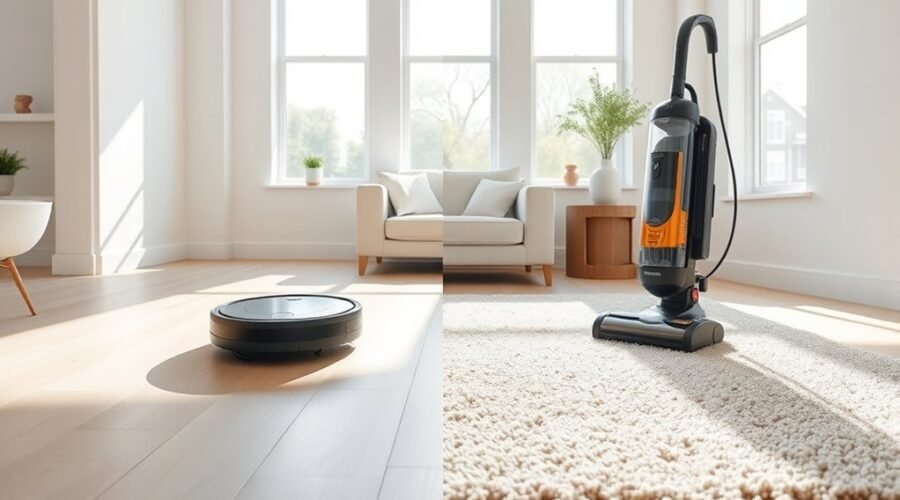
Robot vacuums and upright vacuums solve different cleaning problems. One offers hands-free upkeep for hard floors and light daily debris, while the other delivers stronger suction for deeper carpet cleaning and larger messes. The real difference is not just power, but how each fits into a home’s routine, storage limits, and floor types. The better choice depends on more than convenience, and the details are worth comparing closely.
What Is a Robot Vacuum?
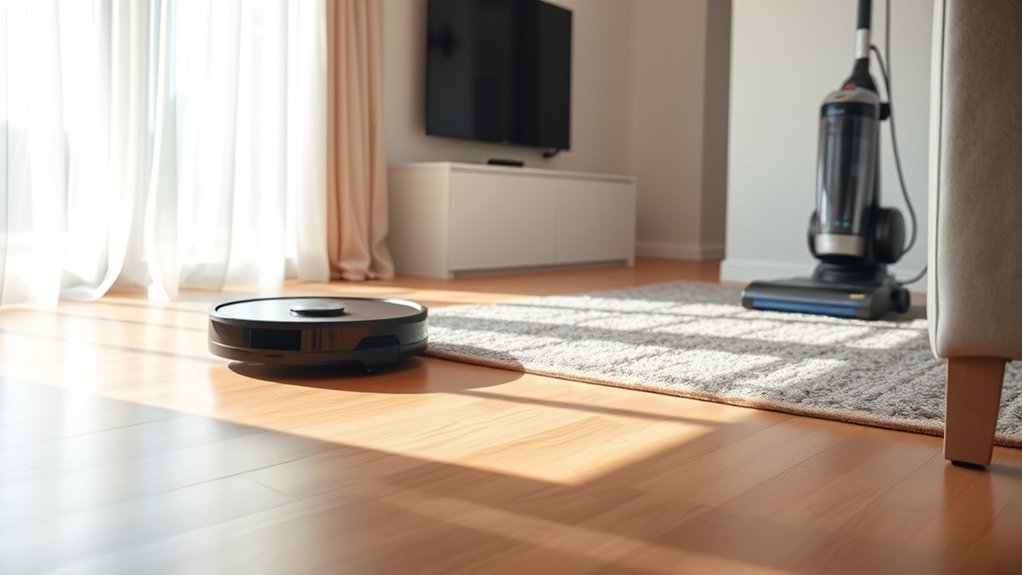
A robot vacuum is an automated floor-cleaning device that moves on its own using sensors and software to navigate around a home with little to no human input.
A robot vacuum is typically compact and round, designed for routine cleaning on hard floors and low-pile carpets. It can be scheduled through smartphone apps, letting users set cleaning times remotely and reclaim time for other priorities.
Most models return to a docking station when battery levels drop, reducing the need for constant oversight. Their suction power, usually between 2,000 and 8,200 Pa, supports light debris pickup and daily maintenance.
Compared with a traditional vacuum, a robot vacuum offers less deep-cleaning strength, yet it delivers steady upkeep with far less effort. For households seeking cleaner floors with greater freedom from manual labor, it functions as a practical, hands-off option.
What Is an Upright Vacuum?
Often considered the workhorse of household floor care, an upright vacuum is a manually operated cleaning device built for efficient dust and debris removal. Its vertical form supports straightforward handling, while the user directs each pass for targeted results.
Many models use replaceable bags or bagless bins, and HEPA filters are often included to capture fine allergens more effectively. An upright vacuum is valued for powerful suction, commonly in the 180W to 400W range, which supports deep cleaning on carpets and helps lift embedded dirt that lighter tools may leave behind.
Attachments add practical range, making it possible to clean upholstery, crevices, and other hard-to-reach areas. Although it demands physical effort, this design offers direct control and dependable thoroughness.
For homes with thick carpets or heavy debris, the upright vacuum remains a strong, liberation-minded choice for users seeking cleaner spaces with minimal compromise.
How Robot Vacuums and Uprights Compare
Robot vacuums usually cover space more slowly but can run on a schedule and keep hard floors and low-pile carpets consistently tidy, while upright vacuums clean faster in a manual pass and are better for large or urgent jobs.
Uprights also tend to deliver stronger suction, making them more effective for embedded dirt and thick carpets, whereas robot vacuums rely on lower suction but steady maintenance cleaning.
In practice, robot vacuums suit routine upkeep and hard-to-reach areas under furniture, while uprights are the better choice for deep cleaning, corners, and heavy debris.
Cleaning Speed And Coverage
When speed and floor coverage are the main priorities, upright vacuums usually have the advantage, since their manual operation and strong suction let them clear larger messes and deep carpet debris more quickly. Their cleaning speed is often higher because users can move directly to problem spots, while robot vacuums follow programmed routes at about 0.5 to 1 meter per second. | Type | Practical effect | |—|—| | Upright vacuum | Faster on heavy debris | | Robot vacuum | Better for scheduled maintenance | | Upright vacuum | Wider reach per pass | | Robot vacuum | Coverage can pause for charging | Robot vacuums still offer steady coverage over time, but obstacles and battery limits can interrupt sessions. For households seeking more control and less routine effort, the choice depends on whether immediate cleanup or automated upkeep matters more.
Suction Power Differences
Suction power is one of the clearest differences between robot vacuums and uprights. A robot vacuum usually delivers about 2,000 to 8,000 Pa, with premium models reaching 8,200 Pa, which suits routine maintenance and light cleaning.
A regular vacuum cleaner or upright, however, is measured in watts, often 180W to 400W, and typically produces stronger airflow for deeper carpet cleaning and embedded dirt removal. This gap matters when freedom from dust requires more than surface pickup.
- Robot vacuums handle everyday crumbs and loose debris.
- Uprights tackle thicker carpets and stubborn particles more effectively.
- Stronger suction power often means a more thorough clean.
For those seeking less effort, the robot vacuum offers convenience; for deeper results, the regular vacuum cleaner remains the stronger tool.
Best Uses For Each
In practical terms, each vacuum type serves a different cleaning role: robot vacuums are best suited to maintaining cleanliness in uncluttered homes with hard floors or low-pile rugs, where they can run daily and keep dirt from building up between deeper cleans.
Meanwhile, upright vacuums are better for thorough cleaning sessions, especially on high-pile carpets and in homes that face larger messes.
Robot vacuum cleaners support routine upkeep and can save time, but they work less well around cords, clutter, and stairs.
By contrast, regular vacuums offer manual control, stronger suction, and more reliable deep cleaning for dense carpet and heavy debris.
For many homes, the most practical approach is using both: one for daily maintenance and one for periodic deep cleaning.
Which Vacuum Cleans Better?
Robot vacuums are often the better choice for daily cleaning, keeping hard floors and low-pile carpets tidy with little effort, especially in homes where routine maintenance matters most.
Upright vacuums usually clean better in deep-cleaning tasks, using stronger suction to pull embedded dirt from thick carpets, stairs, and larger messes.
In direct comparison, robots handle convenience and consistency, while uprights deliver more thorough results when cleaning power is the priority.
Deep Cleaning Power
When deep cleaning is the priority, upright vacuums generally have the edge. Their stronger suction and airflow make a traditional vacuum better at lifting embedded dirt from thick carpets, where a robot vacuum often falls short.
In performance tests, uprights remove far more debris, giving households more freedom from stubborn messes and hidden grit.
- Deep cleaning: upright models often deliver 180W to 400W of suction.
- Robot vacuum: useful for surface dust, but less effective on high-pile carpet.
- Traditional vacuum: stronger for spot cleaning and larger spills.
Robot vacuums support routine upkeep, yet they do not replace the power needed for stubborn stains or deeply packed debris.
For anyone seeking cleaner floors without compromise, the upright remains the more capable tool.
Daily Cleaning Performance
For everyday upkeep, robot vacuums often handle routine dust and small debris more efficiently, especially on hard floors and low-pile carpets where scheduled cleaning keeps buildup from becoming a problem.
Their automated daily cleaning runs quietly, usually around 55–65 dB, allowing households to move freely while floors stay maintained. They can reach under furniture and work around obstacles, which reduces the need for constant manual attention.
However, their strength is maintenance, not perfection: edges, corners, and sudden spills may be missed. Upright vacuums remain stronger for deep cleaning, thicker carpets, and faster response to larger messes.
In practice, robot vacuums support liberation from repetitive chores, while uprights serve as the backup tool when heavier cleaning is required.
Where Robot Vacuums Work Best
Robot vacuums are most effective on hard floors and low-pile carpets, where their lightweight design and frequent cleaning cycles help maintain daily tidiness with minimal effort. A robot vacuum cleaner delivers steady cleaning ability in homes that value freedom from constant chores, especially when rooms stay open and relatively uncluttered.
Advanced sensors help it move under sofas, around tables, and along common paths without much supervision.
- Ideal for apartments, studios, and busy households
- Useful for scheduled cleaning through smartphone apps
- Better for light debris than deep, heavy soil
On hard floors, dirt is collected before it spreads, which keeps surfaces looking orderly with little intervention. In low-pile carpeted areas, the machine can support routine upkeep, though it is less effective on thicker fibers.
It works best as a maintenance tool, not as a substitute for intensive cleaning.
Where Upright Vacuums Still Win
Upright vacuums still outperform robots in situations that demand stronger suction and more direct control, especially on thick carpets where deep dirt can settle below the surface.
An upright vacuum typically delivers 180W to 400W of suction, supporting deeper deep cleaning than most robot units, whose 2,000 to 8,200 Pa is better suited to lighter maintenance. On thick carpets, that extra power helps lift embedded debris rather than skimming the top.
Uprights also handle edges, corners, and stair treads more completely, reducing the stubborn dust that robots often leave behind. Their attachments add practical reach for upholstery, crevices, and car interiors, giving households more freedom to clear spaces robots cannot enter.
They are also better for sudden spills, since a manual vacuum can be deployed immediately.
In short, when precision, reach, and stronger cleaning matter most, the upright remains the more capable tool.
How Easy Is Each Vacuum to Use?
Ease of use is one of the clearest differences between robot and upright vacuums. A Robot Vacuum delivers strong ease of use through automated cleaning, smart scheduling, and mobile app control, allowing floors to be cleaned with minimal effort.
A Robot Vacuum delivers effortless cleaning through automation, scheduling, and app control, minimizing daily effort.
It moves under low furniture and works quietly at scheduled times, freeing users from constant supervision. An Upright Vacuum, by contrast, demands manual pushing, steering, and cord management, which can feel tiring and time-consuming in cluttered rooms.
- A Robot Vacuum suits those who want cleaning to happen in the background.
- An Upright Vacuum gives direct control, but asks for more physical work.
- Quiet automation supports a calmer home, while louder manual cleaning can interrupt the day.
For users seeking more independence from chores, the robot model offers liberation through convenience.
The upright model still serves well when hands-on cleaning is preferred, but it is less effortless in daily use overall.
Maintenance Costs, Storage Space, and Lifespan
Cost often becomes the deciding factor after initial performance, since the two vacuum types differ sharply in upkeep, storage, and long-term value.
Robot vacuum maintenance costs can rise faster because their sensors, motors, and navigation parts are more complex, and repairs may be less straightforward. Their smaller dust containers also demand frequent emptying and filter replacement, adding steady attention.
Upright vacuums usually rely on simpler service needs, with filters, bags, and basic parts easier to replace.
In storage space, robots are clearly freer; they slip into a drawer, closet shelf, or charging corner without claiming much room. Uprights need more storage space for the body, cord, and attachments.
Lifespan also favors the traditional model: a well-maintained upright often lasts 7 to 10 years or longer, while many robot vacuums run 3 to 5 years before wear or battery decline shortens their service.
Which Vacuum Fits Your Home Best?
Choosing between a robot vacuum and an upright vacuum depends less on a single “better” option and more on how a home is used day to day.
For busy households with bare floors or low-pile carpet, a robot vacuum for carpet can support a steady cleaning schedule with little effort, keeping dust from building up.
A regular vacuum is the stronger choice when thick carpets, heavy debris, stairs, or clutter demand more control and suction.
Robotic models also free up storage and reach under furniture, while uprights provide deeper, more forceful cleaning where messes settle in.
- Daily upkeep feels easier when floors are mostly open.
- Deep cleaning matters more when carpets are dense or traffic is heavy.
- Mixed homes often benefit from both: automation for routine care, power for periodic resets.
Frequently Asked Questions
What Are the Key Differences Between a Regular Vacuum and a Robot Vacuum?
A regular vacuum offers stronger suction power and greater cleaning efficiency, especially on carpets; a robot vacuum provides maintenance ease, autonomous operation, and compact storage, but usually sacrifices deep-clean performance and thoroughness on difficult surfaces.
What Are the Downsides of Using a Robotic Vacuum Cleaner?
Downsides include weaker cleaning efficiency, maintenance challenges, and battery limitations. It may miss corners, struggle with cords and thick carpets, and require frequent emptying. Higher upfront cost can also reduce practical freedom for budget-conscious users.
What Are the Key Features to Look for When Buying a Robot Vacuum?
Key features include Smart navigation, Battery life, and Suction power. Advanced mapping, app control, voice compatibility, HEPA filtration, and self-emptying bins improve autonomy. Stronger models free users from constant oversight while cleaning more thoroughly.
What Are the Key Differences Between an Upright Vacuum and a Stick Vacuum?
Upright vacuums deliver stronger suction, greater cleaning efficiency, and broader attachments, favoring deep carpet cleaning. Stick vacuums emphasize stick maneuverability, lighter weight, and easy storage, but usually sacrifice power, capacity, and upright versatility for quick, liberated cleanups.
Conclusion
Robot vacuums and upright vacuums solve cleaning in very different ways. One offers quiet, automated upkeep for hard floors and low-pile carpets; the other delivers stronger suction, deeper carpet cleaning, and faster results on tougher messes. For homes that need daily maintenance with minimal effort, a robot vacuum fits well. For households facing heavy debris, thick carpet, or deep-cleaning demands, an upright still proves more effective. The best choice depends on the home, not the hype.