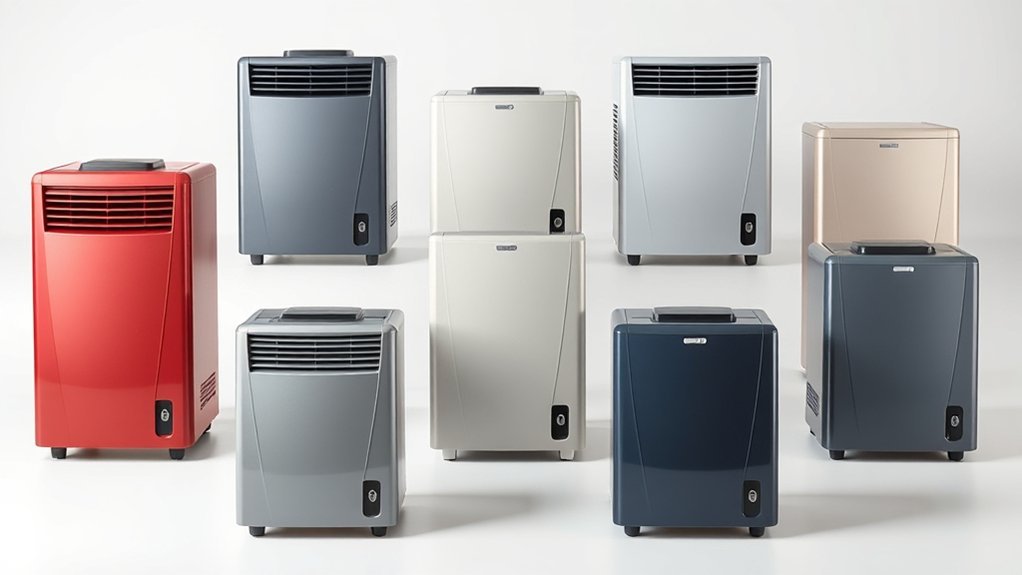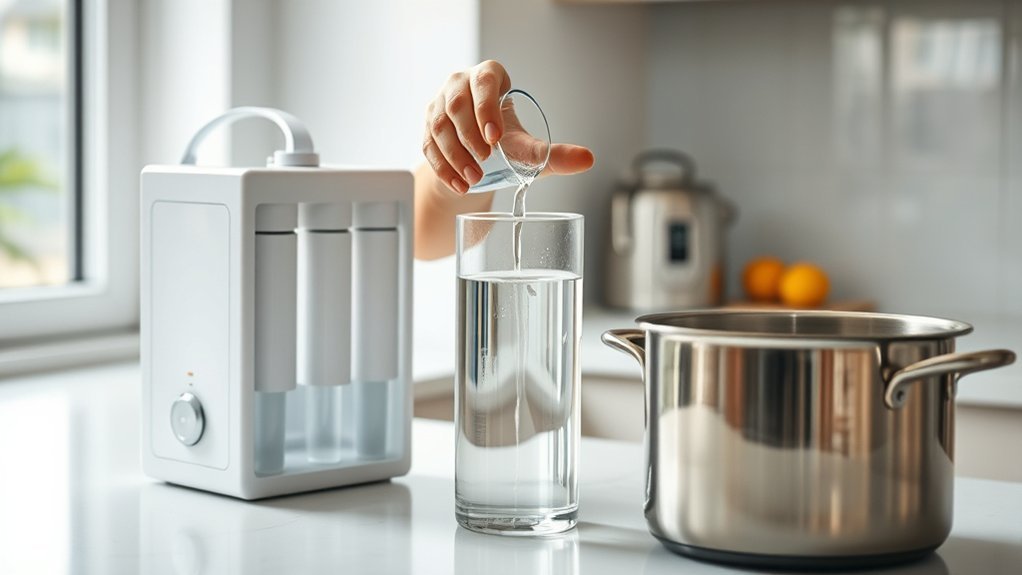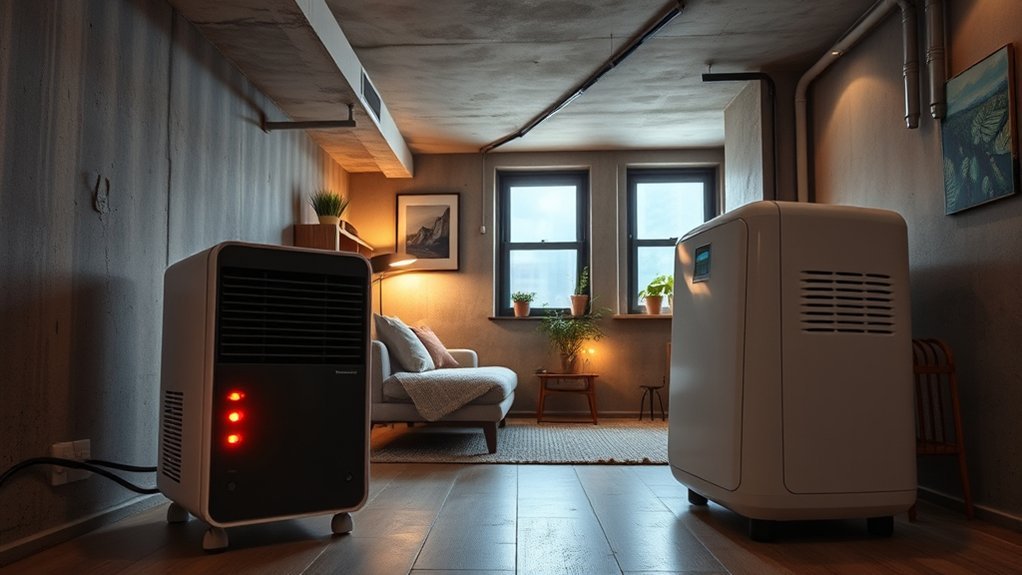
Choosing the right garage dehumidifier size takes more than counting how many cars fit inside. Wet vehicles, bare concrete slabs, uninsulated walls, and frequent door openings create moisture loads that standard room charts overlook. To learn how to size a garage dehumidifier accurately, match your floor area, starting relative humidity (RH), and winter temperature range to current federal pint-per-day (PPD) ratings.
Quick Answer
For a garage under 2,000 square feet, current ENERGY STAR guidelines recommend 20–30 PPD for slightly to moderately damp air (50%–75% RH), 25–40 PPD for very damp air (75%–90% RH), and 30–50 PPD for wet conditions (90%–100% RH). Garages over 2,000 square feet start at 30+, 40+, or 50+ PPD. Size toward the top of your range for detached, uninsulated, or leaky garages.
At a Glance
| Time Required | 10–20 minutes to measure floor area, check relative humidity, and pick a PPD range |
| Difficulty | Easy |
| Tools Needed | Tape measure, digital hygrometer, calculator, grounded 3-prong outlet, garden or drain hose |
| Cost | Hygrometer: $10–$50; portable dehumidifier: varies by PPD capacity, built-in pump, and cold-weather rating |
How Do I Size a Garage Dehumidifier?
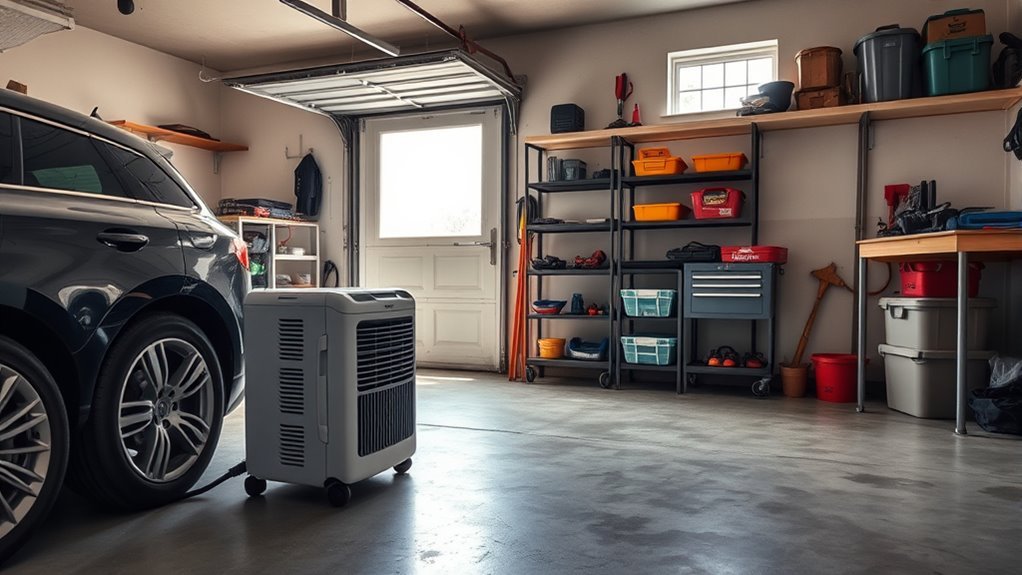
To determine the right garage dehumidifier size, combine three measurements: total open floor area in square feet, peak relative humidity before dehumidification, and your lowest seasonal garage temperature. The ENERGY STAR dehumidifier buying guidance sets baseline portable capacities using space size and dampness level. You then adjust upward for garage-specific moisture loads like rainwater dripping off vehicles, air gaps around overhead doors, and high ceilings.
Start with the official ENERGY STAR baseline table below, then move toward the upper end of the pint range when your garage has poor sealing or heavy daily use.
| Moisture Condition (Without Dehumidifier) | Typical Garage Signs & RH Range | Under 2,000 Sq Ft (1- to 4-Car Garage) | Over 2,000 Sq Ft (Large Shop / Multi-Bay) |
|---|---|---|---|
| Slightly to Moderately Damp | Air feels muggy in summer; intermittent musty odor; 50%–75% RH | 20–30 PPD | 30+ PPD |
| Very Damp | Persistent damp smell; dark damp spots on slab or drywall; surface rust on hand tools; 75%–90% RH | 25–40 PPD | 40+ PPD |
| Wet | Concrete floor or walls sweat; seepage at foundation joints; frequent wet vehicles; 90%–100% RH | 30–50 PPD | 50+ PPD |
Note: ENERGY STAR’s sizing chart is a general portable-dehumidifier baseline, not a dedicated garage standard. Because garages leak far more outside air than bedrooms or basements, choose the top half of your PPD bracket for detached, uninsulated, or tall-ceiling garages.
When comparing older reviews or replacing an existing machine, pay close attention to old vs. current pint ratings. Under the updated DOE test procedure at 65°F (lowered from the pre-2019 standard of 80°F at 60% RH), portable dehumidifiers carry smaller numerical ratings even though their actual moisture-removal power did not shrink. An older “70-pint” unit equals roughly 40–50 PPD on current retail labels, an older “50-pint” unit equals about 30–35 PPD, and an older “30-pint” model equals roughly 20 PPD.
Measure Square Footage and Humidity Levels
Before shopping, measure the total enclosed floor area and take baseline humidity readings over 24 to 48 hours. Relying on a box claim like “covers up to 4,500 square feet” often leads to buying an undersized unit that runs nonstop without ever reaching your target humidity.
Measure Garage Square Footage
Measure the interior length and width of the garage in feet, then multiply them together:
Length (ft) × Width (ft) = Total Square Footage
Include every connected area that shares the same air volume—such as an open storage bay, utility alcove, or attached workshop—not just where you park. Typical residential garage footprints fall well under the 2,000-square-foot threshold:
- 1-car garage (12 × 20 ft to 14 × 24 ft): 240 to 336 sq ft
- Standard 2-car garage (20 × 20 ft to 24 × 24 ft): 400 to 576 sq ft
- Oversized 2-car or 3-car garage (24 × 30 ft to 36 × 24 ft): 600 to 864 sq ft
- 4-car or workshop garage (40 × 24 ft and up): 960 to 1,500+ sq ft
If your garage has ceilings taller than a standard 8- to 9-foot residential height (such as a 12- to 14-foot RV bay or lift ceiling), treat your floor area as a minimum starting point and move to the top of your PPD capacity band to handle the extra cubic feet of air.
Check Relative Humidity
Place a digital hygrometer near the center of the garage, away from direct sunlight or exterior door drafts. Log readings in the morning, mid-afternoon, and after moisture spikes like parking a rain-soaked car inside.
For healthy indoor air and mold prevention, the EPA recommends keeping relative humidity below 60% and ideally between 30% and 50%. Similarly, the CDC recommends keeping indoor humidity no higher than 50% all day long to stop mold spores from germinating on drywall, wood, and stored fabrics.
If your garage stays above 60% relative humidity for more than 24 hours, treat it as an active moisture problem that risks rust and mold growth.
Note Moisture Problem Areas
Inspect the garage for physical signs that your real moisture load is higher than the square footage alone indicates:
- Sweating concrete or metal: Condensation beads on cold concrete slabs in spring (“sweating slab syndrome”), uninsulated steel garage doors, window panes, or cast-iron power tool tables.
- Efflorescence on masonry: White, chalky powder on concrete block or slab edges, which shows water vapor is wicking through the masonry and leaving mineral salts behind.
- Rust and swollen materials: Orange surface corrosion on saw blades, hand tools, or gym weights, plus limp cardboard boxes and musty-smelling cushions.
- Active water intrusion: Puddles near the overhead door bottom seal, damp drywall along the sill plate, or wet floor cracks after heavy rain.
Always fix bulk water intrusion first. A dehumidifier removes water vapor from the air, but it cannot overcome a clogged gutter, negative driveway slope, cracked foundation wall, or torn garage door bottom weatherstripping.
What PPD Capacity Do I Need for a Garage?
Pints per day (PPD) measures how many pints of water a dehumidifier extracts in 24 hours under standardized DOE test conditions (65°F and 60% RH for portable units). While PPD measures drying capacity, energy efficiency is rated separately using Integrated Energy Factor (IEF)—the liters of water the unit removes per kilowatt-hour (L/kWh) of electricity.
Garage Size Ranges by Bay Count and Dampness
Because the ENERGY STAR table groups all spaces under 2,000 square feet together, use both your garage bay size and dampness level to pick a specific current-label PPD rating:
| Garage Type & Typical Area | Slightly / Moderately Damp (50%–75% RH) | Very Damp (75%–90% RH) | Wet / High Load (90%–100% RH) |
|---|---|---|---|
| 1-Car Attached (240–360 sq ft) | 20–22 PPD | 25–30 PPD | 30–35 PPD |
| 2-Car Standard (400–600 sq ft) | 22–30 PPD | 30–35 PPD | 35–50 PPD |
| 3-Car / Detached / Uninsulated (600–1,200 sq ft) | 30 PPD | 35–40 PPD | 50 PPD |
| Large Workshop (Over 2,000 sq ft) | 30–35+ PPD | 40–50+ PPD | 50+ PPD (or commercial unit) |
Notice how dampness can outweigh floor area. A 450-square-foot two-car garage where two wet SUVs park daily in coastal humidity needs a 35–50 PPD dehumidifier, whereas a well-sealed 1,200-square-foot storage garage with mild summer dampness may only need a 30 PPD model.
Use a Four-Step Garage Sizing Rule
Follow this four-step sequence to lock in the right unit before buying:
- Find your ENERGY STAR baseline: Match your floor area and peak untreated RH to the 20–30, 25–40, or 30–50 PPD band.
- Adjust for building envelope: Step up to the top of the band (or the next tier) if the garage is detached, uninsulated, unsealed around the overhead door, or has ceilings over 10 feet.
- Verify winter operating temperature: Check the manufacturer’s minimum operating temperature (often 41°F for low-temp compressors or 32°F and below for desiccants).
- Validate with a standalone hygrometer: Run the unit with doors closed for 48 hours and confirm it holds 45%–50% RH and cycles off automatically.
Pro Tip: If you are replacing an older dehumidifier, note how often you emptied its bucket and whether it reached your target RH. Because DOE lowered test temperatures from 80°F to 65°F, a current 50-PPD portable dehumidifier delivers the same drying power as an older “70-pint” machine.
Oversizing vs Undersizing
ENERGY STAR explicitly advises that it is better to oversize than undersize a portable dehumidifier. Unlike a central air conditioner—which cools air too fast to dehumidify if oversized—a slightly larger dehumidifier simply pulls humidity down to your setpoint faster after the garage door opens and then cycles off, saving wear on the compressor.
Still, avoid buying an industrial unit without checking practical limits: larger units draw more amperage on shared garage circuits, produce louder fan noise (often 50–55+ dBA), and fill a standard 1.5- to 2-gallon internal bucket in hours unless hooked to a continuous drain.
How Should I Adjust for a Detached or Uninsulated Garage?
For a detached, uninsulated, or cinder-block garage, size at the upper end of your PPD bracket—typically 35 to 50 PPD for a standard two-car structure. Without shared house walls or insulation, exterior walls experience wider day-to-night temperature swings that trigger surface condensation whenever warm, humid air leaks inside.
Choose the upper capacity limit (35–50 PPD) if two or more of these apply:
- The overhead garage door opens more than 4–6 times a day during humid weather.
- You park rain-soaked or snow-packed vehicles inside daily (a single wet car can shed several pints of water onto the slab).
- The framing has exposed studs, uninsulated metal siding, or bare concrete block walls.
- Part of the garage sits below grade against damp soil.
- Ceilings are vaulted or open to an unsealed attic truss space.
To prevent a detached garage dehumidifier from trying to dry the entire neighborhood, pair the unit with basic air sealing: replace cracked vinyl bottom door seals, add perimeter weatherstripping along the door jambs, and apply a penetrating concrete sealer to bare slabs to slow vapor transmission.
What Type of Dehumidifier Works Best in a Cold Garage?
In a garage that stays above 65°F, a standard compressor (refrigerant) dehumidifier removes the most water per kilowatt-hour. When winter garage temperatures regularly drop below 65°F, ENERGY STAR warns that frost can build up on compressor coils and slash moisture extraction—making a low-temperature compressor model (down to 41°F) or a desiccant dehumidifier (down to 32°F) the better choice.
Compare the three garage dehumidifier technologies by your lowest expected room temperature:
| Dehumidifier Type | Effective Temperature Range | How It Works & Trade-Offs | Best Garage Fit |
|---|---|---|---|
| Standard Compressor (Refrigerant) | Best at 65°F–90°F (coils risk icing below 60°F–65°F) | Cools air across refrigerant coils; highest capacity (20–50+ PPD) and best energy efficiency in warm weather | Attached, insulated, or southern-climate garages that stay mild year-round |
| Low-Temp Compressor (Auto-Defrost) | Rated down to 41°F (5°C); best above 50°F | Pauses compressor periodically while the fan melts coil frost; extraction rate drops by 50% or more near 45°F–50°F | Cool attached or semi-heated garages that stay between 45°F and 65°F in winter |
| Desiccant (Absorption Wheel) | 32°F–70°F (0°C–21°C); no coils to freeze | Uses a silica-gel rotor and internal heater; quieter, lighter, warms air slightly, and holds steady output in cold rooms, but uses more wattage per pint in summer | Unheated northern or detached garages regularly sitting between 33°F and 55°F |
Never run a standard compressor dehumidifier below its rated minimum temperature (usually 41°F). Ice buildup blocks airflow, strains the compressor, and stops water collection completely.
Recommended Products

【Superior Low-Temperature Performance - No Icing, No Shutdown】 Unlike compressor dehumidifiers that stop working below 65°F (18°C), our Rotary Dehumidifier uses a moisture-absorbing wheel, allowing it to operate powerfully even at temperatures as low as 32°F (0°C). Ideal for year-round use in basements, garages, and cabins.
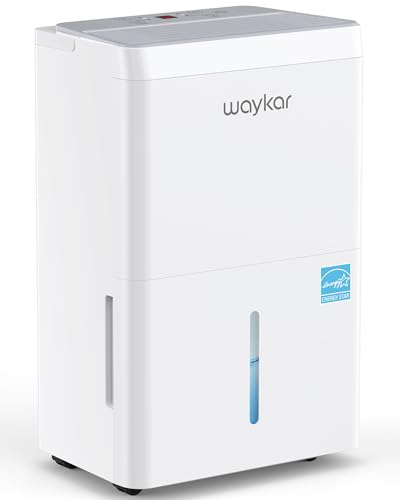
【Waykar 80 Pints for Spaces up to 5,000 Sq. Ft】Effectively extracts up to 80 pints of humidity per day (under 95°F, 90% RH), making it ideal for damp basements, humid homes, bedrooms, laundry areas, storage rooms, and bathrooms. Covers up to 5,000 sq. ft., helping reduce condensation and unpleasant odors to create a cleaner, drier, healthier living space. With a 30%–80% RH adjustable range, maintain full control of indoor comfort through all seasons—from muggy summers to wet winters

1600 Sq.Ft High Capacity Dehumidifier- The GoGuess basement dehumidifier is equipped with a quiet yet powerful compressor that efficiently extracts up to 21 pints of moisture per day (tested at 95°F and 90% RH). Perfect for use in basements, offices, bathrooms, bedrooms, kitchens, storage areas, living rooms, laundry spaces, garages, crawl spaces, and RVs. It helps maintain a healthy humidity level between 30% and 70%, promoting a more comfortable and healthier indoor environment
Which Garage Dehumidifier Features Matter Most?
Beyond pint capacity, the most important garage dehumidifier features are continuous drainage (gravity hose or internal condensate pump), a built-in digital humidistat, auto-restart after power flickers, and a washable dust filter. Because a 50-PPD unit can pull more than 6 gallons of water a day under peak loads, relying on a 1.5-gallon bucket means emptying it three to four times daily.
- Gravity drain hose connection: Lets you attach a standard garden hose or included drain tube so water flows downhill into a floor drain, sump pit, or approved exterior drain.
- Built-in condensate pump: Essential when your floor lacks a drain and water must be pumped upward (often 12–16 feet vertically) into a utility sink or drain line.
- Adjustable humidistat: All ENERGY STAR certified models include a built-in humidistat that cycles the unit on and off automatically to hold your target RH.
- Auto-restart with memory: Resumes your exact humidity setpoint and pump mode automatically after a thunderstorm power outage.
- Washable mesh pre-filter: Captures sawdust, pollen, and sweepings before they coat the damp evaporator coils.
- Caster wheels and pocket handles: Make it easy to roll the unit away from vehicles, workbenches, and floor jacks.
Warning: Always plug a dehumidifier directly into a grounded 3-prong wall outlet—never an extension cord or power strip, which can overheat under continuous compressor draw. Before pressing an older garage or basement unit into service, check its brand and model number against the CPSC dehumidifier recall list; millions of recalled units have been linked to more than 2,000 overheating incidents and 450 fires.
Recommended Products

Energy- Efficient Performance: avylo dehumidifier Certified ENERGY STAR Most Efficient 2025 with an EER of 2.05 L/kWh; Powered by a high-efficiency compressor and optimized airflow design, with a maximum daily dehumidification capacity of 90 pints(90°F,90% RH); Ideal for basements, home, living rooms, garages, and large areas up to 5000 sq. ft., keeping your home dry, comfortable

4,500 SQ. FT. DEHUMIDIFIER – Removes up to 50 pints of moisture per day with an adjustable humidity setting from 35% to 85%. Perfect for use in basement, bathroom, bedroom, office, kitchen, cellar, or crawlspace. Maintain a healthy 45%-55% humidity range

【The Undisputed Champion — Industry‑Leading Dehumidifier Brand】When you choose AEOCKY, you get double market validation. In 2025, AEOCKY was an industry‑leading dehumidifier brand on Amazon US. This means you’re not just choosing a flagship from a market leader, but the top choice proven by millions of real users—representing the ultimate combination of performance, quality, and trust.
What Humidity Should I Set My Garage Dehumidifier To?
Set your garage dehumidifier between 45% and 50% relative humidity for everyday protection. This setpoint sits inside the EPA’s 30%–50% optimal indoor range, meets the CDC’s 50% maximum threshold for preventing mold growth, and stops steel tools, gym racks, and vehicle rotors from flash-rusting without wasting electricity trying to over-dry a leaky structure.
Fine-tune your humidistat setpoint based on what you store and the season:
- General parking and household storage (45%–50% RH): Prevents musty cardboard, mildew on sports gear, and mold on drywall while allowing the compressor to cycle off regularly.
- Precision woodworking, classic cars, or machine tools (40%–45% RH): Slows bare cast-iron oxidation and keeps kiln-dried lumber stable, provided the garage is well sealed.
- Cold winter weather (45%–50% RH or lower as needed): Watch interior windows and metal door panels; if condensation forms during cold snaps, lower the setpoint by 5% to keep the interior dew point below the surface temperature.
- Upper warning threshold (60% RH): If your standalone hygrometer stays above 60% RH during a closed-door period, check for air leaks, clogged filters, or standing water.
Choose a Quiet, Efficient Model With Easy Drainage
To keep electric bills reasonable during long, humid summers, look for an ENERGY STAR or ENERGY STAR Most Efficient label. Federal efficiency standards rate portable dehumidifiers by Integrated Energy Factor (IEF), measured in liters of water removed per kilowatt-hour (L/kWh)—a higher IEF means more drying for every dollar spent on electricity.
When comparing models side by side for a garage workshop or gym, weigh these practical specs:
- Noise level (dBA): Portable units typically run between 46 and 55 dBA. If you use the garage as a home gym, studio, or woodworking shop, look for a dual-speed fan that drops below 50 dBA on low.
- Pump lift and hose length: Confirm the included pump hose (usually 15–16 feet) can reach your sink or drain without exceeding the pump’s vertical head limit.
- Top- or front-access filter: A slide-out filter you can remove in seconds without tools encourages weekly cleaning in dusty workshops.
Recommended Products
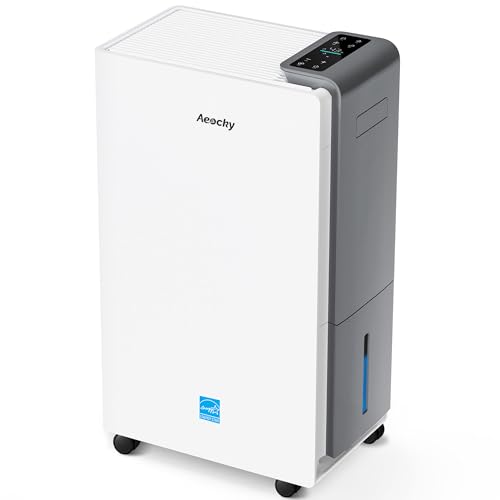
【ENERGY STAR 25 ≠ ENERGY STAR Most Efficient 2025】Don't fall for competitors' word games. With only 2.6% of ENERGY STAR models earning "Most Efficient 2025" title, these options are exceptionally rare on the market. RHEA-001 is one of the few to truly hold this top-tier certification. Many brands use misleading phrases like "Energy Star Efficient 25" or "Energy Star 25" to imply a standard they haven't met. Choosing them is a risk.With AEOCKY, you get verified performance and the peace of mind of authentic, top-tier efficiency.

3000 Sq. Ft High-Efficiency Dehumidifier – The Uthfy basement dehumidifier features a quiet, high-performance compressor that removes up to 38 pints of moisture per day (at 95°F, 90% RH). Ideal for basements, whole homes, offices, bathrooms, bedrooms, kitchens, stockrooms, living rooms, laundry large rooms, garages, crawlspaces, or RVs. During humid seasons, It helps maintain a dry and comfortable indoor environment, ideal for year-round lake-effect humidity control in Michigan, Ohio and Florida waterfront homes.

【Compact Size, Big Efficiency】 The upgraded 2025 Waykar dehumidifier features cutting-edge rotary compressor technology. It’s more compact but still powerful, capable of removing up to 34 pints of moisture per day (at 95℉, 90% RH), ideal for spaces up to 2,000 sq. ft. such as living rooms, basements, bedrooms, and offices. The adjustable humidity range from 30% to 80% helps you easily maintain the ideal indoor humidity
Where Should I Place a Garage Dehumidifier?
Place your garage dehumidifier in an open area with at least 12 to 18 inches of clearance on all sides (and 24–36 inches above top-discharge fans) so damp air can circulate freely. Keep it away from sawdust, rain blow-in near the overhead door, and vehicle bumpers, and always run it with garage doors and windows shut.
Follow these placement and maintenance steps for reliable moisture control:
- Close exterior doors and windows: Running a dehumidifier with the garage door open pulls in an endless supply of humid outdoor air. As the EPA Care for Your Air guide notes, outdoor ventilation only helps when outside air is drier than indoor air.
- Level the cabinet: Use a bubble level on the floor; a tilted dehumidifier can prevent the float switch from tripping or stop water from reaching the gravity drain port.
- Slope gravity hoses continuously downward: Keep the drain hose short, straight, and free of upward loops that trap standing water or cause backflow into the bucket.
- Rinse the air filter every 2–4 weeks: Wash the removable mesh filter with warm water and let it dry completely before reinstalling—check it weekly if you sand wood or sweep concrete floors.
- Wash the collection bucket monthly: Even with a drain hose attached, wipe the reservoir with mild dish soap and water to prevent slimy biofilm and clogged pump intakes.
When Do I Need a Bigger Unit or Professional Help?
You need a higher-capacity dehumidifier (or a second unit) if your current machine runs continuously for 48+ hours in a closed, leak-free garage within its rated temperature range and still cannot bring relative humidity below 60%. However, if your bucket fills rapidly while the garage successfully reaches 45%–50% RH, the unit is sized correctly—you only need to hook up a continuous drain hose.
Consider stepping up to a 50+ PPD commercial dehumidifier or a dedicated ducted garage system if:
- Your garage exceeds 1,500–2,000 square feet or has tall 12- to 16-foot ceilings that a single portable fan cannot circulate.
- Humidity stays above 60% RH despite clean filters, sealed door perimeters, and temperatures above 65°F.
- You run a commercial detail bay, home gym with multiple users, or wet workshop that generates heavy daily moisture.
Warning: Never tie a garage duct or return vent into your home’s central HVAC or whole-house dehumidifier. Under the 2024 International Mechanical Code (Section 601.5), return air for heating or air-conditioning systems must never be taken from a garage because carbon monoxide, gasoline vapors, and chemical fumes can be distributed into living spaces. Any permanent garage HVAC or dehumidification system must be dedicated solely to the garage.
Call a building contractor, waterproofing specialist, or electrician instead of buying a bigger dehumidifier if you spot recurring puddles after rain, crumbling foundation mortar, widespread mold on drywall, or a unit that trips circuit breakers or smells like hot plastic.
Troubleshooting a Garage Dehumidifier
When a garage dehumidifier fails to lower humidity or stops collecting water, the culprit is usually cold air, a clogged filter, or air leakage around the overhead door rather than a broken compressor. Walk through the diagnostic table below from easiest fix to most involved before replacing the machine.
| Symptom | Most Likely Cause | How to Fix It |
|---|---|---|
| Humidity will not drop below 60% RH | Overhead door gaps, open windows, active slab seepage, or undersized PPD rating | Keep doors closed, replace worn bottom door seals, squeegee standing water from wet cars, and size up if RH stays high after 48 hours |
| Unit runs nonstop but collects little water | Garage temperature is below 60°F–65°F, or dust is blocking the intake filter and coils | Check room temperature against the manual’s minimum rating, wash the filter, and leave 12–18 inches of clearance around vents |
| Coils ice over or unit short-cycles | Ambient air is too cold for a standard refrigerant compressor (below 65°F, severe below 50°F) | Unplug the unit to let ice melt completely; switch to a low-temp compressor (down to 41°F) or desiccant unit (down to 32°F) for winter |
| Bucket fills every few hours | High initial moisture load being pulled from damp concrete, lumber, or humid air | Attach a continuous gravity drain hose or use a condensate pump; heavy water collection during the first week is normal |
| Water puddles underneath the cabinet | Unlevel floor, loose hose washer, kinked gravity line, or slime blocking the drain nozzle | Level the unit on the slab, tighten the hose coupling with a rubber washer, clear algae from the nozzle, and reseat the bucket |
Key Takeaways
- Size by dampness first, square footage second: Most 1- to 3-car garages measure 240 to 864 sq ft—well under the 2,000 sq ft threshold—so moisture level (20–30, 25–40, or 30–50 PPD) drives your choice.
- Use current 65°F DOE pint labels: An older pre-2019 “70-pint” dehumidifier is equivalent to a 40–50 PPD model on current store shelves.
- Aim for 45%–50% RH: This target satisfies EPA (30%–50%) and CDC (50% max) mold-prevention guidelines while protecting tools and vehicles from rust.
- Match technology to winter lows: Standard compressors lose efficiency and risk coil frost below 65°F; use a low-temp compressor down to 41°F or a desiccant unit down to 32°F.
- Keep garage air isolated: Never connect garage dehumidification or return ducts to your home’s living-space HVAC system.
Frequently Asked Questions
How big of a dehumidifier do I need for my garage?
For a garage under 2,000 square feet, the current ENERGY STAR baseline is 20–30 PPD for slightly to moderately damp conditions, 25–40 PPD for very damp conditions, and 30–50 PPD for wet conditions. For more than 2,000 square feet, the baseline starts at 30+, 40+, or 50+ PPD respectively. Favor the upper end for detached, poorly insulated, high-ceiling, frequently opened, or high-moisture garages.
Where should I place a dehumidifier in my garage?
Place it on a level surface with at least 12 to 18 inches of airflow clearance around the intake and exhaust, away from sawdust, rain, vehicle impact, and blocked storage areas. Keep doors and windows closed while it operates, and position it close to a floor drain or utility sink if you use continuous drainage.
Is it worth putting a dehumidifier in a garage?
Yes, when the garage stays above 50%–60% relative humidity, smells musty, develops slab or tool condensation, or stores rust-prone tools, gym equipment, and vehicles. A dehumidifier controls airborne moisture effectively, provided you first repair active roof leaks, foundation seepage, or poor exterior grading.
What dehumidifier is best for a garage?
For a mild or warm garage (65°F and above), an ENERGY STAR compressor dehumidifier with a built-in humidistat, auto-restart, and continuous drain hose connection is the best all-around choice. For a garage that drops below 65°F in winter, choose a low-temperature compressor model rated to 41°F or a desiccant dehumidifier rated down to 32°F.
Can I use a dehumidifier in an unheated garage?
Yes, as long as the unit is rated for your garage’s lowest winter temperatures. ENERGY STAR notes that frost can form on standard compressor coils below 65°F, reducing performance. Check the manufacturer’s minimum operating temperature—typically 41°F for low-temp compressors—or use a desiccant dehumidifier when temperatures dip near freezing.
What humidity should I set my garage dehumidifier to?
Set your garage dehumidifier to 45%–50% relative humidity as a practical starting point. EPA guidance recommends keeping indoor humidity below 60% and ideally between 30% and 50%, while the CDC recommends keeping home humidity no higher than 50%. In cold weather, lower the setting slightly if condensation forms on windows or metal doors.
Conclusion
Selecting the right garage dehumidifier size comes down to matching your starting dampness, total floor area, and winter temperature range. Most 1- to 3-car garages under 2,000 square feet need 20–30 PPD for mild dampness, 25–40 PPD for very damp air, or 30–50 PPD for wet conditions—sizing toward the upper limit when the building is detached, uninsulated, or opened frequently.
Put a $15 digital hygrometer in your garage today to log peak humidity and minimum temperature over the next 48 hours. Once you seal obvious door gaps and set up a continuous drain path, you can pick a dehumidifier rated for your exact conditions and keep your tools, vehicles, and storage bone-dry at 45%–50% RH.
Sources
- ENERGY STAR: Dehumidifiers: current PPD capacity chart, drainage options, 65°F coil-frost guidance, placement, humidistats, and Integrated Energy Factor (IEF).
- ENERGY STAR: Dehumidifier Testing and Capacity: DOE test procedure change from 80°F to 65°F and old-to-new portable pint capacity comparisons.
- U.S. EPA: A Brief Guide to Mold, Moisture and Your Home: indoor relative humidity targets (below 60%, ideally 30%–50%), leak repair, and condensation control.
- CDC: Mold: mold prevention and keeping indoor humidity no higher than 50% all day long.
- U.S. Consumer Product Safety Commission: Dehumidifier Recalls: recall notices and overheating/fire-hazard warnings for older portable dehumidifiers.
- International Code Council: 2024 International Mechanical Code, Chapter 6 (Duct Systems): Section 601.5 prohibition on taking HVAC return air from a garage unless served by a dedicated garage-only system.
- U.S. EPA: Care for Your Air: A Guide to Indoor Air Quality: hygrometer measurement and when outdoor ventilation helps or hurts indoor humidity.