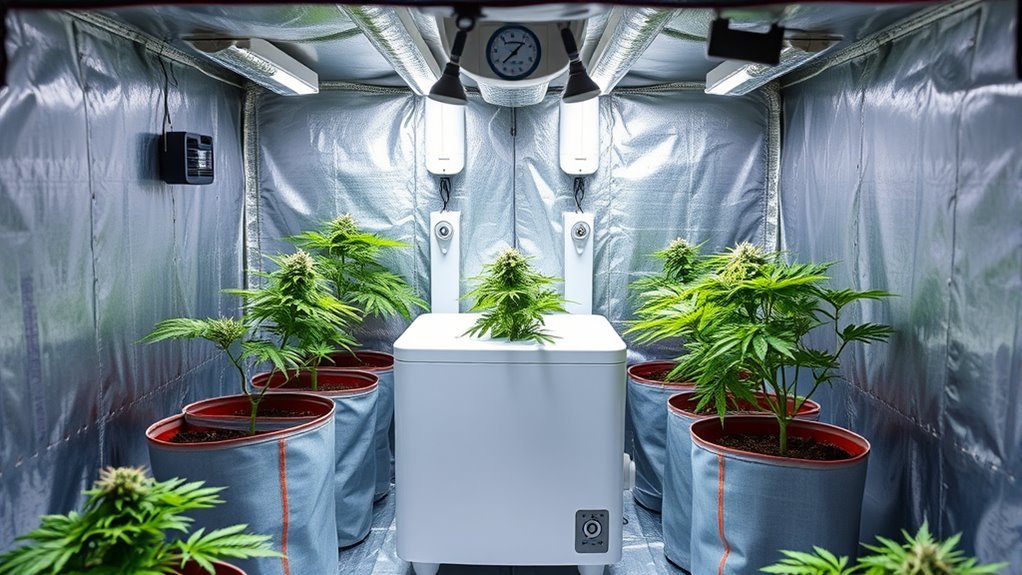
A grow tent dehumidifier should be sized by how much water your plants add to the air each day, not by tent footprint alone. Tent size is still useful for a quick starting point, but the better method is to calculate daily moisture load, add headroom for humidity spikes, then choose a unit with enough pints-per-day capacity to keep the canopy stable.
Quick Answer
For most grow tents, start around 20–30 pints per day for a 2×2, 35–55 pints for a 4×4, and 70–105 pints for a 4×8. Then adjust by your real watering load: gallons watered per day × 8 = pints of moisture the dehumidifier may need to remove.
Key Takeaways
- Size by daily water use first, then use tent size as a cross-check.
- A safe formula is: gallons watered per cycle × 8 ÷ days between watering, then add 20% to 30% headroom.
- Compressor dehumidifiers usually fit warm, humid grow tents best, but cold rooms may need a desiccant unit instead.
- Monitor humidity at canopy level and during lights-off, when RH often spikes.
At a Glance
| Time Required | 10–20 minutes to calculate size, then 24–48 hours of monitoring after setup |
| Difficulty | Easy to moderate |
| Tools Needed | Hygrometer, thermometer, watering log, measuring container, dehumidifier, drain hose or reservoir, and optional ducting |
| Cost | The sizing calculation is free; equipment cost depends on capacity, drain features, efficiency rating, and whether you need one large unit or multiple smaller units. |
What Size Dehumidifier Does Your Grow Tent Need?
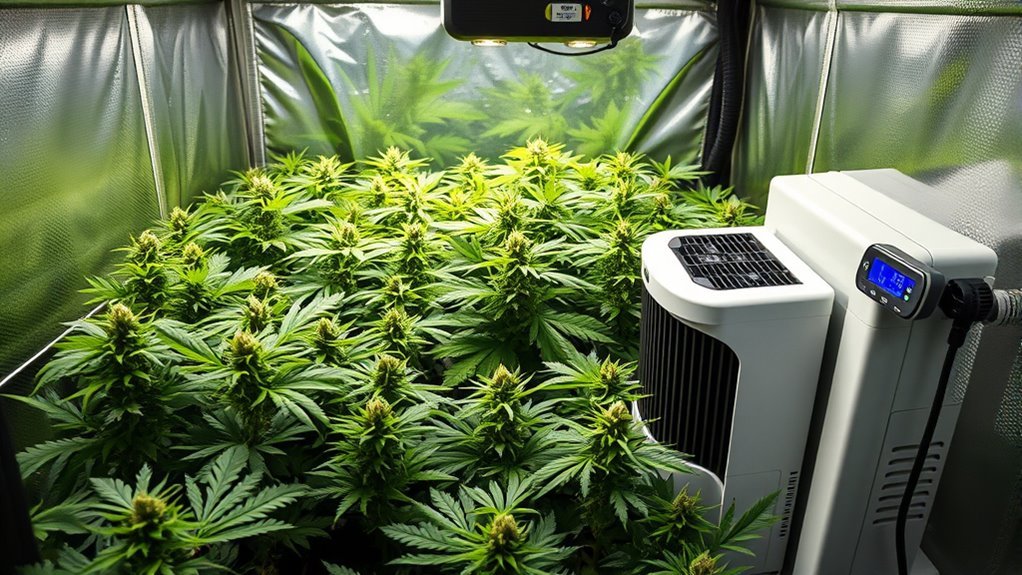
To size a dehumidifier for a grow tent, match the unit’s pints-per-day capacity to the amount of water your plants and wet growing media add to the space. A 22-pint unit may be enough for a small 2×2 tent, a 35- to 55-pint unit often fits a 4×4, and a 70-pint or larger setup is usually a better starting point for a 4×8.
Those numbers are only starting points. A lightly watered 4×4 can need less capacity than a dense 3×3 in late flower, and a sealed room can spike faster than a vented tent. The best target is your daily moisture load plus a safety buffer.
Note: Dehumidifier labels are tested under standard conditions. ENERGY STAR explains that portable dehumidifiers are now tested at 65°F, and newer units may show lower pint ratings than older models that were tested under warmer conditions. Compare current ratings, not old rule-of-thumb numbers.
Recommended Products
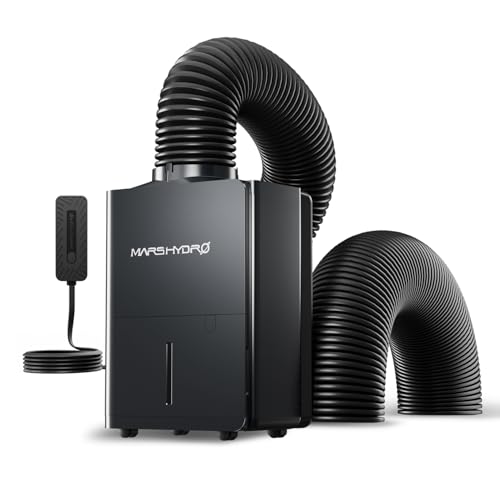
Grow Tent-Optimized Unique Design: Equipped with an air duct, this dehumidifier can sit outside your grow tent, channeling moisture out without introducing extra heat that might disrupt plant growth. It’s perfectly suited for 3x3, 2x4, and 4x4 ft grow tents

🍀 1657ML Larger Capacity: The water tank of this dehumidifier can hold of water at most 1657ml(58 OZ), you don’t need to pour water frequently and don’t worry about the water overflow or water leaking. Please read the instruction manual before using the product!

Semiconductor dehumidifiers use thermoelectric cooling to remove moisture from the air. They create a drier, more comfortable environment by reducing humidity and improving air quality.
How to Estimate Your Humidity Load
Start with watering volume. Most of the water you add to containers eventually leaves through plant transpiration, evaporation from the media, runoff handling, or room humidity. You do not need a lab calculation to get close; you need a simple daily water log.
- Record gallons watered per cycle. Include all plants in the tent.
- Convert gallons to pints. One gallon equals 8 pints.
- Divide by watering interval. If you water every two days, divide by two.
- Add 20% to 30% headroom. Use the higher end for dense canopies, late flower, sealed rooms, high ambient humidity, or lights-off spikes.
Formula: gallons per watering × 8 ÷ days between watering = baseline pints per day. Then multiply by 1.2 to 1.3 for headroom.
For example, if six plants each receive 1 gallon every two days, that is 6 gallons per watering. Six gallons × 8 = 48 pints across two days, or 24 pints per day. With a 25% buffer, your target becomes 30 pints per day. In that case, a 35-pint unit is a safer choice than a 22-pint unit.
Pro Tip: Put one hygrometer at canopy height and one outside the tent in the lung room. If the lung room stays humid, the tent dehumidifier has to fight the whole room, not just the tent.
Best Dehumidifier Size by Tent Size
Use this chart as a starting point after you estimate daily water use. Choose the high end if the tent is packed, the plants drink heavily, the room is sealed, or humidity rises sharply after lights turn off.
| Tent Size | Typical Starting Capacity | When to Size Up |
|---|---|---|
| 2×2 | 20–30 pints per day | Dense canopy, humid apartment, or more than 15–20 pints/day of water load |
| 2×4 or 3×3 | 30–40 pints per day | Late veg, heavy irrigation, or weak exhaust |
| 4×4 | 35–55 pints per day | Four to six mature plants, flower stage, sealed setup, or frequent RH spikes |
| 4×8 | 70–105 pints per day | Eight or more mature plants, high transpiration, or hot and damp lung room |
If your calculated load lands between two sizes, choose the larger unit with a humidistat and continuous drain. Slightly oversizing is usually better than undersizing, as long as the unit does not short-cycle constantly.
Warning: Do not run extension cords across wet floors or place a drain bucket where it can overflow onto outlets, timers, or power strips. Use a safe outlet, keep cords elevated, and route continuous drainage securely.
Recommended Products

Superior Humidity Control: Features a high-efficiency compressor that removes up to 12L of moisture daily; Equipped with high-precision sensors that monitor temperature and humidity to maintain the perfect grow room environment

Superior Performance & Efficient Dehumidification: Removing up to 70 pints (under 90% RH @ 95°F condition) of moisture per day, AIRPLUS dehumidifiers has superior performance. Ideal for rooms up to 4500 sq.ft. If you want a dehumidifier for bathroom, it will definitely be a great choice.
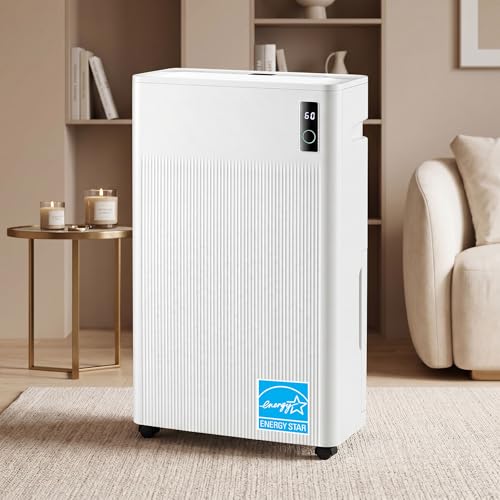
[70 Pint Whole House Dehumidifier] Dehumidifier with drain hose engineered with R290 refrigerant to efficiently remove moisture for spaces up to 4500 sq. ft., making it the perfect dehumidifier for basements, whole house, and large garages to prevent dampness
Which Type of Dehumidifier Works Best for Grow Tents?
For most warm grow tents, a compressor dehumidifier is the practical choice because it can remove more moisture per day than a tiny thermoelectric unit. But the best type depends on temperature, humidity target, room size, and how much water your plants add each day.
Compressor vs. Thermoelectric vs. Desiccant
| Type | Best For | Watch Out For |
|---|---|---|
| Compressor | Warm, humid grow rooms with moderate to heavy daily moisture loads | Adds heat, needs airflow clearance, and may lose performance in cold spaces |
| Thermoelectric / semiconductor | Very small cabinets, seedling areas, or low-moisture spaces | Usually too weak for dense tents or flowering plants |
| Desiccant | Cool rooms, low-dew-point targets, or spaces where compressor performance drops | Often uses more energy and can add noticeable heat |
ASHRAE notes that dehumidifier selection depends on the required dryness level and operating range. That is why a compressor unit can be the right answer for a warm 4×4 tent, while a desiccant unit may be better for a cold basement lung room.
Winter Humidity Control
Winter can make grow tent humidity confusing. A heated tent may still need strong dehumidification because warm air around the canopy holds more moisture. At the same time, a cold lung room can reduce the performance of a compressor unit. Track temperature and RH together, not RH alone.
Michigan State University Extension explains that vapor pressure deficit is a better way to understand plant water loss than relative humidity alone. If RH looks acceptable but leaves stay wet, the VPD may still be too low.
Where to Place a Grow Tent Dehumidifier
For most tents, place the dehumidifier outside the tent in the lung room. This keeps heat, vibration, and light disruption away from the canopy while still drying the air that feeds the tent. If you need tighter control, duct dry air toward the tent intake or use a room setup that lets the dehumidifier condition the whole lung room.
Inside Vs Outside Placement
| Placement | Effect |
|---|---|
| Outside | Less heat in the canopy and more free tent space |
| Inside | Faster local drying, but more heat, crowding, and tank-emptying |
| Ducted outside | Better control without placing the unit under the lights |
| With stronger exhaust fan | Supports negative pressure and steadier air exchange |
Inside placement only makes sense when outside placement cannot control RH. If you put a unit inside, keep it away from direct leaf contact, avoid blowing hot dry air straight at plants, and use continuous drainage if possible.
Ventilation And Airflow Setup
A dehumidifier works best when air can actually reach it. Keep oscillating fans moving air through the canopy, but avoid blasting plants in one fixed spot. Use an exhaust fan that is slightly stronger than intake to maintain negative pressure, then let the dehumidifier dry the lung room air before it cycles back into the tent.
Air circulation matters for disease pressure too. In cannabis research, higher temperature and relative humidity inside inflorescences were linked with higher total yeast and mold levels, while air circulation from fans reduced RH and mold counts in tested inflorescences. The same principle applies broadly: stagnant, humid pockets are the enemy.
What Humidity Should a Grow Tent Run?
Ideal humidity depends on plant stage, temperature, airflow, and crop type. Use RH as a simple guide, then fine-tune by watching VPD, leaf condition, and lights-off spikes.
- Seedlings and clones: 65% to 75% RH. Young plants often tolerate higher humidity because their roots are still developing.
- Vegetative growth: 50% to 70% RH. Keep airflow strong and avoid wet leaves overnight.
- Flowering and fruiting: 40% to 55% RH for many dense-canopy crops. Use the lower end when flowers, fruit clusters, or buds become dense.
- Late flower or high mold pressure: 35% to 50% RH may be appropriate if temperature and VPD stay in range.
- Drying harvested cannabis where legal: manage by water activity and equilibrium RH. Many operators aim for a controlled dry room around 55% to 65% RH with gentle air exchange, not direct fan blast on the flowers.
The CDC recommends keeping home humidity no higher than 50% all day to help prevent mold in homes, while the EPA says indoor RH should be kept below 60% and ideally between 30% and 50% when possible. Grow tents sometimes run higher than home comfort targets during propagation and veg, so monitoring and airflow become even more important.
High humidity is not only a room reading. Dense flowers, fruit clusters, and shaded canopy pockets can hold a wetter microclimate than the air outside the tent.
How to Fine-Tune Your Dehumidifier After Setup
After you install the dehumidifier, watch the tent for at least one full lights-on and lights-off cycle. The unit is the right size if it reaches the target RH without running nonstop all day and without dropping humidity far below your setpoint.
| Problem | Likely Cause | Fix |
|---|---|---|
| RH stays high | Unit is undersized, lung room is damp, or airflow is weak | Increase capacity, dry the lung room, improve exhaust, and prune overcrowded growth if appropriate |
| RH spikes after lights-off | Cooler air holds less moisture and plants/media keep releasing water | Run the dehumidifier on a humidistat, improve night airflow, and avoid heavy watering right before lights-off |
| Air gets too dry | Setpoint is too low or unit is short-cycling | Raise the humidistat setting, use auto mode, or reduce run time |
| Tank fills constantly | High moisture load or no drain line | Use continuous drainage, a condensate pump if needed, and a leak-safe drain path |
| Unit blows warm air into tent | Dehumidifier is inside or ducted poorly | Move it outside the tent or redirect airflow away from the canopy |
Frequently Asked Questions
Should I put a dehumidifier in a grow tent?
Usually, no. Place the dehumidifier outside the grow tent in the lung room when possible. This reduces heat inside the tent, saves canopy space, and still lets the unit dry the air feeding the tent.
Is a dehumidifier good for allergic rhinitis?
A dehumidifier may help if dampness, mold, or dust mites are allergy triggers in your home, because lower humidity can make those problems harder to sustain. It does not treat allergic rhinitis directly, and it will not remove pollen or pet dander the way filtration can. For ongoing symptoms, ask a qualified clinician.
What is the best dehumidifier for a grow tent?
For most warm grow tents, the best choice is a compressor dehumidifier with enough pints-per-day capacity, a built-in humidistat, auto restart, and continuous drain support. For a 4×4 tent, many growers land in the 35- to 55-pint range, but your watering load should decide the final size.
Is it better to undersize or oversize a dehumidifier?
Slightly oversize rather than undersize. A small buffer helps the unit handle peak transpiration and lights-off spikes. Avoid extreme oversizing, though, because a large unit can short-cycle and swing humidity too quickly if the humidistat is poor.
Why does grow tent humidity rise when the lights go off?
When lights turn off, air temperature usually drops. Cooler air holds less moisture, so relative humidity rises even if the actual amount of water vapor has not changed much. Wet media and dense canopies can keep releasing moisture at the same time.
Do I need continuous drainage?
Continuous drainage is strongly recommended for medium and large tents. A tank can fill during the most humid part of the cycle, shut the unit off, and let RH climb again. Use a secure hose path or condensate pump if the drain is higher than the unit.
Conclusion
The right grow tent dehumidifier is the one that can remove your plants’ daily moisture load without overheating the canopy or running nonstop. Start with your watering volume, convert gallons to pints, add a 20% to 30% buffer, and then check that number against your tent size. Place the unit outside the tent when possible, monitor canopy RH and temperature, and fine-tune the setup after a full day-and-night cycle. That gives your plants a steadier environment and gives you more control over mold pressure, transpiration, and overall plant health.
Sources
- ENERGY STAR — Dehumidifier Testing and Capacity — supports pints-per-day capacity and modern test-condition context.
- CDC — Mold Prevention — supports home humidity and mold-prevention guidance.
- U.S. EPA — Mold Course, Humidity — supports indoor RH ranges and mold risk context.
- Michigan State University Extension — Vapor Pressure Deficit — supports VPD and plant transpiration guidance.
- ASHRAE — Desiccant Dehumidification Equipment and Components — supports equipment-selection nuance by operating range.
- Frontiers in Microbiology — Yeast and Mold in Cannabis Inflorescences — supports humidity, airflow, drying, and microbial-risk context for legal cannabis production.