
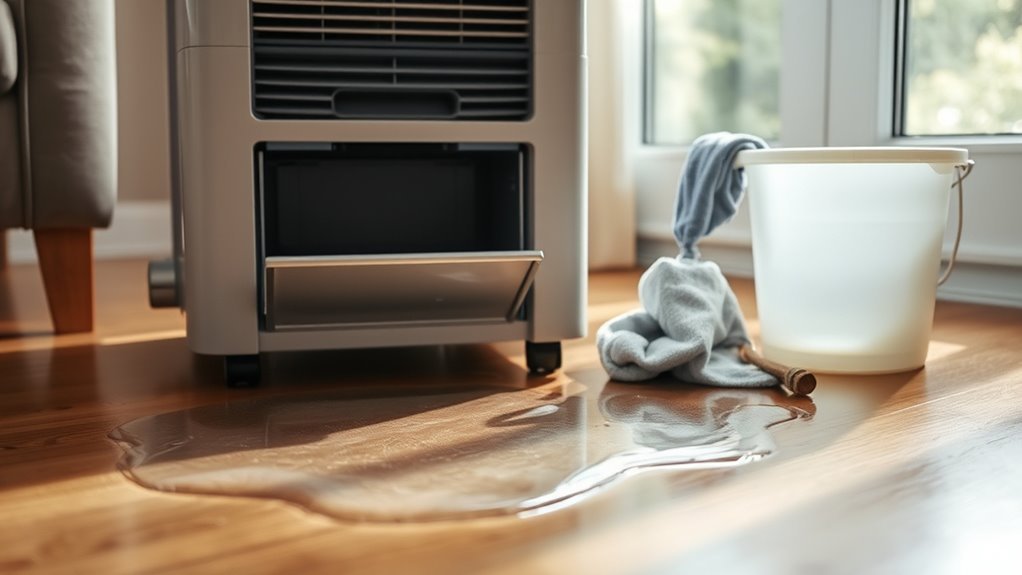
A dehumidifier leaking from the bottom almost always points to an unseated or cracked water bucket, a loose drain hose fitting, a missing drain plug, a clogged line, or frost melting over the internal drip pan. Most floor puddles come from simple external drainage parts you can fix in minutes without opening the cabinet. This guide covers portable dehumidifiers with a removable bucket, gravity drain, or built-in condensate pump rather than whole-home HVAC systems.
Quick Answer
Turn the dehumidifier off, unplug it, and dry the floor to see where fresh water appears first. Reseat or test the water bucket for cracks, check the 3/4-inch hose washer and downward slope, secure any rear drain plug, and clean the air filter to stop coil icing. If water leaks from the cabinet center, arrange service.
Why Is My Dehumidifier Leaking From the Bottom?
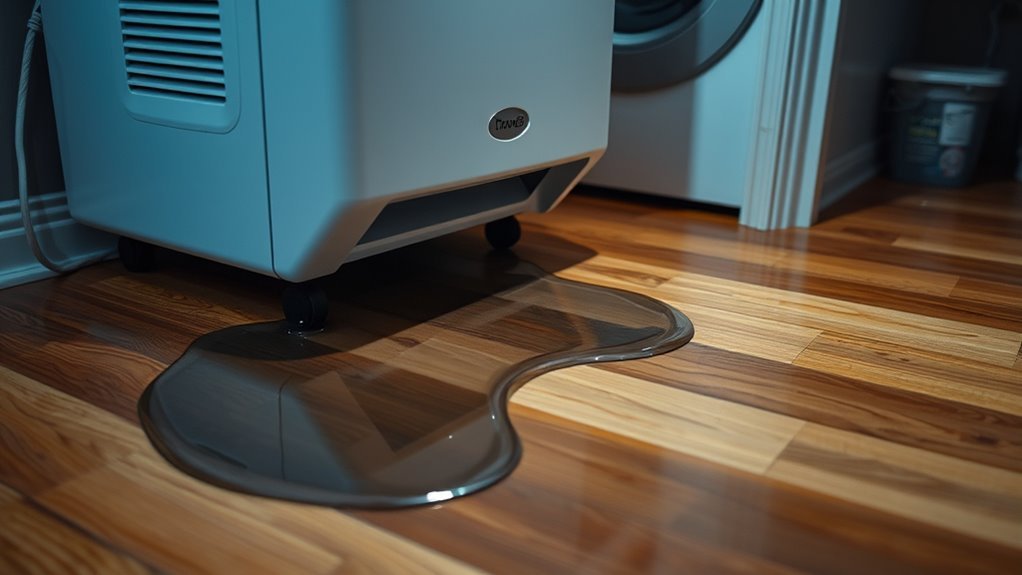
Water escapes from the bottom of a dehumidifier when condensate misses the collection bucket, backs up in a hose or pump line, leaks past a loose drain plug, or overflows the internal catch tray. Noting the exact spot and timing of the first fresh drops narrows down the faulty part quickly.
Use the location of the puddle to match your symptom to the most likely culprit before you start adjusting parts.
| Where water appears | Likely cause | First check |
|---|---|---|
| Front or bucket side | Cracked, full, tilted, or misaligned bucket, or stuck float | Empty, inspect, test in a sink, and reseat the bucket |
| Rear drain connection | Loose fitting, missing 3/4-inch rubber washer, or blocked hose | Check the rubber washer, hand-tighten, and fix the downward slope |
| Rear drain port, no hose attached | Drain plug, cap, or rubber bung loose, missing, or uncapped | Tighten the drain plug or cap per your model’s manual |
| Pump tube connection | Unseated 1/4-inch tube, blocked line, pump mode off, or lift over 16 ft | Reseat the push-in tube, check pump mode, and look for error codes |
| Center of the cabinet | Overflowing internal tray, cracked drip pan, clogged channel, or melting frost | Unplug the unit and inspect only user-accessible trays and filters |
| Only after shutdown | Ice thawing off the evaporator coils, or water trapped in a sagging hose | Check for coil frost, clean the filter, and straighten the hose route |
| After moving the unit or bucket | Residual condensate dripping off coils into cabinet seams | Wait 30 minutes after shutdown before removing the tank |
Warning: Unplug the dehumidifier before removing the bucket, disconnecting a hose, cleaning the filter, or inspecting the cabinet. Never touch a wet plug or outlet while standing in water. If water has reached an electrical compartment, leave the unit unplugged and arrange qualified service.
Locate the leak before changing parts
Pinpoint the exact leak path with dry paper towels before buying replacement parts. Drying the cabinet and watching the first fresh drip prevents you from mistaking a spilled bucket for a cracked internal pan.
- Switch off and unplug the dehumidifier, then wait 30 minutes so remaining water finishes dripping from the coils.
- Empty the bucket and dry the tank exterior, cabinet base, hose connection, drain port, and floor.
- Slide dry paper towels under the front edge, center base, and rear drain port.
- Inspect the bucket seating, drain plug, and hose washer before reconnecting power.
- Run the unit for 10 to 15 minutes while watching closely, provided no plug, cord, or outlet got wet.
- Check which paper towel gets damp first to confirm the leak source.
Pro Tip: Photograph the hose routing and bucket position before removing anything. A quick photo helps you restore the exact setup and gives manufacturer support clear proof if you need a warranty claim.
Check the Water Tank and Float Switch
The collection bucket must sit flat beneath the internal drain spout and engage the float switch that stops the compressor when the tank is full. A hairline crack, warped rim, stuck float, or unseated bucket lets water pool directly under the front of the machine.
Recommended Products

Country of Origin: CHINA

Powerful Moistue Absorption: Camco’s RV Moisture Absorber Bucket effortlessly absorbs 3x its weight in moisture, making it perfect for tackling humidity and creating a comfortable environment.

[Upgraded 3-in-1 Indoor Dryer Vent Kit] - Our filter bucket features a 3-layer filtration system, effectively capturing and filtering dust, and other particulate matter generated during the drying process, thereby improving indoor air quality and reducing issues such as allergies.
Inspect the tank for hairline cracks
Dry the bucket thoroughly and hold it under a bright light. Inspect the molded bottom seams, corners, handle mounts, and float pivot area, where thin plastic flexes when you carry a full tank. If you spot a crack, order the exact model-specific replacement bucket rather than patching it—sealants and tape fail quickly under water weight and constant flexing.
Test the bucket for a slow leak
Hairline seam cracks often open only when the weight of the water presses down on the base. If visual checks look clean, run a static sink test (EcoAir recommends an overnight sink test, and even 4 hours will reveal most slow seam leaks):
- Remove the bucket, empty it, and wipe the entire outside dry.
- Lay dry paper towels across the bottom of a dry sink, bathtub, or laundry tub, and set the bucket on top.
- Fill the bucket two-thirds full with clean water—staying below the maximum fill line—without splashing the exterior.
- Leave the bucket undisturbed for at least 4 hours or overnight.
- Lift the bucket and inspect the paper towels; any damp spot confirms the bucket itself is leaking and needs replacement.
Check float movement
Inside the bucket sits a plastic or foam float—often carrying a small magnet—that rises with the water level to trigger the auto-shutoff switch and “Bucket Full” light. With the unit unplugged, gently lift and lower the float with your finger. It must move smoothly without scraping or sticking against slime, lint, or mineral scale.
Wipe any buildup off the float and its hinge with a damp cloth and mild dish soap. Never bend the float arm or remove the small magnet built into the float, or the dehumidifier will keep running past capacity and overflow from the bottom.
Fix a Clogged, Kinked, or Loose Drain Hose
Gravity drainage relies entirely on a watertight connection and a steady downward slope to carry condensate away without a pump. A missing rubber washer, cross-threaded connector, upward loop, or submerged hose end forces water to leak out of the rear port or back up into the bucket. If the tank keeps filling while little water exits the line, read our guide on why your dehumidifier is not draining through the hose.
| Check | What to look for | Action |
|---|---|---|
| Hose route | Sharp bends, upward loops, low dips, or hose rising near the drain | Shorten excess hose and maintain a continuous downward slope at least 4 inches below the outlet |
| Connection | Loose or cross-threaded 3/4-inch fitting, flattened or missing washer | Install a fresh 3/4-inch rubber garden hose washer and thread on straight |
| Hose surface | Cracks, splits, pinholes, or crushed sections | Replace the damaged hose |
| Drain end | Hose tip submerged in standing water or pushed too deep into a standpipe | Pull the hose end above the water line so air pressure cannot block flow |
Most portable dehumidifiers use a standard 3/4-inch garden hose thread (GHT) outlet. Frigidaire notes that old garden or washing-machine hoses frequently leak at the rear collar because the rubber or plastic washer inside the female coupling is missing, hardened, or cracked. GE Appliances also points out that if a gravity hose end touches standing water inside a floor drain or sump, airlock prevents drainage; pull the hose tip above the water line and trim away excess length so it runs straight to the drain.
Clear blockages and reseat connections
Algae, dust, and biofilm build up inside slow-moving gravity lines and the plastic drain nozzle. Clear the path and seal the threads with these steps:
- Unplug the dehumidifier, empty the bucket, and unscrew the drain hose.
- Flush the hose with warm water and a splash of white vinegar, then scrub inside the dehumidifier’s plastic drain nozzle using a baby bottle brush or soft pipe cleaner as GE Appliances recommends.
- Press a new 3/4-inch rubber garden hose washer flat inside the hose connector.
- Thread the coupling onto the plastic outlet straight by hand until snug; do not overtighten with wrenches, which can crack or strip plastic threads.
- Route the hose downward with no upward loops, keeping the line at least 4 inches (10 cm) lower than the drain port from start to finish.
Never poke coat hangers, screwdrivers, or stiff wire into the drain nozzle, and never blast compressed air into the port, as either can puncture the internal drip pan or knock an internal tube loose.
Check the drain plug or cap when no hose is used
Many dehumidifiers rely on a screw-on plastic cap and an inner rubber drain plug (or bung) to seal the continuous-drain port when you collect water in the bucket. TCL identifies a loose drain plug as the single most common cause of water leaks on its dehumidifiers, and EcoAir likewise highlights an unseated rubber bung. In addition, GE Appliances notes that leaving a hose attached while using the bucket can cause floor leaks, so disconnect any unused hose and tighten both the inner rubber stopper and outer cap firmly by hand.
Check a built-in condensate pump
Dehumidifiers with a built-in pump use a narrow push-in plastic drain tube (typically 1/4-inch outer diameter) to pump water upward into a utility sink, standpipe, or window. When a pump line leaks or backs up, check five details:
- Confirm Pump mode is actively switched on—some models (including TCL units) automatically restart after a power outage with the pump turned off.
- Push the pump tube firmly into the quick-connect port until it locks, and inspect the release collar or O-ring for drips.
- Keep the hose within your manual’s maximum vertical lift and length—most built-in pumps handle up to 10 to 16.4 feet (3 to 5 meters) of vertical lift.
- Inspect the narrow tubing for kinks, algae clogs, or frozen water if it exits into a cold space.
- Check the control panel for drainage or pump fault codes, such as the PU error code on Frigidaire dehumidifiers, E5 on TCL pump models, or P2/Eb on other brands.
Before storing or moving a pump model in freezing weather, drain the internal pump reservoir as directed in your manual. If the pump motor hums without moving water, repeatedly throws an error code after cleaning the line, or leaks inside the casing, unplug the unit and schedule service.
Keep the Unit Level and the Bucket Aligned
Set your dehumidifier on a hard, flat, level floor rather than thick carpet or an uneven basement slab. Frigidaire lists a tilted cabinet as a primary cause of leaks around the bucket because even a slight forward or side tilt shifts the internal drip stream away from the bucket funnel and onto the base.
Check the top of the cabinet with a spirit level or phone level app, and adjust the leveling feet or move the unit to a flat spot. While the bucket is out, wipe lint and mineral scale off the bucket rim, splash guard, side guides, and the matching rails inside the cabinet so the tank slides all the way home. Keep the bucket installed even when using a gravity hose or pump—most dehumidifiers still pass water through the bucket or rely on its float switch to prevent overflows.
Inspect the Base for Cracks
If the bucket and rear fittings are dry but water still pools beneath the center of the dehumidifier, inspect the exterior base and accessible tray edges. A cracked internal drip pan or clogged internal channel above the bucket will drip straight through the bottom seams.
- Unplug the unit, remove the bucket, and confirm all four feet or caster wheels are intact and level.
- Shine a flashlight into the bucket cavity to look for cracked plastic, stress marks, or mineral tracks along the upper drip tray and spout.
- Press a dry paper towel along the bottom exterior seams and corners to detect slow seepage.
- Check that the small drain hole feeding the bucket spout is not blocked by dust or slime.
- Keep the dehumidifier upright—never flip it upside down or dismantle the outer shell unless your manual explicitly marks the panel as user-serviceable.
If the upper internal drip pan is cracked or leaking behind the sealed cabinet panels, the unit requires professional repair or replacement.
Clean the Filter and Drain Tray
A dust-clogged air filter chokes airflow across the cold evaporator coils, which causes two different leak problems: coils freeze over and overflow the tray when they thaw, or negative air pressure inside the cabinet pulls water droplets backward so they miss the bucket. Follow our complete guide on how to clean a dehumidifier filter every 2 weeks during heavy use.
Unplug the dehumidifier, slide out the mesh filter, vacuum away surface dust, and wash it gently in warm, soapy water if your manual allows. Let the filter dry completely before reinstalling it, and never run the unit without a filter—unfiltered dust coats the wet coils and washes down into the internal drain tray as thick sludge. If your model provides a user-accessible collection tray, wipe away any slime with mild soap and a damp cloth.
Stop Frost and Ice Overflow
Compressor dehumidifiers pull humid air across cold evaporator coils, and those coils can ice over when the room is too cool or airflow is blocked. When a thick block of ice melts during a defrost cycle or after shutdown, the sudden rush of meltwater often overwhelms the catch tray and leaks from the bottom.
Check your room temperature against your unit’s rating label. ENERGY STAR notes that standard compressor dehumidifiers can develop coil frost whenever room air drops below 65°F (18°C), whereas low-temperature basement models (such as TCL units) are rated down to 41°F (5°C). Leave at least 8 to 12 inches (20 to 30 cm) of open clearance around the intake and exhaust vents so air circulates freely.
- Turn the dehumidifier off, unplug it, and surround the base with thick towels to catch meltwater.
- Let the ice melt naturally at room temperature—allow at least 1 hour or until all dripping stops.
- Clean the air filter and move furniture, boxes, or curtains at least 12 inches away from the vents.
- Verify the cabinet sits level and empty the water bucket after the thaw finishes.
- Check the room temperature with a thermometer; if the space regularly stays below 65°F (18°C) and your unit is not a low-temperature model, move it to a warmer spot or switch to a desiccant dehumidifier.
If coils keep icing up in a warm room (above 68°F / 20°C) with a clean filter—especially if frost forms on only one section of the coil—the sealed system may be low on refrigerant; read why a dehumidifier freezes up for deeper diagnostics. Never chip or pry ice off the coils with a knife or screwdriver, which can puncture the copper refrigerant tubing and destroy the appliance.
Moving the Unit or Removing the Bucket Too Soon
Pulling the bucket out the second the dehumidifier stops—or rolling the machine across the floor right after shutdown—causes water still clinging to the coils to drip onto the bottom casing and seep through the cabinet seams. EcoAir explains that this trapped water leaks out slowly over several hours, making a one-time spill look like a persistent bottom leak.
To prevent spills, turn the dehumidifier off and wait at least 30 minutes before removing and emptying the bucket, or at least 1 hour before moving the appliance to another room. Always empty the tank completely before wheeling or lifting the unit, carry it upright with both hands, and if the cabinet was tilted during transport, leave it upright and unplugged for at least 6 hours before turning it back on so compressor oil settles safely.
Check for a Recalled Dehumidifier
Before spending time or money fixing an older or secondhand dehumidifier, check the brand name, model number, serial number, and manufacture date code on the rear rating sticker against the CPSC dehumidifier recall page and the manufacturer’s website.
The U.S. Consumer Product Safety Commission warns that millions of recalled Gree-manufactured dehumidifiers can overheat, smoke, and catch fire. An earlier recall reannouncement cited more than 2,000 overheating incidents, about 450 fires, and $19 million in property damage across 2.5 million units sold under brands including Danby, De’Longhi, Fedders, Frigidaire, GE, Gree, Kenmore, Norpole, Premiere, Seabreeze, SoleusAir, and SuperClima. A separate 2023 recall of 1.56 million Gree-made dehumidifiers covered 42 additional models sold under Kenmore, GE, SoleusAir, Norpole, and Seabreeze following 23 reported fires and 688 overheating incidents. For wider electrical safety guidance, see are dehumidifiers a fire risk.
Warning: If your dehumidifier model is listed in a safety recall, stop using it immediately, unplug it, and follow the recall refund instructions. Never continue running, testing, or repairing a recalled unit.
Test the Dehumidifier After the Fix
Once you have reseated the bucket, replaced a worn hose washer, tightened the drain plug, or thawed frozen coils, run a controlled dry test to verify the leak is gone.
- Wipe the bucket exterior, cabinet base, rear drain port, hose fittings, and floor completely dry.
- Set the dehumidifier on a hard, level surface well clear of extension cords and power strips.
- Place fresh dry paper towels beneath the front bucket edge, center cabinet, and rear drain fitting.
- Reinstall the bucket, drain plug, or hose exactly as specified in your owner’s manual.
- Plug the unit into a grounded wall outlet, turn it on, and inspect the paper towels every 10 minutes for the first hour.
- Unplug the appliance immediately if water reappears under the center of the cabinet or near any electrical component.
While testing, also inspect the floor drain, utility sink, or sump basin receiving your hose—a slow or backed-up household drain often spreads water backward under the dehumidifier and mimics an appliance leak.
Common Mistakes That Cause Repeat Leaks
Avoid these six frequent troubleshooting missteps that keep water pooling under a dehumidifier:
- Running the unit before drying the base: Leftover water trapped in plastic base ribs continues dripping and hides whether your fix worked.
- Letting a gravity hose sag, loop upward, or dip below the water line: Any upward rise or submerged outlet creates backpressure that forces water out at the rear collar or into the bucket.
- Reusing a flattened hose washer or loose drain plug: Finger-tightening an old hose without a fresh 3/4-inch rubber gasket rarely seals a plastic drain port.
- Taping or gluing a cracked bucket: Water pressure flexes thin plastic tank seams and peels patches loose within days.
- Scraping ice off evaporator coils: Sharp tools easily puncture thin refrigerant tubes and turn a simple defrost issue into a ruined unit.
- Removing the bucket immediately after shutoff: Pulling the tank out without waiting 30 minutes lets residual coil drips fall straight onto the base pan.
When to Call for Dehumidifier Repair
Contact the manufacturer’s support team or a qualified appliance technician if external checks do not stop the water. Stop operating the dehumidifier and unplug it immediately if you notice any of the following warning signs:
- Water steadily drips from the center of the cabinet base even though the bucket, drain plug, and hose connection are completely dry.
- The leak returns after you have verified a water-tight bucket, a fresh hose washer, a downward hose slope, a level floor, and a clean filter.
- The built-in condensate pump grinds, hums without pumping water, leaks inside the housing, or repeatedly displays a pump fault code (such as PU, E5, or P2).
- The dehumidifier trips a circuit breaker or its plug-in GFCI/LCDI reset button.
- The power cord, plug blades, or wall outlet feels hot, looks discolored, or gets wet.
- You smell burning plastic or see smoke, sparks, or melted housing around the controls.
- Half of the evaporator coil stays heavily iced even when the room is above 68°F (20°C) and the air filter is clean.
Note: Do not remove the outer cabinet to repair internal drip pans, float microswitches, or pumps unless your manual states the part is user-serviceable. Portable dehumidifiers contain high-voltage capacitors, electrical wiring, and a pressurized refrigerant circuit that require a qualified appliance technician.
Repair or replace the unit?
Check your warranty coverage first—many portable dehumidifiers carry a 1-year limited warranty. If the unit is out of warranty, compare the technician’s diagnostic and repair quote against the price of a new ENERGY STAR model (typically $150 to $300 for portable 20- to 50-pint units). Replacement is almost always the smarter choice when the dehumidifier is recalled, suffers from an internal refrigerant leak, has a cracked internal chassis pan, shows electrical damage, or costs more than half the price of a new unit to repair.
Related Guides
- Why is my dehumidifier freezing up?
- Why does my dehumidifier keep running?
- Why does my dehumidifier smell musty?
- Why is my dehumidifier tripping the breaker?
- Why is my dehumidifier not draining through the hose?
Frequently Asked Questions
How do I stop my dehumidifier from leaking?
Turn the dehumidifier off, unplug it, and dry the unit and floor to see where fresh water starts. Reseat the water bucket, test it in a dry sink for hairline cracks, tighten the rear drain plug, or install a new 3/4-inch rubber washer in the drain hose and slope the line steadily downward. If water continues coming from the center of the cabinet, arrange professional service.
Are dehumidifiers meant to leak from the bottom?
No, a dehumidifier should never leak water from its base. All collected moisture should flow into the removable bucket, out through a continuous gravity drain hose, or through the built-in pump tube. Water pooling underneath the cabinet always indicates a spill, a loose plug or hose fitting, a clogged drain path, melting coil frost, or a cracked internal tray.
Why does my dehumidifier leak only when a hose is attached?
A leak that starts only when a hose is connected usually comes from a missing or worn 3/4-inch rubber washer, cross-threaded plastic threads, a clogged or kinked hose, an upward loop in the line, or a hose end submerged in standing water. Unplug the unit, flush the hose and drain nozzle, insert a fresh rubber washer, and route the hose straight downward with the tip above the drain’s water line.
Why does my dehumidifier leak after it turns off?
Water appearing only after shutdown is typically caused by frost melting off the cold evaporator coils or water flowing backward from a sagging gravity hose. Unplug the unit and let all ice thaw onto towels, clean the air filter, confirm the room temperature is within your model’s operating range (65°F+ for standard units), and remove any dips or upward loops in the drain hose.
Why is my dehumidifier leaking when the bucket is empty?
If the floor is wet while the bucket stays dry, condensate is bypassing the bucket before it ever reaches the tank. Check whether the bucket is pushed only halfway into its guides, the cabinet is tilted on uneven flooring, the rear drain plug is loose, or slime is blocking the internal nozzle above the bucket.
Why does my dehumidifier leak after I move it?
Moving a dehumidifier or pulling out the bucket immediately after turning it off lets leftover water on the coils drip into internal cabinet crevices and slowly seep onto the floor. Always switch the unit off, wait 30 minutes before removing and emptying the bucket, wait at least 1 hour before moving the cabinet, and roll or carry it strictly upright.
Conclusion
When your dehumidifier is leaking from the bottom, unplug it first and use dry paper towels to see whether water starts under the bucket, the rear drain plug, the hose collar, or the center of the cabinet. Most leaks stop as soon as you level the unit, reseat or replace a cracked bucket, tighten the drain plug, or fit a fresh 3/4-inch rubber washer on a downward-sloping gravity hose. If water keeps dripping from the center of the base or reaches electrical parts, leave the dehumidifier unplugged, check its model number against CPSC recall notices, and contact a qualified technician.
Sources
- Frigidaire: Dehumidifier Water Leaking Issues: Tilted cabinets, cracked buckets, worn garden-hose washers, and frost overflow causes
- Frigidaire: Dehumidifier Error Code PU: Built-in condensate pump error code diagnostics and hose checks
- GE Appliances: Dehumidifier drain hose issues: Rubber washer installation, keeping the hose end above standing water, and cleaning with a bottle brush
- GE Appliances: Dehumidifier – Leaking, Water on Floor: Disconnecting an unused drain hose when collecting water in the bucket
- TCL: Troubleshooting a water leak in a TCL dehumidifier: Loose drain plugs, 41°F (5°C) low-temperature limits, and pump troubleshooting
- EcoAir: Why is my dehumidifier leaking water?: Overnight sink leak test, rubber bung checks, and 30- to 60-minute wait times before removing the tank or moving the unit
- ENERGY STAR: Dehumidifiers: Coil frost formation below 65°F on standard compressor dehumidifiers
- U.S. CPSC: Dehumidifier recalls: Federal dehumidifier safety recall lookup database
- U.S. CPSC: Gree Dehumidifier Recall Reannouncement: Overheating and fire statistics across 2.5 million recalled dehumidifiers
- U.S. CPSC: 2023 Gree Recall of 1.56 Million Dehumidifiers: 2023 recall covering 42 dehumidifier models across five brands


[…] Why a dehumidifier leaks from the bottom […]