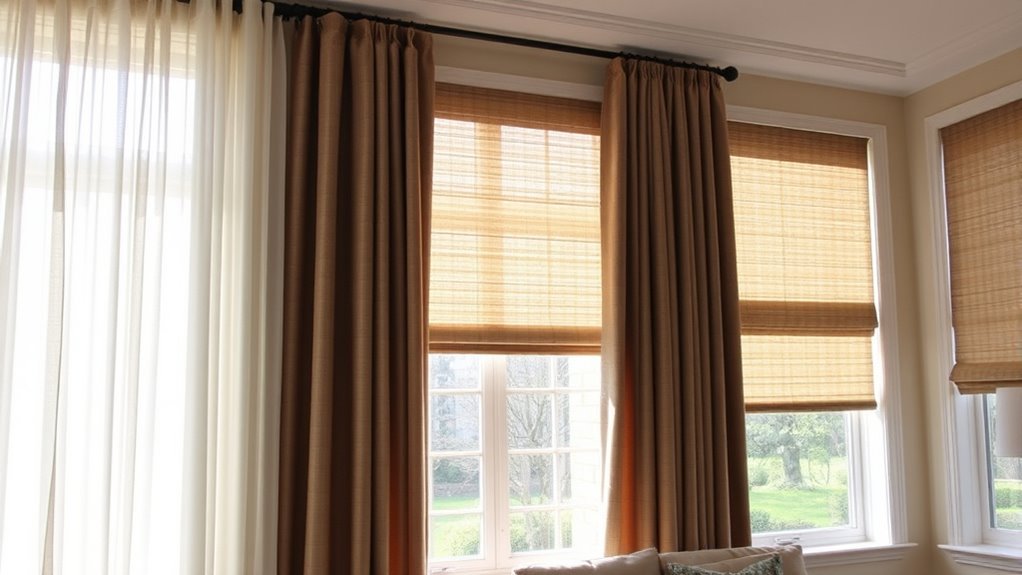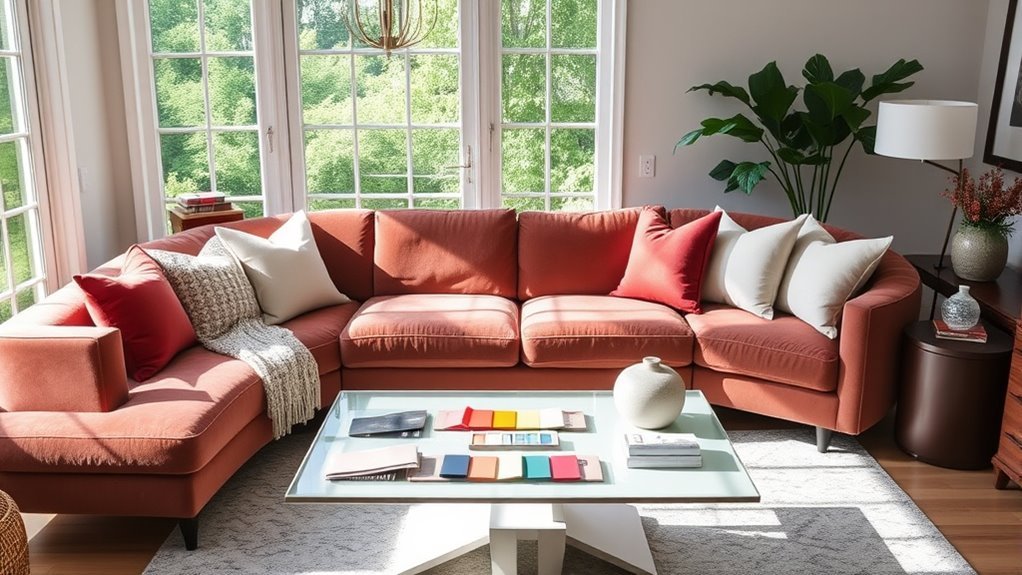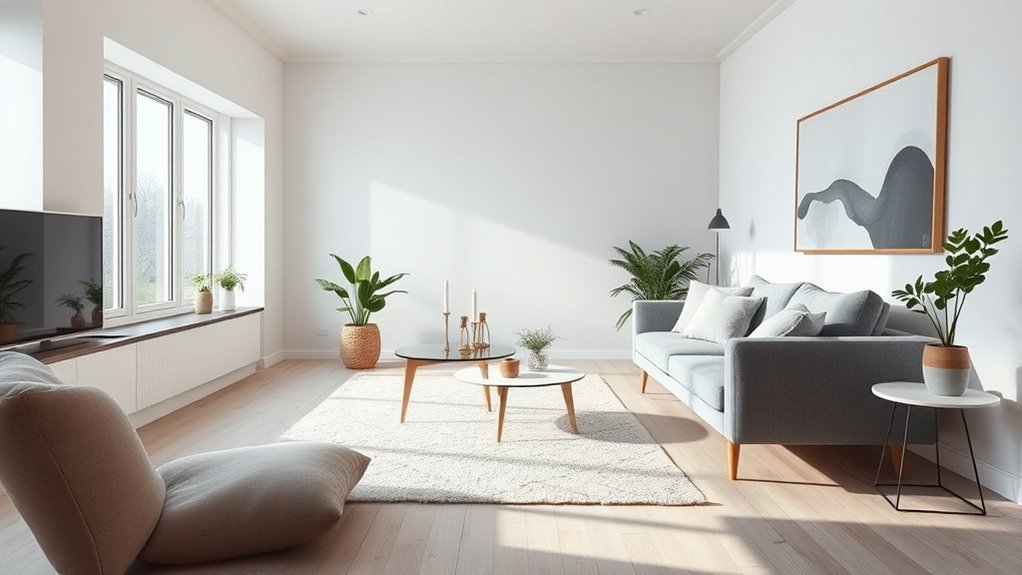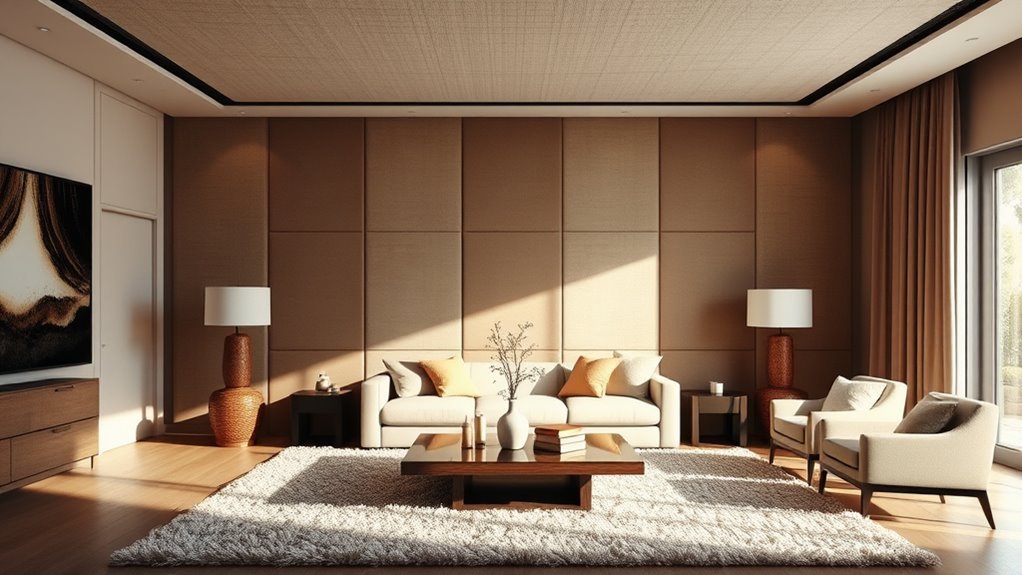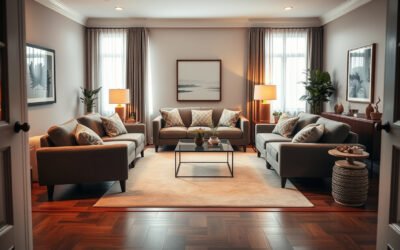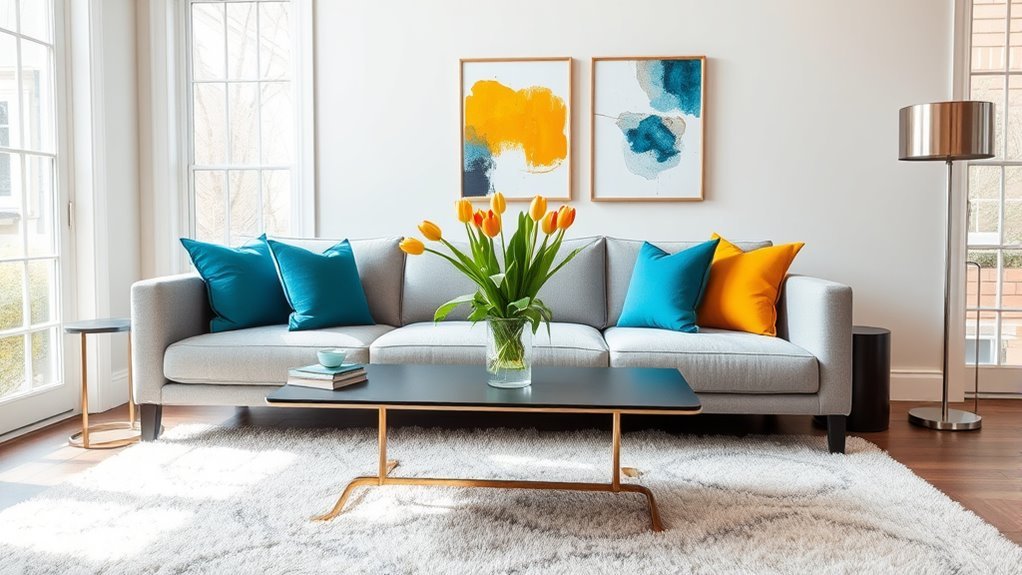
Choosing accent colors in a living room makes the space feel intentional instead of unfinished. Rather than buying random decor and hoping it matches, start with the fixed elements already staying in the room—your sofa, flooring, rug, wall color, and wood tones. Once you anchor your palette to those permanent finishes, you can layer in a dominant backdrop, a secondary supporting shade, and a crisp 10% accent that pulls the whole room together.
Quick Answer
To incorporate accent colors in a living room, identify the undertones of your existing sofa, flooring, and walls first. Apply the 60-30-10 rule: 60% dominant backdrop, 30% secondary furniture or textile color, and 10% accent color repeated across at least three separated spots (low, mid-level, and high) after testing samples in real daylight and evening lamp light.
At a Glance
| Time Required | 30 minutes for initial palette planning; 24 to 48 hours to observe paint and fabric swatches across morning, midday, and evening light |
| Difficulty | Easy to moderate |
| Tools Needed | Color wheel, plain white printer paper (for undertone checks), paint swatches, fabric samples, painter’s tape, and a phone camera |
| Cost | $0 when restyling existing decor; $3.50 to $15 for peel-and-stick paint or fabric swatches, plus optional textiles, art, or accessories |
How Do You Choose an Accent Color From the Room You Already Have?
You choose an accent color by auditing the permanent finishes and large furniture pieces that are staying in your living room. Your sofa, hardwood or tile flooring, fireplace surround, built-in cabinetry, metal hardware, and existing area rug already establish the room’s base undertones. Any new accent shade must either echo those undertones or create deliberate contrast against them.
Take a wide photo of your living room in midday natural light and list every surface you do not plan to replace. If your oak floor and brick fireplace carry warm honey or red-orange notes, look for accents that respect that warmth—such as olive green, terracotta, or muted navy—rather than icy pastels that feel disconnected. If your sofa is cool slate gray, compare fabric or paint swatches directly on the cushions instead of judging colors on a phone screen.
Major paint manufacturers emphasize building palettes around existing focal points. Sherwin-Williams recommends pulling inspiration from a favorite patterned rug, artwork, or fabric already in the space while accounting for permanent architectural features like cabinets, tile, and stone.
Choosing a Dominant Color for Your Living Room
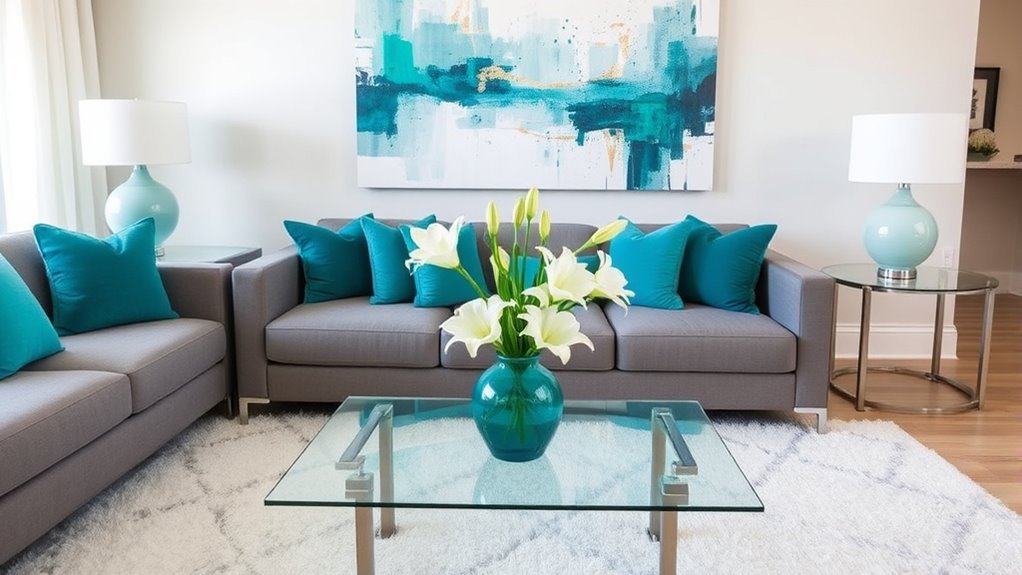
Your dominant color forms the visual backdrop of the living room, covering roughly 60% of the visible surfaces. It usually appears on the walls, large sectional or sofa upholstery, main area rug, or wall-to-wall built-ins. Because it takes up the most square footage, choose a shade you can live with daily—such as warm alabaster, greige, soft taupe, oatmeal, charcoal, muted sage, or deep navy.
Interior designers rely on the 60-30-10 rule to keep living room proportions balanced:
- 60% dominant color (the anchor): Walls, primary sofa or sectional, large area rug, and built-in shelving.
- 30% secondary color (the support): Accent chairs, drapery panels, painted coffee or console tables, wood tones, and secondary textiles.
- 10% accent color (the punctuation): Throw pillows, blankets, table lamps, ceramic vases, framed art details, coffee table books, or a small painted furniture piece.
When selecting a dominant wall or backdrop shade, check its Light Reflectance Value (LRV), which is printed on the back of paint chips and ranges from 0 (absolute black, absorbing all light) to 100 (pure reflective white). Light neutrals with an LRV between 60 and 85 bounce daylight around small or dimly lit living rooms, while mid-tone or dark backdrops with an LRV between 10 and 45 absorb light to make expansive rooms feel cozy and grounded.
Treat the 60-30-10 breakdown as a flexible framework rather than a rigid law. If you want to introduce two accent colors, use a 60-20-10-10 split or divide the 10% accent share into a 7% primary accent and a 3% supporting accent so the two shades do not compete equally for attention.
Note: If your living room walls are already painted a bold saturated shade like emerald green or peacock blue, treat the wall color as your 60% dominant backdrop and use softer, quieter neutrals for your 30% and 10% shares. When your walls are neutral, your 10% accent can carry much higher saturation.
Choose a Secondary Color With the Color Wheel
A color wheel maps the exact visual relationship between your dominant backdrop, your 30% secondary color, and your 10% accent. Instead of guessing which hues pair well, locate your room’s main color on the 12-part wheel and choose one of five proven color harmonies depending on how much energy or calm you want.
- Complementary (high contrast): Two colors directly opposite each other on the wheel, such as blue and orange, green and red-terracotta, or navy and ochre yellow. Use the calmer shade for the 60% or 30% share and the sharper opposite for the 10% accent.
- Split-complementary (balanced contrast): One base color paired with the two shades flanking its direct opposite—for example, a blue-gray room accented with warm rust and golden mustard. You keep visual energy without the tension of a strict opposite pairing.
- Analogous (serene and connected): Two to four colors sitting side by side on the wheel, such as sage green, eucalyptus, teal, and dusty blue. Because they share common pigment undertones, analogous rooms feel cohesive and restful.
- Triadic (dynamic and layered): Three colors spaced equally apart in a triangle on the wheel, such as muted blue, terracotta red, and mustard yellow. Let one color dominate at 60%, mute the second at 30%, and use the third sparingly at 10%.
- Monochromatic (tonal depth): Multiple tints (white added), tones (gray added), and shades (black added) of a single color family—such as oatmeal, warm tan, cognac leather, and espresso brown. Rich texture prevents a monochromatic living room from looking flat.
For instance, if your living room is anchored by warm beige walls and a cream sofa, you can steer the palette in four distinct directions: dusty blue for complementary contrast, olive green for an analogous nature-inspired look, terracotta for warm tonal layering, or chocolate brown for high-contrast monochromatic depth.
Quick Accent Color Decision Guide
Use this reference table to match common fixed living room finishes with secondary and accent color combinations that work with their undertones.
| Existing Room Cue (60% Base) | 30% Secondary & 10% Accent Options | Color Wheel Harmony | What to Check in Your Space |
|---|---|---|---|
| Warm beige walls, cream sofa, or honey-toned wood | Slate or muted blue, olive green, terracotta, chocolate brown | Complementary (blue) or Analogous (terracotta/olive) | Check whether the beige leans yellow, pink, or green before picking warm vs. cool contrast |
| Cool gray upholstery with black metal or chrome finishes | Navy blue, sage green, deep plum, muted rust, warm walnut | Analogous (navy/plum) or Split-complementary (rust/sage) | Confirm whether the gray has blue, violet, or green undertones so warm accents look intentional |
| Deep blue or navy walls or sectional sofa | Camel leather, warm cream, ochre yellow, soft rust, brushed brass | Complementary and Split-complementary | Add enough high-LRV cream or off-white surfaces (LRV 70+) so dark navy does not shrink the room |
| Crisp white walls with pale white oak flooring | Sage green, dusty blue, soft clay, muted mustard, charcoal | Triadic or Analogous | Verify that your sample bridges the gap between cool or warm wall paint and the pale wood grain |
| Cognac or tan leather sofa with neutral walls | Forest green, peacock or denim blue, cream bouclé, matte black | Complementary (blue/teal with orange-tan leather) | Balance the heavy visual weight of warm leather with cool green or blue textiles on the opposite side |
Treat these pairings as starting candidates rather than automatic matches. Always lay real fabric or paint samples directly against your upholstery, flooring, and trim before purchasing full-sized pieces.
Incorporating Accent Colors for Added Character
Incorporating accent colors works best when you repeat your chosen shade in at least three separated spots across the living room. A single rust-colored throw pillow on a beige sofa looks like a stray item. Repeating that rust tone in a pillow on the sofa, an abstract print above the console table, and a glazed ceramic bowl on the coffee table creates a visual triangle that guides the eye around the space.
Introduce your 10% accent color across these five categories so the palette feels layered rather than repetitive:
- Soft textiles: Throw pillows, woven blankets, upholstered ottomans or poufs, drapery trim, and patterned area rugs.
- Wall art and mirrors: Large framed canvases, matted gallery wall prints, painted picture frames, or textile wall hangings.
- Tabletop and shelf accessories: Ceramic vases, stoneware bowls, decorative trays, hardbound book spines, taper candles, and table lamp bases.
- Botanical and natural elements: Fresh cut branches, indoor foliage (such as olive trees, rubber plants, or pothos), travertine stone, and woven seagrass baskets.
- Targeted painted details: The back panel of a built-in bookcase, an interior door and trim, a small side table, or a fireplace mantel.
A strong accent color does not need to cover every surface. It simply needs to repeat across three separated points so the eye recognizes it belongs.
When distributing accents, balance both horizontal placement (left, right, and center of the seating area) and vertical elevation so all the color does not pool at cushion height.
Pro Tip: Use the Three-Height Styling Method for your 10% accent: place one accent low near the floor (under 24 inches, such as a patterned rug detail or floor pouf), one at mid-level seating height (24 to 42 inches, such as throw pillows or a coffee table tray), and one at eye level or higher (above 48 inches, such as framed wall art or drapery panels).
Recommended Products

QUALITY MATERIAL: The pillow cover is composed of a soft and comfy corduroy which is a kind of polyester fabric, features a cute and elegant boho stripe design. Our pillow covers are of good workmanship, they are tightly sewn without loose threads.

Material: Made of High quality durable linen blend, comfortable to touch and lay on. Quality fabric, hide your old pillow patterns perfectly. This material does not pilling or shedding, and holding up well after long time of use
Test Your Colors With Natural Light
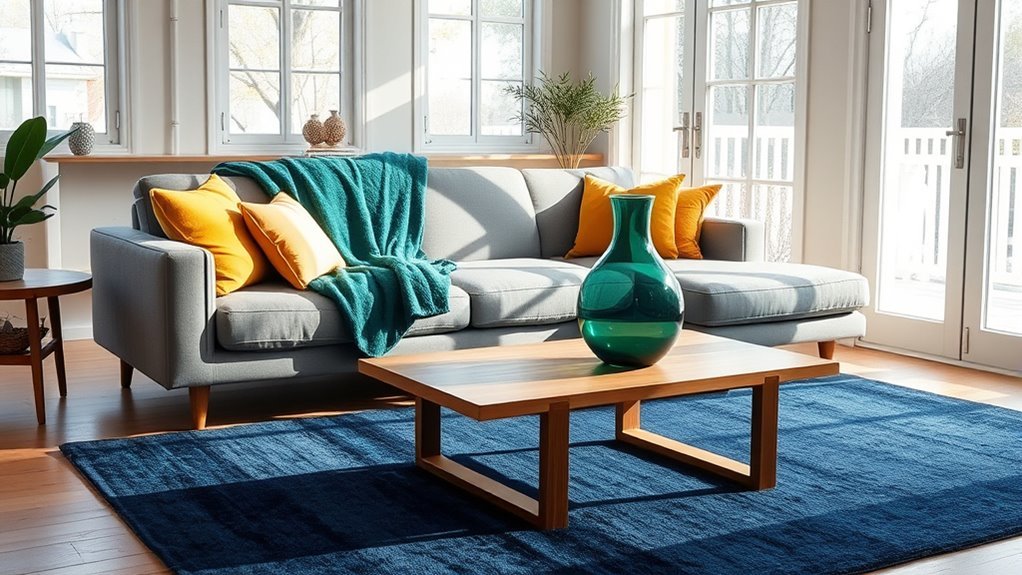
Always test living room accent colors in your own space for at least 24 hours because natural sun exposure and evening light bulbs dramatically alter how pigments look. A sage green or dusty blue swatch that looks crisp under bright hardware-store lighting can turn muddy gray in a shadowed living room or overly neon in direct afternoon sun.
Window direction plays a major role in color accuracy. Sherwin-Williams notes that room direction and the amount of natural light affect how paint colors look throughout the day:
- North-facing living rooms: Receive cool, indirect bluish light all day, which makes colors look darker and grayer. Choose warmer accent shades (terracotta, camel, ochre, warm olive) and higher-LRV backdrop colors to prevent a chilly feel.
- South-facing living rooms: Receive abundant, warm sunlight from morning to late afternoon. Almost any color works here, though deeply saturated accents (navy, forest green, burgundy) hold their richness better than pale pastels, which can wash out at midday.
- East-facing living rooms: Experience bright, warm-yellow sunlight in the morning that shifts to cooler, long shadows by afternoon. Judge your swatches during the hours you actually use the room most.
- West-facing living rooms: Look flat and cool in the morning but flood with intense orange-red light near sunset. Be cautious with fiery orange or bright yellow accents if late-afternoon glare already makes the room feel overly warm.
Artificial lighting is just as influential after dark. According to U.S. Department of Energy Lighting Facts guidelines, residential light bulbs are measured by Correlated Color Temperature (CCT) on the Kelvin (K) scale and by Color Rendering Index (CRI) on a 0 to 100 scale. Warm white LED bulbs rated at 2700K to 3000K cast a cozy, incandescent-style amber glow that flatters warm woods, reds, and creams, but can make cool blues look greenish or dull. Cooler white bulbs (3600K to 5500K) sharpen blues and grays but can make a living room feel clinical. For the truest accent colors at night, use bulbs with a CRI of 90 or higher in the 2700K to 3000K range.
Follow this six-step testing process before committing to paint or non-returnable decor:
- Order three close variations: Gather two or three neighboring shades of your chosen accent—such as rust, muted terracotta, and warm clay—using 8-by-8-inch peel-and-stick paint samples or fabric swatches.
- Position samples against fixed surfaces: Tape swatches directly next to your sofa upholstery, wood trim, fireplace stone, and flooring rather than in the middle of a blank wall.
- Inspect in morning light (8:00 a.m. to 10:00 a.m.): Check whether the shade looks washed out, overly bright, or too icy.
- Inspect in midday light (12:00 p.m. to 2:00 p.m.): Observe which hidden undertones surface when indirect daylight is strongest.
- Inspect under evening lamps (after sunset): Turn on your usual floor lamps, table lamps, and sconces to verify the color does not turn muddy under 2700K–3000K bulbs.
- Take a step-back phone photo: View the room through your camera lens from the doorway to spot whether one sample dominates the room too aggressively.
Warning: When brushing liquid sample pots indoors, open windows, run an exhaust fan, and follow all label safety instructions. The U.S. EPA reports that indoor Volatile Organic Compound (VOC) levels from paints, varnishes, and solvents average 2 to 5 times higher than outdoor air—and can spike much higher during application—causing eye, nose, and throat irritation or headaches.
How to Balance Your Color Scheme for Cohesion
You balance a living room color scheme by aligning undertones, surrounding bold accents with quiet neutral surfaces, and mixing warm and cool color temperatures intentionally. Cohesion never requires buying matching furniture sets; it comes from making sure every shade in the room shares a clear visual relationship.
Match Undertones for Harmony
Undertones are the subtle background pigments—warm yellow, pink, orange, or cool blue, green, and violet—that sit beneath a color’s surface appearance. What looks like a simple beige wall or gray sofa in isolation will reveal its true undertone the moment you place a saturated accent pillow beside it. When a room feels slightly “off,” clashing undertones are almost always the cause.
Use the White Paper Test to identify undertones in seconds: place a sheet of pure white printer paper directly against your wall, sofa fabric, rug, and accent swatch in natural daylight. Against true white, a “neutral” beige will immediately show whether it leans rosy pink, golden yellow, or green-gray. Pair warm-undertone neutrals (creamy whites, honey oak, tan taupe) with earthy or warm-leaning accents first, and test cool-undertone neutrals (blue-gray upholstery, crisp white trim, chrome) with jewel tones, sage, or deliberate warm-wood contrast.
Use Neutrals for Balance
Neutral surfaces give your eyes a place to rest so your 10% accent color stands out cleanly instead of overwhelming the room. The bolder and more saturated your accent hue—such as ruby red, cobalt blue, or marigold yellow—the more neutral breathing room it requires around it.
Instead of relying on flat drywall alone for your neutrals, layer tactile neutral materials: unbleached linen curtains, nubby cream bouclé or wool rugs, natural white oak or walnut wood grain, woven jute or rattan baskets, travertine stone, and matte black iron frames. A neutral-dominant living room feels rich and dimensional when you combine three or four distinct textures alongside a single repeated accent family like olive and moss green.
Consider Color Temperature Effects
Every room needs a deliberate mix of warm and cool elements so it feels neither sterile nor stifling. On the traditional color wheel, reds, oranges, yellows, and warm browns advance visually to make a large room feel intimate, while blues, greens, and violets recede visually to make compact rooms feel more spacious. Better Homes & Gardens recommends weighing both warm and cool color relationships when planning a room’s overall mood.
- Warm up a cool room: If your living room is dominated by cool gray upholstery, white walls, black metal, or navy blue, introduce warm accents like camel leather, rust velvet, ochre, brass lamps, or walnut wood.
- Cool down a warm room: If honey hardwood floors, cognac leather, cream walls, and brass hardware make the room feel overly golden, ground the palette with sage green, slate blue, charcoal, or deep forest green accents.
- Bridge warm and cool tones: Use natural greenery, black picture frames, crisp white matting, and woven rattan as neutral connectors that tie warm and cool hues together effortlessly.
Practical Tips for Accessorizing With Patterns and Textures
Combining patterns and textures keeps your living room accent colors from looking like flat blocks of solid fabric. The secret to mixing patterns without visual chaos is varying the scale of the motif (large, medium, and small) while keeping a consistent color thread across every piece.
For example, on a three-seat sofa, pair a solid 22-by-22-inch pillow in your 30% secondary color with a 20-by-20-inch large-scale botanical or abstract pillow that contains both your neutral base and your 10% accent color, finished with a 14-by-20-inch small-scale geometric or textured lumbar pillow in the accent shade.
Follow these five rules to layer patterns and textures like a designer:
- Vary pattern scale across three tiers: Combine one large-scale print (a 12-inch or larger repeat on an area rug, curtains, or hero pillow), one medium-scale print (a 4-to-8-inch stripe, check, or floral), and one small-scale print (a 1-to-3-inch micro-dot, herringbone, or ticking stripe).
- Anchor prints with a shared color: Make sure every patterned textile shares at least one exact color family—such as navy or terracotta—so disparate prints read as a unified collection.
- Keep at least 50% of textiles solid: Break up patterned rugs and pillows with solid upholstery, plain linen drapery, or a solid chunky-knit throw so patterns do not fight for attention.
- Mix light-reflecting and light-absorbing textures: Pair smooth or lustrous surfaces (velvet pillows, glazed ceramics, brass, glass) with matte, organic textures (washed linen, nubby wool, raw wood, leather, woven seagrass).
- Scale area inversely to saturation: Highly saturated neon or jewel tones work best on small decorative objects, book spines, or piping, whereas muted, desaturated accents (dusty rose, sage, slate) can comfortably cover larger armchairs or curtains.
Common Accent Color Mistakes to Avoid
Even a great accent shade can throw off a living room if the proportions, placement, or lighting are off. Watch out for these six common decorating pitfalls and use the practical fix for each:
- Clustering all accents in one zone: Putting all your accent color on the sofa leaves the rest of the room disconnected. Fix: Spread the accent into a three-point triangle across the sofa, opposite wall or curtains, and coffee table or shelving.
- Matching every single accent item identically: Buying pillows, curtains, a rug, and vases in the exact same catalog shade looks stiff and overly staged. Fix: Blend closely related tones within the same family—such as terracotta, burnt sienna, and soft clay—for a collected look.
- Using too many unrelated accent hues: Scattering red, teal, yellow, and purple in equal amounts creates visual clutter. Fix: Commit to one primary 10% accent color, or use a controlled 7% / 3% split between two related accents.
- Choosing tiny knickknacks that disappear: Coasters and mini votive holders lack the surface area to register across a living room. Fix: Anchor your accent in at least two medium-sized pieces, such as 20-inch throw pillows, a folded throw blanket, or framed wall art.
- Ignoring the “fifth wall” (the floor): Hardwood planks, carpet, and tile occupy nearly as much visual territory as the walls. Fix: Always lay accent swatches directly on the floor and area rug to check for undertone clashes (such as orange oak clashing with pink-beige).
- Buying without a nighttime lighting check: Store showrooms often use bright 4000K+ overhead fluorescent fixtures that distort how colors look at home. Fix: Always check fabric and paint samples at night under your living room’s actual 2700K–3000K lamps.
Accent Color Ideas by Living Room Style
Matching your accent color palette to your living room’s architectural and furniture style makes choosing samples much faster. Use the breakdown below to compare full 60-30-10 combinations across six popular interior design styles:
| Living Room Style | 60% Dominant Base | 30% Secondary Support | 10% Accent Directions |
|---|---|---|---|
| Modern Neutral | Warm white, greige, or soft taupe | Camel leather, warm walnut, or stone gray | Matte black, burnt rust, olive green, or deep burgundy |
| Scandinavian | Chalky off-white or pale gray | Light white oak, birch, and oatmeal linen | Sage green, dusty blue, soft clay, or muted mustard |
| Coastal | Crisp white or sandy linen beige | Denim blue, driftwood gray, and woven jute | Sea glass green, deep navy, or restrained coral |
| Traditional | Warm cream, ivory, or heritage tan | Navy blue, dark mahogany/walnut, or warm chocolate | Oxblood red, forest green, plum, or antique brass/gold |
| Organic Modern | Oatmeal, plaster white, or warm mushroom | Walnut wood, travertine stone, and charcoal | Terracotta, moss green, raw umber, or ochre |
| Maximalist | Deep teal, emerald, or gallery white | Sapphire velvet, warm wood, and patterned rugs | Ruby red, amethyst, marigold, or peacock blue |
For additional guidance on building monochromatic, analogous, complementary, split-complementary, and triadic room palettes, see how Better Homes & Gardens breaks down each color-wheel scheme.
Recommended Products

Package & Size: Package includes 2 brand new square pillow covers, each 18x18 inches (45x45cm). Pillow inserts are not included. The go-to standard for effortless styling—fits most sofa cushions, bed shams, and dining chairs for instant room refresh
Related Guides
Key Takeaways
- Audit fixed elements first: Let permanent features like flooring, fireplace stone, cabinetry, and sofa upholstery dictate your undertone direction before buying accessories.
- Follow the 60-30-10 proportion guide: Dedicate roughly 60% of the room to a dominant backdrop, 30% to secondary furniture and curtains, and 10% to bold accent pieces.
- Match exposure and bulb temperature: Account for North, South, East, or West window light, and test swatches at night under warm 2700K–3000K, 90+ CRI bulbs.
- Repeat accents in a triangle: Place your 10% accent color in at least three separated locations across low, mid-level, and eye-level heights.
- Vary pattern scale and texture: Pair one large, one medium, and one small pattern linked by a shared hue, while keeping at least half of your textiles solid.
Frequently Asked Questions
What is the 3-5-7 rule of decorating?
The 3-5-7 rule is an interior styling guideline that recommends grouping decorative objects in odd numbers of three, five, or seven rather than even pairs. Odd-numbered arrangements create natural visual tension and asymmetry on coffee tables, bookshelves, sofa cushions, and mantels. Ideal Home notes that varying the height and texture of each item within the odd-numbered cluster keeps the display looking organic rather than staged.
What are the rules for using accent colors?
The core rules for using accent colors are to start with the undertones of your room’s fixed finishes, limit your boldest accent to roughly 10% of the visual space, and repeat that shade in at least three separated spots. Always test paint and fabric swatches under both daytime window light and evening lamps, and surround saturated accents with plenty of neutral texture.
What is the 70-20-10 rule in decorating?
The 70-20-10 rule is a calmer variation of the classic 60-30-10 color formula that assigns 70% of a room to the dominant background color, 20% to a secondary supporting tone, and 10% to an accent shade. As Livingetc explains, increasing the dominant backdrop share to 70% prevents visual overwhelm and works especially well in smaller, minimalist, or open-concept living rooms.
What is the 3-4-5 rule in decorating?
The 3-4-5 rule is an eclectic styling formula that combines three patterns, four design eras or styles, and five colors or textures within a single room. Apartment Therapy highlights this method as a structured way to layer pattern, period furniture, and color so a living room looks collected over time rather than bought from one showroom.
How many accent colors should a living room have?
Most living rooms look most cohesive with one main accent color supported by one dominant backdrop and one secondary color. If you want a richer palette, you can add a second supporting accent by splitting the 10% accent share (around 7% primary accent and 3% secondary accent) as long as both shades harmonize on the color wheel.
Should an accent wall match the pillows?
An accent wall should coordinate with your throw pillows rather than match them in the exact same flat shade. If you paint a wall deep navy blue, choose pillows that mix lighter denim blue, cream, and a contrasting accent like rust or ochre, repeating a touch of navy inside a patterned pillow or nearby artwork to bridge the room.
What accent colors work with a beige living room?
The best accent colors for a beige living room are muted slate or dusty blue for crisp contrast, olive or sage green for an organic look, terracotta or rust for added warmth, and espresso brown or matte black for grounding depth. Always check whether your beige leans yellow, pink, or green against a sheet of white paper before choosing your accent swatch.
How do I choose an accent color for a gray sofa?
To choose an accent color for a gray sofa, first identify whether the upholstery has a cool blue, purple, green, or warm greige undertone. Pair cool gray sofas with navy blue, sage green, deep plum, or warm camel and muted rust to counteract chilliness, and always test real fabric swatches directly on the sofa cushions in both daylight and evening lamp light.
Conclusion
Bringing accent colors into your living room succeeds when you respect the fixed finishes already in the space rather than forcing an isolated trend color. Anchor 60% of the room in a calm dominant shade, build depth with a 30% supporting color, and repeat your 10% accent across three separated spots and heights. To get started today, snap a midday photo of your living room, hold a sheet of white paper against your sofa and floor to confirm their undertones, and tape up three fabric or paint swatches to watch how they shift from morning sun to evening lamplight.
Sources
- Sherwin-Williams: How to Choose Paint Colors: Supports using permanent room features as color anchors and testing swatches across different lighting conditions.
- Sherwin-Williams: Choosing Color Based on Room Orientation: Supports North, South, East, and West exposure effects and the 0–100 Light Reflectance Value (LRV) scale.
- U.S. Department of Energy: Lighting Facts Program: Supports Correlated Color Temperature (2700K–3000K warm white vs. 3600K–5500K cool light) and Color Rendering Index (CRI) guidelines for living spaces.
- U.S. EPA: Volatile Organic Compounds’ Impact on Indoor Air Quality: Supports indoor VOC concentration figures (2 to 5 times outdoor levels) and ventilation precautions when testing liquid paints.
- Architectural Digest: Color Wheel for Interior Design: Supports complementary, split-complementary, analogous, triadic, and monochromatic color harmony definitions.
- Better Homes & Gardens: How to Use the Color Wheel: Supports room palette proportions and warm-versus-cool color temperature relationships.
- Ideal Home: 3-5-7 Home Styling Rule: Supports odd-numbered accessory grouping guidelines for living room surfaces.
- Apartment Therapy: 3-4-5 Rule for Decorating a Living Room: Supports the three-patterns, four-styles, five-colors-or-textures decorating framework.
- Livingetc: 70-20-10 Color Rule: Supports the 70% dominant, 20% secondary, and 10% accent color formula variation.