If your drain, sink, window, or discharge point sits above the appliance, choose a dehumidifier with a true built-in or replaceable condensate pump. This updated 2026 guide focuses only on pump-equipped models and compares standardized removal capacity separately from larger “maximum” or saturation claims.
Quick verdict: The GoveeLife H7152 is the strongest smart all-around option, the Midea 50 Pint is the most familiar mainstream choice, the Gasbye stands out for its removable pump, and the AEOCKY LEO-001 has the clearest certified efficiency data. For crawl spaces, compare ALORAIR and CADPXS models by their standardized capacity rather than the larger saturation headline.
Important: A “maximum pint” figure measured in hot, near-saturated air is not directly comparable with a DOE or AHAM rating measured under standardized conditions.
Key Takeaways
- Choose the pump route first: measure vertical lift, hose length, and the final discharge point.
- Use the 65°F/60% RH DOE figure or the stated AHAM figure for cross-model comparisons.
- Portable units with buckets are easier to use in living areas; tankless crawl-space units are better for permanent drainage.
- App control is useful only when Wi-Fi reaches the basement or crawl space reliably.
How These Picks Were Compared
Each model was checked for a real pump function, capacity test conditions, pump-hose setup, drainage flexibility, low-temperature features, maintenance access, and the type of space it is designed to serve. No hands-on testing is claimed.
Quick Comparison of the Best Pumping Dehumidifiers
| Model | Best For | Comparable Capacity | Pump Setup |
|---|---|---|---|
| Gasbye DryPrime-35-WP | Serviceable pump | 36.5 pints at 65°F/60% RH; 75-pint maximum claim | Removable pump, 16.5 ft hose |
| Avylo ADC018 | Large tank and home use | 90 pints at 90°F/90% RH; verify standardized rating | Built-in pump, 15 ft lift claim |
| GoveeLife H7152 | Smart-home control | 50 pints at 65°F/60% RH | Built-in pump, 16.4 ft hose |
| ALORAIR Sentinel HD35P | Crawl spaces | 35 AHAM / 70 saturation | Built-in pump, 19.6 ft hose |
| ALORAIR Sentinel HD35P Wi-Fi | Remote crawl-space monitoring | 35 AHAM / 70 saturation | Built-in pump |
| CADPXS Remois XP70 | Tight installations | 24.2 DOE / 38 AHAM / 80 saturation | Built-in pump, 19.6 ft hose |
| Airzentti 155 Pint | Commercial spaces | Approx. 70 AHAM / 155 near saturation, seller-stated | Built-in pump, 16.4 ft lift claim |
| AEOCKY LEO-001 | Verified efficiency | 44.94 pints certified; 80-pint maximum claim | Built-in pump, up to 5 m claim |
| Midea MAD50P1AWS-A | Mainstream residential use | 50-pint standardized class | Built-in pump |
| Shinco 7,000 Sq. Ft. | Very large rooms | 70 standard-condition claim / 150 maximum | Pump, gravity drain, and bucket |
| HBN 125 Pint | Warehouses and large utility areas | 60 AHAM / 125 maximum | Built-in pump and gravity drain |
Gasbye Energy Star Dehumidifier with Replaceable Pump
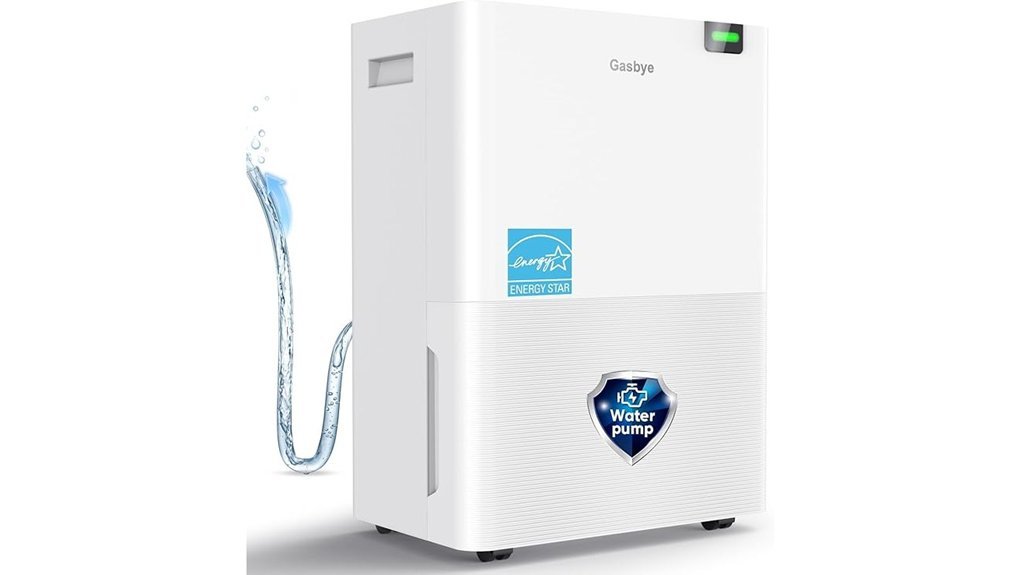
The Gasbye DryPrime-35-WP is a practical choice when you want pump drainage but also care about maintenance access. The manufacturer lists 36.5 pints per day at 65°F/60% RH, 50 pints at 80°F/60% RH, and a 75-pint maximum at 86°F/80% RH. It also includes a removable, cleanable pump and a 16.5-foot pump hose. That serviceable design may be especially useful in basements where a clogged condensate path would otherwise be difficult to reach.
Best For: Homeowners who want a portable basement dehumidifier with a pump that can be accessed for cleaning or replacement.
Why You’ll Like It:
- Removable, cleanable pump can simplify long-term maintenance.
- Includes both gravity and pump-drain hoses for flexible setup.
- Auto shut-off and auto restart support unattended operation.
Who Should Avoid It:
- The 75-pint figure is a maximum-condition claim; use the 36.5-pint DOE-condition figure for a fairer comparison.
- At roughly 39 lb, it is movable but not lightweight.
- The pump and hoses still require correct routing and routine cleaning.
Avylo Dehumidifier with Pump
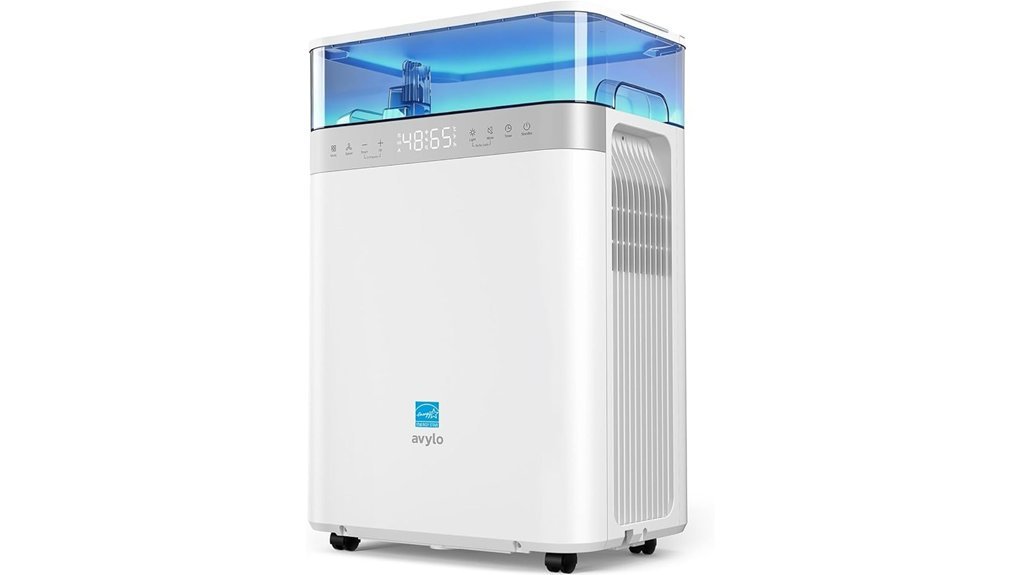
The Avylo ADC018 combines a built-in pump with a 2.11-gallon top-mounted tank and automatic humidity control. Its 90-pint claim is measured at 90°F and 90% relative humidity, so it should not be compared directly with a 50-pint DOE rating. The current listing states a 15-foot pump lift and included pump hose, which are the main reasons it fits this roundup.
Best For: Large basements, garages, and living areas where a roomy tank and upward pump drainage are useful.
Why You’ll Like It:
- Built-in pump supports continuous drainage when a floor-level gravity drain is unavailable.
- Large top-mounted tank is easier to access than many low front buckets.
- Timer, child lock, automatic defrost, and humidity control improve everyday convenience.
Who Should Avoid It:
- The standardized DOE-condition capacity is not clearly stated in the listing, so the 90-pint headline is not enough for a direct comparison.
- The pump setup requires careful hose installation and an appropriate discharge point.
- A newer marketplace brand has a shorter service history than long-established appliance brands.
GoveeLife Smart Dehumidifier for Home (4,500 Sq. Ft.)
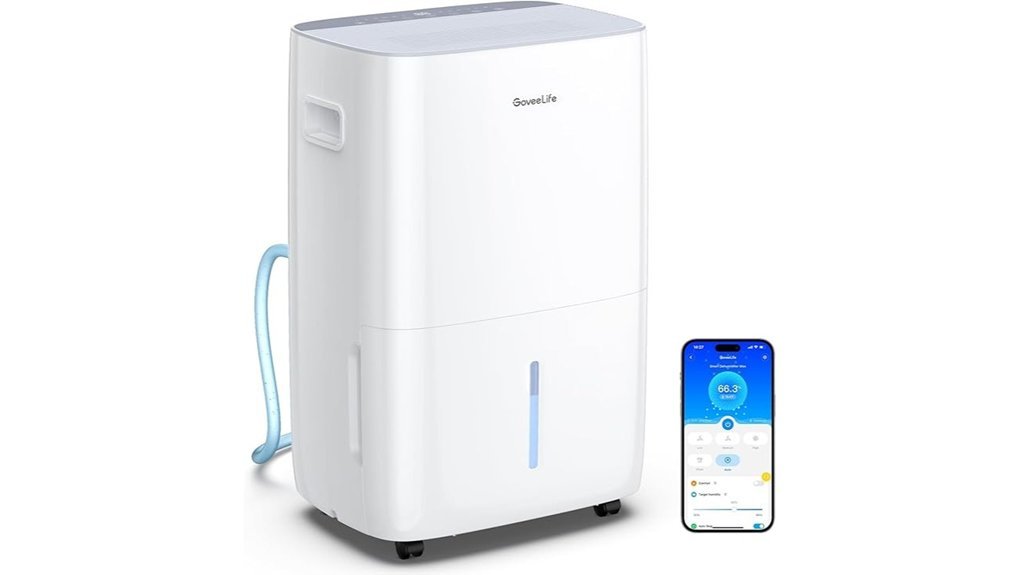
The GoveeLife H7152 is one of the easiest picks to compare because its documentation gives a 50-pint-per-day figure at 65°F and 60% relative humidity. It adds a built-in pump, a 16.4-foot drain hose, a 1.8-gallon bucket, app control, and multiple operating modes. This combination makes it a strong all-around option for buyers who want remote monitoring and flexible drainage.
Best For: Smart-home users who want standardized 50-pint capacity, app control, and pumped drainage in a large room or basement.
Why You’ll Like It:
- Built-in pump and long drain hose reduce dependence on a nearby floor drain.
- App-based control can help monitor humidity in an unattended basement.
- Multiple modes and a large tank provide flexible day-to-day use.
Who Should Avoid It:
- It occupies more floor space than compact crawl-space units.
- Smart features add setup steps and depend on a compatible Wi-Fi connection.
- Coverage claims assume open airflow and suitable temperature and humidity conditions.
ALORAIR 70 Pint Crawl Space Dehumidifier with Pump
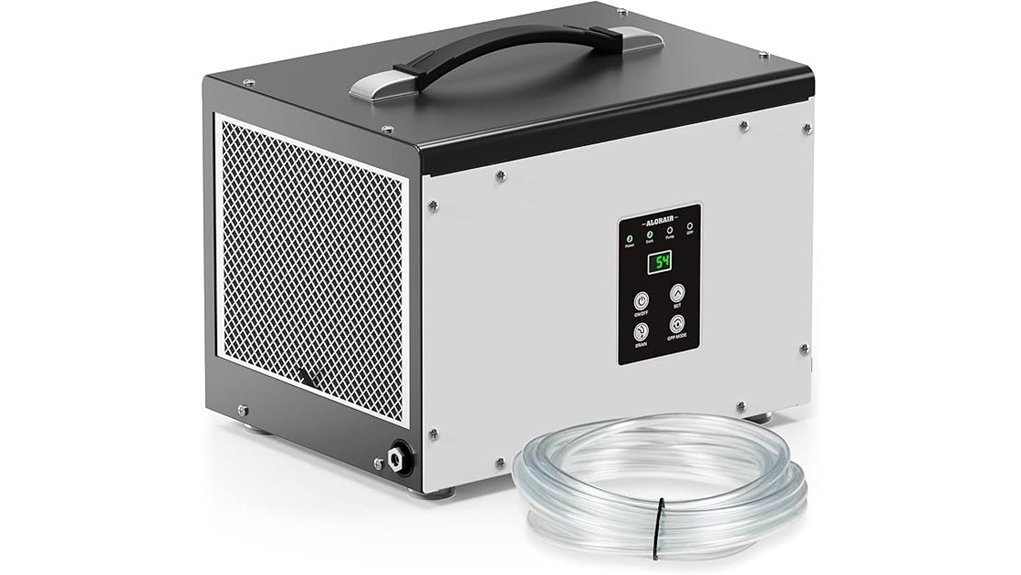
This compact ALORAIR model is rated at about 35 pints per day under AHAM conditions and 70 pints at saturation. That dual rating is important because it prevents an inflated comparison with portable 50-pint DOE-rated machines. The built-in condensate pump can lift water through the supplied hose, while automatic defrost and memory restart suit cooler crawl spaces and basements.
Best For: Crawl spaces and compact basements that need upward drainage and a low-profile metal cabinet.
Why You’ll Like It:
- Built-in pump supports vertical drainage where gravity flow is impractical.
- Compact housing is easier to place between crawl-space joists or in utility areas.
- Automatic defrost and memory restart support continuous moisture control.
Who Should Avoid It:
- Its standardized removal capacity is lower than the 70-pint saturation headline.
- MERV-1 is a basic protective filter, not a high-efficiency air-cleaning filter.
- It has no collection bucket, so the drain line must be installed correctly.
ALORAIR Wi-Fi Dehumidifier, 70 Pint with Pump
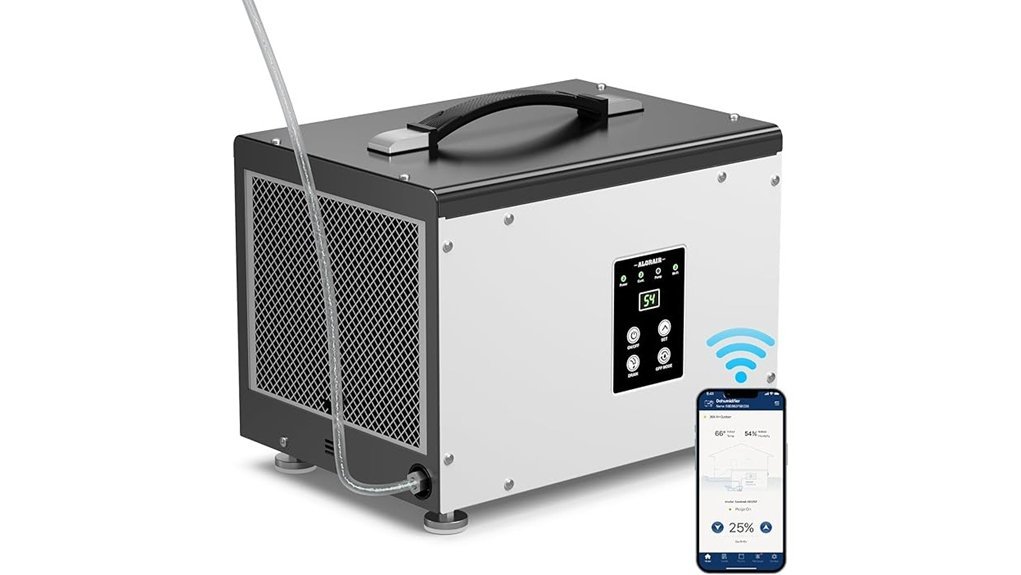
This ALORAIR version adds Wi-Fi monitoring to the brand’s compact pump-equipped crawl-space format. It is designed for spaces up to about 1,000 square feet and is listed at 35 pints per day under AHAM conditions and 70 pints at saturation. The condensate pump supports long or upward drain runs, while the app helps users monitor humidity in a hard-to-access area.
Best For: Owners who want remote humidity checks in a crawl space, storage room, or basement that is difficult to access.
Why You’ll Like It:
- Wi-Fi monitoring can reduce unnecessary trips into a crawl space.
- Built-in pump supports long or upward drainage routes.
- Automatic defrost and restart features are useful in unattended areas.
Who Should Avoid It:
- App pairing and signal strength may be challenging below grade.
- No bucket means drainage must be ready before operation.
- The smart premium may not be worthwhile for an easily accessible room.
CADPXS Crawl Space Dehumidifier with Pump (80 Pint)
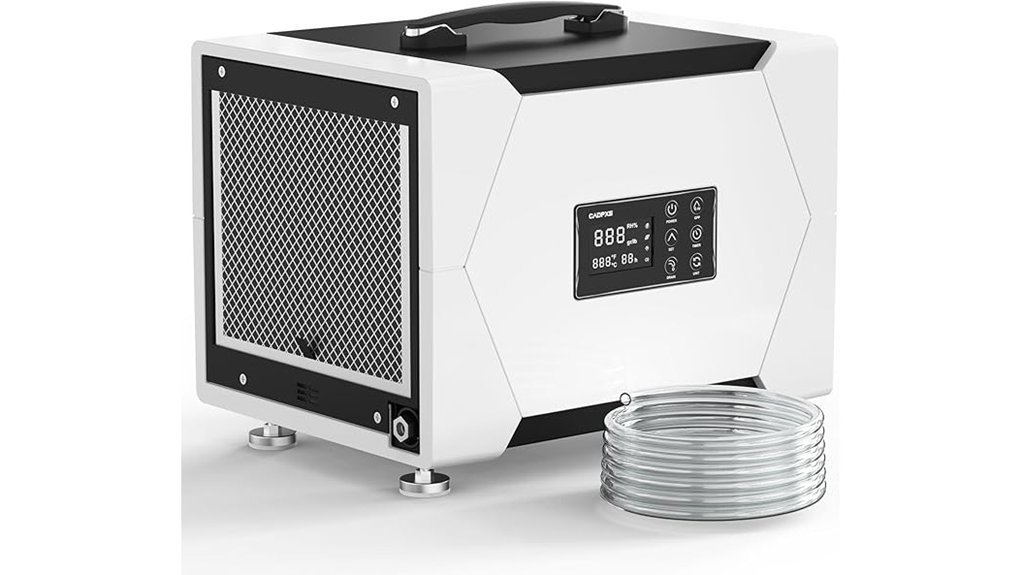
The CADPXS Remois XP70 is listed at 80 pints per day at saturation and about 38 pints per day under AHAM conditions. Its compact cabinet, built-in pump, automatic defrost, memory restart, timer, and 19.6-foot pump hose make it a good fit for tight crawl spaces. The honest way to compare it is by the 38-pint standardized figure rather than the larger saturation number.
Best For: Tight crawl spaces and utility rooms where a compact footprint matters more than maximum standardized capacity.
Why You’ll Like It:
- Compact dimensions help it fit where upright residential models cannot.
- Built-in pump can lift condensate through a long hose run.
- Automatic defrost and memory restart suit unattended installations.
Who Should Avoid It:
- The standardized capacity is much lower than the 80-pint saturation headline.
- At about 37 lb, the small cabinet is still fairly heavy.
- An optional remote may be sold separately.
Airzentti 155 Pints Commercial Dehumidifier with Pump and Hose
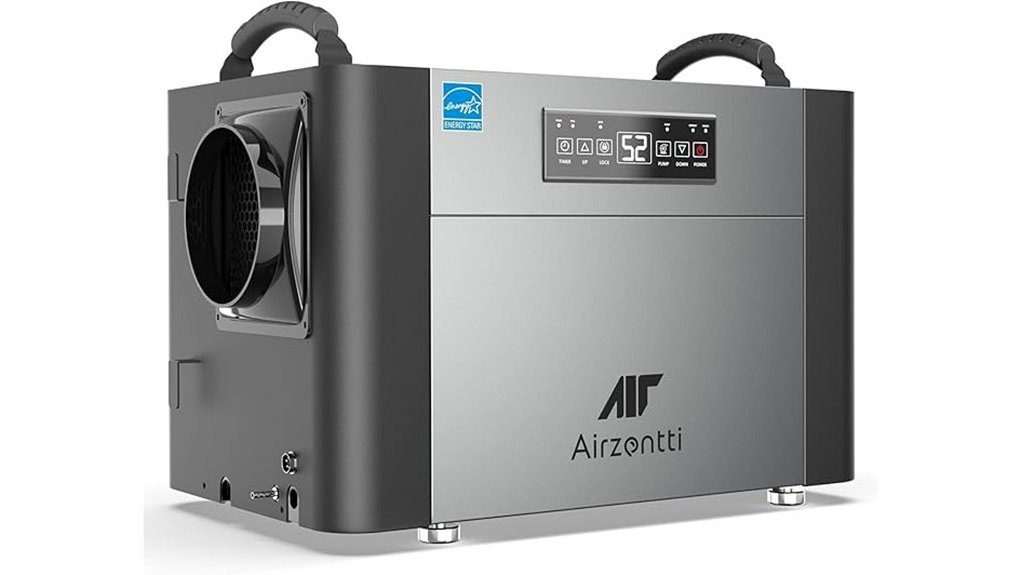
The Airzentti is a tankless commercial-style unit intended for basements, crawl spaces, restoration work, and other large damp areas. The seller listing separates the headline 155-pint near-saturation capacity from an approximately 70-pint AHAM claim, which is the more useful number for comparison. Because this is seller-supplied data, confirm the current technical sheet before sizing a commercial installation. A built-in pump, gravity-drain option, duct collar, and listed 220 CFM airflow support more demanding setups.
Best For: Large basements, workshops, storage areas, and light commercial spaces that need continuous drainage.
Why You’ll Like It:
- Seller-stated approximately 70-pint AHAM capacity is stronger than compact crawl-space models.
- Built-in pump and gravity drain offer two continuous-drain methods.
- Duct collar and listed 220 CFM airflow suit more permanent moisture-control setups.
Who Should Avoid It:
- At about 60 lb, it is less convenient to move than residential uprights.
- Tankless operation requires a dependable drain route.
- Commercial buyers should verify the current AHAM rating, warranty, and service support before purchase.
AEOCKY 4500 Sq.Ft Energy Star Dehumidifier with Pump
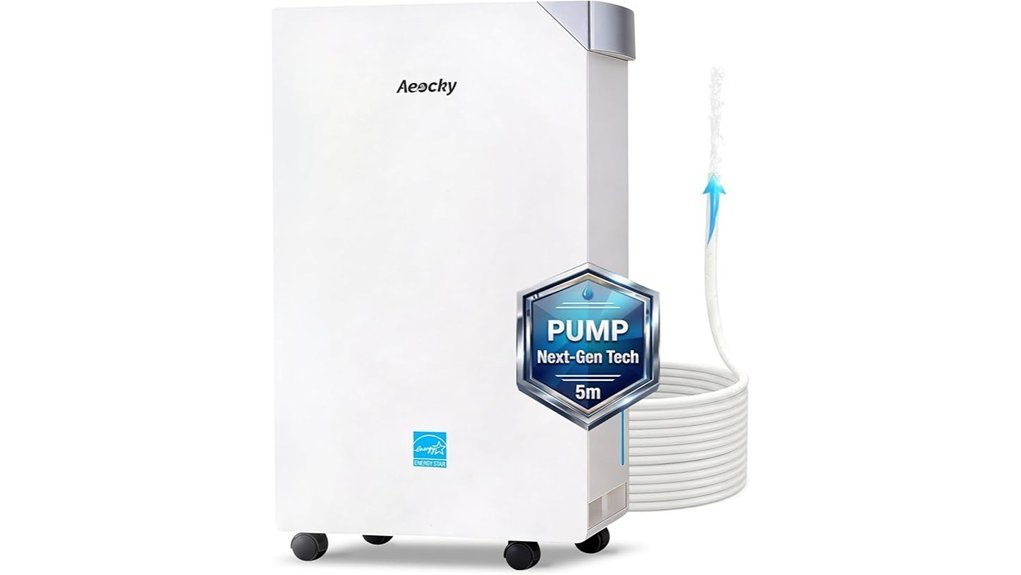
The AEOCKY LEO-001 combines a built-in pump with verifiable ENERGY STAR data. Its certified capacity is 44.94 pints per day with an integrated energy factor of 2.21 L/kWh, while the larger 80-pint number is a maximum-condition claim. The pump is listed for drainage up to 5 meters, making the unit suitable for basements and garages without a convenient floor drain.
Best For: Energy-conscious buyers who want pump drainage and a capacity figure that can be checked against ENERGY STAR data.
Why You’ll Like It:
- ENERGY STAR listing provides a standardized capacity and efficiency figure.
- Built-in pump supports upward drainage through the included hose.
- Slim upright design is easier to place than many commercial crawl-space units.
Who Should Avoid It:
- The 80-pint headline should not be compared directly with DOE-rated 50-pint units.
- A newer model has less long-term field history than older mainstream options.
- The pump and long hose still require periodic inspection and cleaning.
Midea 50 Pint Dehumidifier with Pump
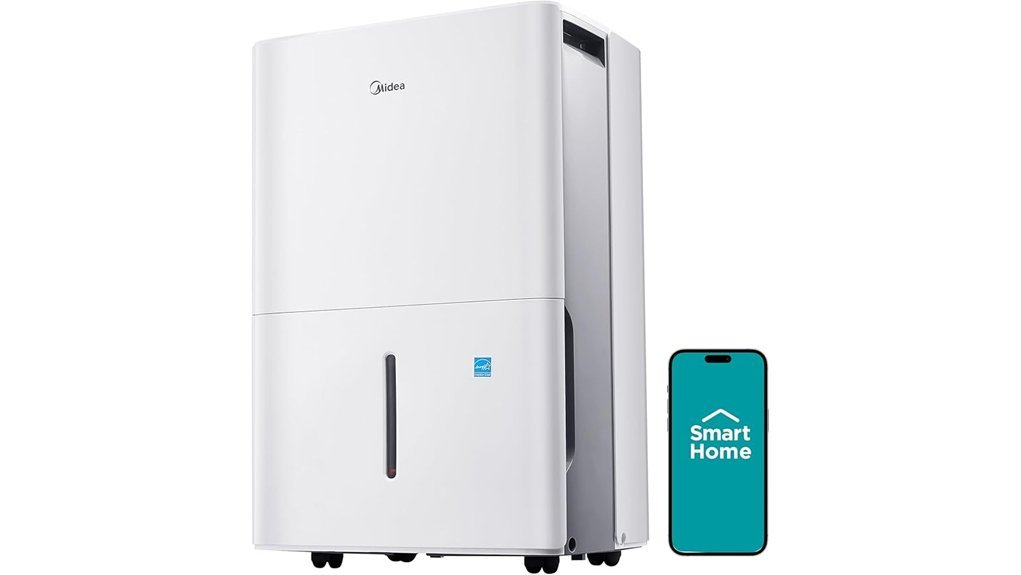
The Midea MAD50P1AWS-A offers a straightforward 50-pint portable format with a built-in pump, adjustable humidistat, removable bucket, automatic defrost, and electronic controls. It can move water upward to a sink, window, or elevated drain, which makes it useful when gravity drainage is not practical. The linked “-A” model should not be described as a Wi-Fi or voice-control unit.
Best For: Homeowners who prefer a recognizable appliance brand, a conventional upright design, and pump drainage without app setup.
Why You’ll Like It:
- Built-in pump reduces manual bucket emptying.
- Simple electronic controls avoid dependence on an app or home network.
- Standardized 50-pint capacity is easier to compare with other residential models.
Who Should Avoid It:
- The large upright cabinet needs adequate clearance around the air intake and outlet.
- Buyers who require Wi-Fi or voice control should choose a different model.
- Confirm which drain hose and adapter are included in the current package before installation.
Shinco 7,000 Sq.Ft Energy Star Dehumidifier with Pump
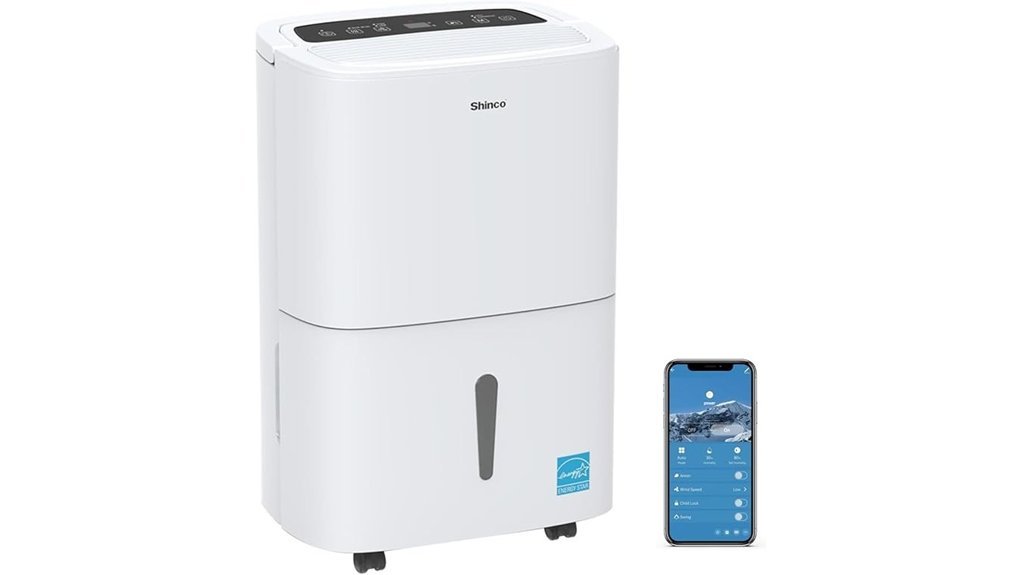
The Shinco is aimed at very large basements, offices, and open storage areas. It combines a built-in pump, bucket collection, gravity drainage, and Wi-Fi control. Its current listing markets up to 150 pints at 95°F and 90% relative humidity and states a lower 70-pint standard-condition figure. Use the smaller figure for comparison and treat the 7,000-square-foot claim as layout-dependent.
Best For: Large open areas where multiple drainage methods and remote control are more important than compact size.
Why You’ll Like It:
- Pump, gravity drain, and bucket collection offer flexible installation.
- Wi-Fi control is useful for a large or occasionally occupied space.
- Casters and handles improve mobility for its size.
Who Should Avoid It:
- The 150-pint headline is a maximum-condition figure, not the standard-condition rating.
- A 1.85-gallon bucket can still fill quickly in severe humidity.
- Verify that Wi-Fi, pump hose, and warranty details match the exact current variation before ordering.
HBN 125 Pints Crawl Space Dehumidifier with Pump
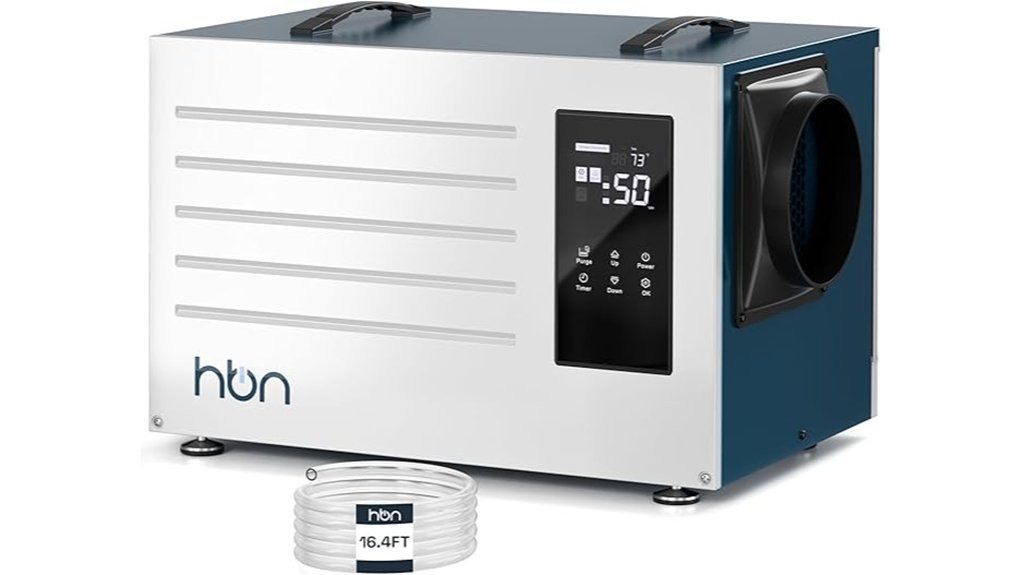
The HBN is positioned for large crawl spaces, basements, warehouses, and other continuously damp areas. Its listing separates a 60-pint AHAM rating from a 125-pint maximum claim at 95°F and 90% relative humidity. The dual-drain design includes a gravity hose and a built-in pump rated for up to 16.4 feet of lift. Treat the listed 5,900-square-foot coverage as a starting point because layout and moisture load can change real-world sizing.
Best For: Large utility or commercial spaces that need a pump-equipped, continuous-drain unit.
Why You’ll Like It:
- Built-in pump supports drainage where gravity flow is not possible.
- Touch controls and automatic humidity regulation simplify continuous use.
- The 60-pint AHAM rating makes it a candidate for open storage and workshop areas.
Who Should Avoid It:
- Commercial capacity and continuous operation can increase energy use.
- The 125-pint headline should not be compared directly with a 60-pint AHAM rating.
- Commercial-style maintenance and drainage setup may be more involved than with a portable home unit.
Factors to Consider When Choosing a Pumping Dehumidifier
A pump-equipped dehumidifier is useful only when its capacity, drainage route, operating temperature, and maintenance needs match your space. Use the checklist below before buying.
Standardized Capacity vs. Maximum Capacity
Do not compare pint numbers until you know the test conditions. DOE/AHAM capacity is measured under standardized indoor conditions, while “maximum,” “saturation,” or 90°F/90% RH claims are measured in much wetter air and can be far higher. When two models use different rating systems, compare the standardized figure first.
Verify the Exact Model and Test Condition
Dehumidifier listings often combine several capacities, colors, or feature variations on one page. Match the ASIN, model number, pump feature, hose package, and capacity test condition before ordering. Do not assume that a Wi-Fi feature, pump, warranty, or included hose shown for one variation applies to every model on the listing.
Room Size and Moisture Load
Square-foot coverage is only a starting point. Ceiling height, open doors, outside air leakage, standing water, drying laundry, foundation seepage, and room temperature can all increase the moisture load. For a wet basement or restoration project, prioritize standardized capacity and airflow over an aggressive coverage headline.
Pump Lift and Hose Routing
Measure the vertical rise and total hose distance from the unit to the discharge point. Keep the hose free of kinks, secure every connection, and route the outlet where water can drain safely. A built-in pump is most useful when the sink, window, or drain is above the dehumidifier. Use gravity drainage when a reliable downward slope is available because it is simpler and places less stress on the pump.
Tank, Gravity, and Pump Options
Residential upright units often include a bucket, gravity-drain port, and pump. Commercial crawl-space units may be tankless and require drainage before operation. A bucket provides backup collection, but a tankless design can be better for permanent installations if the drain route is dependable.
Noise and Placement
Noise ratings are usually measured under selected operating conditions, and the compressor, fan, and pump can sound different during a full cycle. For bedrooms or offices, look for a documented low-mode rating and place the unit on a level surface with the manufacturer’s recommended clearance. Crawl-space and commercial units are better suited to utility areas than quiet living spaces.
Energy Efficiency Ratings
Use the current Integrated Energy Factor (IEF), expressed in liters of water removed per kilowatt-hour. A higher IEF means more moisture removal for the same energy use. ENERGY STAR eligibility depends on product type and certified capacity, so verify the exact model rather than relying only on marketing text.
Filters and Maintenance
Most dehumidifier filters mainly protect the coil and airflow path. A MERV-1 filter is a basic prefilter and should not be treated as a high-efficiency air purifier. Check and clean the filter at the interval in the manual, inspect pump and gravity hoses for slime or debris, and let washable filters dry completely before reinstalling them.
Low-Temperature Operation
Basements and crawl spaces can fall below the ideal operating temperature for a portable compressor dehumidifier. Choose a model with automatic defrost and confirm the minimum operating temperature. Frosting, short cycling, or little water collection can indicate that the room is too cold or the filter and coils need attention.
Warranty and Support
Read the exact warranty for the model and seller. Check whether the pump, compressor, shipping, labor, and replacement parts are covered, and whether registration is required. Do not assume that a multi-year headline means full replacement coverage for the entire term.
Before You Buy
- Measure the vertical pump lift and total hose route.
- Confirm the standardized DOE/AHAM pint rating.
- Check the minimum operating temperature.
- Verify whether pump and gravity hoses are included.
- Confirm a grounded outlet and safe discharge point are available.
- Review filter, pump-cleaning, and warranty requirements.
Frequently Asked Questions
Which Pint Rating Should I Use When Comparing Dehumidifiers?
Use the capacity measured under the same test condition. For portable home models, the 65°F/60% RH DOE figure is usually the fairest comparison. For commercial crawl-space units, compare AHAM figures with other AHAM figures. Treat saturation or 90°F/90% RH numbers as maximum-condition claims, not direct substitutes for standardized capacity.
What Is the Difference Between a Pump and Continuous Drain?
A gravity continuous drain needs the hose to slope downward from the dehumidifier to a lower drain. A pump actively moves water and can send it upward to a sink, window, or elevated drain, within the model’s stated lift limit.
How Do I Maintain My Pumping Dehumidifier?
Unplug the unit before maintenance. Clean the filter according to the manual, inspect both drain connections, flush or clean accessible pump components when permitted, remove hose kinks, and confirm that water reaches the discharge point without leaking.
Can a Dehumidifier Help With Allergens?
Keeping indoor humidity in a suitable range can make conditions less favorable for mold growth and dust mites, but a dehumidifier is not a medical treatment or a substitute for fixing leaks, removing mold, cleaning surfaces, or using appropriate air filtration.
What Is the Ideal Humidity Level for Indoor Spaces?
A practical target for many homes is about 30% to 50% relative humidity, while keeping humidity below 60% helps reduce condensation and mold risk. Adjust the setting for comfort, season, and building conditions.
Are Pumping Dehumidifiers Noisy During Operation?
They can be. The compressor and fan create most of the continuous sound, while the pump may run intermittently. Compare documented low-mode noise ratings and avoid placing a commercial crawl-space model beside a bed or desk.
Can I Use a Pump Dehumidifier Without the Pump?
Many portable models can collect water in a bucket or use a gravity hose instead. Some commercial crawl-space units are tankless, so they must be connected to either a gravity drain or pump hose before use. Follow the exact manual for the selected model.
How High Can a Dehumidifier Pump Water?
Common built-in pump claims range from about 15 to 20 feet of vertical lift, but the exact limit varies. Keep the total hose route within the manufacturer’s instructions and avoid extra bends or extensions that can reduce reliable flow.
Conclusion
The best pumping dehumidifier is the one that combines a verified or clearly stated standardized capacity with a pump route that works in your room. Choose the GoveeLife H7152 for app control and a clear 50-pint rating, the Midea MAD50P1AWS-A for a familiar no-app residential format, the Gasbye DryPrime-35-WP for a removable pump, or the AEOCKY LEO-001 for certified ENERGY STAR efficiency data. For crawl spaces and commercial areas, compare AHAM capacity, low-temperature performance, airflow, and drain requirements before focusing on the larger saturation number.
Final recommendation: Start with your drain height and standardized pint requirement. A correctly sized 50-pint pump model can be a better home choice than a “125-pint” unit whose headline is measured only in near-saturated air.