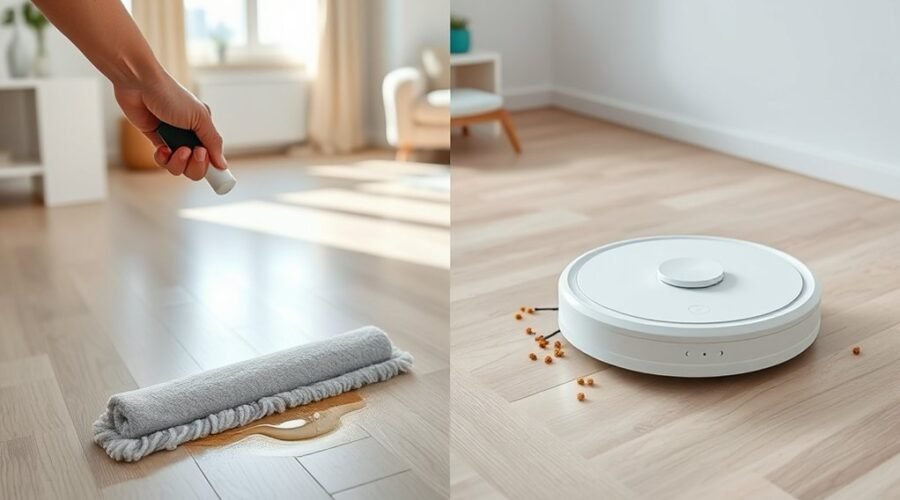
Roller mop and spinning mop robot vacuums both clean floors, but they do so in very different ways. A roller mop applies steady pressure and fresh water for tougher spills and dried grime, while spinning pads are built for lighter upkeep and quick touch-ups. Their strengths also differ in edge cleaning, carpet handling, and maintenance needs. The better choice depends less on brand and more on how messy the home really is.
Roller Mop vs Spinning Mop: What’s the Difference?
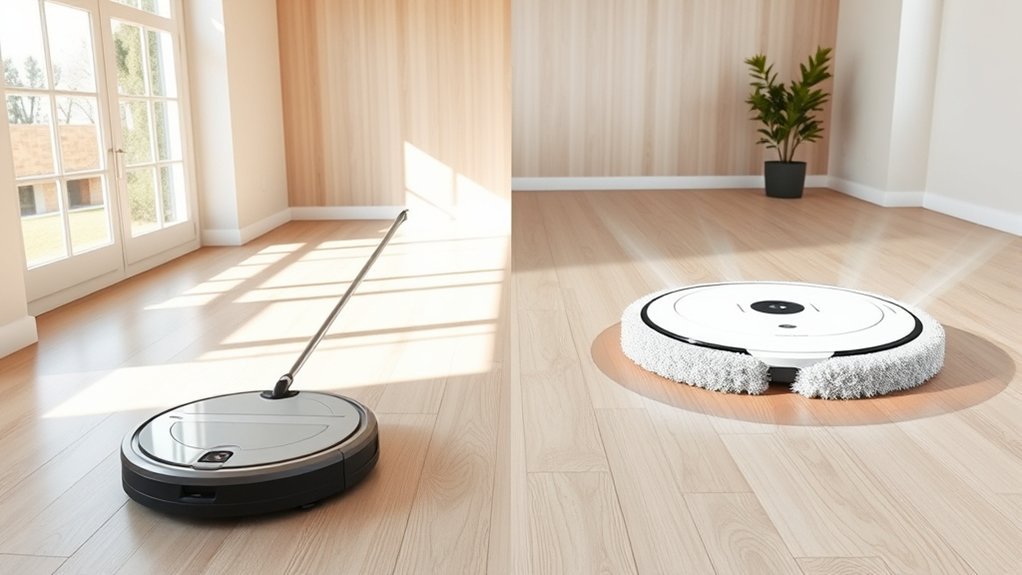
Roller mops and spinning mops differ most in how they clean and manage messes. Roller mops use a cylindrical roller that keeps steady pressure on the floor, which helps lift stubborn dirt, larger spills, and dried residue with greater consistency.
Roller mops maintain steady pressure, making them more effective at lifting stubborn dirt, spills, and dried residue.
Spinning mops depend on rotating pads, making them better for light upkeep and routine cleaning rather than heavy messes. The practical contrast is also visible in coverage: roller mops usually reach broader areas more efficiently and reduce missed spots, while spinning mops may leave corners less treated.
Liquid handling sets them apart as well, since roller systems manage moisture and dirt more effectively. Their maintenance requirements differ too. Roller mops need regular roller and wastewater tank cleaning, while spinning mops often require frequent pad washing and replacement to prevent buildup.
For users seeking cleaner floors with less compromise, roller mops offer stronger liberation from manual intervention.
How Roller Mop Robot Vacuums Work
Behind their stronger cleaning performance, roller mop robot vacuums rely on a cylindrical roller wrapped in absorbent cloth that spins along its axis while pressing steadily against the floor.
This roller mop design keeps the pad in constant contact with surfaces, creating a firm scrubbing action that lifts grime instead of merely spreading it. Clean water is dispensed onto the roller as it moves, helping the system renew the contact area and reduce dirt reapplication.
Many models also include self-cleaning cycles that rinse the roller onboard, so debris is removed during operation and maintenance stays lighter.
Compared with spinning mop systems, the roller approach offers better multi-pass cleaning and stronger handling of stains, dried spills, and mixed debris. Its continuous pressure and high RPM support reliable dirt detection across tile, hardwood, and other floor types.
For users seeking more freedom from manual cleanup, this mechanism delivers practical, steady, and efficient floor care.
How Spinning Mop Robot Vacuums Work
Spinning mop robot vacuums use two rotating microfiber pads to scrub the floor in a manner closer to manual mopping than passive wiping.
As the pads are dampened with water or cleaning solution and pressed downward, they lift light dirt and residue more effectively, especially in routine maintenance cleaning.
Their dual-pad design improves moisture and soil pickup, though performance can weaken if the pads become loaded with debris.
Dual Pad Scrubbing Action
Two rotating microfiber pads give spinning mop robot vacuums their signature scrubbing action, moving in opposite directions to imitate hand-cleaning and improve dirt removal.
These dual spinning pads create active scrubbing that can lift everyday dust, tracked-in grime, and dried spots with less human effort, supporting cleaning efficiency across routine maintenance tasks.
Compared with passive drag-style mops, the twin-pad design presses and moves against the floor, which helps loosen residue more effectively on hard surfaces.
The round pads also cover broad open areas well, making them practical for rooms that need quick, regular upkeep.
Still, their circular shape can leave edges less attended, and buildup on the pads may weaken results if not cleaned, limiting the freedom they promise.
Moisture And Dirt Pickup
Moisture is a key part of how spinning mop robot vacuums lift dirt, since their rotating microfiber pads are usually dampened with water or a cleaning solution before contact with the floor. This moisture supports scrubbing, helping the pads loosen residue and improve dirt pickup without heavy manual effort.
- The twin pads press down and rotate, creating practical floor contact.
- Damp pads handle daily grime well, especially on sealed surfaces.
- Regular cleaning keeps residue from building up on the pads.
Compared with roller mops, spinning systems are more direct in their scrubbing motion, but they are less capable with sticky spills or neglected messes.
For people seeking cleaner floors with less labor, they offer a useful release from routine mopping.
Which Mop Handles Wet Spills Better?
When it comes to wet spills, roller mop systems generally handle the mess better than spinning mop designs. Their cleaning power comes from continuous extraction: dirty water is pulled into an onboard tank as fresh contact remains on the floor. That means the mop surface stays more effective across the pass, rather than pushing liquid around.
The cylindrical roller also applies steady downward pressure and scrubs actively, giving roller mop systems a stronger grip on wet spills and loose residue. Spinning mops, by contrast, rely on rotating pads that can lose effectiveness on larger puddles and may redistribute dirt instead of lifting it away.
In practical use, roller mops offer better moisture control, faster drying, and a more decisive clean on tile, sealed wood, and similar surfaces. For households that want less labor and more freedom from repeated passes, roller designs are the more capable choice for liquid messes.
Which Mop Removes Dried Stains Better?
For dried stains, roller mop systems generally have the edge because their cylindrical design maintains steadier downward pressure and more aggressive contact with the floor. That active reach matters when residue has bonded to hard surfaces, since stain removal improves with force plus fresh water.
A spinning mop can still scrub well, especially with dual pads, but its passive motion often leaves stubborn marks behind.
- Roller mop systems keep clean water moving across the contact zone.
- Spinning mop pads rotate effectively, yet may need extra passes on dried-on grime.
- In practical tests, roller mop units handled tough messes with greater consistency.
For users seeking more freedom from repeated cleanup, the roller mop offers a more decisive path. Its continuous scrubbing action and better handling of stubborn dirt make it the stronger option for dried stains, while spinning mops remain a respectable choice for lighter maintenance.
Why Roller Mops Stay Cleaner
Roller mops stay cleaner because they deliver fresh water directly to the roller, so the cleaning surface is continually refreshed instead of repeatedly reused.
Their self-cleaning design also removes dirty water as they work, which reduces cross-contamination compared with spinning mops.
With constant mop refresh and steady high-speed scrubbing, the roller is less likely to hold onto grime during the cycle.
Clean Water Delivery
A roller mop robot’s cleaner-water system gives it a practical edge in day-to-day floor care. Its clean water delivery sends fresh water directly to the mop surface, so roller mop systems can loosen soil without recirculating grime. That steady feed helps maintain contact pressure, improving scrubbing on stubborn marks and keeping the action purposeful, not lazy.
- Fresh water reaches the mop surface continuously, reducing contamination.
- Consistent pressure supports stronger stain removal and surface adherence.
- Spinning mops often rely on damp pads that soil quickly and smear.
This approach preserves hygiene across the cleaning cycle and supports a more liberated, low-effort routine. The result is a floor-cleaning method that stays cleaner, works harder, and wastes less attention.
Dirty Water Removal
Dirty water removal is where roller mop systems separate themselves most clearly from spinning mop designs. Roller mops pull dirty water away from the floor and into an onboard wastewater tank, limiting the chance that grime is dragged back across the surface.
Their continuous rolling action keeps the cleaning edge engaged, so residue is lifted instead of spread. Because fresh water is applied while scrubbing, the contact zone stays cleaner, and the mop surface does not saturate with contamination as quickly.
Spinning mop systems are more likely to retain dirty water on the pad, which can cause smearing and weaker results over time. For users seeking practical freedom from repeated rework, roller mops offer cleaner separation, better hygiene, and more dependable floor cleaning.
Continuous Mop Refresh
Continuous mop refresh is one of the clearest reasons roller mop systems stay cleaner during a run. Their continuous rolling motion delivers fresh water to the roller while lifting away grime, so the cleaning surface remains more sanitary than a spinning pad.
- Used sections are separated, reducing dirty water transfer.
- Self-cleaning action limits buildup and preserves scrubbing force.
- Steady downward pressure keeps the roller in firm floor contact.
This practical design helps the roller handle wet spills and sticky residue without dragging contamination back across the floor.
How Carpet Detection and Edge Cleaning Compare
When it comes to moving from hard floors to carpet, roller mop robot vacuums typically have the advantage because their sensors can detect surface changes and lift the mop or reduce water flow before the carpet gets damp.
This carpet detection gives households more freedom from constant supervision, since the robot adapts on its own instead of requiring manual boundaries.
On edge cleaning, roller mops usually stay in firmer contact with the floor, so they can scrub along walls and reach corners more effectively than spinning mop systems, which often leave a thin ring of debris.
Their continuous pressure also improves cleaning coverage near baseboards and tight edges.
Spinning mops tend to use a more uniform pattern, which can work well on open spaces but is less precise where dust gathers.
For users seeking a cleaner, more autonomous routine, roller mops generally deliver stronger perimeter performance and broader floor-to-edge coverage.
What Maintenance Each Robot Mop Needs
Roller mop robot vacuums generally require more hands-on upkeep than spinning mop systems because their rollers, wastewater tanks, and debris pathways collect dirt faster during use.
Roller mop vacuums need more hands-on upkeep because rollers, tanks, and debris paths collect dirt quickly.
In practical terms, their maintenance usually means weekly cleaning to prevent clogs, odors, and reduced scrubbing power. Hair tangles and trapped grit can quickly limit performance, so the rollers and internal channels need regular attention to stay effective and free.
- Clean rollers and tanks at least once a week.
- Check for hair, debris, and buildup after heavy use.
- Rinse spinning mops every 4–6 weeks for steady performance.
Which Robot Mop Fits Your Home?
After considering upkeep, the next question is how each design matches the home itself. Roller mop systems suit homes where freedom from mess is urgent: kitchens, entryways, and busy rooms with frequent spills or tracked-in grime. Their continuous floor contact and steady pressure help them handle stubborn stains and mixed flooring with less compromise. Spinning mop systems fit lighter routines, especially apartments or orderly homes that need regular refreshes rather than heavy-duty scrubbing. They can serve broad floor types, yet they are less effective in corners and against deep-set residue.
| Home need | Better fit |
|---|---|
| High-traffic messes, spills, stains | Roller mop systems |
| Light daily cleaning, routine upkeep | Spinning mop systems |
For households seeking less manual intervention, roller mop systems generally offer more relief. For simpler cleaning needs, spinning mop systems can remain practical, affordable, and sufficient.
Frequently Asked Questions
What Is the Best Robot Vacuum and Mop With a Roller Mop?
The best choice is generally a premium roller-mop robot vacuum, such as the 3i S10 Ultra, for strong Robot mop features, superior Cleaning efficiency, and broad Floor compatibility, especially where tough stains, spills, and edge cleaning matter.
What Are the Disadvantages of Spin Mops?
Spin mops often leave dried stains, miss corners, smear residue, and underperform on wet spills. Their spin mop effectiveness declines as pads clog, increasing spin mop maintenance. Many users prefer spin mop alternatives for greater freedom.
What Type of Mop Is Best for Mopping Floors?
A roller mop is often best for mopping floors, especially where spills, traffic, and hygiene matter. It outperforms most spinning options, while traditional mopping techniques, microfiber mop benefits, and eco friendly cleaning solutions suit lighter upkeep.
Which Robot Vacuum Has the Best Mopping Function?
Roller mop robot vacuums generally deliver the best mopping function, thanks to stronger cleaning path efficiency, better surface compatibility, and larger water tank capacity options. They handle spills and stains more effectively than spinning-pad models.
Conclusion
In the clash of roller mop versus spinning mop robot vacuum, the choice is clear: roller mops act like a steady stream, pressing and rinsing away wet spills and dried grime, while spinning mops play the lighter role of a quick refresh. For homes with stubborn messes, roller mops deliver deeper cleaning; for routine upkeep, spinning mops suffice. Each earns its place, but only one truly wades into the mud.