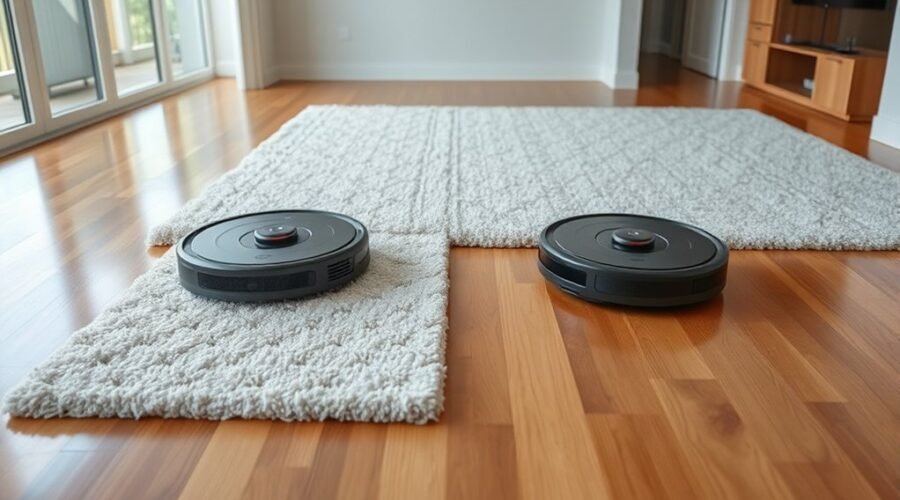
Mop lifting and carpet avoidance solve the same mixed-floor problem in different ways. One keeps damp pads above carpet fibers while still vacuuming across them; the other reroutes the machine around rugs entirely. That distinction affects sensor use, cleaning coverage, and floor compatibility in ways many buyers overlook. For homes with changing surfaces, the better choice is not always obvious, and the tradeoffs become more important under closer inspection.
What’s the Difference Between Mop Lifting and Carpet Avoidance?
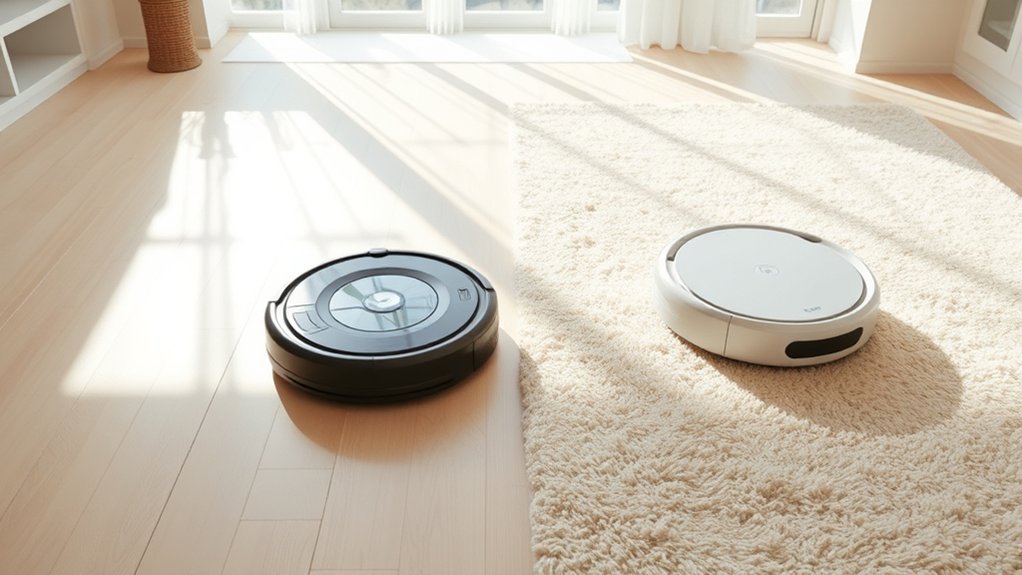
Mop lifting and carpet avoidance are related but distinct robot vacuum functions: mop lifting raises the mopping pads when carpet is detected to prevent moisture damage, while carpet avoidance identifies carpeted areas and changes cleaning behavior, often by increasing suction for deeper debris removal.
Mop Lifting serves mixed flooring homes, where hard floors and rugs coexist, by preserving mop contact only where wet cleaning is safe. Carpet Avoidance focuses on cleaning efficiency, steering vacuuming modes toward peak performance on pile surfaces without wetting them.
Advanced sensors support both features, helping the machine shift intelligently between hard floors and textile areas. The result is a more autonomous, user experience that reduces manual intervention and grants greater control over routine maintenance.
In practice, Mop Lifting protects surfaces; Carpet Avoidance maximizes debris removal on carpets. Together, they create flexible coverage across mixed flooring, yet each addresses a different problem with a distinct response to changing floor conditions.
How Do Robot Vacuums Detect Carpets and Rugs?
Robot vacuums detect carpets and rugs through a combination of infrared sensors, LiDAR mapping, and, in some higher-end models, camera-based object recognition. These advanced sensors support carpet detection by identifying texture changes and floor types in real time.
Once a rug is detected, the machine can modify navigation and boost suction power to preserve cleaning performance on thicker fibers. Many units also use mop lifting, raising the pad before contact to reduce water damage on soft surfaces.
Once a rug is detected, the vacuum boosts suction and lifts the mop to protect softer surfaces.
In practice, the system relies on sensor fusion: infrared sensors measure reflectivity, LiDAR builds spatial maps, and object recognition classifies boundaries with greater precision. This adaptive logic helps the vacuum shift from tile to carpet without manual intervention, reducing friction for the user.
Effective detection is especially important on high-pile rugs, where weak suction can leave debris behind. With better sensing, the robot gains autonomy, efficiency, and a more liberated cleaning workflow overall.
When Does Mop Lifting Work Better?
Mop lifting works best in homes with mixed flooring, where a robot vacuum must move between hard surfaces and carpets without leaving moisture behind. In these layouts, mop lifting technology lets robot vacuums shift from mopping hard floors to passing over carpets without manual intervention, preserving fiber integrity and improving cleaning efficiency.
Models with an automatic mop, such as those using advanced mopping systems, can detect carpeted zones and raise the pad at the right moment, reducing the risk of dirty water transfer. This is especially useful in homes with pets, where muddy tracking often appears on tile, wood, and nearby rugs.
When Is Carpet Avoidance the Better Choice?
Carpet avoidance becomes the stronger option when delicate rugs or moisture-sensitive fibers must stay completely dry, since even a brief pass with a wet mop can leave lasting damage.
It also reduces risk in homes where wet pads may transfer dirt or water onto carpeted surfaces, making the cleaning path safer and more controlled.
For high-pile carpets, avoidance can outperform partial contact strategies because the vacuum can preserve carpet texture while focusing mopping only on hard flooring.
Delicate Rug Protection
For homes with delicate rugs or high-pile carpets, carpet avoidance becomes the safer choice because it prevents mopping pads from touching fibers that can absorb moisture, stain, or deform under repeated passes.
In modern robot vacuums, mop lifting and auto-lift mopping add robust features that detect textile boundaries and pause wet cleaning before contact occurs. This tailored cleaning approach preserves delicate rugs while maintaining cleaning efficiency on nearby hard floors.
Units with strong carpet detection, such as models that switch off mopping on rugs, reduce water damage risk and limit streaks or stains.
For households seeking liberation from manual oversight, carpet avoidance offers precise control: the machine handles mixed surfaces intelligently, protecting high-pile carpets without sacrificing performance where dry and wet cleaning can safely coexist.
Wet Mop Safety
When wet mopping is involved, carpet avoidance becomes the safer option whenever a robot vacuum must move between hard floors and textiles. For wet mop safety, this matters because carpet avoidance reduces water damage risk by stopping moisture transfer before fibers are touched.
Advanced robot vacuums use moisture detection, carpet detection sensors, and responsive cleaning modes to keep mopping pads lifted or disabled on carpets. Models such as the ECOVACS X8 Pro OMNI, Roborock Saros 10R, and 3i S10 Ultra show how auto-lifting functions protect floor coverings while preserving efficiency on hard surfaces.
This balance supports vacuuming and mopping in one pass, letting users move more freely without babysitting the machine. In practice, precise carpet avoidance is the smarter safeguard.
High-Pile Carpet Needs
High-pile carpeting raises the stakes beyond simple wet-mop protection, because dense fibers demand stronger suction and more precise floor recognition to avoid poor pickup and accidental moisture retention.
For robot vacuums, mop lifting helps on mixed floors, but carpet avoidance is often the better choice on high-pile carpets, where wet pads can sink in and compromise home preservation.
Models with carpet detection, like the 3i S10 Ultra, switch off mopping automatically, while advanced sensors in units such as the Roborock Saros 10R read carpet height and protect delicate fibers.
The ECOVACS X8 Pro OMNI shows that even capable machines need strong suction power to reach respectable cleaning efficiency on plush surfaces.
In this scenario, carpet avoidance delivers cleaner results, less risk, and greater freedom.
Which Features Matter Most for Carpet Cleaning?
The most important carpet-cleaning features in a robot vacuum are suction strength, brush design, and intelligent floor detection. For liberation from manual cleanup, suction power must be paired with carpet detection sensors and auto-lifting mop pads. In mixed flooring, mop lifting supports carpet avoidance while preserving efficient cleaning.
| Feature | Function | Benefit |
|---|---|---|
| Suction power | Pulls embedded debris from fibers | Stronger carpet cleaning |
| Auto-lifting mop pads | Raises wet components off carpet | Prevents water damage |
| Anti-tangle brushes | Resists hair wrapping | Less maintenance |
Advanced features matter when they are functional, not decorative. High-end systems like tailored carpet modes increase brush agitation and suction on demand, while smart sensing shuts off water flow as surfaces change. That coordination lets the machine work autonomously, reducing oversight and freeing the user from repeated intervention. Regular maintenance still influences results, but good hardware handles debris, fiber depth, and shift logic with precision.
What Floor Types Suit Each Approach Best?
Mixed flooring benefits most from robot vacuums with mop lifting technology, because the system can raise wet pads as soon as carpet is detected, preserving both carpet fibers and cleaning efficiency.
In mixed flooring environments, Mop Lifting Technology supports seamless navigation from tile to rug without forcing manual intervention. On hard flooring, mopping capabilities remove fine dust and light residue, delivering effective deep cleaning that dry-only units cannot match.
By contrast, Carpet Avoidance suits homes dominated by soft surfaces, where uninterrupted suction protects fibers and keeps moisture away from dense textiles. High pile carpets can challenge weaker sensors, so precise detection matters more than raw power alone.
- Mop lifting favors open-plan homes with both hard flooring and short carpet zones.
- Carpet avoidance favors rooms where rugs dominate and moisture must never enter.
- Advanced robot vacuums with strong navigation can adapt to edges, thresholds, and changing surfaces.
How Do You Choose the Right Robot Vacuum?
Choosing the right robot vacuum depends on matching its core features to the flooring and obstacles in the home. A Robot with auto-lift mopping is preferable in mixed spaces, because it raises Mop pads on carpet and prevents water damage.
High suction matters next: on dense carpet, a Vacuum designed for debris extraction should deliver strong performance, such as 18,000 Pa class systems. Efficiency ratings reveal the real tradeoff between hard floors and pile depth; one model may approach near-perfect cleaning on smooth surfaces while dropping sharply on high-pile carpet.
Obstacle avoidance also deserves scrutiny, especially in homes with cables, toys, or pet items. Top units with precise obstacle avoidance reduce manual intervention and protect a more autonomous routine.
Finally, carpet detection sensors should shift cleaning modes automatically, allowing the machine to adapt without constant oversight. The best choice is the one that frees time while still respecting each room’s surfaces and constraints.
Frequently Asked Questions
Which Robot Vacuum Has the Best Object Avoidance Feature?
The Eufy Omni S2 appears best for object avoidance, with perfect testing. Smart navigation, obstacle detection, sensor technology, floor mapping, and app integration support strong cleaning efficiency, brand reliability; user reviews, maintenance tips, and price comparison remain relevant.
Is the Mop Feature Worth It on Robot Vacuums?
Like a key opening a hidden door, it can be worthwhile on hard floors. Mop effectiveness, cleaning efficiency, and surface compatibility improve, but maintenance requirements, price comparison, battery life, brand reliability, smart features, noise levels, and user experiences vary.
What Are the Downsides of Using a Robotic Vacuum Cleaner?
Robotic vacuum downsides include limited battery life, higher noise levels, maintenance costs, navigation issues, and inconsistent cleaning efficiency. App compatibility varies, dustbin capacity is small, floor compatibility is limited, price range broad, and brand reliability uneven.
Which Robot Vacuum Has the Best Mopping Function?
ECOVACS X8 Pro OMNI and eufy S1 Pro lead mopping, like twin scalpel moons, with superior mop efficiency, water tank management, cleaning modes, floor types, stain removal, maintenance tips, battery life, navigation technology, user reviews, brand comparisons.
Conclusion
In the end, mop lifting and carpet avoidance serve different masters, like two gears in the same well-tuned machine. Mop lifting suits homes that mix hard floors and occasional rugs, preserving moisture-sensitive fibers while keeping cleaning continuous. Carpet avoidance favors spaces where rugs should remain untouched by water and dirt. The best choice depends on flooring layout, sensor accuracy, and cleaning priorities, proving that the smartest robot vacuum is the one that reads the room.