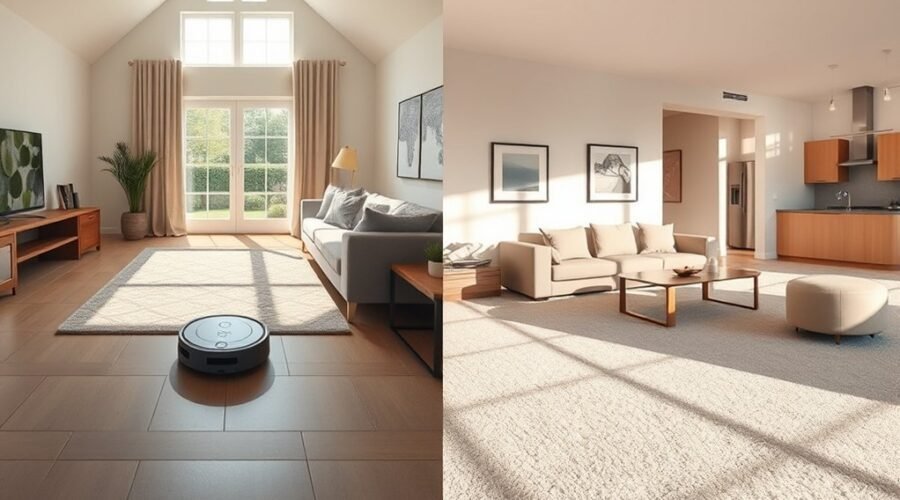
Robot vacuums can clean by room or across an entire home, and each mode serves a different purpose. Room cleaning is useful for quick touch-ups, spills, and busy areas where speed matters. Whole-home cleaning is better for larger layouts and routine coverage, especially when mapping and battery management are strong. The real difference is not just scope, but how much control, time, and consistency each approach demands, which becomes clearer when the right use case is examined.
Room vs Whole-Home Cleaning
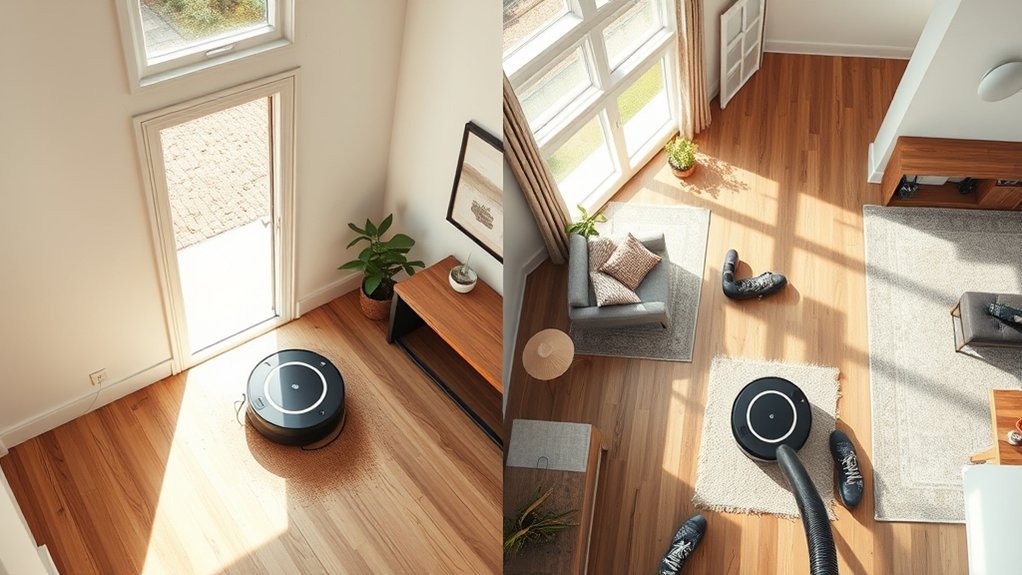
When comparing room cleaning with whole-home cleaning, robot vacuums serve different needs depending on the scope of the job.
Room cleaning supports targeted cleaning in high-traffic spaces, making it useful for quick upkeep, pet hair control, and focused floor care. With customization options such as no-go zones and specific schedules, the machine can concentrate on chosen areas without disturbing the rest of the home.
Whole-home cleaning, by contrast, relies on advanced mapping technology to move through multiple rooms in one cycle with greater efficiency and coverage. This approach reduces manual effort and can deliver nearly complete floor coverage through systematic routes.
Battery life considerations matter more here, since larger layouts may require recharging and resuming before the job is finished. Room cleaning may finish faster in one session, while whole-home cleaning offers broader liberation from repeated sweeping, especially when daily maintenance must remain consistent and hands-off.
When Room Cleaning Works Best
Room cleaning works best in situations that call for focused upkeep rather than whole-home coverage. It suits targeted maintenance in high-traffic areas like living rooms and kitchens, where debris gathers fast and efficient upkeep matters.
With scheduling, a robot vacuum can revisit specific rooms often, helping limit allergens by reducing dust and pet hair before buildup spreads. After cooking spills or children’s playtime, room cleaning provides a quick reset without committing the machine to an entire house.
In multi-floor homes, it lets one level be handled at a time, sidestepping battery life constraints and keeping the task manageable. Customized cleaning paths and no-go zones improve results further, especially when furniture placement and a unique layout make generic routes inefficient.
This approach gives users more control, less waiting, and more freedom from unnecessary coverage.
When Whole-Home Cleaning Is Better
Whole-home cleaning is often the better choice in larger spaces, where full coverage helps prevent dust and allergens from accumulating in overlooked areas. For households seeking practical freedom, whole-home cleaning lets robot vacuums manage multiple rooms in one cycle, reducing daily intervention. With advanced mapping technology, these machines build accurate cleaning paths, avoid obstacles, and deliver thorough coverage that feels more deliberate than piecemeal room care.
| Benefit | Whole-Home Advantage | Result |
|---|---|---|
| Coverage | Multiple rooms | Less buildup |
| Navigation | Advanced mapping technology | Efficient cleaning paths |
| Pets | Pet hair control | Cleaner surfaces |
| Power | Long-lasting batteries | Extended cycles |
| Maintenance | Fewer manual deep cleaning sessions | More time and effort saved |
This approach is especially useful in pet-filled homes, where dander and hair spread quickly across floors. High-quality robot vacuums with long-lasting batteries can finish extensive layouts without interruption, making whole-home cleaning a strong option for reducing manual deep cleaning and keeping living spaces consistently clear.
How the Two Modes Differ
The difference between room cleaning and whole-home cleaning comes down to scope, speed, and control.
Room cleaning mode concentrates on one space, making it useful for quick, targeted maintenance in kitchens or living rooms where dirt gathers fast. It usually delivers higher cleaning efficiency for a limited area, with lower battery usage and fewer interruptions.
Whole home cleaning mode, by contrast, follows a mapped path across the full house, aiming for extensive coverage and fewer missed spots. It may take longer and sometimes needs multiple cycles, yet it supports steady, automated upkeep for larger homes.
- Room cleaning mode: faster response, stronger user control, more customization.
- Whole home cleaning mode: broader reach, more consistent coverage, less hands-on effort.
- Scheduled cleaning: room sessions can be timed by area, while whole-home runs favor regular automation.
For households seeking freedom from constant sweeping, the distinction is clear: one mode offers precision, the other offers total reach.
How to Pick the Right Cleaning Mode
Choosing the right cleaning mode depends on the size of the mess, the layout of the home, and the amount of time available.
Room cleaning mode suits targeted cleaning after spills, tracked-in dirt, or busy activity in one area, delivering efficient cleaning sessions with less waste.
Whole home cleaning mode fits regular maintenance when thorough cleaning is needed across multiple rooms and surfaces.
Many models offer customizable cleaning modes, letting users switch with ease and match the task to the moment.
Mapping technology helps the machine remember room layouts and optimize cleaning paths, improving speed and reducing missed spots.
Battery life also matters: room cleaning mode often finishes on a single charge, while whole home cleaning mode may require more power or multiple cycles in larger spaces.
To preserve time, effort, and autonomy, users should choose the right cleaning mode based on need, not habit, so the vacuum works for the home, not against it.
Best DEEBOT Robots by Use Case
For daily cleaning, the DEEBOT T80 OMNI is a practical fit in mixed-floor homes because its Carpet First function helps maintain carpets without neglecting hard floors.
For deeper, whole-home cleaning, the DEEBOT T90 PRO OMNI stands out with 30,000Pa suction and self-washing mopping, while the X11 OmniCyclone is better for large spaces that need sustained coverage and strong carpet performance.
All three support room-specific schedules and smart app control, so the main difference is whether the priority is routine upkeep or more intensive, full-home cleaning.
Best For Daily Cleaning
- T90 PRO OMNI: focused allergen management.
- X11 OmniCyclone: liberated movement across rooms.
- T80 OMNI: mixed flooring confidence with Carpet First.
Tailored schedules let each unit clean when residents choose, preserving time and control.
For busy households, this balanced approach delivers efficient cleaning without constant intervention.
Best For Deep Cleaning
Deep cleaning favors robots that can combine strong suction, targeted floor care, and reliable navigation, and the DEEBOT T90 PRO OMNI stands out with 30,000Pa suction and self-washing mopping for thorough results in rooms or across an entire home.
Among robot vacuum cleaners, it offers strong cleaning performance on hard floors and carpets, while its advanced features support liberation from manual scrubbing.
For larger spaces, the DEEBOT X11 OmniCyclone uses PowerBoost Technology to maintain deep cleaning across expansive layouts.
The DEEBOT T80 OMNI adds Carpet First mode, raising suction power where fibers trap debris.
All three use obstacle avoidance to support whole-home cleaning without missed areas.
With scheduled cleaning, they keep up consistent care, making deep cleaning more practical for homes that need freedom from constant intervention.
Frequently Asked Questions
What Are the Downsides of Using a Robotic Vacuum Cleaner?
Downsides include robot maintenance issues, suction power limitations, battery life concerns, navigation problems encountered, floor type compatibility, obstacle detection failures, noise level complaints, cleaning path efficiency, dustbin capacity constraints, and app connectivity challenges.
How Does Roomba Know Which Room Is Which?
Roomba knows rooms through mapping technology and room detection, using smart sensors to build a floor plan. Its navigation system and cleaning algorithms respect boundary markers, virtual walls, user settings, and app integration, though truth remains partial.
Are House Cleaning Robots Worth It?
Yes—house cleaning robots can be worth it when robot vacuum advantages, cleaning efficiency, smart home integration, and pet hair performance outweigh cost considerations, maintenance requirements, noise levels, navigation technology limits, battery life concerns, and user reviews.
What Is the Average Lifespan of a Robot Vacuum?
Most robot vacuums last 3–5 years; irony hums as dust wins. Robot vacuum maintenance, battery replacement tips, cleaning schedule optimization, smart home integration, navigation technology advancements, noise level comparison, suction power effectiveness, floor type compatibility, app features overview, price range analysis matter.
Conclusion
In comparing room and whole-home robot vacuum cleaning, the key difference is efficiency versus coverage. Room cleaning is best for quick, targeted maintenance, while whole-home cleaning is better for larger spaces and full-cycle upkeep. One practical statistic often cited is that targeted room cleaning can reduce cleaning time by up to 50% in high-traffic areas. Choosing the right mode depends on layout, battery capacity, and how much of the home needs attention.