A true heater-and-dehumidifier appliance is uncommon. The practical products in this guide are air conditioner and heater combos with a separate dry mode. They can cool, provide supplemental heat, and remove moisture, but most models do not heat and dehumidify at the same time. Compare the room-size guidance, SACC or DOE cooling capacity, heating output, moisture-removal rate, hose or window requirements, drainage setup, and operating noise before choosing one.
- Portable AC headline BTU ratings can look larger than their SACC or DOE ratings; use the lower standardized figure when available.
- Heat mode is usually supplemental and may stop working efficiently in cold outdoor conditions.
- Dry mode normally requires the compressor and may need continuous drainage in humid rooms.
- Single-hose models are easier to install, while dual-hose designs usually create less negative pressure indoors.
Quick Comparison
| Product | Best For | Cooling Rating | Heating / Dry Mode | Suggested Space | Key Limitation | Amazon |
|---|---|---|---|---|---|---|
| Uhome 12,000 BTU | Best Overall Portable | 12,000 BTU ASHRAE | 12,000 BTU heat; up to 91 pints/day dry mode | Up to 400 sq. ft. | Single-hose design; verify the current DOE/SACC figure | Check Price |
| Whynter ARC-14SH | Best Dual-Hose | 14,000 BTU ASHRAE / 9,200 SACC | 13,000 BTU heat; 71 pints/day | Up to 500 sq. ft. | Heavy at about 85 lb. | Check Price |
| Whirlpool 14,000 BTU | Best for Large Rooms | 14,000 BTU ASHRAE / 10,000 SACC | 10,000 BTU heat; up to 108 pints/day | Up to 700 sq. ft. | Large, heavy, and demanding on a circuit | Check Price |
| VEVOR 14,000 BTU | Best High-Capacity Value | 14,000 BTU ASHRAE / 9,800 SACC | Heat and dry modes; confirm the exact variation | Up to about 550 sq. ft. | Specifications vary across similar VEVOR listings | Check Price |
| Midea 12,000 BTU DOE | Best Window Model | 12,000 BTU DOE | Supplemental heat and dry mode | Up to 550 sq. ft. | Heat is intended for milder weather | Check Price |
| Hisense 8,000 BTU DOE | Best Smart Compact Pick | 8,000 BTU DOE | Heat-pump heat and dry mode | Up to 350 sq. ft. | Limited coverage for large open rooms | Check Price |
| ROVSUN 10,000 BTU | Best for Small Rooms | 10,000 BTU ASHRAE | 8,000 BTU heat and dry mode | 300–400 sq. ft. | Single-hose design | Check Price |
| SereneLife 10,000 BTU | Best Compact Alternative | 10,000 BTU ASHRAE / 6,000 DOE | 8,000 BTU heat; 1.2 L/hour | Up to 330 sq. ft. | Modest heating and cooling output | Check Price |
Uhome 12000 BTU Portable Air Conditioner with Heater
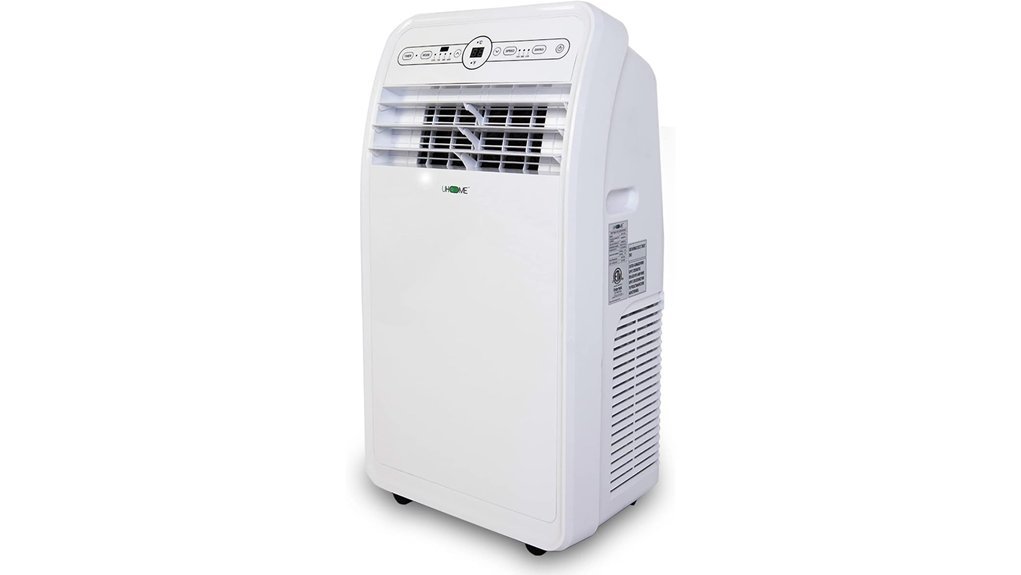
Best Overall Portable: The Uhome UPF1-12H combines cooling, heating, dehumidifying, and fan modes in one movable appliance. Its headline cooling rating is 12,000 BTU ASHRAE, and it is intended for rooms up to about 400 sq. ft. Dry mode is listed to remove up to 91 pints of moisture per day under warm, humid test conditions. Three fan speeds, a 24-hour timer, remote control, washable filter, handles, and casters make it practical for bedrooms, offices, and apartments.
Why You’ll Like It: It offers a useful balance of room coverage, moisture control, and straightforward controls without moving into the size and weight of the largest 14,000 BTU units.
Who Should Buy It: Buyers who need one portable appliance for seasonal cooling, supplemental heating, and humidity control in a medium-sized room.
Who Should Avoid It: Skip it if you need a dual-hose system, very quiet overnight operation, or dependable heating in severe winter weather.
Pros:
- Four operating modes cover cooling, heating, dry, and fan-only use.
- Remote control, LED panel, timer, casters, and washable filter simplify daily use.
- Strong listed moisture-removal capacity for a portable air conditioner.
Cons:
- The single-hose design requires a properly sealed window kit.
- Its 52 dB listed sound level may be noticeable during sleep or focused work.
- At roughly 57 pounds, it rolls easily but is not convenient to carry upstairs.
Whynter Portable Air Conditioner/Heater with Dual Hose (ARC-14SH)
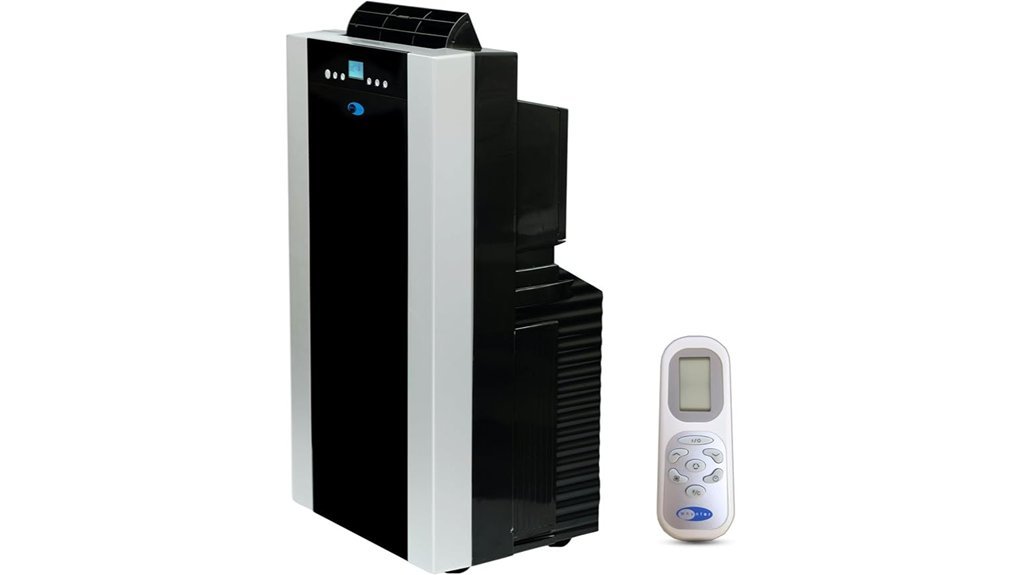
Best Dual-Hose Pick: The Whynter ARC-14SH is a better fit when you value a dual-hose design and strong multi-season performance. It provides 14,000 BTU ASHRAE cooling, 9,200 BTU SACC cooling, 13,000 BTU heating, fan mode, and dehumidification rated up to 71 pints per day. Whynter recommends it for spaces up to 500 sq. ft.
Why You’ll Like It: The separate intake and exhaust hoses can reduce the negative-pressure problem common with single-hose portable air conditioners. It also includes a washable pre-filter, activated-carbon filter, remote, window kit, timer, and storage bag.
Who Should Buy It: Buyers who want a proven dual-hose portable model for a medium room and can accept its larger footprint.
Who Should Avoid It: Skip it if you need to carry the appliance between floors or expect heat mode to replace a primary furnace in freezing weather.
Pros:
- Dual-hose layout supports more balanced air exchange than a typical single-hose unit.
- Published heating, cooling, and moisture-removal specifications are clearly stated.
- Includes useful accessories and a three-year compressor warranty.
Cons:
- At about 85 pounds, it is the heaviest option in this roundup.
- Low-speed noise is listed below 51 dBA, but high speed can be more noticeable.
- Heat mode is intended for ambient conditions above about 45°F, so it is not a deep-winter heating solution.
Whirlpool 14,000 BTU Portable Air Conditioner with Heater
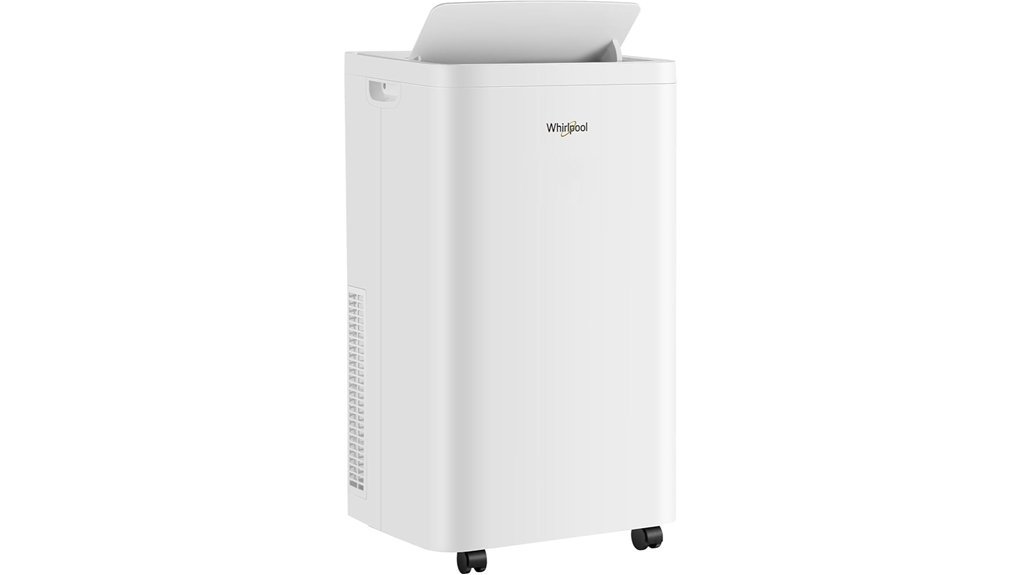
Best for Large Rooms: Whirlpool’s WHNP141HAW combines 14,000 BTU ASHRAE cooling, 10,000 BTU SACC cooling, 10,000 BTU heating, fan operation, and dry mode. The manufacturer rates it for rooms up to 700 sq. ft. and lists moisture removal up to 108 pints per day.
Why You’ll Like It: This model gives you one of the highest published moisture-removal ratings in the group, plus three fan speeds, a 24-hour timer, sleep mode, filter alert, digital controls, remote, casters, and side handles.
Who Should Buy It: Buyers with larger bedrooms, living areas, finished basements, or open rooms that need more capacity than a smaller portable unit can provide.
Who Should Avoid It: Skip it for a small room, a weak or shared electrical circuit, or any space where a large single-hose cabinet would be difficult to vent and position.
Pros:
- High SACC cooling output and broad listed room coverage.
- Strong published dehumidification capacity.
- Filter alert, washable filter, remote, timer, and mobility features improve usability.
Cons:
- Its 75.6-pound weight makes frequent room-to-room movement less convenient.
- A 1,400-watt appliance can place a substantial load on a household circuit.
- Large-room performance still depends on insulation, ceiling height, sunlight, and a tight window seal.
VEVOR Portable Air Conditioner and Heater Combo
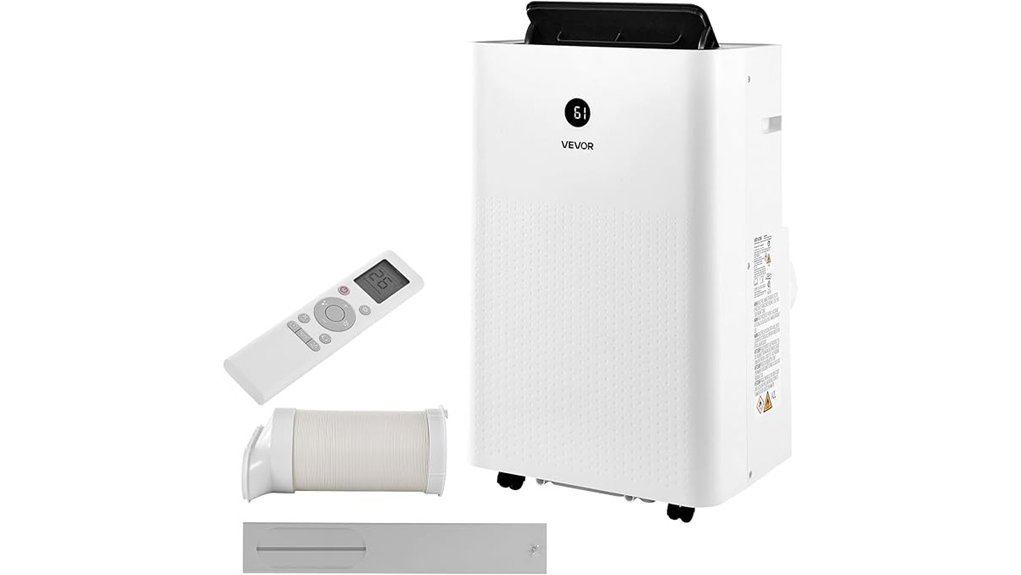
Best High-Capacity Value: This VEVOR portable combo provides cooling, heating, dry, fan, and sleep modes. The linked variation is listed at 14,000 BTU ASHRAE and 9,800 BTU SACC for spaces up to about 550 sq. ft. Because VEVOR sells several similar cabinets and capacities, confirm the exact heat function and specifications on the selected variation before ordering.
Why You’ll Like It: The LED touch panel, remote, 24-hour timer, adjustable air direction, window panel, and exhaust hose make it a feature-rich option for apartments and home offices.
Who Should Buy It: Buyers who want high listed cooling capacity and multiple operating modes without moving to an 85-pound dual-hose unit.
Who Should Avoid It: Skip it if you want the clearest long-term specification history or prefer a dual-hose design with more established documentation.
Pros:
- Lists both ASHRAE and SACC cooling figures for a more useful comparison.
- Includes a heater, dehumidifier, fan, sleep setting, remote, and timer.
- Adjustable window hardware supports common sliding and double-hung installations.
Cons:
- Its listed sound level can be distracting in a very quiet bedroom.
- The roughly 68-pound cabinet is movable on casters but awkward to lift.
- Confirm the exact Amazon variation includes heat because VEVOR also sells similar cooling-only versions.
Midea Inverter Window Air Conditioner with Heat Combo
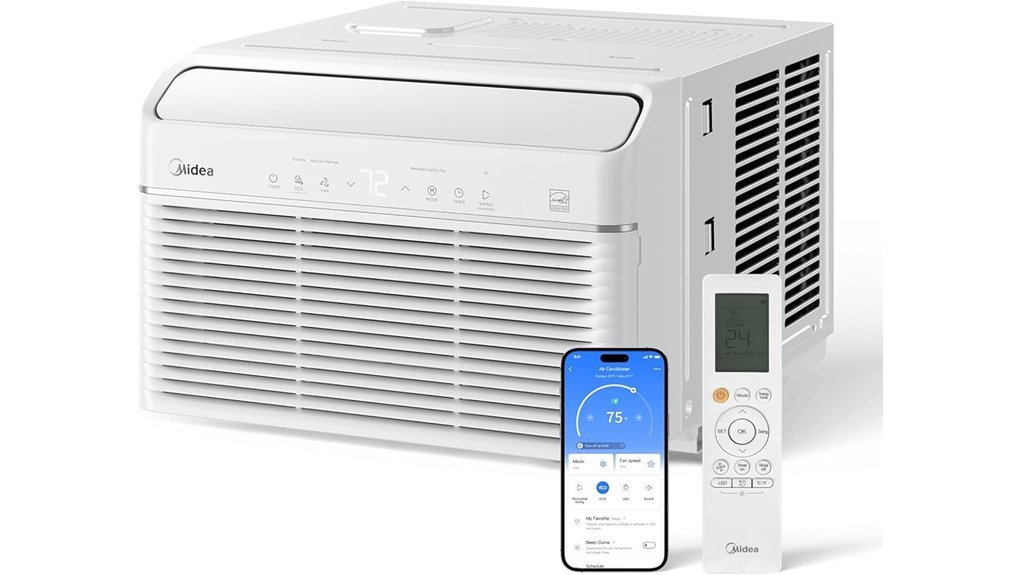
Best Window Model: This 12,000 BTU DOE Midea window air conditioner combines cooling, dehumidifying, fan operation, and supplemental heat for rooms up to 550 sq. ft. Its inverter compressor can adjust output instead of relying only on full-power starts and stops, while the Midea SmartHome app, remote, Alexa, and Google Assistant add flexible control.
Why You’ll Like It: A window-mounted unit does not occupy floor space or require a portable exhaust hose beside the appliance. The model is listed to operate as low as 45 dBA and includes a washable filter, a 24-hour timer, and multiple fan settings.
Who Should Buy It: Buyers who have a compatible double-hung window and want a more permanent, space-saving installation with inverter operation and smart controls.
Who Should Avoid It: Skip it if your window is incompatible, your lease restricts window units, or you need dependable heat during deep-winter temperatures.
Pros:
- Inverter operation supports steadier temperatures and lower noise.
- Smartphone, voice, remote, and panel controls offer several ways to adjust settings.
- Window mounting preserves floor space and avoids rolling a heavy unit between rooms.
Cons:
- The heat function is intended for supplemental use in milder weather, not as a primary deep-winter heater.
- Installation requires a compatible double-hung window and careful support.
- At about 58 pounds, safe installation may require two people.
Hisense 8,000 BTU Portable Inverter Air Conditioner
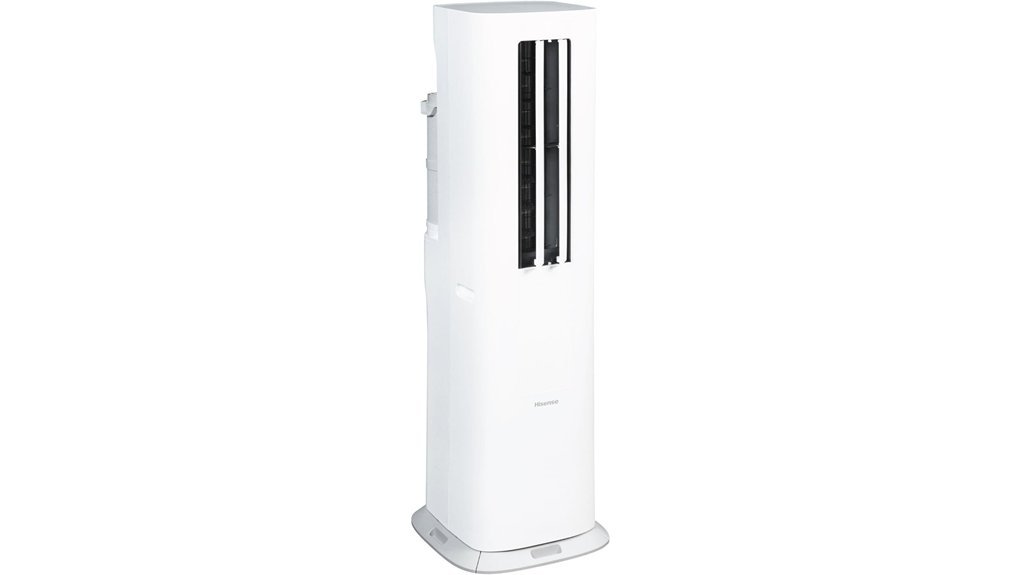
Best Smart Compact Pick: This Hisense smart inverter model offers cooling, heat-pump heating, dry, and fan modes for rooms up to about 350 sq. ft. Its built-in twin-hose design separates intake and exhaust airflow, while the ConnectLife app, voice compatibility, control panel, and included remote provide flexible control.
Why You’ll Like It: It is better suited to a bedroom or office than a large open-plan area. The vertical fan is designed for broad air distribution, and an elevated drain connector supports continuous drainage during heating or dehumidifying use.
Who Should Buy It: Buyers who want a compact-coverage dual-hose model with inverter operation and smart control.
Who Should Avoid It: Skip it for a large open room or if you prefer a basic portable AC without app setup, voice features, or a tall tower-style cabinet.
Pros:
- Dual-hose design supports faster, more balanced room conditioning.
- ConnectLife app, remote control, and multiple modes add convenience.
- Compact coverage rating makes it easier to match to a bedroom or office.
Cons:
- Its 350 sq. ft. rating is too limited for large rooms.
- App setup adds complexity for buyers who prefer simple controls.
- The window kit still needs a secure seal for efficient operation.
ROVSUN 10000 BTU Portable Air Conditioner & Heater Combo
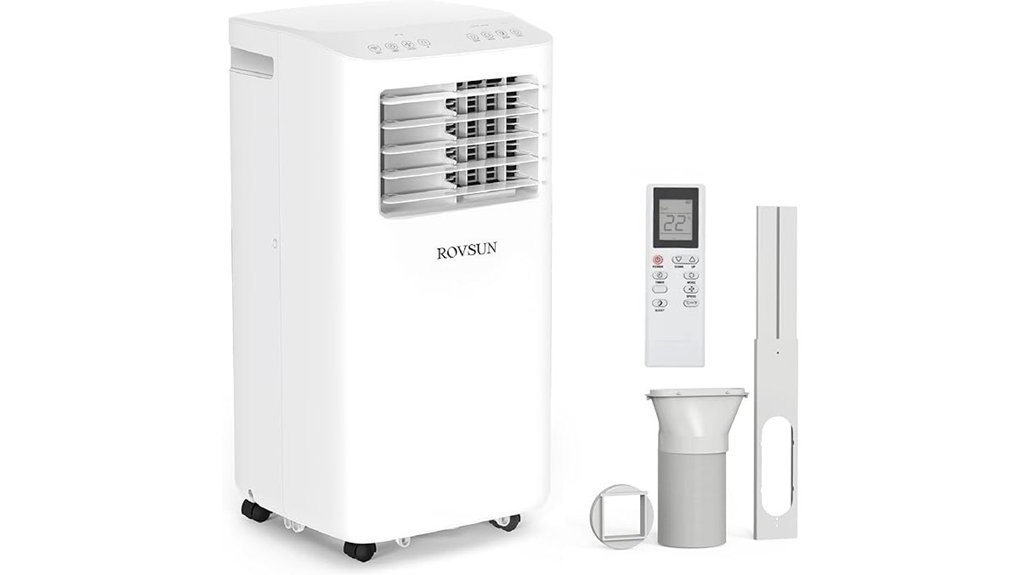
Best for Small Rooms: The ROVSUN portable combo provides 10,000 BTU ASHRAE cooling, 8,000 BTU heating, dry mode, and fan operation. It is intended for roughly 300 to 400 sq. ft. and offers two fan speeds, a 60°F-to-86°F temperature range, sleep mode, memory mode, and a 24-hour timer.
Why You’ll Like It: Casters, side handles, a washable filter, remote control, app control, drain hose, exhaust hose, and window kit make it a practical all-in-one package for a bedroom or small apartment.
Who Should Buy It: Buyers who need compact multi-season room conditioning and want Wi-Fi control without paying for oversized capacity.
Who Should Avoid It: Skip it if you need dual-hose efficiency, very quiet sleep performance, or primary heating during severe cold.
Pros:
- Clear cooling, heating, electrical, noise, and room-size specifications improve comparison.
- Includes cooling, heating, dry, fan, sleep, timer, and Wi-Fi functions.
- Washable filter and included installation parts simplify upkeep and setup.
Cons:
- Single-hose operation is less balanced than a dual-hose design.
- Its 52-to-53 dB listed sound may be noticeable in a quiet bedroom.
- The heating output is better for supplemental warmth than whole-room winter heating in severe cold.
SereneLife 10,000 BTU Portable Air Conditioner and Heater
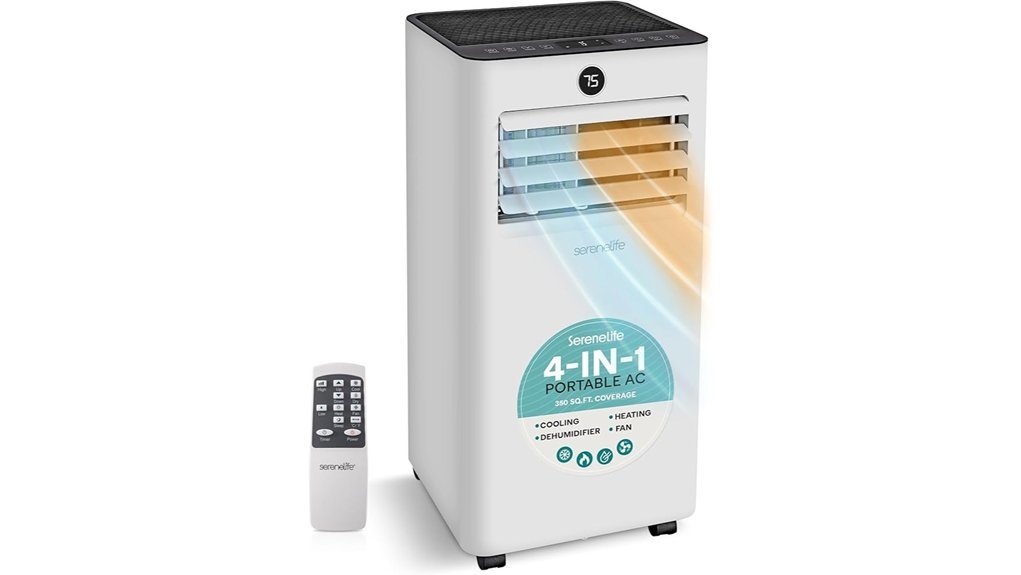
Best Compact Alternative: The SereneLife SLPACHT102 provides 10,000 BTU ASHRAE cooling, 6,000 BTU DOE cooling, 8,000 BTU heating, dry mode, and fan operation. The manufacturer rates it for rooms up to about 330 sq. ft. and lists moisture removal at 1.2 liters per hour.
Why You’ll Like It: The narrow cabinet, rolling wheels, remote, front display, two fan speeds, 24-hour timer, washable filter, window kit, and drain pipe suit apartments, bedrooms, and home offices.
Who Should Buy It: Buyers with smaller rooms where compact size and simple four-mode operation matter more than maximum output.
Who Should Avoid It: Skip it for a large room, a noise-sensitive bedroom, or a space that needs strong primary heating.
Pros:
- Compact footprint and 47-pound weight make it easier to position than larger models.
- Includes the key parts needed for window venting and drainage.
- Published DOE cooling capacity and moisture-removal rate make expectations clearer.
Cons:
- The 330 sq. ft. coverage is modest and should be treated as an upper-room-size guideline.
- Its 8,000 BTU heating capacity is intended for supplemental room heat.
- At 55 dBA, it may be too audible for noise-sensitive sleepers.
How to Choose an AC, Heater, and Dry-Mode Combo
The products in this roundup are portable or window air conditioners with separate heat and dry modes. They can simplify room comfort across seasons, but they are not the same as a dedicated low-temperature basement dehumidifier, a standalone space heater, or a whole-home HVAC system. Use the checklist below to match the appliance to your room, window, drainage options, electrical circuit, and climate.
Heating and Dehumidifying Capacity
Check the heating output and moisture-removal rating separately. A high cooling BTU number does not automatically mean equally strong heating. Also confirm whether the manufacturer states pints per day, pints per hour, or liters per hour, because those figures are not directly interchangeable without conversion. Dry-mode ratings are usually measured under warm, humid test conditions, so real-world water collection may be lower in a cool room.
ASHRAE vs. SACC or DOE Ratings
Portable air conditioners often display a larger ASHRAE cooling number and a lower SACC or DOE number. For portable units, the SACC or DOE figure is more useful when comparing expected room-cooling performance because it accounts for operating effects that the headline ASHRAE number does not. Compare like with like rather than assuming every “14,000 BTU” product performs identically.
Room Size Coverage
Start with measured floor area, then adjust for high ceilings, direct afternoon sun, poor insulation, open doorways, kitchens, and heat-producing electronics. A unit near the top of its advertised range may struggle in a difficult room. Oversizing can also lead to short cycles and uneven comfort, so choose capacity based on the actual space instead of automatically buying the largest model.
Energy Efficiency Ratings
For window units, compare CEER and the EnergyGuide label. For portable units, compare SACC, CEER, wattage, and estimated annual energy use when those figures are available. Inverter compressors can adjust output more gradually, while fixed-speed compressors usually cycle on and off. Do not compare a room air conditioner’s SEER claim directly with a central HVAC system unless the same test standard is being used.
Noise Level Performance
Published decibel figures may represent a low fan setting rather than maximum operation. For a bedroom or office, look for a clearly stated low-speed noise rating, sleep mode, and owner manual that explains fan behavior. Window units often keep more compressor noise outside, while portable units place the compressor inside the room.
Control and Timer Options
A 24-hour timer, sleep mode, remote, temperature memory, adjustable fan speed, and automatic swing can improve daily convenience. App and voice controls are helpful when you want to start the unit before entering the room, but they also add setup steps. Choose smart controls only when you will actually use them.
Portability and Installation
Casters help on one level, but a 50-to-85-pound appliance is still difficult to carry upstairs. Measure the window opening, check the panel’s adjustment range, and confirm whether the kit supports a double-hung or sliding window. Keep the exhaust hose short and straight, seal gaps around the panel, and make sure the drain hose can flow without kinks when continuous drainage is required.
Drainage and Condensate Management
Some portable units self-evaporate much of the condensate during cooling, but heating and dry modes can collect more water. Check whether the model has upper and lower drain ports, whether a hose is included, and whether the drain path can maintain a continuous downward slope. Never assume “self-evaporating” means the unit will never need manual or continuous drainage.
Maintenance and Filter Care
Clean the washable filter according to the manual, keep the intake and outlet clear, inspect the window seal, and drain stored water before moving or storing the unit. During heavy dehumidifying use, check the tank or continuous-drain connection regularly. Never reinstall a washed filter until it is fully dry.
Safety and Electrical Requirements
Confirm the certification and electrical requirements for the exact model you buy. Use a grounded outlet that matches the manual, avoid overloaded circuits, and do not use an extension cord or power strip unless the manufacturer specifically allows it. Keep the unit upright, maintain the required clearance, and follow any waiting period stated in the manual after transport so the refrigerant can settle.
Frequently Asked Questions
Can a Heater Dehumidifier Combo Reduce Mold Growth in Winter?
It can help reduce damp conditions that support mold by lowering indoor humidity and improving comfort. It will not remove established mold, repair leaks, stop groundwater, or replace ventilation. Fix the moisture source first and clean or remediate existing growth safely.
How Much Electricity Does a Heater Dehumidifier Combo Use Monthly?
Monthly use depends on wattage and runtime. Estimate it with this formula: (watts ÷ 1,000) × hours used per day × 30 = monthly kWh. Multiply the result by your electricity rate. The compressor cycles, so actual consumption may be lower than a calculation that assumes continuous full-power operation.
Is a Heater Dehumidifier Combo Safe for Overnight Bedroom Use?
Use it overnight only when the exact model’s manual permits unattended or sleep-mode operation. Keep air inlets, outlets, curtains, and bedding clear; use the specified grounded outlet; maintain the window seal; clean the filter; and stop using the appliance if the plug, cord, outlet, or cabinet becomes unusually hot.
Do Heater Dehumidifier Combos Work in Very Cold Basements?
Performance can fall in a cold basement, and many heat-pump or dry modes have minimum operating temperatures. A portable AC combo may not be the best choice for near-freezing conditions. For persistent basement moisture, consider a dehumidifier specifically rated for low-temperature operation and address drainage, leaks, and insulation.
Can Heat and Dry Modes Run at the Same Time?
Usually not. Most products in this category let you select heat mode or dry mode as separate operating settings. Check the manual for the exact model instead of assuming simultaneous heating and dehumidification.
Are These True Heater-Dehumidifier Combos?
They are more accurately described as air conditioners with heat and dry modes. They can provide supplemental warmth and remove moisture, but the functions are normally selected separately. Buyers who mainly need basement humidity control should compare dedicated dehumidifiers instead.
Do Portable AC and Heater Combos Need a Drain Hose?
Sometimes. Cooling mode may self-evaporate much of the water, while dry or heat mode may require manual draining or a continuous hose. The need depends on indoor humidity, runtime, model design, and drain-port height. Follow the exact manual and never let a hose run uphill.
What Maintenance Does a Heater Dehumidifier Combo Need?
Clean the filter on the schedule in the manual, inspect the intake and exhaust path, keep the window kit sealed, empty or continuously drain collected water, and check the hose for kinks. Before seasonal storage, drain the unit fully, run fan mode if the manual recommends it, and store the appliance upright in a dry place.
Final Recommendation
The best option is the one that matches your room, window, drainage plan, electrical circuit, climate, and noise tolerance. Choose the Uhome for balanced portable performance, the Whynter ARC-14SH for established dual-hose operation, the Whirlpool for the highest listed large-room capacity, or the Midea when a window-mounted inverter model fits your space. The Hisense is the stronger compact smart pick, while ROVSUN and SereneLife are easier to justify in smaller rooms.