Last updated: August 2026
If you want one floor-standing appliance that can cool a room and reduce muggy air, look for a portable air conditioner with a dehumidifier or dry mode. These portable AC dehumidifier combos use a compressor for refrigerated cooling, sit on the floor, roll across one level, and exhaust heat outdoors through a window kit. They are different from standalone dehumidifiers, which remove moisture but do not provide refrigerated cooling.
For most buyers, the Whynter ARC-14S is the strongest all-around choice because its dual-hose design, 9,500 BTU SACC rating, and manufacturer-listed 500-square-foot coverage make it a practical medium-room option. The HUMHOLD 14,000 BTU model has the highest SACC rating in this group, while the DREO 319S and 318S stand out for smart controls and low-setting noise. Feelfunn and Shinco are simpler choices for smaller rooms. Every true portable AC in this guide requires an exhaust hose and a suitable window opening.
- Use the SACC/DOE rating before the larger ASHRAE number when comparing portable AC cooling power.
- Dry mode can reduce room humidity, but it is not a substitute for a properly sized standalone dehumidifier in a persistently damp basement or water-damaged area.
- Measure the window opening and plan the exhaust-hose and drainage route before ordering.
Quick Comparison
| Product | Cooling Rating | Room Guidance | Best For | Amazon |
|---|---|---|---|---|
| Whynter ARC-14S | 14,000 BTU ASHRAE / 9,500 BTU SACC | Manufacturer: up to 500 sq. ft. | Best overall; dual-hose cooling | Check Price |
| HUMHOLD 14,000 BTU | 14,000 BTU ASHRAE / 10,000 BTU SACC | Manufacturer: up to 700 sq. ft.; size conservatively | Highest listed SACC rating | Check Price |
| DREO 319S | 10,000 BTU ASHRAE / 6,000 BTU SACC | Manufacturer: up to 200 sq. ft. | Smart controls and quiet rooms | Check Price |
| DREO 318S | 8,000 BTU ASHRAE / 5,000 BTU SACC | Manufacturer: up to 150 sq. ft. | Small bedrooms and offices | Check Price |
| Feelfunn 8,000 BTU | 8,000 BTU ASHRAE / 5,000 BTU SACC | Listing: up to 350 sq. ft.; better for a smaller enclosed room | Compact, simple operation | Check Price |
| Shinco 8,000 BTU | 8,000 BTU ASHRAE / 4,550 BTU SACC | Best treated as up to about 200 sq. ft. | Basic controls and small rooms | Check Price |
Selection note: Ratings and coverage figures are based on manufacturer or retailer specifications available at the time of update. Room shape, insulation, ceiling height, direct sun, outdoor temperature, and hose installation can materially change real-world performance. Exact prices, discounts, ratings, review counts, and stock status are intentionally not stated because they can change.
How We Compared These Portable AC Dehumidifier Combos
We prioritized products that are true compressor-based portable air conditioners with a cooling mode, fan mode, and dry or dehumidifier mode. The main comparison points were SACC/DOE cooling capacity, room-use fit, hose design, drainage behavior, low-setting noise, controls, portability, window-kit requirements, current model identity, and the clarity of product documentation. Manufacturer coverage claims were treated as guidance rather than guaranteed performance, and the lower SACC/DOE figure was given more weight than the larger ASHRAE headline number when both were available.
Whynter 14,000 BTU Portable Air Conditioner (ARC-14S)
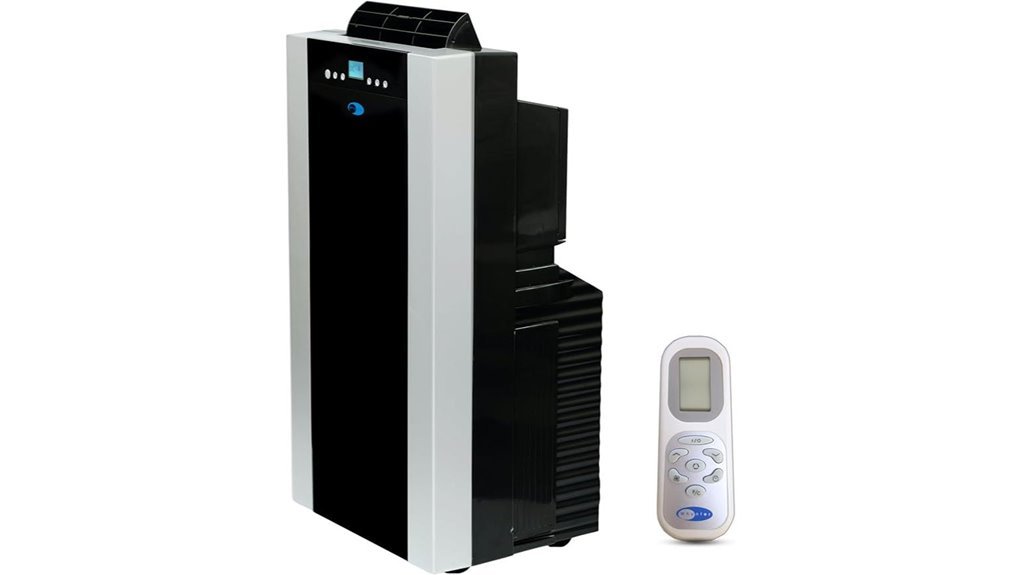
The Whynter ARC-14S is the best-balanced option in this lineup for buyers who want meaningful cooling and dehumidifying in a medium-size room. It is rated at 14,000 BTU ASHRAE and 9,500 BTU SACC, and the manufacturer lists coverage up to 500 square feet. Its dual-hose layout draws and exhausts air through separate hoses, which can reduce the negative-pressure problem common with many single-hose portable units.
It offers cool, fan, and dehumidify functions, three fan speeds, a 61°F to 89°F thermostat range, and a listed moisture-removal capacity of up to 71 pints per day under the manufacturer’s test conditions. The included window kit, hoses, filters, and storage bag make it a complete package. At about 73 pounds, however, it is better rolled across one level than carried between floors.
Best For: Medium-size bedrooms, living rooms, or offices where dual-hose cooling and strong moisture removal matter more than compact size.
Why You’ll Like It: It combines a comparatively strong SACC rating with a dual-hose design and useful dehumidifying capacity.
Who Should Avoid It: Buyers who need a lightweight unit, a very quiet compressor cycle, or an appliance that can cool several separated rooms.
Pros:
- 14,000 BTU ASHRAE and 9,500 BTU SACC cooling ratings.
- Dual-hose setup can improve room-air balance compared with basic single-hose designs.
- Includes the main installation accessories and a washable pre-filter.
Cons:
- Heavy and bulky at about 73 pounds.
- Compressor and airflow noise may still be noticeable in a quiet bedroom.
- Requires space for two hoses and a compatible window opening.
HUMHOLD 14,000 BTU Portable Air Conditioner
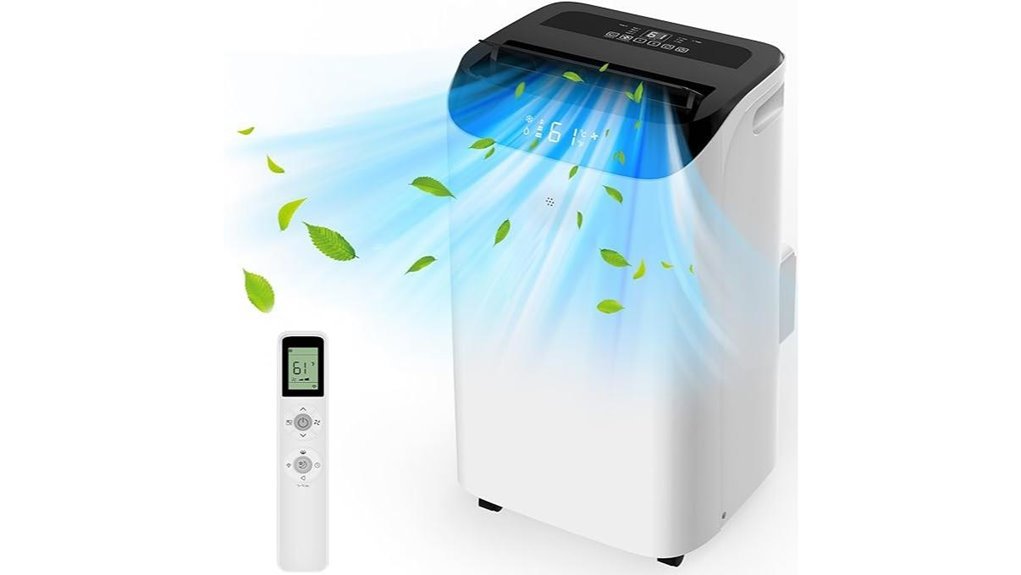
The HUMHOLD model is the highest-capacity single-hose option kept in this guide. It is listed at 14,000 BTU ASHRAE and 10,000 BTU SACC, with manufacturer-stated coverage up to 700 square feet. Current product information also lists a 65-pound unit weight, so it is better treated as a roll-around appliance than something to carry between floors. Heat load, insulation, sun exposure, and doorway traffic will affect the area it can cool comfortably.
Its cool, fan, and dry modes are joined by smart mode, sleep mode, three fan speeds, auto-swing, a 24-hour timer, and a remote. The listing states a lowest-setting noise figure of 48 dB and up to 95 pints per day of moisture removal under specified test conditions. Automatic evaporation can reduce routine draining, but a drain hose may still be necessary in very humid weather or while using dry mode.
Best For: Buyers who need the highest listed SACC rating in this group for one larger enclosed bedroom, living room, apartment area, basement room, or office.
Why You’ll Like It: The 10,000 BTU SACC rating, remote controls, multiple operating modes, and dry mode make it a flexible higher-capacity option.
Who Should Avoid It: Anyone who must lift the unit frequently or who has a crank-out window that cannot accept the supplied slider kit without an adapter.
Pros:
- 14,000 BTU ASHRAE and 10,000 BTU SACC ratings.
- Cooling, fan, and dehumidifier modes with sleep and smart functions.
- Washable filter, casters, auto-swing, remote, and timer.
Cons:
- Large and heavy enough that stairs may require two people.
- Large coverage claims should be treated as best-case figures.
- May require continuous drainage in high humidity.
DREO Portable Air Conditioner 319S Smart 3-in-1 AC
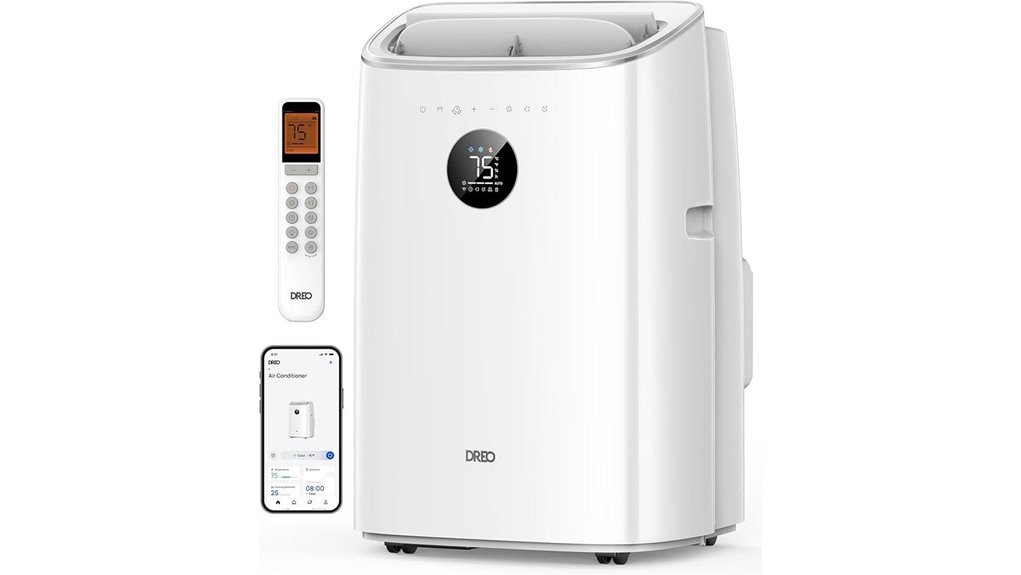
The DREO 319S is the better DREO choice when you want app and voice control with more cooling headroom than the 318S. It is rated at 10,000 BTU ASHRAE and 6,000 BTU SACC, with listed coverage up to 200 square feet. The 3-in-1 design provides cool, fan, and dry modes, while the adjustable thermostat runs from 61°F to 86°F.
DREO lists operation as low as 45 dB on its lowest setting, plus control through the app, remote, touch panel, Alexa, Google Assistant, and Siri. Its moisture-management design is intended to reduce routine draining during cooling, but drainage requirements still depend on humidity and operating mode.
Best For: Smart-home users cooling a small bedroom, home office, studio, or similar enclosed room.
Why You’ll Like It: It offers the strongest cooling rating of the two DREO models here without giving up app scheduling, voice control, or low-setting quietness.
Who Should Avoid It: Buyers expecting a 10,000 BTU portable unit to cool a large open-plan area; its SACC rating and listed coverage point to a smaller-room use case.
Pros:
- 10,000 BTU ASHRAE and 6,000 BTU SACC ratings.
- App, voice, remote, and touch controls.
- Low-setting noise listed at 45 dB.
Cons:
- Listed coverage is only about 200 square feet.
- At 57.2 pounds, it is rollable but not especially light.
- Dry mode or very humid conditions may still require drainage.
DREO Portable Air Conditioner 318S (8,000 BTU Smart AC)
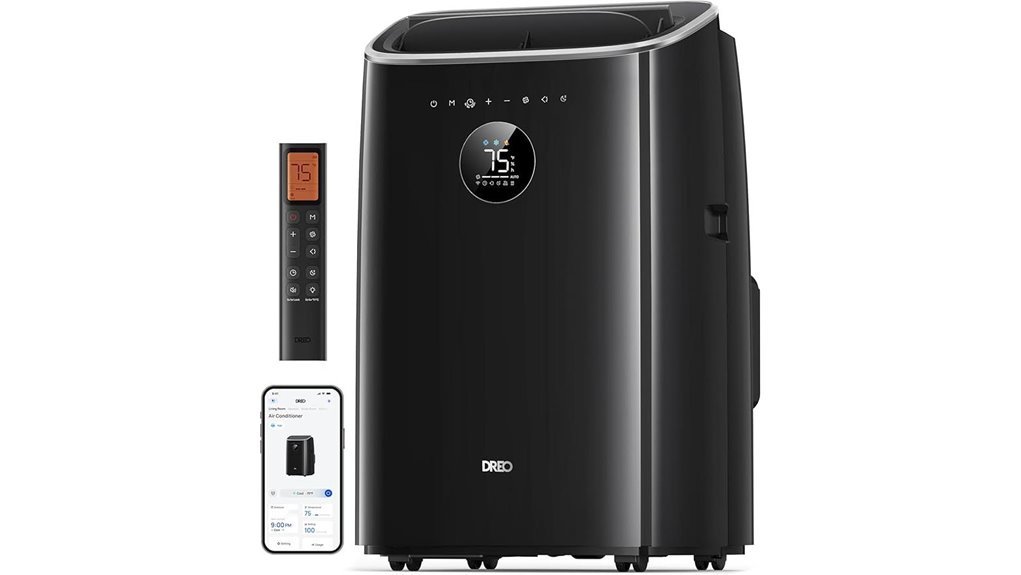
The DREO 318S is the compact smart option for a small bedroom or office. Its 8,000 BTU ASHRAE and 5,000 BTU SACC cooling system is listed for spaces up to 150 square feet, and it offers cool, fan, and dry modes. The smaller coverage figure is more realistic than trying to stretch an entry-level portable unit across a large living area.
You can adjust it through the DREO app, remote, touch panel, Alexa, Google Assistant, or Siri. The manufacturer lists noise as low as 45 dB, making it one of the quieter low-setting options in the group. A self-evaporation system reduces routine water handling during normal cooling, while a drain connection is available when conditions demand it.
Best For: Small bedrooms, offices, dorm-style rooms, and enclosed spaces where smart controls and lower noise matter.
Why You’ll Like It: It combines compact-room cooling with app schedules, voice control, and a low listed sound level.
Who Should Avoid It: Buyers trying to cool a large, sunny, poorly insulated, or open-plan room.
Pros:
- 8,000 BTU ASHRAE and 5,000 BTU SACC ratings.
- Quiet low-setting operation listed at 45 dB.
- App, remote, touch, and voice control options.
Cons:
- Best suited to rooms around 150 square feet.
- Still requires a window exhaust kit and floor space for the hose.
- Drainage needs can increase in very humid conditions.
Feelfunn 8,000 BTU Portable Air Conditioner with Remote
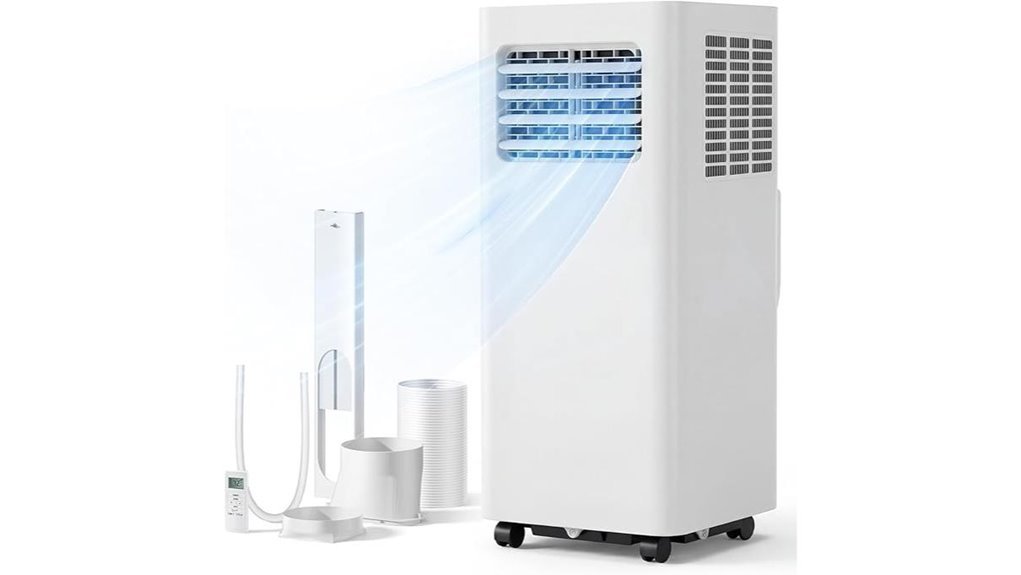
The Feelfunn is a compact 3-in-1 unit listed at 8,000 BTU ASHRAE and 5,000 BTU SACC. Its current listing states coverage up to 350 square feet, but that is an upper-end marketing figure for a portable AC with this SACC rating. It is more convincing for a smaller enclosed bedroom, office, dorm-style room, or apartment area than for a large open space.
It includes cool, fan, and dehumidifier modes, a remote, LED controls, sleep mode, a 24-hour timer, casters, hidden handles, a washable filter, and a window kit for common vertical or horizontal slider windows. Current product details list the unit at about 41.6 pounds and 48 dB, making it one of the lighter options in this group, although the noise figure still should not be read as silent operation.
Best For: Small rooms where compact dimensions, basic controls, mobility, and dry mode matter more than high cooling capacity.
Why You’ll Like It: It offers the core features most people need in a smaller, easier-to-position floor unit.
Who Should Avoid It: Buyers cooling a large, poorly insulated, high-ceiling, or sun-exposed room, or anyone who wants extensive manufacturer documentation and long-established brand support.
Pros:
- 8,000 BTU ASHRAE and 5,000 BTU SACC ratings.
- Remote, sleep mode, timer, casters, handles, and washable filter.
- Window kit supports common horizontal and vertical slider windows.
Cons:
- Real-world cooling may fall short of the 350-square-foot listing claim.
- No app or voice control.
- Requires an exhaust hose and may need drainage in humid conditions.
- Manufacturer documentation is limited, so confirm the current warranty and support terms before ordering.
Shinco 8,000 BTU Portable Air Conditioner with Remote
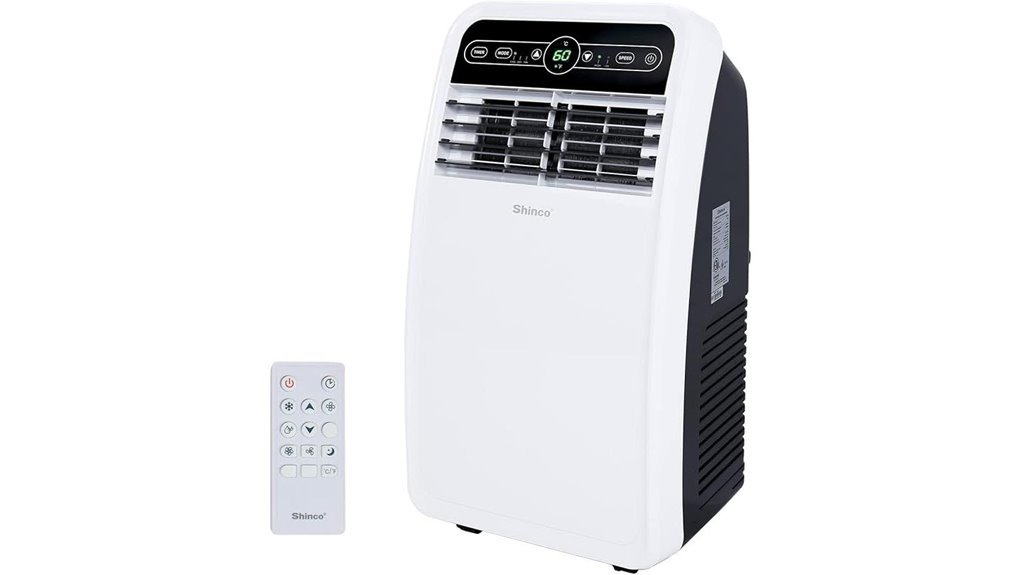
Shinco’s 8,000 BTU model is a simple 3-in-1 portable AC with 8,000 BTU ASHRAE and 4,550 BTU SACC ratings. Coverage claims for this ASIN vary across listings, so a conservative target of about 200 square feet is more useful than relying on the largest advertised number. It is best suited to a small bedroom, office, or enclosed sitting area.
The unit offers cool, fan, and dehumidifier modes, a remote, 24-hour timer, sleep mode, adjustable airflow, casters, and an included window kit. The listed dehumidification capacity is up to 19.2 liters per day under specified test conditions. Coverage and efficiency details vary across retailer pages, so compare the 4,550 BTU SACC rating and current EnergyGuide information rather than relying on the largest square-foot claim.
Best For: Buyers who want straightforward buttons, a remote, and basic dry mode for a small room.
Why You’ll Like It: It covers the essentials without requiring an app or smart-home setup.
Who Should Avoid It: Buyers who need medium-room cooling, app control, or a stronger SACC rating.
Pros:
- 8,000 BTU ASHRAE and 4,550 BTU SACC ratings.
- Cooling, fan, and dehumidifier modes.
- Remote, sleep mode, 24-hour timer, casters, and window kit.
Cons:
- Low 4,550 BTU SACC rating limits practical room size.
- Coverage specifications vary between listings.
- No app or voice control.
Factors to Consider When Choosing a Floor Air Conditioner With Dehumidifier Mode
The right unit depends on more than the largest BTU number. Compare SACC cooling capacity, room heat load, hose design, drainage needs, noise, controls, window compatibility, electrical requirements, and energy information. A correctly sized and properly sealed portable AC will usually perform better than an oversized model with a leaking window panel or a long, kinked exhaust hose.
ASHRAE vs. SACC Cooling Capacity
Portable AC listings often show two cooling numbers. ASHRAE BTU is the larger laboratory capacity, while SACC or DOE BTU accounts more realistically for heat added by the exhaust system and air infiltration. Use SACC first when comparing two portable units. A 14,000 BTU ASHRAE model may have a SACC rating closer to 9,500 or 10,000 BTU, so comparing only the large headline number can be misleading.
Room Size and Heat Load
Measure the room and then adjust for real conditions. Direct afternoon sun, poor insulation, high ceilings, several occupants, cooking appliances, and open doorways all increase the cooling load. Manufacturer coverage figures are useful for rough comparison, but they are not guarantees. For difficult rooms, choose based on SACC and avoid sizing at the absolute upper limit.
Hose Design and Window Fit
Every compressor-based portable AC in this guide must vent hot air outdoors. Confirm that the included slider panel fits your window type and opening width. Standard kits usually suit vertical or horizontal sliding windows, while casement or crank-out windows may need a separate seal. Keep the exhaust hose short, straight, and fully extended only as needed. Dual-hose designs can reduce negative pressure, while single-hose models are usually simpler and less bulky.
Dehumidifier Mode and Drainage
Dry mode can make a warm room feel more comfortable by removing moisture, but it does not turn a portable AC into a whole-home dehumidifier. Pints-per-day ratings are measured under specified temperature and humidity conditions and may not match your room. Self-evaporation can reduce bucket emptying during normal cooling, yet high humidity or dedicated dry mode may require a drain hose. For persistent dampness, water intrusion, or a large basement, use a properly sized standalone dehumidifier instead.
Noise Levels
Portable ACs place the compressor inside the room, so they are usually more noticeable than central air or many window units. Low-setting figures around 45 to 55 dB are useful for comparison, but compressor startup, cycling, vibration, and high fan speed can sound louder. For a bedroom, place the unit on a level floor, keep it away from rattling furniture, and choose sleep mode if available.
Energy Efficiency
Do not compare portable ACs by one headline efficiency claim alone. Look for the current CEER or EER, SACC/DOE capacity, input wattage, and EnergyGuide information when those figures are published for the model. Timers, sleep schedules, clean filters, a sealed window kit, and a sensible thermostat setting can reduce wasted runtime. An oversized unit is not automatically more efficient and may cycle before removing enough humidity.
Electrical Safety and Outlet Requirements
Portable air conditioners draw substantial current when the compressor starts. Use the grounded wall outlet and circuit specified in the product manual, keep the plug accessible, and avoid extension cords, power strips, or undersized smart plugs. Do not defeat the grounding pin or share an overloaded circuit with other high-draw appliances.
Portability and Maintenance
Casters make a 50- to 73-pound appliance easy to roll on one level, but they do not make it easy to carry upstairs. Check handle placement, dimensions, hose storage, and whether the filter can be removed without tools. Clean the filter according to the manual, inspect the drain plugs, and keep the air inlet and outlet clear.
- Measure the room and window opening.
- Compare SACC/DOE, not only ASHRAE BTU.
- Check whether your window needs a special seal.
- Plan a drainage route for very humid conditions.
- Confirm the grounded circuit and outlet meet the manual’s requirements.
- Allow clearance around the air intake and exhaust.
Frequently Asked Questions
How Often Should I Clean the Filter and Drain System?
Follow the product manual first. A practical starting point is to inspect the filter every two weeks during frequent use and clean it whenever dust is visible. Check drain plugs, hoses, and any internal tank regularly, especially in humid weather. Always switch off and unplug the unit before cleaning.
Can These Units Run Overnight?
They can usually run overnight when installed and operated according to the manual. Keep the exhaust hose secure, maintain the required clearances, use a grounded wall outlet, keep the filter clean, and arrange drainage if the tank may fill. Sleep mode can reduce fan speed, but it does not make the compressor silent.
Do I Need a Window Kit for Every Portable AC?
Yes for the compressor-based portable air conditioners in this guide. They must exhaust heat outdoors through a hose. Small “ventless air conditioners” are normally evaporative coolers, not refrigerated ACs, and they can add moisture to the room. That makes them a poor substitute in already humid conditions.
How Noisy Are Portable AC Dehumidifier Combos at Night?
Most are audible because the fan and compressor are in the room. Low settings commonly fall in the mid-40s to mid-50s dB range, but cycling and vibration may sound louder than the published number suggests. Light sleepers should prioritize low-setting noise, sleep mode, stable placement, and enough distance from the bed.
Is Dry Mode the Same as a Standalone Dehumidifier?
No. Dry mode is useful for cooling one room while reducing humidity, but its controls, drainage behavior, and operating range differ from a dedicated dehumidifier. A standalone unit is usually the better tool for a damp basement, crawl space, water-damage problem, or whole-area moisture control.
Which Is Better If Humidity Is My Main Problem: a Portable AC or a Dehumidifier?
Choose a portable AC with dry mode when you mainly need to cool one room and want humidity reduction as a secondary benefit. Choose a properly sized standalone dehumidifier when moisture control is the main job, especially in a basement, crawl space, persistently damp area, or space with water intrusion. A portable AC still has to vent heat outdoors, and its dry-mode behavior and drainage requirements vary by model.
Can I Use a Smart Plug With a Portable Air Conditioner?
Only when the appliance manual explicitly allows it and the smart plug is specifically rated for the unit’s running current and compressor startup load. Some portable ACs do not restart automatically after power is restored, and an undersized plug can overheat. A direct grounded wall outlet and the unit’s built-in timer or app are the safer default.
Conclusion
The best floor air conditioner dehumidifier is really a properly sized portable AC with a useful dry mode. For the strongest all-around combination, the Whynter ARC-14S is the first model to compare because it pairs a 9,500 BTU SACC rating with a dual-hose design. HUMHOLD has the highest listed SACC capacity in this group, DREO 319S is the best smart option, and DREO 318S makes more sense for a small room where low-setting noise and app control matter.
Feelfunn and Shinco are simpler small-room alternatives, but their coverage should be sized conservatively. Before ordering any model, measure the room and window, confirm the SACC rating, and decide where the exhaust hose and drain water will go. Those checks matter more than chasing the largest advertised BTU or square-foot number.