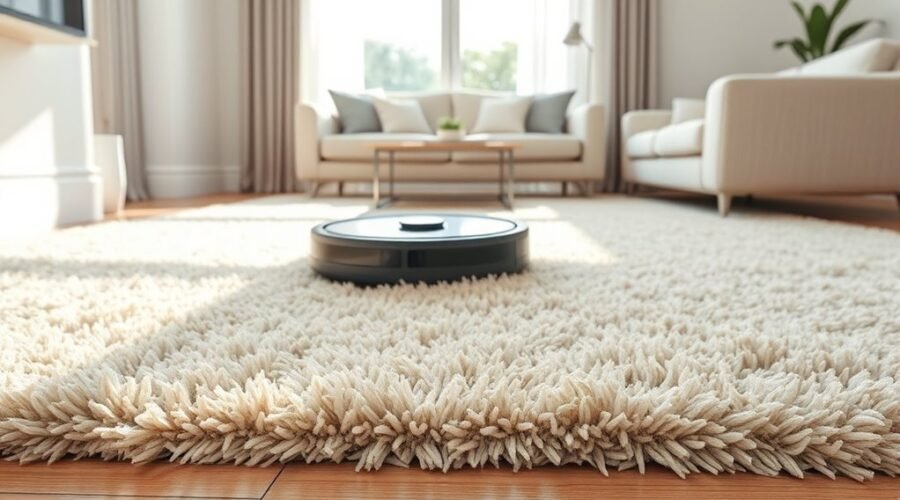
High-pile carpet traps dirt beneath long, soft fibers, making it harder for robot vacuums to clean. A robot vacuum for high-pile carpet needs good traction, suitable brushes, and enough clearance to move without getting stuck. This guide explains which features work, how popular models compare, and when manual cleaning is the better choice.
Quick Answer
Yes, some robot vacuums can clean high-pile carpet, especially models with adjustable chassis height, strong suction, effective brushes, and carpet-specific cleaning modes. However, thick shag rugs can trap wheels and brushes, while delicate fibers may suffer damage. Use a compatible robot for routine maintenance and a suitable manual vacuum for deeper cleaning.
Key Takeaways
- Check the manufacturer’s supported carpet pile height. A high threshold-climbing rating does not guarantee good carpet cleaning.
- Strong suction helps, but brush contact, airflow, traction, and repeated passes also affect debris pickup.
- The Roborock Saros 20 specifies carpet compatibility up to 1.18 inches (3 cm), subject to its operating conditions.
- Keep mop pads away from plush rugs, and avoid using aggressive brushes on delicate shag or wool carpet.
- Regular robot cleaning reduces surface debris, but deeply embedded dirt often requires an appropriate full-size vacuum.
Can Robot Vacuums Clean High-Pile Carpet?
)
Yes, robot vacuums can clean some high-pile carpets, but their success depends on the carpet and the robot’s design. Many models collect surface dust, crumbs, and pet hair. Removing dirt trapped near the carpet backing is more difficult.
High-pile carpet has longer fibers than standard low-pile flooring. Thick plush, frieze, and shag styles can create extra resistance as the vacuum moves.
A capable robot needs to overcome three challenges:
- Movement: Its wheels must maintain traction without sinking into the fibers.
- Debris pickup: The main brush must reach dirt without pulling excessively on the pile.
- Navigation: Sensors must recognize the surface and prevent unnecessary stops.
Premium models such as the Roborock Saros 20 and Dreame X50 Ultra offer advanced movement and carpet-cleaning features. However, their capabilities differ, and neither should be assumed suitable for every shag rug.
For ordinary plush carpeting, a compatible robot can reduce your daily cleaning workload. Very deep or delicate pile may still require manual care.
What Thick Carpet Needs From a Robot Vacuum
Thick carpet requires more than powerful suction. A robot must move freely, maintain useful brush contact, and avoid damaging the fibers.
Carpet pile height is one of the first things to check. Measure the exposed fiber length rather than assuming that a robot’s threshold-climbing specification applies to carpet.
A tall doorway threshold is a firm obstacle. Plush carpet compresses, bends, and creates ongoing resistance beneath the robot.
Several design features help:
- Stable wheels: Maintain traction across soft carpet.
- Suitable brush rollers: Agitate dirt without snagging fibers.
- Carpet Boost: Automatically increases suction when compatible carpet is detected.
- Adjustable chassis: Helps certain robots maintain clearance on thicker flooring.
- Multi-pass cleaning: Provides additional opportunities to collect trapped debris.
- Anti-tangle systems: Reduce hair buildup around brushes.
Thick-carpet performance depends on the combination of traction, airflow, brush contact, and carpet compatibility, not suction alone.
A self-emptying dock can also help if your household produces plenty of pet hair or debris. It reduces manual bin emptying, although you still need to clean brushes and filters.
Before using a robot on shag or delicate carpet, read the carpet manufacturer’s care instructions. Some fibers cannot tolerate aggressive rotating brushes.
Which Robot Features Matter Most?
The most useful robot vacuum features for high-pile carpet are reliable mobility, effective brushing, carpet detection, and suitable suction. These affect cleaning more directly than convenience features alone.
1. Suction power: Strong suction helps remove loose dirt and hair. Premium robots may advertise more than 10,000 Pa, but a higher number does not automatically mean better carpet pickup.
Pa means pascals, a measure of pressure. The advertised maximum does not describe every aspect of airflow, brush performance, or real-world debris removal.
2. Brush design: Dual rollers or rubberized brushes can improve contact with carpet and reduce hair tangling. However, they are not suitable for every delicate rug.
3. Carpet Boost: This setting increases suction when the robot detects carpeting. It can help with embedded debris while conserving energy on hard floors.
4. Mobility and clearance: Strong drive wheels and an adjustable chassis can help a robot move over dense fibers and raised rug edges.
5. Multi-pass cleaning: Repeated or cross-direction cleaning improves coverage in busy areas where grit and pet hair collect.
6. Navigation: Accurate mapping, obstacle avoidance, and no-go zones reduce interruptions near furniture, loose rugs, and tassels.
Look for documented carpet compatibility first. Then compare suction, brushes, and cleaning modes within the models that support your flooring.
Is Suction Enough for Thick Carpet?
No, suction alone cannot guarantee effective cleaning on thick carpet. A robot also needs a brush system that reaches debris and enough mobility to maintain steady contact.
A machine with impressive peak suction may still struggle if its wheels sink into the carpet or its brushes cannot move freely.
Suction vs Brush Contact
Suction draws air and debris into the vacuum. Brush contact loosens hair, dust, and particles trapped between carpet fibers.
Both matter because thick pile can hide debris below the surface. If the brush barely touches the fibers, the robot may leave dirt behind despite strong suction.
Dual rubber rollers can improve pickup on compatible carpet. Their design may also reduce hair wrapping compared with conventional bristle brushes.
However, more agitation is not always better.
The Carpet and Rug Institute’s high-pile vacuum guidance warns that rotating brushes can permanently change the texture of some shag and high-nap carpets.
For these delicate styles, a straight-suction vacuum with an appropriate floor tool may be safer than an aggressive rotating brush.
Warning: Do not run an aggressive rotating brush over delicate shag, loose-loop, or specialty carpet without confirming that the carpet manufacturer allows it. Snagging and excessive agitation can damage fibers. Stop immediately if the robot pulls strands or changes the carpet’s texture.
For compatible carpet, effective cleaning depends on four elements working together:
- Enough suction and airflow to collect loosened dirt.
- Suitable brush contact to release trapped particles.
- Stable movement to maintain coverage.
- Repeated passes when a single pass leaves debris behind.
Why Passes Matter
Repeated cleaning passes can improve thick-carpet pickup because the brush approaches fibers more than once. This helps collect debris that remains after the first cleaning cycle.
Some robots also clean in crossing directions, reaching dirt from different angles.
However, additional passes cannot overcome poor traction or an incompatible brush design. The vacuum must already be able to move safely across the carpet.
| Factor | Effect | Note |
|---|---|---|
| Pass count | Improves coverage | More opportunities to collect dirt |
| Suction | Helps remove loosened debris | Works with airflow and brush contact |
| Brush design | Releases trapped particles | Must suit the carpet fibers |
| Navigation | Supports consistent coverage | Reduces missed areas and stalls |
| Traffic zones | Collect dirt faster | May need more frequent cleaning |
Use extra passes mainly in entryways, living rooms, and other busy areas. If cleaning becomes slower without improving debris pickup, a suitable manual vacuum may work better.
Best Robot Vacuums for High-Pile Carpet
The best robot vacuums for high-pile carpet are models with documented carpet capabilities, suitable brushes, and dependable movement. However, not every premium robot supports extremely plush or shaggy flooring.
The following models offer features worth comparing. These are specification-based options, not an independently tested performance ranking.
Top High-Pile Picks
Five models from Dreame, Roborock, iRobot, and Shark illustrate different approaches to carpet cleaning. The most useful choice depends on your pile height, rug construction, and whether your home also has hard floors.
- Roborock Saros 20: A strong option to investigate for thicker carpet because it has a specific manufacturer-stated pile-height capability. Its AdaptiLift Chassis 3.0 adjusts the robot’s height, and Roborock specifies carpet cleaning for pile heights up to 1.18 inches (3 cm). The feature must be enabled in the app. Its published maximum suction is 36,000 Pa. See the official Saros 20 carpet and chassis specifications.
- Dreame X50 Ultra: A useful option for homes with several floor types and raised transitions. Its ProLeap system can cross certain obstacles up to 6 cm, while its carpet modes include suction boosting and repeated cleaning. However, Dreame’s published carpet examples focus on short and medium pile. Its climbing rating should not be treated as proof of deep-shag compatibility. See the Dreame X50 Ultra specifications.
- iRobot Roomba Combo 10 Max: Worth considering for pet owners who need regular vacuuming across carpet and hard floors. Its dual rubber brushes help manage hair, and Dirt Detect can trigger extra cleaning. Its retractable mop system also keeps the pad away from carpets. However, the manufacturer does not establish universal compatibility with very deep shag. See the Roomba Combo 10 Max product details.
- Shark PowerDetect: Suitable for comparison when raised rug edges and frequent debris are concerns. Models with NeverStuck Technology can lift to cross obstacles and thick carpet transitions. DirtDetect also adjusts cleaning when it detects heavier debris. Confirm the exact PowerDetect model before assuming it supports your rug. See the Shark PowerDetect NeverTouch Pro specifications.
Roborock S8 MaxV Ultra is another option for homes with mixed flooring. It includes dual rollers, Carpet Boost+, and 10,000 Pa advertised maximum suction.
Its VibraRise 3.0 system can lift the mop module up to 20 mm above the ground. However, mop clearance is different from carpet pile compatibility. See the Roborock S8 MaxV Ultra specifications.
If you have unusually thick shag, prioritize an explicit carpet-height specification over general claims about suction or obstacle climbing.
Carpet Performance Features
Comparing high-pile performance requires looking beyond a single specification. A vacuum must combine cleaning power with safe movement and proper carpet contact.
Consider these differences:
| Model | Relevant feature | Important limitation |
|---|---|---|
| Roborock Saros 20 | Adjustable chassis; stated support for pile up to 3 cm | Performance depends on carpet conditions and enabled settings |
| Dreame X50 Ultra | ProLeap movement; suction boost; repeated carpet cleaning | Threshold-climbing ability does not prove deep-shag compatibility |
| Roomba Combo 10 Max | Dual rubber brushes; extra cleaning passes; retractable mop | Very deep-pile compatibility is not established by the cited specifications |
| Shark PowerDetect | NeverStuck movement; automatic dirt detection | Carpet performance varies by model and rug construction |
| Roborock S8 MaxV Ultra | Dual rollers; Carpet Boost+; liftable mop | Mop-lift height is not a maximum supported pile height |
Manufacturer suction specifications can also vary widely. For example, the Saros 20 advertises 36,000 Pa, while the S8 MaxV Ultra advertises 10,000 Pa.
Those figures describe peak suction under stated test conditions. They do not establish which model removes more deeply embedded dirt from your particular carpet.
For a realistic comparison, consider carpet-height support, roller design, navigation, available cleaning modes, and the manufacturer’s stated limitations.
A self-emptying dock adds convenience, especially for pet hair, but it cannot compensate for poor brush contact or insufficient traction.
Set Up Your Robot for Carpet Success
Correct settings can improve high-pile carpet cleaning and reduce unnecessary stops. Start by confirming carpet compatibility, then adjust suction, cleaning passes, and restricted areas.
Use this routine for a robot that supports your carpet:
- Check compatibility. Confirm that the manufacturer permits the robot on your carpet’s pile height and fiber type.
- Prepare the area. Remove loose cords, small objects, and debris that could tangle around the brushes.
- Enable Carpet Boost. Select automatic suction boosting if your model supports it. Avoid Quiet mode when you need stronger pickup.
- Set additional cleaning passes. Use multi-pass cleaning in busy areas where a single pass leaves visible debris.
- Configure carpet protection. Select vacuum-only cleaning, mop removal, or suitable no-mop zones on plush rugs.
- Set no-go zones. Exclude long tassels, loose rug corners, and areas where the robot repeatedly gets stuck.
- Enable edge cleaning where suitable. Include wall edges after the main cleaning pass if your robot supports that option.
- Inspect the first cleaning run. Check for wheel slipping, tangled fibers, missed patches, or damage before scheduling unattended cleaning.
For general maintenance, schedule more frequent cleaning in busy rooms. Two or three sessions weekly may be a useful starting routine, although homes with pets or heavy traffic may need more.
Check the amount of dirt collected and adjust the schedule rather than relying on a fixed routine for every home.
Brushes and filters also need regular maintenance. Remove wrapped hair, empty the bin when needed, and follow the manufacturer’s filter-cleaning instructions.
Pro Tip: Before allowing unattended cleaning, run the robot on a small, less visible section of the rug while you watch. Compare the pile before and after cleaning. Stop if fibers pull, the robot drags heavily, or the brush makes unusual sounds.
If the vacuum completes its route without stalling and collects debris without disturbing the fibers, you have a better basis for using regular scheduled cleaning.
Can Vacuum-Mop Combos Handle Thick Rugs?
Some vacuum-mop combos can handle thick rugs, but their carpet performance depends on the vacuum system and how they manage mop pads. A combination model is not automatically weaker than a vacuum-only robot.
The main concern is preventing moisture from reaching carpet fibers.
Many hybrid robots lift their mop pads when they detect carpet. However, a small mop lift may be adequate for short pile but insufficient for a very plush rug.
Models that retract or detach their mops can offer better separation between wet cleaning and carpet vacuuming.
| Feature | Thick-rug effect |
|---|---|
| Carpet Boost | Increases suction when compatible carpet is detected |
| Multi-pass cleaning | Improves coverage and debris pickup |
| Brush maintenance | Helps maintain airflow and roller movement |
For plush rugs, consider three additional questions:
- Does the robot lift, retract, or detach the mop?
- Can it vacuum the rug without carrying a wet pad across the fibers?
- Does the manufacturer specify support for your carpet’s pile height?
A model that works well on hard floors may still struggle on thick carpeting. Mop handling and vacuuming ability must both suit your home.
When a robot cannot keep the mop safely clear, use a no-mop zone or exclude the rug from combination cleaning.
Common High-Pile Carpet Mistakes
Most high-pile carpet problems come from choosing an incompatible robot, using unsuitable settings, or ignoring early signs of trouble. Avoiding these mistakes helps protect both the rug and the machine.
- Choosing a robot made mainly for low-pile carpet: Basic models may lack the clearance and traction required for plush flooring.
- Running Quiet mode during heavy cleaning: Reduced suction may leave dirt and hair in the fibers.
- Leaving Carpet Boost disabled: The robot may use less suction than the carpet needs.
- Skipping extra passes: Busy carpeted areas may retain debris after one cleaning cycle.
- Ignoring tangled brushes: Hair and long fibers can interfere with roller movement and reduce pickup.
- Confusing threshold height with pile height: Crossing a firm obstacle is different from moving across soft carpet.
- Allowing brushes near loose tassels: Fringe can wrap around rollers or become damaged.
- Ignoring carpet care instructions: Some plush, shag, and delicate fibers are unsuitable for aggressive brush agitation.
Another problem involves the robot’s sensors.
Long fibers and very dark carpeting can sometimes interfere with cliff sensors, which are designed to prevent falls.
Roborock explains in its shag-carpet troubleshooting guidance that long fibers may trigger cliff detection and prevent the robot from cleaning.
If the robot refuses to cross a rug, the problem may involve its sensors rather than insufficient suction.
Do not cover or disable safety sensors to force it onto the carpet. Instead, clean the sensors according to the manual and exclude rugs the robot cannot recognize safely.
When a Robot Vacuum Is Not Enough
A robot vacuum may not be enough when thick carpet holds deeply embedded dirt, pet hair, or grit that its brushes cannot reach. It is also unsuitable when the machine repeatedly stalls or pulls at delicate fibers.
Even a capable model may keep the surface looking clean while leaving heavier debris near the backing.
| What happens | Result |
|---|---|
| Deep dirt remains trapped | The surface looks clean, but embedded soil remains |
| Brushes collect long hair | Pickup decreases and the robot may stop |
| The robot loses traction | Coverage becomes uneven or cleaning fails |
| Brushes pull delicate fibers | Carpet texture may become damaged |
| Heavy soil builds up | A suitable manual vacuum becomes necessary |
For routine surface cleaning, a compatible robot can save time. For deeper maintenance, a full-size vacuum with the correct carpet attachment usually offers more control.
Very high-pile or delicate shag carpet may need a straight-suction canister vacuum rather than an upright with an aggressive rotating brush.
For other carpet styles, an upright or canister with an adjustable cleaning head may work well if the carpet manufacturer approves its brush action.
Do not assume maximum suction and brush agitation are always the safest combination.
Long-term carpet care may also require professional cleaning when deeply embedded dirt cannot be removed with routine vacuuming.
The practical approach is to use the robot for compatible day-to-day cleaning and a suitable manual machine for thorough maintenance.
Frequently Asked Questions
Do Any Robot Vacuums Work on High-Pile Carpet?
Yes, some robot vacuums work on high-pile carpet. Models with adjustable chassis height, suitable rollers, strong suction, and advanced navigation can handle certain plush surfaces. However, compatibility depends on carpet thickness and fiber type. Very deep shag may still be unsuitable.
What Type of Vacuum Is Best for High-Pile Carpets?
A vacuum with suitable suction, adjustable cleaning height, and a carpet-safe floor tool is best for high-pile carpet. For delicate shag, a straight-suction canister vacuum may be preferable because aggressive rotating brushes can damage fibers. Follow the carpet manufacturer’s care instructions.
What Are the Downsides of Using a Robotic Vacuum Cleaner?
Robot vacuums can struggle with deeply embedded dirt, long carpet fibers, loose rugs, and navigation obstacles. They also require brush cleaning, filter maintenance, charging, and occasional manual help. Premium models can be expensive, and thick carpet may reduce cleaning efficiency and battery runtime.
Do Robot Vacuums Clean Carpets Well?
Yes, robot vacuums can clean carpets well when their suction, brushes, and movement systems match the flooring. Most perform more reliably on low- and medium-pile carpet than on deep shag. Carpet Boost, repeated passes, and regular maintenance can improve routine cleaning results.
Conclusion
Robot vacuums can maintain high-pile carpet, but the right model and settings make a major difference. Carpet compatibility, brush design, traction, and effective suction matter more than a single impressive specification.
Choose a robot that supports your carpet’s pile height, test it on a small area, and use suitable cleaning modes. For delicate shag or deeply embedded dirt, combine robot maintenance with a carpet-safe manual vacuum.
Sources
- The Carpet and Rug Institute: Vacuums for High-Pile Carpet: High-pile maintenance, brush-related damage risks, and suitable manual vacuum designs.
- Roborock: Saros 20: AdaptiLift Chassis 3.0, maximum advertised suction, carpet pile-height support, and cleaning features.
- Dreame: X50 Ultra: ProLeap climbing capabilities, carpet modes, mop lifting, and repeated cleaning.
- iRobot: Roomba Combo 10 Max: Dual rubber brushes, dirt detection, automatic cleaning, and retractable mopping.
- SharkNinja: Shark PowerDetect NeverTouch Pro: NeverStuck movement, carpet transitions, and debris detection.
- Roborock: S8 MaxV Ultra: Suction specification, dual-roller system, Carpet Boost+, and mop lifting.
- Roborock Support: Shag Carpet Troubleshooting: How long carpet fibers can interfere with cliff sensors and prevent robot movement.