A robot vacuum can expose more than dust collection habits if its Wi-Fi, app, or cloud account is left open. These devices often store maps, schedules, and home activity data, which can be valuable to attackers or intrusive vendors. The main risk is not the appliance itself, but the network access and data trail it creates. Practical controls can reduce that exposure, but the most important ones are often overlooked.
Robot Vacuum Wi-Fi Risks
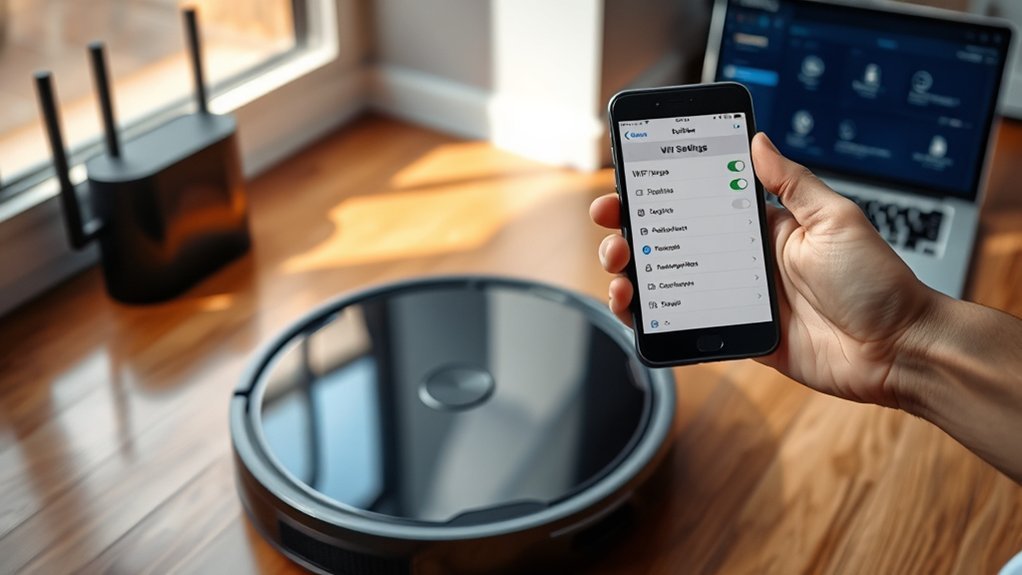
Robot vacuums introduce meaningful Wi-Fi security risks because they are networked devices that can be targeted by automated attacks, often exploiting weak passwords and default credentials.
In robot vacuum security, the attack surface extends beyond simple device takeover. The average smart home faces 29 intrusion attempts daily, and exposed vacuums can be hijacked when firmware contains unpatched flaws, as demonstrated by the DJI vacuum hack.
Once inside, adversaries may extract home maps, cleaning schedules, usage logs, and images, converting convenience into surveillance. These privacy risks matter because layout data can reveal routines, entry points, and occupancy patterns, supporting broader compromise.
Adversaries can turn robot vacuums into surveillance tools, exposing maps, schedules, logs, and home layout intelligence.
Cloud storage further increases exposure when transmitted or stored data is not encrypted, weakening data security and enabling unauthorized access at scale.
Poor network hygiene consequently creates a direct path from a household appliance to intimate domestic intelligence, leaving users dependent on infrastructure they do not control.
Lock Down Robot Vacuum Wi-Fi
To reduce the attack surface created by networked vacuum cleaners, the device should be isolated and hardened at the Wi‑Fi layer before routine use begins. For robot vacuum privacy, security and data protection depend on strict control of Wi‑Fi networks and credentials.
| Control | Risk Reduced | Action |
|---|---|---|
| WPA2/WPA3 | Interception | Enable strong encryption |
| Guest SSID | Lateral movement | Isolate the vacuum |
| Firmware updates | Exploits | Patch promptly |
A strong, unique password should be assigned, combining letters, numbers, and symbols. The vacuum should join a guest network, not the primary LAN, so personal devices remain outside its reach. WPA2 or WPA3 must secure the radio link against opportunistic intrusion. Firmware should be updated regularly to close known vulnerabilities and stabilize operation. Activity logs should be reviewed for unexpected connections, repeated failures, or unusual timing. This disciplined configuration preserves user autonomy by limiting surveillance, reducing compromise paths, and keeping the appliance inside a narrow, defensible trust boundary.
Secure the App and Account
The robot vacuum’s app and cloud account should be hardened with a strong, unique password and, where available, two-factor authentication to reduce the risk of unauthorized control or data exposure. Strong passwords should combine letters, numbers, and symbols, and never be reused across services.
Two-Factor Authentication adds a second verification step, forcing an attacker to defeat both credentials and time-sensitive codes. App permissions should be reviewed routinely so the application receives only the access required for operation, limiting unnecessary data reach.
The app itself should stay updated, because security patches close known vulnerabilities before they can be exploited. Account activity logs should be checked for unfamiliar logins, repeated failures, or configuration changes that suggest compromise.
This discipline reduces dependence on opaque platforms and restores user control over household devices. A hardened account is a practical safeguard against silent intrusion, unauthorized surveillance, and remote manipulation of cleaning routines and stored device data.
Tighten Privacy Settings
Privacy settings in the robot vacuum app should be reviewed regularly to restrict data sharing and minimize collection of home and usage information. Each control should be treated as a boundary against unnecessary exposure. Disable camera and audio features when they are not required, because those sensors can create security vulnerabilities through unauthorized access to recordings. Opt out of data collection options whenever the app permits, reducing transmission of PII and limiting profiles built from daily routines.
| Setting | Effect |
|---|---|
| Camera and audio off | Less sensitive capture |
| Data collection disabled | Less PII shared |
Cloud storage should be used only when encryption is confirmed, since unprotected logs and layout maps can reveal domestic patterns. Firmware updates should be applied promptly, because vendors often close privacy settings flaws and other security vulnerabilities in maintenance releases. The result is tighter control, lower surveillance risk, and greater autonomy over household data.
Pick a Robot Vacuum With Better Privacy
A robot vacuum’s privacy profile should begin with the vendor’s data policy, including clear controls over cloud use, local-only operation, and retention of map data.
Devices with strong encryption for transmission and storage, plus timely firmware updates, reduce exposure to interception and unauthorized access.
Models using LiDAR instead of cameras generally present lower privacy risk because they avoid capturing images of the home.
Privacy Policies Matter
When evaluating a robot vacuum for WiFi use, buyers should prioritize brands that publish clear privacy policies detailing what data is collected, how it is shared, and how long it is retained. Transparent privacy policies reduce uncertainty and help users resist silent data extraction.
Devices backed by recognized data security standards, such as TÜV Rheinland or ISO/IEC 27001, signal baseline controls rather than vague promises. Models with user-controlled privacy settings let owners limit account linkage, telemetry, and other sensitive disclosures.
Independent reviews, including Mozilla’s Privacy Not Included, can expose hidden risks before purchase. A liberation-minded buyer should favor products that minimize dependency on opaque cloud practices and preserve control at the device edge.
Privacy is not a luxury feature; it is a requirement for informed consent and practical autonomy.
Encryption And Updates
Encryption and update discipline should be treated as core procurement criteria for any robot vacuum connected to WiFi.
End-to-end encryption is essential because it limits exposure of home layouts, cleaning logs, and other telemetry during transmission. Models with regular firmware updates reduce residual risk by closing known vulnerabilities and hardening the device against remote compromise.
Buyers should favor brands with recognized security certifications, such as TÜV Rheinland or ISO/IEC 27001, because certification signals controlled data-protection practices. Strong privacy settings matter as well: they should permit clear control over sharing, telemetry, and PII collection.
Two-factor authentication further constrains unauthorized access. A vacuum that lacks these controls creates unnecessary dependence on vendor goodwill, while a well-secured model supports user autonomy and safer household operation.
Camera Vs LiDAR
Beyond encryption and update policies, the sensing method itself should be treated as a privacy decision. A robot vacuum with a camera can capture sensitive images of rooms, objects, and routines, creating a larger attack surface if the device or cloud account is compromised. Such systems often collect more data about home layout and activity, increasing exposure to unauthorized access.
LiDAR Technology reduces this risk by using laser-based mapping without storing visual imagery, limiting what can leak. Many LiDAR models also provide stronger privacy features, including user-controlled mapping disablement and data-sharing restrictions.
For users seeking liberation from unnecessary surveillance, the safer choice is usually LiDAR-based hardware, because it preserves navigation while minimizing visual disclosure and improving direct control over household data.
Protect Maps, Logs, and Cloud Data
Maps, logs, and cloud-stored room layouts should be treated as sensitive data, since they can reveal a home’s floor plan, usage patterns, and occupancy habits.
In robot vacuum cameras and navigation systems, privacy and security depend on disciplined data handling. The app should be audited regularly, with sharing and retention settings reduced to the minimum needed.
Cloud backups of maps and logs must use strong encryption, because weak storage creates an easy breach path for outsiders and vendors alike.
Cloud backups of maps and logs should be strongly encrypted, preventing weak storage from exposing private household data.
Account access should rely on strong, unique passwords, plus two-factor authentication to block unauthorized logins.
Firmware updates are necessary, since vulnerabilities in mapping and logging code can expose private records.
When the device is idle, disconnecting it from Wi-Fi narrows the attack surface and limits remote tampering.
A liberated user keeps control by denying unnecessary collection, enforcing encryption, and treating every stored route as a potential surveillance artifact.
Frequently Asked Questions
Are Robot Vacuums Safe for Privacy?
Generally, robot vacuums are not fully safe for privacy; data collection, weak user consent, and inconsistent device encryption can expose home maps and activity patterns. Security depends on vendor practices, firmware discipline, and access controls.
How Can I Discreetly Hide My Robot Vacuum Inside a Cabinet?
Out of sight, not out of mind: a ventilated cabinet design with hidden storage should preserve vacuum accessibility, allow dock clearance, and avoid heat buildup. Cable routing must remain tidy, unobstructed, and immediately serviceable.
Which Robot Vacuum Is the Most Privacy Friendly?
Valetudo-based robot vacuum brands are generally the most privacy friendly, because local-only processing minimizes exposure; Narwal and Matic follow with strong privacy features and data encryption, while Ecovacs remains acceptable only with strict opt-out controls.
What Are the Potential Security Risks With Robot Vacuums?
Robot vacuums can expose data vulnerabilities, enable unauthorized access, and amplify intrusion if firmware updates are ignored. Coincidence often reveals patterns: maps, schedules, and camera feeds quietly disclose household rhythms, empowering surveillance and coercion.
Conclusion
Securing a robot vacuum on Wi‑Fi requires layered controls: WPA2/WPA3, a segregated guest network, strong unique credentials, and two-factor authentication. Privacy risks are reduced further by limiting data sharing, disabling unneeded sensors, and keeping app and firmware updates current. Users should also inspect logs and cloud settings for anomalies. With these measures in place, the device becomes less of an open door and more of a locked toolbox in the home network.