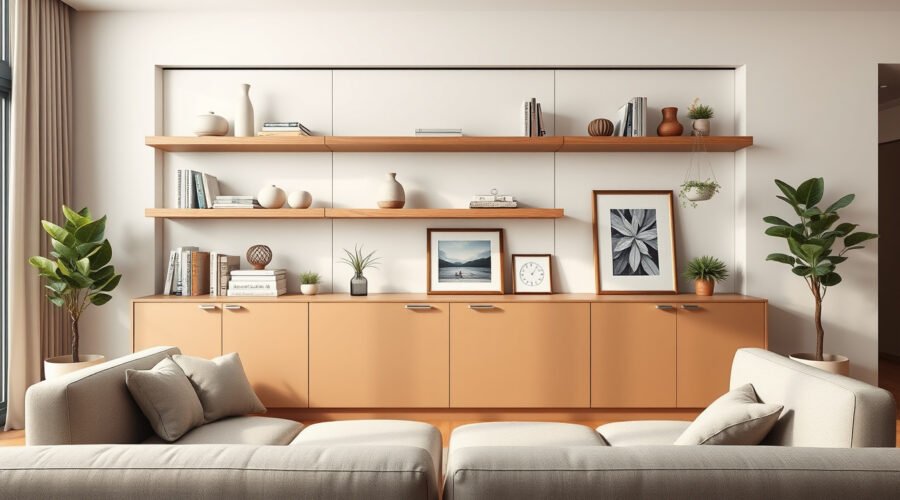
Choosing between open shelving vs. closed storage in your living room comes down to what you own, how fast you need to reach it, and how much visual upkeep you tolerate. Open shelves turn books, art, plants, and ceramics into part of your decor while keeping daily favorites at arm’s reach. Closed cabinets conceal toys, tangled cables, gaming gear, paperwork, and extra throws behind clean doors or drawers. For most living rooms, pairing closed base cabinets on the bottom with limited open shelving above delivers the best balance of calm organization and personal style.
Quick Answer
Choose open shelving when visibility, quick grab-and-go access, and decorative display matter most. Choose closed storage when you need to hide everyday clutter, reduce direct dust buildup, and reset the room quickly. In multipurpose living rooms, aim for roughly two-thirds closed cabinetry below and one-third open shelving above.
Key Takeaways
- Match depth to contents: Standard open bookshelves need 10 to 12 inches of depth, while closed media consoles and sideboards typically require 15 to 20 inches to fit electronics, board games, and storage bins.
- Respect weight limits: Floating open shelves mounted into two wood wall studs safely hold 35 to 100 pounds depending on bracket and wood thickness, whereas drywall-only anchors max out at 10 to 25 pounds.
- Leave breathing room on open shelves: Fill open shelving to only 60% to 70% capacity so displayed items look intentional rather than crowded.
- Plan for airflow and safety: Leave 4 to 6 inches of ventilation clearance around heat-producing electronics inside closed cabinets, and anchor tall bookcases or consoles directly to wall studs.
Open Shelving vs. Closed Storage: Quick Comparison
Open shelving and closed storage differ in how they handle visual clutter, usable depth, cleaning time, and room flow. While open ledges keep items visible and shallow against the wall, enclosed cabinets trade a slightly deeper footprint for high-capacity concealment. Use the comparison table below to weigh how each option performs in a real living room.
| Feature | Open Shelving | Closed Storage |
| Best for | Hardcover books, framed art, trailing plants, ceramics, travel souvenirs, and curated decor | Toys, board games, power strips, cables, paperwork, gaming consoles, extra throws, and bulky gear |
| Typical depth | 10 to 12 inches for standard books and decor; 12 to 14 inches for larger baskets or vinyl records | 15 to 20 inches for media consoles and credenzas; 18 to 24 inches for built-in base cabinets |
| Everyday access | Immediate one-hand reach because every item stays visible | Requires opening a door or drawer and needs 14 to 22 inches of front pull-out or swing clearance |
| Clutter control | Low unless shelves stay edited with 30% to 40% empty negative space | High because mismatched packaging, cords, and everyday supplies stay out of sight |
| Aesthetic feel | Airy, layered, personal, and decorative | Clean, architectural, calm, and streamlined |
| Maintenance | Requires weekly damp dusting around and beneath individual objects plus visual restyling | Faster exterior wipe-downs and reduced interior dust, with seasonal drawer decluttering |
| Small rooms | Keeps upper walls feeling open when lightly styled and matched to wall color | Prevents visual crowding when flat-front or legged cabinets hide busy household gear |
| Kids and pets | Leaves fragile items exposed on lower ledges and can tempt climbing if toys sit high | Blocks casual reach and accepts child safety latches, though tall units still require wall anchoring |
Why Choose Open Shelving?
Open shelving works best when your storage doubles as wall decor and holds items you enjoy seeing every day. It keeps books, framed photos, ceramic vessels, plants, and woven baskets visible while preserving an airy, open sightline across the wall. In compact living rooms, replacing bulky upper cabinets with open ledges draws the eye upward without boxing in the seating area.
Open shelves also excel in dead zones where cabinet doors cannot swing open easily. You can mount floating shelves in narrow alcoves beside a fireplace, above a radiator or low credenza, or next to a reading chair where a hinged door would hit an armrest. Custom wood open shelving also typically costs less per linear foot than custom cabinetry because it eliminates doors, hinges, and drawer boxes.
The primary trade-off is ongoing maintenance. Because both the shelf surface and every displayed object sit exposed to room air, settled house dust accumulates quickly. According to U.S. EPA indoor particulate matter guidance, frequent dusting with a damp cloth and using a HEPA-filter vacuum prevents settled dust, pollen, and pet dander from being kicked back into the air during cleaning.
Pro Tip: Treat open shelves like an art gallery, not a utility closet. Leave 30% to 40% of each shelf empty as negative space, repeat two or three colors across the wall, and limit woven baskets to one or two per unit so the shelves do not look heavy.
Pros and Cons of Closed Storage
Closed storage is the most practical choice when your living room holds utilitarian, mismatched, or bulky household items. Sideboards, media consoles, credenzas, storage ottomans, and built-in base cabinets conceal remotes, tangled cords, board games, pet gear, and paperwork behind solid fronts. The main drawbacks are a deeper floor footprint, higher furniture cost, and the clearance needed to swing doors or pull out drawers.
Recommended Products

3-Tier Storage Spaces console table: The 3-tier narrow console table includes 2 dense mesh shelves and 2 spacious non-woven fabric drawers below the wooden tabletop. 2-tier open shelf design allows you to place books, vases, DVDs, storage boxes, etc. assuring your desktop is more tidy and satisfying your various needs
Organized and Clutter-Free Appearance
Closed storage creates an instant sense of calm by removing visual noise from your line of sight. That visual barrier matters most in multipurpose living rooms that double as a home office, kids’ play zone, or media room.
Neuroscience and environmental psychology confirm why hidden storage feels more relaxing. As summarized in a Princeton Alumni Weekly report on visual clutter, psychology professor Sabine Kastner found that visible clutter actively competes for your brain’s attention. In a 2011 functional MRI study in The Journal of Neuroscience, McMains and Kastner demonstrated that multiple simultaneous stimuli in the visual field mutually suppress neural activity in the visual cortex, forcing top-down attention to work harder to filter distractions.
Household clutter can also affect daily stress levels. A 2010 UCLA study published in Personality and Social Psychology Bulletin by Darby Saxbe and Rena Repetti found that homeowners who described their living spaces as cluttered or unfinished experienced flatter diurnal cortisol slopes and increased depressed mood throughout the day. Closing a cabinet door eliminates dozens of competing visual stimuli in seconds.
Enhanced Protection for Items
Closed cabinets shield stored belongings from direct room dust, cooking aerosols, pet hair, sunlight fading, and accidental spills. While standard cabinet doors are not airtight, they drastically cut how often you have to wipe down individual board games, seasonal decor, camera gear, or extra linens.
Doors and drawers also deter pets from chewing cords or knocking breakables onto the floor. If you have toddlers, solid cabinet doors allow you to install hidden magnetic or spring-loaded safety latches inside the frame—an option that open shelving cannot support.
Customizable Storage Solutions Available
Modern closed storage furniture offers interior and exterior options that adapt to both media equipment and household supplies. Look for cabinets with 32-millimeter adjustable shelf pin holes, pull-out trays, rear cable-management grommets, and felt-lined shallow drawers for remotes.
Door materials also let you tune the balance between concealment and texture:
- Solid wood or painted MDF doors: Provide 100% visual concealment for mixed household clutter and blend into painted walls.
- Cane, rattan, or perforated metal inserts: Hide interior mess while allowing airflow and infrared remote signals to pass through to media devices.
- Reeded, ribbed, or fluted glass doors: Diffuse shapes into soft silhouettes while bouncing light back into a dark room.
- Clear tempered glass doors: Keep collectible books and ceramics visible while cutting direct dust buildup by roughly 80% compared to open shelves.
Key Differences Between Open and Closed Storage
Beyond visibility, open shelving and closed storage differ in their usable dimensions, structural weight limits, floor clearance requirements, and tip-over risks. Comparing these physical specifications before you shop prevents sagging shelves, blocked walkways, and unsafe installations.
Open shelving is shallower and relies heavily on wall framing or shelf thickness to prevent bowing. Closed cabinetry is deeper and transfers weight to the floor (or across multiple wall studs in a floating console), allowing you to stack heavy items densely without worrying about how they look. Compare the standard dimensions and load limits for common living room storage pieces below.
| Storage Type or Item Category | Recommended Depth | Vertical Shelf Spacing | Typical Safe Load & Structural Notes |
|---|---|---|---|
| Floating open shelf (drywall anchors only) | 6 to 8 inches | 10 to 12 inches | 10 to 25 lbs total with heavy-duty toggle bolts; suitable for light frames and small plants only |
| Floating open shelf (anchored into 2 wood studs) | 10 to 12 inches | 10 to 14 inches | 35 to 50 lbs per stud (75 to 100 lbs across two studs) using 1.5- to 2-inch solid hardwood and steel rod brackets |
| Standard bookcase (novels, hardcovers, decor) | 10 to 12 inches | 9 to 11 inches | A 36-inch span of 3/4-inch plywood holds up to 129 lbs; 3/4-inch MDF bows past 1/4 inch around 87 lbs |
| Oversized art books, vinyl records, and baskets | 12 to 15 inches | 12 to 15 inches | Heavy art books and vinyl weigh 25 to 35 lbs per linear foot; limit shelf spans to 30 to 36 inches to prevent sag |
| Closed media console or credenza | 15 to 20 inches | 10 to 16 inches (adjustable) | Supports TVs and heavy AV receivers; allow 16 to 20 inches in front for cabinet doors or drawers to open |
| Built-in closed base cabinets | 18 to 24 inches | 12 to 18 inches | Floor-supported framing handles bulky appliances, board game stacks, and heavy storage bins |
When measuring for closed cabinets, factor in walkway and door-swing clearances. In line with U.S. Access Board ADA accessibility guidelines, maintain at least 36 inches of clear width for main living room walkways (and never less than 32 inches at narrow pinch points up to 24 inches long). If a closed sideboard has 18-inch hinged doors, check that opening them does not collide with your coffee table or sofa.
Furniture stability is equally critical. Under the CPSC mandatory safety standard for clothing storage units (16 CFR Part 1261) incorporating ASTM F2057-23, freestanding dressers and chests at least 27 inches tall, weighing 30 pounds or more, with 3.2 cubic feet or more of enclosed storage must pass strict tip-over stability tests with 60-pound test weights. However, open bookcases, display shelves, and many living room media consoles fall outside that clothing-unit definition and can tip easily if unanchored.
Warning: Always anchor TVs, bookcases, and tall living room cabinets directly into wall studs using anti-tip brackets or straps. According to CPSC furniture safety guidance, tip-overs caused 217 reported fatalities between 2013 and mid-2023—71% involving children ages one to three—so always store heavy items on bottom shelves and keep remotes, candy, or toys off high ledges where kids might climb.
Which Storage Is Right for Your Living Room? Use This 3-Step Test
Sorting your existing living room belongings before shopping tells you the exact ratio of open shelving vs. closed storage your space requires. Instead of guessing based on catalog photos, run everything you plan to store through this three-step audit.
- Run the display test: Group every item into two piles—things that add beauty to the room (hardcover books, framed photos, pottery, plants) and functional necessities that create visual noise (routers, cords, toys, paperwork, spare throws). Measure the volume of each pile.
- Run the access test: Identify items you reach for daily versus weekly or seasonally. Daily essentials belong between waist and eye level (30 to 60 inches off the floor)—either on open shelves for instant reach or inside top-row drawers and easy-open cabinets.
- Run the maintenance test: Decide how many minutes per week you will realistically spend dusting and straightening. If lifting and wiping around dozens of decorative objects every week feels like a chore, shift your budget toward closed cabinets or glass-front doors.
If your audit leaves you with roughly 70% practical household gear and 30% display items, choose a hybrid layout with closed base cabinetry and two or three open shelves above.
Practical Considerations for Open Shelving
Getting open shelving right requires deliberate spacing, structural support, and visual restraint so your wall looks styled rather than messy. Before mounting brackets or buying an open bookcase, apply these five setup rules:
- Follow the 60/40 fill rule: Cover only 60% to 70% of each shelf’s surface area and leave 30% to 40% empty negative space so individual objects stand out.
- Choose rigid materials for wide spans: If your shelves span 36 inches or more and hold heavy books, choose 1.5-inch solid hardwood (such as oak, walnut, or maple) or 3/4-inch cabinet-grade plywood with a hardwood front edge. Thin particleboard or MDF shelves often sag noticeably within 12 to 18 months under sustained book loads.
- Vary object heights in triangles: Group items in odd numbers (threes or fives) and stagger tall vertical pieces, medium vessels, and low horizontal book stacks to guide the eye smoothly across the wall.
- Limit basket count: Use matching woven or canvas bins on the lowest open shelf for quick-grab items like throw blankets, but avoid lining every shelf with bins—which turns open shelving into clunky faux drawers.
- Keep cords and paper off the ledges: Never use open shelves for mail piles, charging stations, loose medications, or fragile heirlooms at pet-tail height.
How Closed Storage Organizes Your Space
Closed storage transforms chaotic living rooms by replacing dozens of small, colorful item silhouettes with calm, continuous cabinet fronts. To make closed cabinetry work efficiently, you need both the right furniture footprint and an organized interior layout.
Maximum Space Use
Closed storage makes the best use of the lower 24 to 36 inches of wall height, where open shelving is hardest to reach and most vulnerable to pets and toddlers. Because solid doors conceal the interior, you can utilize 90% to 100% of the internal cubic volume with stacked games, files, or media accessories without hurting the room’s appearance.
In a small living room, prevent closed cabinetry from feeling boxy by choosing a wall-mounted floating credenza or a sideboard on 6- to 8-inch tapered legs. Seeing continuous flooring underneath the cabinet tricks the eye into reading the room’s footprint as wider.
Clutter Concealment Solutions
Without internal boundaries, a deep closed cabinet quickly turns into a dark junk drawer where small items disappear at the back. Equip the interior of your closed storage with dedicated zones:
- Shallow top drawers with dividers: Corral TV remotes, gaming controllers, coasters, spare batteries, and charging cables so you never have to dig for them.
- Pull-out bins or labeled baskets on deep shelves: Group board games, kids’ craft supplies, pet leashes, and seasonal candles by category so you can slide a whole bin out like a drawer.
- Vertical file slots or magazine files: Keep instruction manuals, warranties, and household paperwork upright inside a single cabinet bay.
Aesthetic Impact: Open vs. Closed Storage
Open shelving and closed storage shape the mood, visual weight, and focal point of your living room in opposite ways. Open shelves introduce shadow lines, book spines, organic plant shapes, and personal history, making a room feel warm, collected, and lived-in. Painting the wall behind open shelves a contrasting shade—or matching floating shelves to the exact wall paint—changes whether the display pops or recedes.
Closed storage acts as quiet architecture. By presenting smooth wood grain, matte paint, or subtle fluted texture, closed cabinets allow statement pieces like an oversized sectional, a fireplace mantel, a large canvas painting, or a picture window to command the room.
A practical living room does not need to choose all open or all closed storage. Hide the visually distracting items and reserve open shelves for the pieces that deserve attention.
Maintenance: Which Option Is Easier?
Closed storage is significantly easier to maintain day to day because cabinet doors block most airborne room dust and hide imperfectly stacked items. Wiping down flat cabinet doors and hardware with a damp microfiber cloth takes two minutes, whereas cleaning an open bookcase requires lifting every vase, frame, and book stack to wipe underneath.
If you choose open shelving, cut your cleaning time by avoiding tiny knickknacks, using fewer larger statement pieces, and running a portable HEPA air purifier in the living room to capture airborne dust before it settles. For closed cabinets, wipe fingerprint smudges around pulls weekly and schedule a 15-minute interior declutter every season so hidden shelves stay functional.
Best Choice by Lifestyle
Your household routine, room size, and housing status should guide your balance of open vs. closed storage:
- Small apartment or studio: Use a legged or wall-mounted closed credenza for 70% to 80% of your storage so multi-use living/working clutter disappears, paired with one or two upper floating shelves to draw the eye up.
- Family living room with young kids: Prioritize closed base cabinets with child-resistant latches for toys and electronics, anchor all units to studs, and keep upper open shelves strictly for lightweight, non-tempting decor.
- Pet-friendly household: Avoid low open shelves where wagging tails knock over ceramics or pet hair collects on woven baskets; use closed cabinets below 36 inches.
- Book lover or art collector: Use 10- to 12-inch deep open bookcases or glass-front cabinets so spines and art remain visible, and group books by height or color for visual calm.
- Minimalist home: Choose handleless push-to-open closed cabinetry finished in the same color as your walls for a flush, built-in architectural look.
- Renter: Choose freestanding modular bookcases with removable lower cabinet door inserts, and secure tall units into wall studs—patching two small screw holes when moving out takes minutes and prevents dangerous tip-overs.
Mixing Open and Closed Storage Options
A hybrid storage layout—combining closed base cabinets on the bottom with open shelving on top—gives most living rooms the highest functionality and visual appeal. Designers commonly use a two-thirds closed, one-third open ratio (or a 60/40 split) so everyday mess stays concealed at floor level while eye-level walls stay light and personal.
Use this five-step blueprint to build a balanced mixed storage wall:
- Anchor the base with closed cabinets: Install a 24- to 32-inch-high closed credenza or built-in base cabinet (16 to 24 inches deep) along the bottom to hold heavy items, cords, and games.
- Step back the depth for upper open shelves: Mount 10- to 12-inch deep open shelves starting 12 to 18 inches above the base cabinet counter so the upper wall feels open and won’t bump your head.
- Frame the television with breathing room: On a media wall, leave at least 4 to 6 inches of visual space around the TV screen rather than crowding open shelves right against the bezel.
- Repeat finishes for cohesion: Match the wood species of your floating open shelves to your coffee table, floor tone, or cabinet hardware so the two systems look unified.
- Add integrated lighting: Install warm LED puck lights or recessed strip lighting (2700K to 3000K) under the lowest open shelf to illuminate the countertop and avoid dark shadows.
Note: Never seal heat-producing electronics inside an unventilated closed cabinet. Manufacturers such as Sony recommend at least 4 inches (10 cm) of open airflow clearance behind and around a PlayStation 5, while AV receiver makers like Denon specify 5 to 6 inches of top clearance and 2 inches on each side—or cabinet doors with cane mesh, louvers, or thermostatic cooling fans.
Common Mistakes to Avoid
Even expensive custom built-ins or designer shelving can frustrate you daily if the dimensions, mounting method, or door clearances are wrong. Watch out for these seven common living room storage mistakes:
- Packing open shelves from edge to edge: Stuffing every inch of an open shelf turns a display wall into a visible storage locker; always leave 30% to 40% empty space.
- Mounting heavy floating shelves into drywall alone: Plastic drywall plugs fail under book loads; always anchor floating shelf brackets into solid wood studs (typically spaced 16 inches on center).
- Using wide spans of thin MDF for heavy books: Unsupported 3/4-inch MDF spans wider than 32 to 36 inches bow permanently under hardcover books or vinyl records.
- Trapping hot electronics behind solid doors: Running gaming consoles, amplifiers, or routers inside sealed wooden cabinets causes thermal throttling and premature hardware failure.
- Skipping wall anchors on freestanding units: Assuming a heavy cabinet won’t tip is dangerous; open drawers or climbing children shift the center of gravity forward rapidly.
- Forgetting baseboard thickness and outlet locations: Standard baseboards (0.5 to 0.75 inches thick) push flush furniture away from the wall and can block power outlets unless the unit has a rear notch or cord cutout.
- Blocking walkways with cabinet door swings: Failing to measure the open door arc can trap traffic between the cabinet and your coffee table.
Making the Right Choice for Your Living Room
Make your final choice between open shelving and closed storage by matching your furniture to the exact items sitting in your living room right now:
- Go with mostly open shelving if at least 70% of your items are books, art, plants, and pottery, your room lacks floor depth for 18-inch cabinets, and you don’t mind weekly damp dusting.
- Go with mostly closed storage if your living room handles kids’ toys, board games, work paperwork, pet gear, or media cords, and you want to reset the room in under five minutes before guests arrive.
- Go with a 60/40 or 70/30 hybrid system if you want concealed lower cabinets for practical clutter and two or three open upper ledges for personal display.
Frequently Asked Questions
What are the pros and cons of open shelves?
Open shelves make a living room feel lighter and more personal, cost less than custom cabinetry, and provide instant grab-and-go access to books, plants, and decor. The main drawbacks are faster dust accumulation, lower storage density, and the need to keep displayed items visually edited with 30% to 40% empty space.
Are open shelves better than closed cabinets?
Neither option is universally better for every living room. Open shelves are better for displaying books, art, and plants in shallow spaces (10 to 12 inches deep), while closed cabinets are better for hiding visual clutter like toys, cables, and board games. Most living rooms perform best with a hybrid mix of closed cabinets on the bottom and open shelves above.
Which option is easier to keep clean?
Closed storage is much easier to keep clean because solid or glass doors block most airborne room dust and hide everyday items inside. Open shelving requires weekly damp dusting where you lift and wipe around each individual object so settled dust does not build up.
Is open shelving a good idea in a small living room?
Yes, a limited number of upper open shelves can make a small living room feel wider and taller because the wall remains visible behind the objects. However, packed open shelves quickly make a compact room feel chaotic, so pair a few airy upper shelves with a closed, legged credenza below to hide bulky clutter.
What should I store in closed cabinets?
Store visually distracting or utilitarian items in closed cabinets, including remote controls, charging cables, routers, gaming consoles (with proper ventilation), board games, kids’ toys, paperwork, pet supplies, and extra blankets. Always place the heaviest items on lower shelves or drawers and anchor the cabinet to wall studs.
Can I mix open shelving and closed storage?
Yes, combining roughly two-thirds closed storage on the bottom with one-third open shelving above is the most versatile layout for a living room. Lower closed cabinets (16 to 24 inches deep) conceal heavy or messy household gear, while shallower upper open shelves (10 to 12 inches deep) display books, plants, and personal art at eye level.
Does closed storage make a small living room look bigger?
Closed storage can make a small living room feel calmer and more spacious when flat doors painted to match the wall or raised on 6- to 8-inch legs hide dozens of mismatched items. Avoid floor-to-ceiling solid cabinets in a narrow room unless they are recessed or painted the exact wall color, and maintain at least 36 inches of walkway clearance.
How deep and far apart should living room shelves be?
Standard open living room shelves should be 10 to 12 inches deep and spaced 9 to 12 inches apart vertically for regular books and decor, or 12 to 15 inches deep and 12 to 15 inches apart for oversized art books, vinyl records, and woven baskets. Closed media consoles and base cabinets typically need 15 to 24 inches of depth.
Conclusion
Open shelving and closed storage solve complementary problems in a living room: open ledges bring warmth, personality, and instant access to your favorite books and decor, while closed cabinets eliminate visual clutter and cut weekly dusting time. Before buying any furniture, measure your available walkway clearance, sort your belongings into display versus conceal piles, and anchor your chosen storage securely to your living room wall studs.
Sources
- U.S. EPA: Sources of Indoor Particulate Matter: supports guidance on frequent cleaning, damp dusting, and HEPA filtration to reduce settled indoor dust.
- Princeton Alumni Weekly: Psychology: Your Attention, Please: summarizes Princeton psychology professor Sabine Kastner’s findings on visual clutter and attention.
- The Journal of Neuroscience (McMains & Kastner, 2011): supports fMRI findings showing multiple visual stimuli compete for neural representation in the human visual cortex.
- Personality and Social Psychology Bulletin (Saxbe & Repetti, 2010): supports the UCLA study linking cluttered home environments to diurnal cortisol patterns and depressed mood.
- U.S. Access Board: ADA Chapter 4 Accessible Routes: supports the 36-inch minimum continuous clear width for accessible walkways and 32-inch minimum clearance at narrow points.
- U.S. Consumer Product Safety Commission: Clothing Storage Units (16 CFR Part 1261 / ASTM F2057-23): supports mandatory tip-over stability testing criteria (27+ inches tall, 30+ lbs, 3.2+ cubic feet) and scope distinctions for freestanding furniture.
- U.S. Consumer Product Safety Commission: Furniture and TV Anchoring Guidance: supports tip-over fatality data (217 deaths between 2013 and mid-2023), anchoring furniture and TVs, keeping heavy items low, and keeping remotes and toys off high shelves.