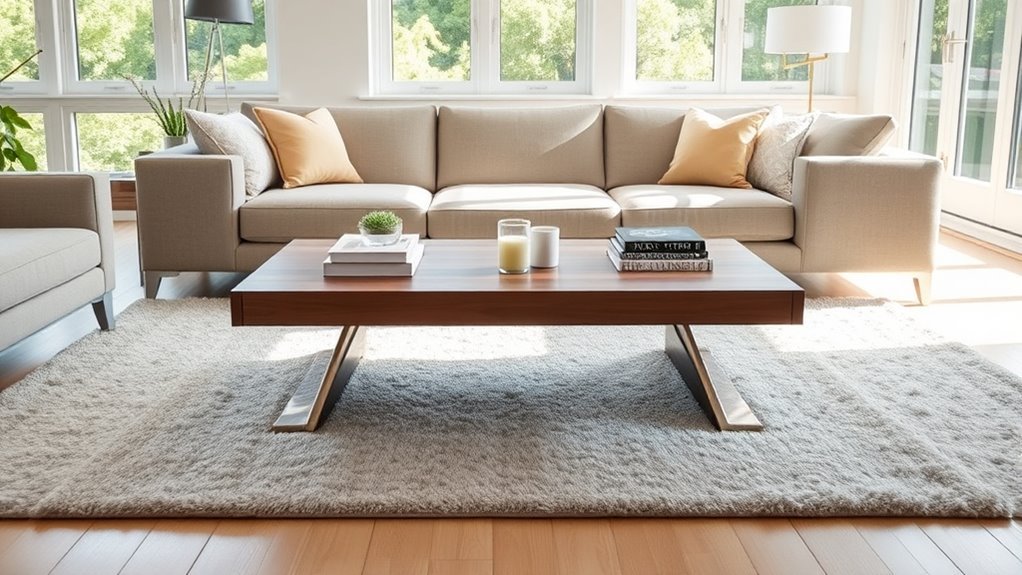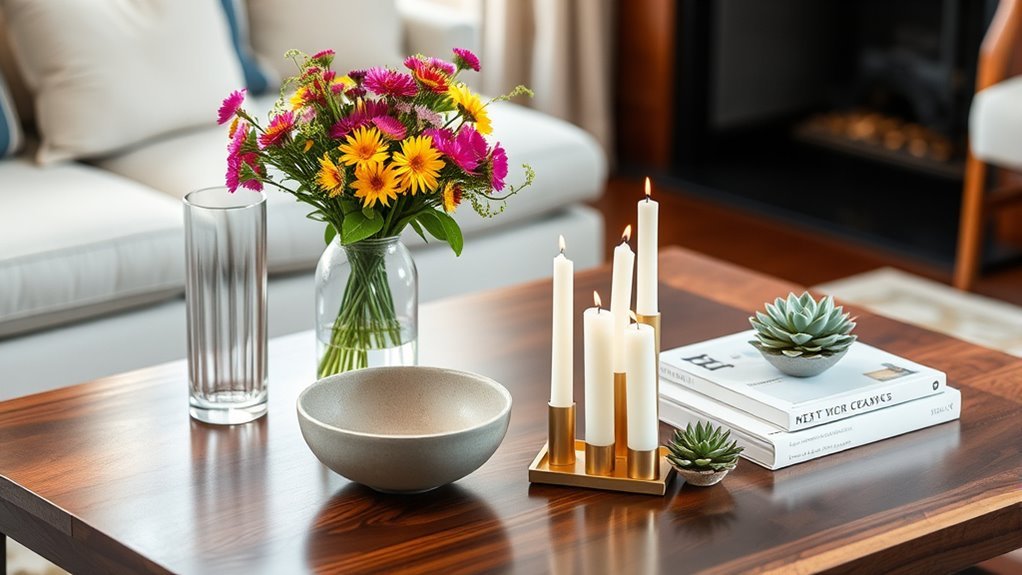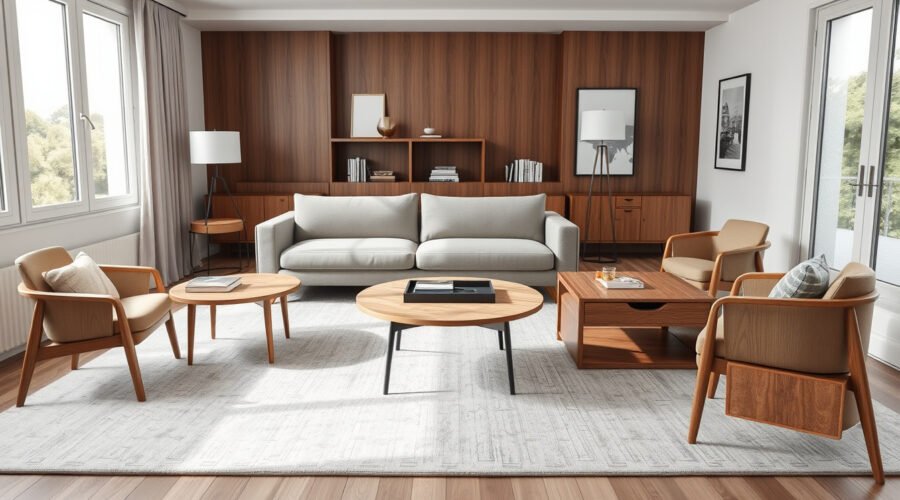
Choosing a round vs. rectangular coffee table is about more than style. The shape you pick controls how easily people walk through the room, whether guests at the ends of the sofa can reach their drinks, and how balanced your seating area looks. Round tables soften tight or boxy spaces and improve angled foot traffic, while rectangular tables echo straight sofas and offer longer, easier-to-organize surface zones.
Quick Answer
Choose a round coffee table for small or square rooms, L-shaped or curved sectionals, and homes with kids or tight walkways. Choose a rectangular coffee table for standard straight sofas, long or narrow rooms, and layouts where multiple people need easy reach and extra storage.
Key Takeaways
- Round coffee tables eliminate sharp corners, soften boxy rooms, and fit neatly inside the nook of L-shaped or curved seating.
- Rectangular coffee tables give end-seat guests equal reach, maximize linear surface area, and provide more drawer or lift-top storage options.
- Leave 16–18 inches between the sofa and coffee table for comfortable legroom and effortless reach, plus 30–36 inches for main walkways.
- Target a table length or diameter around two-thirds the length of your sofa and within 1–2 inches of your sofa’s seat cushion height.
Round vs. Rectangular Coffee Table: Which Is Right for You?
The right coffee table shape depends on your sofa configuration, room proportions, walking paths, and daily habits. A round coffee table creates a central gathering point that encourages conversation and lets people breeze past without dodging corners. A rectangular coffee table anchors linear seating and divides cleanly into zones for trays, books, remotes, and board games.
Treat your coffee table as part of the room’s circulation system. If anyone has to turn sideways to squeeze past a corner, the table is too wide or the wrong shape for that layout. Conversely, if people sitting on the outer cushions have to lean forward or stand up to set down a mug, a longer rectangular or oval shape—or a pair of nesting tables—will serve the sofa better.
| Coffee Table Shape | Typical Dimensions | Best For | Watch Out For |
|---|---|---|---|
| Round | 30–42 in. diameter | Small or square rooms, curved sofas, L-shaped sectionals, homes with kids | Harder to reach from the outer ends of a long 84–96 in. sofa |
| Rectangular | 42–60 in. long × 20–30 in. deep | Straight sofas, long sectionals, narrow rooms, heavy hosting, hidden storage | Sharp 90-degree corners can bottleneck diagonal walkways |
| Oval | 42–54 in. long × 22–28 in. deep | Narrow rooms needing full-sofa reach with softer, shin-friendly edges | Fewer built-in drawer or lift-top storage models available |
| Square | 36–48 in. square | Large L- or U-shaped sectionals and symmetrical facing sofas | Takes up deep floor space and feels bulky in compact rooms |
Benefits of Round Coffee Tables in Small Spaces
Round coffee tables excel in small living rooms because they shave off the four corners that usually jut into walkways. That extra diagonal clearance makes a compact apartment, studio, or square den feel noticeably easier to navigate, especially when a doorway, accent chair, or media console sits nearby.
A circular silhouette also carries less visual weight than a boxy frame. Because most living rooms are already packed with rectangles—the sofa, area rug, TV screen, windows, and bookshelves—introducing a curved centerpiece breaks up rigid grid lines and makes the seating zone feel more open.
| Small-Space Benefit | Why It Helps Your Layout |
|---|---|
| Diagonal circulation | Curved edges let you pivot naturally between a sofa, accent chair, and hallway without catching a corner. |
| Visual contrast | A circular top softens straight sofa lines, rectangular rugs, and boxy apartment walls. |
| Shared center point | Swivel chairs and corner sectionals face a single hub rather than one long edge. |
| Child- and shin-safe profile | Continuous curved edges remove the 90-degree corners that bruise shins and pose hazards to toddlers. |
Warning: A large round table demands as much front-to-back depth as its width. A 40-inch round table extends 16 inches deeper into a narrow room than a 40-by-24-inch rectangular table, which can trap knees or block egress paths.
Surface Area: Round vs. Rectangular
A rectangular coffee table delivers about 21% more surface area than a round table with the same footprint width, and its straight edges are much easier to divide into functional zones. You can park a decorative tray at one end, stack art books in the center, and still leave clear coasters along the front edge for three or four people.
Round tables pull items toward the center because the perimeter curves away from the corners. That layout looks effortless with a single sculptural bowl, candle, or round tray, but it can feel crowded when several people want to set down plates, laptops, or board games at the same time.
How to Compare Surface Area by the Numbers
Instead of guessing which table holds more, compare the exact square inches using basic geometry:
- Rectangular surface area: length × width
- Round surface area: 3.14 × radius × radius (where radius is half the diameter)
For example, a standard 48-by-24-inch rectangular table gives you 1,152 square inches of tabletop while taking up only 24 inches of room depth. A 36-inch round table provides 1,018 square inches—roughly the same as a 42-by-24-inch rectangle (1,008 square inches)—but requires 12 extra inches of front-to-back floor depth.
Usable Space and Nesting Alternatives
If you regularly host game nights, eat dinner at the sofa, or work on a laptop, a rectangular table’s straight front edge is far more practical. If you love the softer look of a circle but need extra reach for guests, choose a nesting round coffee table set. You can keep the smaller table tucked underneath on weekdays and slide it toward the end of the sofa whenever company arrives.
Note: Total tabletop area is only half the equation. A slightly smaller rectangular or drum-style round table with a lower shelf, hidden drawer, or lift top keeps remotes, chargers, and throws off the main surface so it feels twice as spacious.
How Table Shape Affects Movement and Traffic Flow
Your coffee table’s shape dictates whether footsteps flow smoothly around the seating area or bottleneck at the corners. Rectangular tables establish crisp, parallel lanes that align with rectangular rugs and media consoles, whereas round and oval tables allow diagonal paths around tight furniture groupings.
Interior designers rely on two clearance zones to keep a living room comfortable. Aim for 16–18 inches between the coffee table and sofa (up to 20 inches in spacious rooms) so you can reach a drink without standing up, and leave 30–36 inches for main walkways behind or beside seating (with 24 inches as a minimum for low-traffic pass-throughs).
Movement Patterns in Small or Square Rooms
When a living room has doorways or hallways feeding into the seating zone at angles, a round table keeps circulation fluid. Because there are no corners extending outward, you gain several extra inches of diagonal clearance right where legs pivot between the sofa and accent chairs.
Movement Patterns in Long or Narrow Rooms
In narrow living rooms (such as townhomes or rail-style apartments under 12 feet wide), depth is your biggest constraint. A slim rectangular or oval coffee table measuring 18–22 inches deep preserves your 16–18 inch sofa gap and still leaves a clear 30–36 inch path past the TV wall, whereas a wide round table would push right into the walkway.
Traffic Flow Checklist Before You Buy
- Test reach distance: Sit back naturally on the sofa and confirm the table edge sits 16–18 inches from the front cushion.
- Check knee and shin clearance: Never go tighter than 14 inches from the sofa or your knees will feel pinned when standing up.
- Measure open storage swing: Add the full pull-out depth of drawers or the forward arc of a lift-top mechanism to your clearance math.
- Protect primary walkways: Keep at least 30–36 inches open along the main path from the room entrance to the seating area.
- Round off tight turns: Switch from rectangular to round or oval whenever a walkway cuts diagonally across the corner of the rug.
How to Match Coffee Table Shapes to Your Sofa Style
Your sofa’s footprint and seat configuration are the fastest way to narrow down the right coffee table shape. Pairing complementary lines ensures every seat can reach the surface and prevents the table from looking either dwarfed or shoehorned into the room.
| Sofa Style & Length | Best Table Shapes | Recommended Rectangular Size | Recommended Round Size |
|---|---|---|---|
| Compact Sofa / Loveseat (60–72 in.) | Round, Oval, Slim Rectangular | 38–48 in. L × 18–22 in. D | 28–34 in. diameter |
| Standard 3-Seat Sofa (80–84 in.) | Rectangular, Oval, Nesting Round | 52–56 in. L × 22–26 in. D | 36–40 in. diameter (or nested pair) |
| Long Sofa (90–96 in.) | Rectangular, Large Oval | 60–64 in. L × 24–30 in. D | 42–48 in. diameter (or two 30 in. tables) |
| Chaise Sectional (84–108 in. total) | Round, Oval | Two-thirds of open non-chaise seat width | 32–38 in. diameter |
| L-Shaped or U-Shaped Sectional | Round, Square, Rectangular | 48–60 in. L (for long asymmetrical L-shapes) | 36–44 in. diameter (check interior pit gap) |
Straight Sofas
A rectangular coffee table is the natural partner for a standard straight sofa. A 54-to-60-inch rectangular table in front of an 84-to-90-inch sofa echoes its horizontal lines and puts a coaster within arm’s reach of every seat. If you prefer a round table to soften the room, choose a generous 36-to-42-inch diameter—or use two nested round tables—so the piece does not look lost in the center.
L-Shaped and U-Shaped Sectionals
Round coffee tables shine inside L-shaped and U-shaped sectionals because they eliminate corner-on-corner collisions where the two sofa wings meet. For a U-shaped sectional, measure the open floor width between the facing chaises and subtract 32 to 36 inches (allowing 16–18 inches of legroom on each side) to find your maximum round diameter or square width.
Chaise Sectionals
With a chaise sectional, never calculate the two-thirds rule using the entire sofa width. Instead, measure only the open seating portion beside the chaise cushion, then choose a round, oval, or compact rectangular table that is two-thirds of that inner span so people can slip past the chaise without bumping a corner.
Curved Sofas
Curved and crescent sofas look most cohesive with round, oval, or kidney-shaped coffee tables. Repeating the sweeping arc maintains an even 16–18 inch reach gap along the bowed front cushion, whereas a straight rectangular edge leaves an awkward gap at the ends and crowds the center.
Two Sofas Facing Each Other
When two straight sofas face each other in a formal or conversation layout, a rectangular or oval coffee table bridges the gap evenly so guests on both sides can reach the center. If the two sofas are deep and spaced far apart in a large square room, a 40-to-48-inch square table anchors the footprint best.
Pro Tip: Follow the West Elm furniture measuring guide and outline the exact width and depth of both shapes on your rug with painter’s tape, leaving 1–2 inches of extra wiggle room to test your reach and walkways for a full day before ordering.
5 Essential Factors Beyond Table Shape
Even the right shape will frustrate you if its height, scale, or visual weight clashes with your living room. Check these five physical details before you commit to a design.
1. Height and Proportion
According to the Pottery Barn coffee table buying guide, your table should match the height of your sofa’s seat cushions or sit 1–2 inches lower. Because most modern sofas have a 17–19 inch seat height, the sweet spot for most coffee tables is 15–18 inches tall; anything taller than the seat cushions looks high and forces an awkward upward reach.
2. Room Width and Rug Scale
Your coffee table should sit comfortably inside the borders of your area rug with at least 12–18 inches of exposed rug around the table on walking sides. Small, square rooms (such as 10-by-10 or 12-by-12 feet) look more balanced with a 30–36 inch round table, while long rectangular rooms (such as 12-by-18 feet) call for a 48–54 inch rectangular or oval piece.
3. Hidden vs. Open Storage Needs
If your coffee table needs to hide board games, kids’ toys, remotes, or throw blankets, rectangular tables offer far more built-in drawer, cubby, and dual lift-top configurations. Round tables do come in storage drum styles with lift-off lids or lower shelves, though curved drawers hold less than rectangular ones.
4. Visual Weight and Base Style
A solid plinth or blocky wood rectangular table grounds a spacious room with high ceilings, but it can make a small space feel boxed in. If your sofa has a low skirt or chunky arms that sit close to the floor, balance that heaviness with a round glass top, an open metal frame, or slender tapered legs that let light and rug texture show underneath.
5. Child Safety and Everyday Durability
For households with babies and toddlers learning to walk, American Academy of Pediatrics home safety guidelines specifically flag coffee tables with hard edges and sharp corners as a primary household injury hazard, alongside unstable furniture that can tip when a child pulls up on it. A round or oval table with a broad, stable base—or an upholstered ottoman coffee table—eliminates sharp corners at toddler head height.
When a Round Coffee Table Is the Better Choice
A round coffee table is your strongest option when preserving floor flow, softening angular furniture, and eliminating sharp corners matter more than end-to-end surface length. It works especially well when people enter the seating area from multiple doorways.
- Small or square living rooms: Curved edges prevent bottlenecks in compact footprints.
- L-shaped, U-shaped, and curved sectionals: A circular top nestles into the corner nook with equal clearance on all sides.
- Multi-directional foot traffic: Diagonal paths around chairs and doorways stay clear.
- Homes with young children or active pets: Zero 90-degree corners mean fewer forehead bumps and bruised shins.
- Boxy, linear rooms: One curved centerpiece breaks up straight sofas, rectangular rugs, and flat media walls.
When a Rectangular Coffee Table Is the Better Choice
A rectangular coffee table is the smarter investment when your seating is long and linear, your room is narrow, or your tabletop does heavy daily work. It ensures nobody at the far end of the couch is left holding their drink.
- Standard 3-seat and extra-long sofas (80–96+ inches): The elongated top spans two-thirds of the sofa so every cushion has easy reach.
- Long, narrow living rooms: A slim 20-to-24-inch depth preserves walkway clearance better than a wide circle.
- Heavy storage needs: Full-width drawers, lower shelves, and split lift-top mechanisms fit rectangular frames cleanly.
- Entertaining and working from the sofa: Straight edges organize laptops, serving trays, puzzles, and board games without crowding the center.
- Facing-sofa layouts: A long tabletop bridges two parallel couches evenly.
Frequently Asked Questions
Should my coffee table be round or rectangular?
Choose a round coffee table if your living room is small, square, or has tight angled walkways, or if you have an L-shaped or curved sectional. Choose a rectangular coffee table if you have a straight sofa, a long or narrow room, or need spread-out surface space for trays, books, and snacks.
Is a round coffee table better for a small living room?
Yes, a round coffee table is usually better for a small, square living room because it removes sharp corners and makes angled movement easier. However, in a very narrow small room, a slim rectangular or oval table (18 to 22 inches deep) can save more front-to-back walkway space than a wide circle.
How far should a coffee table be from the sofa?
Place your coffee table 16 to 18 inches from the front edge of the sofa cushions. Less than 14 inches crowds your knees when standing up, while more than 20 inches forces you to lean forward off the backrest to reach your drink.
What shape coffee table works best with a sectional?
Round coffee tables work best with compact L-shaped, U-shaped, and chaise sectionals because they sit comfortably in the corner nook without blocking movement. Rectangular coffee tables work better with extra-long L-shaped sectionals where several seats along the main wing need easy reach.
What size round coffee table do I need for a sectional?
Most sectionals pair best with a 32-to-42-inch round coffee table. Measure the open floor space inside the L- or U-shaped seating area and subtract 32 to 36 inches (16 to 18 inches per side) so everyone has enough legroom around the perimeter.
Can I use a rectangular coffee table in a small room?
Yes, a rectangular coffee table works well in a small room as long as its depth stays slim (around 18 to 22 inches) and its length stays close to two-thirds of your sofa. Choose rounded corners, slender legs, or a glass top to keep the footprint feeling light.
Is an oval coffee table better than round or rectangular?
An oval coffee table is the ideal compromise when you need the full-sofa reach of a rectangular table alongside the soft, corner-free traffic flow of a round table. It works especially well in narrow living rooms and homes with young children.
Can you mix round and rectangular tables in the same living room?
Yes, mixing a rectangular coffee table with round side tables—or a round coffee table with square or rectangular end tables—creates a balanced, designer look. Keep one element consistent, such as wood tone, metal finish, or tabletop height, so the combination feels intentional.
Conclusion
Your living room layout—not a passing trend—should decide your coffee table shape. Pick a round table to soften boxy rooms, fit inside a sectional nook, and keep tight walkways bump-free, or choose a rectangular table when you need end-to-end sofa reach, structured surface zones, and hidden storage. Grab a tape measure and a roll of painter’s tape today, mark a two-thirds-length footprint 16–18 inches in front of your sofa, and see which shape lets your room breathe.
Sources
- Homes & Gardens: Living Room Layout Guide: Supports sofa-to-table spacing, 36-inch main walkway clearance, and painter’s tape layout testing.
- Livingetc: 18-Inch Seating Rule: Supports the ergonomic 18-inch sofa-to-coffee-table reach distance.
- The Spruce: Coffee Table Height and Size Guide: Supports standard coffee table height and the two-thirds sofa-length proportion rule.
- Good Housekeeping: Measuring Living Room Furniture: Supports measuring room traffic flow and furniture scale before purchasing.
- West Elm: How to Measure Furniture for Delivery: Supports taping full furniture dimensions on the floor and leaving 1–2 inches of measurement buffer.
- Pottery Barn: The Coffee Table Buying Guide: Supports matching table height to seat cushions (or 1–2 inches lower) and selecting durable materials for active homes.
- HealthyChildren.org (American Academy of Pediatrics): Home Safety Tips: Supports childproofing against sharp coffee table corners and checking furniture stability.