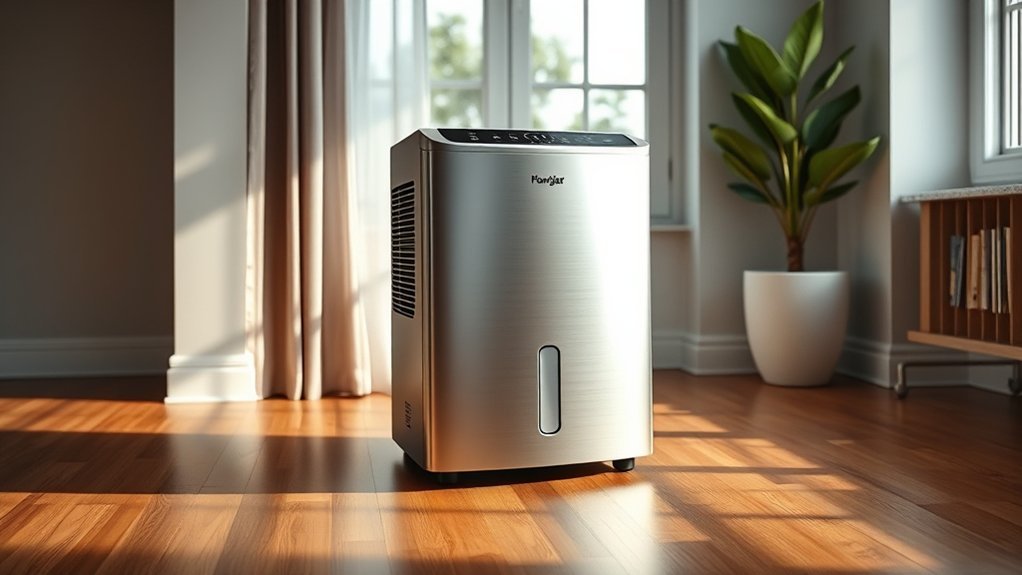
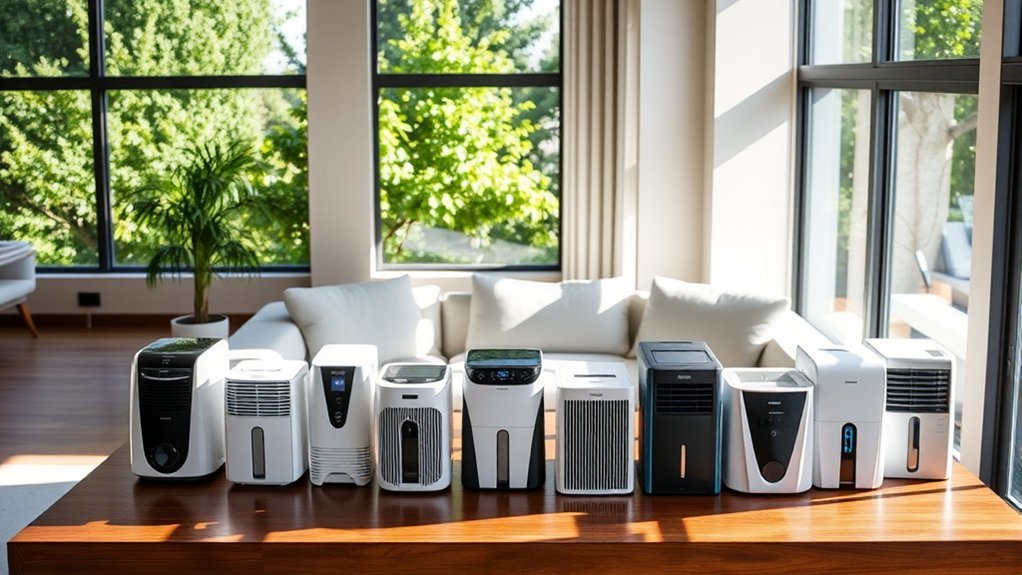
If condensation is collecting on metal walls, tools, vehicles, lumber, or stored equipment, the best dehumidifier for a pole barn can help protect an enclosed, weather-protected post-frame building from rust, mold, and dampness. However, choosing the right pole barn dehumidifier depends on far more than the square-foot number printed in a product title. Air leakage, 10- to 16-foot ceiling heights, indoor temperature, drainage access, concrete or dirt floor moisture, and large overhead door openings all determine real-world moisture removal.
The Waykar 150 Pint Dehumidifier with Pump (YDZ-150PM) is the best overall choice when high extraction capacity and flexible, unattended upward drainage matter most. The GoveeLife H7151 Smart Dehumidifier Max is the best smart-control option for remote barn monitoring, while the AEOCKY Leo-Lite 74 Pint is the strongest efficiency-focused midsize pick. The Ludatido 80 Pint favors simple physical controls and a large collection bucket, and the PLUSCENT 32 Pint is a compact match for a small, insulated tack room or partitioned workshop bay.
Affiliate disclosure: As an Amazon Associate I earn from qualifying purchases. This article contains Amazon affiliate links—if you purchase through one of these links, we may earn a commission at no additional cost to you.
Quick verdict: Best Pole Barn Dehumidifiers at a Glance
- Best Overall for Large Pole Barns: Waykar 150 Pint with Pump (Model YDZ-150PM) — 70-pint DOE / 150-pint max rating with a 9.84-ft vertical condensate pump.
- Best Smart Option for Detached Barns: GoveeLife H7151 Smart Dehumidifier Max — 50-pint DOE (109-pint max) capacity with Wi-Fi app alerts and scheduling.
- Best Efficiency-Focused Midsize Option: AEOCKY Leo-Lite 74 Pint — ENERGY STAR Version 6.0 efficiency with low 4-amp current draw and intelligent humidistat cycling.
- Best Simple Large-Tank Option: Ludatido 80 Pint — Straightforward button controls, 1.72-gallon (6.5L) bucket, and included gravity hose.
- Best for a Small Partitioned Barn Room: PLUSCENT 32 Pint — Compact footprint for an insulated tack room, tool crib, or small workshop zone.
Important capacity note (DOE vs. Maximum Pints)
Headline pint ratings are not always measured under the same conditions. Current U.S. Department of Energy (DOE Appendix X1) standards test portable dehumidifiers at 65°F and 60% relative humidity (RH), whereas older 2012 DOE ratings used 80°F and 60% RH, and many brands advertise “maximum” extraction measured at 86°F/80% RH or 95°F/90%–95% RH. A unit rated for 50 pints under current DOE testing can equal a 100- to 150-pint “maximum” unit. Always treat square-foot coverage claims as rough residential estimates—not guarantees for a tall, drafty, cold, or dirt-floor pole barn.
How these picks were compared
This evaluation prioritizes pole-barn relevance, continuous and pumped drainage flexibility, clearly stated DOE vs. maximum capacity test conditions, operating-temperature limitations, humidistat controls, filter maintenance needs, and published manufacturer documentation. No hands-on testing is claimed.
Use-case warning
The five models below are portable residential-style compressor dehumidifiers. Use them only in an enclosed space that remains within the manufacturer’s permitted operating temperature range (typically 41°F to 95°F) and protects the appliance from rain, wash water, heavy sawdust, flammable vapors, livestock contact, and vehicle impact. An open-sided, freezing, or continuously wet pole barn requires building-envelope sealing, a ground-vapor barrier, or hardwired commercial/desiccant equipment instead.
Quick Comparison of Pole Barn Dehumidifiers
| Product | Best For | Capacity & Test Context | Drainage & Tank | Smart Control | Main Limitation | Details |
|---|---|---|---|---|---|---|
| Waykar 150 Pint with Pump (YDZ-150PM) | Large enclosed barns and flexible upward drainage | Up to 150 pints/day max (95°F/90% RH); 70 pints/day DOE standard | 1.85-gal (7L) tank, 3.28-ft gravity hose, or built-in pump (16.4-ft hose, 9.84-ft lift) | Digital touch panel; no app control | 150-pint headline is a hot/humid saturation rating, not cool-barn output | Check Price on Amazon |
| GoveeLife H7151 Smart Max | Remote humidity monitoring, alerts, and scheduling | 50 pints/day (2019 DOE); 70 pints (2012 DOE); up to 109 pints/day max | 2.0-gal (7.6L) tank or 3-ft continuous gravity hose | Wi-Fi app, Alexa/Google voice control, and touch panel | Remote features require reliable barn Wi-Fi; no built-in pump | Check Price on Amazon |
| AEOCKY Leo-Lite 74 Pint | Low-amp efficiency in a midsize enclosed barn | 74 pints/day at 95°F/95% RH; 52 pints/day at 86°F/80% RH | 1.45-gal (5.5L) tank or continuous gravity hose | Intelligent humidistat; no app control | No built-in pump; single fan speed on base Leo-Lite trim | Check Price on Amazon |
| Ludatido 80 Pint | Simple physical controls and a larger collection tank | 80 pints/day at 86°F/80% RH (standardized 65°F DOE rating not published) | 1.72-gal (6.5L) tank or included 3.9-ft gravity hose | Physical touch buttons and 3-color RH light; no app | Limited standardized DOE and long-term warranty documentation | Check Price on Amazon |
| PLUSCENT 32 Pint | Small, insulated, or partitioned pole-barn rooms | Marketed as a 32-pint class unit for up to 2,500 sq ft (232.3 sq m) | Internal bucket or continuous gravity hose | On-unit controls; no app control | Undersized for a full-size barn; stock availability varies | Check Price on Amazon |
Waykar 150 Pint Dehumidifier with Pump
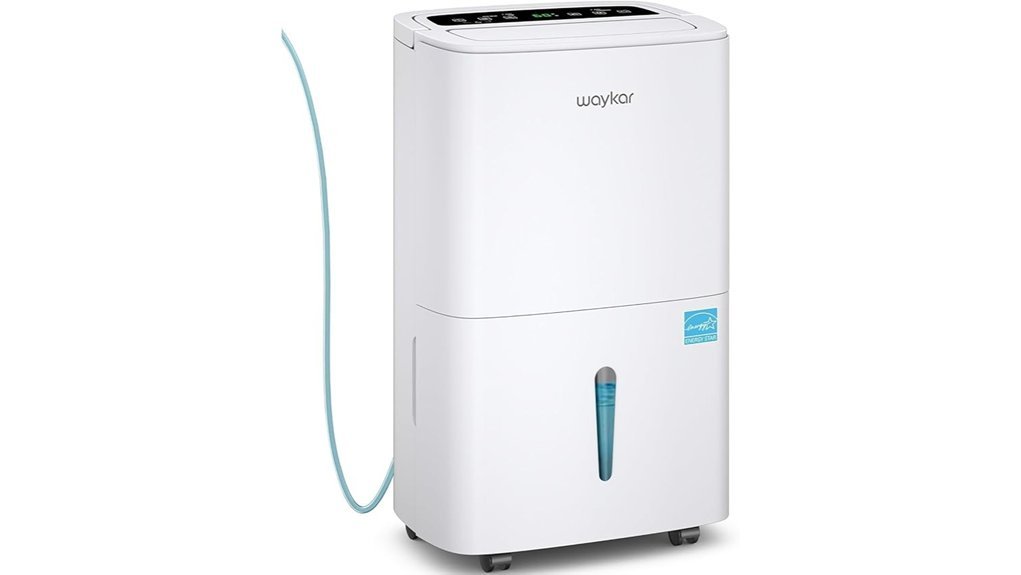
The Waykar 150 Pint Dehumidifier with Pump (Model YDZ-150PM) is the strongest all-around option in this comparison when drainage flexibility and high airflow are the deciding factors. Its built-in condensate pump can push water vertically up to 9.84 feet through an included 16.4-foot pump hose, while the 1.85-gallon (7-liter) bucket and 3.28-foot gravity hose cover simpler setups. That versatility is crucial in a detached pole barn where no floor drain exists and water must be routed up into a utility sink or through an elevated wall port.
Waykar rates the YDZ-150PM for up to 150 pints (18.75 gallons) per day under hot, saturated conditions (95°F and 90% RH), while its standardized DOE rating (65°F and 60% RH) is 70 pints per day with an Integrated Energy Factor (IEF) of 1.8 L/kWh. Although it is advertised for up to 7,000 square feet in residential spaces, high barn ceilings and overhead doors increase the real moisture load—so size your building conservatively rather than relying on the maximum headline figure alone.
With a 212 CFM airflow rating and two fan speeds, this unit circulates air more aggressively than smaller bedroom or bathroom models. It also includes an adjustable humidistat (30% to 80% RH), a 24-hour timer, automatic defrost, and auto-restart after power interruptions.
Key Specifications:
- Model Number: YDZ-150PM
- Moisture Removal Capacity: Up to 150 pints/day (95°F, 90% RH); 70 pints/day (DOE 65°F, 60% RH)
- Airflow & Fan Speeds: 212 CFM; 2 speeds
- Water Tank Volume: 1.85 gallons (7 liters)
- Drainage Methods: Internal bucket, 3.28-ft gravity hose, or built-in pump (16.4-ft hose, 9.84-ft vertical lift)
- Humidity Adjustment Range: 30% to 80% RH
- Dimensions & Refrigerant: 10.48″ D × 14.89″ W × 24.22″ H; R32 refrigerant
Verification note: The Amazon product linked here is identified as part number YDZ-150PM. Because multi-variation listings sometimes group pump and non-pump variants together, verify that the “With Pump” option and model YDZ-150PM are selected before checkout.
Why You’ll Like It: It solves the common pole-barn drainage obstacle by pumping condensate upward and across longer distances without requiring an external condensate pump.
Best For: Large, reasonably sealed pole barns and multi-bay workshops where condensate must travel upward or where daily bucket emptying is impractical.
Who Should Avoid It: Owners of a tiny partitioned room with a floor drain directly beneath the unit, or anyone attempting to dry an uninsulated, freezing, or open-sided barn with a residential compressor unit.
Pros:
- Built-in pump (up to 9.84 feet of vertical lift) offers far greater placement freedom than gravity drainage alone.
- Strong 70-pint DOE standardized capacity and 212 CFM airflow suit larger enclosed bays.
- Three drainage modes: 1.85-gallon tank, short gravity hose, and long 16.4-foot pump hose.
- Adjustable humidistat (30%–80% RH), 24-hour timer, auto-restart, and auto-defrost support unattended operation.
Cons:
- The 150-pint headline figure represents 95°F/90% RH saturation, not typical 60°F–70°F barn output.
- No Wi-Fi app connectivity for remote monitoring from the main house.
- The internal pump adds a mechanical part that requires periodic cleaning to prevent slime buildup.
Verdict: If you have a full-size enclosed pole barn and need unattended drainage without a floor drain right next to the machine, the Waykar YDZ-150PM is the most capable all-around pick on this list.
GoveeLife H7151 Smart Dehumidifier (50 Pint)
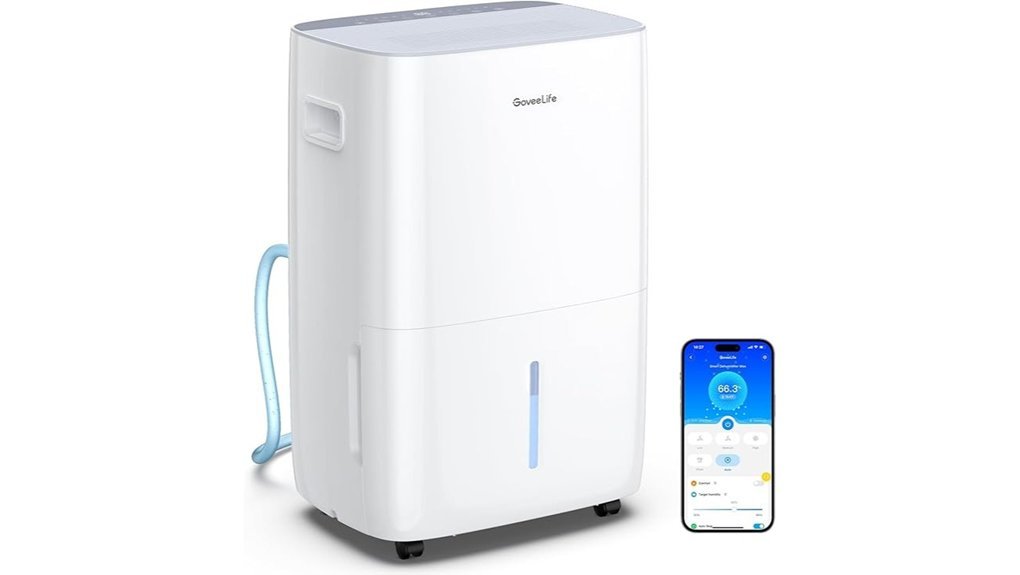
The GoveeLife H7151 Smart Dehumidifier Max is the best choice for property owners who want to check barn humidity, adjust target settings, or receive full-tank alerts on a smartphone without walking out to a detached building. It pairs physical touch controls with the Govee Home app and voice assistant support (Alexa and Google Assistant), provided your pole barn has reliable 2.4 GHz Wi-Fi coverage.
GoveeLife is unusually transparent about how its capacity translates across testing standards: the H7151 removes 50 pints per day under the 2019 DOE standard (65°F, 60% RH), 70 pints per day under the 2012 DOE standard (80°F, 60% RH), and up to 109 pints per day at maximum saturation (95°F, 90% RH). While advertised for up to 4,500 square feet, tall metal walls, frequent overhead door openings, and cool concrete slabs will reduce its effective coverage area.
Published specifications include a generous 2.0-gallon (7.6-liter) bucket, 850-watt maximum power input, three fan speeds, and an included 3-foot corrugated gravity drain hose. Even better for a pole barn, the H7151 can pair with a separate wireless Govee thermo-hygrometer placed across the shop—allowing the dehumidifier to respond to humidity levels near your tools or vehicles rather than just right next to its own exhaust grille.
Key Specifications:
- Model / Part Number: H7151 (H7151101)
- Moisture Removal Capacity: 50 pints/day (2019 DOE); 70 pints/day (2012 DOE); 109 pints/day max
- Water Tank Volume: 2.0 gallons (7.6 liters)
- Drainage Methods: 2.0-gallon bucket or continuous gravity drain hose (3-ft hose included)
- Power & Noise: 120V, 850W max input; 3 fan speeds; ~53 dB max noise
- Smart Connectivity: Wi-Fi (2.4 GHz), Govee Home App, Alexa, Google Assistant, Govee sensor linking
- Dimensions & Weight: 11.61″ D × 15.35″ W × 24.41″ H; ~39–43.6 lbs
Why You’ll Like It: Remote app monitoring and wireless remote-sensor pairing let you spot rising barn humidity after a rainstorm before condensation forms on cold steel tools.
Best For: Wi-Fi-connected workshops, classic-car or boat storage barns, and owners who value remote alerts and automated schedules.
Who Should Avoid It: Buyers whose metal barn blocks Wi-Fi signals, those who need upward pump drainage without buying an external condensate pump, or anyone trying to dry an unsealed structure.
Pros:
- Clearly documented 50-pint (2019 DOE) / 70-pint (2012 DOE) / 109-pint max capacity ratings.
- Govee Home app provides real-time humidity graphs, scheduling, and full-bucket push notifications.
- Can link with external Govee humidity sensors for more accurate whole-shop humidity readings.
- Large 2.0-gallon (7.6L) bucket, washable filter, auto-defrost, and auto-restart after power loss.
Cons:
- Metal pole-barn siding can weaken Wi-Fi signals unless you have an access point or mesh node inside the barn.
- No built-in condensate pump (gravity hose requires a continuous downhill slope).
- Operating noise (~53 dB on high) is noticeable in a quiet workshop office.
Verdict: When your pole barn has Wi-Fi and a floor-level drain, the GoveeLife H7151 offers the best remote visibility and smart automation in this class.
AEOCKY Leo-Lite 74 Pint Dehumidifier
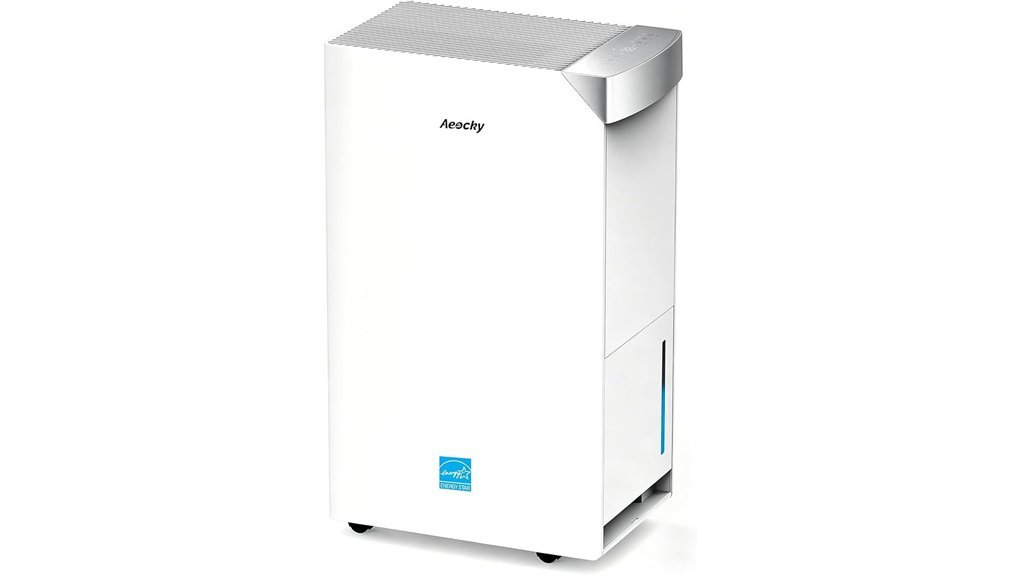
The AEOCKY Leo-Lite 74 Pint Dehumidifier is the most appealing choice for a midsize, well-sealed pole barn or insulated workshop when electrical efficiency and low current draw matter more than smartphone apps or internal pumps. Drawing approximately 4 amps of current and built to meet ENERGY STAR Version 6.0 efficiency standards, it leaves plenty of headroom on a shared 15- or 20-amp workshop branch circuit.
AEOCKY publishes two warm-air extraction figures for the Leo-Lite: up to 74 pints per day at 95°F and 95% RH, and 52 pints per day at 86°F and 80% RH. Because both figures use warmer, wetter air than the 65°F/60% RH DOE basement test, expect lower daily pint totals when your barn is cool. Retail listings advertise the Leo-Lite for 4,500 to 5,000 square feet, which translates more realistically to a tight, insulated 1,000- to 2,000-square-foot workshop bay.
The slender tower cabinet (14.4″ D × 8.6″ W × 23.3″ H) houses a 1.45-gallon (5.5-liter) tank and includes a drain hose for continuous gravity drainage, along with automatic defrost, power-off memory restart, a 24-hour timer, and smooth-rolling casters.
Key Specifications:
- Model / UPC: LEO-Lite (UPC 850070532372)
- Moisture Removal Capacity: Up to 74 pints/day (95°F, 95% RH); 52 pints/day (86°F, 80% RH)
- Electrical Draw: ~4 Amps; ENERGY STAR Version 6.0 compliant design
- Water Tank Volume: 1.45 gallons (5.5 liters)
- Drainage Methods: 1.45-gallon bucket or included continuous gravity drain hose
- Dimensions & Weight: 14.4″ D × 8.6″ W × 23.3″ H; 34.3 lbs (15.56 kg)
Before you buy: AEOCKY sells several sub-models under the Leo family (including LEO-Lite, LEO-Lite-2, and LEO-001). Confirm the exact model number and UPC (such as 850070532372) on the live Amazon listing and cross-check the ENERGY STAR database if verified certification is required for a utility rebate.
Why You’ll Like It: Its low 4-amp electrical draw and intelligent humidistat cycling keep electricity costs and circuit loading modest in an insulated shop.
Best For: Midsize, insulated pole-barn workshops with a nearby floor drain and shared electrical circuits.
Who Should Avoid It: Anyone who needs upward pump drainage, multi-speed fan customization, remote Wi-Fi alerts, or cold-barn operation below freezing.
Pros:
- ENERGY STAR Version 6.0 focus with a modest ~4-amp electrical draw.
- Intelligent humidistat cycles the rotary compressor off once the target RH is maintained.
- Slim 8.6-inch cabinet width tucks neatly beside workbenches or shelving.
- Automatic defrost, power-outage memory restart, and included gravity drain hose.
Cons:
- Headline 74-pint and 52-pint ratings are measured at 95°F/95% RH and 86°F/80% RH rather than 65°F.
- Smaller 1.45-gallon bucket fills quickly if you do not connect the gravity drain hose.
- No built-in condensate pump or Wi-Fi app integration.
Verdict: For a tight, insulated midsize pole barn with an accessible floor drain, the AEOCKY Leo-Lite delivers dependable, energy-conscious humidity control without smart-home complexity.
Ludatido 80 Pint Dehumidifier
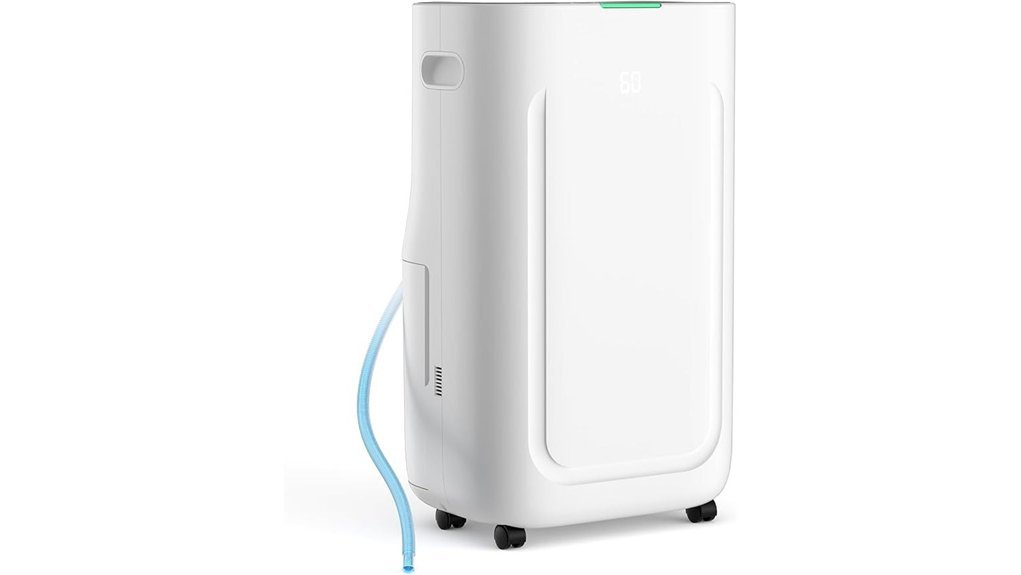
The Ludatido 80 Pint Dehumidifier is a straightforward option for buyers who prefer physical button controls, a visual humidity color indicator, and a sizable 1.72-gallon (6.5-liter) removable bucket instead of smartphone apps. It suits an enclosed storage bay or hobby workshop where you periodically empty the tank by hand or route the included 3.9-foot gravity hose into a nearby floor drain.
According to the product manual, the 80-pint-per-day rating is measured at 86°F and 80% relative humidity, with an advertised residential coverage of up to 5,000 square feet. Because the manual does not publish a corresponding 65°F/60% RH DOE Appendix X1 figure, you should expect substantially lower water collection in a cool 60°F–65°F metal building.
Everyday usability is simple: the top panel offers two fan speeds (Low and High), four operating modes (Dehumidify, Dry, Continuous, and Loop), a 24-hour timer, and a child lock. A front three-color LED ring gives an instant visual check across the barn—glowing blue when relative humidity is below 50%, green between 50% and 70%, and red when humidity exceeds 70%.
Key Specifications:
- ASIN: B0DQKDF184
- Moisture Removal Capacity: 80 pints/day (measured at 86°F, 80% RH)
- Water Tank Volume: 1.72 gallons (6.5 liters)
- Drainage Methods: 6.5-liter bucket with handle or included 3.9-ft gravity drain hose
- Controls & Modes: 4 modes (Dehumidify, Dry, Continuous, Loop), 2 fan speeds, 3-color RH indicator light
- Dimensions & Weight: 13.38″ D × 9.44″ W × 22.44″ H; 31.9 lbs
Why You’ll Like It: The 1.72-gallon bucket and color-coded humidity light make manual monitoring from across the shop effortless without Wi-Fi.
Best For: Enclosed storage barns and workshops where simple push-button operation and a larger collection tank matter more than brand recognition or app controls.
Who Should Avoid It: Buyers who require a built-in condensate pump, verified DOE/ENERGY STAR certification data, or an established long-term manufacturer warranty.
Pros:
- Generous 1.72-gallon (6.5-liter) tank reduces how often you need to empty the bucket manually.
- Three-color LED humidity indicator lets you check barn moisture status at a glance.
- Includes a 3.9-foot gravity drain hose, four operating modes, two fan speeds, and auto-defrost.
- Lightweight 31.9-pound chassis with 360-degree caster wheels.
Cons:
- The 80-pint rating is tested at 86°F/80% RH; no standardized 65°F DOE capacity is published.
- No built-in condensate pump, and the included 3.9-foot gravity hose is relatively short.
- Long-term warranty support and parts availability are less documented than with major brands.
Verdict: Choose the Ludatido 80 Pint if you want a simple, no-Wi-Fi dehumidifier with a large 6.5-liter bucket and visual humidity ring for a moderate enclosed storage space.
PLUSCENT 32 Pint Dehumidifier
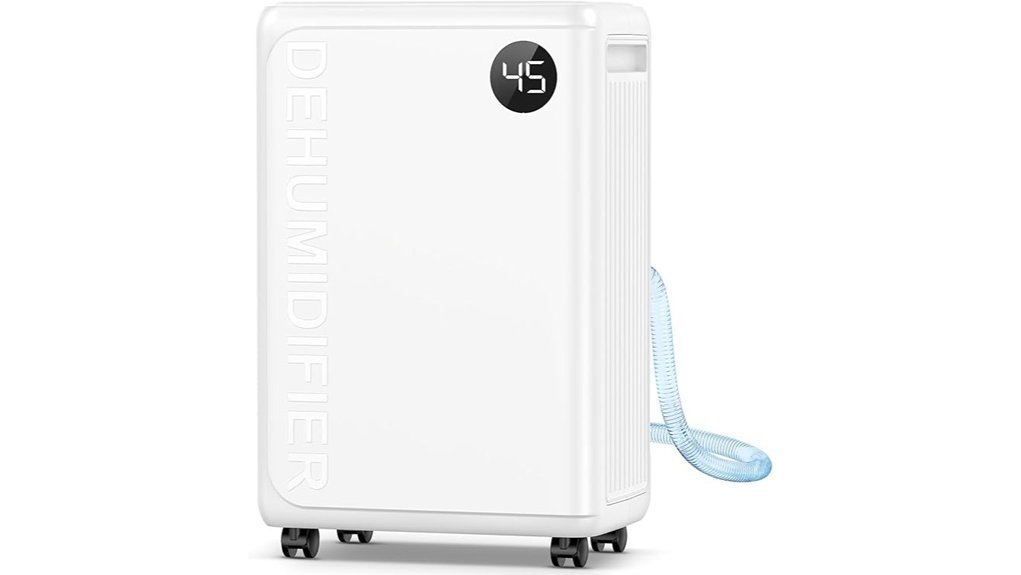
The PLUSCENT 32 Pint Dehumidifier is the most compact unit in this roundup. Rather than attempting to dry a massive multi-vehicle post-frame building, it is a realistic choice only for a small, insulated, partitioned room inside a pole barn—such as an enclosed tack room, reloading or tool room, workshop office, or small single-stall storage bay.
Retail listings market this model as a 32-pint dehumidifier for indoor spaces up to 2,500 square feet (232.3 square meters). Because the manufacturer does not publish detailed DOE Appendix X1 test conditions for that 32-pint figure, treat it as a light-duty residential unit. In a barn environment, keep its workload confined to a sealed, insulated room of a few hundred square feet where outdoor air cannot pour in.
Its feature set covers the essentials for a small zone: adjustable target humidity, three operating modes (standard dehumidification, continuous run, and clothes-drying mode), a 24-hour timer, automatic defrost, a removable collection bucket, and a continuous gravity-drain port.
Key Specifications:
- ASIN: B0G7SV29NL
- Moisture Removal Capacity: 32-pint class (manufacturer rating; standardized DOE capacity not published)
- Advertised Max Area: Up to 2,500 sq ft (232.3 sq m) residential; best kept under 500–800 sq ft in a sealed barn room
- Operating Modes: 3 modes (Dehumidify, Continuous, Dry) + 24-hour timer
- Drainage Methods: Internal water tank or continuous gravity drain hose
Availability note: Stock for the PLUSCENT 32 Pint fluctuates frequently. If it is out of stock when you check, look for a comparable 30- to 35-pint ENERGY STAR unit with documented DOE specs, such as the Honeywell 32-Pint (TPFIT32WK) or Midea Cube 35 Pint.
Why You’ll Like It: Its smaller footprint and lighter electrical draw fit neatly into a finished tack room, gun/tool vault, or small workshop office.
Best For: Small, insulated, partitioned rooms built inside a pole barn, or light seasonal dampness control.
Who Should Avoid It: Owners of an open-bay, full-size, high-ceiling, uninsulated, or dirt-floor pole barn.
Pros:
- Compact, easy-to-move cabinet fits comfortably in tight tack rooms or enclosed tool rooms.
- Includes three operating modes, adjustable humidity control, and a 24-hour timer.
- Supports continuous gravity hose drainage and automatic defrost.
Cons:
- Severely undersized for a full-size, unpartitioned multi-bay pole barn.
- No built-in condensate pump for upward water removal.
- Standardized DOE test conditions and tank volume are poorly documented, and retail stock can be sporadic.
Verdict: Use the PLUSCENT 32 Pint strictly for a small, insulated room partitioned off from the rest of your barn—never for an entire multi-bay metal building.
Factors to Consider When Choosing a Dehumidifier for a Pole Barn
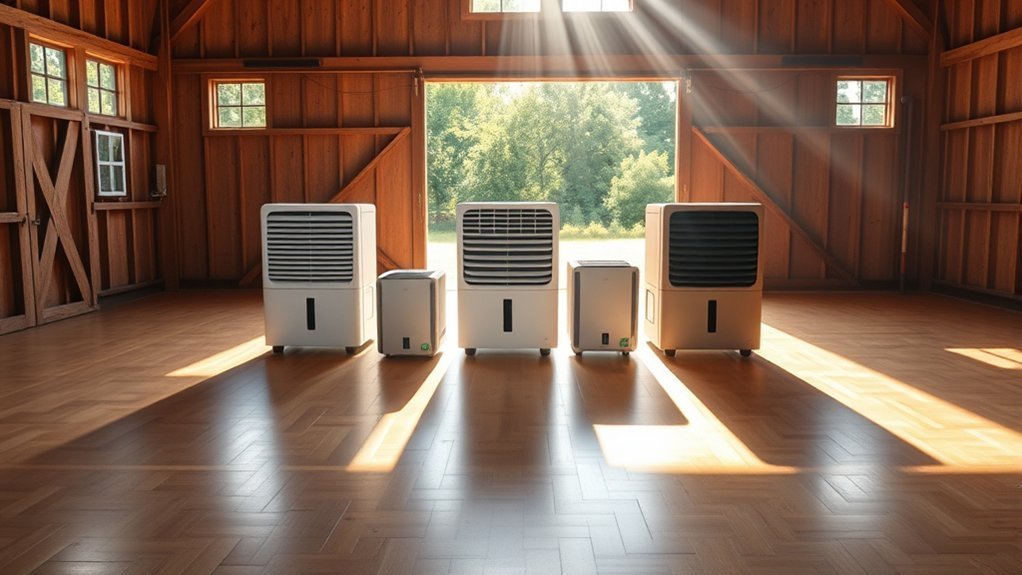
A pole barn is far more challenging to dehumidify than a finished residential basement. Uninsulated steel roofing and siding cool rapidly at night (dropping below the indoor dew point and causing “metal building sweating”), 12- to 16-foot sidewalls double the cubic volume of air, large overhead doors dump humid outdoor air into the shop whenever opened, and unsealed concrete or gravel floors release ground moisture continuously. Evaluate your building envelope before relying on any advertised square-foot rating.
Seal the Building Before Sizing
No dehumidifier can dry the great outdoors. If wind blows freely through ridge vents, open eaves, unsealed rib closures, or gaps around sliding and overhead doors, humid outside air will replace dry indoor air faster than a portable unit can process it. Before running a dehumidifier, install foam closure strips along metal panel ribs, repair bottom astragal and perimeter weatherstripping on overhead doors, and fix any roof or window leaks.
If your pole barn has an exposed dirt, sand, or crushed-gravel floor, groundwater vapor will migrate upward relentlessly. Installing a heavy-duty polyethylene ground-vapor barrier (typically 10- to 20-mil reinforced sheeting prior to pouring a slab or under gravel), extending downspouts away from the perimeter posts, and grading soil away from the skirt board will cut your moisture load far more effectively than buying a larger dehumidifier.
Key Capacity Requirements and Ceiling Height Math
Residential dehumidifier coverage ratings assume a standard 8-foot ceiling. Most pole barns have 10-, 12-, 14-, or 16-foot sidewalls—and even more volume if the trusses are open to the ridge. A 30×40-foot pole barn (1,200 sq ft) with a 14-foot ceiling contains 16,800 cubic feet of air, which is the same air volume as a 2,100-square-foot basement with 8-foot ceilings.
| Pole Barn Floor Size | Sidewall Height | Total Cubic Volume | Equivalent 8-Ft Basement Area | Recommended Equipment Approach (Sealed & Insulated) |
|---|---|---|---|---|
| 12 × 20 ft (240 sq ft Room/Bay) | 8–10 ft | 1,920–2,400 cu ft | 240–300 sq ft | 20–35 Pint DOE unit (or compact 32-pint class model) |
| 24 × 32 ft (768 sq ft) | 10–12 ft | 7,680–9,216 cu ft | 960–1,152 sq ft | 50 Pint DOE (70–110 Pint Max) portable unit |
| 30 × 40 ft (1,200 sq ft) | 12–14 ft | 14,400–16,800 cu ft | 1,800–2,100 sq ft | 50–70 Pint DOE (110–150 Pint Max) unit with continuous/pump drain |
| 40 × 60 ft (2,400 sq ft) | 14–16 ft | 33,600–38,400 cu ft | 4,200–4,800 sq ft | Two 50–70 Pint DOE portables placed at opposite ends, or a commercial 70–120 Pint unit |
Record your barn’s temperature and relative humidity with an independent digital hygrometer for several days before buying. When choosing between two capacities, stepping up to a larger unit helps the shop recover faster after an overhead door opens or a rain-soaked tractor or truck pulls inside.
Understand Advertised Pint Ratings (DOE vs. Saturation)
Two dehumidifiers advertised as “50 Pint” and “150 Pint” may actually have nearly identical compressors and cooling coils. That happens because brands use three different testing benchmarks in product titles:
| Rating Standard | Test Temperature & Humidity | Typical Rating for the Same Large Unit |
|---|---|---|
| Current DOE Standard (Appendix X1 / 2019+) | 65°F and 60% RH | 50 to 70 Pints / Day (Most realistic for cool barns & basements) |
| Legacy DOE Standard (2012–2019) | 80°F and 60% RH | 70 to 95 Pints / Day |
| Manufacturer “Max” or Saturation Rating | 86°F/80% RH or 95°F/90%–95% RH | 100 to 150 Pints / Day (Hot, tropical greenhouse conditions) |
Before you buy: Match the exact model number or UPC on the rating plate, then check the 65°F/60% RH DOE capacity and Integrated Energy Factor (IEF in L/kWh). For example, the GoveeLife H7151 is rated at 50 pints (2019 DOE), 70 pints (2012 DOE), and 109 pints (95°F/90% RH max)—illustrating how one machine carries three different numbers.
Operating Temperature, Winter Limits, and Commercial Alternatives
Standard residential compressor dehumidifiers lose extraction capacity rapidly when indoor air drops below 60°F, and most manuals prohibit operation below 41°F (5°C). In cool air, the evaporator coil drops below freezing and accumulates frost. While automatic defrost temporarily shuts off the compressor and runs the fan to melt coil ice, a unit in a 45°F unheated winter barn will spend most of its time defrosting rather than removing moisture.
If your pole barn requires heavy-duty or cold-weather dehumidification beyond what a residential tower can provide, consider two specialized alternatives:
- Horizontal Commercial / Crawl-Space Dehumidifiers: Rugged metal-housed units—such as the AlorAir Sentinel HD55 or HD90, AprilAire E070 or E100, or Santa Fe Compact70—use hot-gas bypass defrost systems, high-static-pressure blowers, and MERV-8/MERV-10 filtration to operate more reliably in cooler (down to ~33°F–40°F), dustier workshop conditions.
- Desiccant Dehumidifiers: For unheated winter pole barns that regularly stay between 30°F and 50°F, a rotor-based desiccant dehumidifier absorbs moisture chemically using silica gel rather than condensing it on a cold coil—allowing it to dry cold air without freezing up.
Energy Efficiency Ratings
An efficient dehumidifier removes more liters of water per kilowatt-hour of electricity consumed, measured by its Integrated Energy Factor (IEF). ENERGY STAR Version 6.0 certification helps identify efficient models, and checking the unit’s amperage draw (typically 4 to 7.5 amps on 120V circuits) ensures you will not trip a breaker when lights, battery chargers, or shop fans are running on the same circuit.
Noise Level Considerations
Corrugated steel walls, concrete floors, and open trusses reflect sound waves, making a 50–55 dB dehumidifier sound louder inside a pole barn than in a carpeted home. Place the machine on a level concrete pad or heavy rubber anti-vibration mat, keep it away from loose sheet-metal wainscoting or rattling tool racks, and maintain at least 8 to 12 inches of unobstructed airflow clearance around the intake and exhaust grilles.
Drainage Options Available
Continuous unattended drainage is essential in a detached pole barn. Your four primary options are:
- Removable water tank (bucket): Requires zero plumbing, but a 1.5- to 2.0-gallon bucket can fill up in 4 to 8 hours during humid summer weather, pausing the machine until emptied.
- Continuous gravity hose: Simple and reliable when the dehumidifier sits above a floor drain or sump pit and the hose maintains a steady downward slope with no upward loops.
- Built-in condensate pump: Essential when water must be pushed vertically (up to ~9.8 feet on the Waykar YDZ-150PM) into a utility sink or elevated drain line.
- External condensate pump: A separate $50–$80 HVAC condensate reservoir pump can be placed on the floor next to any gravity-drain dehumidifier (such as the GoveeLife H7151 or AEOCKY Leo-Lite) to pump water up to 15–20 feet vertically.
Never route a drain hose where winter temperatures will freeze the line solid, and do not discharge water directly against wooden foundation posts or slab edges.
Smart Features and Controls
When your pole barn sits 100 feet or more from your house, Wi-Fi app monitoring lets you verify humidity levels, confirm that the tank isn’t full, and adjust schedules remotely. Keep in mind that steel siding and roofing act as a Faraday cage that blocks outdoor Wi-Fi signals—you may need a point-to-point wireless bridge or mesh node inside the barn. Always place an independent digital hygrometer 10 to 20 feet away from the dehumidifier to verify true room humidity.
Dust, Filter, and Maintenance Requirements
Woodworking sawdust, grinding dust, soil particles, pollen, and chaff clog residential mesh filters rapidly. Inspect the intake screen weekly during the first month of operation, vacuum or rinse it with warm water as needed, and pause the dehumidifier while sawing, sanding, or sweeping concrete floors so fine dust isn’t pulled directly onto the wet evaporator coils.
Electrical and Placement Safety
Plug your dehumidifier directly into a properly grounded 120V GFCI-protected receptacle on a circuit rated for the appliance’s startup and running amperage. Never use lightweight extension cords, which can overheat under continuous compressor loads. Keep residential dehumidifiers well away from gasoline cans, paint thinners, solvents, welding sparks, pressure-washing spray, and livestock stalls.
Before You Buy Checklist
- Measure the enclosed floor area and sidewall/ceiling height to calculate total cubic volume.
- Log barn temperature and relative humidity for several days using a standalone hygrometer.
- Seal overhead door perimeter gaps, rib closures, and active roof or wall leaks first.
- Confirm that dirt or gravel floors have a proper ground-vapor barrier and exterior drainage.
- Match the exact model number or UPC and compare 65°F/60% RH DOE capacity rather than headline “max” pints.
- Verify that winter barn temperatures stay above the unit’s minimum operating limit (typically 41°F), or choose a desiccant/commercial unit instead.
- Plan your drainage path (gravity floor drain vs. built-in or external condensate pump) before choosing a model.
- Verify that your 120V grounded outlet and circuit breaker can handle the continuous amp draw without an extension cord.
- Leave 8 to 12 inches of clearance around all air intakes and exhaust grilles.
- Schedule frequent filter cleanings and shut the unit off during heavy woodworking or sweeping.
Frequently Asked Questions
How Often Should I Empty the Dehumidifier’s Water Tank?
Check the bucket at least once or twice a day during the first week of operation. In a damp pole barn during humid summer weather, a 50- to 70-pint DOE dehumidifier can fill a 1.5- to 2.0-gallon bucket in just 4 to 8 hours. For reliable unattended protection, attach a continuous gravity drain hose to a floor drain or use a model with a built-in condensate pump.
Can I Use a Dehumidifier in Winter?
Only if your pole barn stays within the manufacturer’s permitted operating temperature range—typically above 41°F (5°C), and ideally above 55°F–60°F for effective compressor extraction. In colder temperatures, residential compressor dehumidifiers lose capacity rapidly and spend long periods in auto-defrost mode. For unheated winter barns between 30°F and 50°F, use background heating or switch to a desiccant dehumidifier.
What Humidity Level Is Best for a Pole Barn?
A practical target for most enclosed storage barns and workshops is 45% to 55% relative humidity. Keeping indoor relative humidity consistently below 60% inhibits mold growth, prevents musty odors, and sharply reduces surface rust on cast-iron machine tables, hand tools, and vehicle components without forcing the compressor to run nonstop.
What Maintenance Is Required for Dehumidifiers?
Inspect and vacuum or rinse the washable air filter every 1 to 2 weeks in a dusty barn, flush the water bucket and drain hose periodically to prevent algae or slime blockages, wipe dust from the intake and exhaust grilles, and unplug the unit when performing dusty woodworking or grinding work.
Are Dehumidifiers Noisy During Operation?
Yes—all compressor dehumidifiers produce fan and compressor hum (typically 42 to 53 dB), which can echo off bare metal walls and concrete slabs. Placing the unit on a firm, level rubber mat away from loose sheet-metal panels helps minimize vibration noise.
How Do I Determine the Right Capacity for My Pole Barn?
Multiply your enclosed floor area by your sidewall height to find the cubic air volume, divide by 8 to find the equivalent 8-foot residential basement square footage, and evaluate moisture sources (unsealed doors, concrete curing, wet vehicles, or high local humidity). Compare units using their standardized 65°F/60% RH DOE pint rating rather than inflated 95°F maximum claims. Barns larger than 2,000 square feet with tall ceilings often require two portable units or a dedicated commercial dehumidifier.
Will a Dehumidifier Stop Condensation on Metal Walls?
A dehumidifier reduces condensation by lowering the indoor air’s dew point, making it harder for moisture to condense on cool steel panels. However, if bare single-skin metal roofing or siding drops well below freezing overnight while warm air rises inside, condensation can still occur until you add insulation, a vapor retarder, and proper air sealing.
Can I Run a Dehumidifier With the Pole-Barn Doors Open?
No—running a dehumidifier with overhead or sliding barn doors open wastes electricity because humid outdoor air enters far faster than the machine can dry it. Turn the dehumidifier off while doors are open for projects or ventilation, then close the building so the unit can pull indoor humidity back down.
Do I Need a Built-In Pump?
You need a built-in condensate pump (or a separate external HVAC condensate pump) if your drain termination point—such as a utility sink, elevated wall drain, or window port—is higher than the dehumidifier’s drain outlet. If you have a floor drain or sump basin directly below the unit, a simple gravity drain hose works without extra moving parts.
Can One Portable Dehumidifier Handle a Dirt-Floor Pole Barn?
Rarely. An uncovered dirt or gravel floor acts as an endless wick for groundwater vapor, especially after rain. Always install a heavy-duty polyethylene ground-vapor barrier and improve exterior gutter and grading drainage before expecting a portable dehumidifier to control barn humidity.
How Soon Should Humidity Drop After Installation?
In an enclosed, reasonably sealed pole barn with a vapor barrier, an appropriately sized dehumidifier should lower relative humidity noticeably within 24 to 72 hours. If stored lumber, cardboard, or damp concrete slabs are releasing trapped moisture, full stabilization may take one to two weeks. Monitor progress with a separate digital hygrometer placed across the room.
Final Recommendation
Choose the Waykar 150 Pint with Pump (YDZ-150PM) when you have a larger enclosed pole barn and need strong 70-pint DOE (150-pint max) extraction paired with a built-in pump that lifts water up to 9.84 feet.
Choose the GoveeLife H7151 Smart Dehumidifier Max when your barn has Wi-Fi and you want smartphone humidity tracking, full-bucket alerts, and remote sensor pairing alongside 50-pint DOE (109-pint max) performance.
Choose the AEOCKY Leo-Lite 74 Pint for a midsize, insulated workshop with a floor drain where ENERGY STAR Version 6.0 efficiency and a low 4-amp electrical draw are top priorities.
Choose the Ludatido 80 Pint when you want simple push-button controls, a visual 3-color humidity light, and a 1.72-gallon bucket for manual or short-hose gravity drainage.
Choose the PLUSCENT 32 Pint strictly for a small, insulated tack room, tool vault, or partitioned office inside a barn—never for a full-size, unsealed metal building.
Conclusion
A well-matched pole barn dehumidifier can protect tools, vehicles, machinery, and stored lumber from rust, mold, and condensation damage, but the appliance is only half of the equation. Seal perimeter door and roof-rib gaps, stop ground moisture with a proper vapor barrier, and set up a dependable gravity or pumped drain line before expecting a portable machine to dry the building.
By comparing standardized 65°F/60% RH DOE capacity ratings, accounting for tall barn ceilings, respecting winter operating-temperature limits, and cleaning dust filters regularly, you can select the right dehumidifier setup to keep your enclosed post-frame building dry and protected year-round.