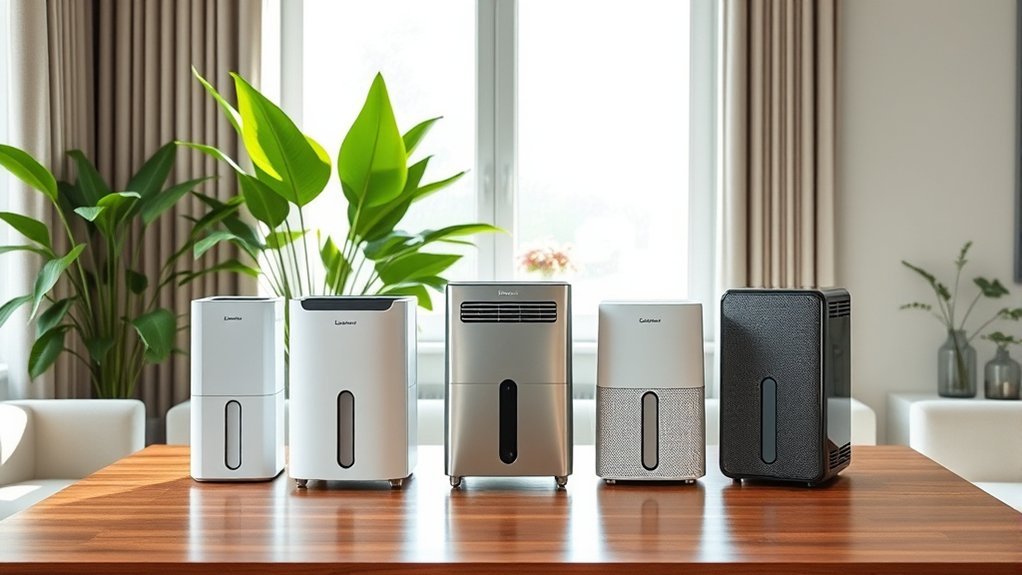
If you need a garage dehumidifier with a built-in pump, focus on automatic drainage, operating temperature, moisture-removal capacity, pump lift, and the actual conditions inside your garage. The GoveeLife Smart Dehumidifier Max is the most balanced option for smart control and flexible pump drainage, while the Midea 60-Pint model offers a larger tank and a higher listed daily capacity. For an especially large or persistently damp garage, the Waykar 150-Pint model provides a heavier-duty option.
Do not choose by square-foot claims or headline pint numbers alone. Garage temperature, outside-air leakage, humidity level, ceiling height, wet vehicles, and the test conditions used for capacity ratings can all affect real-world performance. Also verify the pump’s maximum vertical lift before routing water to an elevated sink, window, or drain.
Quick Comparison of Garage Dehumidifiers With Pumps
| Product | Best Use | Listed Capacity | Tank | Notable Feature | Check Details |
|---|---|---|---|---|---|
| GoveeLife Smart Max | Best overall | Up to 50 pints/day at 65°F, 60% RH | 1.8 gallons | Smart control and included 16-foot pump drain hose | Check Amazon |
| Midea 60-Pint | Larger garages | Up to 60 pints/day | 2.64 gallons | Built-in pump, large tank, app and voice control | Check Amazon |
| Waykar 150-Pint | Heavy-duty moisture control | Up to 150 pints/day at 95°F, 90% RH | 1.85 gallons / 7 liters | Pump lift up to 9.84 feet and self-drying mode | Check Amazon |
Important: These headline capacities are not necessarily measured under identical conditions. For example, the GoveeLife listing specifies its 50-pint figure at 65°F and 60% RH, while Waykar lists 150 pints at 95°F and 90% RH. Confirm the current standardized rating, pump lift limit, operating-temperature range, and included hoses for the exact model before comparing capacity directly.
GoveeLife Smart Dehumidifier for Home with Pump
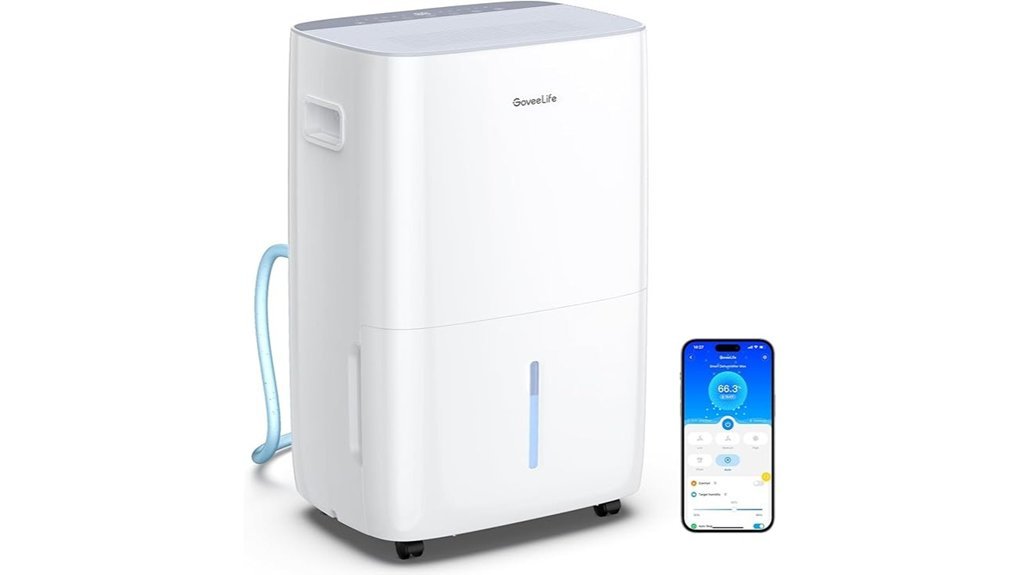
The GoveeLife Smart Dehumidifier Max with Pump is a practical choice for homeowners who want automatic pump drainage without giving up smart controls. Its current listing specifies moisture removal of up to 50 pints per day at 65°F and 60% relative humidity and manufacturer-claimed coverage up to 4,500 square feet. Actual garage performance will depend on temperature, humidity, insulation, ceiling height, and how often outside air enters the space.
Its built-in condensate pump and included 16-foot external drain hose provide more placement flexibility than gravity drainage alone. The 1.8-gallon tank also allows manual collection when a permanent drain route is unavailable. Auto, Comfort, Drying, Maintain, and Sleep modes make the unit adaptable to seasonal humidity changes and different garage uses.
The current product information lists a working-temperature range of approximately 41-86°F. That makes temperature especially important in an unheated garage, since auto-defrost does not mean the appliance should be operated below its rated range.
Why You’ll Like It
The combination of automatic pump drainage, app-based control, multiple operating modes, and automatic humidity management makes this the easiest of the three models to monitor remotely. It is especially useful when the garage is detached or is not checked every day.
Who Should Buy This: Owners of medium to large garages who value smart monitoring, automatic drainage, and a long included pump hose more than maximum headline capacity.
Who Should Avoid This: Buyers who do not use smartphone controls, need a larger backup tank, have a garage that regularly falls below the listed operating-temperature range, or have unusually severe moisture problems that require a larger unit.
Pros:
- Built-in pump with an included 16-foot external drain hose.
- Smart controls make it easier to monitor and adjust garage humidity remotely.
- Five operating modes provide more control over humidity management, drying, and nighttime operation.
- Automatic defrost and shutdown drainage features support more hands-off operation.
Cons:
- Its approximately 40.1-pound weight may make stair or elevated shelf placement difficult.
- Manufacturer square-foot coverage should not be treated as guaranteed garage coverage.
- App features add little value for buyers who prefer simple manual controls.
- Cold unheated garages may fall below its listed operating range during winter.
Midea 60 Pint Dehumidifier with Pump & Smart Control
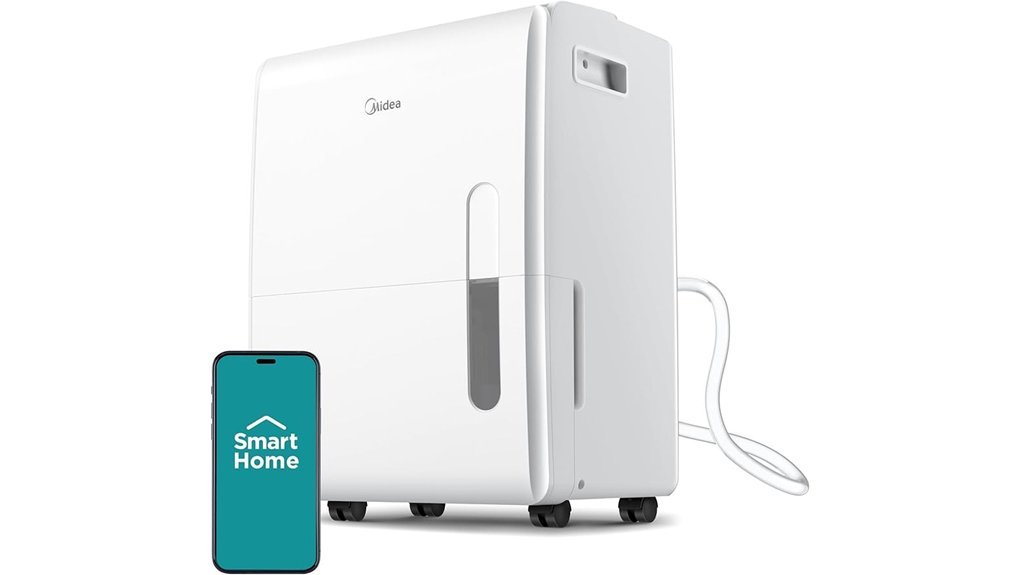
The Midea 60-Pint Dehumidifier with Pump, model MAD60PS1AWS-A, combines a higher listed daily capacity with a large 2.64-gallon collection tank. It is marketed for spaces up to 5,500 square feet, although garage conditions and the rating method matter more than the coverage number alone.
You can route collected water through the built-in pump, use continuous hose drainage when gravity flow is available, or collect water in the tank. The adjustable humidity setting ranges from 30% to 80%, while SmartHome app control plus Alexa and Google Assistant compatibility provide remote adjustment and voice control.
Why You’ll Like It
The larger tank reduces how frequently the bucket must be emptied when pump or gravity drainage is temporarily unavailable. It is a useful choice for buyers who want more backup water capacity than the other two models while keeping smart control and automatic drainage.
Who Should Buy This: Owners of larger attached garages, workshops, and storage rooms who want a large tank, built-in pump, adjustable humidity control, and smart connectivity.
Who Should Avoid This: Buyers who regularly move the unit, are especially sensitive to appliance noise, do not need smart features, or have an unheated garage where the winter temperature may fall outside the manufacturer’s permitted operating range.
Pros:
- Built-in pump supports drainage to destinations that are not directly below the appliance.
- Large 2.64-gallon tank provides useful backup when continuous drainage is unavailable.
- SmartHome, Alexa, and Google Assistant support make remote humidity adjustments easier.
- Washable filter, wheels, included drain components, and removable tank improve everyday usability.
Cons:
- The listed weight of approximately 57.8 pounds makes it the heaviest option in this comparison.
- The listed 50-60 dB operating range may be noticeable in an attached garage or quiet workshop.
- Wi-Fi and voice features are unnecessary for buyers who only need basic automatic humidity control.
Waykar 150 Pints Energy Star Dehumidifier with Pump
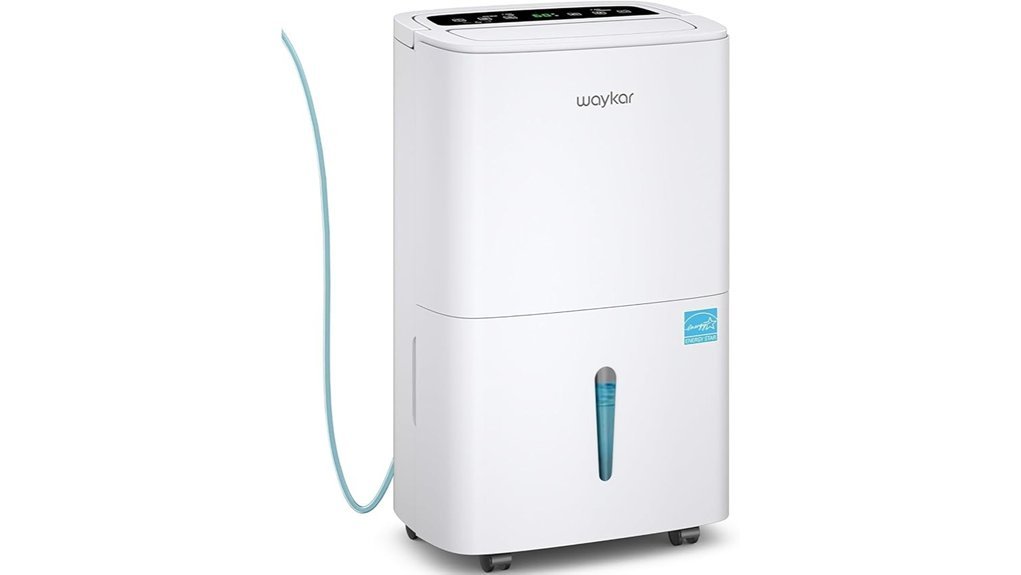
The Waykar 150-Pint Dehumidifier with Pump is designed for larger and more demanding spaces. Its headline 150-pint capacity is measured at 95°F and 90% relative humidity, so it should not be compared directly with a 50- or 60-pint figure measured under different conditions.
The exact product listing describes coverage up to 7,000 square feet, adjustable humidity from 30% to 80%, a built-in pump capable of raising discharged water up to 9.84 feet, a 1.85-gallon/7-liter tank, gravity-drain support, auto-defrost, automatic restart, self-drying, a timer, washable filtration, and mobile casters. Those features make it better suited to a large workshop, multi-bay garage, or persistently damp storage area than to a small one-car garage.
Why You’ll Like It
Its main advantage is high maximum moisture-removal capability under hot and highly humid conditions. The verified pump lift is also useful when the discharge point is above the unit, while self-drying and automatic-defrost functions support extended operation.
Who Should Buy This: Owners of large garages, workshops, storage areas, or highly humid spaces where a smaller residential unit struggles to maintain the selected humidity.
Who Should Avoid This: Buyers with a small one-car garage, only mild seasonal humidity, limited floor space, or no need for heavy-duty moisture removal.
Pros:
- High maximum moisture-removal capacity for demanding hot and humid conditions.
- Built-in pump is currently listed for upward drainage of up to 9.84 feet.
- Gravity drainage, auto-defrost, self-drying, timer, restart memory, and washable filtration support extended use.
- Casters and a carrying handle help with repositioning around a garage or workshop.
Cons:
- The 150-pint headline figure is measured at 95°F and 90% RH and is not directly comparable with every competing rating.
- It may be oversized for a typical one-car garage with moderate humidity.
- Its 1.85-gallon tank is smaller than the Midea’s 2.64-gallon tank when manual collection is required.
- Recheck the current listing or manual before installation in case pump-lift or hose specifications change.
Factors to Consider When Choosing a Garage Dehumidifier With Pump
When comparing garage dehumidifiers, start with the unit’s moisture-removal rating and test conditions, operating-temperature range, automatic drainage route, pump lift, and electrical requirements. Square-foot coverage can provide an initial reference, but it should not replace an assessment of the actual garage conditions.
Garage Size and Moisture Load
A small attached garage with minor summer humidity does not have the same moisture load as a detached workshop with wet vehicles, poor air sealing, and frequent door openings. Measure the garage, check its relative humidity with a separate hygrometer, and identify moisture sources before selecting capacity.
Manufacturer coverage figures are often based on assumptions that may not match a garage. Choose based on rated moisture removal and real conditions rather than buying solely because a listing claims coverage of several thousand square feet.
Pint Capacity and Test Conditions
Pint capacity describes how much moisture a dehumidifier can remove during a specified test period. However, not every headline number is measured at the same temperature and humidity. A model advertised as removing 150 pints at 95°F and 90% RH should not automatically be considered three times as powerful as a 50-pint model rated at 65°F and 60% RH.
Check the exact product label, current listing, manual, or certification information for the rating conditions. A correctly sized unit should be able to reduce and maintain garage humidity without being selected solely on the largest marketing number.
Pump Drainage and Vertical Lift
A built-in condensate pump is useful when water must travel upward to a utility sink, through a window, or across the garage to a suitable drain. This is different from gravity drainage, which requires the hose to maintain a downhill route.
Do not confuse hose length with vertical pump lift. A 16-foot hose does not necessarily mean the pump can raise water 16 vertical feet. Check the exact maximum lift, permitted hose diameter, maximum total hose length, and routing instructions for the model you purchase.
Operating Temperature and Auto-Defrost
Garages can become much colder than indoor living spaces. Compressor dehumidifiers lose performance as temperatures fall, and frost may form on the coils. Auto-defrost can help manage frost within the appliance’s rated operating range, but it does not make every model suitable for freezing temperatures.
Check the manufacturer’s minimum operating temperature before winter use. Do not run the unit outside its permitted range. A heated garage or equipment specifically designed for colder conditions may be necessary when temperatures stay low.
Energy Efficiency
An ENERGY STAR certified dehumidifier meets applicable energy-efficiency requirements for its product class. Certification can be useful when the machine will operate for long periods, but overall energy use still depends heavily on selecting the right capacity and humidity target.
Automatic humidity control, compressor cycling, clean filters, unobstructed airflow, and a sensible humidity setting can reduce unnecessary runtime. Avoid setting the garage substantially drier than necessary unless stored materials require tighter humidity control.
Noise and Placement
Noise is especially important when the garage shares a wall with a bedroom, office, or living room. Compressor and fan noise may also be joined by short bursts of sound when the condensate pump activates.
Place the unit on a stable, level surface with the manufacturer-required clearance around its air intake and exhaust. Avoid enclosed cabinets, soft flooring, or locations where tools, vehicles, and storage boxes can restrict airflow or damage the unit.
Smart Controls
Wi-Fi control can be useful when the garage is detached or rarely visited. Remote humidity readings, schedules, filter reminders, and operating alerts can make ongoing garage humidity control easier.
Smart features do not replace a reliable drain connection or periodic inspection. Check the hose, filter, tank, pump inlet, and surrounding floor regularly even when the dehumidifier is controlled remotely.
Electrical Requirements
Check the appliance nameplate for its voltage and current requirements, then confirm that the garage circuit can support it along with refrigerators, freezers, power tools, chargers, heaters, compressors, and other equipment. Use a properly grounded outlet and follow the manufacturer’s instructions regarding extension cords.
Repeated breaker trips, damaged cords, unusually hot plugs, or water near the outlet require immediate attention. Do not place the unit where vehicles, tools, or stored items can damage its power cord.
Before You Buy
- Measure the garage and check its current humidity with a separate hygrometer.
- Confirm the exact model number and moisture-removal rating conditions.
- Check the minimum and maximum operating temperatures.
- Verify maximum vertical pump lift rather than relying on hose length.
- Confirm the included pump and gravity-drain hose lengths.
- Plan where discharged water will go without creating a slip, freeze, or drainage hazard.
- Confirm that the garage circuit can safely support the appliance.
- Check tank size, filter access, unit weight, dimensions, and required airflow clearance.
- Read the current warranty, drain-hose, and pump-maintenance instructions.
Frequently Asked Questions
How Often Should I Clean a Garage Dehumidifier Pump?
Follow the cleaning schedule in the exact model manual. Inspect the reservoir, pump inlet, drain hose, and filter regularly, especially when the garage contains dust, sawdust, insects, or dirty water. Clean the system sooner if drainage slows, the pump becomes louder, or a warning code appears.
Can a Dehumidifier With a Pump Run in Freezing Temperatures?
Only when the specific model is rated for those temperatures. Auto-defrost does not automatically make a standard compressor dehumidifier suitable for a freezing garage. Operating below the rated range can reduce performance and cause ice to form on the coils.
Do Garage Dehumidifiers With Pumps Need Dedicated Outlets?
Not every model requires a dedicated circuit, but you must check its nameplate rating and the total electrical load already connected to the garage circuit. Large tools, freezers, heaters, compressors, and vehicle chargers can contribute to overloads.
How Far Can the Drain Hose Pump Water Uphill?
The answer depends on the exact pump. Maximum hose length and maximum vertical lift are separate measurements. For example, the current Waykar listing reviewed here specifies upward pump drainage up to 9.84 feet, while a long hose on another model does not automatically indicate the same lift capability. Check the current manual or listing before installation and do not extend the hose beyond the manufacturer’s limit.
Is Pump Drainage Better Than Manual Emptying?
Pump drainage is better when you want unattended operation and the available discharge point is above the unit. Manual emptying can be simpler when portability matters or when there is no safe permanent drainage location. Gravity drainage is usually the simplest continuous option when a nearby floor-level drain is available and the hose can run downhill.
What Humidity Setting Is Best for a Garage?
A setting near 50% relative humidity is a reasonable starting point for many garages. Adjust it based on condensation, stored materials, seasonal conditions, and the manufacturer’s guidance. Setting the target unnecessarily low can increase energy use and runtime.
Conclusion
The GoveeLife Smart Dehumidifier Max is the strongest all-around choice for buyers who want smart monitoring, multiple operating modes, a built-in pump, and a long included drain hose. The Midea 60-Pint Dehumidifier is better when a larger collection tank and higher listed daily capacity are priorities. The Waykar 150-Pint Dehumidifier is the heavy-duty option for a large or persistently damp garage and currently offers a verified pump lift of up to 9.84 feet.
Before ordering, verify the current moisture-removal rating and test conditions, operating-temperature range, pump lift, hose requirements, dimensions, and electrical load for the exact model. Correct sizing and a properly installed automatic drainage route will usually matter more than the largest square-foot or pint figure in the product title.