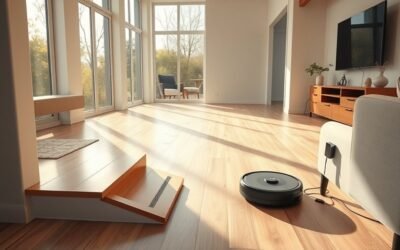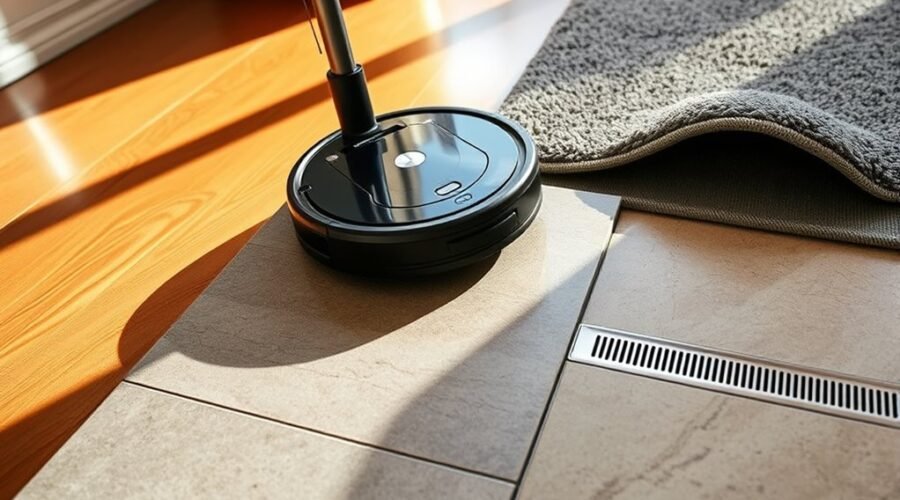
Robot vacuums can clean uneven floors, but only within clear limits. Their performance depends on wheel design, suction, sensors, and how much height change the floor presents. Small thresholds and shallow grout lines are often manageable, while larger bumps, warped boards, or rough changes can stop them cold. The right model can make the difference between smooth coverage and constant recovery.
Can Robot Vacuums Clean Uneven Floors?
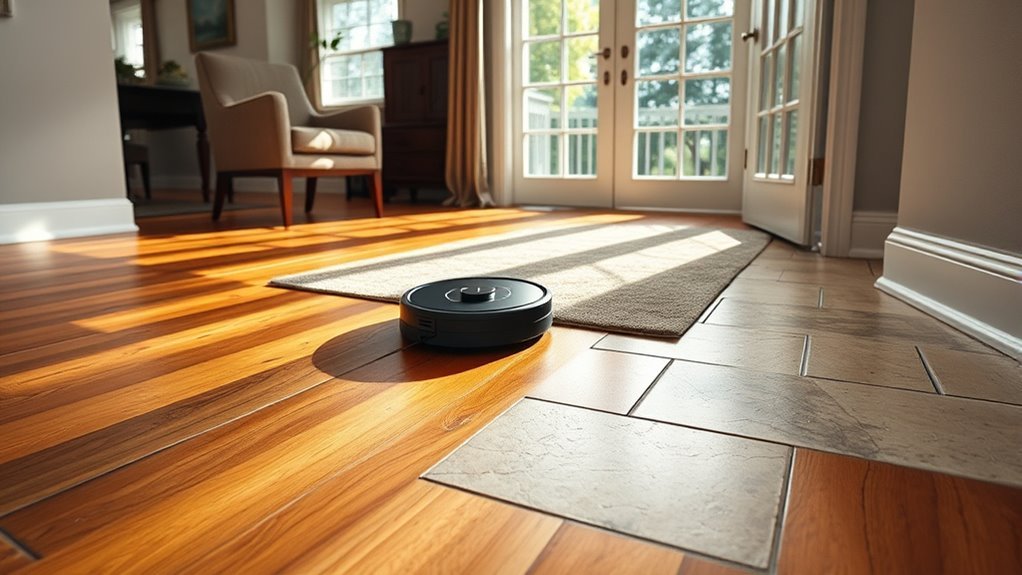
Yes—robot vacuums can clean uneven floors, but performance depends heavily on the model and the severity of the surface irregularities. A robot vacuum with strong suction power and a stable cleaning path can handle minor height changes, but uneven floors still create challenges for many units.
Advanced models with larger wheels, adaptive sensors, and better navigation and obstacle avoidance tend to keep contact with the floor more consistently, which improves debris pickup and route stability. High-end models such as the Narwal Freo Z Ultra and Ecovacs Deebot X2 Omni show stronger performance on thresholds near 0.8 inches and 0.7 inches.
For rough surfaces, at least 5,000Pa is often recommended to maintain effective cleaning. Still, performance can drop when wood shifts with heat or when nails and other protrusions obstruct movement.
In practical terms, the best robot vacuum choices offer more freedom from manual cleaning, but heavily uneven floors remain a technical limit.
Why Do Robot Vacuums Get Stuck on Bumps?
Robot vacuums often get stuck on bumps because uneven surfaces interrupt both sensing and movement. On uneven floors, sensors may misread height changes, so robot vacuums fail to classify bumps and other obstacles accurately.
Uneven floors can confuse sensors, making robot vacuums misread bumps and struggle to detect obstacles accurately.
When a wheel meets a raised edge, warped plank, or hidden nail, the chassis can hang up and the unit can stop moving. Small wheels and limited suspension worsen this problem, especially where gaps or irregular boards create repeated jolts.
Suction efficiency may also drop on uneven floors, because the base cannot keep a stable seal or maintain steady contact. That loss can reduce traction and cleaning capabilities at the same time.
Advanced models with stronger navigation features, height adjustment, and larger wheels handle irregularities better, but they still have limits.
For users seeking freedom from manual cleaning, the practical lesson is clear: robot vacuums improve automation, yet bumps still expose weak spots in design and terrain handling.
How Do Robot Vacuums Handle Thresholds and Grout?
Robot vacuums typically clear thresholds around 0.6 to 0.8 inches, though advanced models can manage higher rises with larger wheels and adaptive suspension.
Deep grout lines can be harder to read than solid edges, so sensors may misjudge gaps and cause stalls or entrapment.
Adjustable brush height and floor-adaptive designs improve movement across tile changes and reduce performance loss on uneven surfaces.
Threshold Climbing Limits
Most robot vacuums can climb thresholds in the 0.6–0.8 inch range, though performance varies widely by model. These threshold climbing limits shape whether a vacuum for uneven floors can move freely across rooms or stall at changes.
Advanced models improve navigation with larger wheels, adaptive suspension, and better obstacle detection, while high-end units can show about 25% better performance than standard designs.
- Taller thresholds need stronger traction.
- Wider wheelbases improve stability.
- Grout lines reduce crossing confidence.
- Adjustable brush heights and suction help on rough surfaces.
On uneven floors, selection matters: the wrong machine remains trapped, while the right one preserves autonomy and coverage.
Grout Line Challenges
Grout lines and small floor shifts can interrupt a vacuum’s path because sensors may misread the uneven surface, causing hesitation, stalling, or missed coverage.
A robot vacuum on uneven floors often loses cleaning efficiency when grout lines are deep or tiles are heavily textured. Standard units may cross thresholds of 0.6–0.8 inches, yet performance varies widely.
Advanced models with adjustable brushes and high-traction wheels improve traction, stabilize movement, and reduce texture challenges. Independent tests show some systems, including the Narwal Freo Z Ultra, maintain consistent suction over grout lines and raise cleaning coverage by up to 25%.
Even so, navigation remains limited where surface relief is sharp, so liberation from manual cleaning still depends on floor geometry and model design.
What Features Help Robot Vacuums Work on Rough Floors?
On rough floors, performance depends on hardware and navigation features that help the vacuum stay stable and maintain contact with uneven surfaces. A robot vacuum built for uneven floors should combine mechanical support with smart control.
Advanced robot vacuums often use adaptive suspension and larger wheels to improve traction and stability over dips, seams, and grit. Automatic height adjustment helps brushes stay engaged, which protects cleaning performance on textured surfaces.
Adaptive suspension and larger wheels help robot vacuums stay stable and maintain cleaning power on rough, textured floors.
Terrain detection adds another layer of control, letting the machine read changes and avoid wasted passes or stalls. High suction power matters because loose debris is harder to lift from irregular ground.
Thresholds also define capability; many premium units cross 0.6–0.8 inches.
- Adaptive suspension
- Terrain detection
- Automatic height adjustment
- High suction power
Which Robot Vacuums Work Best on Uneven Floors?
Among robot vacuums built for rough flooring, the strongest performers are models designed with larger wheels, adaptive suspension, and enough suction to maintain contact and debris pickup across dips and thresholds.
In practice, the best robot vacuums for uneven floors include the Narwal Freo Z Ultra and Ecovacs Deebot X2 Omni, both using advanced technology for steadier navigation. The Narwal Freo Z Ultra crosses a 0.8-inch threshold, while the Roborock S8 Pro Ultra manages 0.6 inches, making each suitable for common floor changes.
For sustained cleaning, suction power matters: 5,000Pa is a practical minimum, while 12,000Pa offers stronger performance consistency on irregular surfaces.
The MOVA Z60 Ultra has also shown strong threshold climbing, surpassing its claimed 48 mm limit in tests.
Still, even capable models face limits on heavily uneven floors, so robot vacuum performance remains tied to the specific floor profile.
How to Choose the Right Robot Vacuum for Your Home?
Selecting the right robot vacuum starts with the home’s flooring profile, since uneven surfaces, thresholds, and deep grout lines can sharply affect navigation and pickup. A practical buyer should match the machine to the terrain, not the other way around.
- Measure changes in elevation and note where the robot vacuum must climb; 0.8-inch crossings are a useful benchmark for uneven floors.
- Target at least 5,000Pa suction power; advanced models with 10,000–12,000Pa usually deliver steadier cleaning performance on grout and rough patches.
- Prefer automatic height adjustment, adaptive suspension, and terrain detection so brushes stay engaged across mixed flooring.
- Compare user reviews and test data for specific layouts; Narwal Freo Z Ultra and Ecovacs Deebot X2 Omni are strong options for changes in elevation.
These features reduce manual intervention and support cleaner, more autonomous living.
Frequently Asked Questions
Which Robot Vacuum Cleaner Is Best for Uneven Floors?
Narwal Freo Z Ultra appears best for uneven floors, thanks to superior robot vacuum features, navigation technology, sensor capabilities, and suction power; its uneven floor performance outpaces brand comparisons. Battery life, price range, maintenance tips still matter.
What Are the Downsides of Using a Robotic Vacuum Cleaner?
Downsides include navigation issues: will it stall at a threshold? Robot efficiency drops, suction power weakens, battery life limits coverage, maintenance costs rise, carpet performance varies, noise levels persist, obstacle detection fails, brand reliability depends on user reviews.
Which Robot Vacuum Is Best for Multi-Level Floors?
The MOVA Z60 Ultra appears best for multi-level floors, thanks to multi surface compatibility and height adjustment technology. Brand comparisons, user reviews, and price ranges favor it, though navigation accuracy, battery life concerns, obstacle detection features, cleaning performance, and floor surface adaptability remain decisive.
Can a Robot Vacuum Clean Different Floors?
Yes—like a nimble scout, it can. Robot vacuum compatibility spans carpet vs. hardfloor; sensor technology, brush design, and height adjustment improve cleaning efficiency, though uneven floor challenges, navigation issues, battery life, and maintenance requirements remain.
Conclusion
Robot vacuums can clean uneven floors, but their success depends on the surface. Advanced models can clear thresholds up to 0.8 inches, a useful benchmark for homes with small changes in elevation. Still, deep grout, raised bumps, and irregular flooring can trigger misreads or wheel lockups. For best results, buyers should match wheel clearance, suction power, and sensor quality to the floor layout. Careful model selection remains the difference between smooth cleaning and frequent rescues.