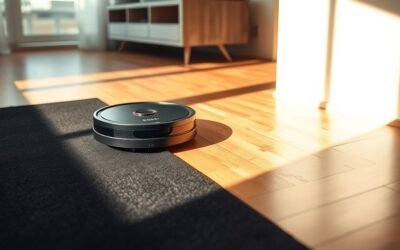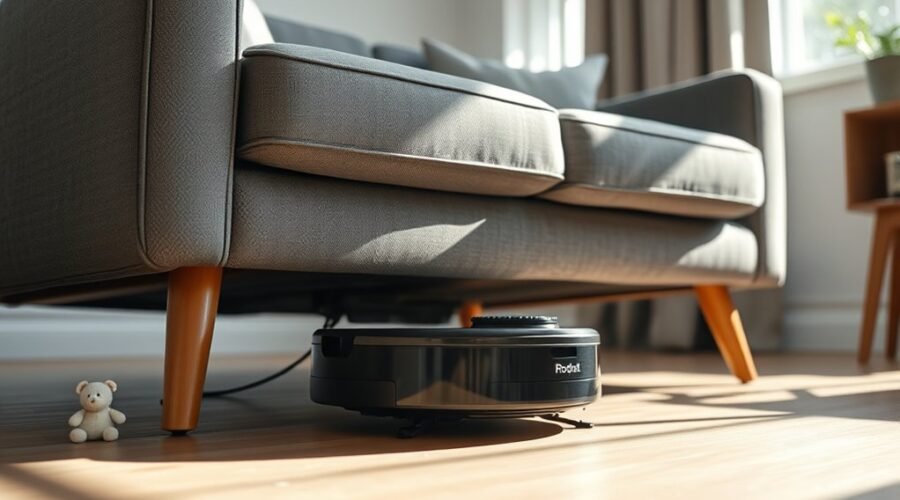
Robot vacuums can clean under couches, but your sofa’s height determines whether they can reach the dust underneath. A low-profile robot vacuum may fit where a taller model gets stuck. Before you start cleaning, you need to check the clearance, floor obstacles, and the robot’s full height.
Quick Answer
Yes, robot vacuums can clean under couches when there is enough space for the entire machine. For example, the Roomba j7 is 3.4 inches tall, while the Narwal Flow measures 3.7 inches. Leave extra overhead clearance, remove cords and toys, and check the lowest parts of your sofa to prevent jams.
Key Takeaways
- Measure the lowest point beneath your couch, not just the opening at the front.
- Allow about 1 cm of extra space as a starting buffer, but follow the manufacturer’s clearance recommendation.
- Loose fabric, hidden cables, furniture frames, and uneven floors can trap a robot that otherwise fits.
- Compatible furniture risers, clear pathways, and app-based no-go zones can prevent repeated problems.
- A slim robot vacuum with reliable navigation offers the best chance of cleaning beneath low furniture.
Can Robot Vacuums Clean Under Couches?
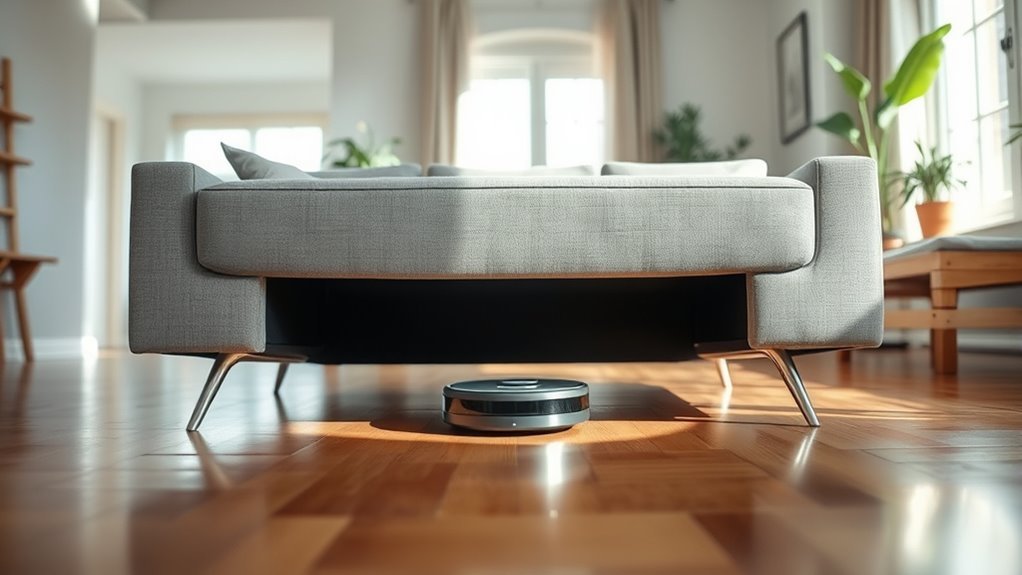
Yes, many robot vacuums can clean under couches without you moving the furniture. They use rotating brushes and suction to collect dust, crumbs, pet hair, and other loose debris from hard-to-reach floors.
However, a robot must fit beneath the couch and have enough room to move without scraping the frame. Its sensors also need to recognize the surrounding furniture so it can avoid obstacles and find a route out.
A robot vacuum can clean beneath your couch only when the complete cleaning path provides enough space for it to move safely.
Most models can handle everyday dust on accessible hard floors and low-pile carpets. Their performance depends on suction, brush condition, navigation, and the type of debris under the sofa.
For example, a robot may enter an open couch with tall legs easily. The same machine might struggle beneath a sofa with a low center support or hanging fabric.
Regular cleaning also helps prevent dust and pet hair from building up in areas you rarely reach with a regular vacuum.
Still, robot vacuums cannot always replace manual cleaning. Corners behind furniture legs, narrow gaps, and thick dirt deposits may need a hose attachment or another cleaning tool.
How Much Clearance Does a Robot Vacuum Need?
A robot vacuum needs an opening that is taller than its highest point. There is no universal 3.6-inch clearance requirement because robot heights vary between models.
For example, the official Roomba j7 specifications list a height of 3.4 inches. The Narwal Flow specifications give a height of 3.7 inches, or 95 mm.
That means a couch with only 3.6 inches of space cannot accommodate a 3.7-inch-tall Narwal Flow. A shorter model might physically fit, although it still needs additional room for reliable movement.
As a practical starting point, aim for at least 1 cm of space above the robot’s body. This helps account for small floor changes, furniture movement, and other restrictions.
However, the manufacturer’s minimum cleaning clearance takes priority. For example, Narwal’s guidance for several Freo models recommends 13–14 cm, or about 5.1–5.5 inches, beneath furniture. Those models have different dimensions from the Flow.
Also, check for these common clearance problems:
- Raised sensor towers: A LiDAR sensor on top of the robot may be its highest point.
- Low support beams: A couch may have plenty of space near the legs but less space in the middle.
- Thick carpets: Carpet fibers can change the robot’s effective height and limit movement.
- Sagging furniture: Loose upholstery or a low frame may reduce usable space.
Always compare the actual robot dimensions with the lowest opening it must pass through.
Why Robot Vacuums Get Stuck Under Furniture?
Robot vacuums usually get stuck under furniture because of insufficient clearance, sensor errors, or hidden obstacles. A machine may enter successfully but become trapped when it turns or reaches a lower part of the frame.
Understanding the cause helps you choose a permanent fix instead of repeatedly rescuing the robot.
Low Clearance Issues
Low clearance is one of the most common reasons a robot vacuum becomes stuck beneath a couch. The front opening may be high enough, while another part of the furniture sits closer to the floor.
When the robot reaches this tighter section, its upper body or sensors may touch the frame. It can then stop, reverse unsuccessfully, or repeatedly attempt another route.
Other clearance problems include:
- Low sofa skirts that drag against the robot.
- Crossbars or support beams beneath the seating area.
- Uneven floors that change the available height.
- Rug edges that lift or tilt the vacuum.
Check the entire area beneath the couch, especially where the robot previously stopped. If the gap is too small, prevent the machine from entering until you fix the restriction.
Sensor Misreads
Robot vacuum sensors help the machine recognize obstacles, furniture, and changes in floor height. However, not every model can accurately judge the space above its body.
A robot may detect an open path ahead but fail to recognize a low sofa rail. As it moves forward, the top of the machine can touch the furniture before its front bumper detects a problem.
Dirty sensors can also affect navigation. Dust, hair, or residue may interfere with the robot’s ability to recognize nearby surfaces.
Some advanced machines can adjust their navigation hardware when entering low spaces. Models without suitable overhead sensing may need more room or a physical boundary.
If your robot repeatedly enters a space it cannot leave, cleaning its sensors may help. However, sensor cleaning cannot solve a gap that is physically too small.
Hidden Floor Obstacles
Objects beneath a couch can trap a robot vacuum even when there is plenty of overhead space. Charging cables, toys, shoes, and loose fabric are common examples.
Long cords may wrap around rotating brushes or wheels. Small objects can become lodged beneath the vacuum, preventing it from moving normally.
On smooth hardwood, dust or moisture may also reduce wheel grip. If the machine cannot gain traction, its wheels may spin without moving it forward.
Upholstery is another concern. Hanging fabric or loose sofa covers can catch on moving parts and increase resistance.
Inspect the area after a failed cleaning run. Check for trapped objects, wheel obstructions, and fabric caught around the brushes.
How to Keep a Robot Vacuum From Getting Stuck?
You can prevent most under-couch problems by preparing the cleaning area, maintaining the vacuum, and blocking spaces that are too tight. Start with the easiest fixes before changing your furniture.
- Remove floor clutter. Pick up cables, toys, shoes, and loose items that could block the robot or wrap around its brushes.
- Inspect the robot’s wheels and brushes. Remove tangled hair and debris that could stop them from rotating freely.
- Clean the sensors. Use the cleaning method recommended for your model to remove dust without damaging sensor surfaces.
- Check furniture placement. Move nearby chairs or small items that create narrow entrances or difficult turning spaces.
- Block unsafe areas. Use a compatible physical barrier or an app-based no-go zone if your robot repeatedly becomes trapped.
- Run a supervised cleaning test. Watch the first pass beneath the couch to confirm that the robot can enter, turn, and exit.
For compatible Roomba models, the iRobot Smart Map guide explains how to create Keep Out Zones. These virtual boundaries stop the robot from entering selected areas.
Some robots also support magnetic boundary strips or separate virtual-wall accessories. However, these features are model-dependent, so check compatibility before using them.
Regular maintenance matters too. The official Roomba care instructions explain how to clean cliff sensors, wheels, and brushes. For the specified sensors, iRobot recommends a clean, dry microfiber or soft cotton cloth.
If your robot still gets stuck after these checks, inspect the exact stopping point. A repeated jam in the same location often indicates a clearance or navigation problem rather than a general cleaning failure.
Furniture Fixes That Make More Clearance?
Small furniture changes can give your robot vacuum more room beneath a couch. Raising compatible legs, organizing cables, and removing floor-level restrictions often improve access.
However, the goal is not simply to create a taller opening. You also need a clear route throughout the space beneath the furniture.
Raise Furniture Legs
Replacing short couch legs with taller ones can create enough clearance for a robot vacuum. This may eliminate the need to move heavy furniture whenever you clean.
Some furniture supports screw-on replacement legs or adjustable risers. Six-inch replacement legs are one possible option, but the additional height depends on the original leg length and furniture design.
For example, replacing existing short legs with taller compatible legs may open space beneath a low sofa. The improvement depends on how much higher the replacement supports the frame.
| Benefit | Effect |
|---|---|
| More clearance | Easier robot navigation |
| Better floor access | Easier dust removal |
| Adjustable legs | Flexible furniture height |
| Higher seating | May make standing easier |
Before making changes, inspect the couch’s leg attachments and support structure. Choose replacement parts designed to support the furniture safely.
Warning: Do not use unstable blocks or incompatible furniture legs to raise a couch. Poorly supported furniture can tip, shift, or become damaged. Follow the furniture manufacturer’s instructions and weight limits before installing risers or replacement legs.
If your sofa cannot safely accommodate taller legs, use a slimmer robot or a manual cleaning attachment instead.
Clear Floor Obstacles
Creating a clear floor area helps a robot vacuum travel beneath furniture without interruption. Even a small obstruction can redirect its path into a tight corner.
Use cable organizers to lift charging cords and other wiring away from the floor. Secure loose sofa covers so they do not hang into the robot’s cleaning path.
Check whether nearby rug edges or door thresholds prevent the robot from reaching the couch. A suitable transition strip may help with a raised doorway, but it will not solve inadequate overhead clearance.
Keep the entrance to the couch open so the robot has enough space to approach from a useful angle.
If the couch has a low decorative skirt, make sure the fabric does not hide a rigid frame that could trap the machine.
Measure Robot Clearance
Measuring your couch and robot vacuum is the most reliable way to avoid clearance problems. A tape measure can show whether the machine has enough room before you let it enter.
Follow these steps:
- Find the robot’s full height. Check the manufacturer’s specifications, including any raised navigation sensor or other top-mounted parts.
- Measure beneath the couch. Check the front opening, side openings, middle support bars, and lowest points.
- Compare the measurements. Allow extra overhead room rather than relying on an exact fit. Follow any larger clearance specified by the manufacturer.
- Check the floor surface. Measure with rugs or carpets in their normal positions.
- Test the route. Watch whether the robot can move in, turn around, and come back out without touching the frame.
Pro Tip: If you cannot reach the middle of your couch with a tape measure, use a straight piece of cardboard marked at the robot’s full height plus your chosen clearance buffer. Slide it beneath the frame to locate low sections before allowing the robot to enter.
A robot that passes beneath the front edge may still get stuck farther inside. Testing the complete route helps reveal these hidden restrictions.
Which Robot Vacuums Work Best Under Couches?
The best robot vacuums for cleaning under couches have low-profile bodies, reliable navigation, and effective obstacle detection. The right choice depends on the space beneath your furniture, not simply the vacuum’s advertised cleaning power.
Start by comparing verified model heights.
- Roomba j7: This robot measures 3.4 inches high, making it a possible fit for couches with sufficient additional clearance. It also uses navigation features designed to recognize and avoid certain objects.
- Narwal Flow: At 3.7 inches, or 95 mm, it needs a taller opening than the Roomba j7. Its design combines a relatively low body with navigation and obstacle-handling features.
These examples show why height matters. A machine with more features may still be unsuitable if it cannot pass below your sofa.
When comparing models, consider the following features:
- Overall height: Check the highest part of the vacuum rather than measuring the main body alone.
- Obstacle detection: A capable navigation system can help the robot avoid furniture legs, toys, and other barriers.
- Brush design: Effective main and side brushes improve cleaning along sofa legs, edges, and corners.
- Mapping controls: No-go zones let you block areas where the robot repeatedly gets trapped.
- Floor compatibility: Choose a robot suitable for your hardwood, tile, laminate, or carpet.
- Easy maintenance: Accessible wheels, brushes, and sensors make routine cleaning simpler.
Some low-profile robots avoid tall navigation towers, while others use retractable sensors. Either approach can improve access beneath furniture when the design supports it.
However, a shorter body does not automatically mean better cleaning. Suction, brush performance, and navigation still determine how effectively the robot collects debris.
For daily maintenance, a suitable low-profile robot can reduce the amount of dust beneath your couch. It may not remove every bit of embedded dirt or reach every corner.
Choose the machine that fits your lowest furniture opening while offering the cleaning features your floors need.
Frequently Asked Questions
Is There a Robot Vacuum That Can Go Under a Couch?
Yes, many robot vacuums can go under a couch if there is enough clearance. For example, the Roomba j7 measures 3.4 inches high, while the Narwal Flow measures 3.7 inches. Measure your couch’s lowest opening and allow additional space before choosing a model.
What Are the Downsides of Using a Robotic Vacuum Cleaner?
Robot vacuums may struggle with thick carpets, embedded dirt, tight corners, and cluttered floors. They can become tangled in cords or stuck beneath low furniture. Brushes, sensors, filters, and dustbins also need regular maintenance. Cleaning performance varies by model, so a regular vacuum may still be needed for deeper cleaning.
How to Keep a Robot Vacuum From Going Under a Couch?
Use an app-based no-go zone or a compatible physical barrier to stop your robot from entering beneath the couch. Foam tubes or other stable floor-level barriers may help block access. Some models support magnetic strips or virtual walls. Choose a method your robot recognizes and ensure the barrier cannot become tangled in its brushes.
How to Clean Under a Couch Without Moving It?
You can clean beneath a couch without moving it by using a slim robot vacuum or a vacuum with a long, flexible attachment. A low-profile vacuum mop may also work on suitable floors. Remove reachable clutter first, then use the tool that fits beneath the lowest section of the furniture.
Conclusion
Robot vacuums can clean under couches effectively when there is enough clearance for the entire machine. Height alone is not enough, because hidden frames, loose cords, dirty sensors, and floor obstacles can prevent reliable cleaning.
Measure the lowest space beneath your sofa and compare it with your robot’s dimensions. Then clear the floor and test the cleaning path. With the right fit and regular maintenance, you can keep dust under your couch under control without moving heavy furniture every time.
Sources
- iRobot: Roomba j7 Robot Vacuum: Official robot height and obstacle-avoidance features.
- Narwal Robotics: Robot Vacuum Threshold Height: Narwal Flow dimensions and mobility features.
- Narwal Support: Furniture Clearance Requirements: Recommended clearance and robot heights for specified Narwal models.
- iRobot Support: Guide to Imprint Smart Maps: Keep Out Zones, map customization, and navigation troubleshooting.
- iRobot Support: Care and Maintenance Procedures: Cleaning sensors, wheels, brushes, and related robot components.