
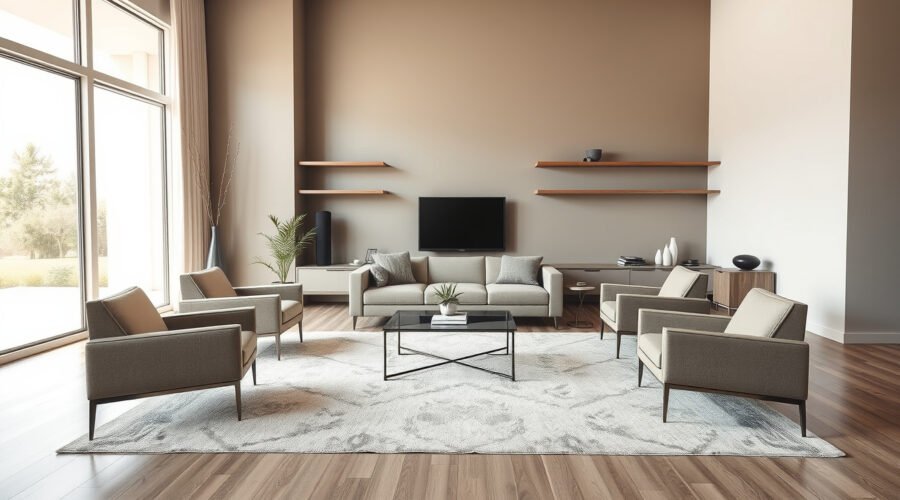
Comparing floating furniture vs wall-mounted furniture means weighing two distinct spatial strategies rather than strict opposites. In interior design, floating furniture refers to freestanding sofas, accent chairs, and tables pulled away from the perimeter walls toward the center of a room. Wall-mounted furniture refers to cabinets, media consoles, desks, and shelving physically anchored into wall framing or masonry off the floor.
Quick Answer
Float freestanding seating when your room is at least 12 feet deep and you want a 6-to-8-foot conversation zone or clear open-plan dividers. Choose wall-mounted furniture to free up floor space with vertical storage. In narrow rooms, combine wall-aligned seating with wall-mounted consoles to preserve a 30-to-36-inch walkway.
Key Takeaways
- Conversation spacing: Place floated sofas and chairs 6 to 8 feet apart with seat heights within 4 inches of each other (16 to 20 inches high) for effortless eye contact.
- Walkway clearances: Reserve 30 to 36 inches for main traffic routes behind floated furniture, or at least 18 to 24 inches for secondary pass-throughs.
- Reachable tables: Position your coffee table 14 to 18 inches from the sofa edge and side tables within 6 to 12 inches of armrests.
- Micro-floating in tight rooms: Pulling a wall-aligned sofa just 3 to 12 inches off the wall clears baseboards, curtains, and vents while adding visual depth.
- Structural mounting: Anchor heavy wall-mounted cabinets and shelves into wood studs spaced 16 or 24 inches on center (supporting 100 to 200+ pounds across two studs) or solid masonry, never plain drywall alone.
- Hybrid layouts win: Most living rooms work best by floating the primary seating group on an 8 × 10 or 9 × 12 foot rug while mounting media units and storage on the perimeter walls.
Floating Furniture vs Wall-Mounted Furniture: Which Layout Works Best?
The right choice depends on whether you are solving a circulation and seating problem or a floor-space and storage problem. Floating freestanding seating pulls people together in the middle of the room, while wall-mounted units lift bulky storage off the floor so the room feels wider and easier to clean.
In practice, these two approaches solve different halves of a room layout. A floated sofa defines where people gather and routes foot traffic behind the seating zone. Meanwhile, a wall-mounted media console or shelving system keeps the perimeter streamlined so the pathway around your floated seating stays wide enough to use comfortably.
Recommended Products

Safe Floating TV Stand: The TV console is equipped with a built-in socket, 3 AC outlets, 1 USB port, and 1 Type-C port, which perfectly solves the problem of powering multiple devices (router, DVD, TV). The built-in design ensures the safety of electricity, especially for kids and pets.
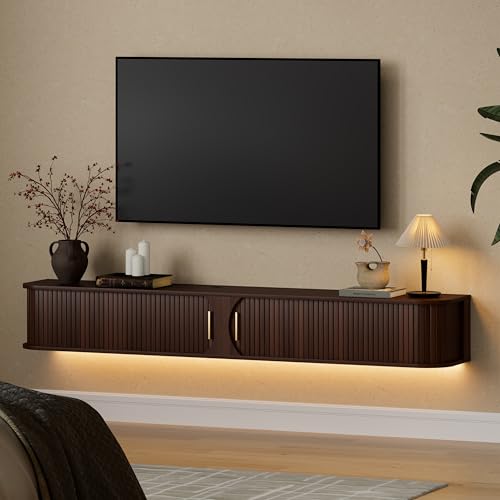
LED TV Stand with Built-in Power Outlet: This entertainment center for the living room features a mid-century modern design,with 2 USB ports and 2 AC outlets,Its integrated LED lighting system supports adjustable brightness and color temperature, reducing eye strain while serving as ambient lighting to add warmth to any space, Allows easy power access for your TV, speakers, game consoles, and other devices,creating a cinematic experience.
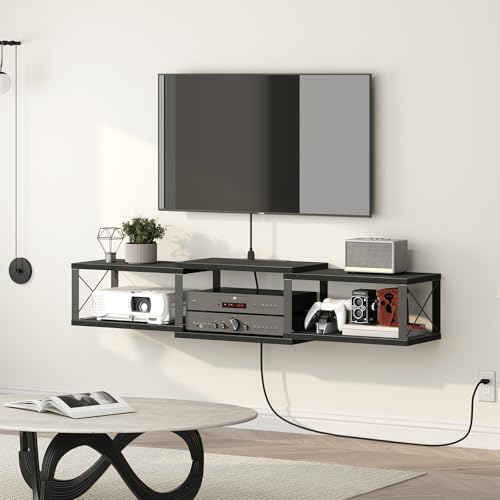
Optimize Your Space: Size: 43.7"L x 11.0"W x 8.9"H. Our floating tv stand saves valuable floor space and includes generous storage for all your media essentials - routers, DVD players, remotes, projectors, set-top boxes, game consoles, TV components, and decorations
Quick Layout Decision Guide
Use this decision matrix before lifting heavy pieces or drilling into drywall. Match your primary room bottleneck in the first column to the layout strategy and exact clearance checks required to solve it.
| Room Need | Best Layout Choice | Why It Works | What to Check First |
|---|---|---|---|
| Better conversation | Floating seating (6–8 ft apart) | Seats face each other at a comfortable acoustic distance instead of lining distant walls | 14–18 in coffee table reach, 8 × 10 ft or larger rug, and 30–36 in walkway clearance |
| More visible floor area | Wall-mounted storage (6–12 in off floor) | Storage moves vertically and exposes continuous flooring underneath | 16 or 24 in wall stud spacing, mounting bracket rating, cable routing, and loaded weight |
| One clear corridor in a narrow room | Wall-aligned freestanding furniture (3–6 in off wall) | Keeping the largest sofa near the perimeter protects a single 30–36 in main path | Door swings, baseboard heaters, vents, outlets, and total room depth (under 11–12 ft) |
| Open-plan zoning | Floating sofa or L-sectional | The sofa back acts as a low architectural divider between living and dining areas | Sightlines across zones, finished upholstery on the sofa back, and 30–36 in paths |
| Storage and media wall | Wall-mounted cabinets and shelves | Replaces 18–20 in deep floor cabinets with 10–15 in deep elevated units | Wood studs vs. masonry, TV seated eye level (42–48 in), and total equipment weight |
| Small living room | Mixed layout | A wall-aligned sofa saves depth while one floated accent chair and a mounted console add balance | Minimum 18–24 in secondary squeeze-through gaps around the floated chair |
5-Minute Layout Test Before You Move Anything
Test your floor plan with a tape measure and painter’s tape before dragging a sofa across hardwood or drilling mounting holes into drywall. Checking circulation first prevents the most common mistake in room design: creating a seating cluster that blocks doors or squeezes walkways below usable widths.
- Mark fixed architectural obstacles: Measure and note door swings (typically 30 to 36 inches of arc), low window sills, floor vents, radiators, electrical outlets, and fixed focal points such as a fireplace or coax/Ethernet wall plate.
- Reserve the primary walkway: Better Homes & Gardens recommends 2.5 to 3 feet (30 to 36 inches) of clearance for main walkways. Tape that corridor on the floor first so furniture never encroaches on daily foot traffic.
- Tape the total furniture footprint: Outline the exact depth and width of your sofa (usually 34 to 40 inches deep), coffee table (20 to 30 inches deep), and chairs on the floor to verify that at least 18 to 24 inches remains for secondary paths between pieces.
- Check seated reach to surfaces: Homes & Gardens gives 14 to 18 inches between a sofa and coffee table as the ideal starting point—close enough to set down a glass without leaning, yet wide enough for your shins when standing up.
- Locate wall framing before mounting: Live with the taped freestanding layout for a day before drilling. For wall-mounted consoles or shelves, scan the wall for pipes and wiring, mark wood studs (spaced 16 or 24 inches on center), and confirm the product’s weight rating against your wall material.
What’s in This Article
- Floating Furniture vs Wall-Mounted Furniture: Which Layout Works Best?
- Quick Layout Decision Guide
- 5-Minute Layout Test Before You Move Anything
- What Does Floating Furniture Mean, and What Are the Benefits?
- How Wall-Mounted Furniture Maximizes Space
- Should Furniture Touch the Wall?
- Is Floating Furniture Better for Conversation?
- Which Looks Better: Floating or Wall-Mounted Furniture?
- Which Layout Works Best for Your Room?
- How Does Floating Furniture Improve Conversation?
- Essential Tips for Successful Floating Furniture Arrangements
- Floating Furniture Challenges: What to Watch Out For?
- Balancing Floating and Wall Placement for Optimal Design
- Sources and Layout Notes
- Frequently Asked Questions
- Final Thoughts on Floating vs. Wall-Mounted Furniture
What Does Floating Furniture Mean, and What Are the Benefits?
In space planning, floating furniture means positioning freestanding seating and tables out in the room—anywhere from 12 inches to several feet off the walls—rather than pushing every piece against the perimeter. Because retail catalogs also use “floating” to describe wall-mounted shelves or vanities with hidden brackets, this guide always uses floating for floor-standing placement away from walls and wall-mounted for hardware fixed to a wall.
Floating your seating solves the “waiting-room effect” in medium and large rooms deeper than 12 to 13 feet (3.6 to 4 meters). When sofas sit flush against opposite walls in a 16-foot-wide living room, guests end up 10 to 12 feet apart, leaving a hollow dead zone in the center. Pulling the seating inward tightens the group to a comfortable 6-to-8-foot span and routes foot traffic behind the sofa instead of directly across the TV viewing path.
In open-concept homes, a floated sofa or sectional also acts as a low architectural divider that separates the living area from a kitchen island or dining table without blocking natural light or sightlines. Adding a 10-to-14-inch-deep console table behind the floated sofa finishes the exposed backrest and provides a drop zone for keys, task lamps, or baskets.
How Wall-Mounted Furniture Maximizes Space
Wall-mounted furniture maximizes usable square footage by shifting storage vertically and keeping the floor plane visible underneath. Lifting a media console, desk, or cabinet 6 to 12 inches off the floor tricks the eye into reading the full room width from baseboard to baseboard, making compact apartments and narrow rooms feel noticeably larger.
Standard freestanding bookcases and media centers consume 16 to 20 inches of floor depth, whereas wall-mounted shelving and floating media cabinets typically measure just 10 to 15 inches deep. That 4-to-8-inch reduction can be the difference between a cramped 24-inch squeeze and a comfortable 30-inch walkway in a small living room.
Because cantilevered wall units transfer constant leverage onto their fasteners, safe installation depends on wall structure. According to the This Old House guide to locating wall studs, wood framing studs in US homes are typically 1.5 inches wide and spaced 16 or 24 inches apart on center. Driving lag screws at least 2.5 inches deep into two or more wood studs—or using masonry anchors in brick or concrete—provides reliable structural support, while basic plastic drywall plugs hold only light decorative loads.
| Wall Material & Fastener Type | Typical Safe Load Capacity | Best Wall-Mounted Furniture Use |
|---|---|---|
| Wood studs (lag screws into 2+ studs at 16″ or 24″ spacing) | 100 to 200+ lbs (plan 35–50 lbs per stud for continuous shelf loads) | Floating media consoles, heavy hardwood bookshelves, wall desks, and upper cabinets |
| Solid concrete or brick masonry (1/4″ or 5/16″ masonry sleeve anchors) | 100 to 200+ lbs | Heavy media units, wall-mounted bookcases, and cantilevered storage cabinets |
| 1 stud + heavy-duty metal toggle bolts in 1/2″ drywall | 50 to 100 lbs | Medium floating shelves (24–36 in wide), plants, and framed art ledges |
| Metal toggle bolts in drywall only (no stud engagement) | 20 to 50 lbs | Short decorative shelves, light bathroom cabinets, and small entryway ledges |
| Plastic expansion anchors in drywall only | 10 to 25 lbs | Picture frames and lightweight decor only (never use for consoles or book storage) |
When designing a media wall, follow the The Home Depot floating shelf installation guide by securing internal brackets into at least one wall stud and allowing 12 inches of vertical clearance between stacked shelves. Mount floating TV consoles so the top surface sits 24 to 30 inches above the floor, keeping the center of the television screen at seated eye level (42 to 48 inches off the floor).
Pro tip: Combine closed wall-mounted cabinets on the lower row (24 to 28 inches high) to hide routers, gaming consoles, and cords with open floating shelves above to keep the wall feeling airy.
Should Furniture Touch the Wall?
Freestanding seating should rarely press flush against drywall, even when your room is too narrow for a full walkway behind the sofa. Leaving a small 3-to-12-inch (8-to-30-centimeter) breathing gap—often called a “micro-float”—prevents upholstery from scuffing paint, lets window draperies hang straight to the floor, and gives baseboards, power plugs, and heating registers room to function.
True wall-hugging placement is only necessary for backdrop storage pieces (bookcases, sideboards, dressers, and headboards) or when a living room is narrower than 10 to 11 feet. In a 10-foot-wide room, a 35-inch-deep sofa, a 16-inch coffee table gap, a 24-inch coffee table, and a 36-inch main walkway already add up to 111 inches (9 feet 3 inches), leaving just 9 inches behind the sofa for a micro-float rather than a rear corridor.
Test the difference in two minutes: pull your wall-aligned sofa and accent chairs forward by 4 to 6 inches. That subtle shadow line behind the frame makes the ceiling and walls read as continuous, adding visual depth without sacrificing your walkway.
Is Floating Furniture Better for Conversation?
Floating furniture is significantly better for conversation in medium and large rooms because it keeps faces within a natural 6-to-8-foot (1.8-to-2.4-meter) acoustic circle. Once seating stretches past 9 to 10 feet apart—common when sofas and chairs are pushed against opposite perimeter walls—people have to raise their voices and lean forward to hear one another.
Wall-aligned seating also forces guests into a single linear row facing a television or blank wall, which requires turning your neck 90 degrees to talk to the person beside you. Pulling two accent chairs off the wall and angling them inward toward a floated sofa creates a triangle where up to five or six people can maintain effortless eye contact.
Furthermore, pulling a sofa away from a hard drywall surface slightly reduces low-frequency sound reflection right behind listeners’ ears. When paired with an area rug and upholstered seating in the center of the room, conversations sound clearer and warmer than in an echoey perimeter layout.
Which Looks Better: Floating or Wall-Mounted Furniture?
Floating furniture creates a layered, architectural look with strong three-dimensional depth, while wall-mounted furniture delivers a crisp, minimalist aesthetic with uninterrupted floor lines. Neither style looks better in isolation; the visual appeal comes from matching furniture proportions to your room volume.
Because a floated sofa or armchair is visible from 360 degrees, its back and side profiles become focal features. Sculpted wood frames, tailored upholstery seams, or a slim console table styled with low lamps keep the back of a floated sofa from looking like a blank fabric barrier when you walk into the room.
Wall-mounted pieces shine when you want to reduce visual weight on the perimeter. A 60-to-70-inch floating media console mounted under a 55-to-65-inch TV balances the screen horizontally while leaving 8 to 12 inches of open floor underneath. To keep wall-mounted setups looking high-end rather than cluttered, route power and HDMI cables through an in-wall rated conduit kit or cord channel painted to match the wall.
Which Layout Works Best for Your Room?
Select your layout by calculating your room’s total depth and identifying where doors and hallways force foot traffic to travel. Rooms deeper than 12 to 13 feet can comfortably support a floated sofa with a 30-to-36-inch rear walkway, while rooms under 11 feet deep generally need wall-aligned seating paired with wall-mounted storage.
Before finalizing your arrangement, compare the four core layout configurations below against your room’s dimensions and daily activities.
| Layout Type | Best For | Considerations |
|---|---|---|
| Floating Furniture | Rooms 12+ ft deep, open floor plans, social conversation zones | Requires 30–36 in perimeter walkways, a finished sofa back, and an 8 × 10 ft or larger anchor rug |
| Against the Wall (with 3–6 in micro-float) | Narrow rooms under 11 ft wide, studio apartments, single-corridor layouts | Can leave seats over 9 ft apart in wide rooms unless paired with floated accent chairs |
| Wall-Mounted Furniture | Media walls, compact home offices, vertical book and cabinet storage | Requires locating 16 or 24 in studs or masonry anchors, hiding cables, and checking load ratings |
| Mixed Layout | Most everyday living rooms combining entertainment, conversation, and storage | Float the primary seating group on a rug while mounting the media console and shelving on the wall |
In roughly 80% of multi-use living rooms, the mixed layout outperforms an all-or-nothing rule. Floating the seating area establishes intimacy, while mounting the TV console and bookshelves preserves the perimeter walkways that make the floated seating possible.
How Does Floating Furniture Improve Conversation?
Floating furniture improves social connection only when the seating geometry, seat heights, and traffic paths work together as a unified island. Moving a sofa into the middle of the room fails if guests still have to shout across a 10-foot gap or dodge family members walking directly between the sofa and coffee table.
If people routinely cut through the center of your seating group to reach a kitchen or patio door, shift the entire cluster toward the focal wall to open a 30-to-36-inch bypass behind the sofa, or switch to a wall-aligned sofa facing two floated swivel chairs.
Enhanced Conversation Flow
Conversation flows naturally when seating is arranged in one of three proven geometries—face-to-face parallel sofas, an L-shape (sofa plus two perpendicular chairs), or a U-shape—with every seat positioned 4 to 8 feet from the opposite speaker. Use these three spacing rules to build the arrangement:
- Center the cluster on a shared coffee table: Choose a coffee table measuring one-half to two-thirds the length of your sofa (about 42 to 56 inches long for an 84-inch sofa) and set it 14 to 18 inches from every seat.
- Keep walkways outside the conversation circle: Route the primary 30-to-36-inch traffic lane behind the sofa back or outside the accent chairs so passersby never interrupt eye contact.
- Leave breathing room between chairs: Space adjacent accent chairs 24 to 30 inches apart, or angle a pair of swivel chairs 15 to 30 degrees toward each other with a shared 18-inch drink table between them.
This perimeter-bypass layout turns the middle of the room into a protected social pocket where guests can sit down and leave without asking others to tuck in their legs.
Intimate Social Settings
Creating an intimate setting requires vertical alignment as well as horizontal closeness. Interior designers follow the 4-inch seat-height rule: keep the seat cushions of your sofa, armchairs, and ottomans within 4 inches of one another—ideally between 16 and 20 inches off the floor—so nobody feels perched above or sunk below the rest of the group.
Match your coffee table height to that same plane by picking a table that sits level with the sofa seat cushion or up to 2 to 4 inches lower. When seat heights, table surfaces, and inward chair angles align, the group feels physically balanced and relaxed.
Centralized Interaction Zones
A centralized interaction zone uses floor coverings, surfaces, and lighting to bind floated pieces into a single visual island. Anchor your central zone with three practical elements:
- Size the area rug to the sofa width: Pick a rug that extends at least 6 to 12 inches past both ends of the sofa—typically an 8 × 10 foot rug for a standard 72-to-84-inch sofa, or a 9 × 12 foot rug for an 84-to-96-inch sofa or L-sectional.
- Frame the open side with low-profile seating: Use swivel chairs, a backless bench, or a 16-to-18-inch-high ottoman on the entry side of the zone so you never greet people with a tall, boxy chair back at the doorway.
- Put a drink surface within 12 inches of every seat: Supplement the central coffee table with side or end tables positioned 6 to 12 inches from sofa arms, standing roughly level with the armrest height (usually 24 to 28 inches).
When every seat has a rug beneath its front legs and a table within easy arm’s reach, the floated layout looks intentional rather than temporary.
Essential Tips for Successful Floating Furniture Arrangements
Successful floating layouts rely on precise floor measurements, clear zone boundaries, and proportional furniture scale. Because floated pieces occupy the visual center of your room, small sizing errors—like a rug that is too small or a console table that overhangs the sofa—stand out immediately.
Use the reference guidelines below to get your measurements, zone boundaries, and sightlines right on the first try.
Recommended Products

New & Improved Area Rug With More Cushioning – Our new inner layer is 25% thicker than the previous material, giving this 8x10 area rug a softer, more cushioned feel underfoot. Made for families who spend time on the floor, it adds extra comfort for playing with the kids, reading, relaxing, or simply walking barefoot at home

PET FRIENDLY & NON-SLIP BACKING: 8x10 area rugs featuring simple of colors while promising a luxurious feel underfoot. The blend of a hexagon pattern and a stylish design. Non-slip TPR backing makes the covering for bringing your space together. Make the most of your time at home with our pet-friendly and easy-to-clean area rugs. Elevate the floors of your home with this show-stopping and detailed rug

Ultra-Soft Low Pile Rug: Gent drizz living room rugs 8x10 made of Upgraded durable low pile faux wool fibers, 0.25'' thick, featuring a soft fuzzy density surface, soft and pliable to the touch, providing great comfort for your bare feet. The low pile makes it easy for your Large area rug to clean and is perfect for homes with kids and pets
Measure Before You Move
Before shifting a heavy sofa or drilling wall brackets, map out your room clearances with painter’s tape. Confirm primary walkways at 2.5 to 3 feet (30 to 36 inches) per Better Homes & Gardens and coffee table reach at 14 to 18 inches per Homes & Gardens, then verify every remaining gap against this measurement checklist:
| Layout Measurement | Recommended Range | Why It Matters |
|---|---|---|
| Main walkway (behind floated sofa or primary path) | 30–36 in (76–91 cm) | Allows comfortable walking without brushing against upholstery or walls |
| Secondary walkway (between chairs or low-traffic side) | 18–24 in (46–61 cm) | Minimum single-person pass-through in compact rooms |
| Micro-float gap (wall-aligned sofa to drywall) | 3–12 in (8–30 cm) | Clears curtains, baseboards, and cords while adding shadow depth |
| Sofa front edge to coffee table | 14–18 in (36–46 cm) | Balances comfortable seated reach with shin clearance when standing |
| Face-to-face conversation distance | 6–8 ft (1.8–2.4 m); max 9 ft | Keeps conversation natural without raising voices |
| Console table behind floated sofa | 10–14 in deep; 1–2 in below sofa back | Conceals the sofa back without eating into rear walkway width |
| Area rug border to room walls | 8–18 in (20–46 cm) of bare floor | Frames the seating island without crowding the baseboards |
Define Functional Zones Clearly
In open-plan homes where one continuous space serves as living room, dining room, and workspace, furniture placement must replace interior walls. Use three zoning techniques to give each area a clear boundary:
- Commit to “all legs on” or “front legs on” rug placement: In large open-plan rooms, use a 9 × 12 or 10 × 14 foot rug so all four legs of the floated sofa and chairs sit completely on the rug. In mid-sized rooms, use an 8 × 10 foot rug and slide it at least 3 to 6 inches under the front legs of every seating piece; never leave a small “postage-stamp” rug floating isolated under the coffee table alone.
- Back the floated sofa with a proportioned console table: Choose a sofa table that is at least two-thirds the length of the sofa (for example, a 54-to-60-inch console behind an 84-inch couch), 10 to 14 inches deep, and 28 to 32 inches tall so it never peeks above the back cushions.
- Maintain a 24-to-36-inch buffer between functional zones: Leave at least 36 inches between the back of a floated living room sofa and a dining table apron so dining chairs can slide out while someone walks past.
Balance Visual and Practical
A balanced layout pairs visual lightness with practical access to power and lighting. When you float a sofa away from the walls, choose sofas and chairs with exposed legs (4 to 6 inches of floor clearance), open-base coffee tables, and armless slipper or swivel chairs so sightlines carry across the floor.
Because floated seating sits away from wall outlets, plan your lighting early. Use rechargeable cordless table lamps on your behind-sofa console table, position an arched floor lamp anchored in a perimeter corner to reach over the seating cluster, or run lamp cords strictly underneath a non-slip rug pad only where nobody walks.
Note: Maintain at least 12 inches of clearance between upholstered furniture and electric baseboard heaters or radiators to prevent heat damage and fire hazards, and never drape power cords across open walkways where they create a tripping hazard.
Floating Furniture Challenges: What to Watch Out For?
Both floating layouts and wall-mounted installations come with practical traps when room dimensions or wall structures do not match the furniture. Watch for these four common problems and apply the corresponding fix before committing to a layout:
- Blocking the room entry with a tall sofa back: Walking through the front door directly into the back of a high-backed sectional makes a room feel barricaded. Fix it by switching to a lower-profile sofa (28 to 32 inches tall), styling the back with a 10-to-12-inch-deep console table, or rotating the layout so the sofa faces the entry at an angle.
- Oversized depth in a shallow room: Deep cloud-style sofas (40 to 44 inches deep) paired with a wide coffee table quickly swallow a 10-to-11-foot room. Choose a standard 34-to-36-inch-deep sofa and a slim 20-to-24-inch coffee table or nesting tables when floor depth is tight.
- Dead “no-man’s-land” behind the sofa: Pulling a sofa 18 to 20 inches off the wall creates an awkward gap that is too narrow to walk through comfortably yet too wide to look like a 6-inch micro-float. Either push the sofa back to a 4-to-10-inch gap (or fill a 12-inch gap with a slim console table), or pull it forward to a full 30-to-36-inch walkway.
- Stud misalignment and wall-mounting limits: Wall-mounted cabinets often have pre-drilled bracket holes that do not line up with 16-inch or 24-inch wood studs, or the wall may use thin metal studs or plaster. According to The Home Depot shelving bracket installation guide, you should use continuous mounting tracks (standards) or heavy-duty metal toggle bolts when a bracket end misses a stud, and use a masonry drill bit with concrete anchors on brick or concrete walls.
When you opt for tall freestanding bookcases, dressers, or media stands against the wall instead of wall-mounted units, childproofing is still essential. The U.S. Consumer Product Safety Commission (CPSC) Anchor It! guidelines emphasize anchoring all freestanding storage furniture and televisions to the wall with anti-tip straps or brackets, noting that nearly 80% of furniture and TV tip-over fatalities involve children 5 years old and younger.
Warning: Always scan walls with a multi-sensor detector for live electrical wiring, water pipes, and HVAC ducts before drilling, especially near outlets, light switches, kitchens, or bathrooms. Follow the product’s specific mounting manual and never hang heavy cabinets or media consoles on plastic drywall plugs alone.
Recommended Products

【Standard 90° bending】In order to ensure that each shelf bracket can be at 90° to the maximum extent possible, we add a rigorous picking process before the shelf brackets are packaged. The standardized 90-degree design is so important that it’ s the objective factor in ensuring that items remain level and do not tip over after being placed on the board(board is not included).

✓ HIGH-QUALITY METAL MATERIALS: Our shelf support is made of thick and heavy duty iron materials.Features a thick black matte surface coating that delivers enhanced water resistance and effective anti‑rust performance for long‑term daily use.

COMPLETE SET FOR VARIOUS MOUNTING NEEDS: This Heavy Duty Toggle Bolts Assortment Kit includes 164 pieces of drywall anchors, toggle bolts, and screws in multiple sizes to fit different installation requirements. The set contains 40pcs #6×1", 40pcs #5×1", 40pcs #7×1", 20pcs #6×1-1/5", 12pcs #8×1-3/5", and 20pcs black #8×1-1/4" wall anchors, along with toggle bolts in 1/4" (4pcs), 3/16" (12pcs), and 1/8" (16pcs). Ideal for mounting shelves, mirrors, or curtain rods.
Balancing Floating and Wall Placement for Optimal Design
The most functional living rooms blend freestanding floating seating, wall-aligned backdrop pieces, and wall-mounted storage based on room width. Rather than forcing every piece off the walls or bolting everything to the perimeter, match the hybrid ratio to your room size:
- Small living rooms (10 × 12 ft or under 150 sq ft): Place a 72-to-80-inch sofa 3 to 6 inches off the longest wall, mount the TV and a 12-inch-deep floating media console on the opposite wall (saving 6 to 8 inches of floor depth compared with a bulky cabinet), and float one compact swivel chair angled on the corner of a 6 × 9 or 8 × 10 foot rug.
- Medium living rooms (12 × 15 ft to 14 × 18 ft): Float the main sofa 30 to 36 inches off the back wall on an 8 × 10 or 9 × 12 foot rug to create a dedicated rear walkway, place two accent chairs across from or perpendicular to the sofa, and use wall-mounted shelves and cabinets along the focal wall.
- Large or open-plan spaces (15 × 20 ft and larger): Float the entire seating group—such as an L-sectional, two armchairs, and a 12-inch-deep behind-sofa console table—on a 9 × 12 or 10 × 14 foot rug with all furniture legs on the pile, while anchoring the perimeter walls with wall-mounted media cabinetry, art, and bookcases.
Start by locking in your focal point and primary 30-to-36-inch traffic path, then test the seating cluster before installing any permanent wall brackets.
Sources and Layout Notes
This guide combines standard interior-design clearance dimensions and structural wall-mounting specifications from authoritative home-improvement, safety, and design sources:
- Homes & Gardens living room layout guidance: Supports floor-taping footprints, focal-point planning, 30-to-36-inch walkways, and avoiding unstyled sofa backs at room entrances.
- Homes & Gardens living room spacing guidance: Supports the 14-to-18-inch sofa-to-coffee-table reach range, 30-to-36-inch primary walkways, and 18-to-24-inch tight-room clearances.
- Good Housekeeping designer guidance: Supports pulling furniture off perimeter walls to add visual depth and balancing floating seating with room scale.
- Better Homes & Gardens layout guidance: Supports the 2.5-to-3-foot (30-to-36-inch) primary walkway clearance and conversation-zone spacing checks.
- Better Homes & Gardens wall-stud guidance: Supports locating structural framing before hanging heavy wall-mounted units.
- IKEA wall-mounting guidance: Supports matching fixing hardware to specific wall materials and following manufacturer assembly instructions.
- The Home Depot shelf-hanging guidance: Supports factoring in both shelf weight and stored-item load when choosing stud or anchor mounting locations.
- This Old House guide to locating wall studs: Supports standard 16-inch and 24-inch on-center wood stud spacing and 1.5-inch stud width measurements.
- The Home Depot floating shelf installation guide: Supports securing internal floating brackets into wall studs and leaving 12 inches of vertical spacing between stacked shelves.
- The Home Depot shelving bracket installation guide: Supports using toggle bolts when studs do not align and 1/4-inch masonry bits with concrete anchors for masonry walls.
- U.S. Consumer Product Safety Commission (CPSC) Anchor It! guidelines: Supports anchoring freestanding storage units and TVs to walls to prevent tip-over injuries and fatalities.
Frequently Asked Questions
What does floating furniture mean?
In interior layout design, floating furniture means placing freestanding sofas, chairs, and tables away from the perimeter walls toward the center of a room. Because retailers also use the phrase to describe wall-mounted shelves or consoles with hidden brackets, always check whether the context refers to floor placement or wall-mounted hardware.
Is it better to float a sofa or put it against a wall?
Float a sofa when your room is at least 12 to 13 feet deep and you want a 6-to-8-foot conversation cluster, a 30-to-36-inch rear walkway, or an open-plan room divider. Place the sofa near a wall (with a 3-to-6-inch breathing gap) when a narrow room needs to preserve one clear traffic corridor.
What are the benefits of floating furniture?
Floating furniture brings seating within a comfortable 6-to-8-foot conversation distance, defines distinct zones in open floor plans without building walls, and routes foot traffic around the seating group rather than directly in front of the television or fireplace.
How much space do you need around floating furniture?
Leave 30 to 36 inches (76 to 91 cm) for main walkways behind a floated sofa or around the seating group, and at least 18 to 24 inches (46 to 61 cm) for secondary squeeze-through gaps. Keep 14 to 18 inches between the sofa and coffee table and 6 to 12 inches between armrests and side tables.
Does floating furniture work in small rooms?
Yes, floating furniture works in small rooms when you use a hybrid approach instead of floating every piece. Pull a wall-aligned sofa 3 to 6 inches off the wall for visual depth, mount the TV and media console on the opposite wall to save floor depth, and float a single slim accent chair on the corner of the rug.
When should you use wall-mounted furniture?
Use wall-mounted furniture when you want to free up visible floor area, replace bulky 18-to-20-inch-deep floor cabinets with 10-to-15-inch-deep vertical storage, and keep 6 to 12 inches of open space underneath for easier cleaning. Confirm first that you can anchor into wood studs (16 or 24 inches on center) or solid masonry.
Does floating furniture make a room look bigger?
Floating furniture makes a room look bigger when air and light can circulate behind the seating and visible flooring extends underneath raised furniture legs and wall-mounted consoles. However, floating oversized sofas in a room narrower than 11 feet will crowd walkways and make the space feel smaller.
How do you anchor a floating sofa?
Anchor a floating sofa visually by placing at least its front legs (3 to 6 inches deep) or all four legs onto an 8 × 10 or 9 × 12 foot area rug that extends 6 to 12 inches past each end of the sofa. Complete the island with a coffee table 14 to 18 inches in front and a 10-to-14-inch-deep console table behind the backrest.
Final Thoughts on Floating vs. Wall-Mounted Furniture
The strongest living room layouts combine both approaches rather than treating them as mutually exclusive. Float your freestanding seating on a properly sized rug to bring people within a 6-to-8-foot conversation zone, and use wall-mounted consoles and shelving to clear floor space along the perimeter.
Grab a roll of painter’s tape and a tape measure today to mark out a 30-to-36-inch main walkway and a 14-to-18-inch coffee table gap on your floor. Once the freestanding circulation feels effortless in daily use, locate your wall studs and mount your vertical storage with hardware matched to your wall material and load.




[…] Floating Furniture vs. Furniture Against the Wall: Pros & Cons […]
[…] Open floor plan: Float one or both sofas away from the perimeter walls to carve out a dedicated living zone. Anchor the seating on a large area rug and leave a 36-inch walkway behind the floating frame. For more placement strategies, see our guide to floating furniture versus wall placement. […]