Updated October 2026.
Finding the best bathroom exhaust fan with a humidity sensor makes everyday moisture control automatic, especially when household members or guests forget to flip a wall switch. These fixtures are mechanical ventilation fans, not stand-alone dehumidifiers: they detect elevated moisture and exhaust damp air outdoors through a duct rather than collecting water in a tank. Choosing the right unit depends on matching your room’s required airflow (CFM), tested sound rating (sones), sensor type, ceiling cutout dimensions, housing depth, duct diameter, lighting features, and switch wiring.
Quick Comparison
| Product | Best For | Listed Airflow | Listed Sound | Duct & Light | Key Consideration | Amazon |
|---|---|---|---|---|---|---|
| Panasonic WhisperFit FV-0511VFC1 | Best overall flexibility | 50/80/110 CFM | 0.4–0.8 sones | 4″ or 3″ duct; no light | 10.25 x 10.25-inch housing; no integrated light | Check Price on Amazon |
| OREiN OL17003 | Best fan, light, and night light | 160 CFM | 1.0 sone | 6″ duct; 3-CCT LED + night light | 11.81 x 11.02-inch cutout and 6-inch duct | Check Price on Amazon |
| VIVOHOME 240 CFM | High-airflow, no-light installations | 90/160/240 CFM auto stages | Unverified (listing conflicts) | 6″ duct; no light | 11.37 x 12.12-inch cutout; verify sound claims | Check Price on Amazon |
| VIVOHOME AutoFlow with Light | Remote control and adjustable lighting | 30/110/160 CFM auto stages | Varies by speed stage | 4″ duct; 3-CCT LED + night mode | 10.2-inch square cutout; 4-inch duct limits peak CFM on long runs | Check Price on Amazon |
| Broan-NuTone BES8 | Compact room-side retrofit | 80 CFM | 1.5 sones | 4″ duct; no light | For bathrooms up to about 75 sq. ft.; single speed | Check Price on Amazon |
| KAZE APPLIANCE SNP100HL9 | Quiet 100 CFM fan with light | 100 CFM | 0.8 sones | 4″ duct; 4000K dimmable LED | 9 x 9-inch cutout; fixed 4000K light color | Check Price on Amazon |
| JULLISON 100 CFM | Basic grille-only 100 CFM fan | 100 CFM | 1.2 sones | 4″ duct; no light | 9.25 x 9.25-inch cutout; confirm exact variant | Check Price on Amazon |
| Delta BreezSlim SLM70H | Small retrofit openings | 70 CFM | 2.0 sones | 3″ duct; no light | Compact 7.5 x 7.25 x 3.94-inch housing; 3-inch duct | Check Price on Amazon |
Important: Measure your existing ceiling opening, housing depth, joist bay spacing, and duct diameter before ordering. Every bathroom exhaust fan must vent directly outdoors through an approved roof or wall cap—never into an attic, crawlspace, soffit cavity, or wall cavity. Electrical work must follow the manufacturer’s wiring diagram and local building code; hiring a licensed electrician is the safest choice if you are unfamiliar with branch-circuit wiring.
Panasonic WhisperFit Bathroom Exhaust Fan (FV-0511VFC1) — Best Overall
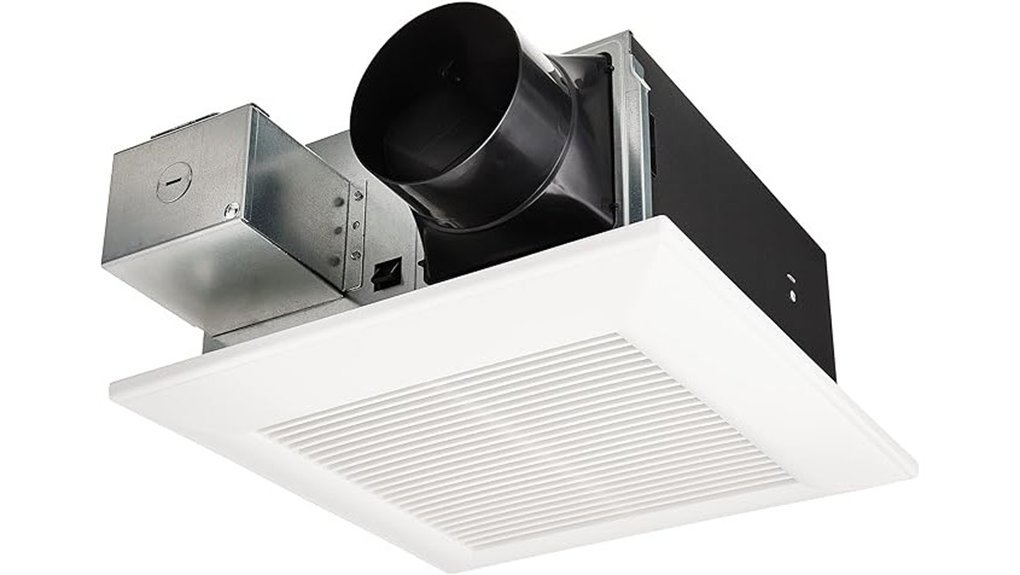
The Panasonic WhisperFit DC (FV-0511VFC1) is the strongest all-around bathroom exhaust fan with a humidity sensor for buyers who want adaptable airflow, smart moisture detection, and complete manufacturer documentation. Instead of relying only on a basic fixed humidity percentage, its advanced condensation sensor monitors both relative humidity and room temperature to anticipate mirror and wall condensation before dampness lingers. The built-in Pick-A-Flow selector lets you set airflow to 50, 80, or 110 CFM with a slide switch, while its ECM brushless DC motor automatically adjusts speed to maintain rated airflow even when duct resistance increases.
With a low-profile 5-5/8-inch housing depth, Flex-Z Fast installation bracket, 4-inch oval duct adapter, and included 3-inch duct reducer, it handles attic-free ceiling retrofits cleanly in standard 2×6 joist bays.
Key Specifications:
- Airflow Capacity: Selectable 50, 80, or 110 CFM (Pick-A-Flow switch)
- Sound Rating: Less than 0.3 sones (50 CFM), 0.4 sones (80 CFM), and 0.8 sones (110 CFM) at 0.1 in. w.g.
- Humidity Sensor: Automatic temperature-and-humidity condensation sensor with 20-minute delay shutoff timer
- Duct Diameter: 4-inch oval/round adapter with detachable 3-inch reducer included
- Housing Dimensions: 10.25 x 10.25 x 5.625 inches
- Lighting: None (grille-only unit)
- Certifications & Warranty: ENERGY STAR certified, HVI certified, UL listed for tub/shower enclosure with GFCI; 6-year ECM motor warranty, 3-year parts warranty
Best For: Homeowners who want one quiet, well-documented fan that can be tuned for small, medium, or master bathrooms up to roughly 100 square feet.
Why You’ll Like It: Selectable multi-speed airflow eliminates the guesswork of buying a single-speed fan that turns out to be too weak or louder than necessary.
Who Should Avoid It: Buyers who need an integrated ceiling light or night light in the same fixture.
Pros:
- Selectable 50, 80, or 110 CFM airflow with ECM motor static-pressure compensation.
- Dual temperature-and-humidity condensation sensing plus a built-in 20-minute delay timer reduce false cycling.
- Ultra-quiet operation (0.4 sones at 80 CFM; 0.8 sones at 110 CFM) and a 6-year motor warranty.
Cons:
- No integrated bathroom light or night light.
- Using the included 3-inch duct reducer increases static pressure and sound compared with a 4-inch duct run.
- Requires enlarging the ceiling opening if you are replacing an older 7.5 x 7.25-inch builder-grade fan.
Verdict: If you already have separate bathroom lighting and want near-silent, hands-free moisture control backed by verifiable HVI performance data, the Panasonic WhisperFit FV-0511VFC1 is the most reliable choice in this roundup.
OREiN OL17003 Bathroom Exhaust Fan with Light — Best Fan and Light Combo
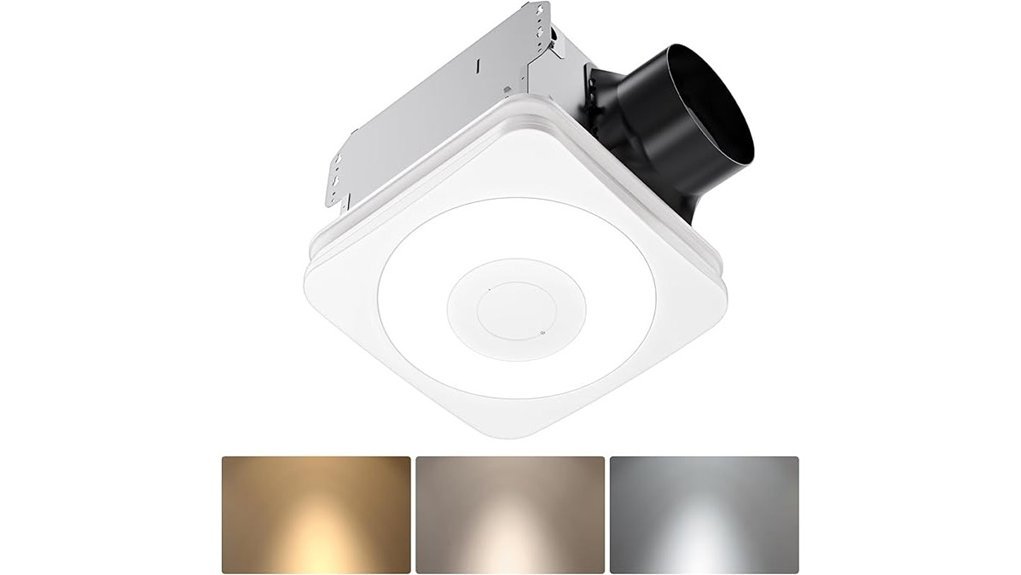
The OREiN OL17003 combines high-volume ventilation, a bright main LED light, and a soft perimeter night light in a single ceiling unit. Listed at 160 CFM and 1.0 sone, it uses a built-in relative humidity sensor that triggers the exhaust blower automatically when indoor humidity climbs above 60%. The 1500-lumen main LED panel lets you toggle among 3000K (warm white), 4000K (neutral white), and 5000K (daylight), while a dedicated 2200K warm night light provides gentle illumination for late-night bathroom visits.
Key Specifications:
- Airflow Capacity: 160 CFM
- Sound Rating: Listed at 1.0 sone
- Humidity Sensor: Fixed threshold (activates above 60% relative humidity)
- Duct Diameter: 6-inch duct connection
- Ceiling Cutout: Approximately 11.81 x 11.02 inches
- Lighting: 1500-lumen main LED (selectable 3000K/4000K/5000K) plus 2200K night light
- Certifications & Warranty: ETL listed, ENERGY STAR listed; 5-year limited warranty
Best For: Medium-to-large bathrooms (up to roughly 150 square feet) that can accommodate a 6-inch duct and benefit from combining ventilation, main lighting, and a night light in one cutout.
Why You’ll Like It: It consolidates three ceiling functions—exhaust fan, overhead vanity/general light, and night light—into one sleek fixture.
Who Should Avoid It: Homeowners restricted to a small ceiling opening or existing 3- or 4-inch ductwork with no practical way to upgrade to a 6-inch duct.
Pros:
- Strong 160 CFM listed airflow handles heavy shower steam in larger bathrooms.
- Three selectable main-light color temperatures (3000K/4000K/5000K) plus a 2200K night light.
- Room-side mounting tabs and a listed five-year limited warranty.
Cons:
- Requires a larger ceiling opening of about 11.81 x 11.02 inches.
- Uses a 6-inch duct collar; reducing a 160 CFM fan onto a 4-inch duct will restrict airflow and increase noise.
- Not compatible with external dimmer or timer wall switches; follow the manual’s switch-wiring instructions carefully.
Verdict: Provided your ceiling framing and duct path can take a 6-inch connection, the OREiN OL17003 is the most versatile all-in-one fan, light, and night-light upgrade for larger bathrooms.
VIVOHOME 240 CFM Bathroom Exhaust Fan with Humidity Sensor — Best High-Airflow Option
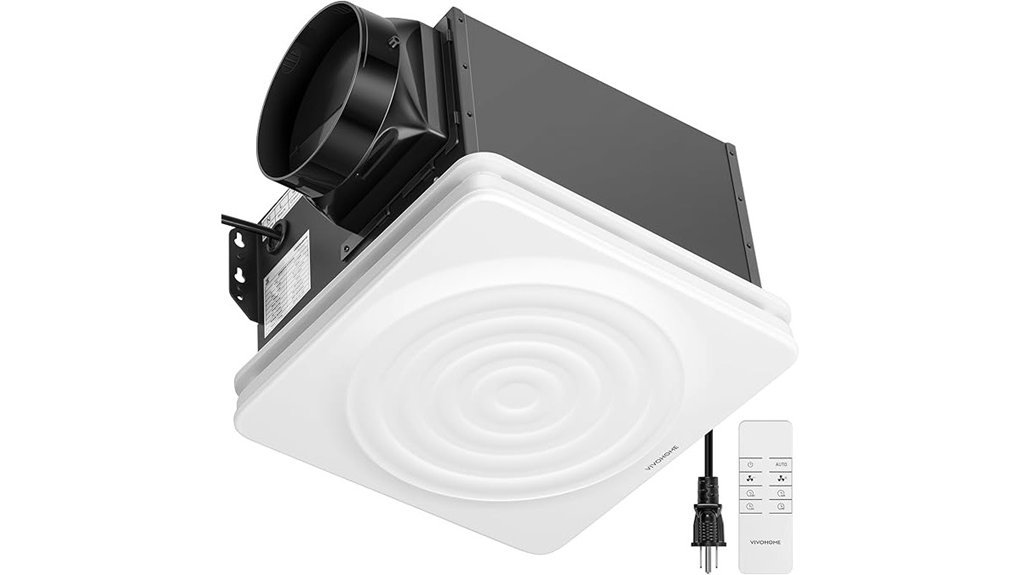
This VIVOHOME model is a high-capacity, grille-only exhaust fan engineered for large master bathrooms or spaces with multiple steam-producing fixtures. Its current Amazon listing specifies three automatic humidity-responsive airflow stages (90, 160, and 240 CFM), along with six manual speed levels and a wireless remote with timer presets. Because it moves up to 240 CFM through a 6-inch duct, it is built for heavy-duty ventilation rather than a small powder-room swap.
Key Specifications:
- Airflow Capacity: Automatic 90, 160, and 240 CFM stages (plus 6 manual speed settings)
- Sound Rating: Unverified (Amazon title and bullet points show conflicting sone figures)
- Humidity Sensor: Multi-stage automatic humidity sensing with remote timer (0.5, 1, or 1.5 hours)
- Duct Diameter: 6-inch duct connection (flexible duct kit and clamp included)
- Ceiling Cutout: Approximately 11.37 x 12.12 inches
- Lighting: None (grille-only unit)
- Controls: Wireless remote control included
Best For: Spacious master bathrooms over 100 square feet where an HVI fixture calculation calls for 150 to 240 CFM and ceiling lighting is already handled separately.
Why You’ll Like It: Stepped automatic airflow keeps background ventilation quieter at 90 CFM and ramps up to 240 CFM only when heavy shower steam demands maximum exhaust.
Who Should Avoid It: Buyers with tight joist cavities, 3- or 4-inch ductwork, or standard bathrooms that need 110 CFM or less.
Pros:
- Automatic 90, 160, and 240 CFM humidity stages plus six manual speed settings.
- Handheld remote includes 30-, 60-, and 90-minute shutoff timers.
- Ships with a 6-inch duct kit and backdraft damper to support high-volume exhaust.
Cons:
- The Amazon product title and feature bullets conflict on the exact sone rating, so noise levels should be treated as unverified.
- Requires a large 11.37 x 12.12-inch ceiling opening that typically involves drywall trimming.
- Exhausting 240 CFM requires adequate replacement air (such as an undercut bathroom door) to maintain proper airflow.
Verdict: For oversized bathrooms with multi-head showers or jetted tubs—and an accessible 6-inch duct path outdoors—the VIVOHOME 240 CFM delivers the highest airflow ceiling in this guide, though buyers should expect audible air movement at top speed.
VIVOHOME AutoFlow Bathroom Exhaust Fan with Light & Sensor — Best Smart Controls
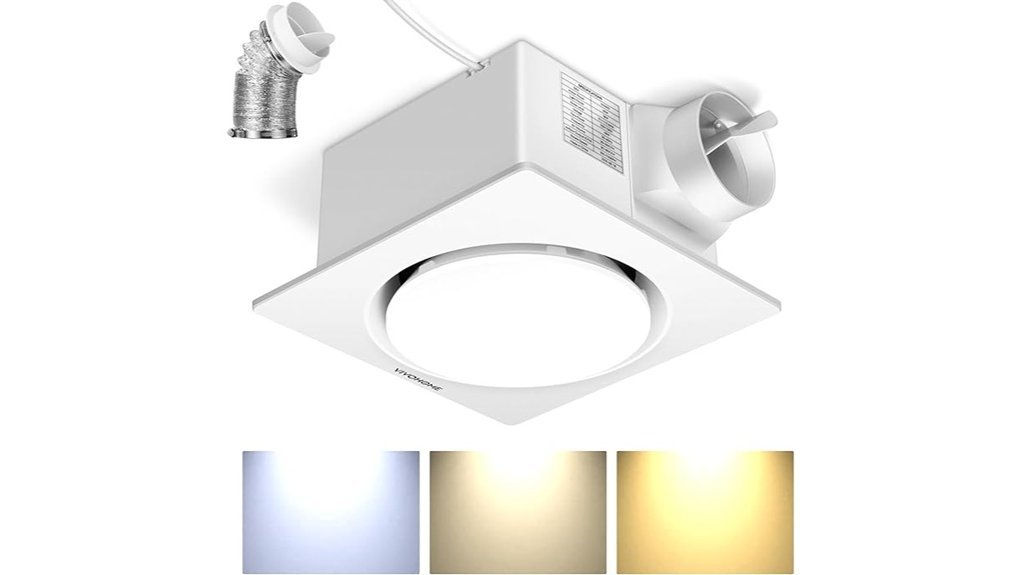
The VIVOHOME AutoFlow VH1810 pairs multi-stage humidity sensing, customizable LED lighting, and wireless remote operation in a 4-inch-duct package. In automatic AutoFlow mode, the fan is listed to idle at 30 CFM when relative humidity is below 50%, step up to 110 CFM between 50% and 80% humidity, and boost to 160 CFM when humidity exceeds 80%. Its integrated LED fixture provides 2700K, 4000K, and 5700K color temperatures, six dimming levels, a one-touch 1500-lumen full-brightness preset, and a warm night-light mode.
Key Specifications:
- Airflow Capacity: Automatic 30, 110, and 160 CFM stages (plus manual speed selection)
- Sound Rating: Varies by speed stage (quietest in 30 CFM low-humidity mode)
- Humidity Sensor: Three-stage relative humidity sensor (thresholds at 50% and 80% RH)
- Duct Diameter: 4-inch duct connection (duct kit included)
- Ceiling Cutout: Approximately 10.2 x 10.2 inches
- Lighting: 1500-lumen LED with 3 color temperatures (2700K/4000K/5700K), 6 brightness levels, and night mode
- Controls: Wireless remote control included
Best For: Tech-friendly homeowners who want remote control over fan speeds, dimming levels, and light warmth without upgrading existing 4-inch ductwork.
Why You’ll Like It: Its multi-stage speed logic and six-level dimmable light give you far more customization than a basic single-speed humidity fan.
Who Should Avoid It: Buyers who prefer a simple wall-switch toggle with no remote to keep track of, or anyone with a long, winding 4-inch duct run where 160 CFM airflow will face heavy backpressure.
Pros:
- Automatic 30, 110, and 160 CFM humidity stages plus manual speed override.
- Three selectable light colors (2700K/4000K/5700K), six brightness steps, and a dedicated night mode.
- Connects to standard 4-inch ducting and includes a remote and mounting hardware.
Cons:
- Note that in Automatic Mode, the fan runs continuously at 30 CFM whenever humidity is below 50% rather than shutting off completely.
- Pushing 160 CFM through a 4-inch duct creates significant static pressure unless the duct run is very short and straight.
- Requires an approximately 10.2 x 10.2-inch square cutout and relies on a battery-powered remote for full feature access.
Verdict: The VIVOHOME AutoFlow VH1810 is a feature-packed pick for households that want ASHRAE-style continuous low-speed ventilation (30 CFM) that automatically ramps up during showers while offering customizable LED lighting.
Broan-NuTone BES8 Humidity Sensing Bathroom Exhaust Fan — Best Easy Retrofit
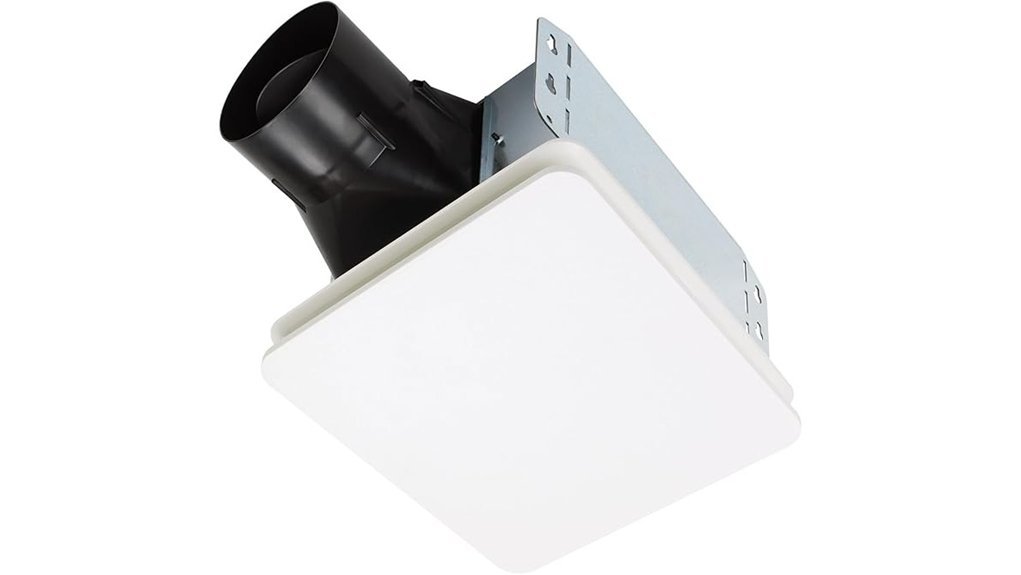
The Broan-NuTone Roomside Series BES8 is a practical, no-frills 80 CFM exhaust fan designed specifically for replacing older, noisy builder-grade fans in small-to-medium bathrooms. Its Sensaire humidity-sensing circuitry detects rapid increases in moisture at the ceiling level—turning the fan on automatically when a shower starts and shutting it off once humidity normalizes—while also allowing users to adjust the sensitivity setpoint from roughly 50% to 80% relative humidity. The EzDuct room-side connector and SlideClip CleanCover grille let you complete the swap from below the ceiling without crawling into the attic.
Key Specifications:
- Airflow Capacity: 80 CFM
- Sound Rating: Listed at 1.5 sones
- Humidity Sensor: User-adjustable Sensaire rate-of-rise and relative-humidity sensor
- Duct Diameter: 4-inch round duct connector
- Housing / Cutout: Compact retrofit footprint (commonly listed around 7.5 x 7.25 inches or 8 x 8.25 inches depending on sub-series; verify the exact BES8 template before cutting)
- Lighting: None (low-profile CleanCover grille)
- Certifications & Warranty: ENERGY STAR certified, UL listed; 3-year limited warranty
Best For: Hall and guest bathrooms up to about 75 square feet where an attic-free, room-side replacement and backed-up brand support matter more than integrated lights or remotes.
Why You’ll Like It: Because its sensor reacts to how quickly humidity rises—not just a static percentage—it responds fast to shower steam while resisting false starts on muggy summer afternoons.
Who Should Avoid It: Buyers who need more than 80 CFM, an integrated ceiling light, or sub-1.0-sone quietness.
Pros:
- 80 CFM airflow and a respectable 1.5-sone sound rating for smaller bathrooms.
- Adjustable humidity sensitivity and room-side installation hardware reduce drywall repair.
- ENERGY STAR certified, standard 4-inch duct collar, and a three-year manufacturer warranty.
Cons:
- No integrated main light or night light.
- Sized for bathrooms up to roughly 75 square feet, not large master baths.
- Single-speed AC motor lacks the multi-speed versatility of the Panasonic WhisperFit.
Verdict: For a straightforward weekend retrofit in a half-bath or compact full bathroom with existing 4-inch ducting, the Broan-NuTone BES8 is one of the easiest and most dependable humidity-sensing swaps available.
KAZE APPLIANCE SNP100HL9 — Best Quiet 100 CFM Fan with Light
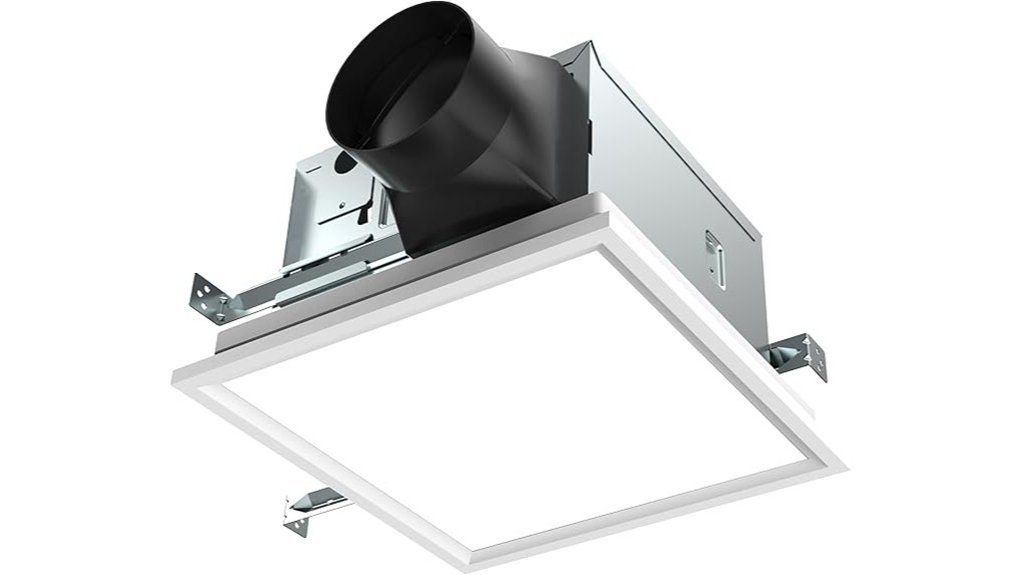
The KAZE APPLIANCE SNP100HL9 hits a sweet spot for standard 80- to 100-square-foot bathrooms by pairing 100 CFM airflow, a quiet 0.8-sone rating, customizable humidity controls, and a dimmable 4000K edge-lit LED panel. Unlike fixed-threshold fans locked at 60% relative humidity, the SNP100HL9 includes physical adjustment dials under the grille that let you tune the humidity trigger from 30% to 80% relative humidity and set the post-shower run timer anywhere from 5 to 60 minutes. It mounts into a 9 x 9-inch ceiling opening from below and connects to standard 4-inch ductwork.
Key Specifications:
- Airflow Capacity: 100 CFM
- Sound Rating: Listed at 0.8 sones
- Humidity Sensor: Adjustable 30% to 80% RH set point with adjustable 5- to 60-minute delay timer
- Duct Diameter: 4-inch round duct adapter
- Housing Dimensions: 9 x 9 x 5.75 inches
- Lighting: Dimmable 15W, 1040-lumen edge-lit LED panel (fixed 4000K neutral white)
- Certifications & Warranty: HVI certified, ETL listed for over tub/shower with GFCI, ENERGY STAR qualified; 3-year limited warranty
Best For: Standard full bathrooms around 90 to 100 square feet that need quiet operation, clean neutral-white LED lighting, and fine-tuned control over when the humidity sensor turns on and off.
Why You’ll Like It: Independent dials for humidity sensitivity (30%–80%) and shutoff delay (5–60 minutes) let you dial in the exact response your local climate requires.
Who Should Avoid It: Buyers who want warm (2700K/3000K) selectable light colors or whose ceiling joist bay is shallower than 6 inches.
Pros:
- 100 CFM airflow with a quiet 0.8-sone sound rating.
- Wide 30% to 80% adjustable humidity threshold and 5- to 60-minute run-on timer.
- Dimmable 4000K, 1040-lumen edge-lit LED panel and a three-year warranty.
Cons:
- The LED color temperature is fixed at a cool/neutral 4000K with no warm-white toggle.
- Requires a 9 x 9-inch ceiling opening and about 5.75 inches of housing depth.
- Sized for medium bathrooms up to 100 square feet rather than sprawling master suites.
Verdict: If you want a quiet, sub-1.0-sone 100 CFM fan with an integrated light—and you dislike fixed humidity sensors that cannot be adjusted for seasonal weather changes—the KAZE SNP100HL9 is the smartest 4-inch-duct option here.
JULLISON Bathroom Exhaust Fan with Humidity Sensor (100 CFM) — Best Basic 100 CFM Option
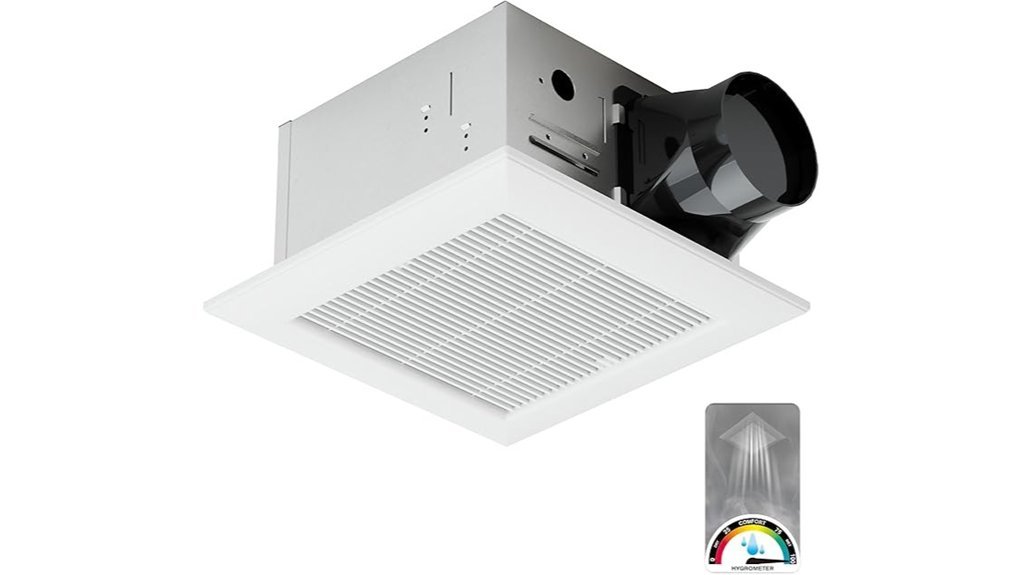
The linked JULLISON model is the grille-only humidity-sensing version (distinct from the brand’s separate lighted variation on the same listing page). Rated at 100 CFM and 1.2 sones, it pairs a standard 4-inch duct collar with a 9.25 x 9.25-inch ceiling cutout, ETL safety listing, and wet-location approval when installed on a GFCI-protected branch circuit. Its clean, light-free grille is tailored for bathrooms that already have dedicated vanity or recessed ceiling lights.
Key Specifications:
- Airflow Capacity: 100 CFM
- Sound Rating: Listed at 1.2 sones
- Humidity Sensor: Built-in automatic moisture sensor
- Duct Diameter: 4-inch round duct connection
- Ceiling Cutout: 9.25 x 9.25 inches
- Lighting: None on this exact ASIN (grille-only variant)
- Certifications: ETL certified, wet-location rated (with GFCI protection)
Best For: Buyers seeking a straightforward, single-speed 100 CFM humidity-sensing fan without paying extra for an integrated LED panel or wireless remote.
Why You’ll Like It: It handles core 100 CFM moisture extraction with simple wiring and no remote-control batteries to replace.
Who Should Avoid It: Buyers who need a fan-light combo, multi-speed DC motor adjustments, or a compact 7.5-inch housing footprint.
Pros:
- 100 CFM listed airflow and a moderate 1.2-sone sound rating.
- Automatic humidity-sensing operation with a standard 4-inch duct collar.
- Room-side installation design, wet-location suitability, and ETL certification.
Cons:
- This specific ASIN does not include an integrated light.
- The 9.25 x 9.25-inch cutout requires trimming if you are upgrading from a smaller 7.5- or 8-inch housing.
- Amazon’s shared parent-child listing metadata mixes feature bullets across variants, so double-check the exact variant name before checkout.
Verdict: When you simply need a 100 CFM, 4-inch-duct exhaust fan with automatic moisture sensing and no built-in light, the JULLISON 100 CFM covers the essentials cleanly.
Delta BreezSlim SLM70H Exhaust Bath Fan with Humidity Sensor — Best Compact Retrofit
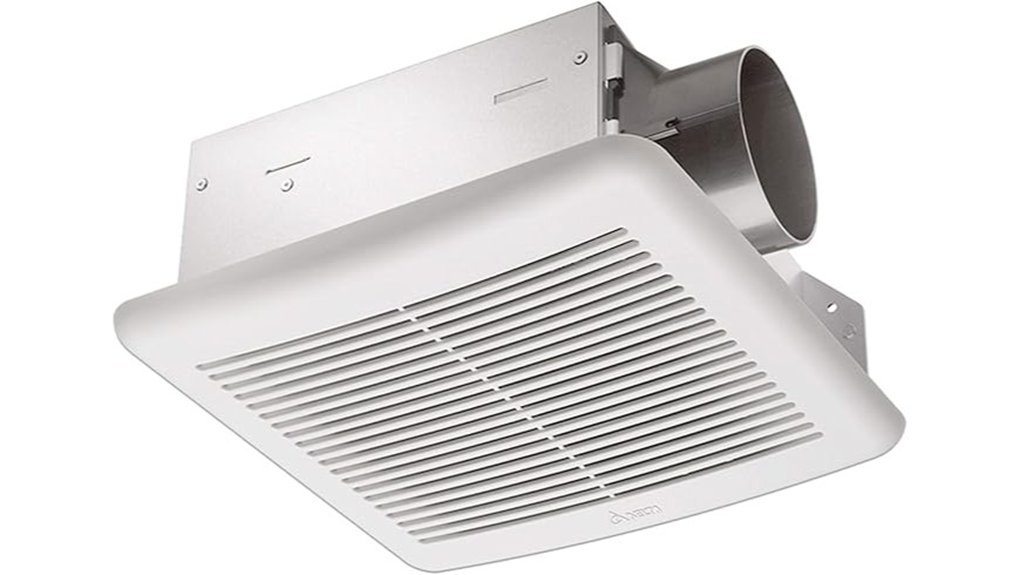
The Delta BreezSlim SLM70H is purpose-built for tight ceiling or wall cavities where larger modern fans simply will not fit. Its energy-efficient brushless DC motor draws just 13.1 watts while delivering 70 CFM of airflow. In humidity mode, the fan activates automatically when relative humidity exceeds roughly 60% and shuts off once moisture drops below that threshold; flipping the wall switch off and back on toggles the unit into continuous 70 CFM manual mode. An indicator LED underneath the grille glows amber in humidity-sensing mode and blue in manual full-speed mode.
Measuring just 7.5 x 7.25 x 3.94 inches, the housing slips into shallow 2×4 ceiling or wall framing that blocks standard 5.75-inch-deep fans.
Key Specifications:
- Airflow Capacity: 70 CFM (13.1W brushless DC motor)
- Sound Rating: 2.0 sones at 0.1 in. w.g.
- Humidity Sensor: Fixed threshold (activates above ~60% RH) with wall-switch manual override and LED mode indicator
- Duct Diameter: 3-inch round duct collar
- Housing Dimensions: 7.5 x 7.25 x 3.94 inches (approved for ceiling or wall mount)
- Lighting: None (grille-only unit)
- Certifications & Warranty: ENERGY STAR qualified, HVI certified, UL listed; 3-year limited warranty
Best For: Older homes, powder rooms, and compact full bathrooms up to 65–70 square feet with shallow 2×4 framing or existing 3-inch ductwork.
Why You’ll Like It: Its ultra-shallow 3.94-inch depth and 7.5 x 7.25-inch footprint match the exact dimensions of millions of older economy bath fans, saving hours of framing and drywall work.
Who Should Avoid It: Buyers who have 4-inch ductwork and room for a larger, quieter housing, or anyone seeking near-silent operation below 1.0 sone.
Pros:
- Ultra-compact 7.5 x 7.25 x 3.94-inch housing approved for both ceiling and wall installation.
- Reliable brushless DC motor with built-in overload cutoff and LED status indicator.
- Direct connection to existing 3-inch ducts without needing a reducer.
Cons:
- At 2.0 sones (at 0.1-inch static pressure), it is noticeably more audible than larger 4-inch and 6-inch fans.
- The 3-inch duct outlet restricts airflow if your duct run is long or has multiple elbows.
- Single 70 CFM speed is limited to small bathrooms.
Verdict: When a shallow 2×4 ceiling or wall cavity and a 3-inch duct rule out larger fans, the Delta BreezSlim SLM70H is the most trustworthy compact humidity-sensing retrofit on the market.
Factors to Consider When Choosing a Bathroom Exhaust Fan with a Humidity Sensor
The right model is rarely just the fan with the highest advertised CFM or the lowest sone number. It has to match your room volume, ceiling joist depth, duct diameter, switch wiring, and local climate.
Exhaust Fan vs. Dehumidifier
A humidity-sensing bathroom exhaust fan does not condense water into a bucket like a portable refrigerant dehumidifier. Instead, it senses airborne moisture and pulls steamy bathroom air outside through an exhaust duct while drawing drier replacement air into the room from the hallway. That makes an exhaust fan ideal for clearing point-source shower steam, but it will not lower humidity if your entire house or basement has high ambient moisture.
Airflow Capacity (CFM) and Room Size
Airflow is measured in cubic feet per minute (CFM). The Home Ventilating Institute (HVI) recommends at least 50 CFM for bathrooms under 50 square feet, roughly 1 CFM per square foot for bathrooms between 50 and 100 square feet (assuming an 8-foot ceiling), and a fixture-based calculation for bathrooms over 100 square feet. For larger rooms, add 50 CFM for each toilet, shower, or standard bathtub, and 100 CFM for a jetted tub or steam-heavy enclosure.
| Bathroom Floor Area / Layout | Minimum Recommended CFM | Typical Duct Size | Matching Picks in This Guide |
|---|---|---|---|
| Under 50 sq. ft. (powder room / compact bath) | 50–70 CFM | 3-inch or 4-inch | Delta BreezSlim SLM70H, Panasonic FV-0511VFC1 (50 CFM setting) |
| 50 to 80 sq. ft. (standard hall/guest bath) | 70–80 CFM | 4-inch | Broan-NuTone BES8, Panasonic FV-0511VFC1 (80 CFM setting) |
| 80 to 110 sq. ft. (full primary bathroom) | 90–110 CFM | 4-inch | Panasonic FV-0511VFC1 (110 CFM), KAZE SNP100HL9, JULLISON 100 CFM |
| Over 100 sq. ft. or multiple fixtures (e.g., shower + tub + enclosed toilet) | 150–240 CFM (by fixture count) | 6-inch recommended | OREiN OL17003 (160 CFM), VIVOHOME 240 CFM |
If your bathroom has 9- to 10-foot ceilings, an enclosed water-closet stall, or a duct run longer than 15 feet with multiple 90-degree bends, step up to the next CFM tier.
Noise Level (Sones) and Static Pressure Test Conditions
Bathroom fan loudness is measured in sones on a linear scale: 1.0 sone sounds roughly like a quiet modern refrigerator, while 2.0 sones is twice as loud as 1.0 sone. Always check the static pressure (measured in inches of water gauge, or in. w.g.) at which a fan was tested:
- 0.1 in. w.g.: Represents a short, smooth duct run with minimal resistance. Almost all advertised sone ratings are measured at 0.1 in. w.g.
- 0.25 in. w.g.: Represents real-world installed resistance in longer duct runs, flexible ducts, or runs with several elbows and a roof/wall damper.
Fans with brushless DC (ECM) motors—such as the Panasonic WhisperFit FV-0511VFC1—maintain their airflow far better at 0.25 in. w.g. than inexpensive AC motors. Also watch out for multi-speed listings that advertise the sone rating of their lowest 30 CFM idle speed while putting the highest 160 or 240 CFM number in the headline.
Humidity Sensor Types: Fixed Threshold vs. Rate-of-Rise vs. Condensation
Not all humidity sensors think alike. Understanding how a fan triggers prevents the common headache of a fan that runs all day in July or fails to kick on during a quick warm shower:
- Fixed-Threshold Sensors (e.g., OREiN OL17003, Delta SLM70H): Turn on whenever relative humidity crosses a preset number (typically 60% RH). They are simple and reliable in climate-controlled homes, but if your indoor summer humidity naturally sits above 60%, a fixed-threshold fan may run continuously until you switch it off or lower indoor humidity with air conditioning.
- Adjustable-Threshold Sensors (e.g., KAZE SNP100HL9): Let you turn a small dial under the cover from 30% to 80% RH so you can raise the threshold in humid summers and lower it in dry winters.
- Rate-of-Rise & Condensation Sensors (e.g., Broan-NuTone BES8 Sensaire, Panasonic FV-0511VFC1): Respond to rapid spikes in humidity or calculate the dew point from both temperature and relative humidity. Because they look for sudden shower steam rather than just background mugginess, they are much less prone to false summer cycling.
Duct Size and Installed Performance
Verify your existing duct diameter before ordering. Compact retrofits like the Delta BreezSlim SLM70H fit 3-inch ducts, standard 80 to 110 CFM models use 4-inch ducts, and high-capacity 160 to 240 CFM models typically need 6-inch ducts. Pushing 150+ CFM through a 4-inch duct creates high air velocity, turbulent noise, and static pressure that chokes actual airflow. Use smooth, rigid metal ducting (or stretched, insulated flex duct in unconditioned attics to prevent condensation inside the pipe) and vent directly outdoors.
Energy Efficiency and Certifications
ENERGY STAR certification requires independent lab verification of airflow efficiency (CFM per watt), low sound levels, and preserved airflow at 0.25 in. w.g. static pressure. HVI (Home Ventilating Institute) certification ensures that the CFM and sone numbers on the box come from standardized third-party testing rather than unverified seller estimates. For safety, look for UL or ETL listings, and verify that the exact model is rated for wet or damp locations with GFCI branch-circuit protection if the fan sits directly above a bathtub or shower stall.
Installation and Wall-Switch Wiring Requirements
Measure the existing ceiling cutout length and width, available depth above the drywall, joist direction, and duct location. While “room-side installation” means the housing can be fastened from below without attic access, you will still need to trim drywall if you are moving from a 7.5 x 7.25-inch opening to a 10.25- or 11.8-inch housing.
Pay close attention to switch wiring, especially on fan-and-light combinations. For a humidity sensor to monitor the room automatically, the sensor circuit needs continuous power. If a fan-and-light combo is wired to a single simple toggle switch with only two-conductor wire, turning off the bathroom light at the wall switch will also cut power to the humidity sensor—Unless the unit uses a wireless remote controller module wired ahead of the light switch or you have a dual wall switch (3-wire cable) that feeds the fan/sensor independently from the light.
Lighting and Control Options
Integrated LED panels save ceiling space, but compare lumen output (1000 to 1500 lumens is bright enough for general lighting in most small-to-medium baths), color temperature (2700K–3000K warm white flatters skin tones, while 4000K–5000K feels crisper), dimming support, and night-light warmth. Never pair a humidity-sensing fan or electronic LED driver with a wall dimmer or timer switch unless the installation manual explicitly approves it.
Warranty and Parts Support
A multi-year warranty is only as good as the company’s replacement-parts pipeline. Established ventilation brands like Panasonic, Broan-NuTone, and Delta Electronics publish full exploded parts diagrams, replacement blower assemblies, and technical support lines. Keep a copy of your purchase receipt, model sticker, and wiring manual for future maintenance.
- Measure your ceiling cutout (length x width), available joist depth, and joist spacing.
- Confirm whether your existing duct is 3, 4, or 6 inches in diameter and terminates outdoors.
- Calculate required CFM from room square footage, ceiling height, and fixture count.
- Compare sone ratings at the speed you will actually use—and favor HVI-certified ratings.
- Choose an adjustable, rate-of-rise, or condensation sensor if your home gets humid in summer.
- Check your wall switch box to see if you have separate switches (or constant power) for the fan and light.
- Verify wet-location and GFCI requirements if mounting above a tub or shower enclosure.
Frequently Asked Questions
Do Humidity-Sensing Bathroom Fans Work Like Dehumidifiers?
No. They exhaust warm, steamy bathroom air outdoors through a duct and draw drier replacement air into the bathroom from adjacent rooms. Because they do not condense moisture into a collection tank, they are designed to clear shower humidity rather than replace a portable or whole-house dehumidifier.
How Do I Install a Bathroom Exhaust Fan with a Humidity Sensor?
Switch off power at the circuit breaker and verify with a voltage tester, remove the old fan, check and resize the ceiling opening if needed, connect the exhaust collar to an outdoor-vented duct with foil tape or clamps, secure the housing to the ceiling framing, and wire the unit according to the manufacturer’s diagram. Because bathroom electrical and ceiling work involves shock, fire, and moisture hazards, hire a licensed electrician if you are not experienced with residential wiring.
How Much CFM Do I Need?
For bathrooms under 50 square feet, 50 CFM is the standard HVI minimum. For bathrooms between 50 and 100 square feet with 8-foot ceilings, allow at least 1 CFM per square foot. For bathrooms over 100 square feet, calculate by fixtures: add 50 CFM for each toilet, shower, or standard tub, and 100 CFM for a jetted tub. Increase capacity if you have ceilings over 8 feet or a long, restrictive duct run.
How Loud Are Bathroom Exhaust Fans with Humidity Sensors?
Noise is measured in sones, where 1.0 sone is roughly comparable to a quiet refrigerator hum and 2.0 sones is twice as loud. Quiet modern fans rate between 0.3 and 1.0 sone at 0.1-inch static pressure, while basic compact fans often rate around 1.5 to 2.0 sones. Real-world loudness also depends heavily on duct diameter, sharp bends in flex ducting, and whether the external damper opens freely.
Why Does My Humidity-Sensing Bathroom Fan Keep Running?
If a humidity-sensing fan runs nonstop, the indoor ambient humidity in your home has likely risen above the sensor’s fixed trigger point (often 60% RH during muggy summer weather), or the post-shower delay timer is still counting down. On models with an adjustable sensitivity dial (such as the KAZE SNP100HL9 or Broan-NuTone BES8), raise the relative humidity threshold toward 70%–80%. On fixed-threshold models, running central air conditioning or turning off the fan wall switch during humid weather spells will stop continuous cycling.
Does the Wall Switch Need to Stay On for the Humidity Sensor to Work?
Yes, the humidity sensor circuit must receive electrical power to monitor moisture and turn the fan on automatically. On a simple single-switch grille-only fan, you leave the wall switch in the “On” position so the fan sleeps in standby and activates only when humidity spikes. On most models, flicking the wall switch off and back on within two seconds overrides the sensor and forces the fan into continuous manual exhaust mode.
Can a Humidity-Sensing Fan Be Installed Over a Shower?
Only when the exact model number is UL or ETL listed for installation over a tub or shower enclosure and wired to a GFCI-protected branch circuit as specified in the manual. Never install an unrated fan or fan-light combo directly inside a shower zone.
Can I Use These Fans in Non-Bathroom Areas?
Yes—many homeowners install humidity-sensing exhaust fans in laundry rooms, mudrooms, or home exercise rooms where damp air accumulates, provided the manufacturer approves that use and the duct vents directly outdoors. Do not use residential bathroom exhaust fans as kitchen range hoods, as they are not rated for airborne cooking grease.
Do These Fans Require Regular Maintenance?
Yes. Every 6 to 12 months, turn off power at the breaker, unclip the ceiling grille, wash the plastic grille in warm soapy water, and gently vacuum dust off the blower wheel and humidity sensor slots. Periodically verify that the outdoor wall or roof damper flaps open freely and that attic ductwork remains sealed and uncrushed.
Will a Humidity-Sensing Fan Prevent Mold?
It significantly reduces the lingering surface condensation and high relative humidity that feed bathroom mold and peeling paint, but no fan can guarantee 100% prevention alone. Plumbing leaks, uninsulated cold exterior walls, blocked ducts, or doors sealed so tightly that replacement air cannot enter the bathroom can still cause dampness.
Conclusion
A bathroom exhaust fan with a humidity sensor takes human forgetfulness out of bathroom ventilation by clearing steam automatically during and after every shower. For most homes that do not need an integrated ceiling light, the Panasonic WhisperFit FV-0511VFC1 is the clear #1 choice thanks to its selectable 50, 80, and 110 CFM Pick-A-Flow switch, smart temperature-and-humidity condensation sensor, and ultra-quiet 0.4- to 0.8-sone operation. If you want an all-in-one fan, bright LED light, and night light for a larger bathroom with 6-inch ducting, choose the OREiN OL17003. For standard 4-inch-duct bathrooms that need both a light and fine-tuned sensor dials, go with the KAZE APPLIANCE SNP100HL9, or pick the Broan-NuTone BES8 or Delta BreezSlim SLM70H for a compact room-side retrofit. Whichever model fits your ceiling opening, pairing it with a smooth, properly sized outdoor duct run is the key to quiet, reliable moisture control.