Last updated: August 2026. Product specifications, ratings, warranties, and included accessories can change, so confirm the current Amazon listing and manufacturer documentation before purchase.
Commercial dehumidifiers can help a nightclub manage excess moisture caused by crowds, outdoor-air intake, wet cleaning, bars, kitchens, open doors, and limited HVAC latent capacity. The right choice depends on measured humidity, peak occupancy, operating hours, drainage access, airflow, electrical capacity, and acceptable noise. The seven models below are commercially oriented options for back-of-house or targeted humidity control, but they are not substitutes for properly designed ventilation, air-conditioning, leak repair, or mold remediation.
Quick verdict
Best balanced pump-equipped option: Airzentti 155 Pints. Best fixed gravity-drain option: Moiswell M145. Best compact pump model: MOISWELL 70 Pints. Best for severe moisture or off-hours drying: MOUNTO 310 Pints LGR.
How these picks were evaluated
The comparison prioritizes commercially oriented construction, published AHAM capacity where available, continuous drainage, pump or gravity-drain flexibility, airflow, automatic defrost, restart capability, service access, and realistic placement away from guests. Manufacturer square-foot claims were treated only as rough guides because nightclub moisture loads vary widely.
Quick Comparison of Commercial Dehumidifiers for Nightclubs
| Product | Best Use | Published Capacity | Drainage | Main Limitation |
|---|---|---|---|---|
| MOUNTO 310 Pints LGR | Severe moisture, restoration, and off-hours drying | 310 PPD maximum; 165 PPD AHAM | Built-in pump | Heavy, high-airflow restoration equipment |
| VEVOR 125 Pints | Back-of-house or supported ducted installation | 125 PPD maximum; 60 PPD AHAM | Continuous gravity drain | No clearly included condensate pump |
| MOISWELL 70 Pints | Small zones, bars, storage, and compact installs | 70 PPD maximum; 35 PPD AHAM | Built-in pump | May be undersized for a full busy venue |
| Moiswell M145 | Permanent large-zone installation | 155 PPD maximum; 70 PPD AHAM | Gravity drain | Needs a reliable downward drain path |
| HBN 125-Pint | Large back rooms and remote service areas | 125 PPD maximum; 60 PPD AHAM | Gravity drain or built-in pump | Sound and airflow documentation should be confirmed |
| Airzentti 155 Pints | Balanced large-space moisture control | 155 PPD maximum; 70 PPD AHAM | Built-in pump plus gravity drain | Large coverage claims still require load-based sizing |
| ALORAIR Sentinel HD55 | Compact back-of-house installation | 113 PPD maximum; 53 PPD AHAM | Gravity drain | No built-in pump on this specific model |
MOUNTO 310 Pints Portable Dehumidifier with Pump
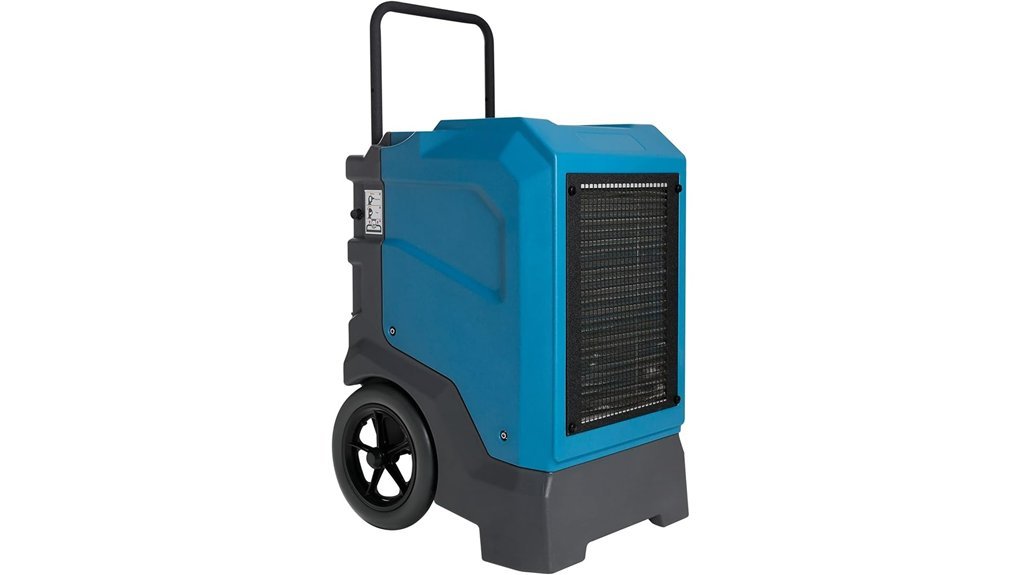
The MOUNTO 310 Pints LGR is the highest-capacity option in this roundup. Published specifications list up to 310 pints per day under maximum conditions and 165 pints per day under AHAM conditions, along with approximately 550 CFM airflow. Its built-in condensate pump, digital humidistat, automatic restart, and large wheels suit water intrusion, post-cleaning drying, or unusually humid periods.
This is restoration-style equipment rather than a discreet comfort appliance. At about 125 pounds, it is movable but not lightweight, and its strong airflow, compressor sound, and warm discharge air should be isolated from occupied areas. It makes the most sense in a mechanical room, service corridor, storage area, or during off-hours.
Why You’ll Like It: It provides substantially more published AHAM capacity than the smaller horizontal models and can pump condensate without relying on a nearby floor drain.
Best For: Large venues with severe moisture, water-damage cleanup, wet flooring, or overnight drying needs.
Who Should Avoid It: Small clubs, venues without a suitable circuit, or operators needing quiet equipment near seating or sound-control areas.
Pros:
- High published capacity: 310 PPD maximum and 165 PPD AHAM.
- Built-in pump with a listed 15-foot lift supports flexible drainage.
- Large wheels and a rigid handle help move the heavy chassis.
Cons:
- Approximately 125 pounds.
- Restoration-style airflow and noise may be unsuitable near patrons.
- Higher power demand than the smaller units in this comparison.
VEVOR 125 Pints Commercial Dehumidifier
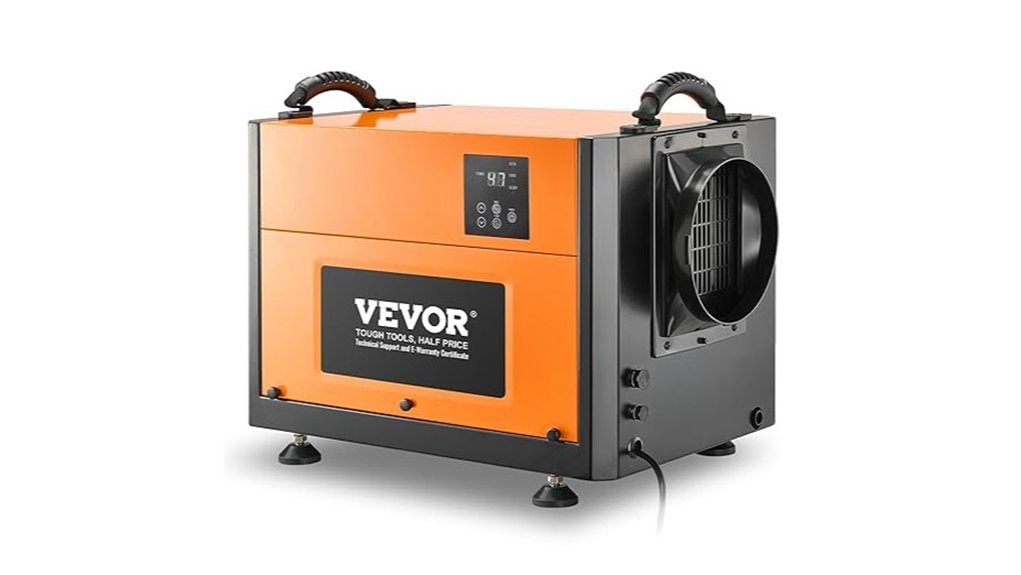
The VEVOR 125 Pints Commercial Dehumidifier uses a low-profile galvanized-steel housing intended for crawl spaces, basements, storage rooms, warehouses, and other service areas. Current manufacturer information for this version lists 125 pints per day under maximum conditions, 60 pints per day under AHAM conditions, and approximately 232 CFM airflow. Its continuous drain hose, automatic defrost, and remote-panel capability can suit a back room or manufacturer-supported ducted installation.
The specific listing centers on gravity drainage rather than a clearly included condensate pump. Plan a continuously downward drain route before buying, and confirm the exact model number, duct accessories, remote-control parts, and included hose on the current listing.
Why You’ll Like It: The horizontal metal enclosure offers floor, shelf, or supported suspended-installation flexibility where an upright unit would use valuable space.
Best For: Storage rooms, service areas, lower levels, and installations with a reliable downward drain.
Who Should Avoid It: Venues that need verified pump lift or cannot provide a suitable gravity-drain route.
Pros:
- Published 60 PPD AHAM capacity and approximately 232 CFM airflow.
- Commercial metal enclosure with automatic defrost.
- Continuous gravity drainage for fixed installations.
Cons:
- A built-in condensate pump is not clearly included.
- Accessories can vary by exact VEVOR version.
- Not designed as a quiet, guest-facing appliance.
MOISWELL 70 Pints Portable Commercial Dehumidifier
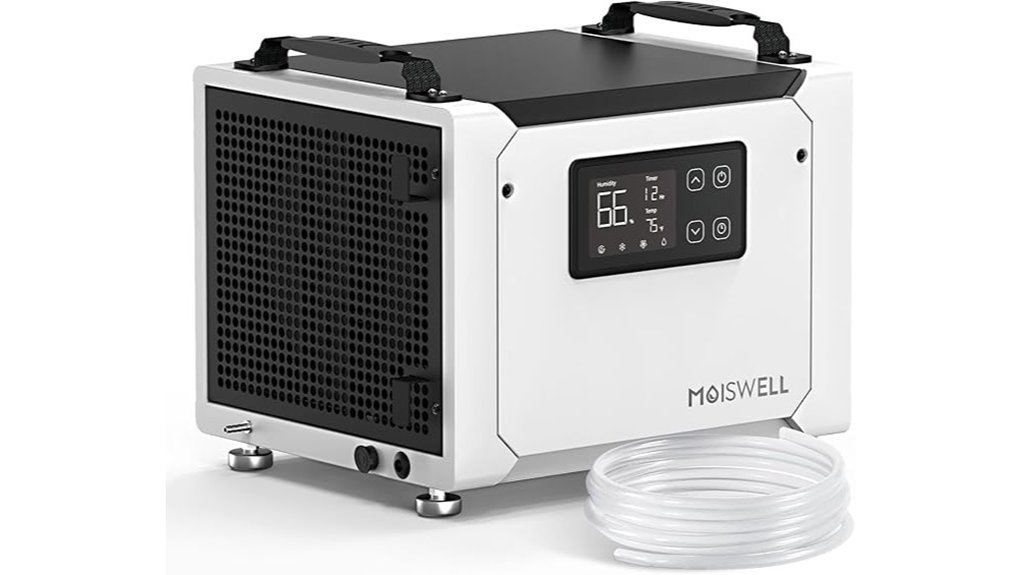
The MOISWELL Defender ME-7S is a compact commercial-style dehumidifier for targeted zones. Manufacturer specifications list up to 70 pints per day under maximum conditions, 35 pints per day under AHAM conditions, and approximately 120 CFM airflow. Its built-in pump can lift condensate through the supplied drain setup, which is useful when the nearest approved drain is above the unit.
At roughly 40 pounds, this model is easier to position than high-capacity restoration equipment. It can work well in a bar area, storage room, coat room, small lounge, office, or localized moisture zone. It is unlikely to handle the full latent load of a large crowded nightclub by itself, especially during humid weather or peak outdoor-air intake.
Why You’ll Like It: It combines compact dimensions, pump drainage, automatic defrost, auto restart, and a published AHAM figure that makes comparison easier.
Best For: Smaller venues or individual problem zones that need upward drainage.
Who Should Avoid It: Large clubs expecting one compact unit to control the entire occupied floor.
Pros:
- Built-in condensate pump with a listed lift of up to 16.4 feet.
- Compact housing and approximately 40-pound weight improve placement flexibility.
- Published 35 PPD AHAM capacity and 120 CFM airflow.
Cons:
- Lower capacity than the larger 125-, 155-, and 310-pint models.
- Multiple separated rooms may require more than one unit.
- Filter and drain-line maintenance remain necessary.
Moiswell M145 155 Pint Commercial Dehumidifier with Drain Hose
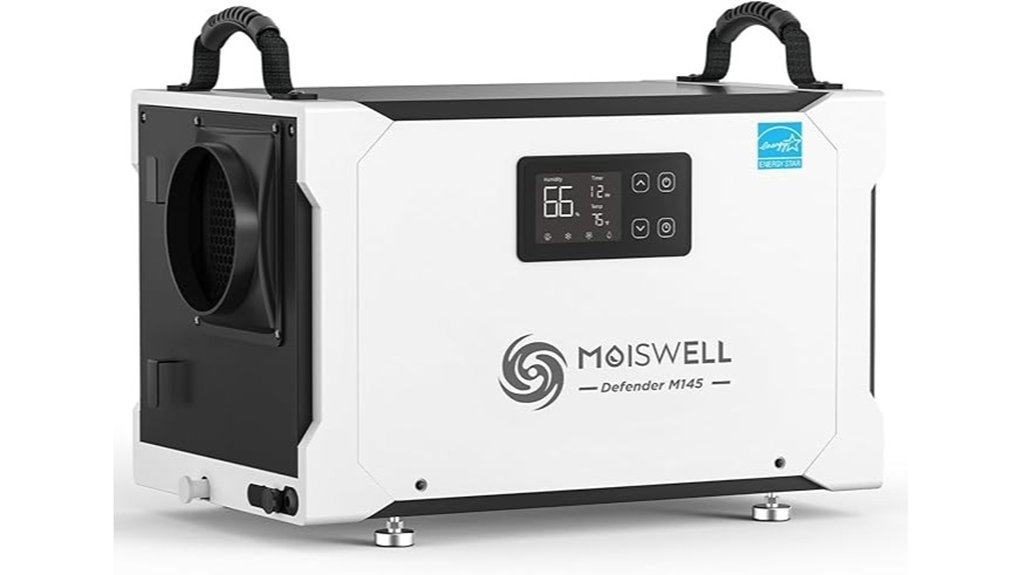
The Moiswell Defender M145 is listed at 155 pints per day under maximum conditions and 70 pints per day under AHAM conditions, with approximately 265 CFM airflow. That makes it a stronger everyday humidity-control candidate than products that publish only a maximum-condition rating. It also includes automatic defrost, auto restart, humidistat cycling, fault detection, and a 6.5-foot drain hose.
This specific M145 is a gravity-drain model, not the pump-equipped MP145. It needs a continuously downward hose route to a floor drain or approved condensate connection. The compact horizontal housing suits permanent back-of-house placement, while compatible ducting and a wired remote may be optional purchases depending on the version.
Why You’ll Like It: It offers a useful balance of published AHAM capacity, strong airflow, compact dimensions, and straightforward gravity drainage.
Best For: Medium-to-large venues with a nearby floor drain and room for a permanent back-of-house installation.
Who Should Avoid It: Locations where condensate must be pumped upward or where staff cannot inspect the drain route.
Pros:
- 70 PPD AHAM capacity and approximately 265 CFM airflow.
- Automatic humidity cycling, defrost, restart, and fault detection.
- Compact horizontal form factor for fixed service-area placement.
Cons:
- Gravity drainage only on this exact model.
- Coverage claims should not replace professional load calculations.
- At about 65 pounds, frequent relocation is not effortless.
HBN 125-Pint Crawl Space Dehumidifier with Pump
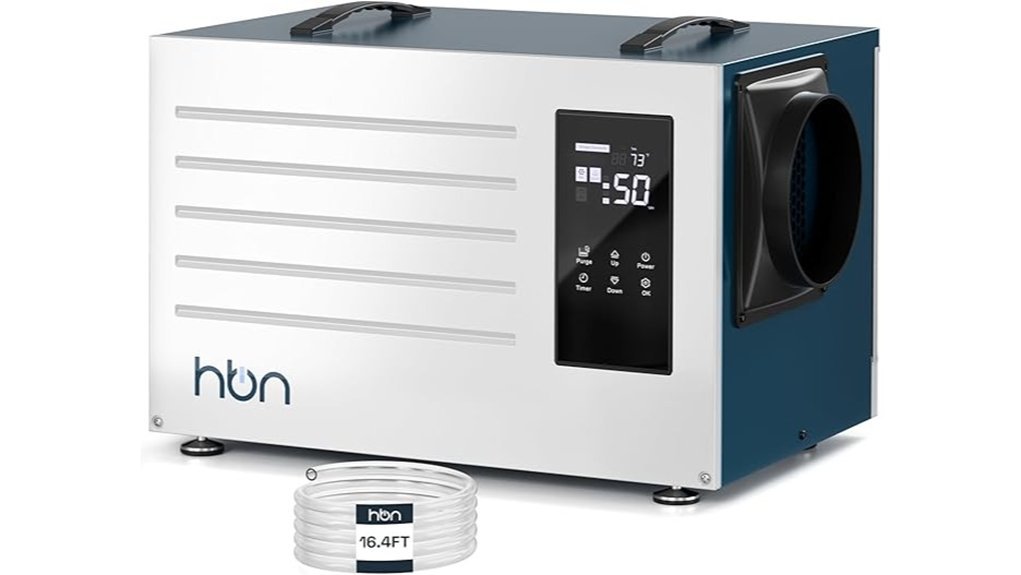
The HBN 125-Pint Crawl Space Dehumidifier combines gravity drainage with a built-in pump. Current listing information states up to 125 pints per day under maximum conditions and 60 pints per day under AHAM conditions. It also lists a 6.6-foot gravity hose and a pump lift of up to 16.4 feet, giving installers more flexibility when a floor drain is unavailable.
Its horizontal format, touchscreen controls, timer, automatic defrost, and power-outage memory suit service rooms, storage areas, lower levels, and other locations where guests will not be close to the equipment. Published airflow and sound information is less consistent across available product references, so confirm those details before sizing or placing it near occupied rooms.
Why You’ll Like It: Dual drainage provides more installation flexibility than gravity-only models while retaining a compact commercial form factor.
Best For: Large back-of-house areas where the drain may be above or some distance from the unit.
Who Should Avoid It: Buyers who need manufacturer-published sound data or fully consistent airflow documentation before purchase.
Pros:
- Published 60 PPD AHAM capacity.
- Gravity and pump drainage options.
- Touchscreen humidity settings, timer, auto defrost, and restart memory.
Cons:
- Airflow documentation should be confirmed for the exact listing.
- Sound may be noticeable near occupied spaces.
- Large square-foot claims may not reflect peak nightclub conditions.
Airzentti 155 Pints Commercial Dehumidifier with Pump
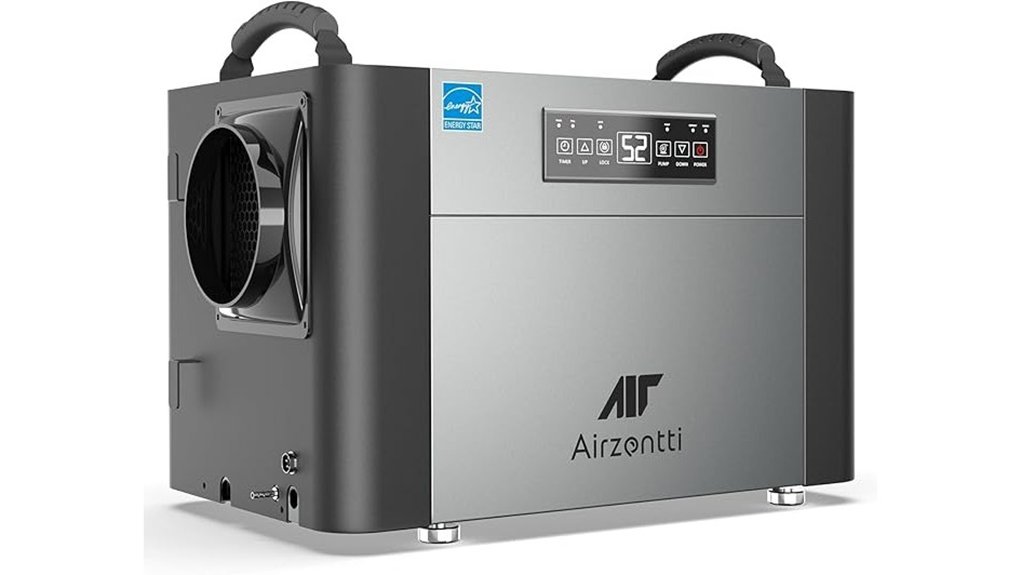
The Airzentti 155 Pints Commercial Dehumidifier is listed at up to 155 pints per day under maximum conditions and 70 pints per day under AHAM conditions, with approximately 220 CFM airflow. Its built-in condensate pump has a listed lift of up to 16.4 feet, and the unit also supports gravity drainage through the supplied drain setup.
For a nightclub, the combination of a meaningful AHAM rating, pump drainage, humidistat control, automatic defrost, restart memory, and screen lock is more useful than a large square-foot claim alone. It is still a substantial commercial appliance at about 60 pounds, so place it in a mechanical or service area and verify circuit capacity, airflow clearance, drain routing, and sound before permanent installation.
Why You’ll Like It: It offers a balanced mix of published-condition capacity, pump flexibility, useful airflow, and commercial controls.
Best For: Medium-to-large clubs needing a pump-equipped unit for regular back-of-house humidity control.
Who Should Avoid It: Venues that cannot isolate compressor, fan, and warm discharge-air effects from guests.
Pros:
- 70 PPD AHAM rating with approximately 220 CFM airflow.
- Built-in pump plus gravity-drain capability.
- Automatic defrost, restart memory, humidity control, and screen lock.
Cons:
- Physical size and weight require installation planning.
- Square-foot coverage is not a substitute for load-based sizing.
- Manufacturer sound-pressure data should be confirmed for sensitive areas.
ALORAIR Commercial Dehumidifier 113 Pint for Basements
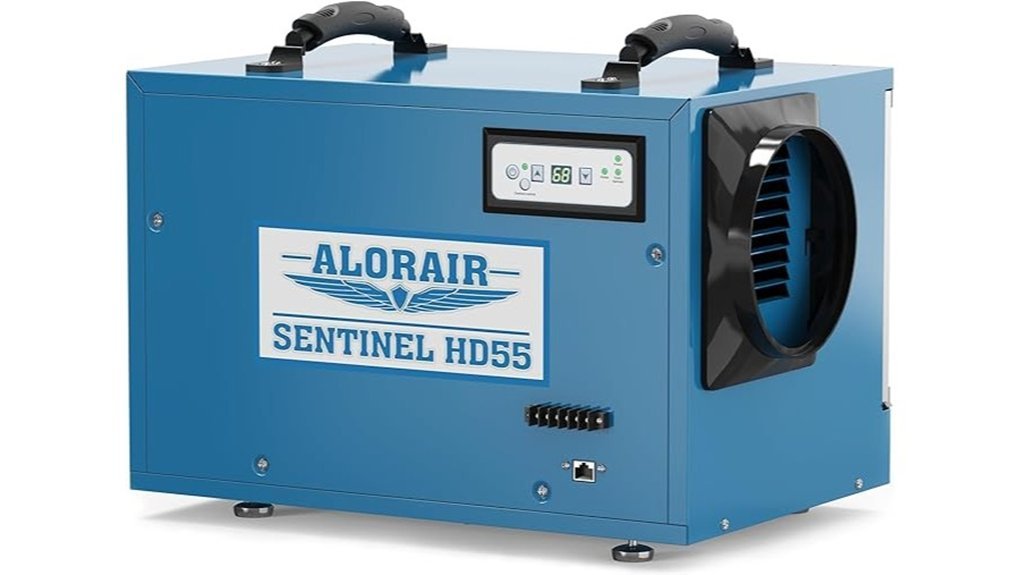
The ALORAIR Sentinel HD55 is a compact commercial model rated at 113 pints per day under maximum conditions and 53 pints per day under AHAM conditions. Manufacturer specifications also list approximately 120 CFM airflow, gravity drainage, automatic defrost, auto restart, a portable handle, and a sound-pressure level below 50 dBA under stated test conditions.
Its roughly 42-pound weight and compact enclosure make it easier to position in a back room than a wheeled restoration unit. However, this exact HD55 uses gravity drainage, so it needs a suitable downward drain route. A compatible remote controller may be optional rather than included, and buyers should verify current warranty terms and accessories.
Why You’ll Like It: It provides a published AHAM rating and relatively modest listed sound level in a compact enclosure.
Best For: Small-to-medium service areas, storage rooms, bars, and permanent gravity-drain installations.
Who Should Avoid It: Venues requiring a built-in pump or higher airflow for a large open floor.
Pros:
- 53 PPD AHAM capacity in a compact housing.
- Listed sound pressure below 50 dBA under stated conditions.
- Automatic defrost, humidity control, and restart.
Cons:
- Gravity drain only on this specific model.
- Optional controls may cost extra.
- Lower airflow than the larger 155-pint models.
Factors to Consider When Choosing a Commercial Dehumidifier for Nightclubs
A nightclub produces a changing moisture load. Attendance, outdoor-air intake, weather, kitchen or bar activity, wet cleaning, door openings, and HVAC runtime can all change the amount of water that must be removed. Use the points below to narrow the list, then confirm final sizing and installation with a commercial HVAC professional.
Compare AHAM Capacity, Not Just Headline Pints
Maximum-condition ratings are measured in hotter and wetter air and usually look much larger than AHAM ratings. When two models use different test conditions, their headline pint numbers are not directly comparable. Prefer a published AHAM capacity and ask the seller or manufacturer for the test condition when it is missing.
Calculate the Real Moisture Load
Square footage alone is not enough. A packed dance floor with frequent door opening and high outdoor-air ventilation can create a much larger latent load than an empty basement of the same size. A professional can estimate the load from occupancy, climate, ventilation, infiltration, operating hours, cleaning practices, and existing HVAC performance.
Coordinate with HVAC and Ventilation
A standalone refrigerant dehumidifier removes moisture but releases heat into the surrounding space. It should complement, not fight, the air-conditioning and ventilation system. Persistent humidity may indicate excessive outdoor-air load, short HVAC cycles, poor controls, duct leakage, dirty coils, active water intrusion, or insufficient latent capacity.
Choose the Right Drainage System
Gravity drainage is simple and reliable when an approved drain sits below the unit. A built-in pump is more flexible when water must travel upward or across a room. Confirm maximum lift, hose length, backflow protection, drain destination, freeze risk, and local plumbing requirements before installation.
Plan for Noise, Heat, and Placement
Even a model with a modest published decibel figure can be distracting in a quiet lounge. Keep commercial units away from guest seating, DJ monitoring positions, offices, recording equipment, and temperature-sensitive storage. Maintain the manufacturer’s intake and exhaust clearances, and do not enclose a unit in a cabinet unless the installation is specifically engineered for airflow, heat rejection, drainage, and service access.
Check Electrical Demand
Review voltage, amperage, wattage, plug type, circuit rating, extension-cord restrictions, and startup current. High-capacity dehumidifiers may need a dedicated circuit. A qualified electrician should review the installation when the unit will run for long periods or share a circuit with refrigeration, lighting, sound, cooking, or bar equipment.
Look for Useful Controls
An adjustable humidistat, automatic restart, automatic defrost, timer, remote sensor, screen lock, and fault display can reduce staff attention. Remote monitoring is useful when a unit is in a locked mechanical room, but confirm whether the controller, cable, Wi-Fi feature, or app is included, optional, or compatible with the exact model.
Maintenance and Serviceability
Choose a unit with an accessible washable or replaceable filter, reachable drain connection, available replacement parts, and clear warranty terms. Build filter cleaning, coil inspection, drain flushing, pump testing, and humidity-sensor checks into the venue’s maintenance schedule. Use a separate calibrated hygrometer to confirm that the built-in reading represents the occupied area.
Before You Buy
- Measure humidity during peak attendance, after wet cleaning, and during humid weather.
- Ask for AHAM capacity, airflow, wattage, and sound-pressure data.
- Confirm whether drainage is gravity, pump, or both.
- Verify pump lift, hose length, operating temperature, and included accessories.
- Confirm circuit capacity and any dedicated-circuit requirement.
- Choose a location that protects guests from noise and warm discharge air.
- Do not use a dehumidifier to hide an active leak, mold problem, or failed ventilation system.
Frequently Asked Questions
What Humidity Level Should a Nightclub Maintain?
Indoor relative humidity should generally remain below 60%, while a range around 30% to 50% is commonly used as a moisture-control target. The practical setpoint for a nightclub depends on climate, condensation risk, comfort, occupancy, and HVAC design. Avoid forcing humidity unnecessarily low because that can increase energy use and heat released by the dehumidifier.
How Do I Maintain a Commercial Dehumidifier?
Clean or replace the filter on the manufacturer’s schedule, keep intake and exhaust openings clear, flush the drain line, test the pump and hose, inspect the coil for dust or ice, and compare the built-in humidity reading with a separate calibrated hygrometer. Arrange professional service if capacity drops, the compressor short-cycles, drainage fails, or the unit shows repeated fault codes.
What’s the Average Lifespan of a Commercial Dehumidifier?
There is no guaranteed lifespan. Runtime, ambient heat, dust, filter care, drain maintenance, coil cleanliness, compressor quality, installation, and parts support all matter. Warranty length describes the manufacturer’s coverage policy, not how long the entire unit is guaranteed to operate.
Can Dehumidifiers Help Reduce Energy Costs?
They can improve moisture control and may allow occupants to feel comfortable at a slightly higher thermostat setting, but a standalone dehumidifier also uses electricity and adds heat to the space. Savings are not guaranteed. The best result comes from coordinating dehumidification with properly sized HVAC, demand-controlled ventilation, air sealing, scheduling, and correction of moisture sources.
Are Dehumidifiers Noisy During Operation?
Commercial models use a compressor and fan, so operational noise and vibration are normal. Compare published sound-pressure data, but also consider duct noise, floor vibration, wall construction, airflow speed, and whether the unit will run while guests are present.
What Is the Best Placement for a Dehumidifier in a Nightclub?
A service room, storage area, mechanical room, or other isolated location is usually better than the dance floor. The unit still needs clear airflow, a safe drain route, electrical access, and room for maintenance. Use ducting only when the manufacturer supports it, and place remote humidity sensors in representative occupied areas rather than beside the dehumidifier outlet.
Can One Dehumidifier Handle an Entire Nightclub?
Sometimes, but not always. Large open venues, multiple floors, separated rooms, high occupancy, frequent door opening, and high outdoor-air requirements may need multiple units or a ducted commercial system. Multiple units can improve air distribution and provide backup capacity if one unit is offline.
Will a Dehumidifier Fix Condensation or Mold?
It can help lower humidity, but it will not repair a roof leak, plumbing leak, cold-surface insulation problem, blocked drain, or inadequate ventilation. Correct the moisture source first. Existing mold or water-damaged material may require professional assessment and remediation rather than humidity control alone.
Conclusion
The best commercial dehumidifier for a nightclub is the one that matches the venue’s measured latent load, drainage route, electrical service, airflow needs, and noise limits. The Airzentti 155 Pints offers the most balanced pump-equipped specification in this list, while the Moiswell M145 is a strong fixed option where gravity drainage is available. Choose the MOISWELL 70 Pints for smaller targeted zones, and reserve the MOUNTO 310 Pints LGR for severe moisture, restoration, or off-hours drying. Before purchasing, compare AHAM capacity, verify the exact included accessories, and have the installation reviewed as part of the venue’s HVAC and moisture-control plan.