Affiliate disclosure: This article contains Amazon affiliate links. We may earn a commission from qualifying purchases at no extra cost to you.
Choosing the best dehumidifier for 900 square feet depends on the room’s moisture level, temperature, layout, and drainage access—not only the floor area. ENERGY STAR guidance for spaces under 2,000 square feet suggests about 20 to 30 pints per day for slightly to moderately damp conditions, 25 to 40 pints for very damp conditions, and 30 to 50 pints for wet, high-load spaces.
For most moderately damp 900-square-foot rooms, the Midea 22-Pint EasyDry Dehumidifier is the strongest overall choice because it combines an appropriate standardized capacity, ENERGY STAR efficiency, a reusable filter, and straightforward controls. The VEAGASO VG380 is better suited to a consistently damp basement where a drain hose and extra listed capacity are useful. The Yaufey 80-Pint offers a larger bucket and flexible presets, but its 80-pint figure is a manufacturer maximum measured at 95°F and 90% relative humidity, so it should not be compared directly with DOE-style pint ratings.
Quick Verdict
Best overall: Choose the Midea 22-Pint EasyDry for a typical 900-square-foot living area or moderately damp basement. Choose the VEAGASO VG380 when the space stays very damp and you can use continuous gravity drainage. Choose the Yaufey when a larger bucket, preset humidity modes, and stronger hot-weather extraction claims matter more than compact size.
Key Takeaways
- Start with actual relative humidity and moisture sources, not the advertised coverage number alone.
- Compare pint ratings only when the test conditions are similar.
- A drain hose can matter more than a slightly larger bucket in a basement.
- A dehumidifier controls airborne moisture but does not repair leaks or remove existing mold.
Quick Comparison of Dehumidifiers for 900 Square Feet
| Product | Capacity Claim | Drainage | Best For | Amazon |
|---|---|---|---|---|
| Midea 22-Pint EasyDry | 22 pints/day under the current standardized rating system | Bucket or gravity-fed continuous drain | Best overall for moderate dampness | Check Price |
| VEAGASO VG380 | Up to 34 pints/day, manufacturer-listed | 2-liter bucket or included gravity drain hose | Very damp basements and continuous drainage | Check Price |
| Yaufey 80-Pint | Up to 80 pints/day at 95°F and 90% RH | 1.06-gallon bucket or included gravity drain hose | Large bucket, presets, and hot-humid conditions | Check Price |
Capacity-rating note: Pint-per-day numbers are meaningful only when the test conditions are comparable. DOE’s current procedure uses cooler, more realistic conditions than many “maximum extraction” marketing claims. Review the ENERGY STAR explanation of dehumidifier testing and capacity before comparing headline ratings.
Actual water removal also depends on room temperature, starting humidity, airflow, layout, and the source of the moisture.
Midea Energy Star Certified Dehumidifier (22 Pint)
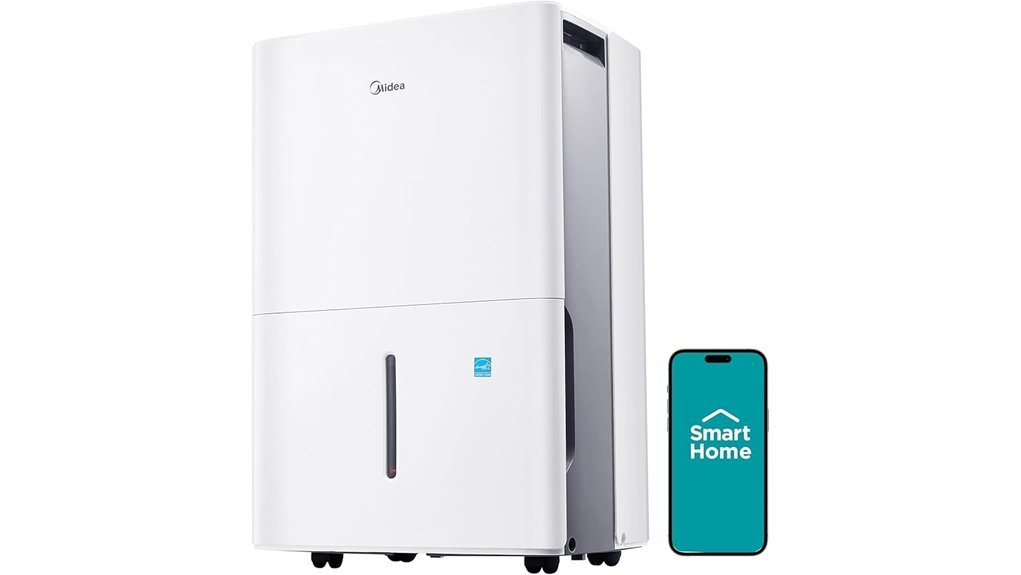
The Midea 22-Pint EasyDry Dehumidifier is the most balanced option for a moderately damp 900-square-foot room, apartment, office, or basement. The linked model is the EasyDry MAD22C1AWS, which is rated for up to 1,500 square feet and removes 22 pints per day under the current standardized capacity system.
Its digital controls let you select a target humidity, fan speed, timer, and continuous operating mode. A reusable filter, automatic restart, automatic defrost, full-bucket shutoff, rolling casters, and a built-in hose connection make routine operation easier. This linked EasyDry model does not include app or voice control.
Best For: Buyers who want a well-documented, energy-efficient compressor dehumidifier for ordinary home humidity control.
Why You’ll Like It: Its standardized 22-pint capacity fits ENERGY STAR’s recommended range for many slightly to moderately damp spaces under 2,000 square feet.
Who Should Skip It: Choose a higher-capacity model if the basement stays very damp, shows recurring condensation, or cannot reach the target humidity after leaks and seepage have been corrected.
Pros:
- Appropriate standardized capacity for many moderately damp 900-square-foot spaces.
- ENERGY STAR certified for improved energy efficiency.
- Reusable filter, timer, casters, automatic defrost, and automatic restart.
- Supports bucket collection or gravity-fed continuous drainage.
- Established manufacturer documentation and a one-year warranty.
Cons:
- The 0.8-gallon bucket may require regular emptying in humid weather.
- The linked EasyDry model does not have Wi-Fi, app, or voice control.
- A drain hose is not included and must run downhill to a suitable drain.
- Its 22-pint capacity may be too low for a persistently wet basement.
VEAGASO 2500 Sq.Ft Dehumidifier with Drain Hose
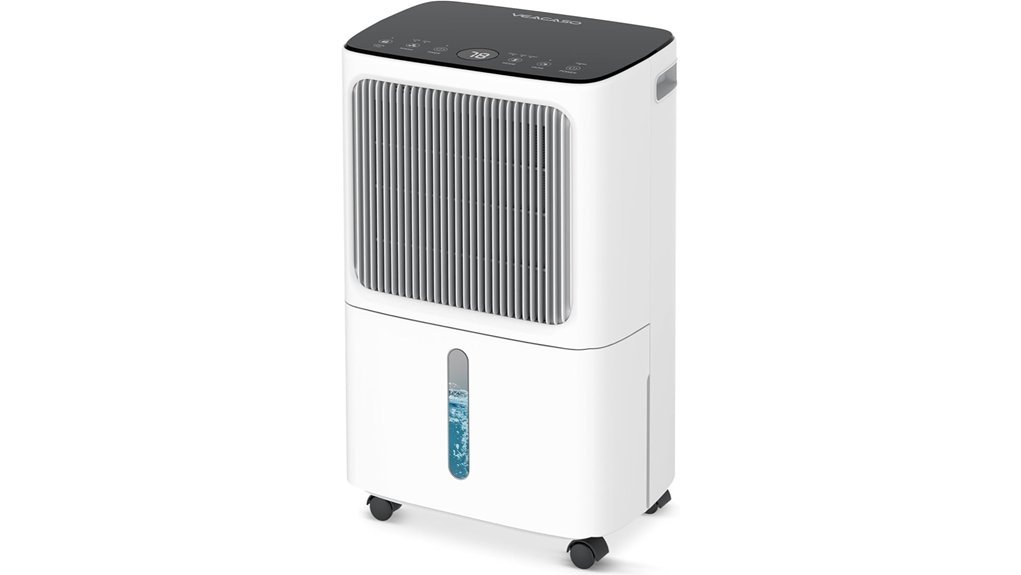
The VEAGASO VG380 is a manufacturer-listed 34-pint compressor dehumidifier for homes, bathrooms, and basements. Its extra listed capacity and included drain hose make it a practical option for a 900-square-foot basement that stays very damp or develops musty odors during humid weather.
The unit offers dehumidify, clothes-drying, and continuous modes. You can use its removable 2-liter bucket or attach the included 3.28-foot hose for continuous gravity drainage. Automatic humidity control cycles the compressor according to the selected setting, while the washable filter, rolling casters, and integrated handle simplify maintenance and movement.
Best For: A consistently damp 900-square-foot basement where continuous drainage and stronger listed moisture removal are priorities.
Why You’ll Like It: It includes the drain hose and offers useful DEHU, DRY, and CONT modes without moving to a much larger cabinet.
Who Should Skip It: It may be more capacity than necessary for a mildly humid bedroom, and buyers should not assume its maximum 34-pint claim is directly equivalent to a standardized DOE rating unless the test basis is confirmed.
Pros:
- Up to 34 pints of manufacturer-listed moisture removal per day.
- Included 3.28-foot drain hose supports continuous gravity drainage.
- Automatic humidity control and three useful operating modes.
- Washable filter, casters, and integrated carrying handle.
- Manufacturer lists a 2-liter tank and noise level of 40 dB or less.
Cons:
- The 2-liter bucket may need frequent emptying without the hose.
- The headline capacity and noise figures are manufacturer-listed claims.
- Gravity drainage requires an uninterrupted downward hose path.
- Compressor cycling may still be noticeable in very quiet rooms.
Yaufey 5000 Sq. Ft. Energy Star Dehumidifier
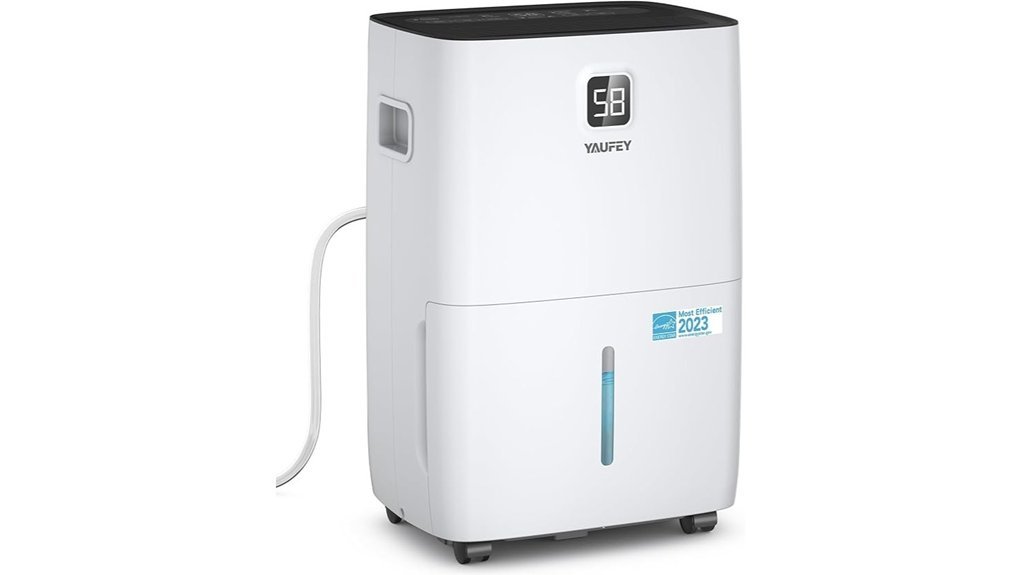
The Yaufey ENERGY STAR Dehumidifier is advertised to remove up to 80 pints per day at 95°F and 90% relative humidity. That hot, highly humid test point produces a larger headline number than the cooler DOE-style test used for standardized ratings, so the 80-pint figure should not be treated as directly comparable with the Midea’s 22-pint rating.
For a 900-square-foot basement, the practical advantages are its 1.06-gallon bucket, included 3.28-foot drain hose, adjustable humidistat, front humidity display, and four operating presets for sleeping areas, living areas, basements, and continuous use. Automatic defrost, automatic restart, a washable filter, a child lock, and rolling casters add convenience.
Best For: Buyers who want a larger collection bucket, preset humidity modes, and continuous drainage for a warm, humid basement or utility area.
Why You’ll Like It: The larger tank can reduce emptying frequency, while the included hose supports lower-maintenance basement operation.
Who Should Skip It: Choose the smaller Midea when compact size, simpler standardized comparison, and ordinary moderate humidity are the main priorities.
Pros:
- Large 1.06-gallon collection bucket.
- Included drain hose for continuous gravity drainage.
- Adjustable humidity control with four preset operating modes.
- ENERGY STAR certified.
- Automatic defrost, restart memory, washable filter, child lock, and casters.
Cons:
- The 80-pint maximum uses hot, highly humid test conditions and is not directly comparable with current DOE-style ratings.
- The larger cabinet may be unnecessary for a mildly humid bedroom or office.
- The bucket can still fill regularly during high extraction.
- The included hose relies on gravity and cannot move water upward.
Factors to Consider When Choosing a Dehumidifier for 900 Square Feet
A coverage number alone does not tell you whether a dehumidifier will work well. Compare the room’s starting humidity, moisture source, temperature, drainage access, noise tolerance, and expected runtime before choosing a model.
Match Capacity to the Dampness Level
ENERGY STAR’s current sizing guidance for spaces under 2,000 square feet recommends approximately 20 to 30 pints per day for slightly to moderately damp conditions, 25 to 40 pints for very damp conditions, and 30 to 50 pints for wet or high-load conditions. Those ranges are more useful than a large maximum-coverage claim printed on a product listing.
It is usually better to choose modest reserve capacity than an underpowered machine that runs continuously without reaching the target humidity. However, a larger unit can cost more, occupy more space, create more fan noise, and cycle more frequently after the room dries.
Understand Test-Condition Ratings
A pint-per-day rating is measured under stated temperature and humidity conditions. DOE’s newer procedure uses cooler conditions intended to better represent basement use, while some manufacturers advertise a maximum extraction figure measured at 86°F or 95°F and very high relative humidity.
Compare standardized ratings with standardized ratings. When a listing gives only a hot-weather maximum, treat it as a separate marketing specification and do not assume it represents the same performance as a current DOE-rated 30-, 40-, or 50-pint model.
Choose an Appropriate Humidity Target
A practical indoor target is generally around 40% to 50% relative humidity. The U.S. Environmental Protection Agency recommends keeping indoor humidity below 60% and ideally between 30% and 50%. Avoid setting the humidistat unnecessarily low because that can increase runtime and energy use without adding meaningful comfort.
For more guidance, review the EPA’s mold and moisture control recommendations. A dehumidifier controls airborne moisture, but it does not repair plumbing leaks, foundation seepage, poor grading, or damaged waterproofing.
Consider Drainage Access
Manual bucket drainage is simple but requires regular emptying. Small buckets can fill quickly during humid weather, causing the unit to shut off until someone empties it.
A continuous drain hose is convenient when a floor drain, sink, or sump is nearby. Most included hoses rely on gravity, so the hose must run continuously downhill without loops or kinks. A unit without a built-in pump cannot push water upward to a higher drain.
Compare Energy Efficiency
Look for an ENERGY STAR label and compare the unit’s Integrated Energy Factor when that information is available. ENERGY STAR states that certified dehumidifiers use more efficient coils, compressors, and fans than similarly sized conventional models.
Timers and remote controls can improve convenience, but the largest energy savings usually come from choosing the right capacity, fixing water leaks, closing exterior openings, maintaining the filter, and setting a realistic humidity target.
Check Noise and Placement
Compressor dehumidifiers produce both fan and compressor noise. A low listed decibel rating can help, but the sound you hear also depends on the selected fan speed, floor surface, wall clearance, and compressor cycling.
Place the machine on a firm, level surface with the manufacturer-recommended clearance around its intake and outlet. Avoid pushing it tightly against furniture, curtains, or a wall.
Evaluate Bucket Size and Portability
A larger bucket reduces emptying frequency but adds weight when full. Casters and integrated handles are useful when the unit must move between a basement, bedroom, bathroom, and laundry area.
Measure the intended location before ordering, especially when placing a unit beside a vanity, washing machine, shelf, or narrow basement walkway.
Look for Cold-Room Features
Basements can become cool enough for frost to form on a compressor dehumidifier’s coils. An automatic defrost function pauses moisture removal and clears frost before operation resumes. Check the manufacturer’s minimum operating temperature when the room regularly becomes cold.
Maintenance and Filter Care
Clean the washable filter according to the manufacturer’s schedule and inspect it more often in dusty rooms or homes with pets. Wash and dry the bucket periodically to prevent residue and odors, and inspect a continuous drain hose for algae, kinks, or blockages.
Keep the air inlet and outlet clear. Unplug the appliance before cleaning it, and never operate a unit with a damaged cord, loose plug, or leaking tank.
Before You Buy
- Measure the actual open area the unit will serve.
- Use a hygrometer to check the starting relative humidity.
- Identify leaks, seepage, shower moisture, or laundry as possible sources.
- Choose capacity based on dampness and rating conditions as well as square footage.
- Confirm whether you can use a gravity drain hose or need a built-in pump.
- Check bucket size, noise rating, minimum operating temperature, dimensions, and warranty.
- Allow enough clearance around the air inlet and outlet.
Frequently Asked Questions
What Size Dehumidifier Do I Need for 900 Square Feet?
For a space under 2,000 square feet, ENERGY STAR recommends about 20 to 30 pints per day for slightly to moderately damp conditions, 25 to 40 pints for very damp conditions, and 30 to 50 pints for wet or high-load conditions. Use the room’s measured humidity and moisture source to choose within those ranges.
Are All Dehumidifier Pint Ratings Directly Comparable?
No. A pint-per-day number depends on the temperature and relative humidity used during testing. Current DOE-style ratings use cooler conditions, while some manufacturers advertise maximum extraction at 86°F or 95°F and very high humidity. Compare the test basis before deciding that one model is much more powerful than another.
Is an 80-Pint Dehumidifier Too Large for 900 Square Feet?
Not necessarily, because some “80-pint” figures are hot-and-humid maximum claims rather than current DOE-style capacity ratings. Check the stated test conditions, cabinet size, bucket capacity, energy certification, and standardized rating when available instead of relying on the headline number alone.
What Humidity Should I Set My Dehumidifier To?
A setting around 45% to 50% works well for many homes. EPA guidance recommends keeping indoor relative humidity below 60% and ideally between 30% and 50%. Avoid setting it lower than necessary because that can increase runtime and electricity consumption.
Can a Dehumidifier Remove Mold?
No. A dehumidifier can reduce the moisture that supports future mold growth, but it does not remove established mold or repair the leak or water problem that caused it. Existing contamination and moisture sources must be cleaned and corrected separately.
Can Dehumidifiers Reduce Allergens?
They may indirectly make conditions less favorable for dust mites and mold by lowering humidity. However, a standard dehumidifier is not a particle air cleaner and does not directly capture pollen, pet dander, or airborne mold spores unless it includes a filtration system designed for that purpose.
Can I Use a Drain Hose Continuously?
Yes, when the model supports continuous drainage. A gravity hose must slope downward to a suitable drain without bends or raised sections. Use a model with a built-in pump when the water must travel upward.
How Often Should I Clean the Filter?
Follow the manufacturer’s instructions. Many reusable filters need inspection every few weeks and cleaning approximately once a month during regular use. Dusty environments and homes with pets may require more frequent cleaning.
Why Is My Dehumidifier Not Collecting Much Water?
The room may already be near the selected humidity, the temperature may be too low, the filter may be dirty, or airflow may be blocked. An underpowered unit can also struggle in a large open layout, while a drainage or bucket-placement problem may prevent normal operation.
How Much Electricity Does a Dehumidifier Use?
Electricity use varies by capacity, compressor efficiency, fan speed, room temperature, starting humidity, and daily runtime. Check the model’s wattage, Integrated Energy Factor, and ENERGY STAR information rather than relying on a single general estimate. A properly sized unit that reaches its target and cycles off may use less energy than an undersized unit running continuously.
Final Recommendation
Best choice for most buyers: Midea 22-Pint EasyDry Dehumidifier
Choose the Midea for a moderately damp 900-square-foot living area, apartment, office, or basement where standardized capacity, energy efficiency, and simple operation matter most.
Choose the VEAGASO VG380 when the room stays very damp and an included continuous-drain hose is a priority.
Choose the Yaufey when you prefer a larger bucket and preset humidity modes, but compare its 80-pint hot-weather maximum carefully rather than treating it as a standardized 80-pint rating.
The right dehumidifier should bring the room toward your selected humidity without running endlessly. Start with the space’s measured dampness, compare capacity ratings under similar test conditions, and use continuous drainage when practical. Most importantly, repair leaks and water-entry problems rather than asking the appliance to compensate for an ongoing source of moisture.