Disclosure: As an Amazon Associate, we earn from qualifying purchases. If you click a link on this page and buy something, we may earn a small commission at no extra cost to you.
For a coastal home, the best dehumidifier is one that can control damp air without turning daily upkeep into a chore. Salt air and high humidity can make basements, bedrooms, bathrooms, garages, and open living spaces feel sticky, musty, and harder to maintain. A strong coastal pick should match your square footage, offer easy drainage, run quietly enough for daily use, and use durable parts that can handle humid conditions.
This guide compares high-capacity, mid-size, Wi-Fi, pump-drain, and compact dehumidifiers for different coastal-home needs. The hOmeLabs 50-pint, Frigidaire 50-pint Wi-Fi, Ludatido 80-pint, DECIUU 100-pint pump model, and AEOCKY 50-pint are the strongest choices for larger or more humid areas. Smaller models like UBBO, KeepGlad, and PLUSCENT can make more sense for bedrooms, bathrooms, closets, RVs, or single-room moisture control.
Quick Verdict
For a damp basement, large room, or open coastal living area, start with a compressor dehumidifier and size it to the space and moisture load. A 50-pint-class unit is a practical starting point for many larger rooms, while very damp spaces may benefit from more capacity. Pick a built-in pump when the drain point is above the unit. Choose compact semiconductor-style models only for smaller enclosed spaces or light moisture control.
How We Compared These Picks
We focused on product-listing details that matter in humid coastal homes: moisture-removal capacity, room-size claims, drainage options, humidity controls, noise, portability, and maintenance. Capacity numbers are not always directly comparable because sellers may quote performance under different temperature and humidity test conditions, so use the pint rating together with the stated test conditions and your actual room needs.
Quick Comparison
| Pick | Best For | Key Strength | Drainage | Check Price |
|---|---|---|---|---|
| Best Overall hOmeLabs 50 Pint |
Large coastal rooms and basements | 50-pint-class moisture removal for large spaces | Tank; confirm hose setup on current listing | Check Price |
| Best Smart Pick Frigidaire 50 Pint Wi-Fi |
Smart-home moisture control | App control, washable filter, and three speeds | Tank or continuous drainage | Check Price |
| Best Pump Pick DECIUU 100 Pint with Pump |
Basements without easy gravity drainage | High capacity plus pump-assisted drainage | Tank, hose, or pump | Check Price |
| Best High-Capacity Pick Ludatido 80 Pint |
Very damp large rooms | High advertised pint capacity and multiple modes | Tank or continuous drain support | Check Price |
| Best Quiet 50-Pint Pick AEOCKY 50 Pint |
Quiet large-room use | Included drain hose and low-noise operation | Tank or included hose | Check Price |
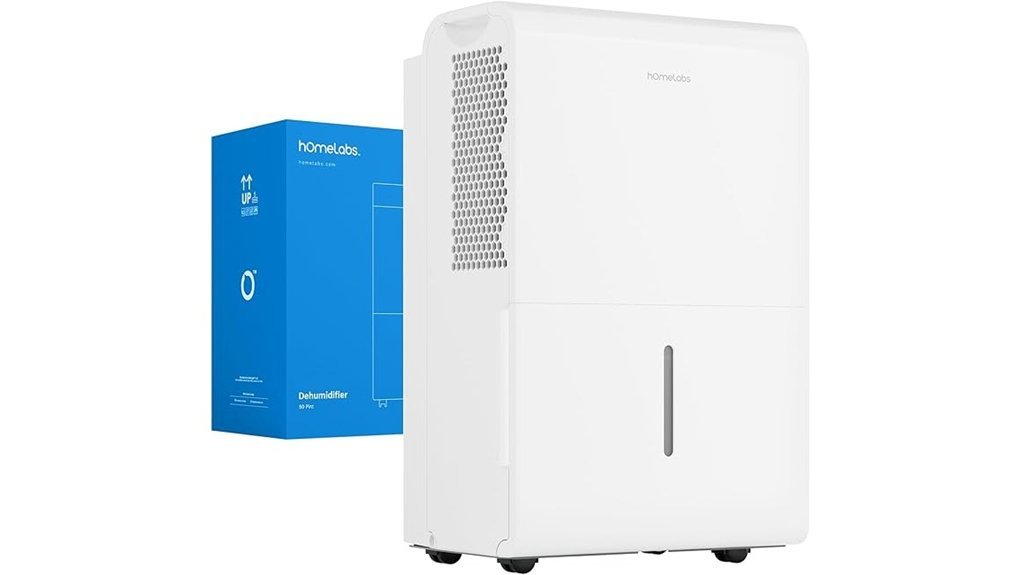
hOmeLabs Dehumidifier 7000 Sq Ft 50 Pint
Best For: Large coastal rooms, basements, offices, and open areas where you want a high-capacity portable unit.
If you need a dehumidifier for a large, humid coastal space, this hOmeLabs 7,000 Sq Ft model is listed to remove up to 50 pints per day. Real-world performance still depends on temperature, humidity, room layout, air leakage, and airflow, so treat the 7,000 sq. ft. figure as a seller coverage claim rather than a guaranteed whole-home result.
The current listing for this ASIN shows adjustable humidity control, auto defrost, auto shut-off, a removable tank, a washable filter, a timer, and portable handling features. The same product family includes Wi-Fi variants, but this exact ASIN should not be described as a Wi-Fi model. If continuous drainage is important, confirm the current hose compatibility and included accessories before ordering.
Pros:
- Listed 50-pint daily moisture removal for larger humid spaces.
- Adjustable humidity control, auto defrost, auto shut-off, timer, and washable filter support daily use.
- Portable design and 41.2-pound listed weight make occasional repositioning practical.
Cons:
- This exact ASIN should not be treated as the Wi-Fi variant in the product family.
- Continuous-drain hose details should be confirmed on the current listing or manual.
- May be more capacity than you need for a small bedroom, closet, or lightly damp room.
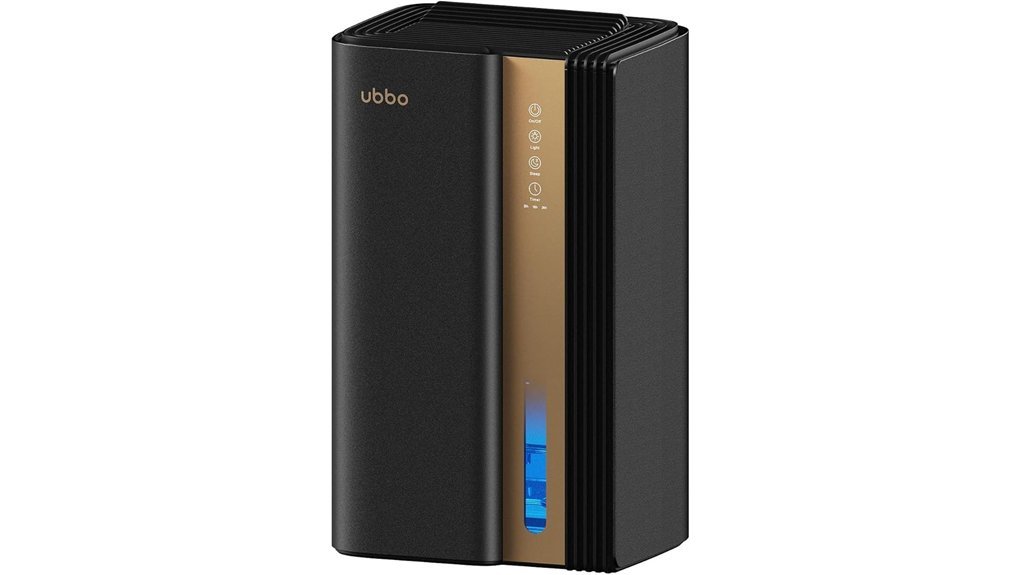
UBBO 95oz Dehumidifier for Home 1000 Sq.Ft
Best For: Small coastal rooms, closets, bathrooms, RVs, and bedrooms that need quiet supplemental moisture control.
The UBBO 95oz Dehumidifier is a compact option, so it should not be your first choice for a wet basement or a large open coastal home. It makes more sense when you need quiet moisture control in a bedroom, bathroom, closet, laundry nook, or RV. The seller lists coverage up to 1,000 sq. ft. and up to 1.2 liters of moisture removal per day under favorable conditions, but this compact semiconductor-style design is better treated as a small-zone unit than as a whole-home solution.
Its 35 dB sleep mode, auto shut-off, overflow alert, timer settings, night light, and drain hose option make it easy to live with. Choose this one if low noise and compact size matter more than maximum moisture removal.
Pros:
- Quiet 35 dB sleep mode suits bedrooms and other low-noise spaces.
- Auto shut-off, overflow alerts, timer settings, and drain hose support improve convenience.
- Compact design works well for closets, bathrooms, RVs, and smaller rooms.
Cons:
- Not powerful enough to replace a 50-pint compressor dehumidifier in a damp coastal basement.
- The 95 oz tank may still need regular emptying without continuous drainage.
- Performance can drop in cooler rooms or very large, open spaces.
Frigidaire 50 Pint Dehumidifier w/Wifi
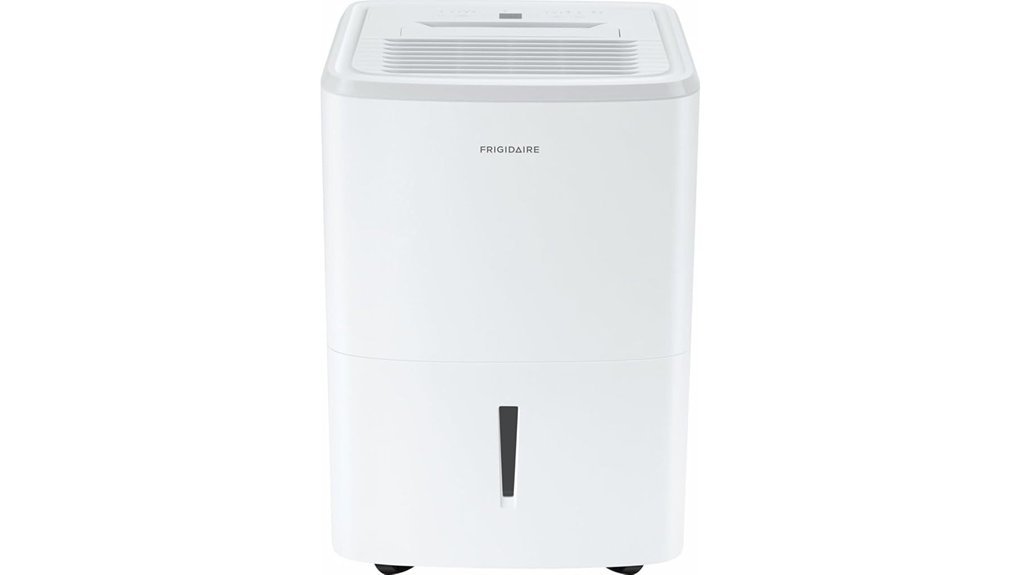
Best For: Coastal homeowners who want a trusted-style 50-pint unit with remote control and simple maintenance.
Frigidaire’s 50-pint Wi-Fi dehumidifier is a practical choice if coastal humidity affects a large room, basement, or open living area. It is listed for spaces up to 4,500 sq. ft. and offers custom humidity control, a washable filter, continuous drainage support, and three fan speeds. Wi-Fi is the main convenience feature, while custom humidity control, a washable filter, continuous-drain capability, and three fan speeds make it easier to manage a frequently damp room.
This model is best for buyers who want a full-size 50-pint unit with smart connectivity instead of a tiny compact dehumidifier. Like most compressor models in this class, it is better suited to occasional repositioning than frequent carrying between floors.
Pros:
- 50-pint daily capacity fits many large-room and basement moisture problems.
- Wi-Fi connectivity allows remote control and easier schedule adjustments.
- Washable filter and continuous drainage support reduce routine maintenance.
Cons:
- Full-size compressor construction makes it less convenient for frequent room-to-room carrying.
- Uses more power than compact units, which is expected for this capacity class.
- May be more than needed for small closets, bathrooms, or mild humidity.
Ludatido 2026 ENERGY STAR Dehumidifier, 80 Pint, 5000 Sq.Ft
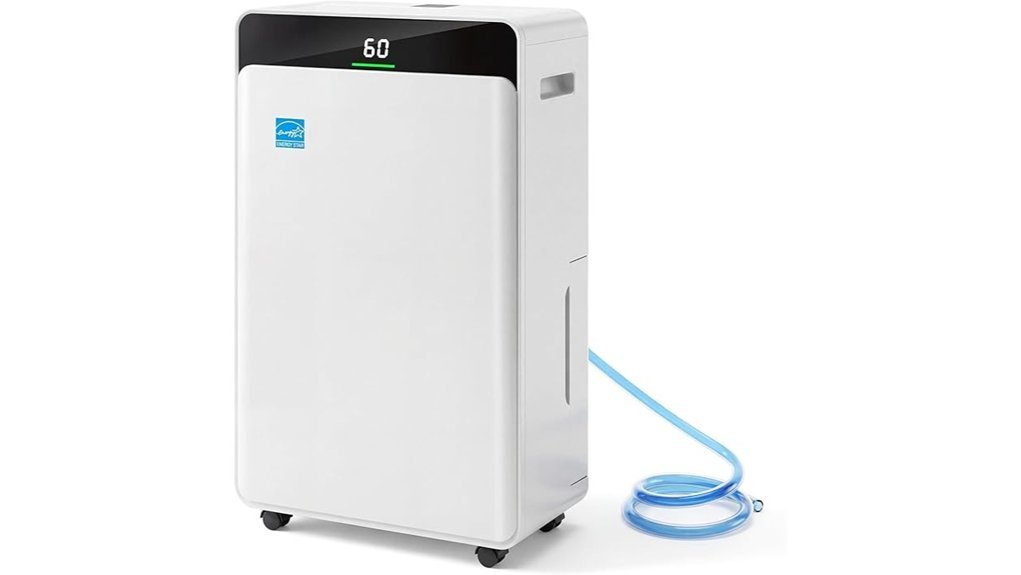
Best For: Large coastal rooms, garages, basements, and very damp areas that need more capacity than a standard compact unit.
The Ludatido 2026 ENERGY STAR Dehumidifier is seller-listed as an 80-pint model for areas up to 5,000 sq. ft., making it a better fit for heavier coastal humidity than small desktop or closet dehumidifiers. It offers dry mode for faster moisture removal, sleep mode for quieter operation, and fan mode for air circulation. Those modes help you adapt the unit to changing conditions throughout the day.
The best reason to consider this model is capacity. Coastal homes can experience humidity spikes after rain, storms, open windows, or damp laundry, so a higher-capacity unit can recover comfort faster. Still, match it to your room size and drainage plan before buying. A large-capacity unit can be unnecessary if you only need light moisture control in a small room, so compare the stated test conditions and your actual moisture load before buying.
Pros:
- Listed 80-pint daily moisture removal offers strong capacity for very humid spaces.
- ENERGY STAR positioning and multiple modes can help balance comfort and energy use.
- Auto shut-off, child lock, and continuous drain support improve everyday usability.
Cons:
- At 13.5 kg, it may be heavy to move between rooms.
- May be oversized for bedrooms, closets, or low-moisture areas.
- You still need to manage tank emptying or set up a proper drain hose.
DECIUU 100 Pint Energy Star Dehumidifier with Pump
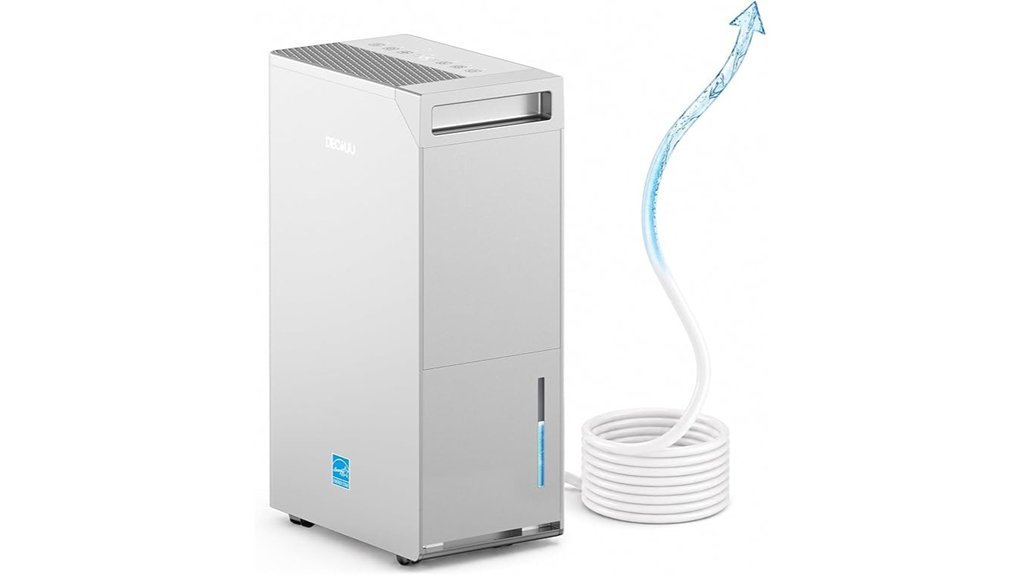
Best For: Basements, laundry rooms, and coastal homes where the drain point sits above the dehumidifier.
If your coastal home has heavy humidity and awkward drainage, the DECIUU Max 100 Pint with Pump is one of the more useful layouts in this roundup. It is listed for spaces up to 5,000 sq. ft. and up to 100 pints per day at 95°F and 90% RH, with a lower listed output at less extreme test conditions. The built-in pump is the key feature because it can move collected water upward when gravity drainage is not practical.
You can set the target humidity from 35% to 80%, drain through a hose, use the pump, or rely on the tank when needed. The seller lists pump lift up to 16.4 ft, which is useful when the nearest drain point is above the unit. The LED panel, timer, wheels, washable filter, and child lock also make it easier to use in a busy home. Choose this model if drainage flexibility matters as much as raw moisture removal.
Pros:
- High listed capacity suits larger damp spaces and basements.
- Built-in pump can help when gravity drainage is not available.
- LED controls, timer, washable filter, child lock, and wheels improve usability.
Cons:
- At 32.77 pounds, it is movable but not truly lightweight.
- May be too much unit for small rooms or occasional humidity problems.
- The 1.45-gallon tank may need regular emptying if you do not use hose or pump drainage.
KeepGlad Dehumidifier for Home with Humidity Display
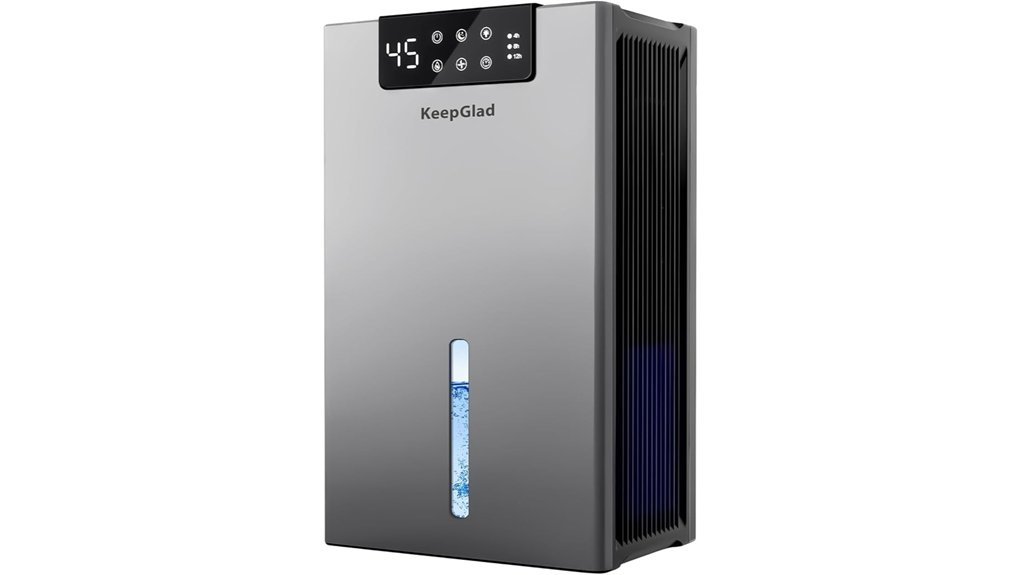
Best For: Bedrooms, bathrooms, RVs, and small damp spaces where a visible humidity display is helpful.
The KeepGlad RX02-B gives you a real-time humidity display, which is useful in a coastal home because humidity can change quickly with weather, ventilation, and room use. It includes a 98-ounce tank, a seller-listed moisture-removal figure up to 40 ounces per day, and a coverage claim up to 1,000 sq. ft. For best results, treat it as a compact room dehumidifier rather than a whole-home solution.
The 90-watt design, three fan speeds, smart sensors, 4-, 8-, and 12-hour timer, drain hose support, auto shut-off, washable filter, quiet 28 dB sleep mode, and seven-color ambient lights make it easy to use in rooms where comfort matters. It is a good support pick if you want to monitor humidity without buying a heavier compressor model.
Pros:
- Real-time humidity display helps you monitor damp coastal air more easily.
- Quiet 28 dB sleep mode suits bedrooms and evening use.
- Continuous drainage, auto shut-off, and a washable filter reduce upkeep.
Cons:
- Not a substitute for a 50-pint or larger model in wet basements.
- The 98-ounce tank may need frequent emptying in very humid conditions.
- Best for smaller enclosed zones rather than open coastal floor plans.
DECIUU 100 Pint Dehumidifier for Basement, Home Use
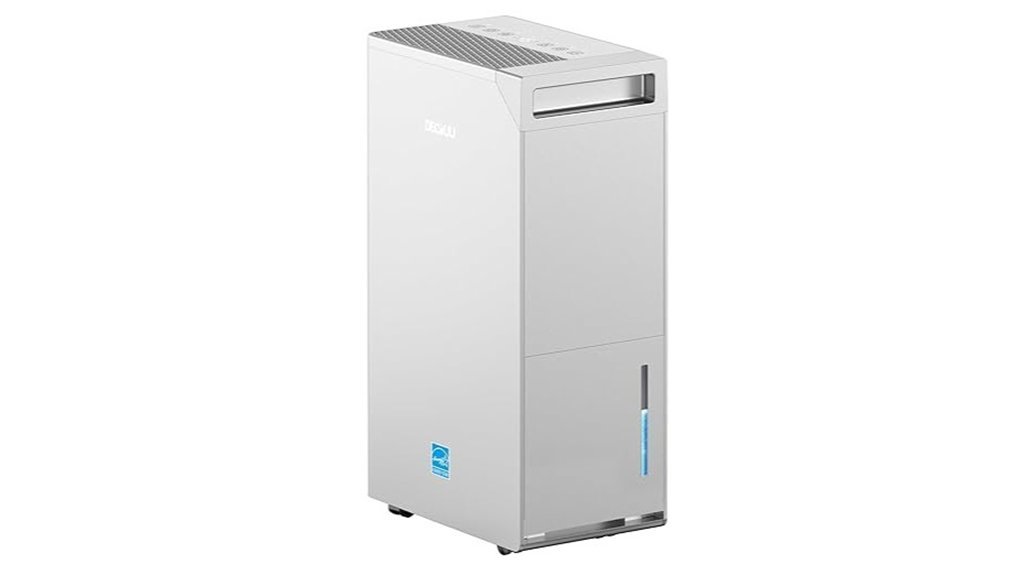
Best For: Large damp rooms and basements where you want high capacity but do not specifically need a pump model.
The DECIUU Max 100 Pint Dehumidifier is another high-capacity option for large coastal spaces. It is listed for up to 5,000 sq. ft. and up to 100 pints per day in high-humidity conditions. Unlike the pump-focused DECIUU option above, this one makes the most sense when standard tank or continuous gravity drainage fits your room layout.
You can set humidity from 35% to 80%, use the timer, choose tank or continuous drainage, and move the unit with wheels and a handle. The current listing also describes a 5.5L tank and an included 6.56 ft drain hose. The washable filter and child lock are helpful for busy households. Choose this model if you want strong capacity but can place the unit near a suitable drain.
Pros:
- High listed moisture removal capacity for large coastal rooms and basements.
- Adjustable humidity, timer, wheels, child lock, and washable filter add convenience.
- Continuous drainage support helps reduce bucket-emptying interruptions.
Cons:
- Large capacity may be unnecessary for smaller rooms or mild humidity.
- Requires regular filter cleaning and drainage management.
- May feel bulkier than compact or mid-size models.
AEOCKY 50 Pint Dehumidifier with Drain Hose
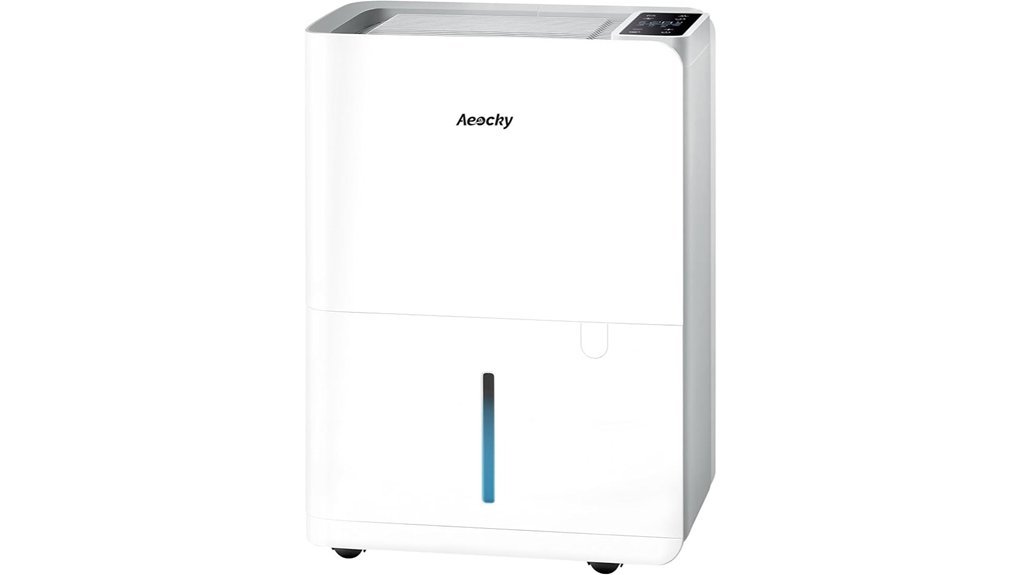
Best For: Coastal homeowners who want a 50-pint unit with quiet operation and a drain hose included.
AEOCKY’s 50-pint dehumidifier is a strong fit for damp coastal rooms where you want steady moisture removal without constant bucket checks. It is listed to remove up to 50 pints per day and cover spaces up to 3,500 sq. ft. The included drain hose is especially useful because coastal homes often need long run times during humid seasons.
The current listing shows roughly 40–43 dB operating noise for this model, along with easy-roll casters, a handle, auto-defrost, and smart humidity control. The advertised 3-year warranty is also worth checking on the current Amazon listing before purchase, since warranty terms can change by seller or model.
Pros:
- 50-pint capacity fits many basements, bedrooms, bathrooms, and large rooms.
- Included drain hose supports continuous gravity drainage.
- Quiet operation, casters, handle, auto-defrost, and smart humidity control improve convenience.
Cons:
- Best suited for larger spaces, so it may be more than small rooms need.
- Continuous drainage requires a suitable drain location.
- Compressor units are larger than compact semiconductor-style dehumidifiers.
PLUSCENT 32 Pint Dehumidifier for Large Rooms
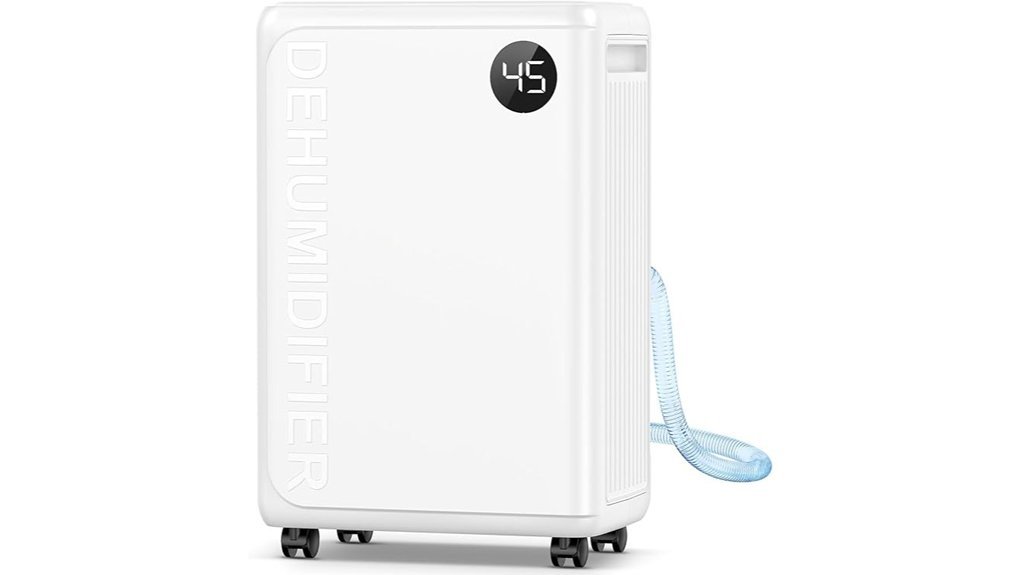
Best For: Medium-size rooms, bedrooms, bathrooms, RVs, laundry areas, and smaller basements.
PLUSCENT is a practical mid-range pick if you need more drying power than a compact unit but do not want a heavy 80- or 100-pint model. This 32-pint dehumidifier is seller-listed for spaces up to 2,500 sq. ft., with the 32-pint figure stated for hot, very humid test conditions. It includes DEHU, CONT, and DRY modes for normal humidity control, continuous operation, or laundry drying support.
The 24-hour timer, smart energy control, 39–42 dB operation, 39.4-inch hose, 2L tank with auto-stop, 360° wheels, and handles make it easy to use around the home. It is a good choice for moderate coastal humidity, but very wet basements may still need a larger 50-pint or higher-capacity model.
Pros:
- 32-pint class capacity suits many medium rooms and smaller basement spaces.
- Multiple modes help with normal humidity, heavy moisture, and laundry drying.
- Drain hose, 24-hour timer, quiet operation, wheels, and handles add convenience.
Cons:
- The 2L tank may require frequent emptying without the drain hose.
- Not the best choice for whole-home coastal humidity control.
- No built-in Wi-Fi or app-based smart controls.
Factors to Consider When Choosing a Dehumidifier for Coastal Home
When you choose a dehumidifier for a coastal home, focus on moisture removal, drainage, durability, noise, and room size. A dehumidifier removes water from indoor air, but it does not remove salt from the air or fully prevent corrosion by itself. You still need cleaning, ventilation, sealed leaks, and moisture-resistant materials to protect your home.
Humidity Removal Capacity
Humidity removal capacity is usually measured in pints per day, but the number only makes sense when you also know the test conditions. Coastal homes may need more capacity when outdoor air, storms, wet crawl spaces, or poor ventilation keep adding moisture. A 50-pint-class unit is a practical starting point for many larger rooms and basements, while very damp spaces may justify more capacity.
Compact models can still help in small rooms, but they should not be expected to dry a large basement or whole home. Compare capacity with your actual square footage, ceiling height, air leakage, room temperature, starting humidity, and the conditions used for the advertised pint rating.
Coastal Durability and Maintenance
Coastal air can be humid and may carry salt residue indoors, which can accelerate corrosion on exposed metal surfaces. Do not assume a dehumidifier is salt-corrosion-rated unless the manufacturer or current listing specifically says so. Prioritize washable filters, easy access for cleaning, and a placement that keeps the unit away from direct salt spray or dripping water.
Even a good dehumidifier still needs care. Wipe the exterior, clean the filter, inspect the drain path, and avoid placing the unit where salt spray or dripping water can reach it directly. Better upkeep can help the unit run longer and reduce performance problems.
Drainage Flexibility
Drainage can decide whether a dehumidifier feels easy or frustrating. In a coastal home, the tank may fill quickly during humid weather, so continuous drainage is often worth prioritizing. A gravity drain hose works well when the unit can sit above a floor drain, sink, or safe drain point.
If your drain point sits above the unit, choose a model with a built-in pump. A pump can push water upward, which is useful in basements, utility rooms, and laundry areas. Auto shut-off is also important because it helps prevent overflow when the tank fills.
Energy Efficiency
A coastal dehumidifier may run often, so energy efficiency matters. Look for ENERGY STAR positioning where available, adjustable humidity settings, timers, auto modes, washable filters, and fan speeds. These features help the unit run only as hard as needed.
Set a realistic humidity target instead of running the unit nonstop at the lowest setting. A practical home target is often around the 40% to 50% range when conditions allow, while keeping indoor relative humidity below 60% helps reduce moisture-related problems.
Quiet Coastal Operation
Noise matters if the dehumidifier will run in a bedroom, office, nursery, or living room. Compact models can be very quiet, but they remove less moisture. Compressor models remove more water, though they usually create more fan and compressor sound.
For bedrooms, look for sleep mode or a lower fan setting. For basements and garages, capacity and drainage usually matter more than ultra-low noise. Match the sound level to where the unit will actually run.
Before You Buy
- Measure the room or basement area before choosing capacity.
- Decide whether you need tank drainage, gravity drainage, or a built-in pump.
- Check the current Amazon listing for exact warranty, included hose, coverage claim, pint-rating test conditions, and any ENERGY STAR or corrosion-resistance wording.
- Choose compact models only for small rooms or support moisture control.
- Clean filters more often if your home gets salt air, dust, pet hair, or heavy pollen.
Frequently Asked Questions
How Often Should Coastal Dehumidifier Filters Be Cleaned?
Follow the manufacturer’s filter-cleaning schedule, and inspect the filter every one to two weeks during heavy coastal use. Clean it sooner if you notice salt residue, dust, pet hair, pollen, or weaker airflow. A clean filter helps maintain airflow and reduces unnecessary strain on the unit.
Can Dehumidifiers Prevent Salt Air Damage Indoors?
Dehumidifiers can reduce indoor moisture, which may slow some humidity-related damage, but they cannot remove salt from the air or fully prevent corrosion by themselves. You should also seal leaks, clean surfaces, improve ventilation, and choose moisture-resistant materials where possible.
What Humidity Level Is Best for Seaside Homes?
A useful target for many homes is around 40% to 50% indoor relative humidity when practical. More broadly, keep indoor RH below 60%, and lower it if you see condensation or persistent dampness. Use a hygrometer so you are adjusting the unit from measured humidity rather than guesswork.
Do Coastal Homes Need Dehumidifiers Year-Round?
Some coastal homes need a dehumidifier most of the year, especially in basements, bathrooms, laundry rooms, crawl-space-adjacent rooms, or poorly ventilated areas. Others only need one during humid seasons, storms, or long rainy periods. A hygrometer can help you decide when to run it.
How Noisy Are Dehumidifiers in Bedrooms?
Bedroom-friendly models are usually quiet on low or sleep mode, but most compressor dehumidifiers still make a steady hum. If you are sensitive to sound, choose a compact model for light moisture or a larger unit with a sleep mode and lower fan setting.
Is a Compact Dehumidifier Enough for a Coastal Basement?
Usually, no. Compact semiconductor-style dehumidifiers work best in smaller enclosed spaces. A damp coastal basement generally needs a compressor dehumidifier sized to the basement area and moisture load, often in the 50-pint class or above when conditions are persistently wet.
Conclusion
If you live near the coast, the right dehumidifier can make your home feel drier, fresher, and easier to maintain. For larger coastal spaces, start by comparing compressor models around the 50-pint class and prioritize a drainage setup you can use consistently. For basements with awkward drainage, a pump model like the DECIUU 100 Pint with Pump can be worth the upgrade. For bedrooms, closets, bathrooms, and RVs, compact picks like UBBO or KeepGlad can help with lighter moisture problems.
Match the unit to your room size, humidity level, drainage setup, and noise needs. Then check the current product listing for exact specs, included accessories, and warranty details before buying. A well-matched dehumidifier can make a coastal home easier to manage by keeping excess indoor moisture under better control.