Planning an Alexa smart-lighting setup for 2026? These five smart bulbs for Amazon Alexa combine voice control, app-based scheduling, color customization, and energy-efficient LED lighting. The Feit Electric RGBW 3-pack is useful when you need several bulbs at once, the Geeni Prisma keeps color control simple, WiZ adds advanced automation options, Kasa combines tunable white with energy monitoring, and the Abode Color Bulb fits especially well into an existing Abode smart-home setup.
Freshness note: Product features in this guide are based on manufacturer and support information available in September 2026 for shoppers planning their 2026 smart-lighting setup. Features can change with hardware, firmware, apps, or regional versions.
Affiliate disclosure: As an Amazon Associate, we earn from qualifying purchases.
Quick Verdict: All five bulbs are suitable for Alexa users, but they solve slightly different needs. Choose Feit Electric when you want a three-bulb RGBW pack, Geeni for straightforward color control, WiZ for automation features, Kasa for tunable white plus energy monitoring, or Abode if you already use the Abode ecosystem.
Before you buy: Confirm that your fixture uses the correct bulb base, check the brightness you need, and make sure you have reliable 2.4GHz Wi-Fi where the bulb will be installed.
Quick Comparison of Alexa-Compatible Smart Bulbs
| Smart Bulb | Best For | Brightness | Color / White | Connection | Amazon |
|---|---|---|---|---|---|
| Feit Electric A19 RGBW 3-Pack | Multi-bulb setups | 800 lumens | RGBW color + adjustable white | 2.4GHz Wi-Fi | Check Price |
| Geeni Prisma | Simple color control | 800 lumens | RGBW + 2700K warm white | 2.4GHz Wi-Fi | Check Price |
| WiZ A19 Color | Automation features | 800 lumens | Full color + white modes | Wi-Fi / smart-home integration | Check Price |
| Kasa KL125 | Energy monitoring | 800 lumens | 16 million colors + 2500-6500K white | 2.4GHz Wi-Fi | Check Price |
| abode Smart LED Color Bulb 2-Pack | Abode ecosystem users | 800 lumens | Full color + 1800-6500K white | 2.4GHz Wi-Fi | Check Price |
Feit Electric Smart Light Bulbs, A19 RGBW Color Changing – 60W Eq – 3 Pack
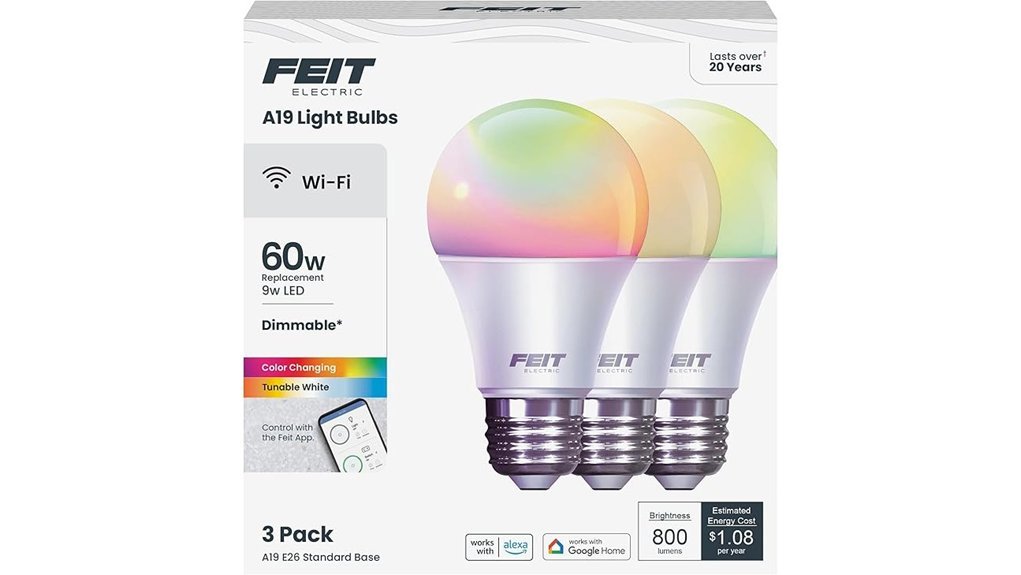
Best For: Alexa users who want several color-changing A19 bulbs for bedrooms, living rooms, or other standard indoor fixtures.
The Feit Electric A19 RGBW smart bulbs give you color-changing lighting, adjustable white light, dimming, scheduling, and Alexa voice control without requiring a separate smart-home hub. Each bulb produces about 800 lumens while using 9W, giving you the familiar light output of a traditional 60W incandescent bulb with much lower power consumption.
Why You’ll Like It: The three-pack makes it easier to add coordinated smart lighting to several fixtures. Through the Feit Electric app, you can turn bulbs on or off, adjust brightness and colors, create groups, and set schedules. Alexa and Google Assistant support add convenient hands-free control.
Pros:
- Three bulbs are included for a multi-light setup.
- RGBW color changing plus adjustable white lighting.
- Approximately 800 lumens from only 9W per bulb.
- Works with Amazon Alexa and Google Assistant.
- No separate smart-home hub is required.
Cons:
- Requires reliable 2.4GHz Wi-Fi for smart features.
- The Feit app is needed for setup and advanced controls.
- Designed primarily for compatible indoor fixtures and should not be treated like a conventional bulb on a standard wall dimmer.
Who Should Avoid This: If you need only one bulb or have weak Wi-Fi coverage around your fixtures, a three-pack may be unnecessary.
Geeni Prisma Smart Color Changing Light Bulb
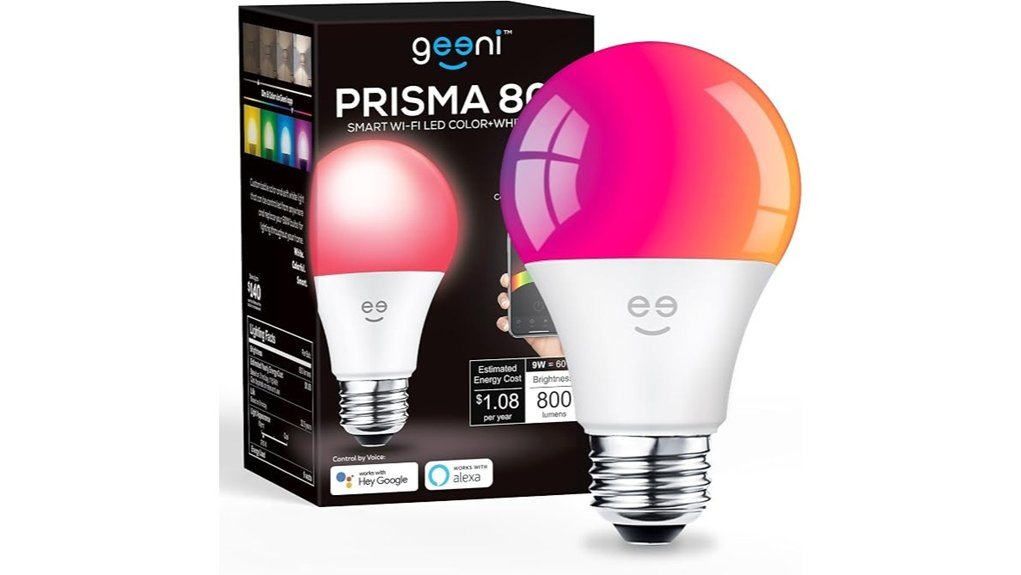
Best For: Buyers who want a straightforward Alexa-compatible color bulb with simple app control and no hub.
The Geeni Prisma is a 9W A19 smart bulb rated at about 800 lumens, making it a 60W-incandescent replacement for general room lighting. It offers millions of RGBW color choices along with a warm 2700K white setting. You can dim the bulb, change colors, create groups, and set schedules from the Geeni app.
Why You’ll Like It: Setup is relatively simple because the bulb connects directly to a 2.4GHz Wi-Fi network. Once linked with Amazon Alexa or Google Assistant, common actions such as power, brightness, and supported color changes can be handled by voice.
Pros:
- 800-lumen output with only 9W of LED power use.
- Millions of RGBW colors for mood and accent lighting.
- Works with Amazon Alexa and Google Assistant.
- No separate hub is required.
- Supports groups, schedules, dimming, and remote app control.
Cons:
- Requires a 2.4GHz Wi-Fi connection.
- The Geeni app is required for setup and full smart control.
- This version uses a 2700K warm-white setting rather than the wider tunable-white range found on some competing bulbs.
- A single-bulb pack may be less convenient when outfitting several rooms at once.
Who Should Avoid This: Buyers who prioritize a wide adjustable white-temperature range for work, reading, and evening lighting may prefer the Kasa or Abode options.
WiZ LED Smart Light Bulb with Voice Control
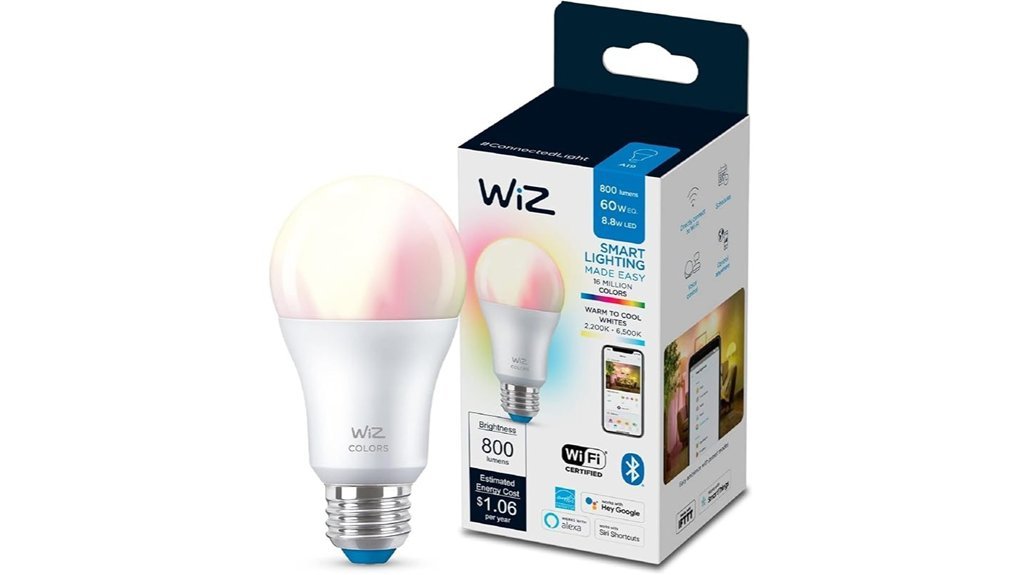
Best For: Alexa users who want flexible lighting automation and compatibility with newer smart-home standards.
The WiZ A19 color smart bulb produces about 800 lumens while drawing approximately 8.8W. It fits a standard E26 socket and supports full-color lighting, dimming, schedules, scenes, remote app control, and Amazon Alexa voice commands. This model is also part of WiZ’s Matter-compatible smart-lighting lineup, which can make integration with compatible smart-home platforms easier.
Why You’ll Like It: WiZ puts a strong emphasis on automation. You can create schedules and scenes, use time-based lighting routines, and take advantage of SpaceSense motion detection when the room has the required compatible WiZ devices.
Pros:
- 800-lumen output suitable for typical 60W-replacement applications.
- Full-color lighting with dimming and app-based scenes.
- Works with Amazon Alexa.
- Supports scheduling and advanced WiZ automation features.
- Matter compatibility can broaden smart-home integration options.
Cons:
- SpaceSense motion detection requires at least two compatible WiZ devices in the room.
- Advanced smart features depend on the WiZ ecosystem, network, and app configuration.
- Its CRI is lower than some of the 90+ CRI alternatives in this list.
Who Should Avoid This: If your main priority is high-CRI white lighting rather than automation or colorful scenes, the Kasa or Abode bulb may be a stronger fit.
Kasa Smart Bulb, Dimmable WiFi Light, Multicolor
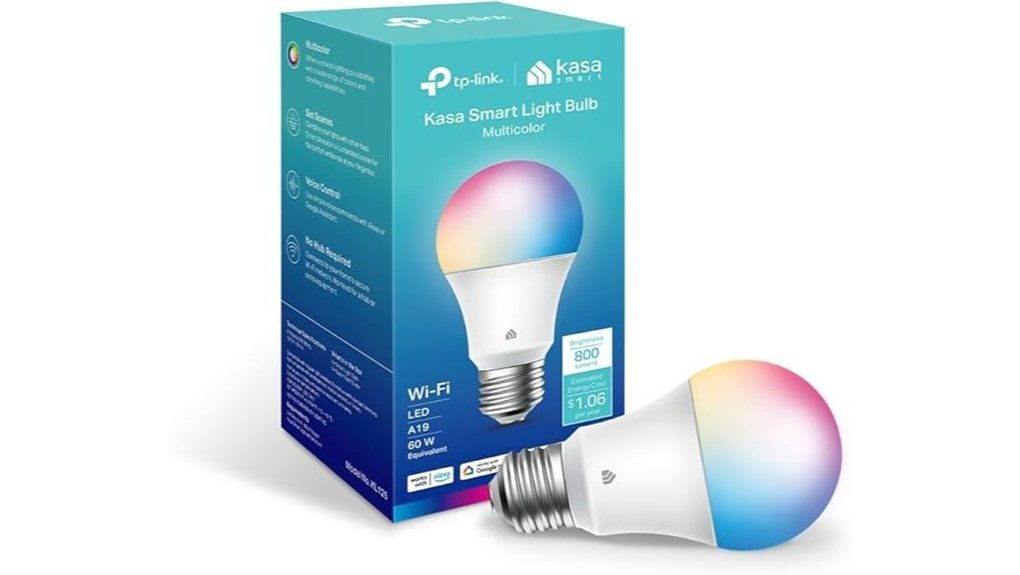
Best For: Buyers who want a well-rounded Alexa smart bulb with tunable white light and built-in energy monitoring.
The Kasa KL125 combines 16 million colors, adjustable 2500K-6500K white light, 800-lumen brightness, and a CRI of at least 90. Maximum power consumption is about 8.8W while replacing the light output of a traditional 60W incandescent bulb. It connects directly to 2.4GHz Wi-Fi, so no separate hub is needed.
Why You’ll Like It: Beyond voice control with Amazon Alexa, the Kasa app supports schedules, scenes, group control, and energy monitoring. The adjustable white range is especially useful if you prefer warmer light at night and cooler light during daytime tasks.
Pros:
- 16 million colors plus 2500K-6500K tunable white.
- 800 lumens with approximately 8.8W maximum power consumption.
- CRI ≥90 for more natural-looking colors.
- Works with Amazon Alexa, Google Assistant, and SmartThings.
- Energy monitoring, scheduling, grouping, and scene controls.
Cons:
- Uses 2.4GHz Wi-Fi rather than 5GHz Wi-Fi.
- The Kasa app and account are needed for setup and full smart features.
- At 800 lumens, it is a standard 60W-replacement bulb rather than a high-output bulb for very large or task-intensive spaces.
Who Should Avoid This: If you simply want basic on/off Alexa control and do not care about tunable whites or energy monitoring, a simpler bulb may meet your needs.
abode Smart LED Color Bulb (2 Pack)
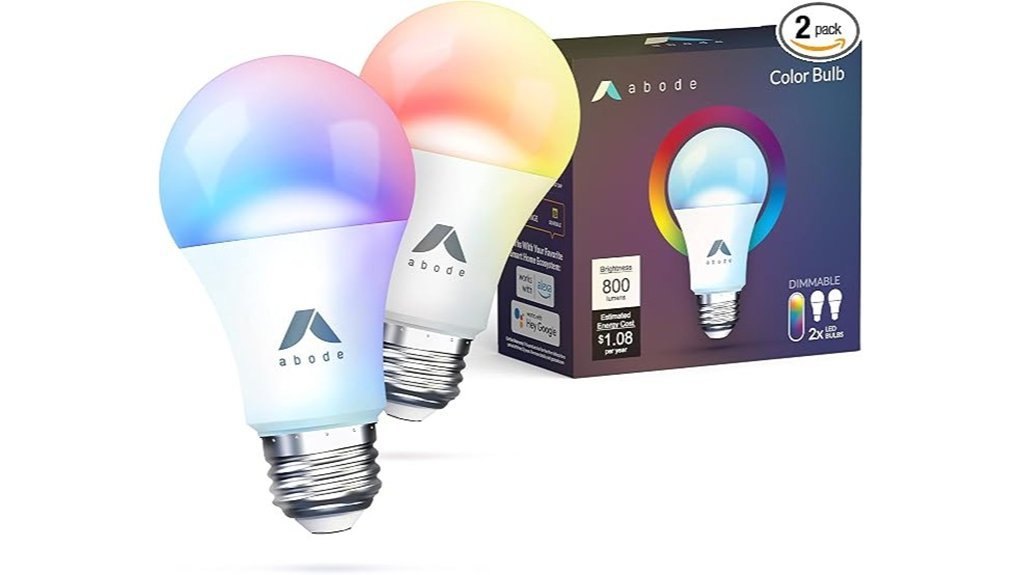
Best For: Alexa users who already use Abode security or smart-home products, or who want a two-pack with a broad adjustable-white range.
The abode Smart LED Color Bulb produces up to 800 lumens from 9W and fits a standard E26 socket. It supports full-color lighting along with an unusually broad 1800K-6500K white-light range. A CRI of 90+ helps white and colored objects appear more natural under the light.
Why You’ll Like It: The bulbs can work without an Abode security hub and connect to Amazon Alexa or Google Assistant. They use 2.4GHz Wi-Fi for normal connectivity, with Bluetooth LE used during initial pairing. Existing Abode users can also incorporate the bulbs into Abode automations.
Pros:
- 800 lumens from 9W.
- Broad 1800K-6500K adjustable-white range plus full-color lighting.
- 90+ CRI.
- Works with Amazon Alexa and Google Assistant without requiring an Abode hub.
- Two bulbs are included.
Cons:
- Requires 2.4GHz Wi-Fi for connected features.
- Initial pairing must be completed through the Abode mobile app.
- Some Abode CUE automation capabilities require a Standard or Pro subscription.
- The Abode Color Bulb does not currently support Apple HomeKit directly.
Who Should Avoid This: Buyers who want completely subscription-free use of Abode’s more advanced CUE automations should understand the plan requirement before choosing this bulb. Basic Alexa control does not require that subscription.
Factors to Consider When Choosing Smart Bulbs for Amazon Alexa in 2026
The best Alexa-compatible smart bulb is not necessarily the model with the longest feature list. Start with compatibility, brightness, bulb size, white-light range, Wi-Fi requirements, and the smart-home features you will actually use.
Amazon Alexa Compatibility
First, verify that the exact bulb model supports Amazon Alexa. Once a compatible bulb is connected through its manufacturer’s app and linked to Alexa, common voice commands can include turning the light on or off, changing brightness, selecting supported colors, and controlling groups. Compatibility can vary between hardware versions, regions, and product generations, so check the exact model rather than assuming that every bulb from a brand behaves the same way.
Wi-Fi and Hub Requirements
Most bulbs in this guide connect directly to a 2.4GHz Wi-Fi network and do not require a separate smart-home hub. That makes installation easier, but Wi-Fi coverage matters. A bulb installed far from your router or behind several walls may respond less reliably. If your router combines 2.4GHz and 5GHz networks, follow the manufacturer’s setup instructions carefully.
Bulb Size and Base
Check the physical fixture before ordering. A19 bulbs with an E26 base are common in U.S. household fixtures, but not every lamp or ceiling fixture uses that combination. Also confirm that the bulb physically fits inside enclosed shades or smaller fixtures and that the fixture is suitable for the bulb’s intended use.
Color and White-Light Options
Full-color smart bulbs can create mood lighting for movies, gaming, holidays, and entertaining, but white-light flexibility can matter even more in daily use. A bulb with tunable white lets you move from warmer evening light to cooler daytime light. If you primarily want colorful accent lighting, a fixed warm-white mode plus RGB colors may be enough.
Lumens and Brightness Output
Lumens measure light output. Around 800 lumens is commonly used as the LED replacement level for a traditional 60W incandescent bulb and works well for many lamps and general room-lighting applications. A larger room, high ceiling, or detailed task area may require more total lumens or several bulbs.
Energy Efficiency
The bulbs in this guide produce approximately 800 lumens while using roughly 9W of electricity, far less than the 60W incandescent bulbs they are designed to replace. When comparing other models, look at both lumens and wattage rather than choosing by wattage alone. Scheduling and automatic shutoff can also prevent lights from remaining on unnecessarily.
Color Rendering Index
Color Rendering Index (CRI) describes how naturally colors appear under a light source. Bulbs rated around 90 CRI or higher can be attractive for living areas, kitchens, closets, and other spaces where accurate-looking colors matter. CRI is separate from RGB color-changing capability, so compare both specifications if they are important to you.
Installation and Setup Ease
Physical installation is usually as simple as switching off the fixture, installing the bulb, restoring power, and following the manufacturer’s app instructions. Smart setup normally involves creating an account, connecting the bulb to Wi-Fi, naming it, and then linking the manufacturer’s service to Alexa. Keep the physical wall switch turned on if you want the bulb to remain available for voice and app commands.
Voice Control Features
Alexa can make smart bulbs particularly useful when your hands are full or when a light switch is inconvenient to reach. Useful commands can include power, brightness, colors, and room groups. Exact supported commands depend on the bulb and its Alexa integration, so do not assume every advanced app feature can also be controlled by voice.
Automation and Scheduling
Scheduling can automatically turn lights on in the morning, off at bedtime, or adjust them around normal routines. More advanced bulbs may offer scenes, sunrise-style routines, motion-related automation, or integrations with other smart-home devices. Check whether advanced automation requires multiple devices, a particular ecosystem, or a subscription before buying.
App and Smart-Home Ecosystem
Alexa support is only part of the experience. You may still need the manufacturer’s app for initial setup, firmware updates, detailed color controls, energy monitoring, or advanced automations. If you already use Kasa, WiZ, Geeni, Feit Electric, or Abode products, staying within that ecosystem may reduce the number of apps you need.
Before You Buy: Quick Checklist
- Confirm Amazon Alexa compatibility for the exact model.
- Check for the correct bulb shape and socket base.
- Make sure 800 lumens is enough for the intended room or fixture.
- Confirm whether you want RGB color, tunable white, or both.
- Verify that 2.4GHz Wi-Fi reaches the installation location.
- Check whether a hub, subscription, or second device is required for advanced features.
- Confirm whether the bulb is suitable for indoor, outdoor, enclosed, or damp-location use before installing it there.
- Check whether the manufacturer’s app provides the schedules, scenes, and automation you want.
Frequently Asked Questions
Can I Use These Smart Bulbs Without a Wi-Fi Connection?
You can still turn most bulbs on and off with the physical fixture switch, but the Alexa-oriented smart features in this guide generally depend on Wi-Fi and the manufacturer’s app or cloud service. Some models may use Bluetooth during setup, but that does not mean all Alexa, remote-control, or automation features will continue working without Wi-Fi.
Are Smart Bulbs Energy-Efficient Compared to Traditional Bulbs?
Yes. Modern LED smart bulbs can provide roughly the light output of a 60W incandescent bulb while consuming around 9W. Actual energy use varies by model, brightness setting, standby consumption, and how long the light stays on.
Do Smart Bulbs Work With Other Smart-Home Systems?
Often, but compatibility is model-specific. Several bulbs here support Google Assistant in addition to Alexa, Kasa also supports SmartThings, and newer Matter-compatible products such as supported WiZ models can offer broader interoperability. Do not assume that every Alexa bulb supports Apple Home or HomeKit; check the exact product before buying.
How Long Do Smart Bulbs Typically Last?
Many LED smart bulbs are rated around 25,000 hours, although the exact rated life varies by model and operating conditions. Heat, fixture type, electrical conditions, and daily use can affect real-world lifespan, so use the manufacturer’s specification for the exact bulb.
Can I Control Smart Bulbs Remotely?
Yes, the models in this guide provide app-based connected control when they are properly configured and have the required network access. This can let you switch lights, adjust settings, or run schedules while away from home. Exact remote functions depend on the manufacturer’s app and service.
Do I Need a Smart-Home Hub?
Not for the five bulbs covered here. They are designed to connect without requiring a traditional dedicated lighting hub. Some optional ecosystem features may still depend on other devices, services, or subscriptions.
Can I Use Smart Bulbs With a Traditional Wall Dimmer?
Do not assume a smart bulb is compatible with a conventional wall dimmer. Many smart bulbs are designed to receive full power continuously and be dimmed through their app or smart-home controls instead. Check the instructions for the exact bulb and fixture before using it with a dimmer.
Which Smart Bulb Is Best for Alexa?
It depends on your priorities. Feit Electric is convenient for a three-bulb setup, Geeni Prisma is a straightforward color-lighting option, WiZ stands out for automation features, Kasa offers a strong mix of tunable white and energy monitoring, and Abode is especially appealing for households already using the Abode ecosystem.
Final Recommendation
For 2026 smart-lighting planning, there is no single best Alexa bulb for every home. Focus on the feature you will use most rather than simply choosing the bulb with the longest specification list.
- Choose Feit Electric if you need a three-pack of Alexa-compatible RGBW bulbs.
- Choose Geeni Prisma if you want simple app and voice-controlled color lighting.
- Choose WiZ if automation and newer smart-home integration are priorities.
- Choose Kasa if tunable white, high CRI, and energy monitoring are important.
- Choose Abode if you use the Abode ecosystem or want a broad 1800-6500K white range.
Before ordering, confirm the exact model, socket, fixture requirements, Wi-Fi compatibility, and any feature-specific subscription or device requirements. That simple check is more useful than choosing by color count or marketing claims alone.
Conclusion
The best smart bulbs for Amazon Alexa combine reliable voice control with the lighting features you actually need. All five options in this guide fit the core Alexa smart-bulb buyer intent, but their strengths differ. Feit Electric works well for multi-bulb installations, Geeni keeps color control straightforward, WiZ emphasizes automation, Kasa adds strong tunable-white and energy-management features, and Abode fits naturally into its own smart-home ecosystem. For buyers preparing a 2026 setup, comparing brightness, color temperature, Wi-Fi requirements, app features, and ecosystem compatibility will lead to a better choice than relying on a single headline feature.