You want a cleaner, healthier lawn without wasting time or money on a weed killer that does not match your turf or target weeds. The most important distinction is selectivity: a lawn weed killer should control listed weeds while protecting the turf species named on its label when used as directed.
This guide compares three selective lawn herbicides with different strengths: an easy ready-to-use option, a concentrated mesotrione herbicide for difficult grassy and broadleaf weeds, and a broadleaf-focused concentrate for clover, oxalis, chickweed, and similar lawn weeds.
Affiliate disclosure: This article contains affiliate links. If you buy through them, the site may earn a referral commission at no extra cost to you.
Quick Verdict
Spectracide WeedStop is the easiest pick for homeowners who want a ready-to-use lawn treatment. Tenacity Turf is the more specialized choice for labeled tough grassy and broadleaf weeds and for certain seeding situations. Bonide Chickweed, Clover & Oxalis Killer is the focused choice when clover, oxalis, chickweed, ground ivy, or other listed broadleaf weeds are the main problem.
Top Picks
|
Category |
Product |
Best Fit |
|---|---|---|
|
✅ Best Ready-to-Use |
Routine lawn weeds and simple spot treatment |
|
|
🎯 Best for Tough Grassy Weeds |
Advanced selective control and certain seeding uses |
|
|
⭐ Best for Broadleaf Weeds |
Clover, oxalis, chickweed, ground ivy, and listed broadleaf weeds |
Selection Criteria
We compared these products by the weeds listed on current manufacturer information, turf selectivity, formulation type, application complexity, visible-result expectations, and label cautions. We also considered how clearly each option solves a different lawn problem so you can choose by weed type and turf compatibility rather than by marketing claims alone.
Exact prices, star ratings, review counts, and availability can change, so they are not used as ranking evidence here. Always confirm the exact container label before application because permitted turf species, rates, timing, re-treatment intervals, and regional registrations can vary by product and location.
Before You Buy
Identify the weed first, confirm your grass species, and read the exact label for the package you plan to buy. Do not assume every selective herbicide is safe on every lawn. Keep spray off desirable plants, prevent drift and runoff, use the personal protective equipment required by the label, and follow the label’s re-entry directions for people and pets.
Spectracide WeedStop

Spectracide Weed Stop for Lawns Plus Crabgrass Killer is the most straightforward option here if you want a ready-to-use product for listed broadleaf and grassy weeds in a compatible lawn. Current manufacturer information says the ready-to-use formula can produce visible results in as fast as about five hours and targets listed weeds including crabgrass, dandelion, chickweed, clover, and yellow nutsedge.
The main reason to choose it is convenience: no concentrate measuring is required for the ready-to-use version. The tradeoff is turf compatibility. The manufacturer excludes several lawn types from the ready-to-use label, so checking your grass species before spraying is essential.
What People Say
Buyer feedback summarized in the product listing emphasizes the convenience of a ready-to-use format and quick visible browning on common weeds. Results can still vary by weed species, growth stage, weather, coverage, and whether the application follows the product label.
Overall Sentiment: Mixed to positive, with the strongest appeal being ease of use.

Long-Term Savings
A ready-to-use product can be economical for spot treatment because it avoids separate measuring tools and mixing. Value depends on the size of the lawn, the weeds present, and whether the product is labeled for your turf; repeated treatment of the wrong weed type will reduce value quickly.
Return On Investment
This option makes the most sense when convenience matters more than concentrate-level cost per treated area. Compare the exact container size and labeled coverage before buying rather than relying on a fixed value claim.
Application & Environmental Notes
|
Consideration |
What to Know |
|---|---|
|
Turf Compatibility |
Use only on lawn species listed on the exact product label. The current ready-to-use manufacturer guidance excludes several turf types. |
|
Non-Target Plants |
Keep spray off ornamental plants, exposed desirable roots, gardens, and other non-target vegetation unless the label specifically allows the use. |
|
People & Pets |
Keep people and pets out of the application area as directed on the label and do not allow re-entry until the label permits it. |
Versatility
It covers a broad list of lawn weeds, including several broadleaf weeds and crabgrass, but it is not a universal turf product. Its best use is selective weed control in compatible residential lawns, not general vegetation removal on driveways or landscape beds.
Problem Solving
Choose it when you want a simple lawn treatment for a mixed set of listed weeds without measuring a concentrate. If the main problem is a difficult grassy weed or your lawn species is excluded by the label, another option may be a better fit.
Eco Friendliness
This is a conventional herbicide, not an organic lawn treatment. The most responsible approach is to apply only where needed, prevent drift and runoff, and follow all label restrictions around non-target plants, weather, and re-entry.
Speed
The manufacturer currently advertises visible results in as fast as about five hours on susceptible weeds. Complete control may take longer, and some listed weeds can require follow-up treatment according to the label.
Use
Use this product only for the residential lawn applications and turf species permitted on the exact label. Do not treat it as a driveway, bed, or all-vegetation killer.
Key Benefits
- Ready-to-use format with no concentrate measuring
- Targets listed broadleaf and grassy lawn weeds, including crabgrass
- Fast visible response on susceptible weeds
- Useful for targeted treatment in compatible residential turf
- Clear turf-species and temperature restrictions on the label help guide safer use
Check Product Details on Amazon
Tenacity Turf
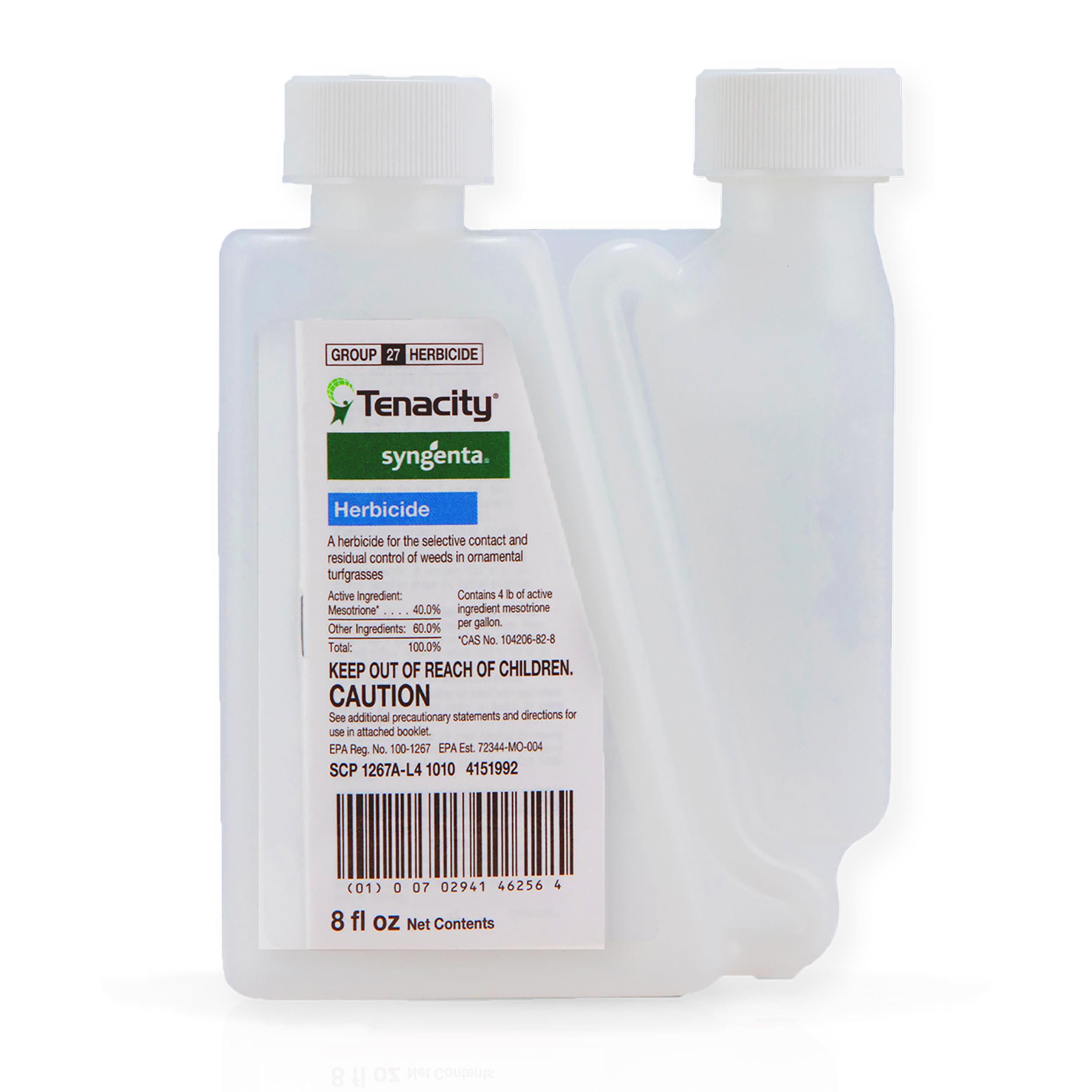
Tenacity is a concentrated selective herbicide with mesotrione as its active ingredient. Current Syngenta information supports both pre-emergence and post-emergence use on labeled turf, with control of numerous grassy and broadleaf weeds. It is especially useful when you need more targeted control than a basic ready-to-use lawn spray can provide.
This is the most application-sensitive option in the roundup. Turf species, rate, timing, repeat applications, seeding timing, and surfactant use all matter. Some grasses are sensitive to Tenacity, so it should not be treated as universally safe for desirable turf.
What People Say
The product listing highlights buyer interest in Tenacity for persistent grassy weeds and the flexibility of pre- and post-emergence use. That flexibility is real, but successful use depends heavily on accurate weed identification, calibrated application, and following the exact label.
Overall Sentiment: Positive among buyers looking for a more specialized selective herbicide.

Long-Term Savings
Because Tenacity is concentrated, a small bottle can cover substantial turf when mixed at the label rate. The value is strongest when its labeled weed spectrum and turf compatibility match your problem; misapplication can damage sensitive turf and erase any savings.
Return On Investment
This option is easier to justify for recurring or difficult labeled weeds, turf renovation, or certain seeding situations than for a few simple broadleaf weeds. Factor in the need for accurate measuring and suitable spray equipment.
Application & Environmental Notes
|
Consideration |
What to Know |
|---|---|
|
Measured Application |
Use a calibrated sprayer and the exact label rate. Do not increase the dose to speed results. |
|
Sensitive Turf |
The current label identifies several turf species as sensitive. Confirm your grass type before application. |
|
Drift & Runoff |
Avoid spray drift to ornamentals, flower beds, gardens, and exposed desirable roots, and follow label precautions for rainfall, irrigation, and nearby water. |
Versatility
Tenacity can be used pre-emergence and post-emergence on labeled turf and has useful flexibility around certain seeding situations. That versatility comes with more label complexity than a ready-to-use product.
Problem Solving
It stands out for difficult labeled weeds such as crabgrass, nimblewill, unwanted bentgrass, ground ivy, yellow foxtail, yellow nutsedge, and other listed species. Always confirm the target weed is on the label before treating.
Eco Friendliness
Do not equate selective use with zero environmental impact. Mesotrione can move through soil and runoff under some conditions, so label directions for drift, rainfall, irrigation, buffers, and non-target vegetation matter.
Speed
Expect a slower visual response than a fast contact herbicide. The current label describes bleaching or whitening symptoms after treatment, and complete weed death can take up to several weeks depending on the species and application.
Use
Use only on turf species and sites allowed by the current label. A non-ionic surfactant is recommended for many post-emergence applications when directed by the label, but application requirements differ by use pattern.
Key Benefits
- Mesotrione-based selective control of numerous grassy and broadleaf weeds
- Pre-emergence and post-emergence flexibility on labeled turf
- Useful in certain seeding and renovation situations
- Concentrated format for larger or repeated treatment programs
- Distinct fit for difficult weeds that basic consumer sprays may not target well
Check Product Details on Amazon
Bonide Chickweed

Bonide Chickweed, Clover & Oxalis Killer Concentrate is the most focused broadleaf option in this roundup. Current Bonide information lists MCPA, triclopyr, and dicamba in the concentrate and positions it for residential turf weeds such as chickweed, clover, oxalis, ground ivy, wild violet, and other listed broadleaf weeds.
It is a good fit when broadleaf weeds are the main problem and you are comfortable measuring a concentrate. It is not the right choice when crabgrass or another grassy weed is your primary target, and turf compatibility still needs to be checked before application.
What People Say
The product listing’s buyer-feedback summary emphasizes results on clover and other difficult broadleaf weeds, with careful mixing and coverage being recurring themes. As with any concentrate, inaccurate measuring or spraying the wrong turf species can increase the risk of lawn injury.
Overall Sentiment: Positive for broadleaf-focused lawn use.

Long-Term Savings
The concentrate format can provide good value when you repeatedly spot-treat listed broadleaf weeds and mix only what the label calls for. Savings depend on correct weed identification and accurate application rather than bottle size alone.
Return On Investment
This product is most compelling when clover, oxalis, chickweed, ground ivy, wild violet, or similar listed broadleaf weeds are recurring problems. If grassy weeds dominate, choose a product that is specifically labeled for them instead.
Application & Environmental Notes
|
Consideration |
What to Know |
|---|---|
|
Broadleaf Focus |
Best matched to listed broadleaf weeds rather than crabgrass or other grassy weed problems. |
|
Turf Compatibility |
Use only on turf species permitted by the exact label. Some warm-season lawns may be sensitive. |
|
Non-Target Plants |
Keep spray away from flower and vegetable beds, shrubs, ornamentals, and exposed desirable roots unless the label explicitly allows the use. |
Versatility
It is versatile within its lane: residential turf with listed broadleaf weeds. It is not a general bed herbicide and should not be presented as a solution for grassy weeds such as crabgrass.
Problem Solving
Choose it for persistent broadleaf weeds such as clover, oxalis, chickweed, ground ivy, and wild violet when those weeds are listed on the label for your turf type.
Eco Friendliness
This is a conventional selective herbicide. Reduce unnecessary exposure by spot-treating only where appropriate, preventing drift, and following the label for rates, weather, re-entry, storage, and disposal.
Speed
Bonide currently says the product begins working overnight, but visible injury and complete control can take longer. Do not reapply early just because a weed is still green; follow the label’s retreatment interval.
Use
Designed for residential turf applications against listed broadleaf weeds. Do not use it as a flower-bed, vegetable-bed, or nonselective vegetation killer.
Key Benefits
- Targets chickweed, clover, oxalis, ground ivy, wild violet, and many other listed broadleaf weeds
- Concentrated formula for measured spot or lawn treatment
- MCPA, triclopyr, and dicamba active-ingredient combination in the current concentrate
- Useful when broadleaf weeds are the main lawn problem
- Manufacturer label provides turf-specific cautions to help avoid misapplication
Check Product Details on Amazon
FAQ
Which Weed Killer Is Best For My Lawn?
Start with your grass species and the weed you need to control. Spectracide is the simplest ready-to-use option for compatible lawns and listed common weeds. Tenacity is better suited to specialized control of difficult grassy and broadleaf weeds and certain seeding situations. Bonide is the more focused choice for listed broadleaf weeds such as clover, oxalis, chickweed, ground ivy, and wild violet. The exact label should make the final decision.
How Do I Apply Weed Killers Safely?
Read the entire product label before mixing or spraying. Wear the personal protective equipment required by that label, avoid windy conditions that can cause drift, keep spray off desirable plants, and follow all weather, water, and re-entry restrictions. Keep children and pets away from the treatment area until the product label says re-entry is allowed.
When Will I See Results And Need Re-Treatment?
Timing depends on the active ingredient, weed species, growth stage, and weather. Some lawn sprays show visible injury within hours, while systemic products such as mesotrione can take days or weeks to show their full effect. Never shorten the re-treatment interval on your own; follow the exact label for repeat applications and reseeding timing.
Do I Need A Surfactant With Tenacity?
For many post-emergence Tenacity applications, the current label recommends a non-ionic surfactant for best results. That does not mean a surfactant belongs in every Tenacity use. Follow the directions for your exact application, especially around pre-emergence use and seeding.
Can I Use These Products On Any Grass Type?
No. Turf compatibility differs substantially. Spectracide excludes several turf species, Tenacity lists some grasses as sensitive, and Bonide also has lawn-type restrictions and cautions. Identify your turf before buying and use only a product whose current label permits your grass species.
Customer Preferences
If convenience is your priority, Spectracide is the easiest starting point because the ready-to-use format reduces measuring and mixing. If your main issue is a stubborn grassy weed or you need a herbicide that fits certain seeding situations, Tenacity offers more specialized flexibility but requires more careful application. If clover, oxalis, chickweed, ground ivy, or similar broadleaf weeds are the problem, Bonide gives you a more focused concentrate.

Wrapping Up
The right lawn weed killer is the one that matches both your weed and your turf. Spectracide is the convenience pick, Tenacity is the specialized option for difficult labeled weeds and certain seeding uses, and Bonide is the broadleaf-focused concentrate. Before buying, identify the weed, confirm your grass species, and read the exact label so you do not trade a weed problem for turf injury.
| Product Name | Image | Best For | Active Ingredients | Item Form |
|---|---|---|---|---|
| Spectracide Weed Stop for Lawns Plus Crabgrass Killer |
|
Ready-to-use control of listed broadleaf and grassy weeds in compatible lawns | 2,4-D, quinclorac, dicamba, sulfentrazone | Ready-to-use spray |
| Tenacity Turf Herbicide – 8 ounces |
|
Difficult labeled grassy and broadleaf weeds; certain seeding uses | Mesotrione | Liquid concentrate |
| Bonide Chickweed, Clover and Oxalis Killer |
|
Listed broadleaf weeds such as clover, oxalis, chickweed, and ground ivy | MCPA, triclopyr, dicamba | Concentrate |
This roundup is reader-supported. When you click through affiliate links, we may earn a referral commission on qualifying purchases.