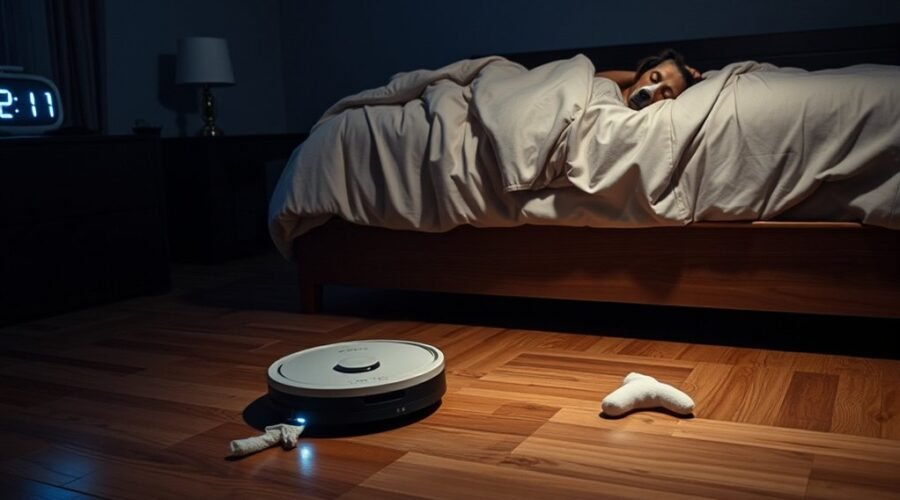
A robot vacuum can often run while someone sleeps, but only under the right conditions. Many models use LiDAR or infrared navigation to move in low light, and quiet modes can keep noise at a tolerable level. Still, overnight cleaning is not always simple. Obstacles, docking noise, and poor room setup can cause problems. The key is knowing which models handle night use well and which limits matter most.
Can a Robot Vacuum Run While You Sleep?
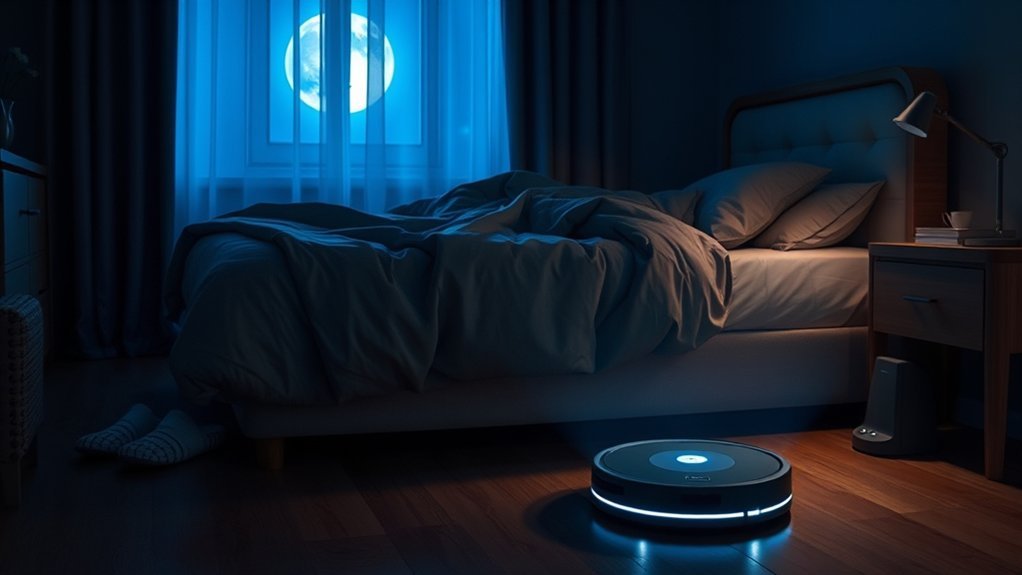
Yes—most robot vacuums can run while a person sleeps, thanks to navigation systems like LiDAR and infrared sensors that let them clean effectively in the dark.
A robot vacuum is built for low light conditions, so ambient light is not required for mapping or obstacle detection. That makes nighttime cleaning practical when rooms are already settled and pathways are mostly clear.
Robot vacuums work well in low light, making nighttime cleaning practical when rooms are settled and pathways are clear.
In many homes, scheduling a run after bedtime supports efficient cleaning because foot traffic drops and fewer objects are moved around. The result is cleaner floors with less interruption to daily routines and a greater sense of control over the household environment.
Regular use at night can also reduce daytime wear, helping the machine last longer and keeping air quality steadier. For those seeking liberation from constant chores, this can be a simple, reliable way to maintain order while resting.
How Quiet Is a Robot Vacuum at Night?
At night, a robot vacuum is often quiet enough to run without major disruption, with most models producing about 55 to 70 decibels—roughly similar to normal conversation or a running dishwasher.
For many households, those noise levels make nighttime cleaning practical, especially when the goal is to keep floors clear without giving up sleep.
Many units include a quiet or eco mode, which can lower sound output to below 60 dB and reduce disturbance further. That setting is useful when the robot vacuum must work near bedrooms or during lighter sleep hours.
The main exception is a self-emptying dock, which can briefly rise to 70 to 80 dB during emptying and create a sharper burst of noise.
Placing the dock in a hallway or separate room helps limit disruption.
In short, a well-chosen robot vacuum can support clean floors and quiet routines.
Do Robot Vacuums Work in the Dark?
Robot vacuums can usually work in the dark because they rely on LiDAR sensors, infrared cameras, and AI mapping rather than room light. For anyone asking do robot vacuums work in the dark, the answer is generally yes, especially with advanced navigation systems that stay effective in the dark under low-light conditions.
- LiDAR helps create room maps.
- Infrared systems can detect nearby objects.
- AI improves obstacle avoidance.
- High-end models often clean more precisely.
- Clean sensors to protect performance.
These systems emit signals and read reflections, so darkness is not a major barrier. High-end models, such as those with TrueMapping 2.0, can move and clean with strong accuracy.
Still, glossy floors or mirrored surfaces may confuse some sensors and cause minor collisions. Regular sensor cleaning supports steady navigation and safer operation.
For practical freedom, this means nighttime cleaning can work well when the machine is maintained and the layout is predictable.
Why Robot Vacuums Work Better at Night
Nighttime often gives robot vacuums their best working conditions because homes are quieter and less obstructed, letting them clean with fewer interruptions.
A robot vacuum often cleans better at night because foot traffic drops and floors stay open for longer stretches. With fewer moving obstacles, navigation and obstacle systems can map rooms more efficiently, and infrared sensors help units work in the dark without relying on bright light.
Many models run at a low sound level, so the quietest robot vacuum can finish a cycle while sleep continues undisturbed. Night runs also let suction power focus on dust, crumbs, and grit gathered during the day, improving pickup in one pass.
For people seeking more freedom from daily chores, scheduled evening cleaning creates cleaner floors by morning and reduces the need to supervise the machine. The result is a simpler routine and a tidier home.
When Overnight Vacuuming Causes Problems
Sometimes overnight vacuuming creates more problems than it solves. At night, a robot vacuum may be quieter than daytime chores, yet certain conditions still undermine a run. Self-emptying docks can reach 70 to 80 decibels, enough to wake light sleepers if placed nearby. Scheduling cleaning for 3-4 a.m. can also trigger disruptions during deep sleep, reducing recovery and leaving the household less free in the morning.
- Low light can reduce navigation accuracy.
- Obstacles may go undetected in darkness.
- Missed spots can leave cleaning incomplete.
- Small furniture risks damage from collisions.
- Even advanced sensors can lose performance in total darkness.
These limits matter because a vacuum that stalls, gets stuck, or returns early fails to deliver reliable cleaning. High-end models offer better night handling, but they are not immune to errors.
For practical use, the main issue is not whether the machine can run, but whether the environment supports safe, effective operation without added disturbances.
How to Set Up a Quiet Overnight Run
A quiet overnight run starts with the right settings and placement. A robot vacuum should be set to its quiet or eco mode, where noise stays around 55 to 60 decibels, close to a soft conversation.
Using app-based scheduling, the user can set cleaning sessions for just after bedtime, ideally between 11 p.m. and 1 a.m., so the work happens while the household rests. The schedule should be saved in advance, removing the need for manual control.
App-based scheduling lets you set cleaning sessions just after bedtime, so the vacuum runs while the household rests.
Before the run, the space should be made into a clutter-free environment by picking up cords, toys, and small items that could block movement. The docking station should be placed in a separate room or hallway with a closed door, which helps reduce noise from self-emptying.
These steps let the robot vacuum clean with less disturbance and more freedom.
Best Ways to Run a Robot Vacuum Overnight
The best overnight runs usually begin with quiet mode and a schedule set for the late-night window, around 11 p.m. to 1 a.m., when foot traffic is low.
Noise can be reduced further by placing the docking station in a separate room or hallway with the door closed, especially if the vacuum self-empties.
A clear floor with regular maintenance cleaning helps it move efficiently and finish without interruptions.
Quiet Mode Scheduling
Scheduling a robot vacuum for nighttime use works best when it runs in quiet or eco mode, since noise levels can drop to around 55 dB and remain less likely to disturb sleep. For households seeking liberation from chores, this supports steady upkeep with less intrusion.
- Set app-based scheduling for 11 p.m. to 1 a.m.
- Keep the floor clutter-free for smoother navigation.
- Use quiet mode to preserve cleaning efficiency.
- Treat overnight passes as maintenance cleaning, not deep cleaning.
- Reserve full-power daytime runs for heavier debris.
Regular nighttime cycles help the robot vacuum maintain order while people rest. Self-emptying bursts can be louder, so the routine should stay simple and predictable.
Dock Placement Tips
For overnight cleaning, the dock works best when placed in a separate room or hallway with a closed door, keeping self-emptying noise farther from bedrooms and reducing the chance of waking light sleepers.
Smart dock placement lowers noise levels and supports cleaner rest without sacrificing cleaning efficiency. Because self-emptying can briefly reach 70 to 80 dB, distance matters.
Flexible options help in homes with multiple floors, where the dock can be set where traffic is low yet the robot can still return easily. The dock should remain visible and unobstructed, since routine maintenance improves docking reliability and prevents interruptions.
A quiet mode can further soften overnight sound, giving households more control. With careful setup, the machine can work independently while residents keep their space, sleep, and autonomy intact.
Night Cleaning Timing
Running a robot vacuum overnight works best between 11 p.m. and 1 a.m., when foot traffic is lowest and fewer obstacles interrupt the cleaning cycle. At this hour, a robot vacuum can run at night with better cleaning efficiency and fewer pauses.
For a smooth schedule, consider:
- using quiet mode
- choosing minimal foot traffic hours
- clearing cords and loose items
- placing the dock away from bedrooms
- checking self-emptying noise disruption
Night runs support maintenance cleaning without constant supervision, giving households more freedom from daily chores. If pets are settled and doors remain closed, the vacuum can finish faster and leave cleaner floors by morning.
A separate room or hallway dock also limits brief noise spikes from emptying.
Frequently Asked Questions
Can I Run My Roomba at Night?
Yes, a Roomba can run at night if noise levels are acceptable. Scheduling options, navigation systems, and floor types influence performance. Battery life improves with calm cycles, pet hair removal works well, and maintenance tips help.
What Are the Downsides of Using a Robotic Vacuum Cleaner?
Noise levels can reach 80 decibels; robotic vacuums may disturb sleepers. Downsides include battery life limits, floor types restrictions, navigation issues, pet interference, reduced cleaning efficiency, and ongoing maintenance costs, though they offer convenience and autonomy.
How Often Should I Let My Robot Vacuum Run?
Daily cleaning suits most homes, especially with pet hair or mixed carpet types; an ideal schedule is nightly or every other day. It preserves battery life, manages noise levels, and supports maintenance tips for consistent results.
Do Robot Vacuums Watch You?
Robot vacuums usually do not watch people; they use surveillance technology for navigation, not monitoring. Privacy concerns remain, so data security, machine learning, user control, and ethical considerations matter in any smart home.
Conclusion
In practice, a robot vacuum can run while sleep proceeds uninterrupted, provided its noise remains tolerable and its path is not staged like a household obstacle course. LiDAR and infrared systems handle darkness well, and nightly cleaning often suits both machine and mess. Still, docking noise, tangled cords, and stray objects can turn convenience into farce. The sensible verdict: overnight cleaning is useful, but only after the room has been made suitably unremarkable.